
Best Bouldering Crash Pads of 2026
The best bouldering crash pads for climbers based on performance, features, portability, and durability

April 13th, 2026, updated with prices, a section on how we tested
Home → Gear Reviews → Climbing
A good bouldering crash pad could save you from a nasty injury when climbing outdoors, but with different styles, foam compounds, and extra features, it can be hard to know which one is right for you. The best pad for you will depend on where and how you climb. If you're a daring highball boulderer, your needs will be different than the indoor climber exploring their local crag for the first time.
We spent two months testing seven crash pads of all different types, hiking with each, tossing them around at the crag, and taking countless falls, including a standardized fall off a tall boulder on Flagstaff Mountain in Boulder, Colorado. We also timed setup and breakdown, weighed each pad ourselves, and unzipped them to examine foam quality and construction up close.
We evaluated each pad on fall comfort, foam construction and layering, landing zone size, carrying system, ease of movement at the crag, durability under abrasion, and extra features like pockets, step pads, and the ability to carry additional pads. We paid close attention to all their different attributes across multiple outdoor climbing sessions with, frankly, an unreasonable number of pads.
Top Pick: The Organic Full Pad and the trimmed-down version, the Organic Simple Pad, earns our top awards for Bouldering Crash Pads. They stood out for its incredibly comfortable hybrid foam construction, durable 1,050-denier ballistic nylon shell, and a starting price that undercuts most of the competition.
We create reader-supported, objective gear reviews independently selected by our editors. This story may contain affiliate links, which help fund our website. When you click on the links to purchase gear, we may get a commission, without costing you an extra cent. Thank you for supporting our work and mission of outdoor coverage for every body! Learn more.
Comparison table
| BOULDERING CRASH PAD | TREELINE AWARD | MSRP* | TYPE | OPEN DIMENSIONS | FOLDED DIMENSIONS | THICKNESS | WEIGHT |
|---|---|---|---|---|---|---|---|
| Organic Full Pad | Best Overall Read why |
$209 | Hybrid | 36" x 48" x 4" | 36" x 24" x 8.5" | 4" | 13 lbs |
| Organic Simple Pad | Best Budget Read why |
$250 | Hybrid | 36" x 48" x 4" | 36" x 24" x 8.5" | 4" | 12 lbs |
| Metolius Magnum Crash Pad | Best Large Crash Pad for Highball Problems Read why |
$400 | Tri-fold hinge | 47" x 70" x 4" | 47" x 25" x 13" | 4" | 18 lbs |
| Metolius Session II Crash Pad | Best Lightweight Read why |
$200 | Hinge | 36" x 48" x 4" | 36" x 26" x 8" | 4" | 9 lbs |
| Asana Superhero | Best for Long Approaches Read why |
$349 | Hybrid | 57" x 40" x 4" | 29" x 40" x 8" | 4" | 15 lbs |
The winners
Best overall crash pad: Organic Full Pad

Type: Hybrid
Open dimensions: 36 inches by 48 inches by 4 inches
Folded dimensions: 36 inches by 24 inches by 8.5 inches
Thickness: 4 inches
Weight: 13 pounds
What we liked: Comfortable foam construction, durable materials, multi-functional flap, great price
What we didn’t like: Not as much closed-cell foam, extra colors cost money, wish there were a couple more handles
Whether it’s your first or your fifth crash pad, if you’re looking for one that can do it all, look no further than the Organic Full Pad. It’s incredibly durable, easy to transport, and has extra features that make your time at the crag that much better. Plus, Organic is one of the only brands we tested that offers hybrid pads (our favorite style), and they have some great sustainability initiatives, too.
The Organic Full and Organic Simple pad (the Simple is our budget pick and the same as the Full, minus some features) were our favorites to use in nearly every climbing scenario, thanks to their stellar performance. The Organic pads felt extremely comfortable to land on, was easy to haul from our car to the crag, and once it was at the bottom of the boulder, it wasn’t too tough to move around either.
Organic Full Pad
-
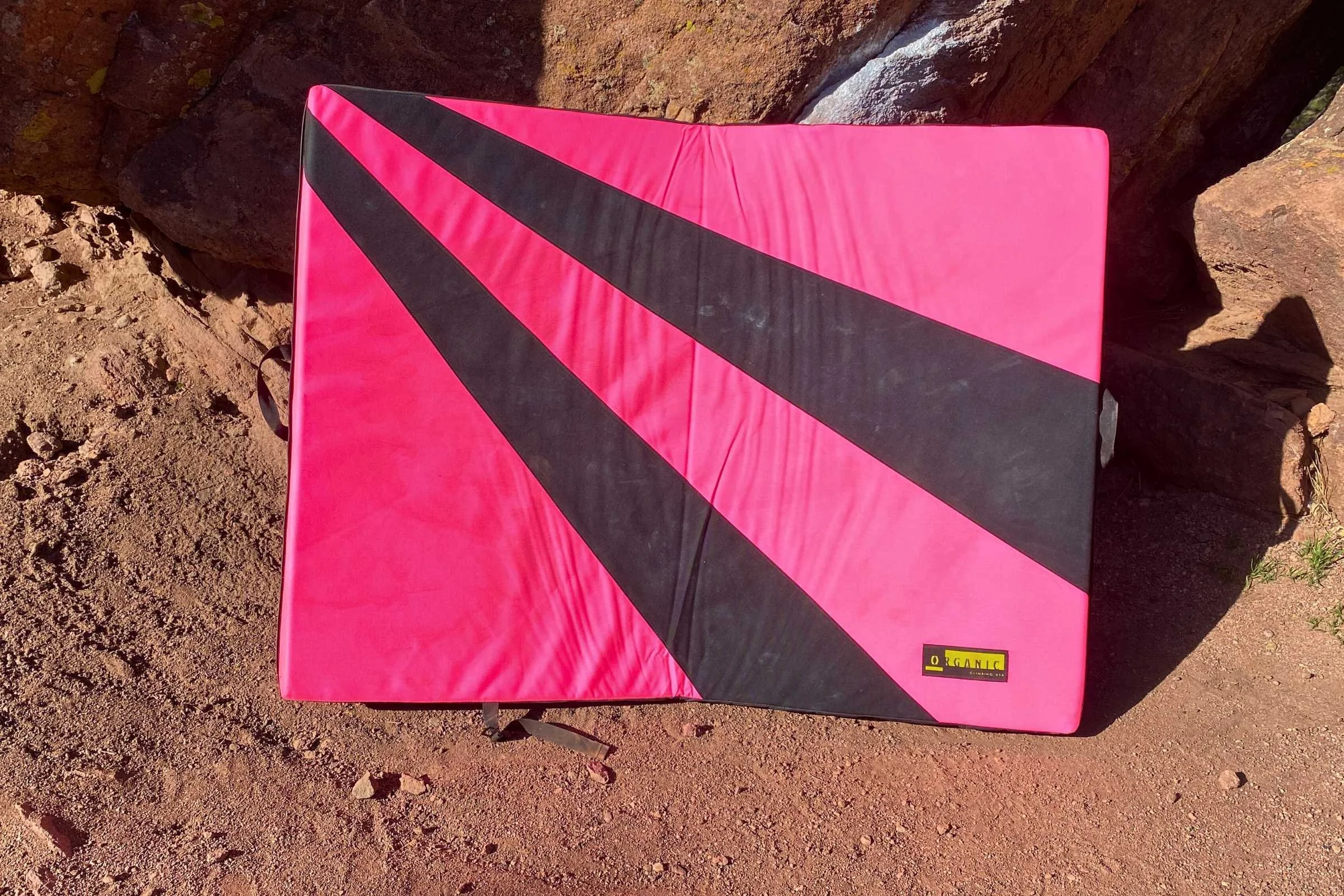
The biggest reason why the Organic Full Pad stood out so much was for its fall comfort. A lot of that comfort is due to the fact that it is a hybrid pad. Hybrid pads are the perfect blend of the two most popular types—hinge and taco. We explain the differences more later, but hybrid pads fold easily and can lie flat like a hinge pad, while maintaining a small layer of foam over the fold so you have more protection, similar to a taco pad. Organic and Asana are the only brands we tested that offer this style, which is a big reason the Full Pad jumped to the top of our list.
-
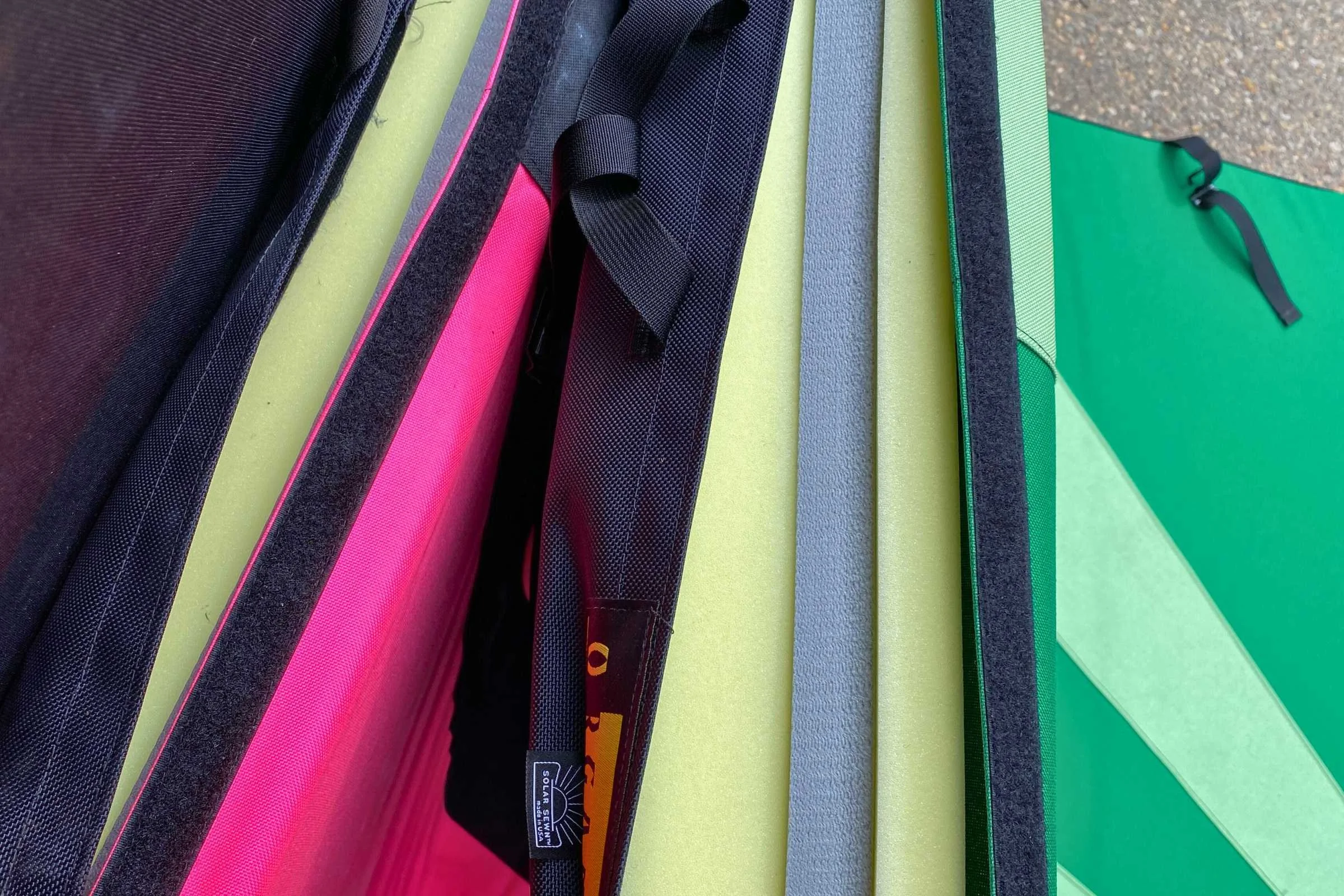
In addition to its clever design, the foam inside the Organic Full Pad also made a difference in its performance compared to other pads we tested. Most other pads utilize a sandwich-style foam construction, which includes a hard, closed-cell foam layer on the top and bottom, with a softer, open-cell foam in the middle.
The Organic pads were different, however, because they instead feature a reverse sandwich. There are 2 inches of open-cell foam on the bottom, followed by 1 inch of closed-cell foam with another 1 inch of open-cell foam on top. This means falling on it felt more comfortable right out of the box, but it still has enough closed-cell foam to distribute high impacts.
The Organic pads were the only pads we tested to have a soft layer on top, and one reason we think the brand does this is because it’s a hybrid pad, and the top layer needs to fold. The open-cell foam that goes over the hinge in the Full Pad is easier to manipulate than closed-cell foam. However, the Asana Superhero is the only other hybrid pad we tested, and its top layer is made from closed-cell foam. It’s the same thickness as Organic’s soft foam (1 inch), and we didn’t really notice a difference when we folded them closed.
The soft top layer Organic uses not only adds some protection along the fold, but it also means that landing on your pad will be comfortable right away. Closed-cell foam as the top layer means landing during your first few sessions can feel a little hard, and your pad will need some break-in time to feel truly comfortable. The Organic Pad, on the other hand, feels soft right away, but will still break in over time.
-
Because it’s a reverse sandwich and has more soft foam than hard foam, the Organic pads will get cushier in the long term, which means they might not be the best for highball bouldering late in their life. For high-impact falls, you want thicker padding and a good amount of closed-cell foam to disperse that energy so you don’t bottom out. The Organic pads have 1 inch of closed-cell foam, compared to the standard 1.5 inches of most other pads. It’s not a big difference, but highballers might want to look into other options.
-
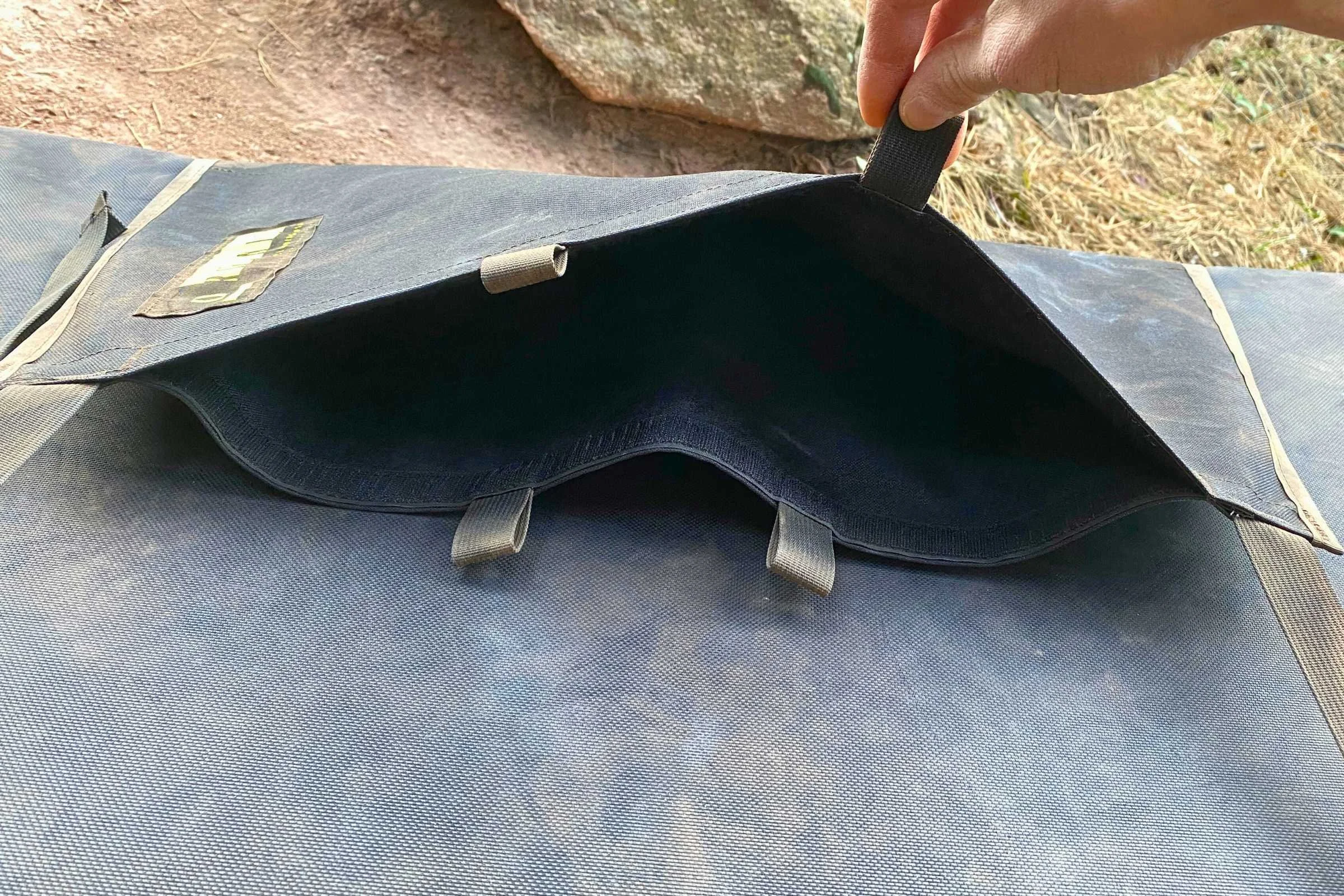
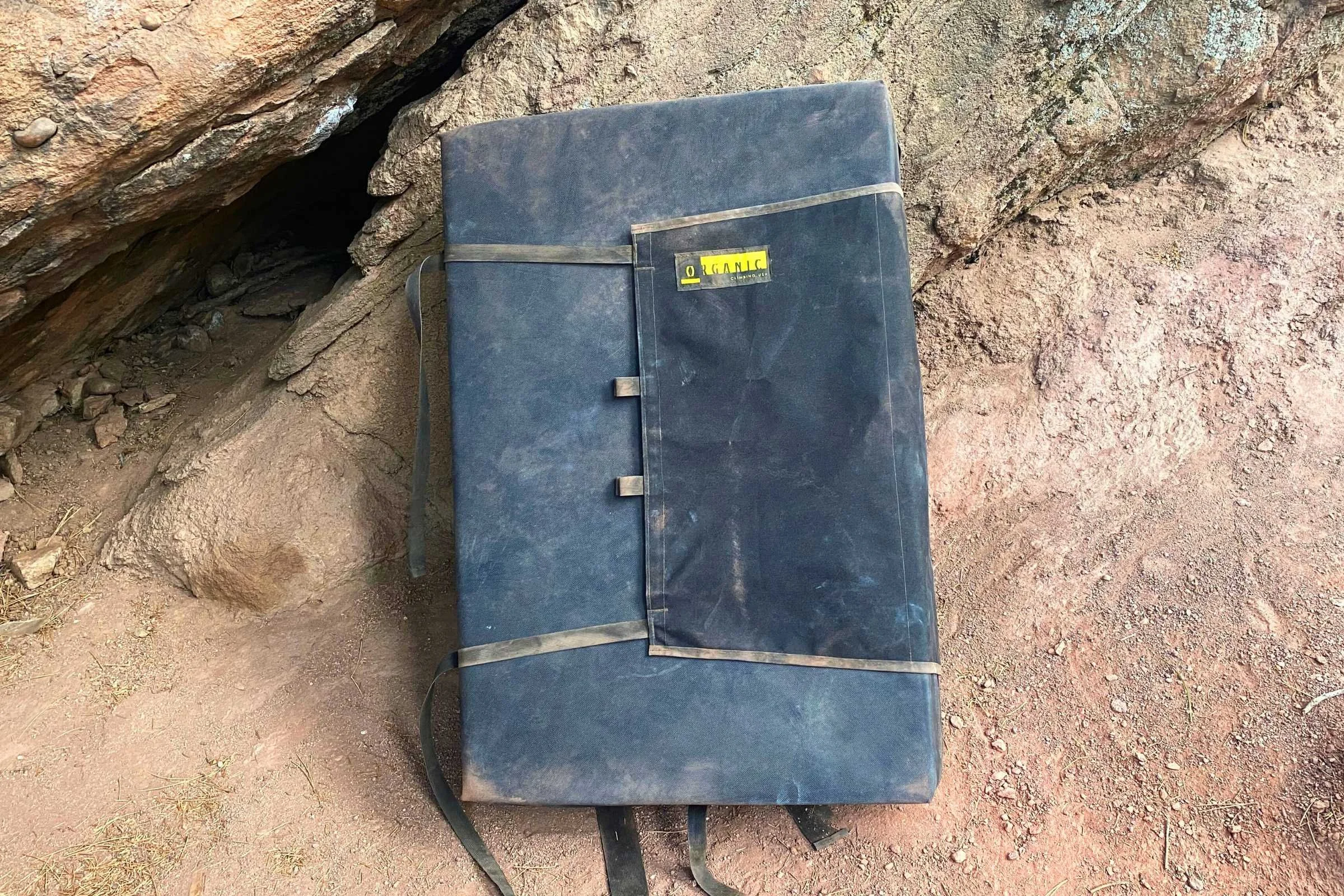
Another reason the Full Pad earned our top spot is that it comes equipped with a flap that has a variety of uses. The flap has adjustable straps to secure the pad closed, but the straps have enough extra length to attach another pad on the back. That means if you ever buy a second pad, you won’t have to buy straps to carry everything at once.
Once you’re at the crag, the flap can also be folded over the shoulder straps so they don’t get dirty, or it can be extended onto the dirt to act as a step pad to help keep your climbing shoes clean.
On top of all this, the flap also has a sleek, Velcro pocket to carry any extra gear. The Full Pad was one of only two pads we tested with a truly useful pocket design, and while a lot of climbers will probably just stuff their gear in the pad and fold it up, having an external pocket can also be useful for stashing things that will “live” in your pad, such as the guidebook to your local crag, an extra chalk bag, and brushes.
-
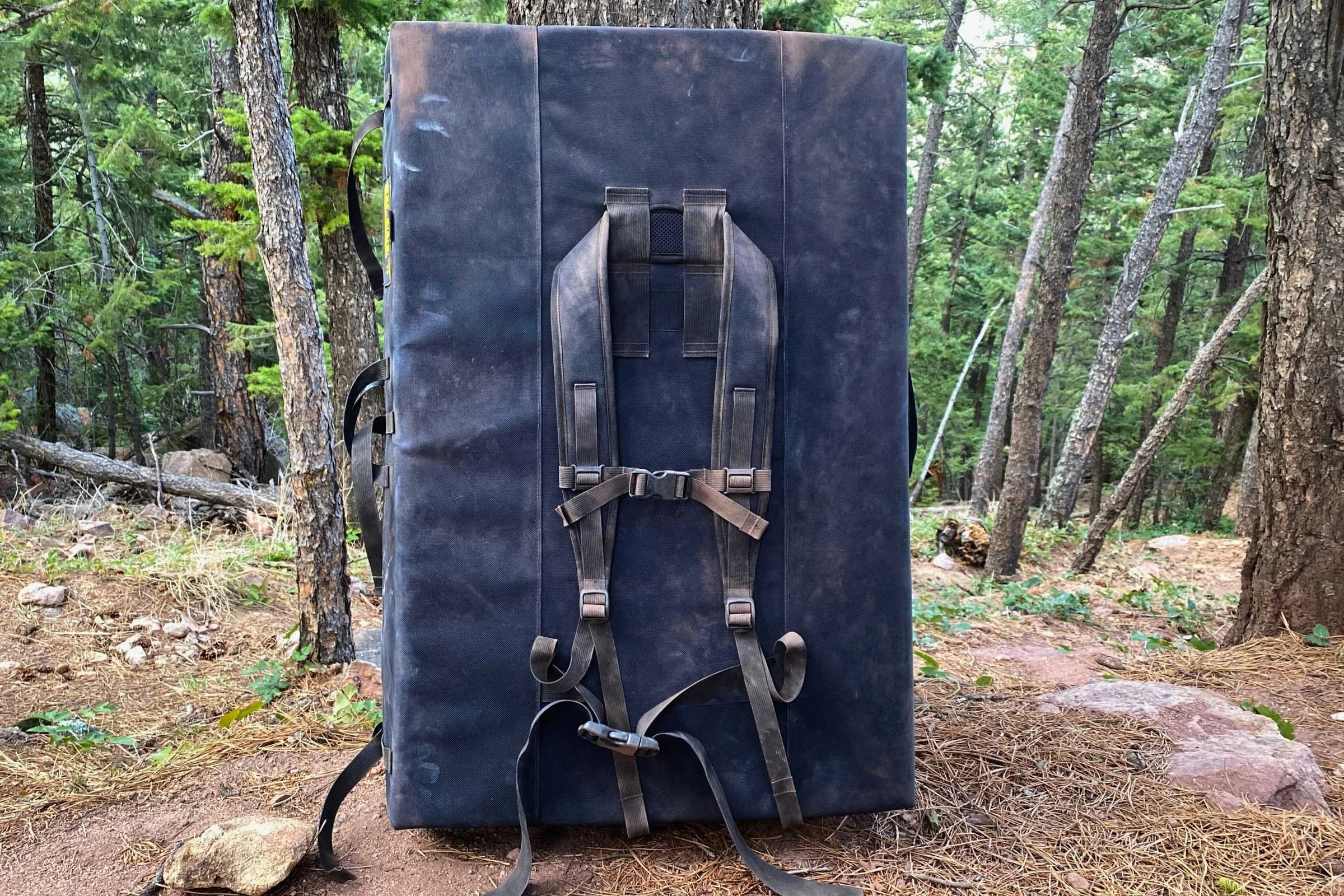
A pad isn’t any good if it’s a pain to get to the boulder, but you don’t have to worry about that with the Full Pad. It doesn’t have a padded hip belt—the Asana Superhero is the only pad we tested that had that feature—though you can buy one separately for $29 more. However, the Full Pad does have some of the most comfortable shoulder straps we tested, and an adjustable sternum strap.
The comfy straps paired with the bare-bones hip belt make carrying the Full Pad on your back surprisingly comfortable. It isn’t the lightest pad we tested (that award goes to the Black Diamond Circuit), but it’s still only 13 pounds, which didn’t feel too heavy on our hikes. We were even able to carry two Organic pads on our back quite comfortably for a total of 25 pounds, and only really noticed the weight on uphills and uneven ground.
-
Once you’re at the crag, the Organic Full Pad has multiple handles so it’s decently easy to move around, which can be crucial if you’re spotting your buddy and need to adjust the pad’s position. It has a handle on both of the short sides, plus you can tug on the flap if it’s extended out. We wish this pad had one or two more extra handles on both of the long sides so you never have to grab the 4 inches of foam to move it, but that’s a small gripe.
-
When it comes to durability, the Organic Full’s 1,050-denier ballistic nylon and 1,200-denier recycled Cordura fabric performed admirably after we scraped it against a sharp rock on Flagstaff Mountain in Boulder, Colorado. It had some small cosmetic imperfections, but we didn’t see any tears or breaks in the fabric’s integrity.
-
With a landing zone of 48 by 36 inches, fantastic fall comfort, and a multi-functional flap, the Organic Full Pad is the best all-around crash pad on the market. The cherry on top? You get all these features starting at a price of just $209. Outside of the Organic Simple Pad, the Metolius Session II, and the Black Diamond Circuit, that’s the lowest price of any pad we tested. The pad is customizable, and if you want more than one color, the price does go up. However, even if you add the max of two extra colors and a flashy logo, you’re still only spending $244—a screaming value compared to its competitors.
Best budget crash pad: Organic Simple Pad

Type: Hybrid
Open dimensions: 36 inches by 48 inches by 4 inches
Folded dimensions: 36 inches by 24 inches by 8.5 inches
Thickness: 4 inches
Weight: 12 pounds
What we liked: Stellar performance for a great price, bare-bones design
What we didn’t like: One strap is awkward to buckle, not as much closed-cell foam, extra colors cost money
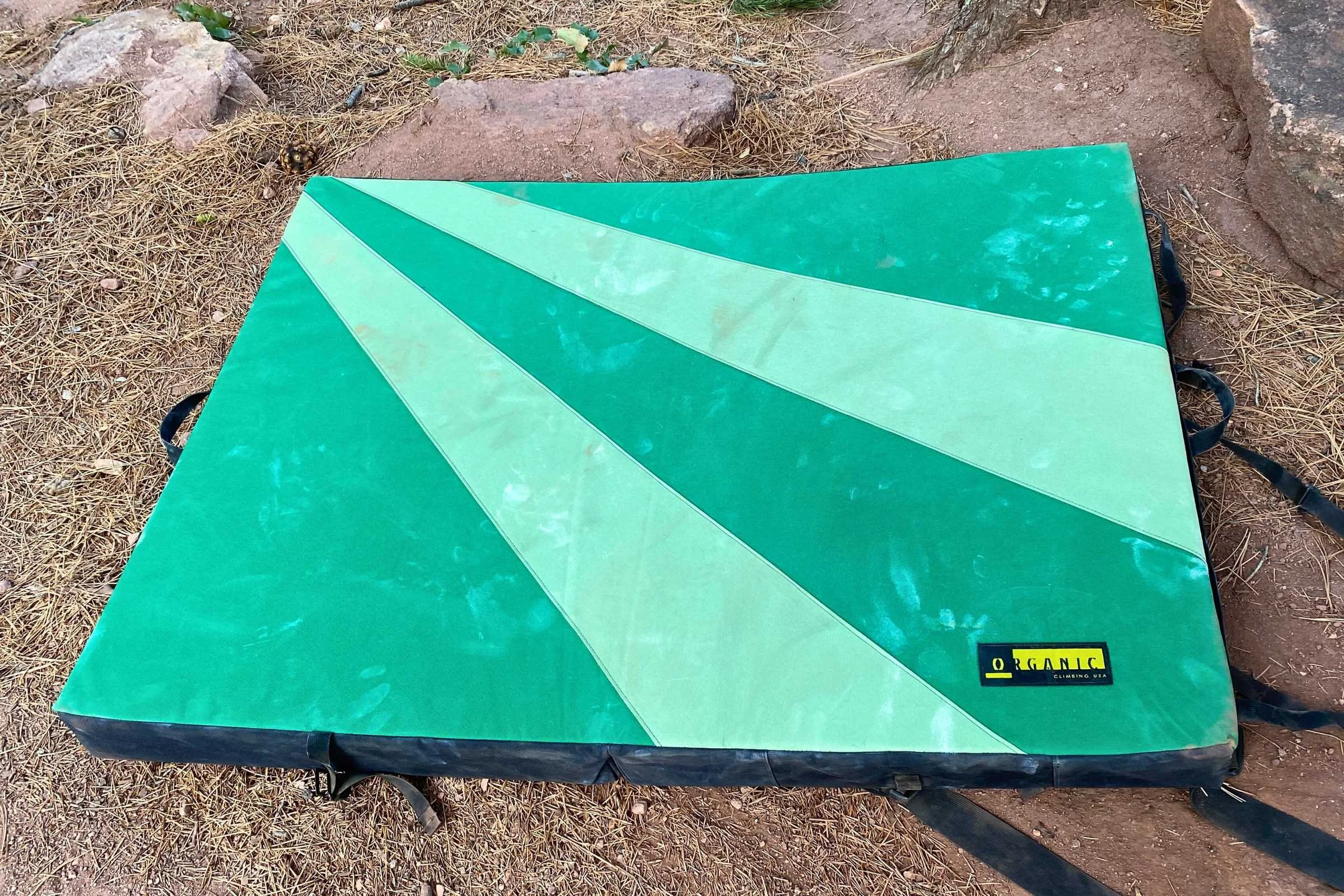
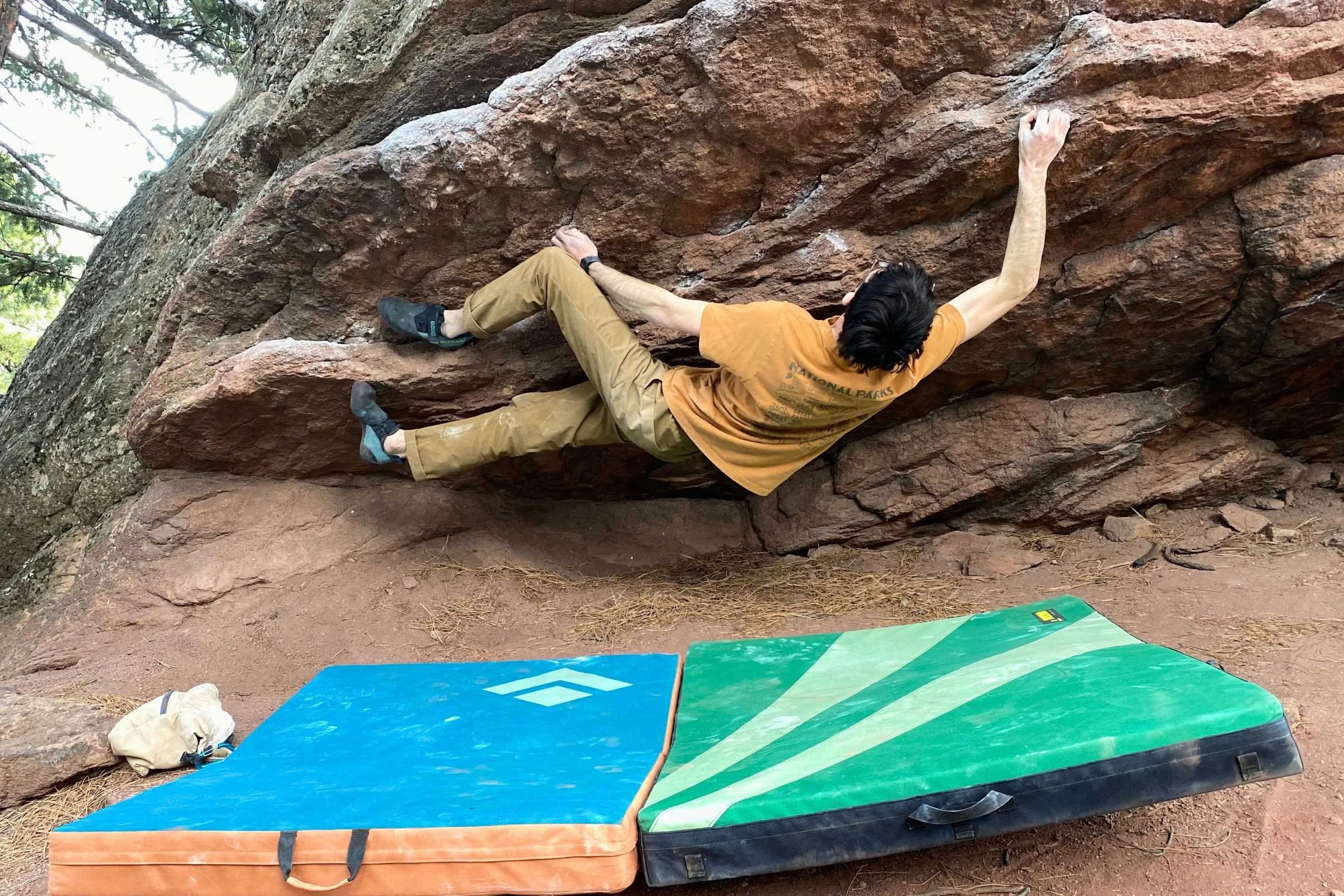
With the same performance as the Organic Full Pad, the Simple Pad is a trimmed-down version that’s $20 more affordable. It’s the least expensive pad we tested, but it still had some of the best performance. You won’t be able to carry additional pads without extra straps, but if you’re only hauling one or want to add a pad to your collection, this is a fantastic choice.
Organic Simple Pad
-
The performance of the Simple Pad was exactly the same as the Full Pad. It has the same hybrid design and sandwich foam construction, and it was incredibly comfortable to fall on, even from a height of around 8 feet.
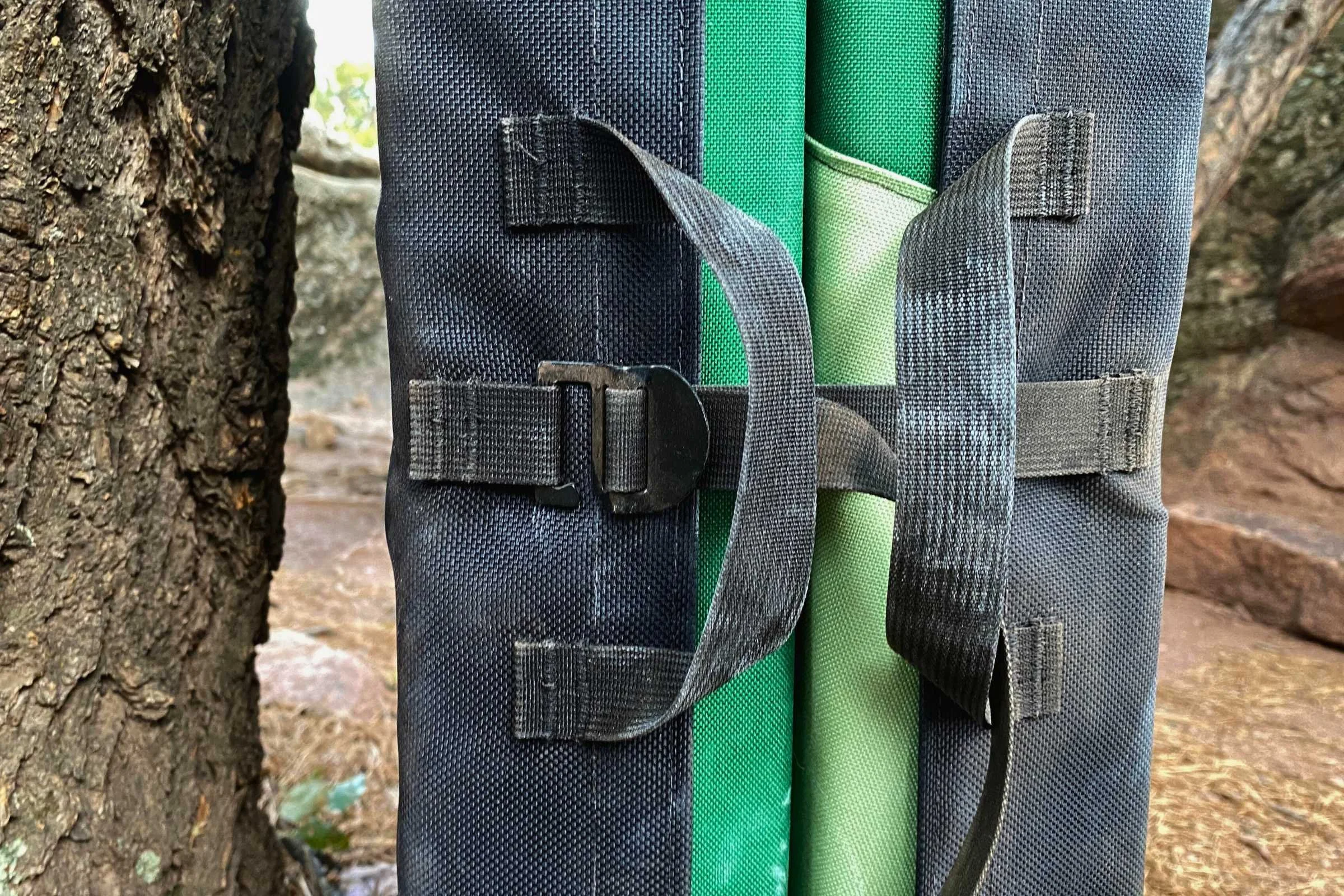
Where the Simple Pad differs, however, is in its lack of features. The Full Pad’s exterior flap is missing, and instead, the Simple is secured with four straps. Without the flap, this pad is great for someone who doesn’t need extras or who’s shopping for an additional pad to add to their collection.
If you really want to save some money and want a pad that you’ll use exclusively with others, you might even want to consider the Simple Strapless Pad, which doesn’t even have shoulder straps. We didn’t test the Simple Strapless, but we do think most people will probably appreciate the functionality of straps.
-
The Simple Pad is naturally very similar to the Full Pad, and another fantastic trait they both share is their sustainability story. Organic had the best sustainability efforts out of any crash pad brand we researched, and we really love all the initiatives they’re taking to reduce their impact.
First off, Organic is a small business based in Pennsylvania, so you can feel good that your money is going to a small group of people, not a giant corporation. The pads are handmade in the brand’s Pennsylvania factory, which runs 100% off solar energy from solar panels on its roof. Plus, nearly all the cutting room scraps are recycled into other products like bags and backpacks, meaning Organic barely throws materials away. On top of all that, each pad is made to order and custom, so the colors and layout of the fabrics are unique and personal.
-
While there isn’t much to complain about when it comes to either of the Organic pads we tested, there was one small detail of the Simple Pad we didn’t like. One of the straps that secures the pad closed needs to be looped through a carry handle if you want to maintain the ability to use the handle. It’s an awkward placement, and we wish the strap was positioned just above or below the handle so you didn’t have to worry about threading the strap through.
-
Weighing basically the same as the Full Pad at 12 pounds, the Simple Pad is also a decently lightweight option. You don’t have the ability to carry extra pads with the built-in straps, but its shoulder straps are the same comfy ones as on the Full. The Simple also performed identically in our durability test, surviving the harsh scraping with some barely-noticeable cosmetic damage.
-
For an incredibly low starting price of $189, the Simple Pad might just be the best deal you can get on a crash pad. It outperformed basically all the other pads we tested, while costing less and being more eco-friendly. If you want to save a few bucks and don’t need the fancy features of the Full, the Simple Pad is the best crash pad for you. Add some flash with extra colors for $10 more each, and you’ll have a durable, stylish, and comfortable crash pad for all your projects.
Best large crash pad for highball problems: Metolius Magnum Crash Pad

Type: Tri-fold hinge
Open dimensions: 47 inches by 70 inches by 4 inches
Folded dimensions: 47 inches by 25 inches by 13 inches
Thickness: 4 inches
Weight: 18 pounds
What we liked: Enormous landing zone, external pockets, carpeted step pad
What we didn’t like: Hard to carry and move around, awkward to attach additional pad
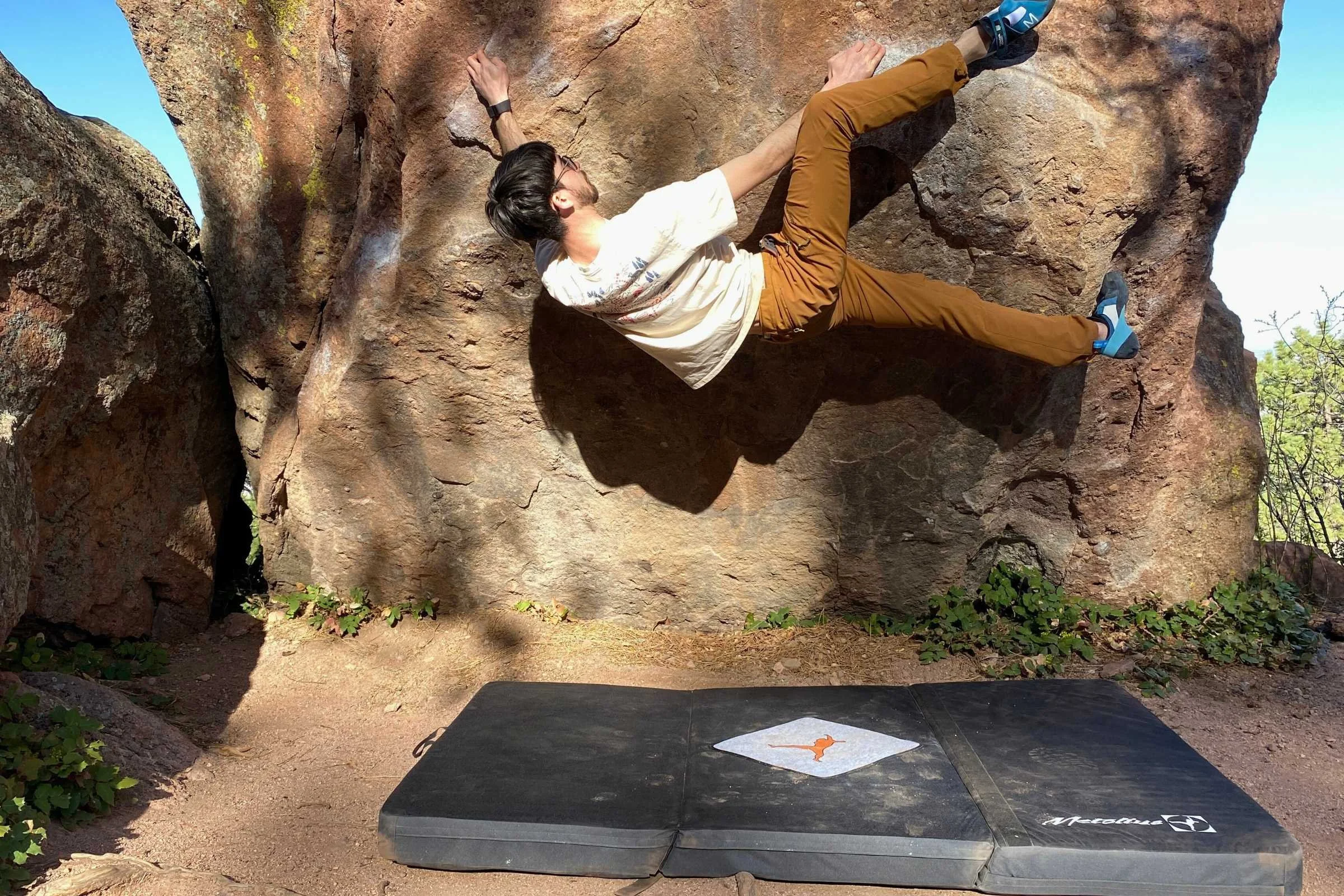
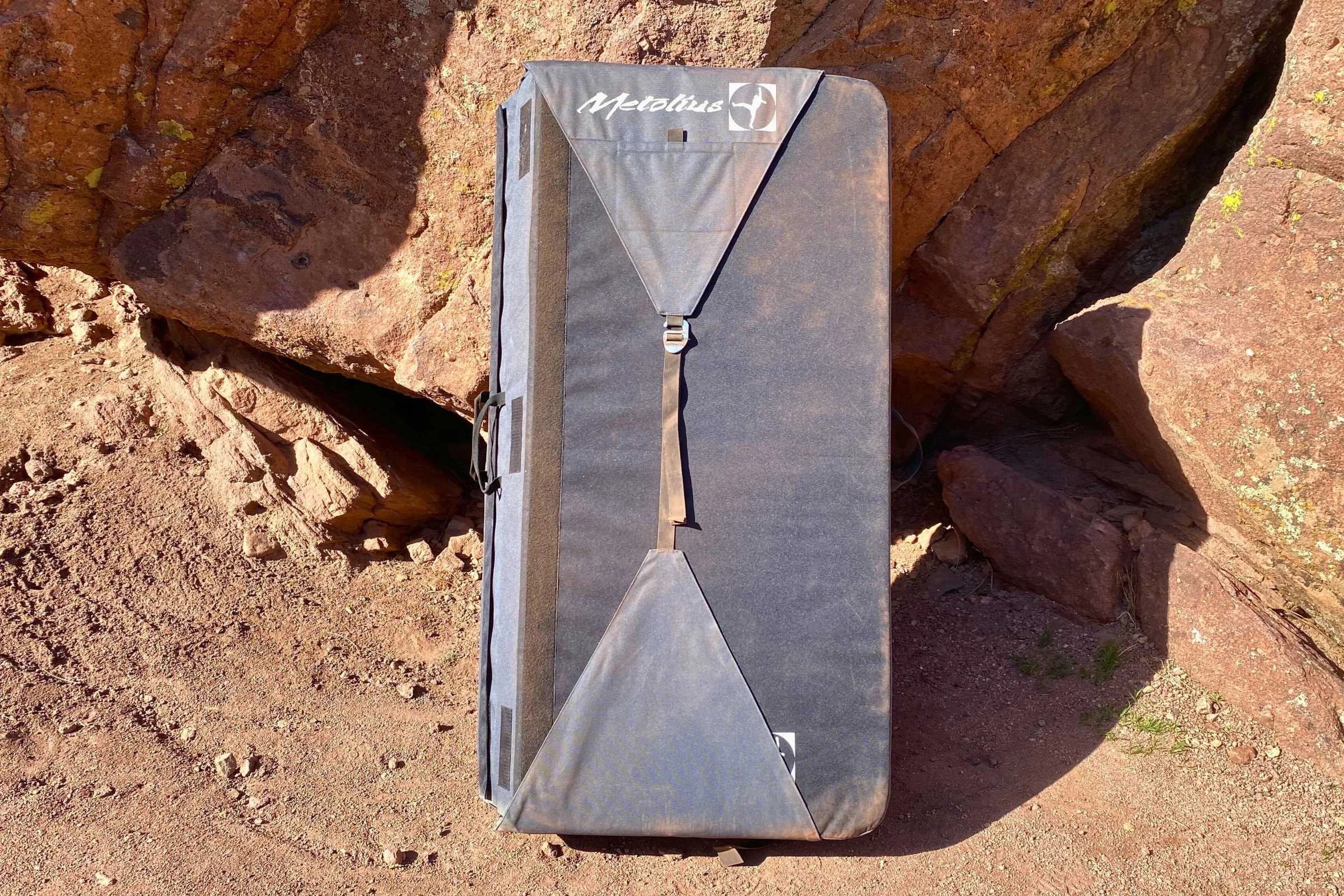
This massive crash pad can be a pain to carry, but its enormous landing zone makes it key for highball problems. Thanks to its tri-fold design, the Metolius Magnum unfolds to a bigger size than any other pad we tested. Plus, its closure system allows you to carry another pad without any extra straps—although awkwardly—so you can protect a huge variety of boulders.
Metolius Magnum Crash Pad
-
The main reason why you’d buy an enormous tri-fold like the Metolius Magnum is simple: coverage. By just carrying the Magnum, you’re protecting a whopping 3,290 square inches of ground, which is slightly less than the 3,456 square inches you’d get with two Organic pads.
Even though this pad has a huge landing zone, it isn’t too ridiculously big when folded up. The tri-fold design means it has a narrower silhouette than normal crash pads, however, it’s taller and thicker.
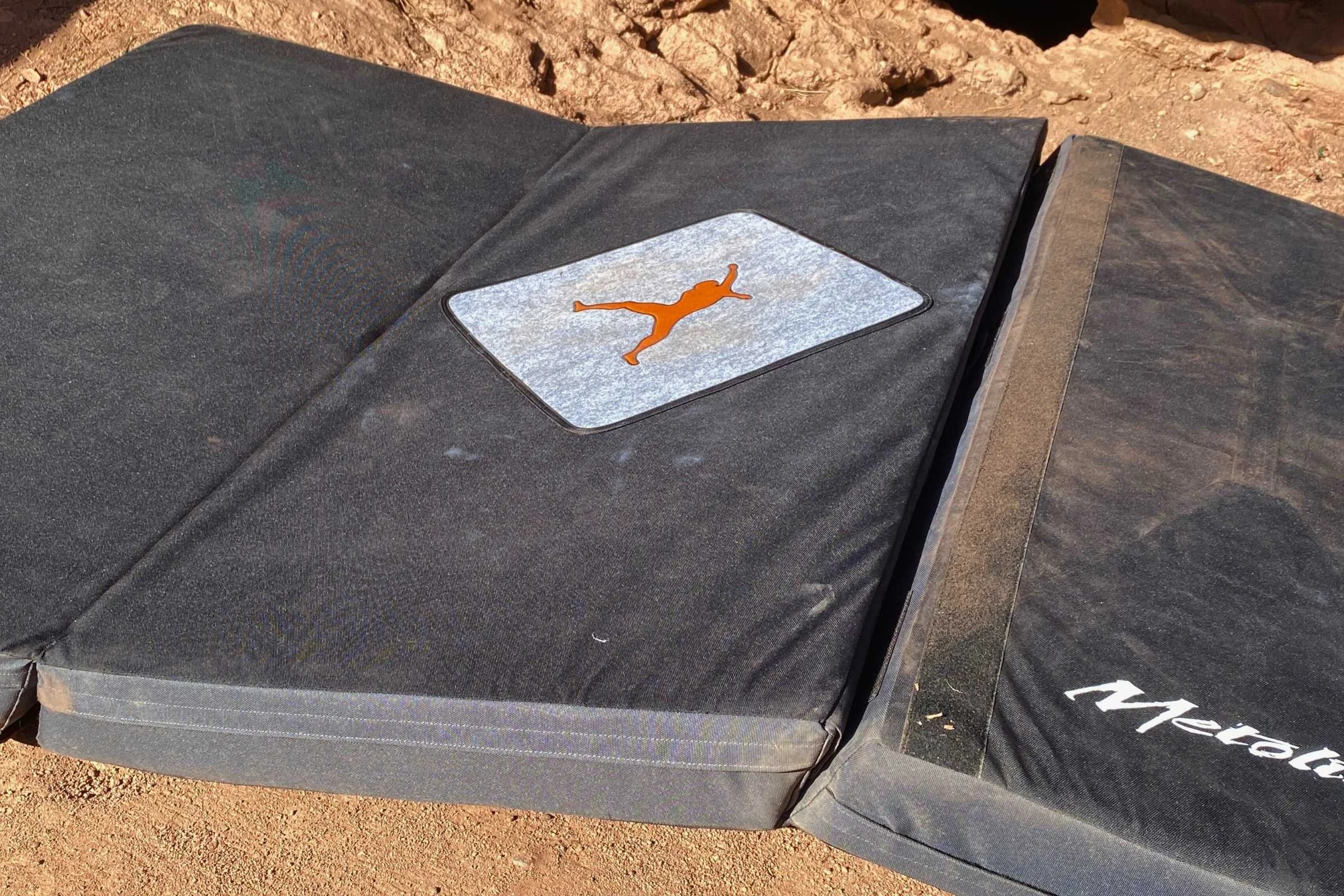
Unfolded, this hinge-style pad has two creases that have Velcro on the inside to help them stay together. In practice, however, we found the Velcro didn’t keep the segments of the pad together all that often, especially on uneven ground or when you land on it. This poses a bigger risk for rolled ankles than other pads we tested, since there’s one more fold than normal pads, and the hinges aren’t protected by a layer of foam.
One of the hinges even has its gap facing up, so be mindful when placing and falling onto this pad, as you don’t want to land in that open space. The hinges are angled to help prevent this, but if the pad is on uneven ground, it might not work perfectly.
The foam construction of the Magnum is quite typical and uses a sandwich-style pattern: 0.5 inches of closed-cell on the bottom, 2.5 inches of open-cell in the middle, and 1 inch of closed-cell on the top. This foam layering does a good job of dispersing energy from tall falls, but the main reason why this pad is our pick for highballs is its size.
When you’re high up, it’s much harder to judge exactly where you’ll land, so you’ll want more coverage than normal. If you are looking for a pad with thicker foam for big falls, we also really liked the Moon Warrior Pad, which has 5 total inches of foam. Other thick pads are also available on the market, but we didn’t test them (yet).
-
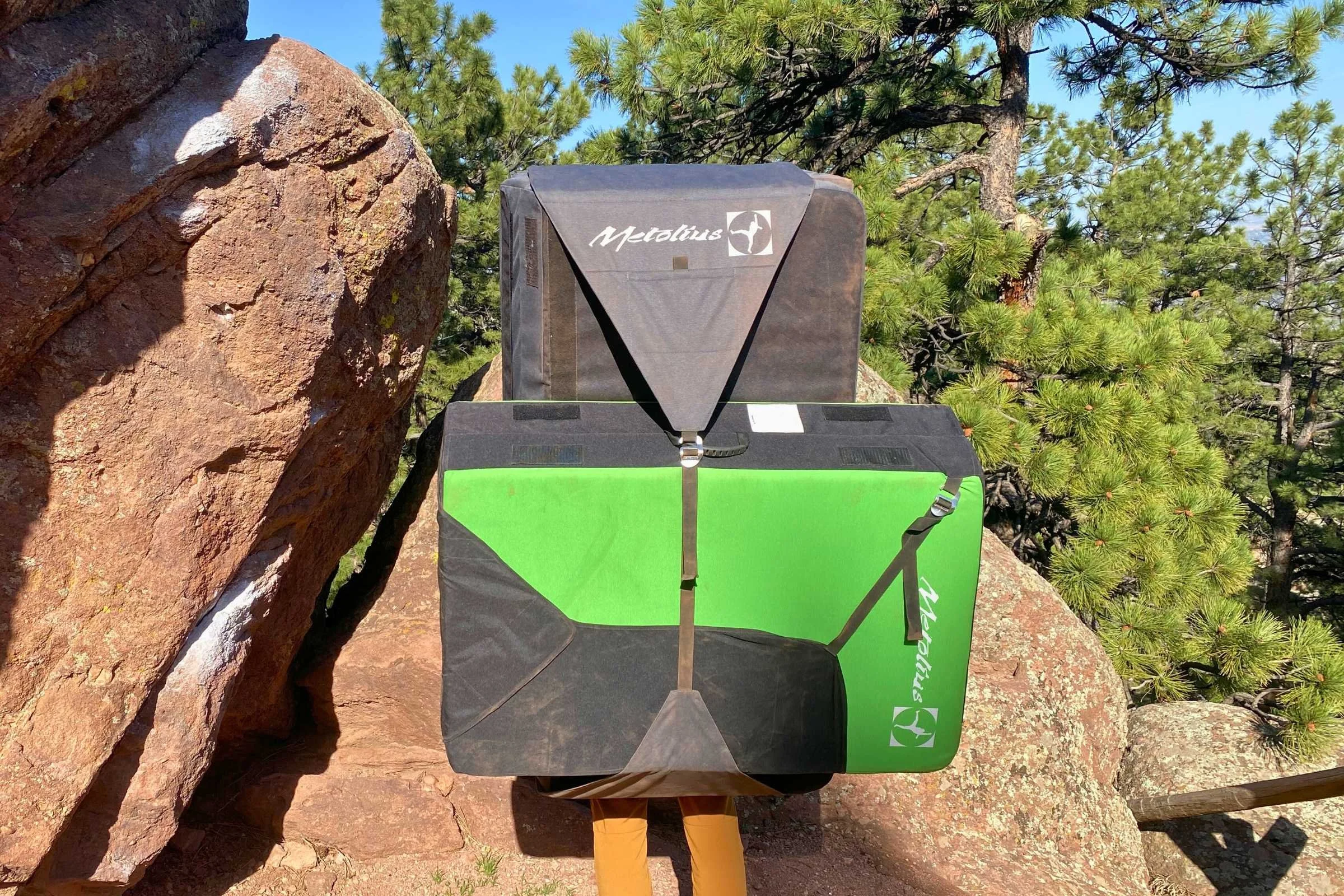
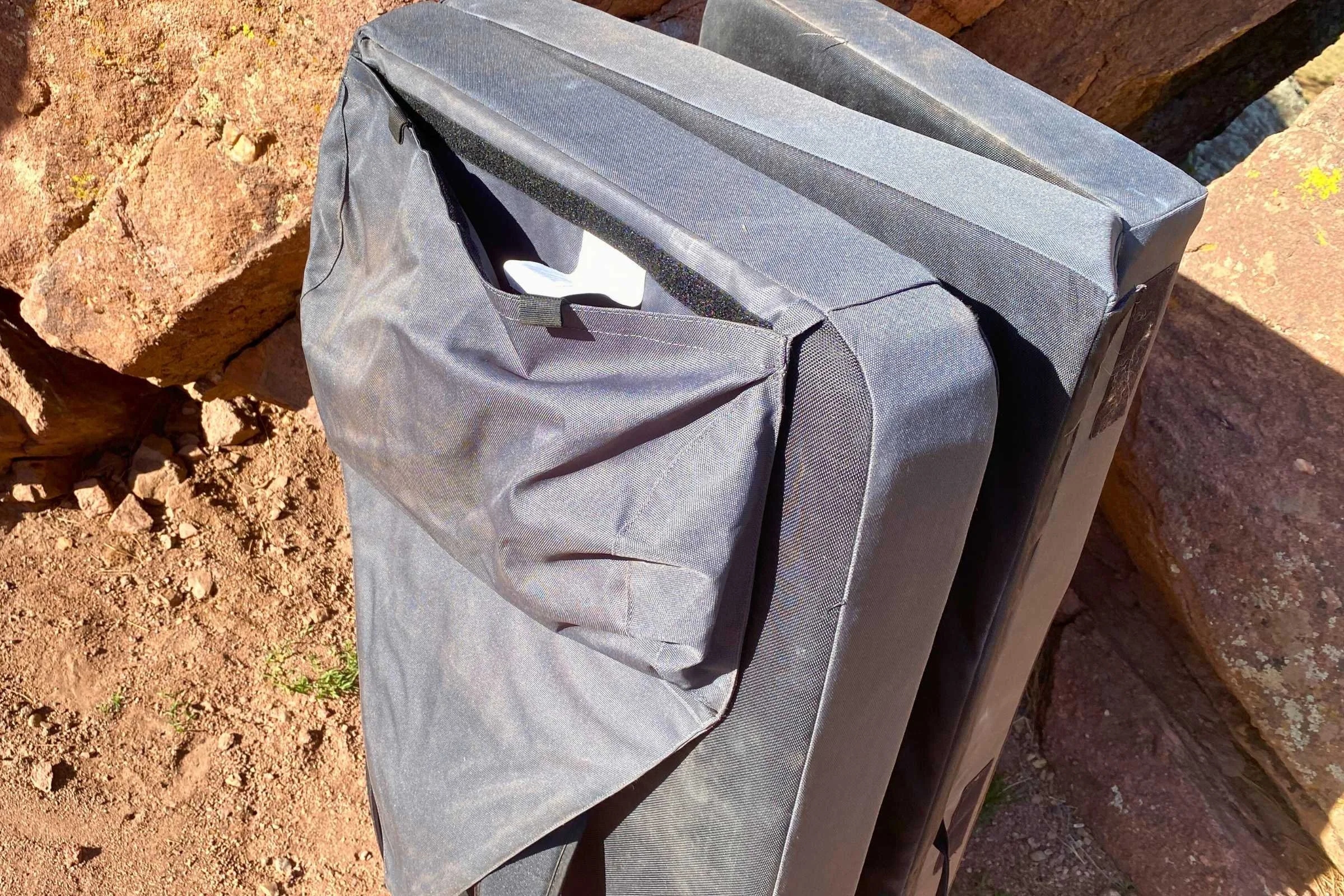
Beyond its foam and construction, we really liked the features of this pad. Since it’s a tri-fold, it’s harder to stuff your gear in between the pieces of foam, so it was critical the Magnum had some better storage options.
Its strap design means you can stuff a bag under the flap on top of the pad, and there’s also a big pocket on the underside of this flap. Both let you carry a lot of extra gear, but we found that your load gets very top-heavy when doing this, and it can be hard to keep your balance on more technical hikes. The bottom flap of its strap system can also hold a bag, but it’s less secure, so you’ll want to make sure your gear is tight or somehow clip it to a strap with a carabiner.
These flaps also can be positioned as a step pad at the crag, or they can be used to cover the pad’s shoulder straps so they don’t get too dirty. Another feature we loved on this and the Metolius Session II pad was a square of carpet in the center of the pad that helps you clean off your shoes right before you get on the boulder.
-
The biggest downside to the Metolius Magnum is the same as its biggest strength: size. Once you’re at the crag, you’ll love how big it is, but getting it there is another story. The tri-fold design means it’s easier to carry than if it was the same size and a bi-fold, but it was still the most difficult pad we tested to hike with.
-
The Magnum was also the heaviest pad we tested, weighing 18 pounds, and its tall silhouette meant it was harder to keep our balance while hiking on uneven terrain. The Magnum does help you out a little bit and has decently comfy shoulder straps and a non-padded hip belt, but since it is so heavy, we wish these features were more plush. A padded hip belt would do wonders for taking some of the weight off your shoulders, and extra features like load lifters and a sternum strap could really help too.
Even though it is a bit awkward to carry, I’ve stuffed small pads like the Black Diamond Circuit under its flaps on some relatively short approach hikes. It doesn’t fit extra pads as naturally as the Organic Full Pad, but you can make it work if you get creative enough.
At the crag, the Magnum’s heavy weight, long design, and two hinges can make it difficult to move around—especially in tight spaces. You’ll probably have to wrestle with it more to get it in the right spot, but it does have a handle on each of the short sides to help you position it a little easier. Like other pads we tested, we wish there were also handles on the long sides so you could position it with even less effort.
-
When it comes to durability, you won’t have to worry about throwing the Magnum around. When we scraped it against a sharp rock, there were some cosmetic marks, but no real tears in the thick fabric. I even have an older version of the Magnum pad that I bought secondhand over five years ago and it’s still kicking. The foam has softened up—which is expected of every pad—but other than that, there are only a few small imperfections and scrapes.
-
If you’re climbing really tall boulders, you might want to look for a pad with 5 inches of foam or more, but if you’re more in need of a pad to cover larger landing areas, go with the Metolius Magnum. It’s also a great option for someone who only wants to carry one pad, since you get a large amount of coverage without having to deal with stacking pads on your back. Its size makes it harder to transport to the boulder, but once you’re there, you’ll be thankful for the extra padding.
Best lightweight crash pad: Metolius Session II Crash Pad

Type: Hinge
Open dimensions: 36 inches by 48 inches by 4 inches
Folded dimensions: 36 inches by 26 inches by 8 inches
Thickness: 4 inches
Weight: 9 pounds
What we liked: Lightweight, carpeted step pad, angled foam at hinge
What we didn’t like: Velcro flap adds time to setup, small footprint
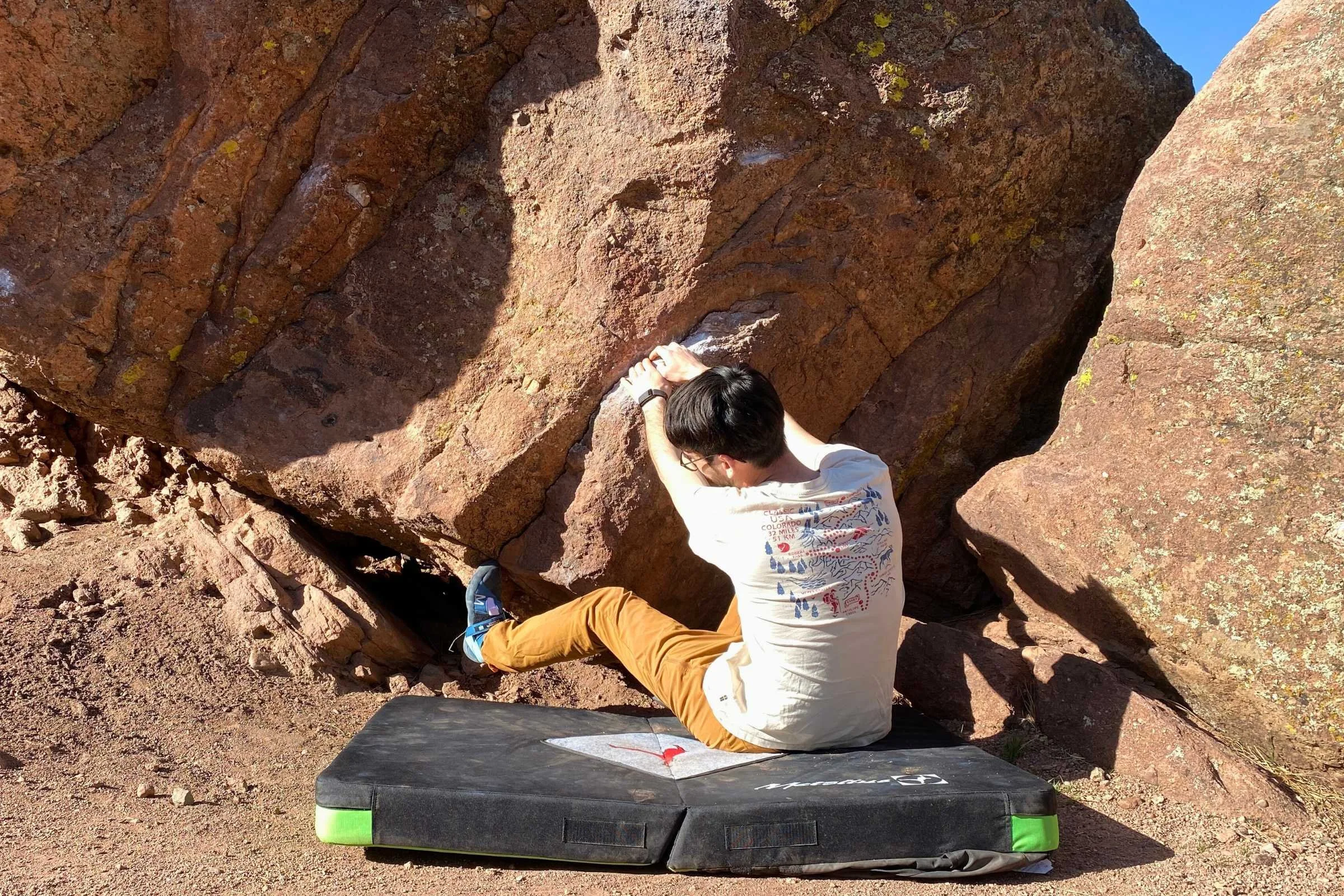
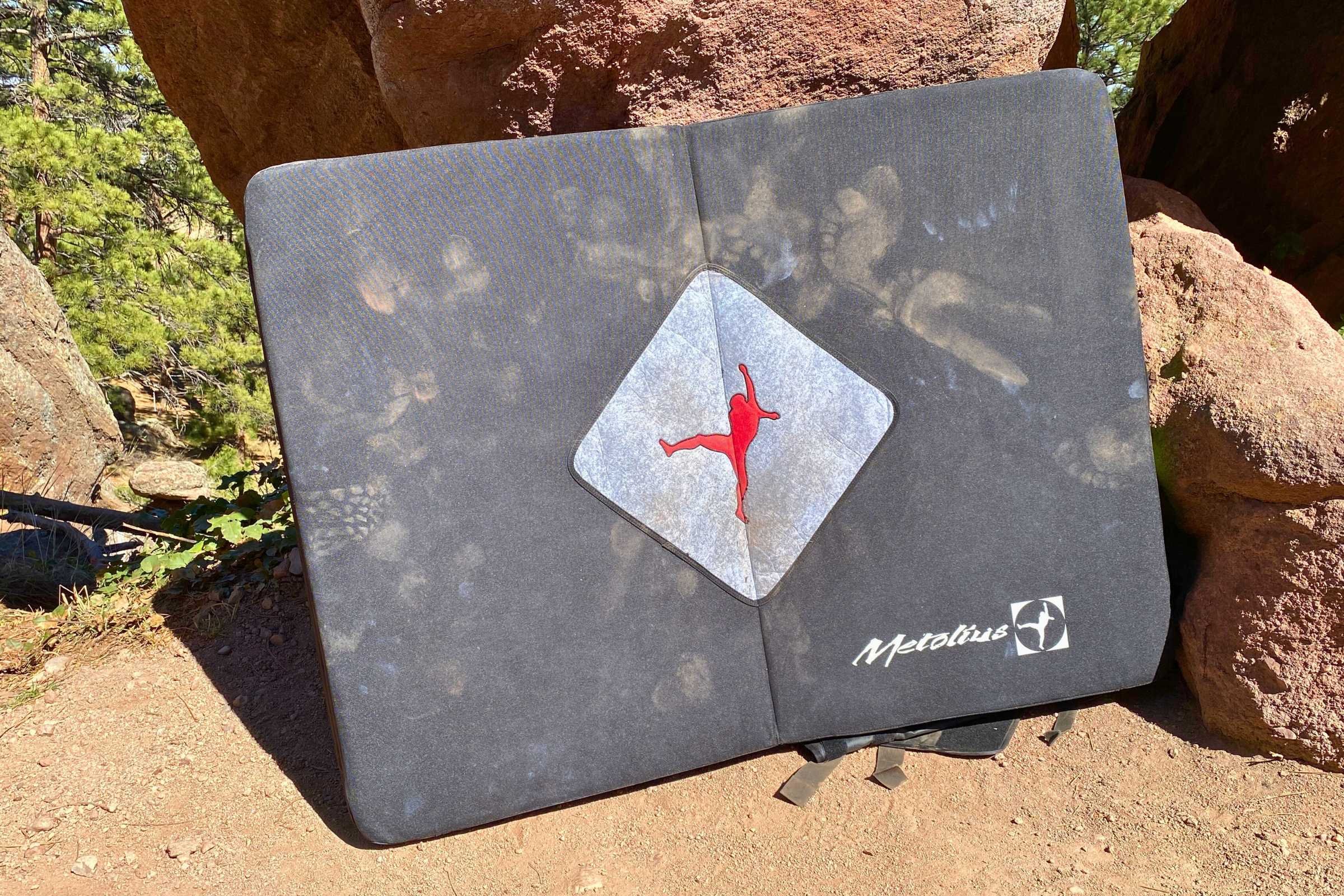
On paper, it’s not the lightest crash pad we tested, but the Metolius Session II still only weighs 9 pounds and has extra features that make it the best lightweight option in our opinion. It’s easy to carry, can be attached to other pads, can stash a small amount of gear, and has a carpeted step pad to keep your shoes clean.
Metolius Session II Crash Pad
-
The Metolius Session II is a hinge-style pad with 4 inches of foam. It uses the same sandwich pattern as the Magnum and the Black Diamond Circuit, featuring closed-cell foam on the top and bottom, and open-cell foam in the middle. The foam feels good to land on, but the real reason the Session II won our pick as the best lightweight pad is for its detailed features.
-
The Black Diamond Circuit weighs 8 pounds, which is 1 pound lighter than the Metolius Session II, and it was almost our top pick for the best lightweight pad for this reason alone. However, the Circuit is a very bare-bones pad and doesn’t have any extra features. While the Session II isn’t full of extras, it has small details that make the climbing experience that much better.
-
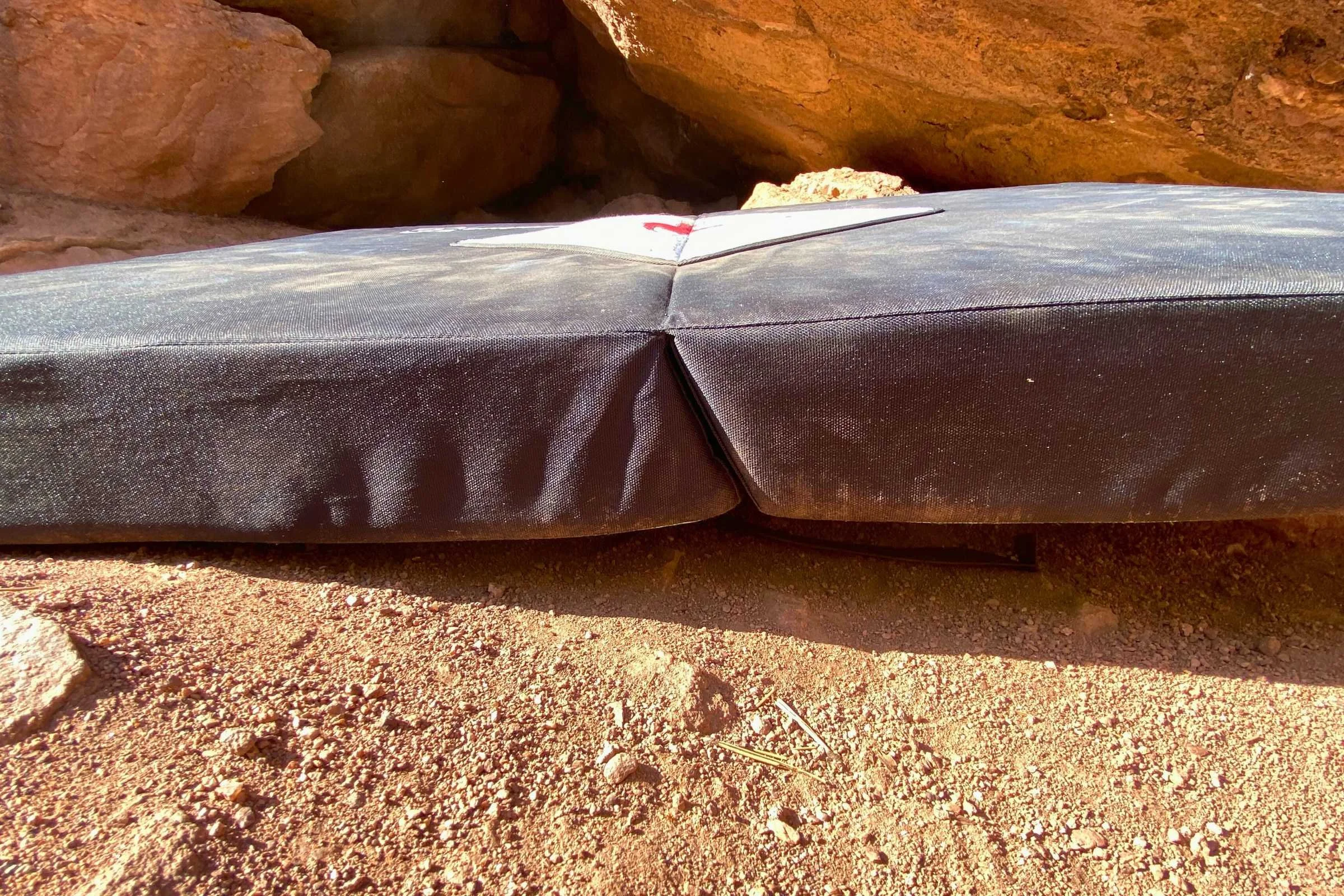
Probably the most important feature the Session II has that the Circuit doesn’t is related to its hinge design. Since hinge pads pose a greater risk to your ankles and feet since there’s a small fold without protection, the Session II uses angled foam at the hinge to reduce this risk. This, combined with Velcro on the inside of the fold, helps prevent you from bottoming out. It isn’t perfect and the Velcro still comes undone sometimes, but it’s better to have the angled foam than not. The Circuit’s hinge, on the other hand, has Velcro but no angled design.
-
The Session II also has a piece of carpet on the landing zone, which is a super helpful detail (that adds almost no weight) to help clean off your climbing shoes right before you step onto a climb. We found ourselves constantly wiping our feet on it to ensure our shoes kept a smooth and sticky surface.
-
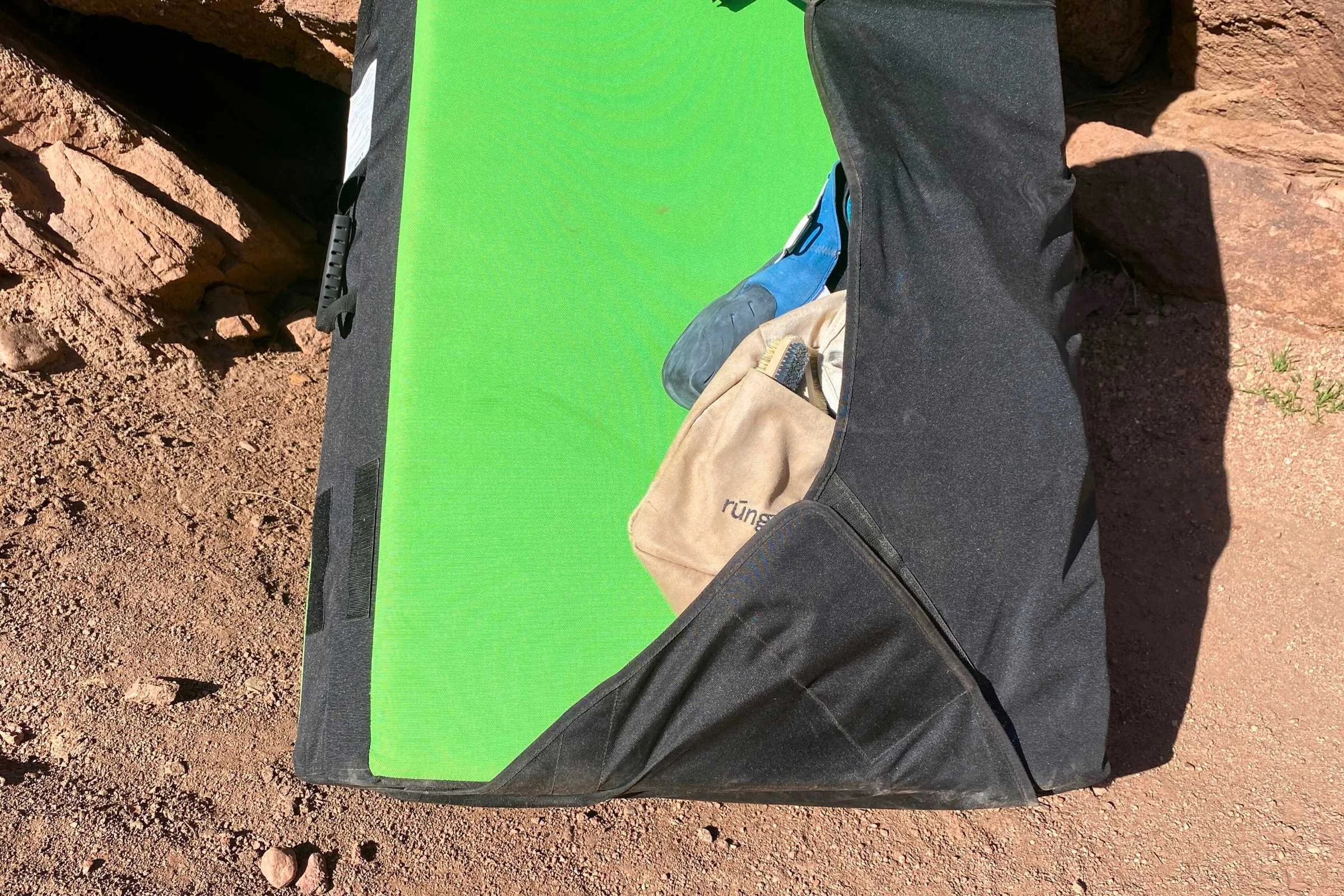
The Session II also has a couple of Velcro flaps that help secure the pad when closed. We actually don’t love this feature, as it adds a time-consuming step to unfolding and refolding the pad. We could set up and break down the similar Black Diamond Circuit pad quicker, but you can also use the Session II’s flap to stash some small pieces of gear, like shoes or a chalk bag. We didn’t think this flap was super secure though, so we probably wouldn’t trust it on long hikes.
-
One detail where the Circuit does beat out the Session II, however, is with its extra strap loops. The Circuit has a couple of extra loops so you can attach it to other crash pads or even attach another crash pad to it. Compatibility depends on the strap and loop layout of your other pad, which is one reason why we didn’t think this feature alone made it better than the Session II. Plus, you probably won’t want to carry the Circuit with another pad attached to its back anyway since it’s small and its shoulder straps aren’t very supportive.
-
Since the Session II pad is lightweight, its shoulder straps don’t matter a whole lot, but it does have padded ones (though not as padded as the ones on Organic or Asana pads), and a non-padded hip belt. The Metolius Session II is slightly better than the Circuit in this regard, which had shoulder straps with even less padding.
-
Since the Session II is a small pad and its shoulder straps aren’t that great, it works best as a secondary pad. Plus, there’s no built-in way to attach another pad to it. However, since it’s small, it can easily be paired with others that are designed to carry additional pads, like the Organic Full or Asana Superhero.
At the crag, the Session II’s lightweight design shines. It’s easy to throw from one end of a traverse to another, and it has two pull handles on its short sides for maneuverability. Again, we wish it had handles on its long sides, but most pads don’t anyway so we can’t hold this detail against the Session II that much.
On top of its pull handles on the sides, the Session II also has a padded handle in its hinge that’s exposed when it’s folded, which makes it a good candidate to carry one-handed on short approaches or from one boulder to another one nearby.
-
Even though the Session II isn’t technically the lightest pad we tested, it’s still the best lightweight pad. For the same price as the 8-pound Circuit, you get better details and small added features, which makes this pad a no-brainer for anyone looking for a small pad for their local lowballs, or a secondary pad for their big projects.
Best crash pad for long approaches: Asana Superhero

Type: Hybrid
Open dimensions: 57 inches by 40 inches by 4 inches
Folded dimensions: 29 inches by 40 inches by 8 inches
Thickness: 4 inches
Weight: 15 pounds
What we liked: Oversized landing zone, best carrying system we tested, can attach another pad
What we didn’t like: Pricey compared to competitors
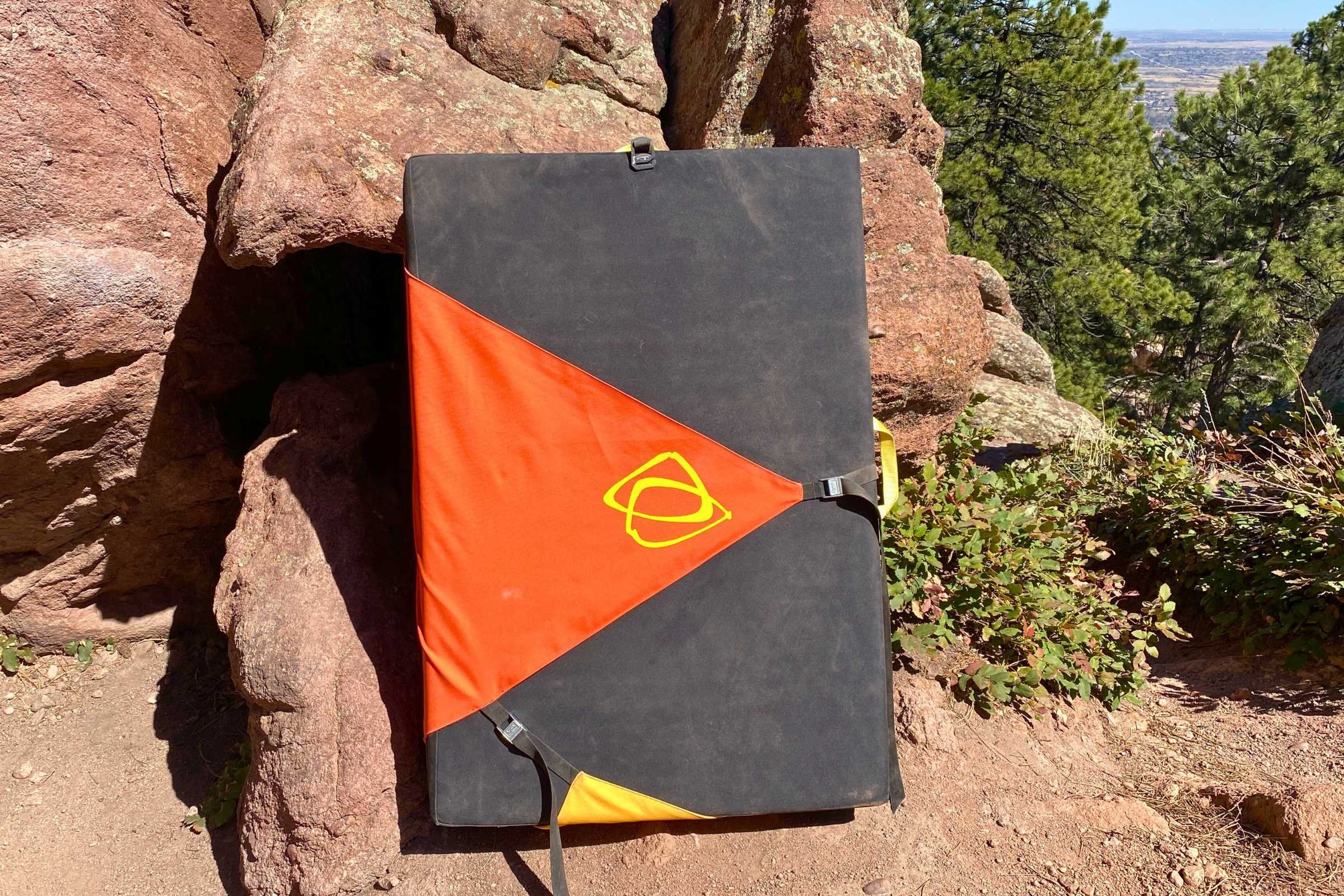
If you’re trekking into the backcountry to find isolated boulders, or you just hate being uncomfortable while carrying crash pads, the Asana Superhero is for you. It has the best carrying system of any pad we tested, not to mention it’s easy to attach an extra pad to its back.
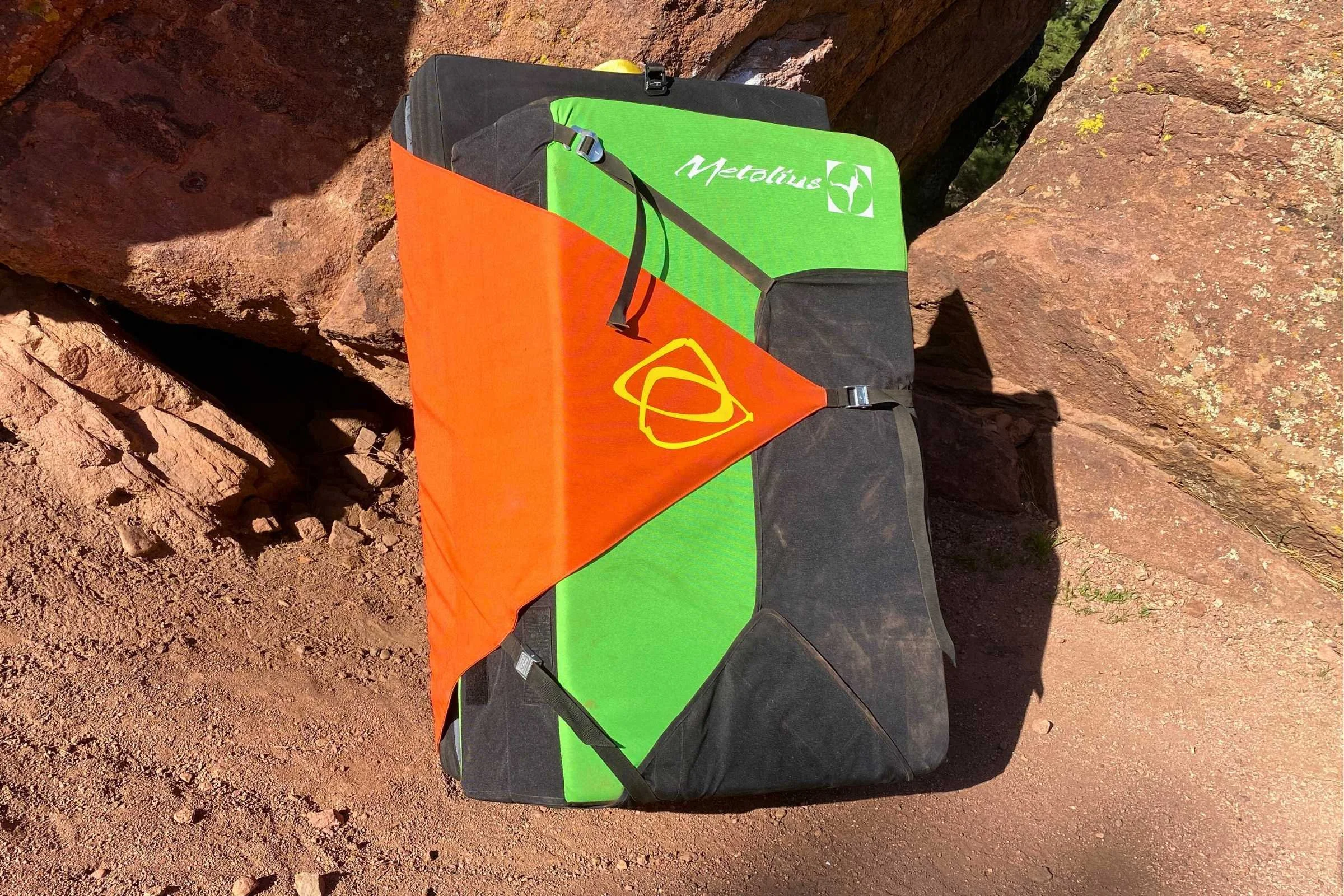
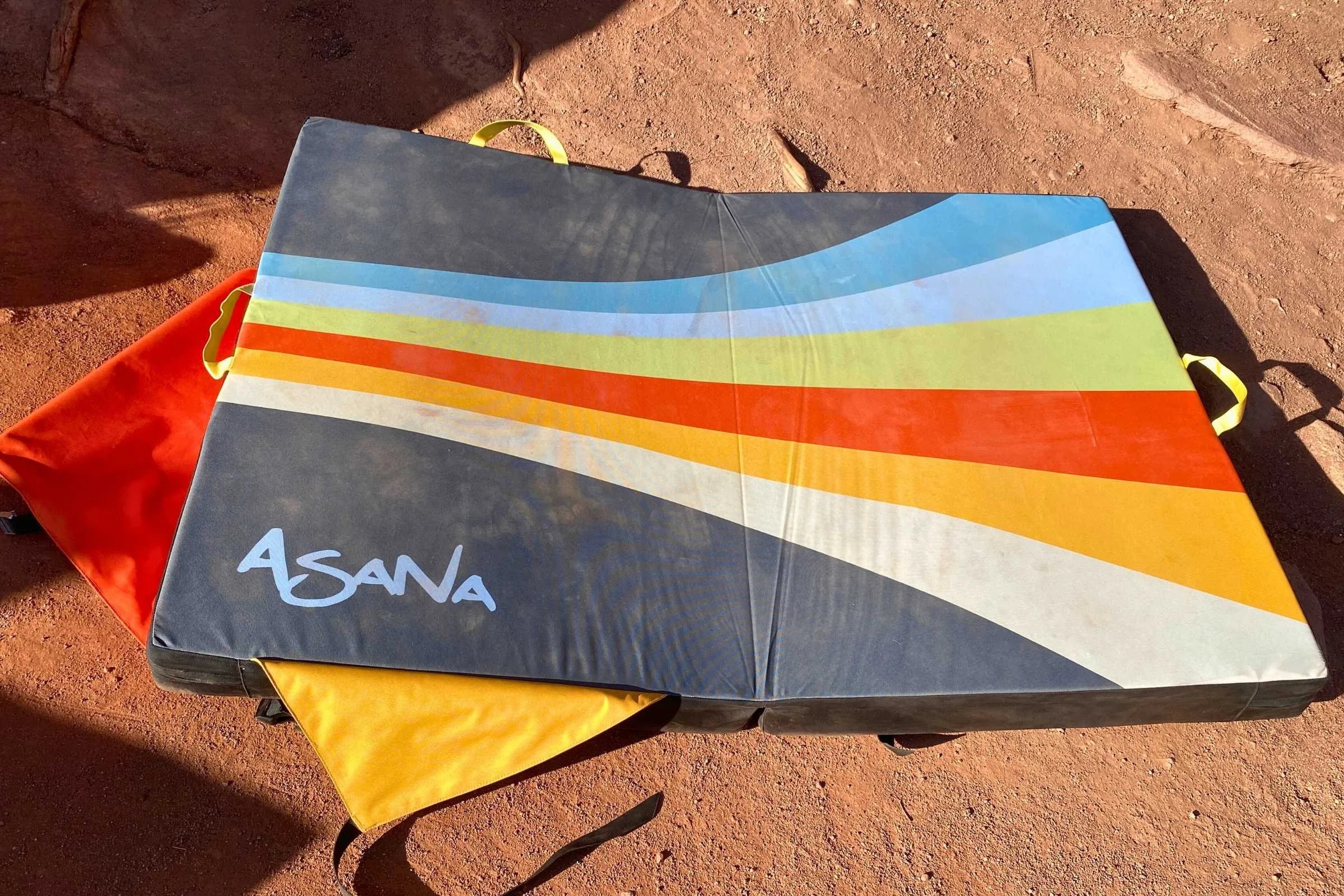
Asana Superhero
-
The Asana Superhero is a hybrid pad, similar to the Organic Full and Simple pads. Unlike the Organic pads, however, its top layer that covers the gap is closed-cell foam instead of open-cell, which provides even better protection from bottoming out. It’s made with the traditional sandwich-style, featuring a plush mid-layer of open-cell foam and closed-cell foam on the top and bottom.
Landing on the Asana Superhero wasn’t quite as comfortable as the Organic pads, but it felt better than most. When we examined the foam closely, the top layer of closed-cell foam on the Superhero felt higher quality than those of the Circuit and Metolius pads.
-
While the padding felt great, the Asana Superhero also excels in its features. The most obvious is its closure system, which has two triangular flaps that use cam buckles, which we thought were easier to use than the metal buckles you typically find on pads. The straps have enough extra length so you can carry at least one extra pad right out of the box, and there’s even a metal buckle (with a built-in bottle opener) on the top of the pad, so you can quickly hang your backpack for a hands-free approach.
-
The Superhero is bigger than your normal pad, measuring 57 by 40 inches when folded open. This extra landing space is super useful and especially important for winding boulders or highballs. Even though this pad is bigger than standard ones, it doesn’t feel that much bigger when carrying and moving it, which is a huge plus.
-
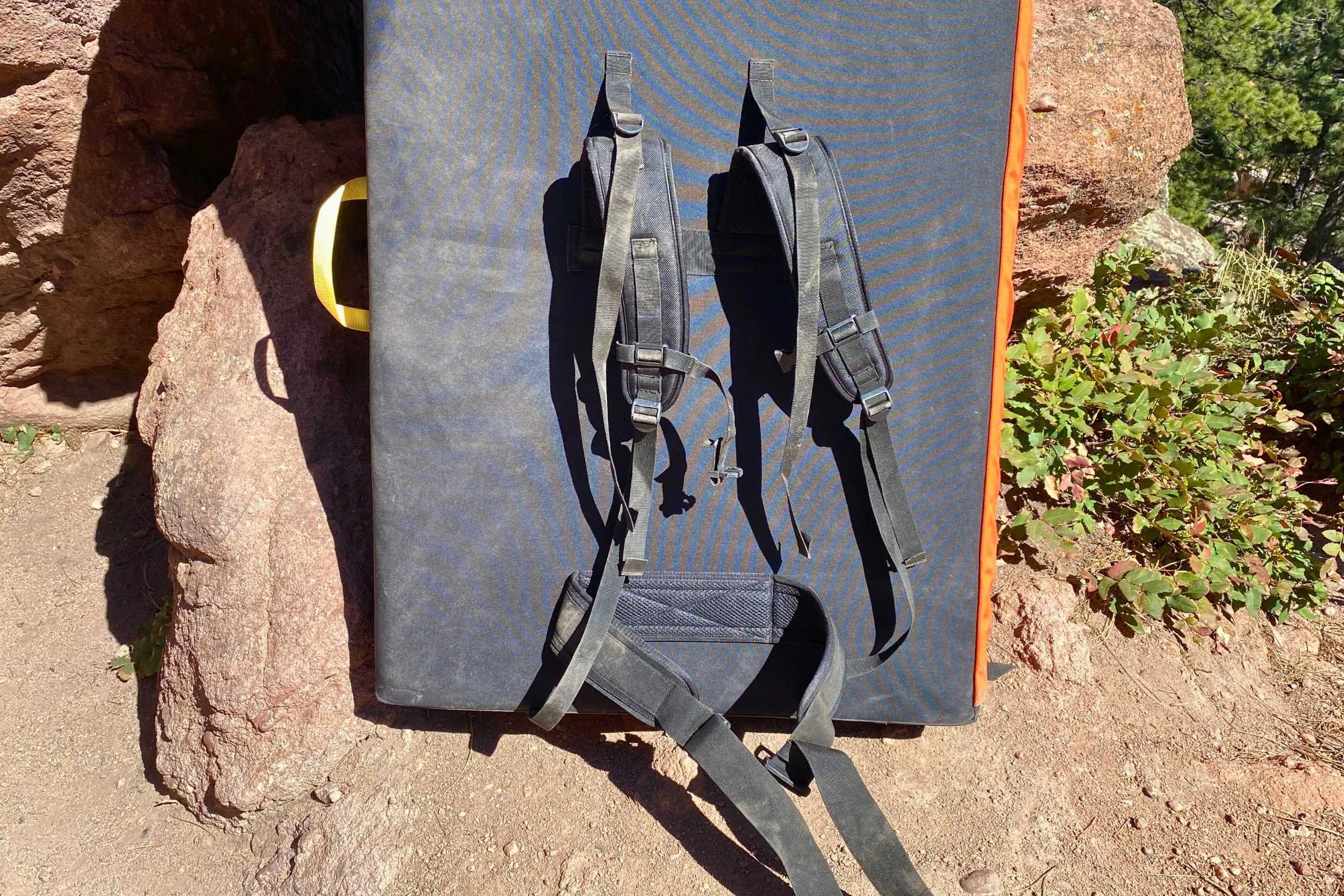
The main reason the Asana Superhero is a winner is because of its fantastic carrying features. It has the softest and most supportive shoulder straps of any pad we tested, and it was the only one that had a padded hip belt. Anyone who’s gone on a backpacking trip will know, a comfortable and supportive hip belt can be an absolute game-changer when carrying large amounts of weight.
-
Since the Superhero is built to carry multiple pads at once, these straps are especially crucial. But on top of the comfortable shoulder and hip straps, this pad also comes with load-lifters to adjust the weight distribution and a sternum strap to further help you carry it comfortably. All these features made the Superhero the most comfortable pad to carry out of any we tested by far, which is why it should be at the top of your list if you have a long approach to your projects.
-
Once you get to the crag, the Superhero’s big size makes it more cumbersome to move around, but it’s one of the few pads we tested that has a handle on both of its short sides as well as one of its long sides. I still wish there was a handle on all four sides, but the three handles on the Superhero made it easier to move around than most other pads we tested, which only have two.
-
When we ran the Superhero against a rock to test its durability, the tough 1,650-denier ballistic nylon shell and 900-denier polyester deck performed admirably, just suffering some slight cosmetic damage.
-
The Asana Superhero costs a pretty penny at $350, but for that price, you’re getting a fantastic combination of comfort, performance, and portability. The triangular flaps are clever, and it’s the most comfortable pad we tested to carry. If your projects take you hours away from the parking lot, you won’t want to suffer hauling a pad other than the Asana Superhero.
Other bouldering crash pads we tested
Moon Warrior Crash Pad

Type: Taco
Open dimensions: 52 inches by 40 inches by 5 inches
Folded dimensions: 26 inches by 40 inches by 10 inches
Thickness: 5 inches
Weight: 14 pounds
What we liked: Thick and high-quality foam great for highballs, unique shoulder strap design, integrated carpet step pad
What we didn’t like: Taco style is harder to fold and unfold, expensive and hard to find in the US
The Moon Warrior Crash Pad was the only taco-style pad we tested. This meant it was one solid pad with no hinge to be seen. This made it great for protecting against bumpy terrain, but it was a bit harder to fold and unfold, and it wouldn’t sit flat on the ground right away.
However, the Warrior was also the thickest pad we tested at 5 inches, and felt the best when falling from really high up. It has a 1-inch layer of closed-cell foam at the top, which felt higher quality than some of the other foams we tested and did a good job of absorbing energy.
Moon Warrior Crash Pad
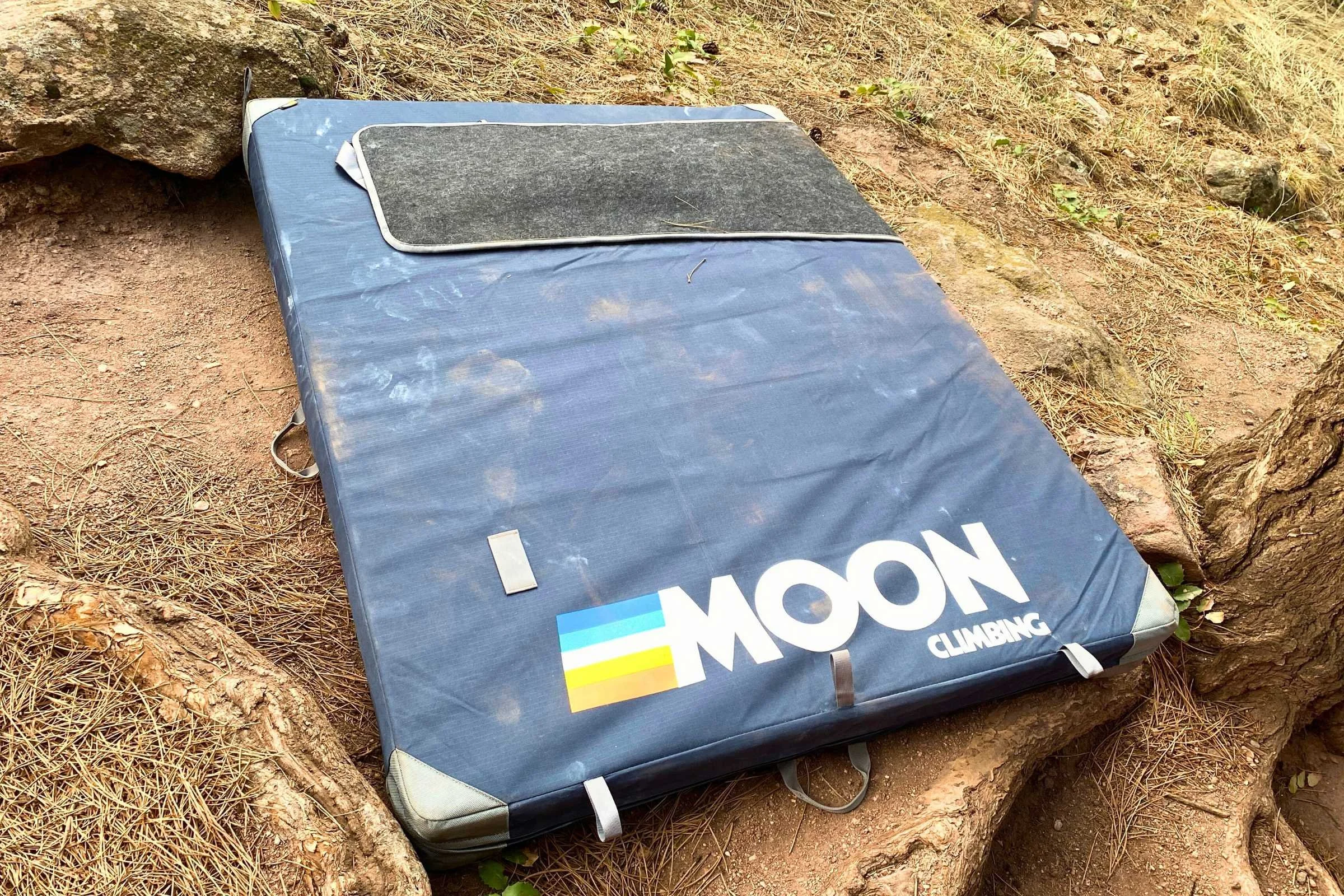
The Moon Warrior Pad is the only taco-style pad we tested.
Its design is unlike other pads we tried, since its shoulder straps are on the side of the pad you fall on. It features a large cover that secures over the shoulder straps with Velcro to protect them from falls, and the cover itself has a carpeted texture to clean your feet off with. The bottom side, therefore, doesn’t have any straps, which means they won’t rub around on the ground and deteriorate over time. Plus, the bottom has sections of non-slip material to help the pad stay in place when you land on it, though in practice we didn’t notice this make that big of a difference.
The Warrior pad is a great option, but it’s pricey, and hard to find in the US. That, combined with its taco design that’s a bit annoying to deal with, kept it out of our top spots.

Type: Hinge
Open dimensions: 47 inches by 36 inches by 4 inches
Folded dimensions: 24 inches by 36 inches by 8 inches
Thickness: 4 inches
Weight: 8 pounds
What we liked: Lightest pad we tested, simple strap design
What we didn’t like: No extra features
Though this pad is the lightest one we tested at 8 pounds, it just came shy of winning our top spot for the best lightweight crash pad. This basic option doesn’t have much going on other than its small, lightweight design, and it was missing some nice-to-have details when compared to the Session II. It doesn’t have a wipe pad or angled foam at the hinge, and it doesn’t feature any external storage (though we didn’t love the storage on the Session II).
Black Diamond Circuit Crash Pad

The Black Diamond Circuit is the lightest pad we tested, but it couldn’t keep up with the Session II’s features.
The only place it could surpass the Session II is in its strap layout, which might be compatible with more pads for carrying multiple at once. However, pads with built-in carry systems will probably be able to fit the Session II without the extra loops, and you probably won’t be attaching additional pads to either the Session II or the Circuit.
The Black Diamond Circuit is lightweight and pretty cheap at $200, but we think the Session II is a slightly better pad. However, if quick setup and breakdown is a priority, you might want to consider the Circuit since it’s easier to open than the Session II, which has a Velcro flap.
Why you need a good bouldering crash pad
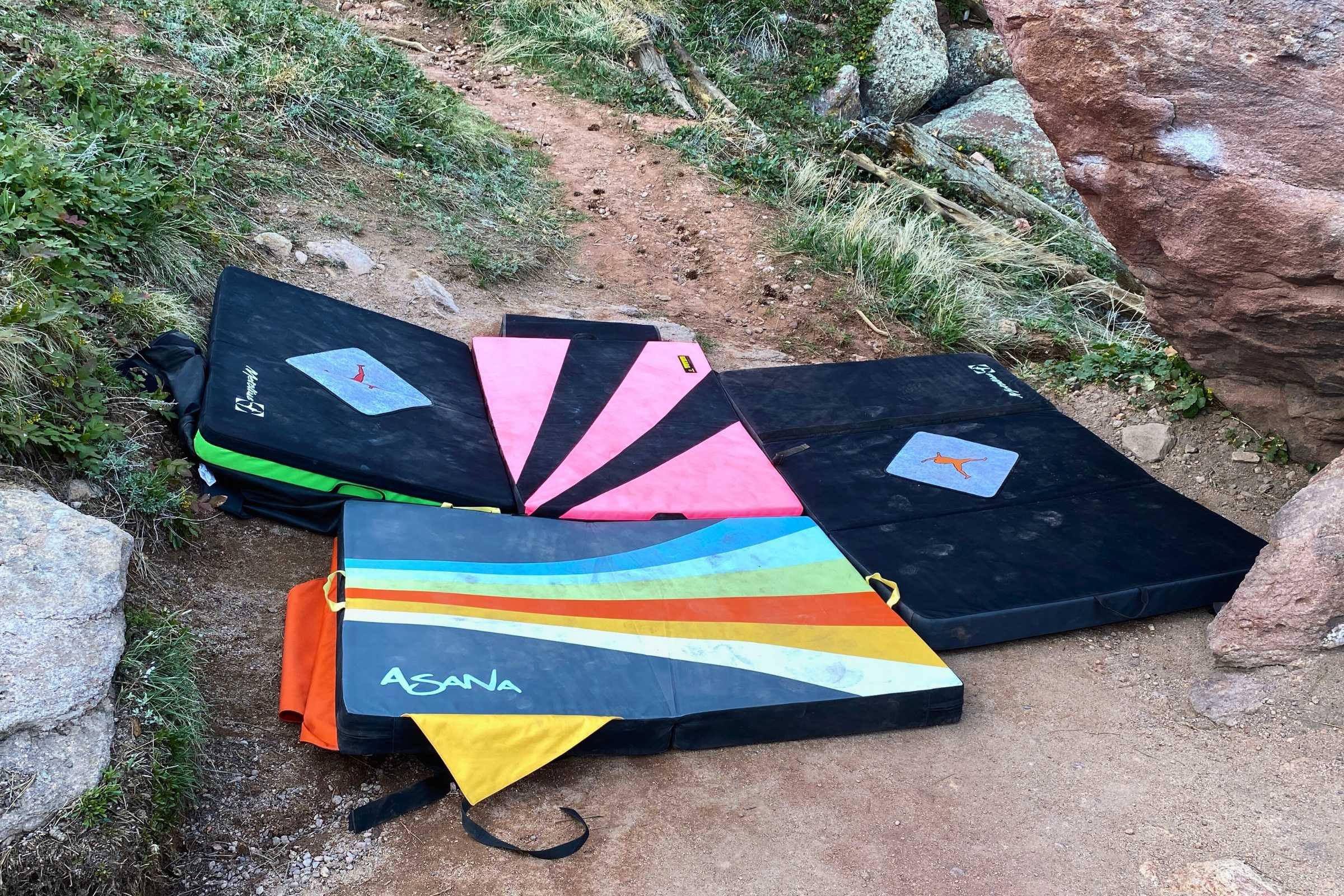
Crash pads come in different sizes and have different features.
While some lifers who have been bouldering at your local crag since the ‘80s might say otherwise, crash pads are critical for nearly every outdoor bouldering session. If you’re new to outdoor climbing, you’ll quickly learn how much scarier and nerve-racking it is to be even a few feet off the ground compared to at the gym.
Gyms have huge, thick pads to absorb repeated falls for years, and while you won’t have the same level of protection in the wild, a good crash pad can help save you from awkward falls and potential injuries.
Bouldering crash pads are typically designed with multiple layers of foam to disperse the energy of your fall and keep you climbing. Normally, pads will have two different types of foam, a more dense, closed-cell foam and a less dense, open-cell one. The closed-cell foam really helps spread out the energy of your impact, while the soft foam helps keep things comfortable.
Different pads have different layering systems for their foams, but the most common construction is the sandwich method. This design has a thinner, 1-inch closed-cell layer on the top, a thick, 2.5-inch layer of open-cell foam in the middle, and another thin layer of closed-cell foam on the bottom.

The Black Diamond Circuit and Metolius Session II both have the typical “sandwich” pattern of foam.
All this foam means you can land on padding instead of the ground, greatly reducing your risk of injury. However, the force of impact isn’t the only risk of injury while bouldering outdoors. What can be even more dangerous is uneven ground. We would honestly rather fall from higher up on a flat landing than from just a couple of feet if there are a bunch of rocks and roots below the boulder. This is where crash pads come in. They provide a large, flat landing zone that can cover up rocks, roots, and other hazards.
Pads are great once they’re set up below your boulder, but they can be notoriously annoying to carry around and hike with. That’s why a crash pad’s weight, shape, and carry systems are important to pay attention to. All the crash pads we tested have shoulder straps and a hip belt, but the quality of padding and features of those straps varied widely.
Cheaper pads will have thin shoulder straps that are fine for short hikes, but your shoulders will probably be hurting on longer approaches. More expensive pads will have more comfortably padded straps (both in the shoulders and the hips), and can have other features that make approach hikes easier, such as sternum straps and load lifters.

Pads that can carry an additional pad are useful for protecting your falls.
While the fancier carry systems might not be important if you only own one pad and you’re not hiking that far, once you start stuffing your backpack into your pad or you’re carrying multiple pads, those comfortable straps become more and more enticing.
If you do want to haul multiple pads to the crag (which most of the time you do), you’ll also want to make sure there’s an easy way to attach at least one other pad to the one you buy. If you want to carry more than two pads, you’ll probably need to get a separate set of straps.
What to look for in bouldering crash pads
Foam quality
The quality of the foam in your crash pad is critical. If your foam is too soft, you run the risk of bottoming out and hitting the ground, while if the foam is too hard, your fall won’t be as comfortable. For these reasons, crash pads are typically made with two different types of foam—closed-cell and open-cell—and layered in a way to get the best out of both.
However, it is good to note that your pad will wear in and get softer over time, so if you plan on doing a lot of high-ball bouldering, you’ll want to make sure your pad still has a robust layer of closed-cell foam, or consider stacking pads.
Size and coverage area
It’s also important to factor in the size of your crash pad when determining which to buy, as it can drastically change your experience. A small, lightweight crash pad is super easy to carry to the crag and move around, but it won’t cover much of the ground. A large crash pad, on the other hand, will be more difficult to hike in, but will provide much more protection which is important for traverses, winding problems, and highballs. You may be able to get away with a smaller crash pad if you’re using it for a home climbing gym or underneath your climbing hangboard mounted in your door frame. But for anything outside, we find more is often better.

Having enough pads to protect your climb is important for any outdoor boulderer.
Weight and portability
Crash pads can be heavy, especially if you’re carrying multiple, which is why knowing their weight and any carry systems they have before you click “add to cart” is crucial. Crash pads typically weigh between 10 and 20 pounds and come with various handles and shoulder straps.
All the crash pads we tested, and most you’ll find online, have shoulder straps and a hip belt so you can haul your pad easily outdoors. They all also had multiple handles on the sides, which makes moving your pad from one position to another below your boulder easier.
Fold type
Bouldering crash pads fold in different ways to make storage and carrying easier. Most will simply fold in half and are called hinge pads. These lay flat on the ground and fold easily, which makes storage and portability great. The downside, however, is if there’s a rock in the hinge of the pad, you could land directly on it without any protection.
Taco pads don’t have any gaps and are instead one solid piece of foam. This is better for protection, but they’re much harder to fold and don’t lie completely flat on the ground right away.
Hybrid pads are similar to hinge pads, except they have a layer of foam that still protects the gap, offering more protection.

The Organic Simple, Organic Full, and Asana Superhero are all hybrid pads.
Durability
It’s obvious that crash pads need to be durable, both for when you’re falling onto them and when you throw them around on rocks, dirt, and tree roots. All the crash pads we tested are made with an extremely durable nylon, and when we scraped the top and bottom of each pad on a sharp rock at Flagstaff Mountain, none of them suffered anything more than slight abrasions.
Carrying system
Having a comfortable carrying system on your crash pad means you won’t be completely exhausted once you finally make it to your project. All pads we tested had shoulder straps and a hip belt, but the padding and comfort of those features varied.
If you know you’re going to be hiking with your pad for extended periods of time, look for extra padding on the shoulder straps. A padded hip belt is a huge plus, but only one pad we tested, the Asana Superhero, had that feature. Load lifters can also help distribute weight for an easier carry.
Corner and edge design
If you want to own and use multiple pads, you should also look at how the corners and edges of the pads are designed to ensure they can easily lie next to each other. Some brands have sharper corners, while others have more rounded ones, and if you mismatch them, it could lead to small holes in between your pads.
Weather resistance
The tough, thick nylon material of pads will naturally be weather resistant, but none of the pads we tested are truly waterproof. You won’t want to store them outside unprotected, and if it starts raining, you should probably pack up to minimize any damage the water might do to the foam.
Versatility for different terrains
There’s no pad that will be perfect for every landing spot. However, you should be able to protect every landing if you have enough of the right pads. Large pads can be helpful for covering bigger obstacles and uneven or large areas, while small pads are better for tight spaces. Thin pads are great for sit starts, while thicker ones are essential for highballs.

Tri-fold pads can cover larger areas of ground than other pads.
Additional features
Many bouldering pads also feature extras to help you carry all your gear to the boulder and back. Most often, people will stuff a backpack in the middle of a pad, fold it up, and cinch it tight, but some pads have pockets specifically for carrying gear. Even if they don’t have dedicated pockets, most pads will have some sort of loop or strap that you can hang gear from with a carabiner.
Price and value
There’s no denying crash pads are expensive. And while you might be attracted by the bells and whistles of some pricey options, at the end of the day, any pad from a reputable brand will help make a landing more comfortable. So before buying, make sure you know what kind of bouldering you want to do (or where), and what sort of pad fits that need the best.

Make sure to buy the pad that’s right for your style of climbing.
Types of bouldering crash pads
Hinge-style pads
Hinge-style pads are the most common. They use two separate pieces of foam, connected at the top by the outer shell fabric. They fold and lay flat and are great for storage, but the hinge creates some risk for bottoming out.
Most hinge pads will have some sort of Velcro to keep the two pads connected, but they don’t always stay together, especially on uneven ground. Some hinge pads also design their foam at an angle at the hinge, so there’s a lower risk of your foot hitting the ground.
Taco-style pads
Taco-style pads use one continuous piece of foam instead of two. This eliminates the exposed hinge, but they’re harder to fold and unfold and don’t always lie flat. Storing taco pads folded could also deteriorate the foam faster.
Hybrid-style pads
Hybrid pads are the happy medium between hinge and taco pads. They have a hinge and two separate pieces of foam, but the top layer is a single piece, which covers the hinge and adds protection.
Tri-fold pads
Tri-fold pads can be bulky, but they unfold to cover much more ground than traditional pads. If you only want to carry one pad, a tri-fold might be the way to go.
Supplemental pads
Supplemental pads provide quality of life improvements, but aren’t necessary for an outdoor bouldering session. They’re typically very thin, which makes them great for sit starts, wiping your shoes clean before a climb, or covering gaps and seams in between other pads.
How to choose the right crash pad

Climbing with just one crash pad might not be enough for some climbs.
Choosing the right crash pad is all about the type of climbing you do. If you’re into highballs deep in the backcountry, you’ll need a different pad than someone doing circuits at the local crag. Below, we get into all the different things you should consider.
First, you should think about the size and weight of the pad you need. Since they’re so heavy, you don’t want to be carrying more weight than you need, especially if the hike is longer than 20 to 30 minutes. If you have some friends who already have pads, getting a small, lightweight pad that’s easy to carry is a perfect option.
From my experience, bringing two to three pads feels great for a lot of climbs, but obviously each boulder is different, and many may need more or less protection. With friends, ensuring you have enough is easy. But if you’re climbing by yourself, having adequate protection can be difficult. Pads like the Asana Superhero and Organic Full Pad are made to haul two pads at once, but sometimes even that doesn’t provide enough coverage.
So, if you’re a solo boulderer, I would highly recommend trying a tri-fold. They provide much more protection than a single pad for simple climbs, and if you can carry another pad along with the tri-fold, you’ll have a ton of coverage.
My go-to combo has been the Metolius Magnum, which covers 3,290 square inches, paired with the Metolius Session II, which covers 1,728 square inches. By hauling both along, I get a total coverage area of 5,018 square inches, with a weight of 27 pounds. Compare that to three Organic pads, which cover a slightly bigger area of 5,184 square inches, but together have a weight penalty of 36 pounds.
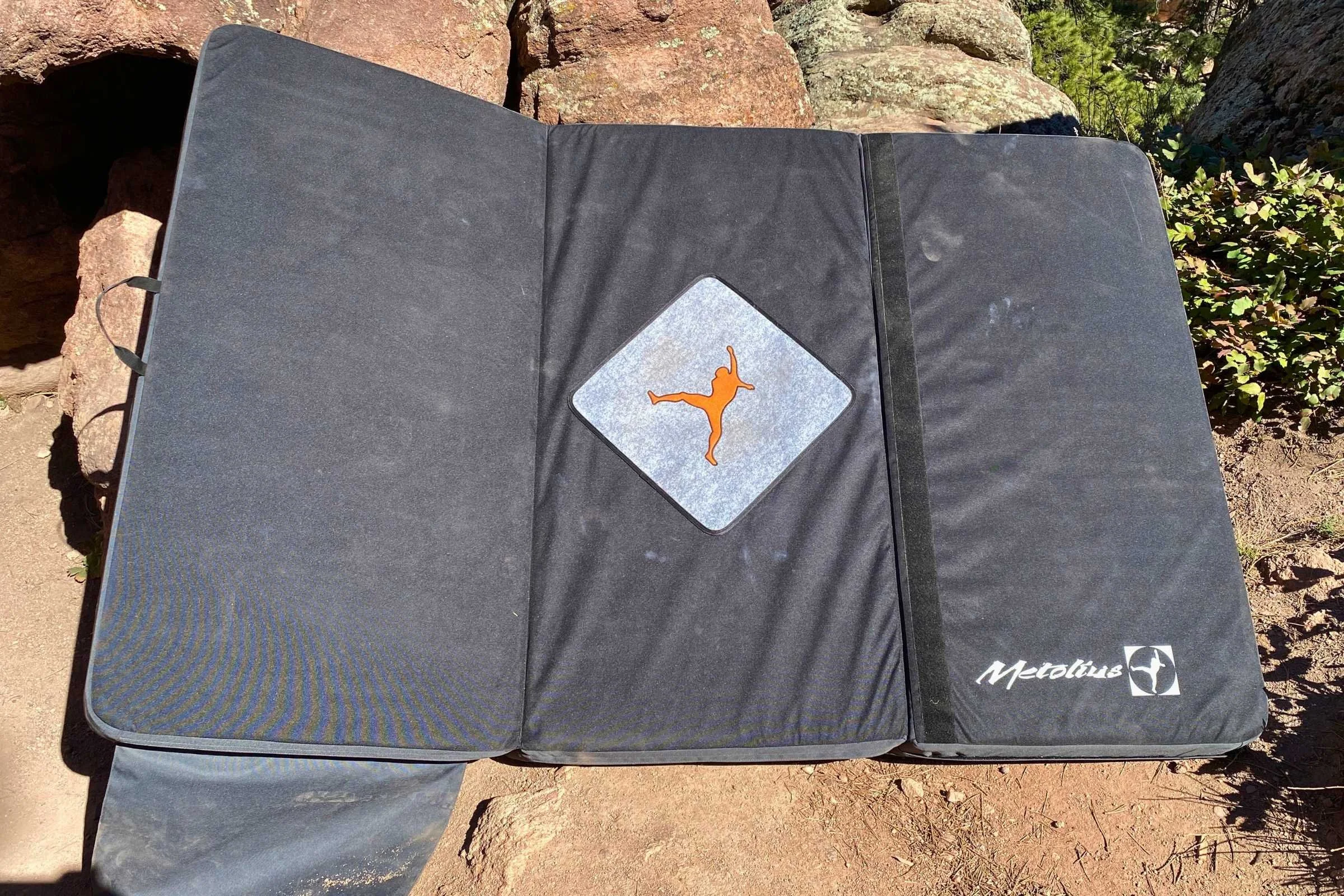
Tri-fold pads are heavier and harder to carry, but have a lot of coverage.
If you’re big into highballs or traverses, you’ll want to bring even more pads. Falling off a highball creates a lot more force, so you’ll want to make sure you have a thick pad (most pads have around 4 inches of foam, but thicker options with 5 inches of foam are great for these falls). Plus, when you’re high up, it’s much harder to know exactly what direction and how far you’ll fall, so having tons of pads to cover the entire landing area is key.
The next thing to consider is how far you’ll typically be hiking to climb. If you know you like to find remote boulders or haul multiple pads at once, consider a pad with comfortable shoulder straps, a padded hip belt, and load lifters. However, if you know the majority of your climbing will be within a stone’s throw of your car, those elements aren’t as important.

A padded hip belt can make carrying multiple crash pads much more comfortable.
Lastly, picking between a hinge, taco, and hybrid pad should also be on your checklist. Our favorite are hybrid pads, but taco pads can also be very useful for uneven terrain. If you opt for hinge pads for their easy folding and storage, supplemental pads can also help reduce your risk of bottoming out, since you can place them over the hinge for more protection.
Care and maintenance of crash pads

Maintaining your pads means they’ll last for years to come.
Crash pads are an investment, so you want to make them last as long as possible. The foam will eventually soften up over time from all the impacts, which means you run a greater risk of bottoming out on higher falls. So, if your crash pad is starting to feel real squishy, it might be time to relegate it to lowball climbs.
Since crash pads are thrown around in the dirt all the time, it’s a good idea to shake them off and clear any debris before storing them. This will help the durable fabric last longer. If there are any stains, be sure to clean them with water and a mild detergent, and completely dry the pad before folding it up for storage. If your pad gets a hole, you can close it with a patch or repair tape. Just make sure to fix the hole as soon as possible to prevent moisture or dirt from damaging the foam inside.
When storing your pad, make sure to keep it out of direct sunlight and stash it in a cool, dry place, like a garage. If your pad is a taco, make sure to store it unfolded to preserve the integrity of the foam.
FAQ
-
Most climbers bring two to three pads for a typical session, but one well-chosen pad is a reasonable starting point. A single standard pad covers around 1,700 square inches — enough for straightforward lowball problems. For traverses, highballs, or uneven landings, stacking two or more pads is strongly advisable to eliminate gaps and cover more ground.
-
Hinge pads fold in half and lie flat but leave an unprotected gap at the fold — a risk for ankles. Taco pads are one solid piece of foam with no gap, but are harder to fold and store. Hybrid pads combine both: they fold like a hinge pad but include a foam layer over the gap for added protection, making them the most versatile option for most climbers.
-
Most crash pads use 4 inches of foam, which is adequate for typical bouldering heights. For highball problems — generally anything above 15 feet — a pad with 5 inches of foam provides meaningfully better energy dispersion on hard landings. Stacking two pads is another practical approach, since even a standard pad on top of another adds significant protection.
-
Crash pad foam softens with repeated impacts over time, gradually reducing its ability to absorb energy. The most reliable sign it's wearing out is a noticeably mushy feel underfoot — especially if you can sense the ground on harder landings. A worn pad is still useful for low problems but should be retired from highball use. Most quality pads last several years with regular use.
-
Crash pads are weather-resistant but not waterproof — the outer nylon shell handles light moisture well, but prolonged exposure to rain will eventually saturate the foam inside. Wet foam loses some of its impact-absorbing ability and takes a long time to dry. If caught in rain at the crag, pack the pad up promptly and dry it fully before storing it folded to prevent mold or foam degradation.
-
A lightweight pad — typically 8 to 10 pounds — makes sense as a secondary pad or for short approaches where coverage from a larger pad is already guaranteed. As a solo pad, the trade-off is real: lighter pads tend to have thinner straps, less foam density, and fewer features. For climbers who hike long distances to remote boulders, a heavier pad with a well-padded carry system often causes less fatigue than a lighter pad with poor straps.
How we researched and tested

Having the right pads for the specific climb can help prevent injuries.
We tested all the bouldering crash pads in this article ourselves by actually taking falls onto every single one of them. We brought them to a tall boulder on Flagstaff Mountain in Boulder, Colorado, and took the exact same fall on each to gauge how the pad felt. We also wore each pad and hiked with it to judge its weight and how comfortable its straps were.
At the crag, we placed each pad and moved it around as we climbed, paying attention to how easy each pad was to move around. We also took note of any features, including pockets, step pads to clean your shoes, extra handles, and more.
We unzipped or undid the Velcro of each pad to get a close-up look at their foam, and took note of the quality, density, and foam pattern. We also performed some standardized tests, both at home and at the crag, including weighing each of them, timing how long it took us to unfold and refold each pad, and scraping them on the same rock to test durability.
After more than two months of testing and multiple outdoor climbing sessions with way too many pads, the tester and author of this guide, Kai Burkhardt, was able to find the best bouldering pads on the market.
- Real falls from standardized height
- Timed setup & breakdown
- Abrasion tests on sharp rock
- Hiked with each pad to crag
- Unzipped to inspect foam quality
- Fall comfort & foam construction
- Landing zone size & coverage
- Carry system & strap comfort
- Mobility & ease of use at crag
- Durability & extra features
About the author / Why you should trust us

Kai Burkhardt has been climbing for nearly 10 years, has worked at multiple climbing gyms, and often climbs outdoors near his home in Boulder, Colorado. He’s been climbing outdoors for several years and has hiked his fair share of miles carrying an unreasonable amount of pads. Burkhardt has been testing and reviewing products for over five years, and for this article, he actually got his hands on all seven pads, carried them around, and took falls to find the absolute best.
Find more of Kai’s Treeline Review guides here.


