Best Biodegradable Soap for Camping of 2026
Environmentally-friendly soaps and wipes for camping, backpacking, and other outdoor activities
April 20th, 2026
Home > Gear Reviews > Camping
What’s the best biodegradable soap for camping and backpacking? Is biodegradable soap safe for the environment? Can I use biodegradable soap in lakes or rivers? How do I use and dispose of soap in the outdoors? These questions have been on our minds for a while, so we decided to tackle them the usual Treeline way—with science! And with a healthy dose of Leave No Trace principles.
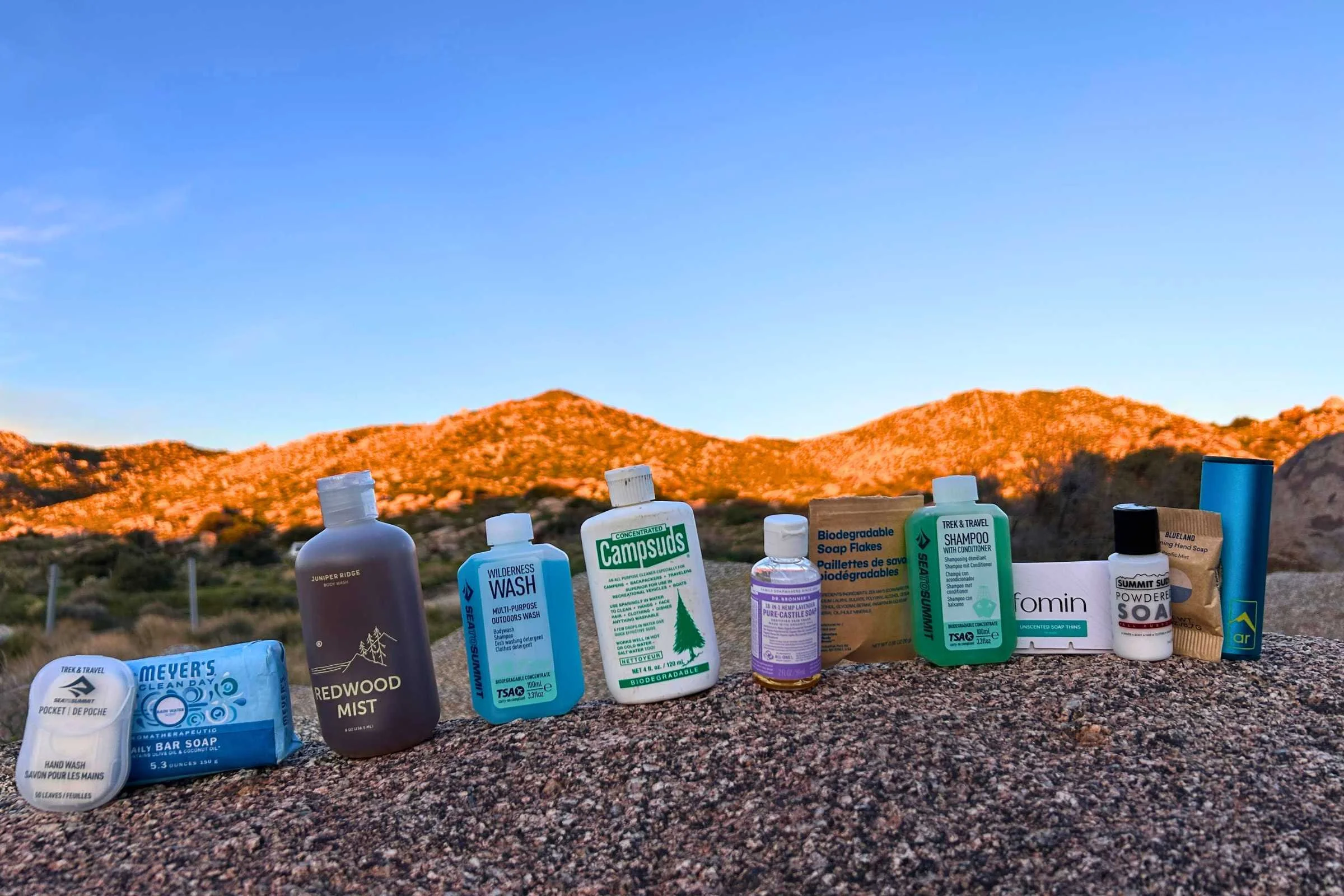
We tested 18 of the top camping and backpacking soaps for functionality, packability, sustainability, and overall user experience, with the winners below. Our top pick is Dr. Bronner’s Pure-Castile Magic Liquid Soap because it’s versatile, affordable, widely available, easy to use, and made of only the most biodegradable ingredients possible.
We also did a deep dive into the policy and practices surrounding “biodegradable” soap ingredients, the chemistry of biodegradation, and how we can all make the best possible decisions about using soap on dishes, bodies, hair, clothes, and gear while camping and backpacking.
Planning a camping trip? Check out our Camping Gear Checklist to make sure you have everything you need.
We create reader-supported, objective gear reviews independently selected by our editors. This story may contain affiliate links, which help fund our website. When you click on the links to purchase gear, we may get a commission, without costing you an extra cent. Thank you for supporting our work and mission of outdoor coverage for every body! Learn more.
Comparison table
| CLEANING PRODUCT | TREELINE AWARD | FORMAT | BEST USE | SLS? | SCENTED? | PRICE |
|---|---|---|---|---|---|---|
| Dr. Bronner's Pure Castile Liquid Soap | Best All-Purpose Read why |
Liquid | All-purpose | No | Either | $0.51-1.60/ fl oz |
| Pika Outdoors Summit Suds | Best for Backpacking Read why |
Powder | All-purpose | No | No | $2.83-6.49/ dry oz |
| Campsuds Biodegradable Concentrated Soap | Best for Camping Read why |
Liquid | All-purpose | Yes | No | $1.63-2.99/ fl oz |
| Sea to Summit Wilderness Wash | Best for Hands, Body, Hair Read why |
Liquid | Multi-purpose | Yes | No | $1.29-4.34/ fl oz |
| Dr. Bronner's Pure Castile Bar Soap | Best Affordable Read why |
Bar | All-purpose | No | Either | 1.04/ dry oz |
The Winners
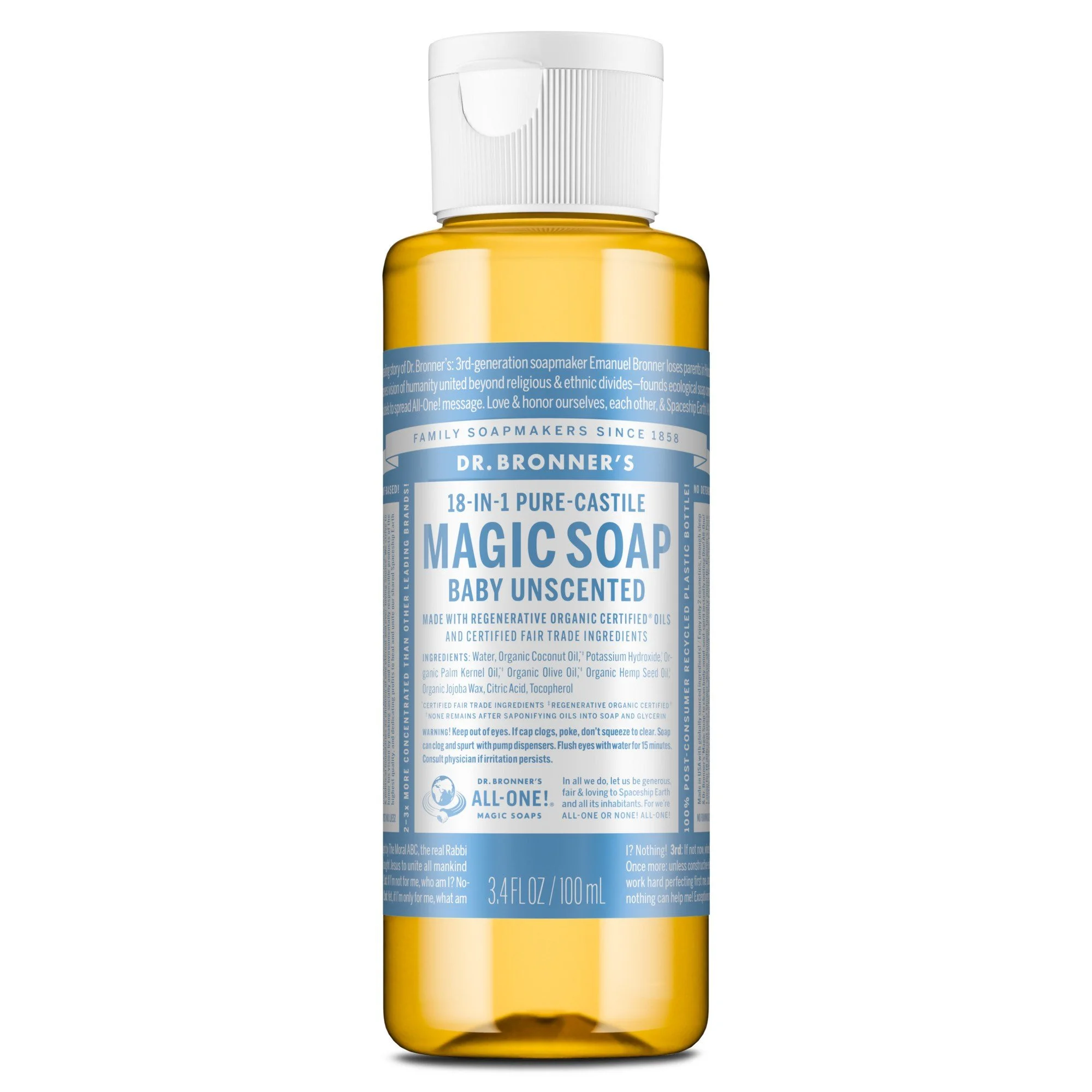
Best All-Purpose Biodegradable Camping Soap: Dr. Bronner's Pure-Castile Magic Liquid Soap (Unscented)
Type (liquid, bar, powder): Liquid
Price per weight: $1.25/fl oz
Contains Sodium Laurel Sulfate (SLS)/Sodium Laureth Sulfate (SLES): No
Intended use: Hands, body, hair, dishes, clothes
What we liked: Doesn’t contain SLS/SLES, is affordable and widely available, comes in a variety of sizes, has an unscented option
What we didn’t like: Partially solidifies at low temps; can leave a residue on dishes; heavier than powdered soap; cap isn’t leakproof
The best all-purpose camping soap in our research and testing was Dr. Bronner’s Pure Castile Liquid Soap. This is a concentrated liquid soap, which means that you generally need less than you think you do. In our testing, it took around ¼-½ teaspoon to make 8 cups of cool water soapy enough to clean things (of course, you might need more or less depending on the temperature and hardness of the water, how dirty your stuff is, etc). It’s affordable, widely available, and one of the most easily biodegradable soaps out there.
Dr. Bronner's Pure-Castile Magic Liquid Soap (Unscented)
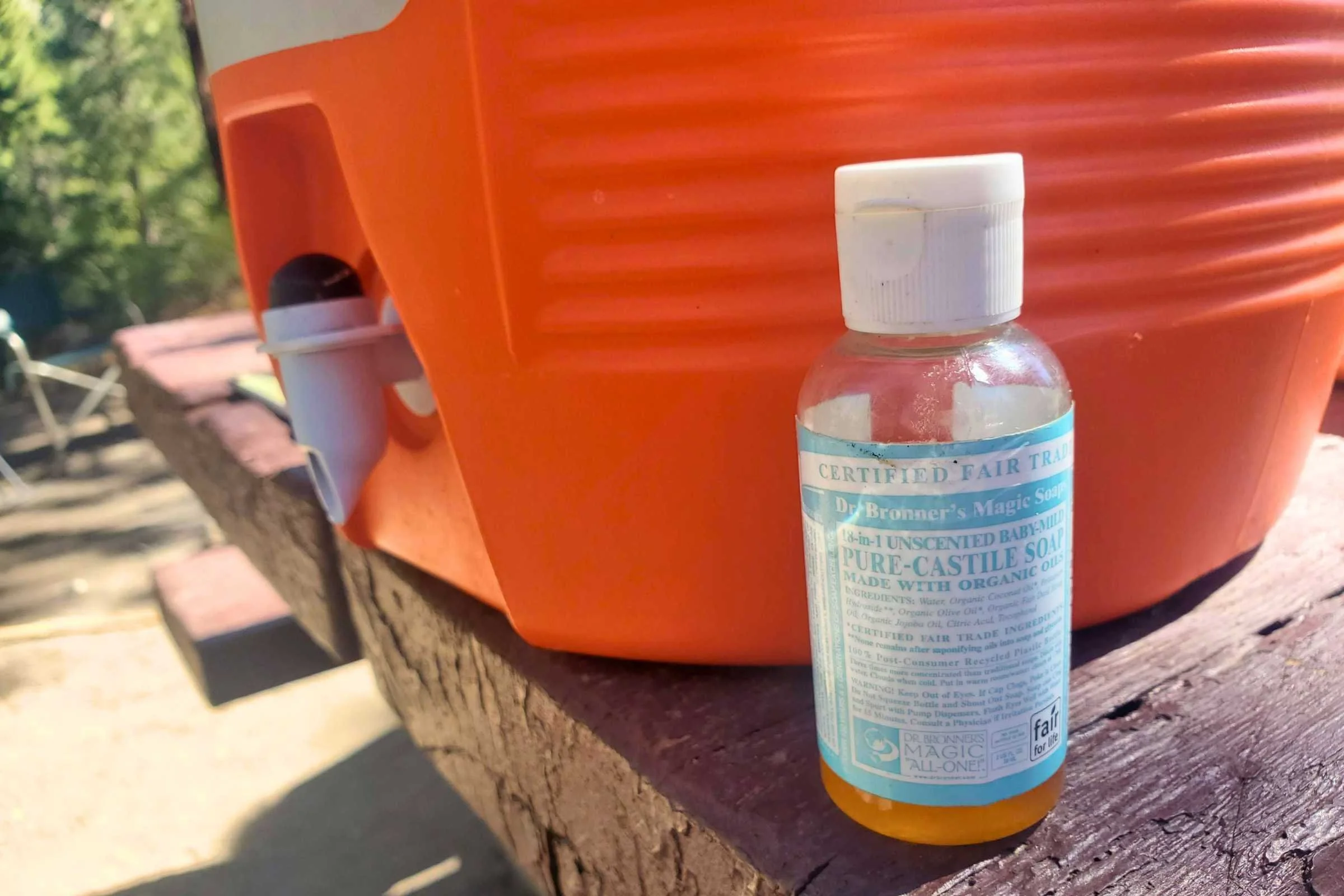
Dr. Bronner’s Pure Castile Liquid Soap is a time-honored staple in the biodegradable cleaning arsenal, and for good reason. It’s the only widely available all-purpose liquid soap made with only saponified (that is, soap-ified) plant oils, making it easy for soil microbes to break down.
We prefer the unscented version for dishwashing purposes, since fragrances can hang around in your dishware and become unwanted flavorings in your next meal. However, if you enjoy a scented version for non-dish purposes, Dr. Bronner’s scents are also entirely plant oil based and break down easily in soil.
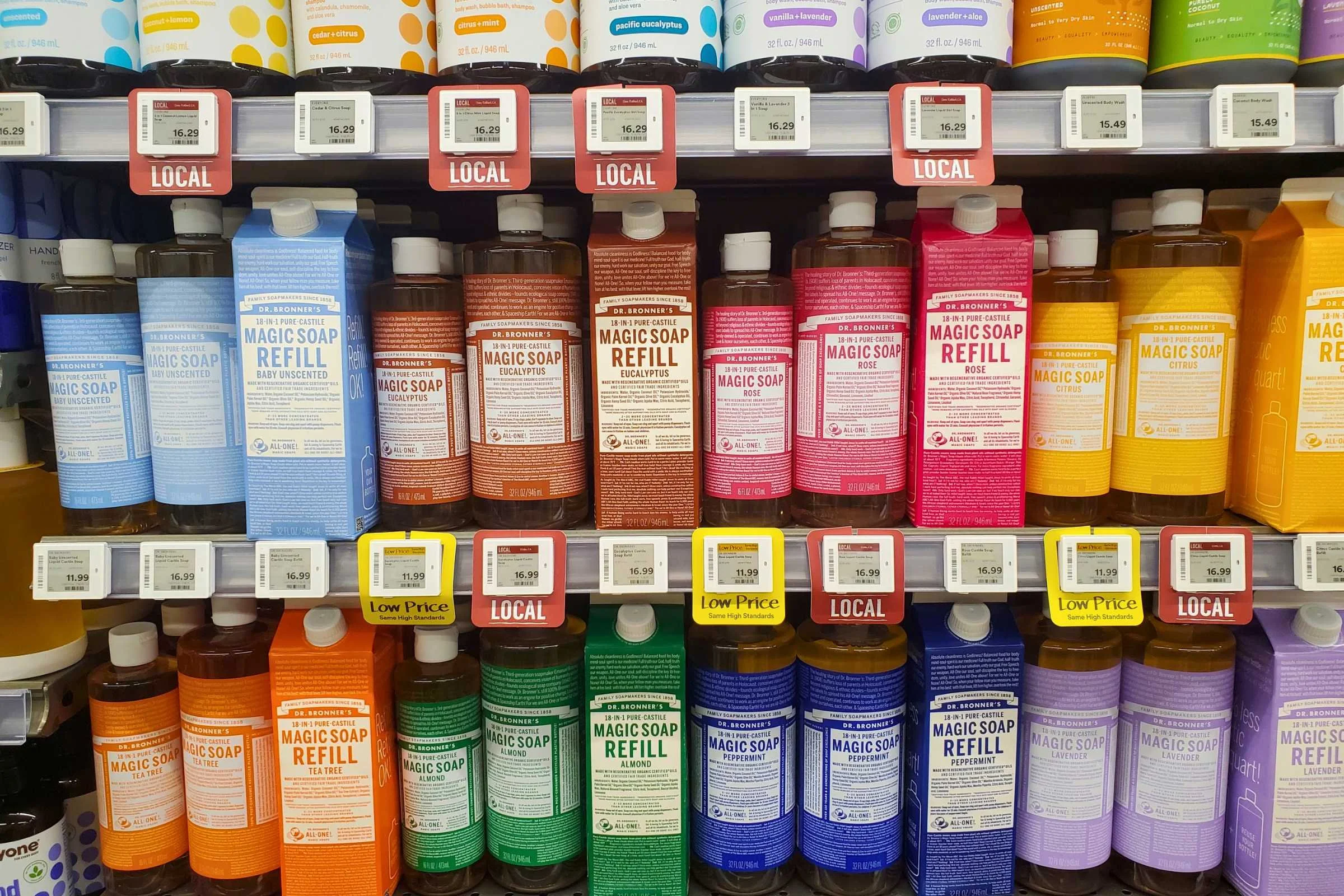
We appreciate that these products are available in stores and online, and they come in a variety of sizes, including a travel-friendly 2-oz bottle. Many stores have bulk refill stations as well, which decreases the impact of packaging. We also love Dr. Bronner’s deep history of environmental and social care and activism.
Functionally speaking, Dr. Bronner’s works best in cool or warm water—when the weather or water are very cold, it’s difficult to get a good lather. If you can heat even a little bit of water to raise the overall temp of your wash water, you’ll see a big difference!
We appreciate that Dr. Bronner’s is not drying to skin when used for bathing or handwashing, and in fact many people use this product at home as dish soap, body wash, shampoo, and a variety of other purposes (apparently including tooth brushing, which we did not try). Castile soap is gentle enough to be used on sensitive skin, and the unscented version is labeled “Baby Unscented” for this reason (not because it’s only for babies).
On the downside, the lack of more intense (and less biodegradable) surfactants, like SLS and SLES, means that this doesn’t work quite as well in cold water as products like Campsuds below, and it becomes sludgey at cold temperatures (to be fair, so do I). Some online reviewers note that the simple cap sometimes leaks in a bag or backpack, so they put the product in a more secure travel vessel, like these mini dropper bottles. It can also leave a residue in hard water areas due to interactions between the soap and dissolved minerals, which requires extra rinsing or a vinegar rinse to fully dissipate.
Despite its drawbacks, we appreciate Dr. Bronner’s for its high biodegradability, its wide availability and affordability, and its clear brand commitment to sustainability.
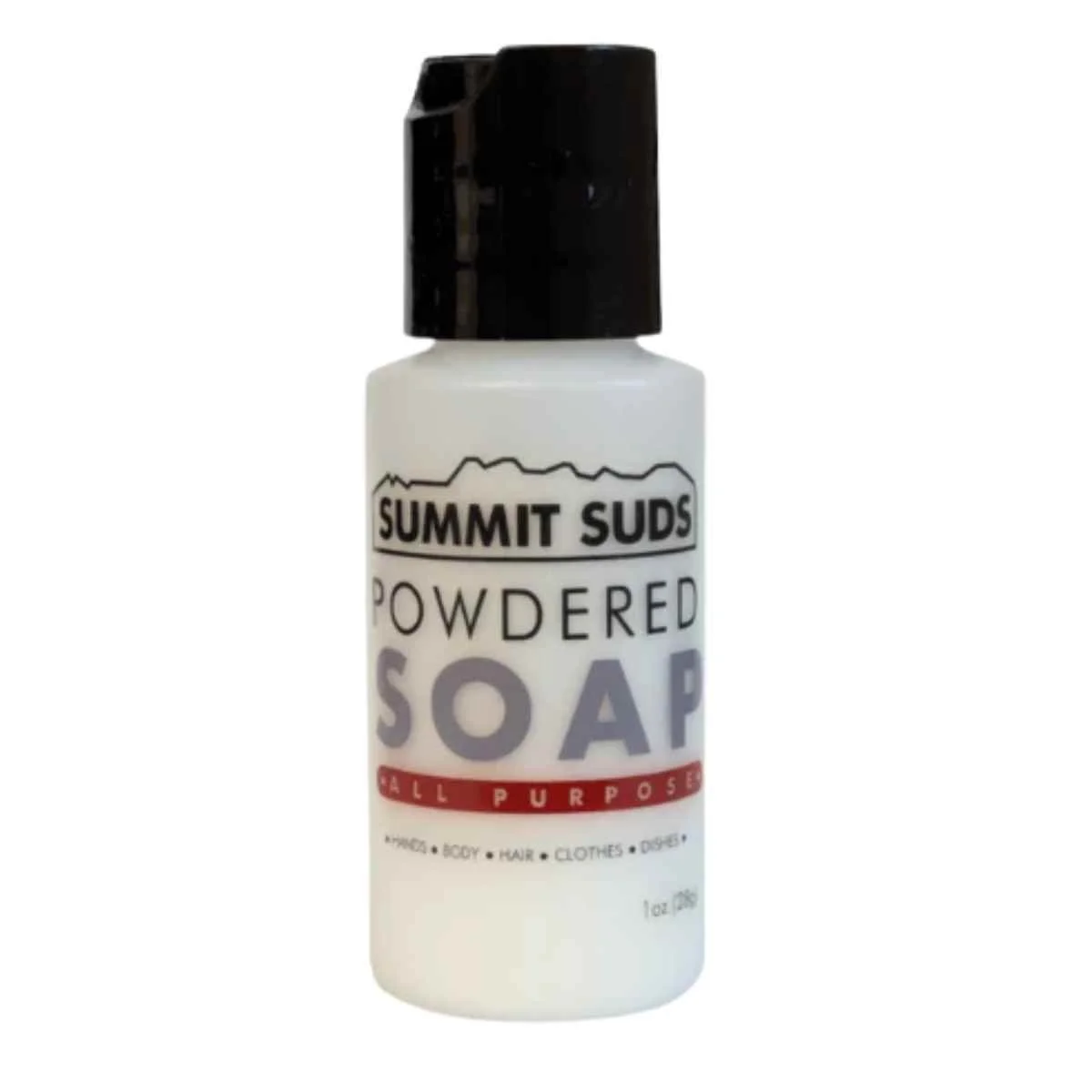
Best Biodegradable Soap for Backpacking: Summit Suds All-Purpose Powdered Soap
Type (liquid, bar, powder): Powder
Price per (dry) weight: $4.40/oz
Contains SLS/SLES: No
Intended use: Hands, body, hair, dishes, clothes
What we liked: Doesn’t contain SLS/SLES, is lightweight, unscented, doesn’t leak
What we didn’t like: Need to use more than some other soaps; relatively expensive; only available online; limited size options
For backpacking purposes, a soap that’s lightweight and doesn’t leak is ideal, and that’s why Summit Suds All-Purpose Powdered Soap is our choice for Best Biodegradable Soap for Backpacking.
This was, in fact, the only powdered soap we found that does not contain SLS/SLES, and we’re thankful that it exists at all! We also love that it’s unscented. It’s a very effective soap, dissolving in water better than other lightweight options like soap flakes or sheets. The texture of the product is truly powdery, as opposed to sandy or gritty, which is pleasant and helps it dissolve quickly.
Summit Suds All-Purpose Powdered Soap
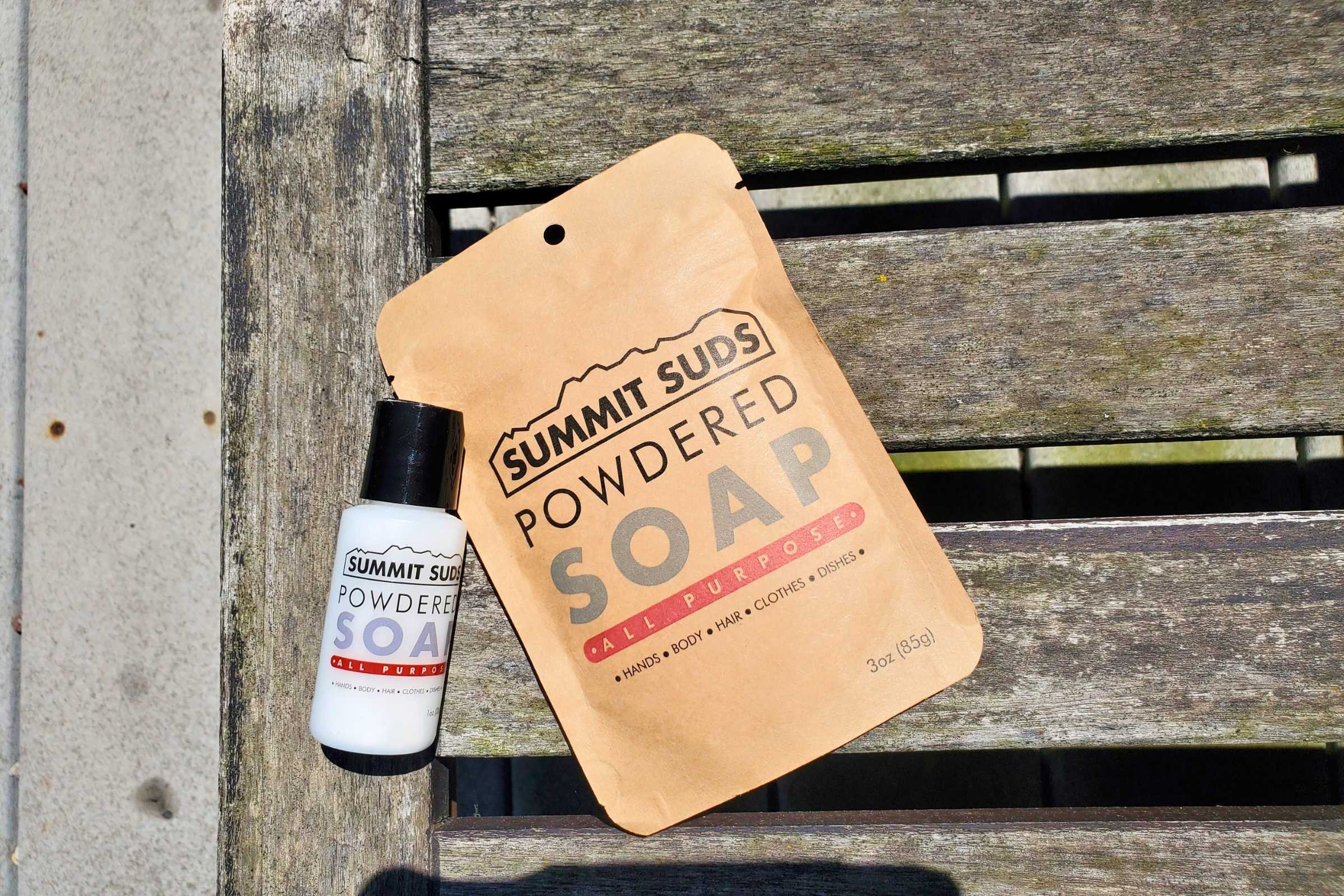
Summit Suds All-Purpose Powdered Soap is our favorite biodegradable soap for backpacking because it’s lightweight, doesn’t leak, and does not contain sodium laurel sulfate (SLS).
You do need a bit more of this (or any) powdered soap to reach the same effectiveness as liquid soap; we needed around a teaspoon of Summit Suds to make 8 cups of cool water soapy enough to clean things. Once there’s enough in the water, though, it thoroughly cleans hands, body, dishes, and clothes without leaving a residue.
The main options for purchasing Summit Suds are a 1-oz squeeze bottle and a 3-oz resealable (and commercially compostable!) refill packet. We’re not convinced a squeeze bottle is the most effective vessel, since it doesn’t come out super smoothly, but on the plus slide it does keep you from spilling it or accidentally using too much. Going forward we may just order the refill bag and put it in our own containers (some online reviewers put it in the same dropper bottles mentioned above).
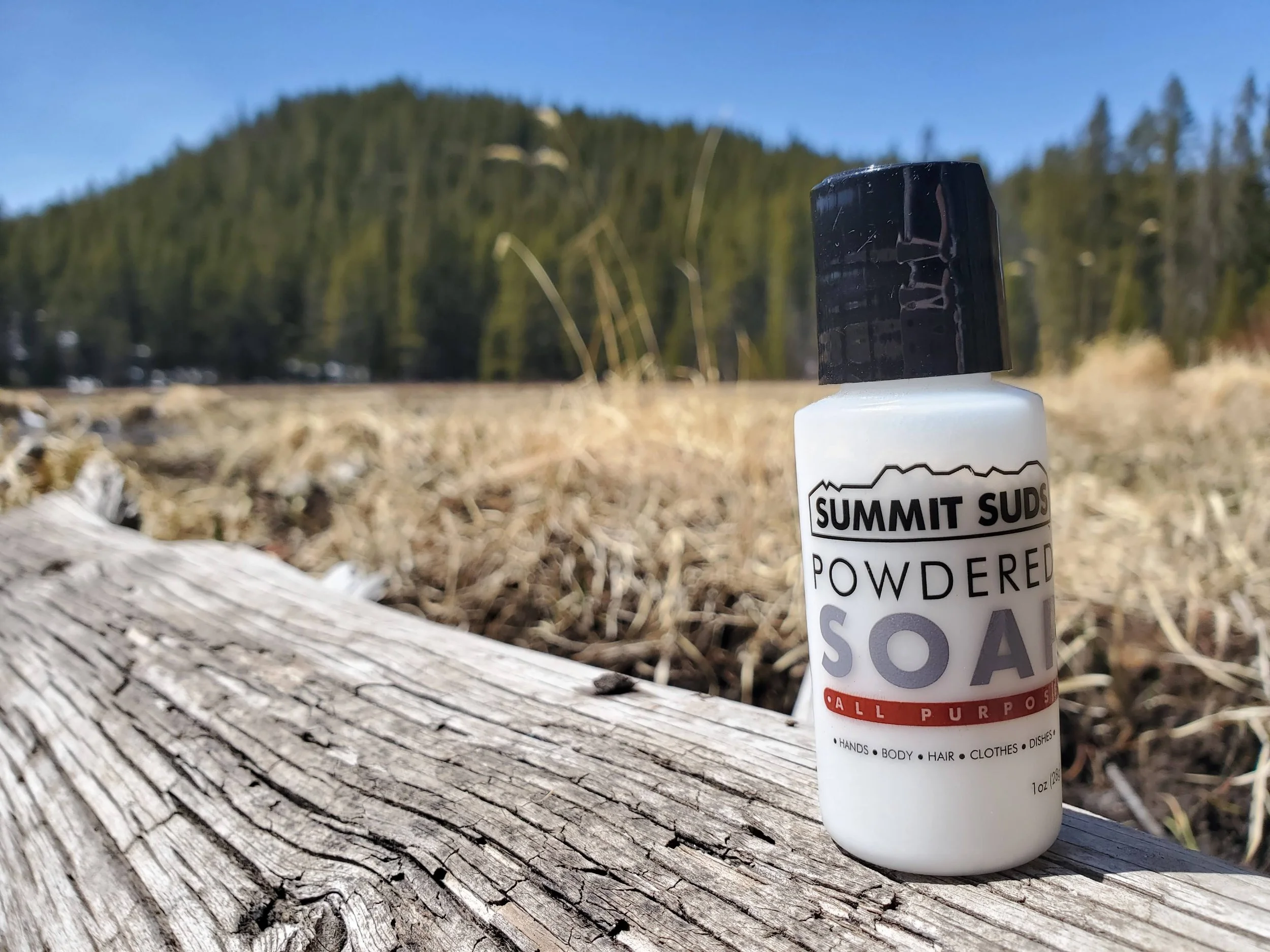
On the down side, Summit Suds is a bit expensive compared to other options. The small bottle is great for travel/backpacking, and we love the compostable refill bags, but this is a rather limited number of size options. Lastly, as mentioned above, since it’s a powder you need to use more than a liquid soap. To use as little as possible, we recommend dissolving this in water and using the soapy water to clean your dishes, clothes, and/or self (as opposed to putting soap directly on the dirty thing and then adding water).
Best Biodegradable Dish Soap for Camping (contains SLS): Campsuds Biodegradable Concentrated Soap
Type (liquid, bar, powder): Liquid
Price per weight: $2/fl oz
Contains SLS/SLES: Yes
Intended use: Hands, body, hair, dishes, clothes
What we liked: Very concentrated; most effective for grease; need very little to be effective; unscented; relatively affordable; various size options; available in some stores as well as online
What we didn’t like: Contains SLS, not in many stores, can be drying to skin/hair, cap isn’t leakproof
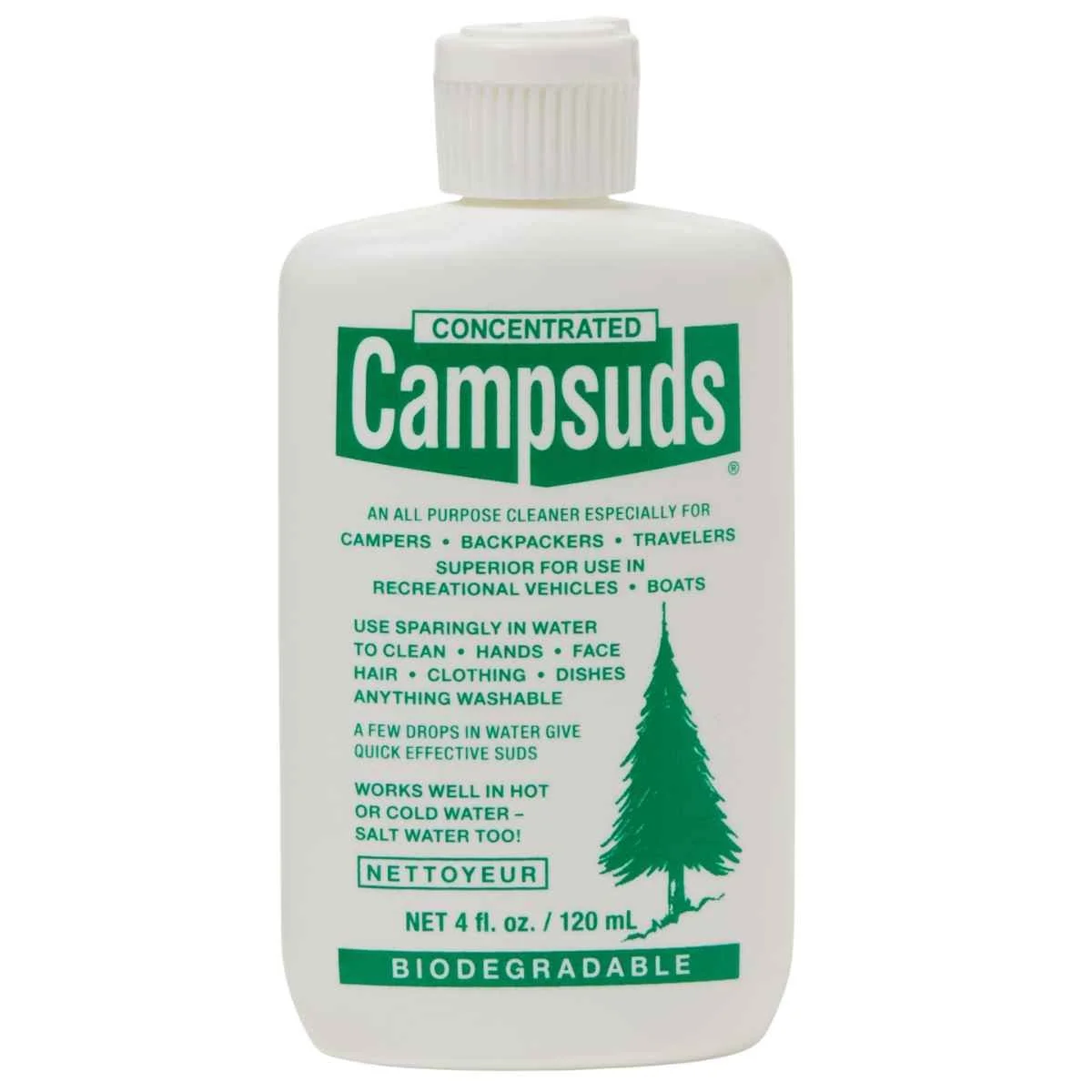
When it comes to dishes, the most effective biodegradable camping soap we tested was Campsuds Biodegradable Concentrated Soap. It does contain SLS, so we do not recommend using this if you’re camping somewhere cold or dry and disposing of your wash water in the environment.
Campsuds Biodegradable Concentrated Soap
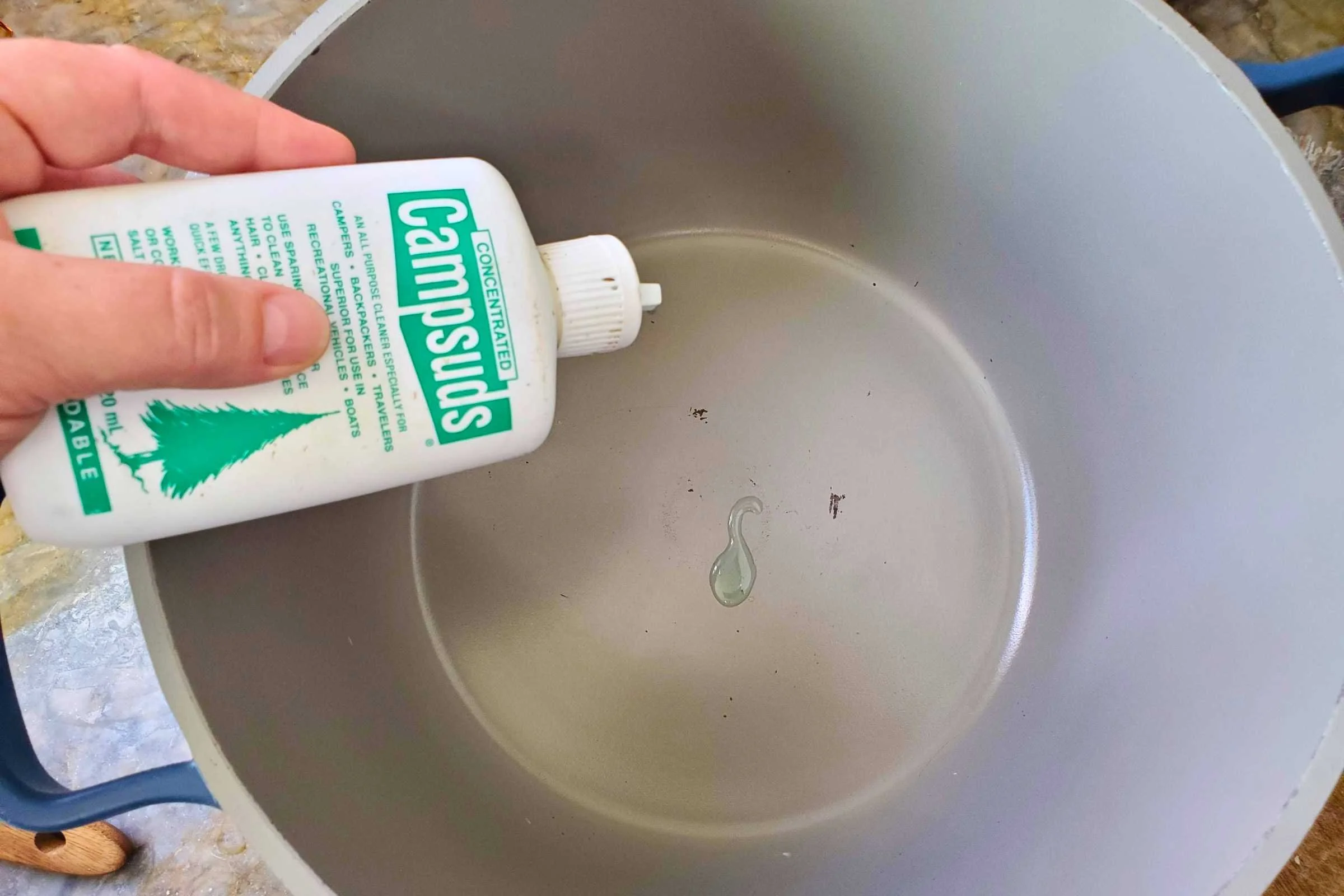
Campsuds is ultra concentrated, so you only need to add a few drops to your wash water.
Because Campsuds contains SLS, it lathers better in cold water than Dr. Bronner’s, and you need slightly less of it to do the job. We found that very little—between ⅛-¼ teaspoon—was necessary to make 8 cups of cool water soapy enough to clean things. It’s effective at cutting grease and grime, and it’s unscented, so your dishes won’t have any lingering perfume-y flavors. We also appreciate that it comes in a variety of size options (including a carry-on-friendly 2-oz size and some larger refill sizes), though the 4-oz bottle is the easiest to find.
Campsuds is marketed as a soap for all purposes (hands, body, dishes, clothes, etc), and it’s perpetually highly rated on Amazon across all these functions. However, our testers and some online customer reviews found it to be more drying to skin and hair than we’d like, so we prefer using it just on dishes, where it performs beautifully.
Compiling experiences across our testing, online customer reviews, and reviews on outdoors sites, the consensus seems to be that compared to close competitor Wilderness Wash (below), Campsuds is the more powerful cleaner. For greasy dishes, grimy gear, and heavily soiled trail clothes, Campsuds is your best bet; the tradeoff being that because it’s a stronger detergent, it’s harsher on skin, clothes, and fabrics.
The main drawback of this soap is the fact that it contains SLS, so we wouldn’t want to use it anywhere cold, dry, or delicate where we’d have to dispose of it outdoors. Also, the cap can leak a bit, so we (and many online reviewers) keep it in a ziploc bag for transport. Lastly, while outdoor retailers like REI are likely to have Campsuds at stores, it’s harder to find in person than our overall winner.
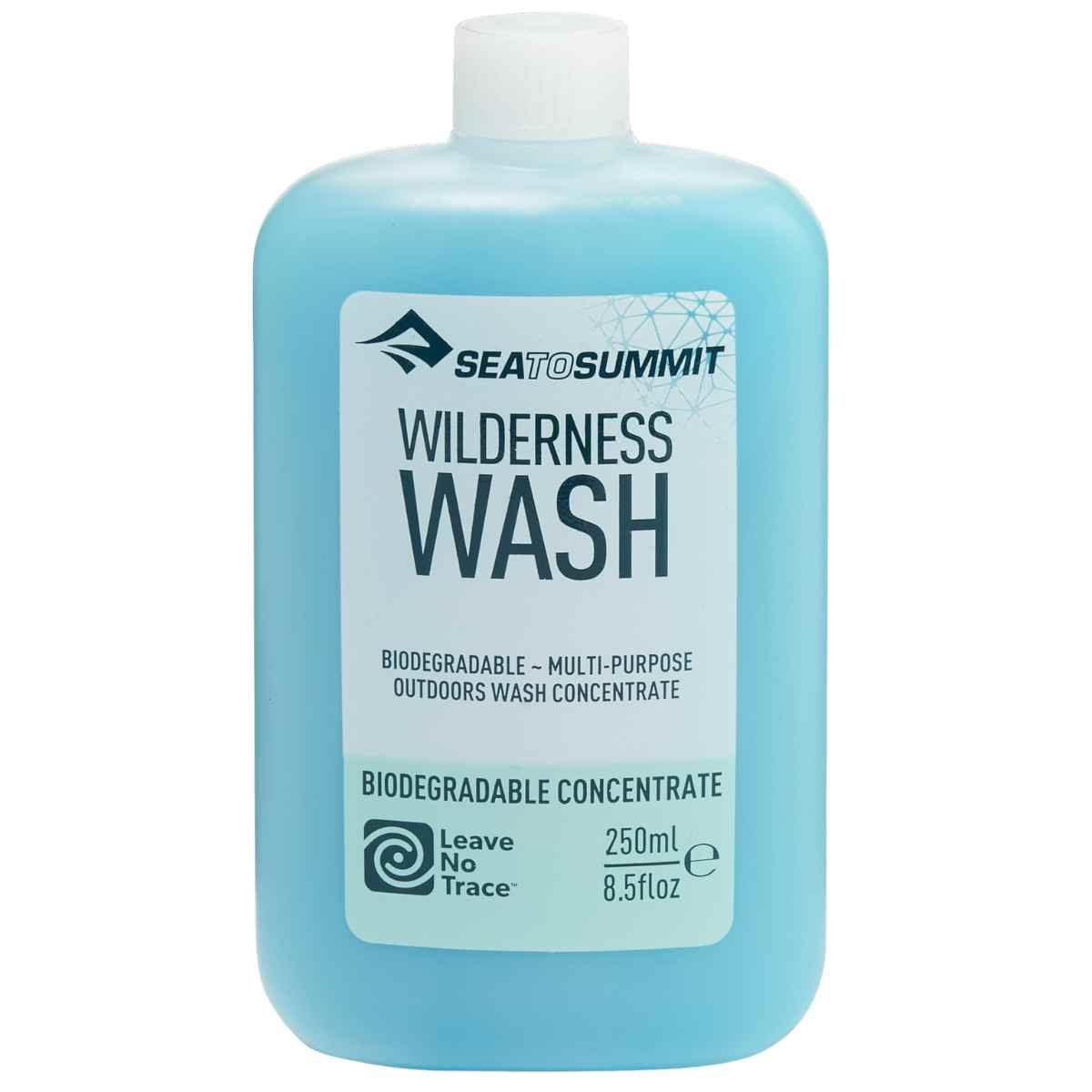
Best Biodegradable Soap for Hands, Body, and Hair While Camping (contains SLS): Sea to Summit Wilderness Wash
Type (liquid, bar, powder): Liquid
Price per weight: $1.29/fl oz
Contains SLS/SLES: Yes
Intended use: Hands, body, hair, dishes, clothes
What we liked: Ultra concentrated; need relatively little to be effective; unscented; relatively affordable; gentle to skin and fabric; available in some stores as well as online; not drying to skin/hair; cap prevents leaks very well
What we didn’t like: Contains SLS, not available in many stores, only comes in one size
A long-time standard of biodegradable camping and backpacking soap is Sea to Summit’s Wilderness Wash, an ultra-concentrated liquid soap that works well as a body wash, shampoo, dish soap, and laundry detergent. It contains SLS, so it shouldn’t be used in dry, cold, or otherwise fragile environments. That aside, we do like how concentrated, effective, and non-drying it was as a body wash and shampoo.
Sea to Summit Wilderness Wash
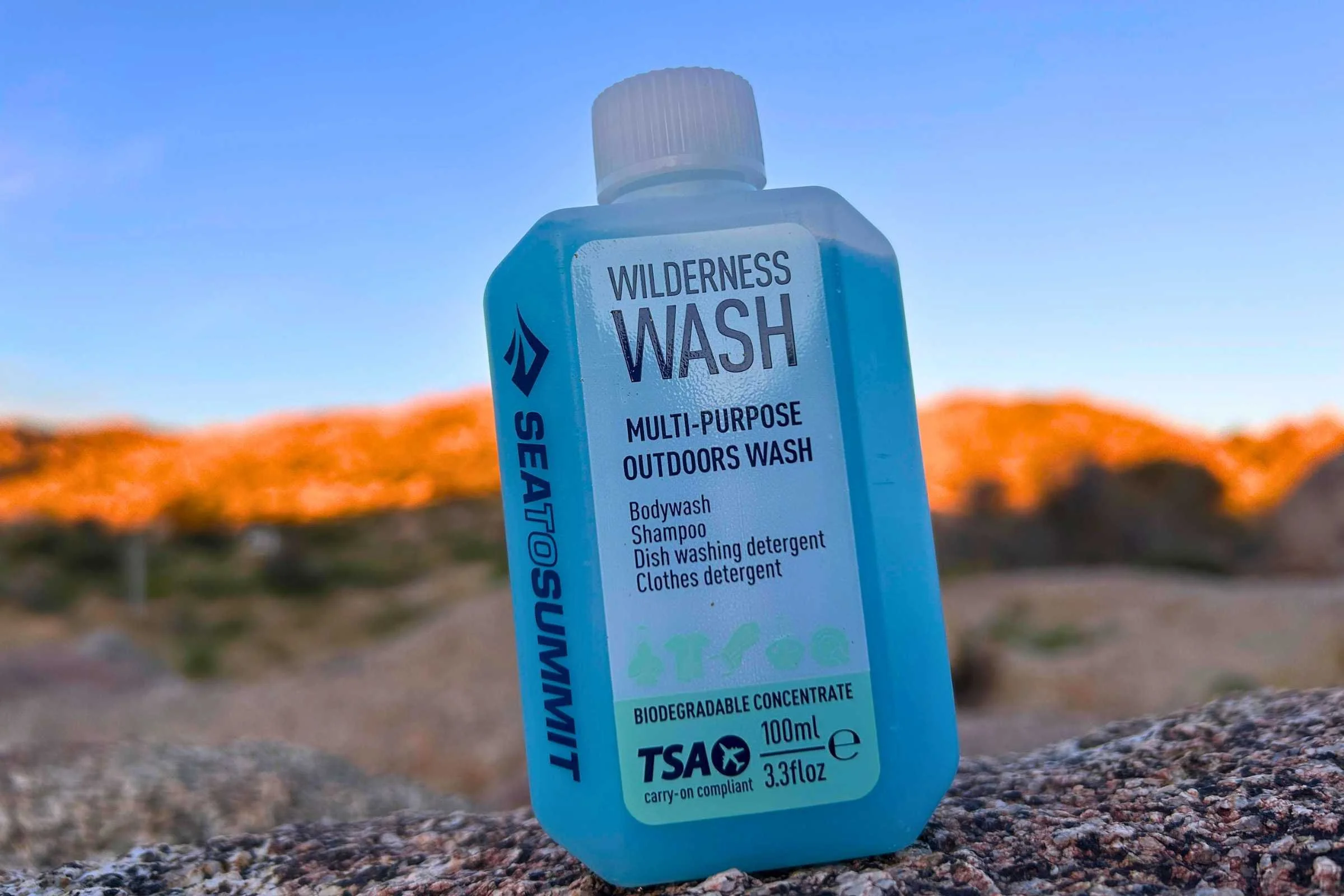
Sea to Summit Wilderness Wash is gentle and non-drying for hands, body, and hair while camping and traveling.
Wilderness Wash and Campsuds are commonly compared to one another, and our takeaways were similar to those of many online customer reviews. Wilderness Wash doesn’t lather quite as well as Campsuds, although we needed roughly the same amount for cleaning purposes (~⅛-¼ teaspoon per 8 cups of cool water).
While we found that Campsuds cut through grease and grime most effectively on dishes, we found Wilderness Wash gentler and less drying for body, hair, and clothes. This, as so many other things, comes down to ingredients: Wilderness Wash uses SLES, a related but milder surfactant than SLS, as well as a couple additional ingredients that are slightly less harsh than their Campsuds counterparts. This is why we prefer Wilderness Wash for bathing and clothes-washing, particularly for use over several days or longer. The cap is also much more leakproof than that of the other liquid soaps we tested.
As for negatives, Wilderness Wash does not get as soapy as you might expect, but that’s true for most of the soaps on this list. It also comes in only one size, a 3.3-fl oz bottle (labeled as TSA compliant, but it’s just on the cusp so who knows). While it’s not as drying as Campsuds, we wouldn’t want to use it as both shampoo and conditioner long term, since it doesn’t do much hair conditioning, but it certainly works.
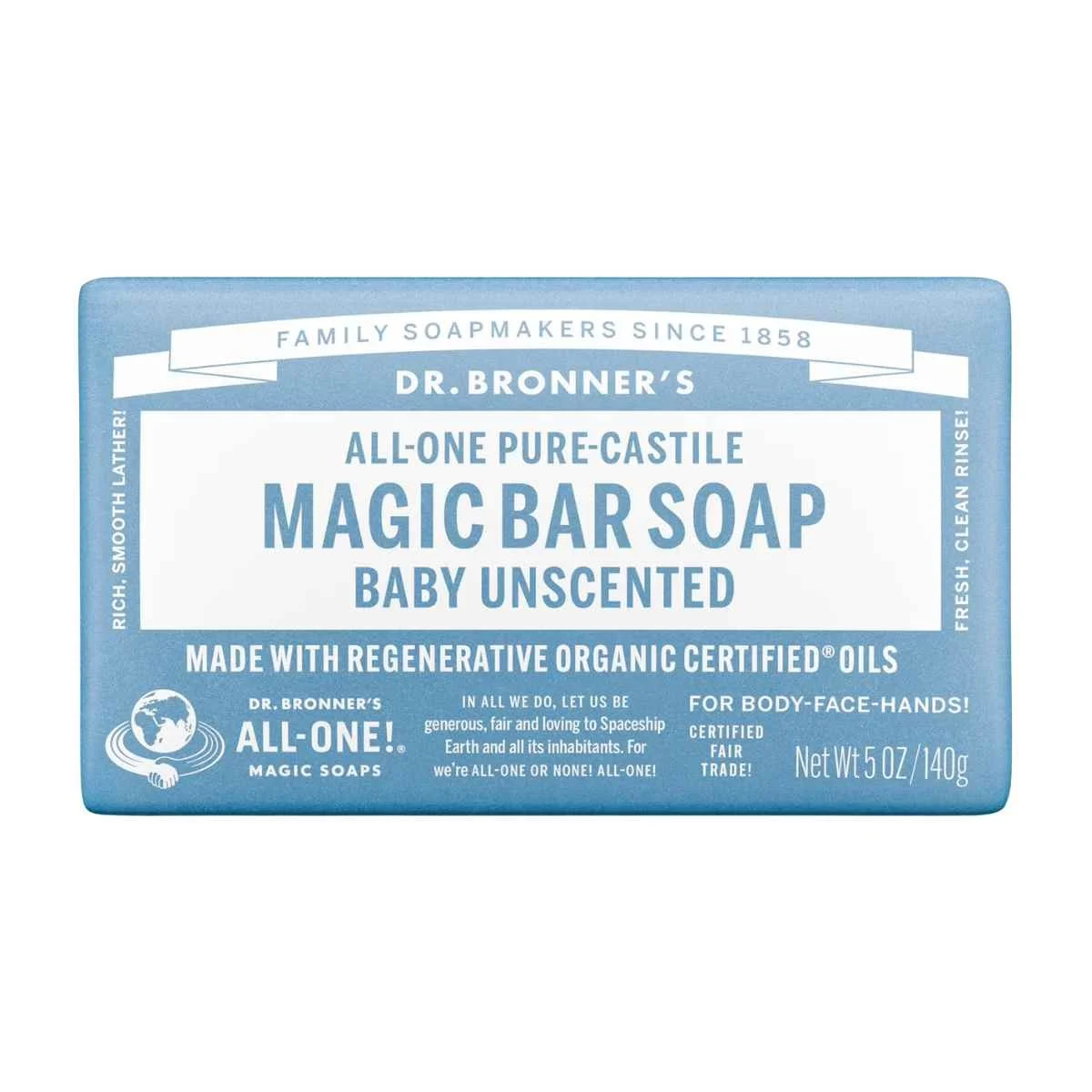
Best Affordable Biodegradable Camping Soap: Dr. Bronner’s Pure-Castile Magic Bar Soap (Unscented)
Type (liquid, bar, powder): Bar
Price per weight: $1.13/oz
Contains SLS/SLES: No
Intended use: Hands, body (But safe to use on hair, dishes, clothes)
What we liked: Doesn’t contain SLS/SLES; exclusively environmentally friendly ingredients; widely available; affordable; no plastic packaging; lathers well, even in cold water
What we didn’t like: Bar soap can be less convenient than other types of soap
Although we were not always on the bar soap for camping bandwagon, researching biodegradable soaps changed our minds. Now, Dr. Bronner’s Pure-Castile Magic Bar Soap is one of our go-to camping soaps (other than the liquid version that’s our overall winner), largely for its affordability and extremely sustainable ingredient list.
Dr. Bronner’s Pure-Castile Magic Bar Soap (Unscented)
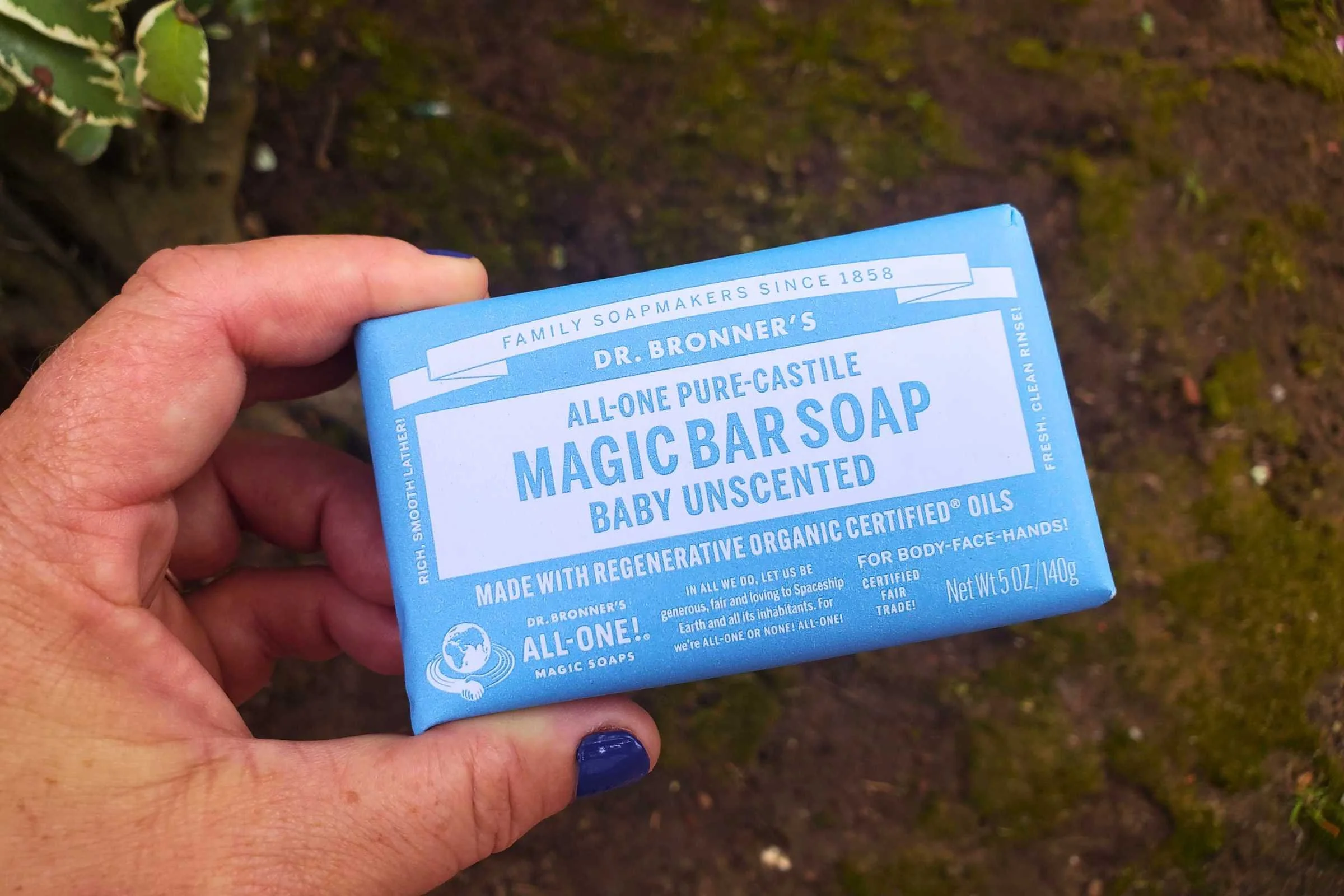
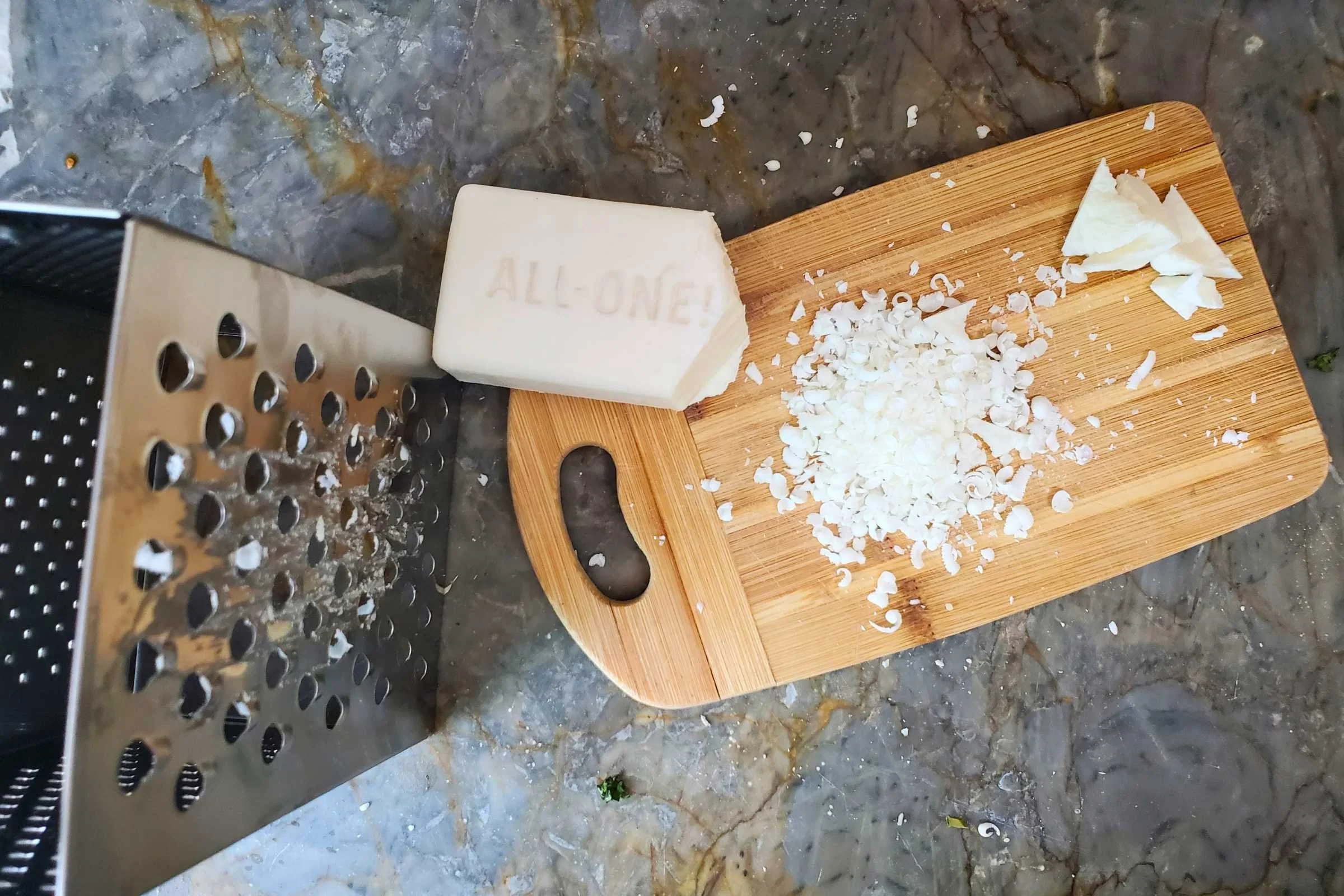
As with many simple bar soaps, it’s composed of nothing but saponified (that is, soap-ified) plant oils, some vitamin E, and that’s it. This makes it particularly easy and quick for microbes in the environment to break down, which is a huge benefit while camping or backpacking. It’s triple-milled, which means it won’t get mushy or soft and foster bacterial growth.
Moreover, the soapiness of Dr. Bronner’s bar soap is basically what you’d expect from any bar soap, which makes it a more familiar experience than you get with camping-appropriate liquid soaps. While using a bar soap to wash dishes feels a bit awkward, it cleans well, particularly if you can warm the water up even a little bit. When dishwashing, we agree with online reviewers’ recommendations to either apply the soap bar directly to your dish brush or grate the soap into warm water to create a tub of soapy water. We even had good experiences testing this as a laundry soap: we used it on some of our shirts that are never quite not-smelly, and Dr. Bronner’s removed the perpetual funk. Magic.
Other than the issues common to all of these soaps (e.g., can leave a residue in cold or hard water, works better in warm water, not quite as moisturizing as products formulated for dry skin) the challenges of this product are primarily that a bar soap is awkward for camping. It’s wet and heavy, and where do you set it in between uses so it doesn’t get gross?
There are two strategies to avoid this. One, as mentioned above, is to grate your soap either in the moment or beforehand for easy transport and using only as much as you need. However, we are very lazy and that effort sounds overwhelming, so we’d go with the second option: slice off a chunk and get a thing to put it in. We like the Matador Soap Bar Case because it’s lightweight and actually helps the soap dry inside.
Best Cleansing Wipe for Camping and Backpacking: Sea to Summit Wilderness Wipes
Type (liquid, bar, powder): Cleansing wipe (not a soap)
Price per weight: $10.95 per pack of 36 wipes ($0.30/wipe)
Contains SLS/SLES: No
Intended use: Hands, face, body (Can use on dishes in a pinch, ideally rinse with water after)
What we liked: Soap-free option; wipes are biodegradable & compostable; unscented; no sticky residue; not drying; lightweight; different size options
What we didn’t like: Need to pack out used wipes; wipes are relatively small; not an ideal solution for dishes; can’t use on clothes or hair; on the expensive side
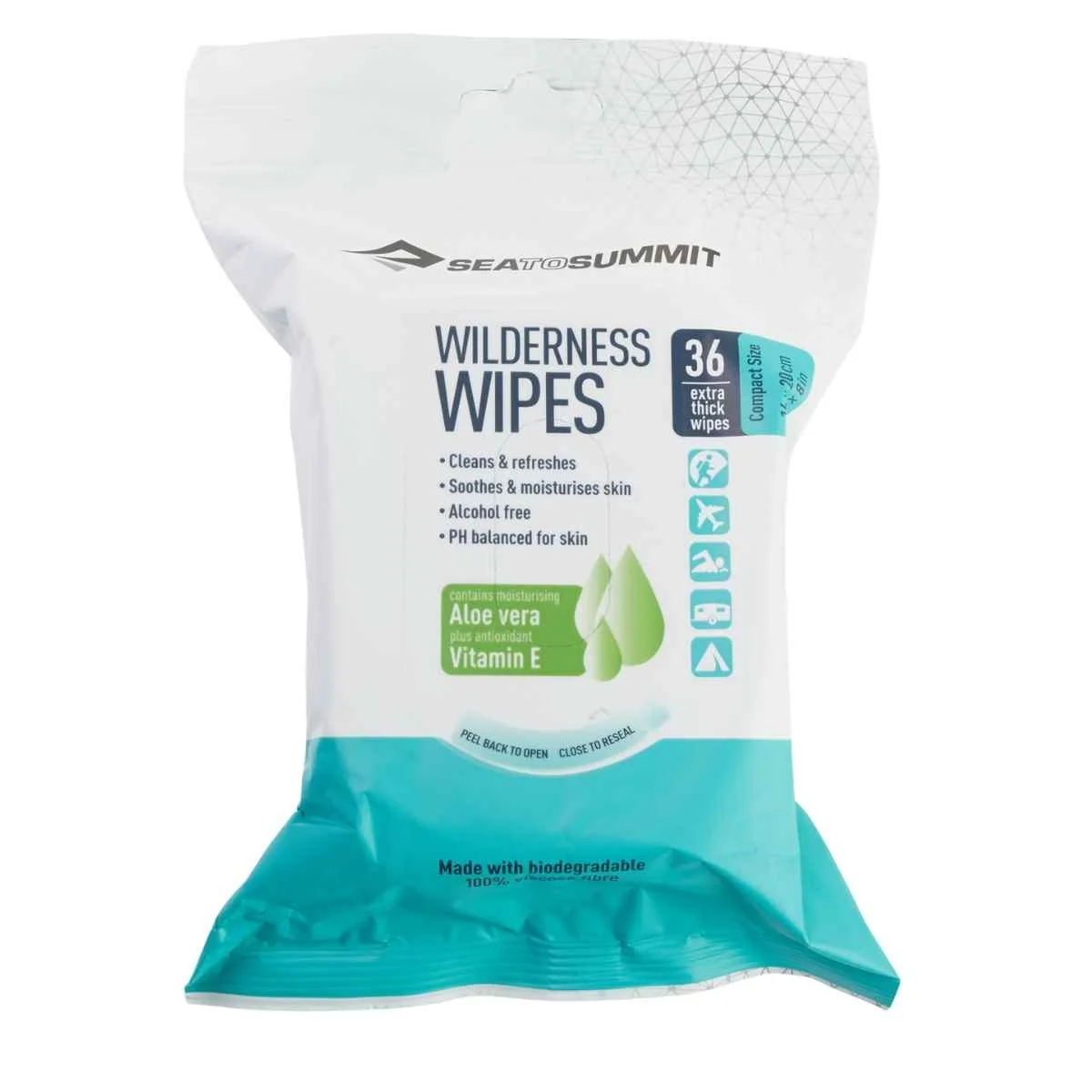
As someone who has always traveled with baby wipes for quick cleansing, I am a lifelong believer in the power of wipes. In our research, we loved Sea to Summit Wilderness Wipes for their packability, complete lack of scent, and lack of residue. While they’re more expensive than drugstore baby wipes, they are highly packable, highly compostable, and do not dry out the skin (even when tested in the desert!).
Sea to Summit Wilderness Wipes
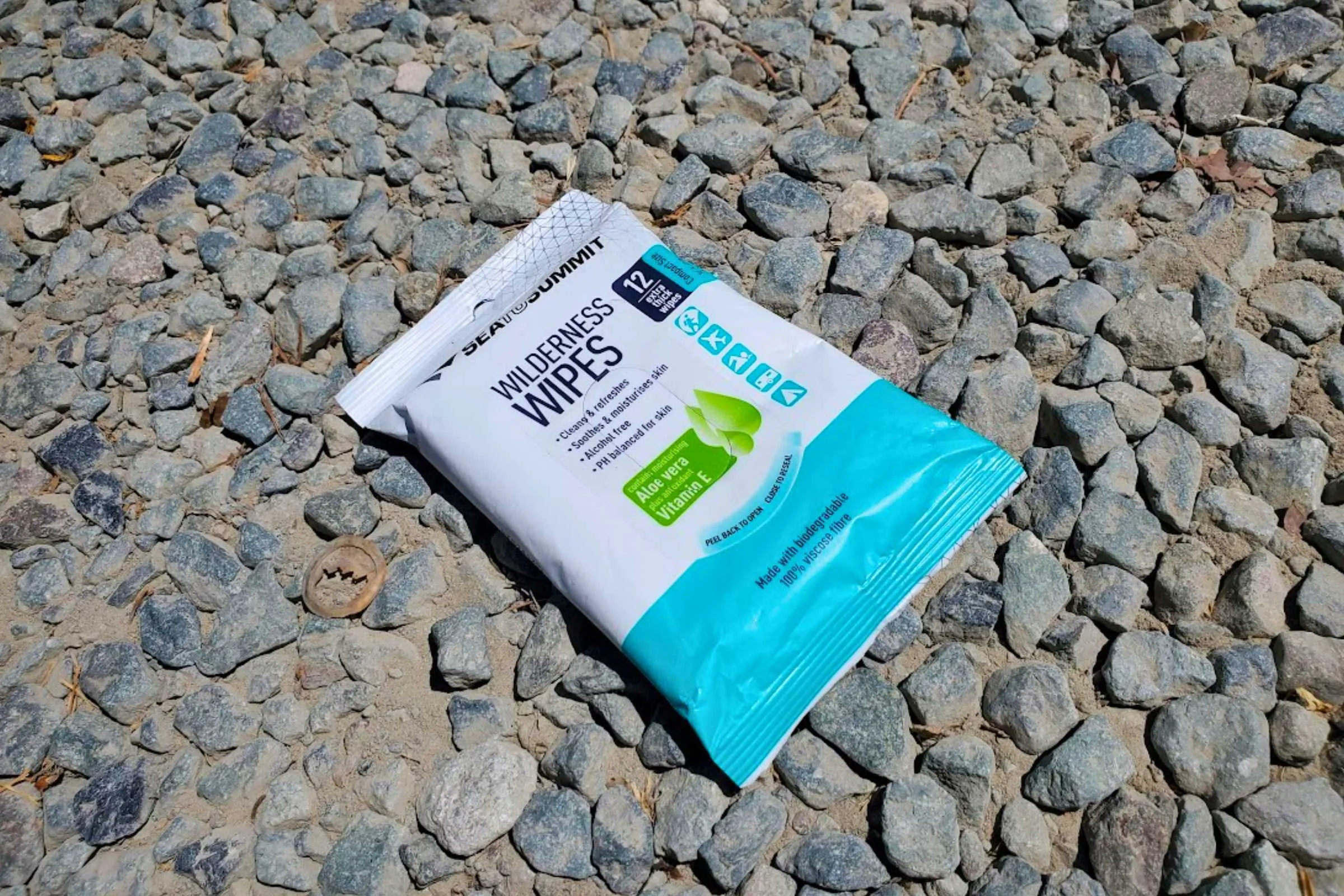
We highly recommend Sea to Summit Wilderness wipes as a no soap cleansing solution for face, hands, and body while camping and backpacking.
While they do contain moisturizing ingredients like vitamin E, glycerin, and aloe vera, they do not leave skin feeling either slippery or sticky afterward, and they did not cause our skin to dry or eyes to burn when used on the face. These were by far our favorite of the wipes we tested—others left more of a residue, were heavier, had more fragrance, and/or had fewer sustainability factors to recommend them.
While we love wipes for their utility, light weight, and the fact that they don’t introduce soap into the environment at all, there are some drawbacks. The main hurdle is that you have to pack these out or find a proper trash receptacle for them (even if they claim to be “compostable,” this generally means “commercially compostable,” not that they should ever be buried in a cathole with your other business). They’re also not as useful for dishes; while you can use them to wipe down dirty dishes in a pinch, wipes often contain antimicrobials and other chemicals you shouldn’t ingest. If you use them for dishes, rinse with water afterward. Needless to say, their usefulness in cleaning clothes and hair is also minimal.
Wilderness Wipes are especially useful when camping with babies and young kids who need a full wipe-down at the end of a muddy camp day. See how they fit into our complete Camping with Kids Checklist, along with all the other hygiene and gear essentials for family camping.
Overall, these wipes are not as all-purpose as our soap winners, but they are a wonderfully helpful and soap-free option to have around!
Other biodegradable soaps we tested
Juniper Ridge Body Wash
Type: Liquid
Price per weight: $1.60/oz when you buy 5
Contains SLS/SLES: No
Intended use: Best for hands and body
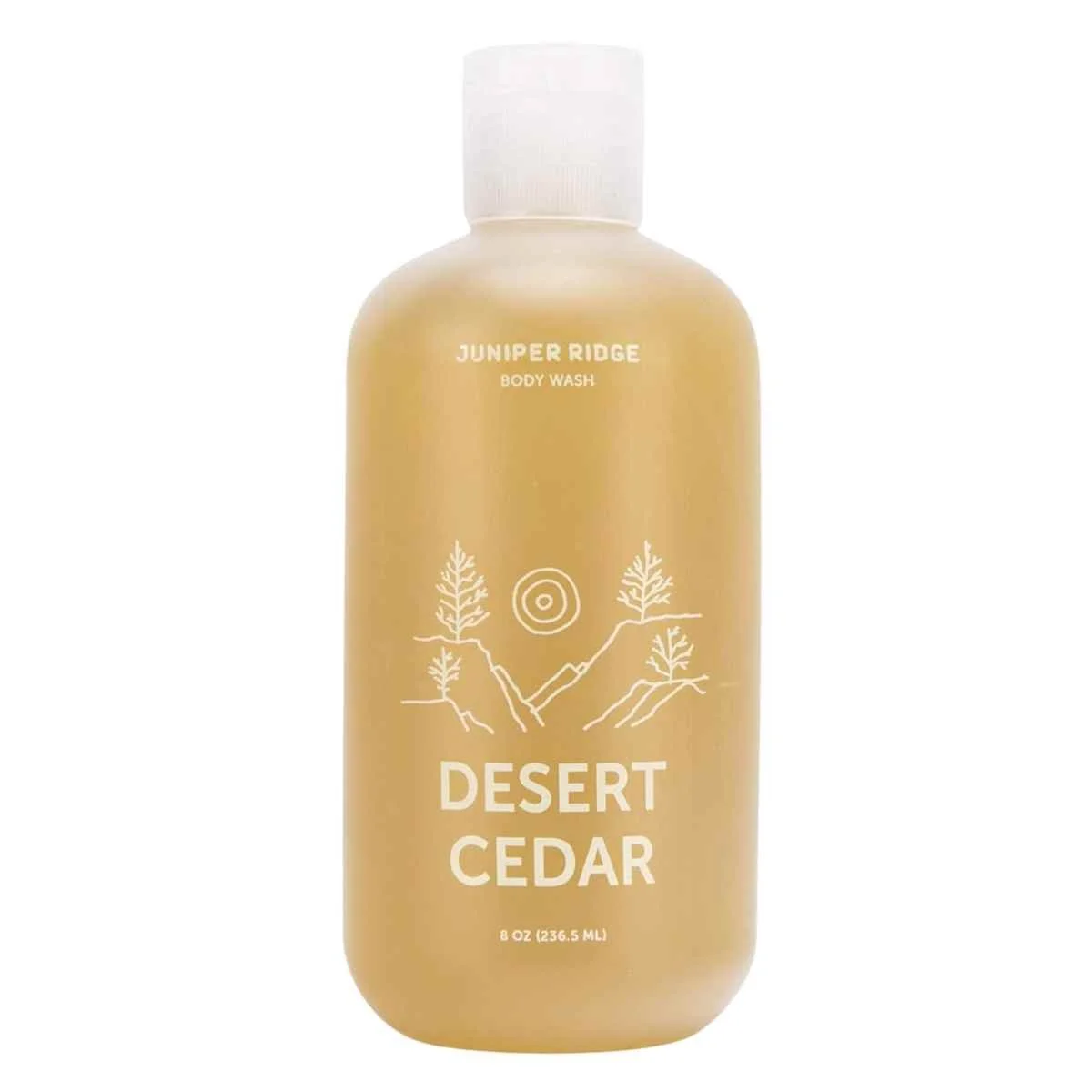
This is a popular body wash mentioned on several biodegradable soap lists online, and, like Dr. Bronner’s, the ingredient list is short and exclusively plant-based. The scents are primarily evergreen-y, which we really like, but they are strongly scented and do not come in an unscented form, which may not be for everyone.
We also found that while they work well as body wash, they’re not as effective at cleaning dishes, like our winners. Most importantly, though, they’re a bit hard to find. We don’t generally see them in stores, Amazon only has two scents (for a price more than double what the brand charges), and the brand site charges shipping for orders under $60.
All that said—we love it and the internet loves it, and if you’re cool with buying a few bottles at once, you’ll have a lovely and aromatic (and biodegradable!) shower.
Juniper Ridge Body Wash
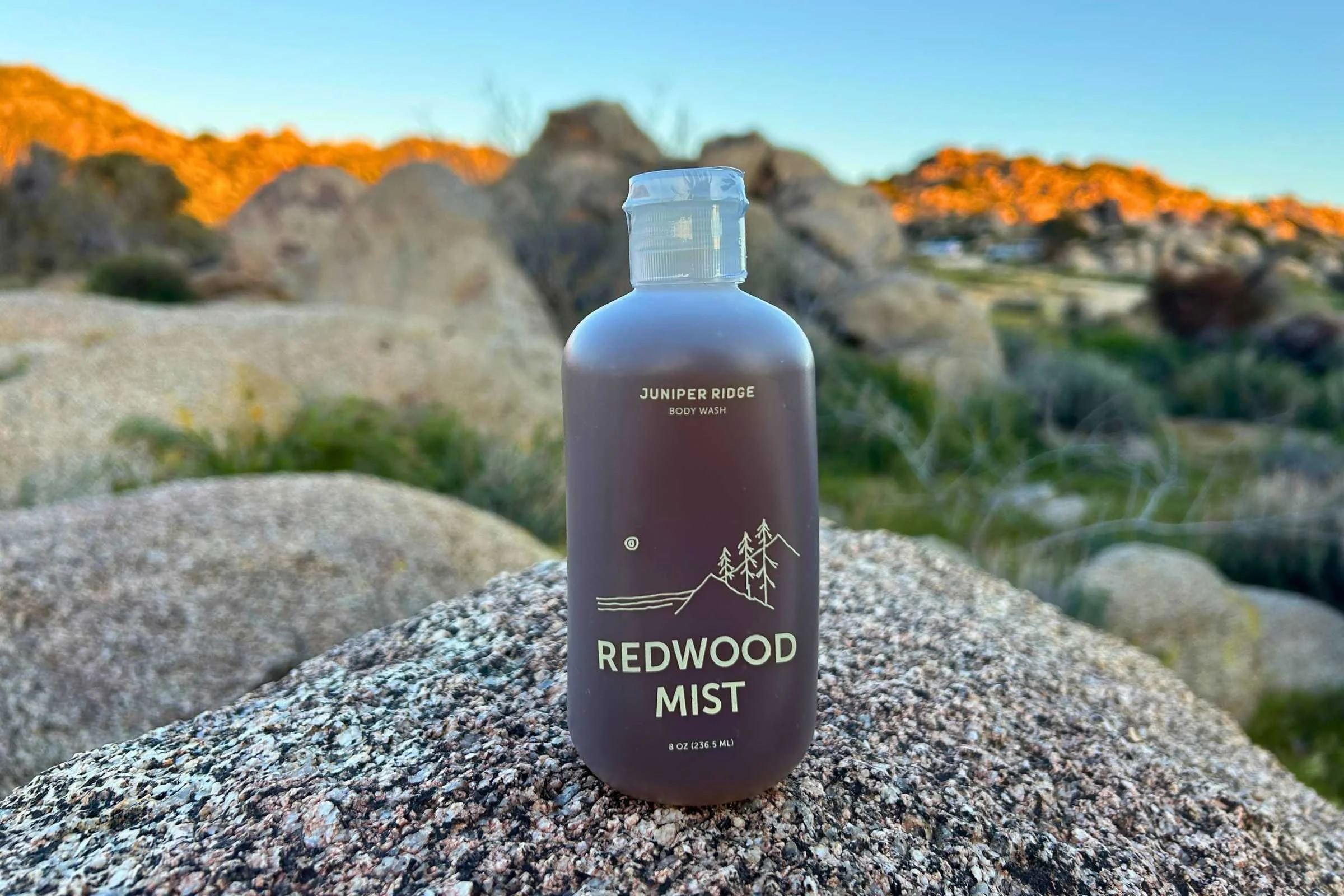
We love Juniper Ridge for its piney scents and high biodegradability, but it’s not as widely available as our winners.
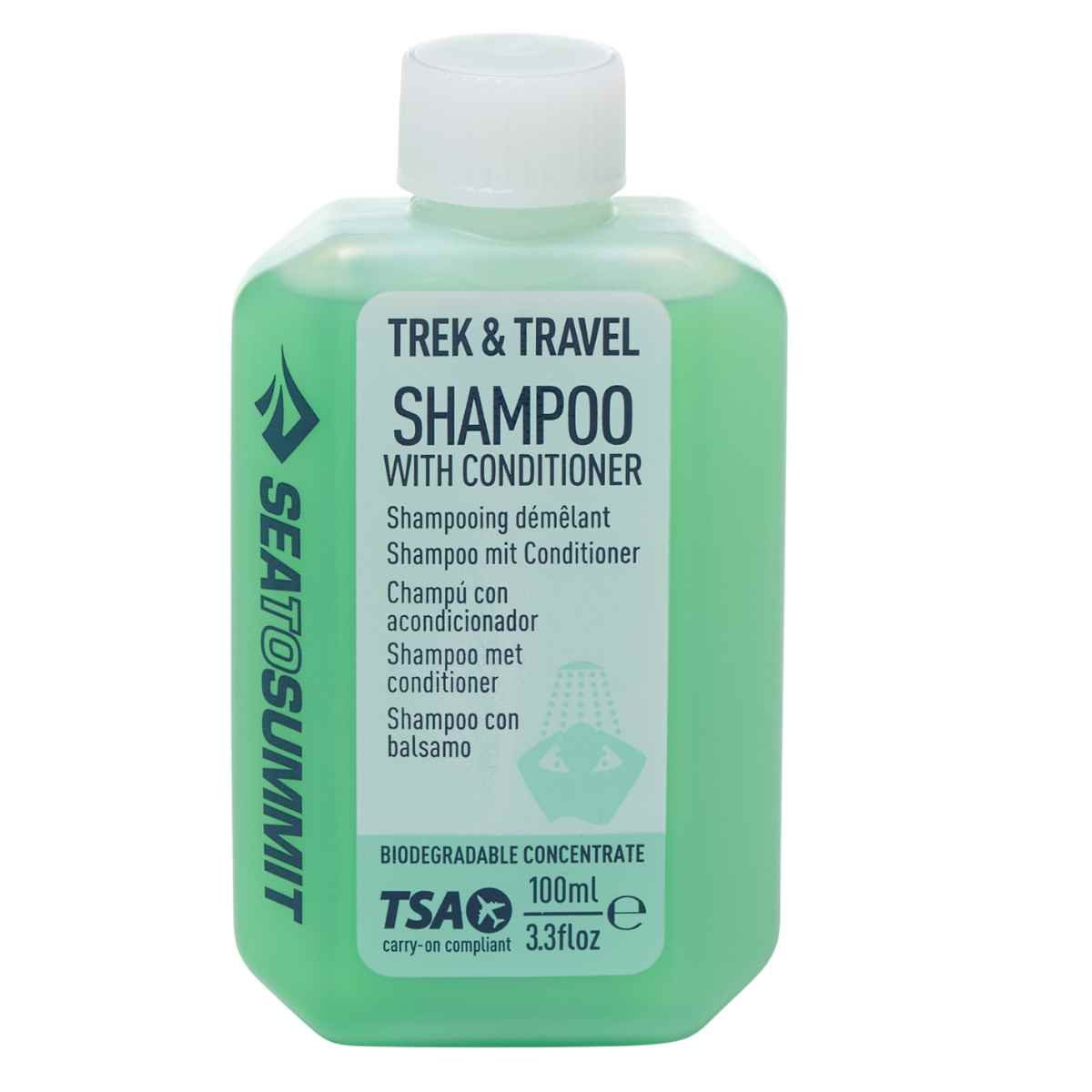
Type: Liquid
Price per weight: $2.40/fl oz
Contains SLS/SLES: Yes
Intended use: Hair
This was our favorite of the travel-optimized shampoo/conditioner combos we tried. It’s not biodegradable, since some of the ingredients that make it nice for hair (like silicones, “fragrance,” and other chemicals) make it extremely not-nice for ecosystems. So we can’t recommend it if you’re disposing of your wash water outdoors, but we do like it as a shampoo/conditioner solution in an appropriate water treatment setting.
It’s scented, but the fragrance is very light and doesn’t bother most people. You need very little for an effective wash, and it doubles as a body soap just fine, so the standard 3.3-oz bottle will last you a long time. It doesn’t do a ton of detangling, so long hair would still benefit from a conditioning/detangling product, but it doesn’t dry out the hair or scalp, and testers with short hair had no issues.
Other than a slight slickness while rinsing it out (“My hair felt squeaky, like cheese curds” noted one tester—if you know, you know), we liked this and would recommend it.
Sea to Summit Trek & Travel Shampoo with Conditioner
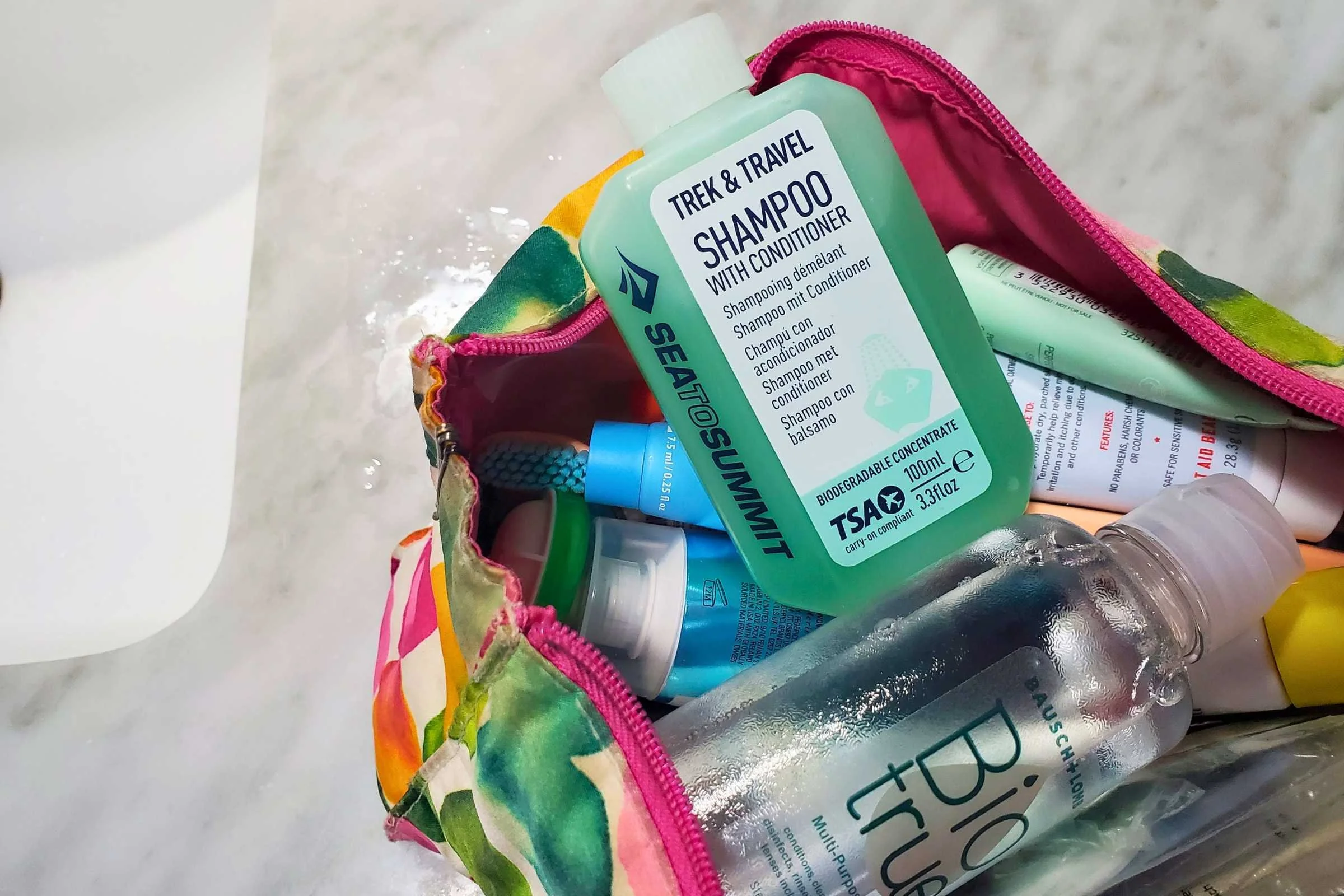
We appreciate Sea to Summit Shampoo & Conditioner for traveling, but it contains ingredients that should not be disposed of outdoors.
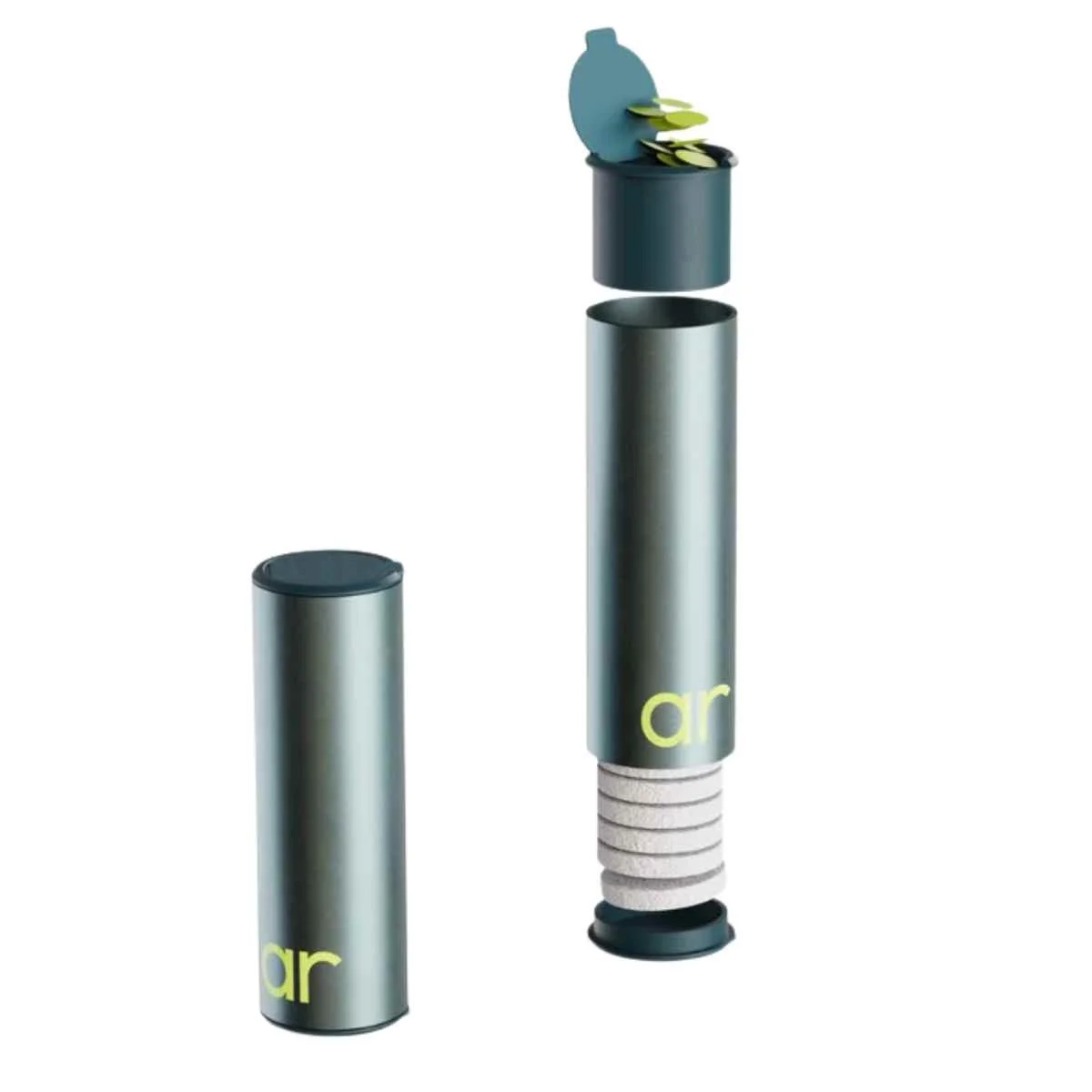
Type: Soap flakes
Price per weight: $7.62/oz for just the soap
Contains SLS/SLES: Yes
Intended use: Primarily hands, though also fine for dishes, body, and clothes
This neat little guy is a travel-sized aluminum canister about the size of a tube of toothpaste that contains two separate compartments. On top, it holds lightweight soap flakes, and on the bottom it contains 10 small disks of compressed towelettes that expand with a little water. It’s kind of like if the Sea to Summit Wilderness Wipes came dry and ultra-compressed and you added your own soap and water.
While we find this very clever and enjoy the low-plastic packaging, it feels like it doesn’t solve a real problem. The soap flakes contain SLS and don’t dissolve particularly well, and the towelettes are nice, but not compostable and not any better than a wipe-based solution. It is kind of fun though. It could be a good thing to just stash in the car and use as needed while camping or picnicking (in a place with appropriate grey water disposal!).
Adventure Ready Clean Capsule
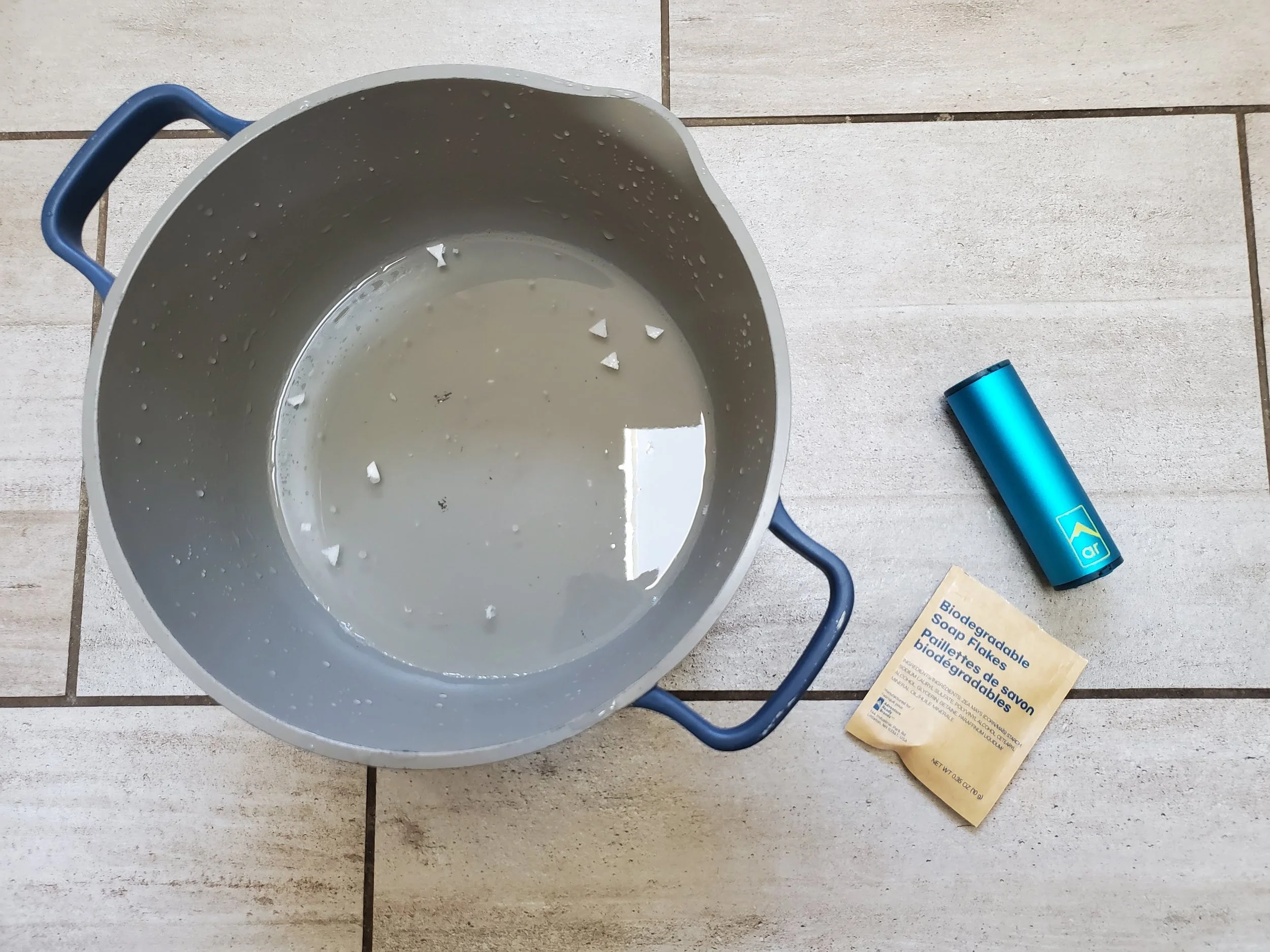
We appreciate the Adventure Ready Clean Capsule for its cleverness, but the soap flakes contain SLS and don’t dissolve particularly well.
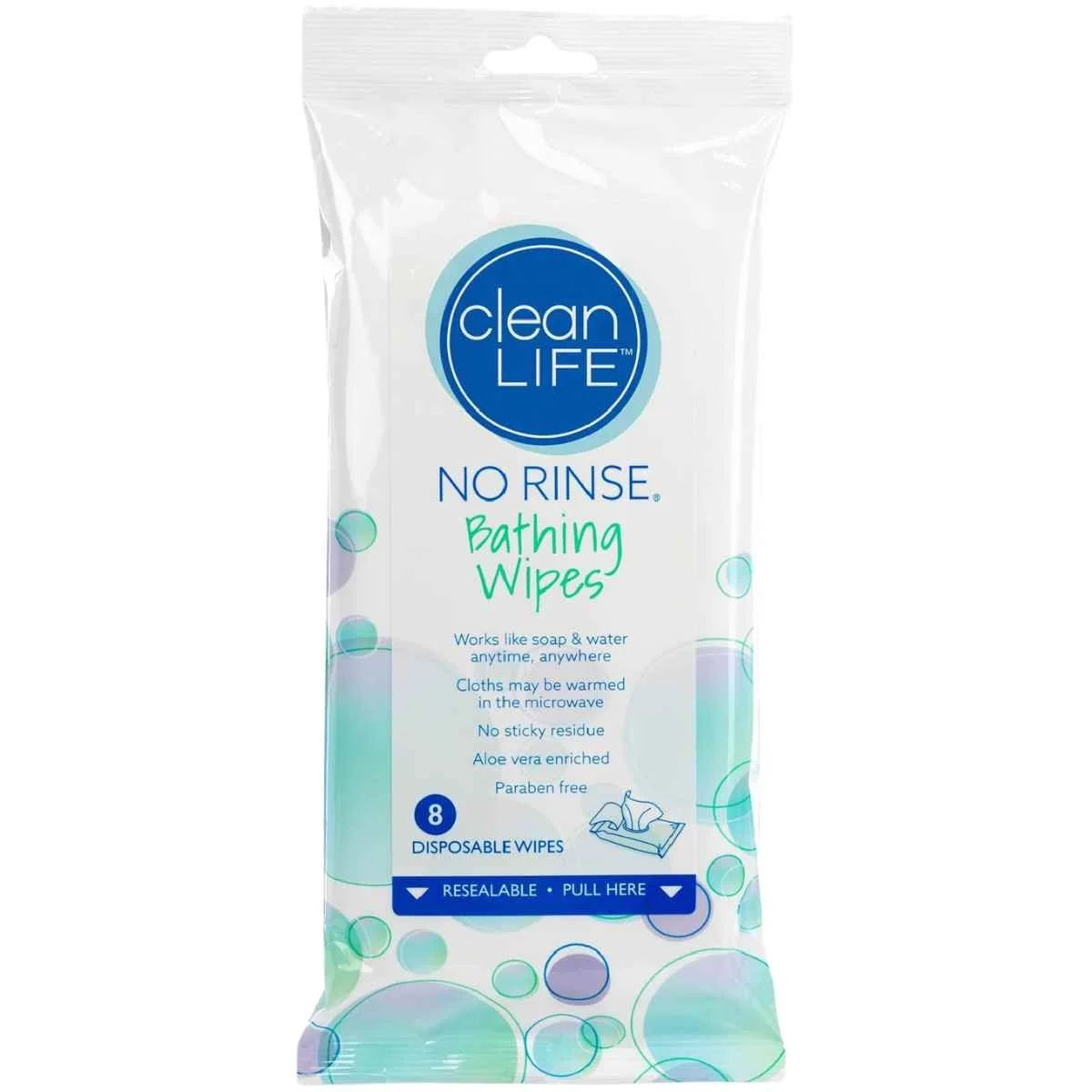
Type: Cleansing wipe (not a soap)
Price per weight: $0.55/wipe when you buy a 5-pack
Contains SLS/SLES: No
Intended use: Face, hands, body
These highly rated wipes are quite large and fluffy compared to traditional cleansing wipes. Although the pack is therefore a bit wider than usual and only 8 come in a pack, one wipe is sufficient to wipe down basically your whole body and still have moisture left for your gear and maybe your friend, too.
On the down side, they do have a slight scent (there is a fragrance-free version, inexplicably more expensive on Amazon?), and they leave a very slight tackiness to the skin that we didn’t get with our Sea to Summit winners. Overall we liked these, though, and would definitely bring them camping and traveling again.
CleanLife No-Rinse Bathing Wipes
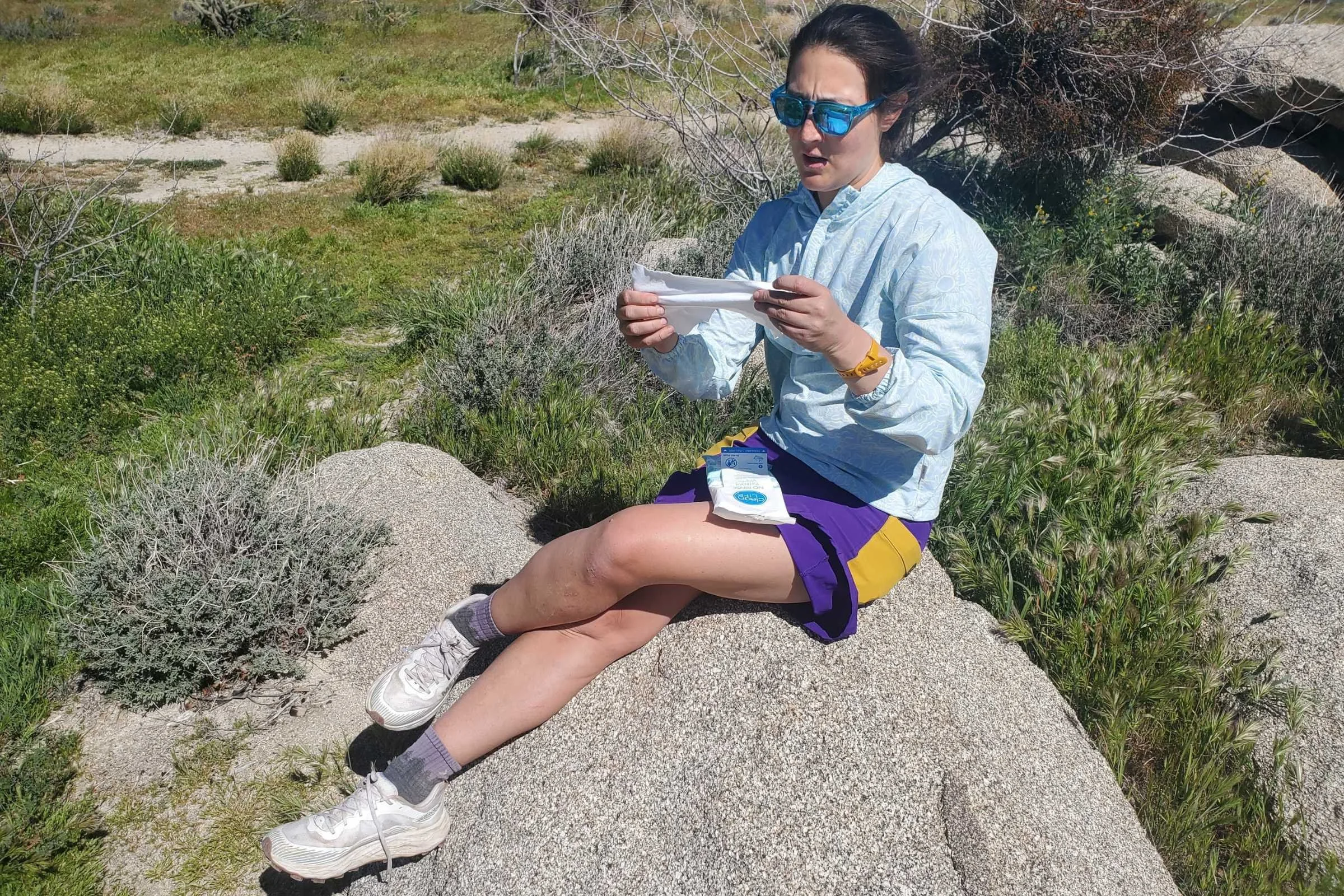
Cleanlife Bathing Wipes are larger and thicker than other wipes, so you’ll likely only need one. They are lightly scented and leave a slight residue compared to Wilderness Wipes.
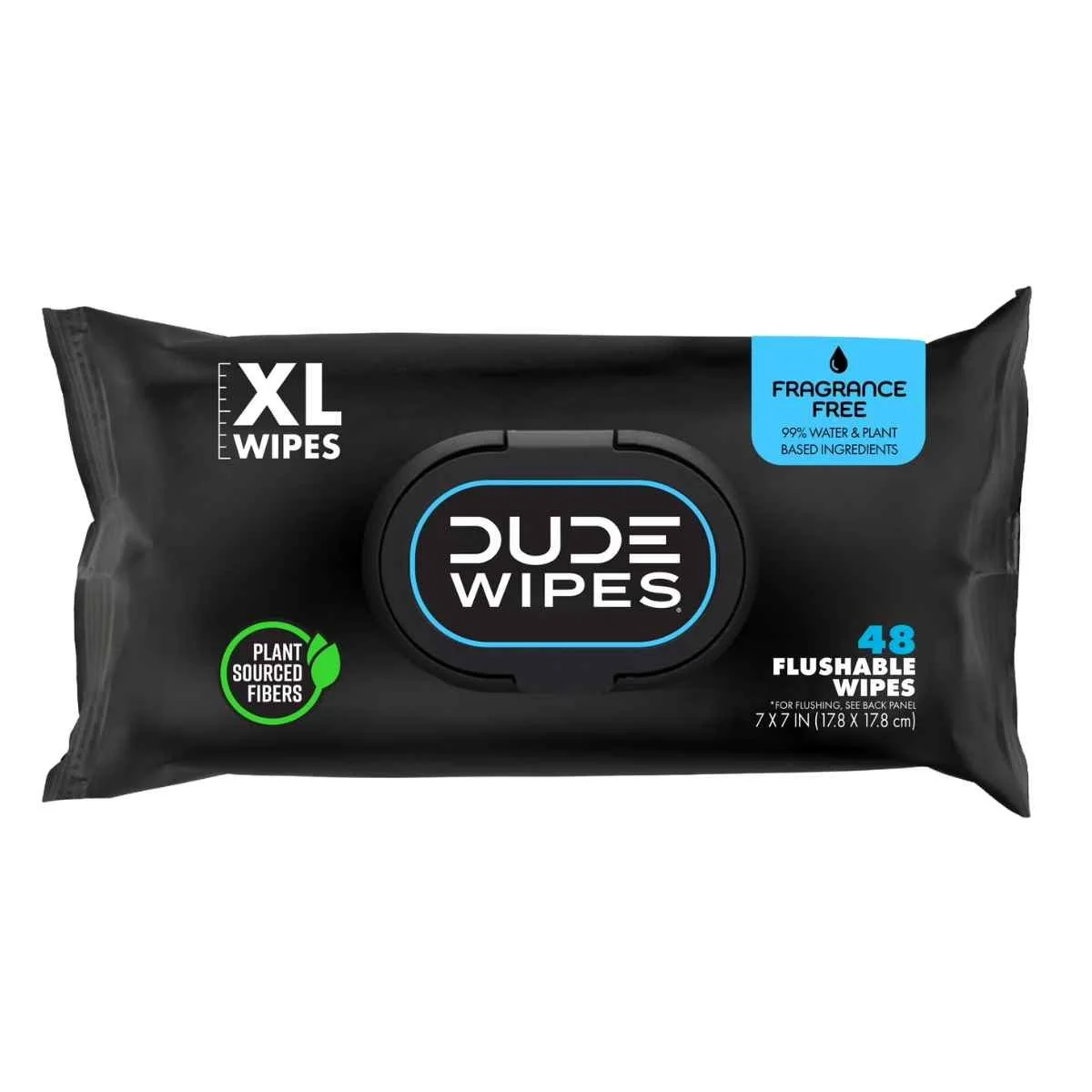
Type: Cleansing wipe (not a soap)
Price per weight: $0.09/wipe when you buy a 3-pack
Contains SLS/SLES: No
Intended use: Hands, body
These wipes are fine. Bigger than Sea to Summit wipes but not as large as the CleanLife wipes (despite “XL” claims on the packaging)—these were a pretty standard wipe. They are more durable than typical flushable wipes, which could be helpful if you’re using them as an all-purpose cleansing wipe, but it makes us question just how “flushable” or otherwise compostable they may be. If you want your wipe experience to be sustainable-ish and masculine-coded, these will do the job.
Dude Wipes
Many Brands of Soap Sheets
Type: Ultra-thin soap sheet
Price per weight: $3-$7 per pack
Contains SLS/SLES: Yes
Intended use: Hands
We tried several soap sheets (often called soap thins) from top-rated brands across Amazon and REI, including Fomin Soap Thins, HongyiTime Soap Sheets, and Sea to Summit Pocket Hand Wash, as well as some smaller brands we found in local stores (like this one from Flower Market Soap Co).
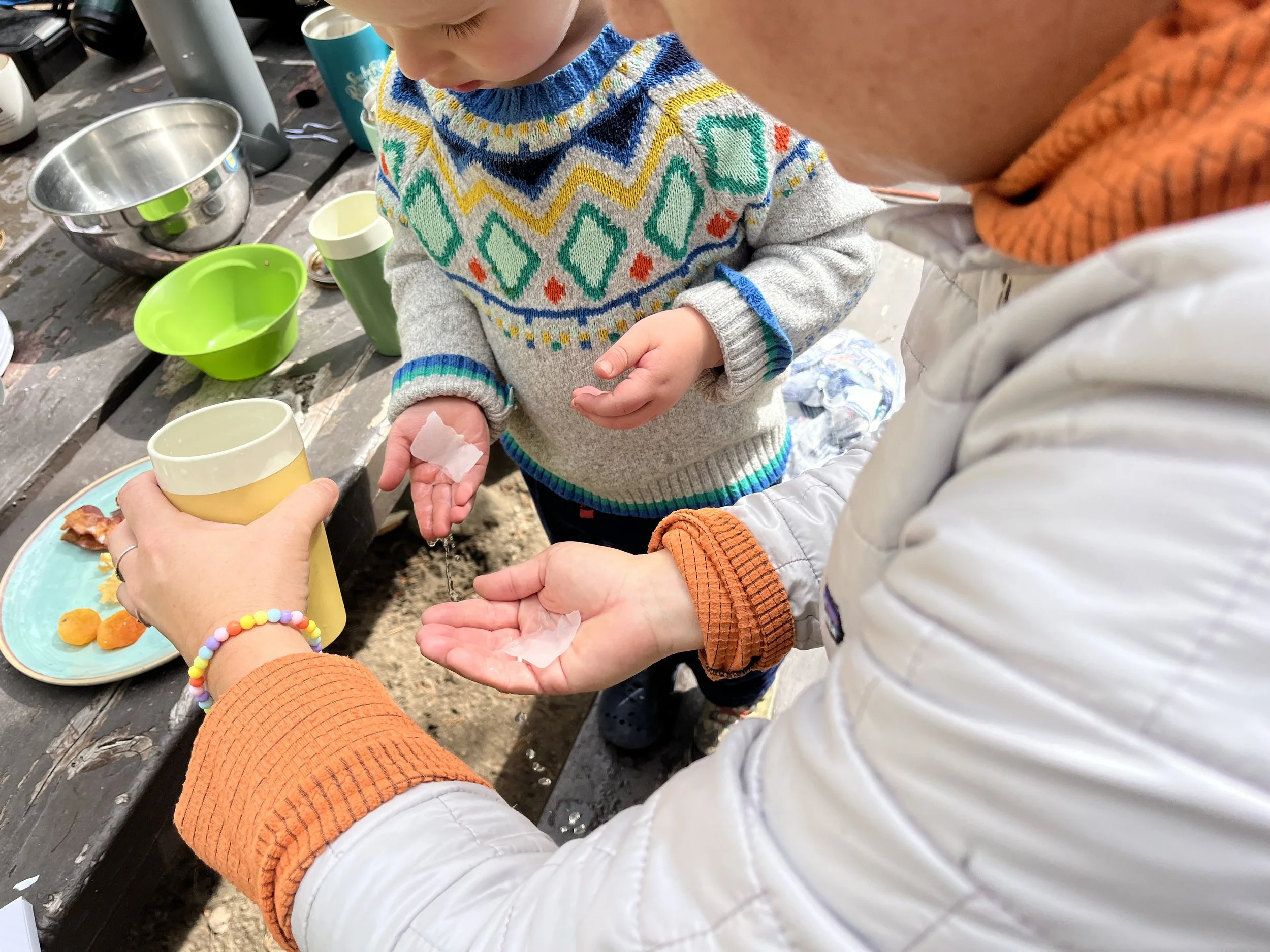
Using soap sheets to wash hands at camp.
We can see why these are compelling: they’re extremely lightweight, and they’re easy to keep in a bag or backpack when traveling somewhere that doesn't always have soap in bathrooms. However, they all contain SLS, and they don’t dissolve particularly easily or well in cool water, so they weren’t winners for us. We might keep some on hand for travel, but we wouldn’t call them a camping staple.
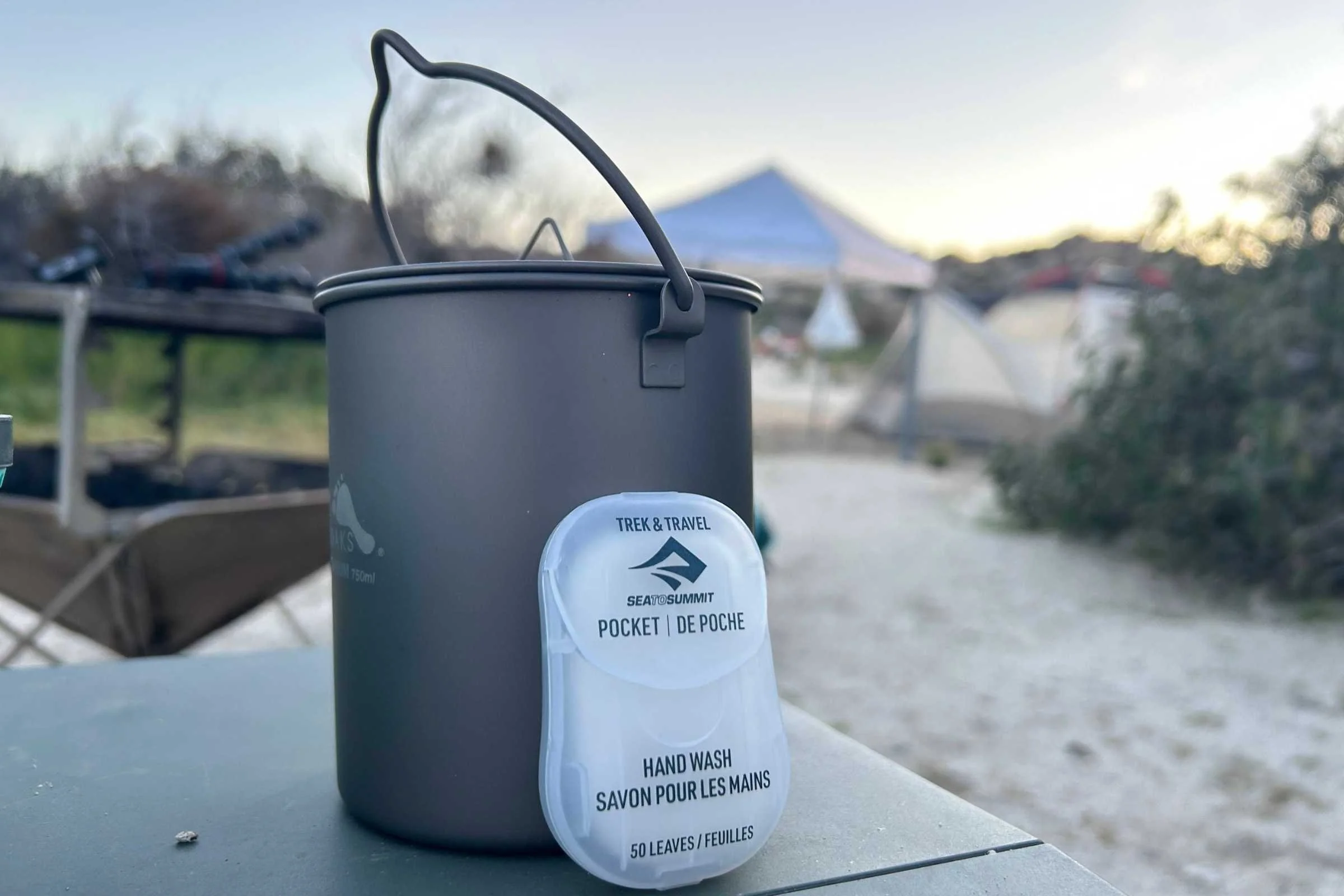
We like having soap thins like Sea to Summit Pocket Hand Wash when we travel, but since they contain SLS and don’t dissolve very well we don’t prefer them over our winners.
What to look for in biodegradable camping soap
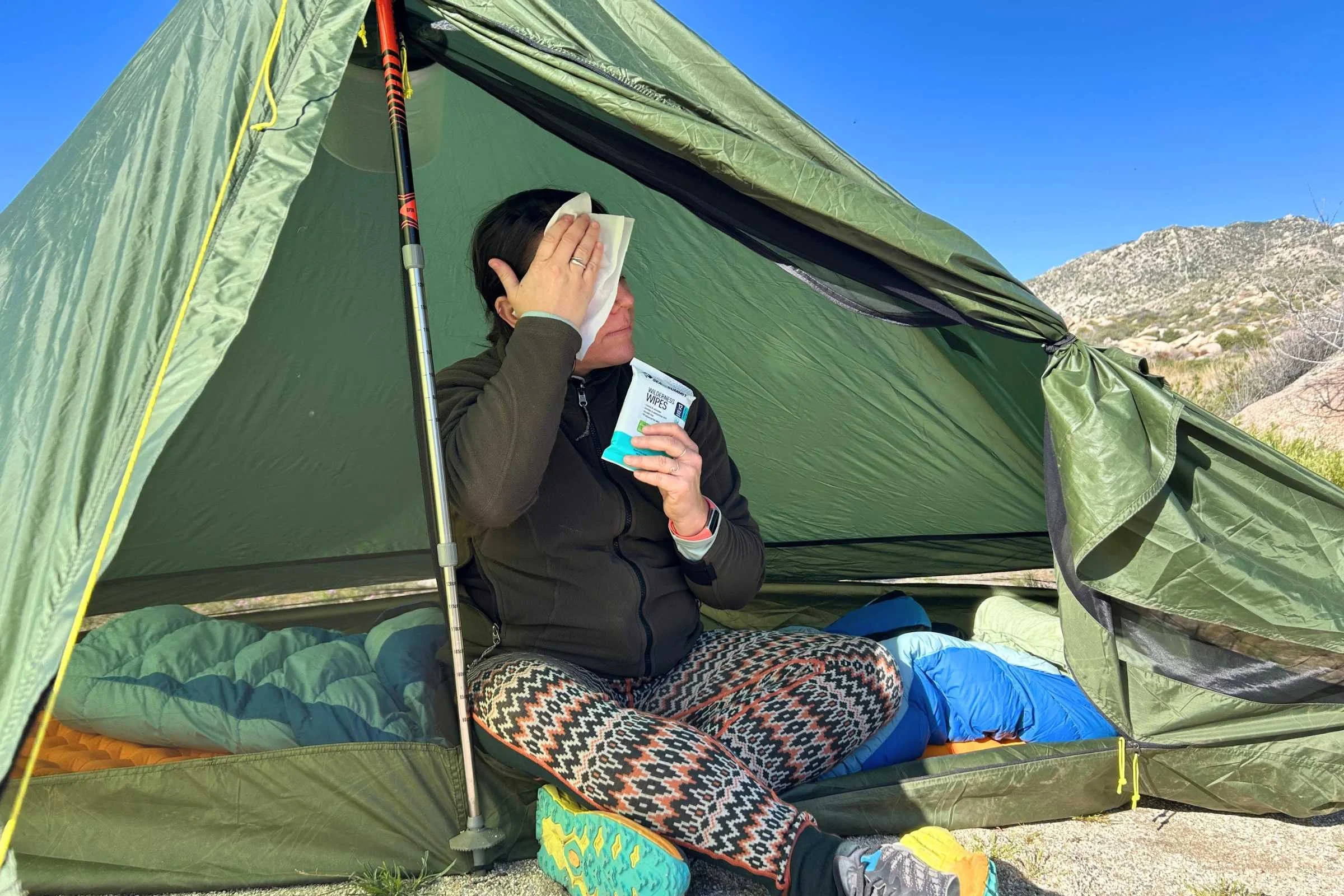
Sea to Summit Wilderness Wipes are gentle on skin, and non-irritating even when used on the face. They do not leave a sticky or slippery residue.
Ingredient lists can be daunting, and (as we’ll get deeper into below) some ingredients are degradable under certain conditions but not others. A good rule of thumb when looking for biodegradable soaps for body, hair, and dishes when camping or backpacking is to look for:
A short ingredient list. The fewer ingredients there are, the lower the chances that one or more is harmful by itself or will break down into harmful substances.
An unscented product. Many fragrances in particular become more toxic as they break down in soil.
Nothing labeled as “anti-bacterial,” “odor-fighting,” “ultra-degreasing,” or any other “advanced” functionality. These “bonus” features and preservatives generally come from chemicals that kill microbes (i.e., the little guys who break down the soap!) or otherwise harm soil and water ecology.
No super long chemical names. Obviously this is subjective, but it’s a helpful guideline.
Once you choose a soap: use as little as possible, and dispose of it by flinging (also called broadcasting) your dirty water over a wide area at least 200 feet from any water source (more on this below).
Lastly, remember that none of these soaps are going to be quite as bubbly or sudsy as most of your soaps at home, particularly in cold water. Many online reviewers are annoyed when their biodegradable soap doesn’t get as “soapy” as they feel it should, so heads-up that this is just a feature of soaps that are made to have fewer and simpler ingredients than those you use at home. Rest assured it’s still working!
How to use biodegradable soap responsibly outdoors
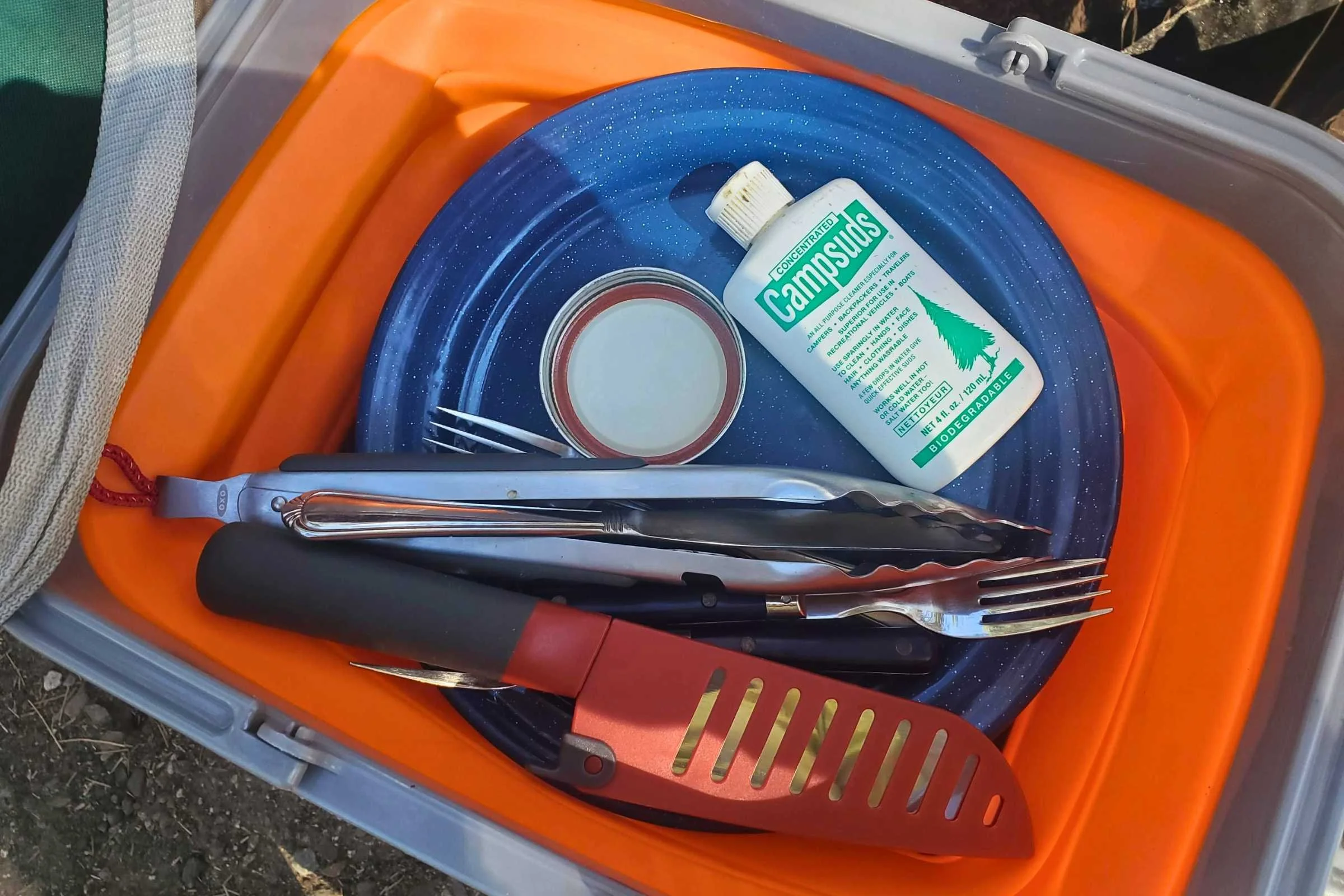
Campsuds is our favorite camping soap for dishwashing, as long as there are grey water disposal facilities available.
Here’s the super-short version of what you need to know:
NEVER use soap in or near water sources like lakes or rivers.
Use a soap labeled as biodegradable that’s unscented and has a short ingredient list (ideally our overall winner, Dr. Bronner’s, or a simple bar soap).
Use as little soap as possible.
Dispose of your soapy water by flinging it over a wide area that’s at least 200 feet (~70 adult steps) away from any water source, and not directly on any plants or trees.
If you’re in a place or season that’s very dry, cold, fragile, or anything other than warm and moist (i.e., the optimal conditions for soil microbes that break down soap in the environment), opt for no-soap options like plain water rinsing or cleansing wipes (disposed of in a proper trash receptacle, of course). If that’s not possible, try to choose a soap without SLS or SLES (see below) and with as short an ingredient list as possible.
When you’re washing things, make sure you’re well away from water sources. When you’re finished, strain the food or other particles out of your dirty water with a sieve or bandana. Follow Leave No Trace principles by putting these in a designated trash receptacle or packing them out with you.
Lastly, dispose of your grey (that is, soapy) water properly. If there is a designated place for this at your campsite, usually a labeled sink or basin near a bathroom, pour your soapy water down the drain. Do not assume you can pour dirty water into a campsite toilet or bathroom sink—often camp bathrooms are not set up to handle this kind of grey water. If there’s no designated area for your grey water, dispose of it by flinging it over a large area that’s not directly on any plants (and again, at least 200 feet/~70 big steps away from water sources). Flinging or “broadcasting” the dirty water keeps the soap chemicals from concentrating too much in any one place, which speeds up their breakdown.
What does “biodegradable” mean in soap?
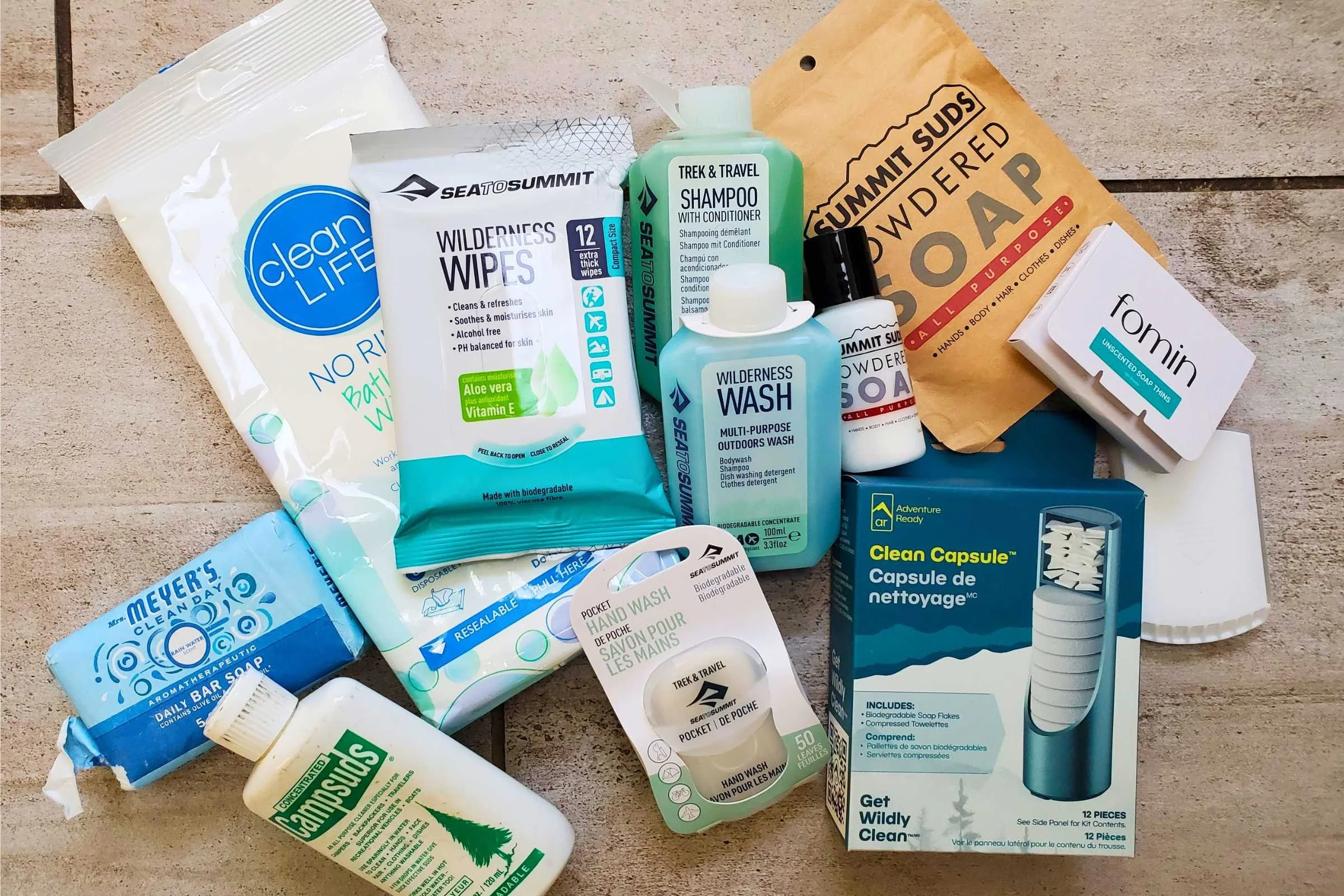
We tested 18 of the top biodegradable soaps on the market to find the best ones for camping and backpacking.
Short answer: “biodegradable” for soap usually means that the surfactant (the chemical that makes it soapy) breaks down between 60–70% within 28 days (+/- 10 days) under standard wastewater treatment conditions. If that sounds technical and only vaguely related to soap use in the outdoors, you are spot-on.
The term “biodegradable” isn’t really regulated, although technically the Federal Trade Commission (FTC) can prosecute any company that uses the term biodegradable “deceptively,” i.e., for something that won’t biodegrade under standard disposal conditions within one year. How often does this prosecution happen, though? And is “one year” even an environmentally meaningful timeframe? Who knows. So we can interpret “biodegradable” labels as essentially unregulated and prone to greenwashing.
If a company is serious about wanting its products to be biodegradable, the standard best practice is adhering to guidelines set by the Organization for Economic Cooperation and Development (OECD), an international research and policy organization. This means going by the rule mentioned above: using surfactants (soap chemicals) that are 60-70% broken down into CO2, water, and mineral salts within ~30 days under standard wastewater treatment conditions.
To clarify, this definition of biodegradability only applies when you use soap in your home and your home is in a place where wastewater treatment is reliable and consistent (not even true for all households in the US, see the CDC Foundation and 2021 Infrastructure Report Card to learn more). If you’re outdoors in a season or a place that’s cold, dry, nutrient poor, has fragile soil, or is anything other than warm and moist, your soap could take months or even years to break down. Also, it’s important to note that “biodegradable” guidelines only apply to the surfactant(s) in a product, which in many cases are only the tip of the iceberg when it comes to problematic ingredients (see below).
Bottom line: there are no guidelines or standards specifically for soap biodegradability in the outdoors. When you’re camping or backpacking, your soap skips the treatment plant and goes straight into ecosystems that are often not prepared to handle it. So how can we make decisions that make as little impact as possible? It all comes down to ingredients.
What should I know about soap ingredients?
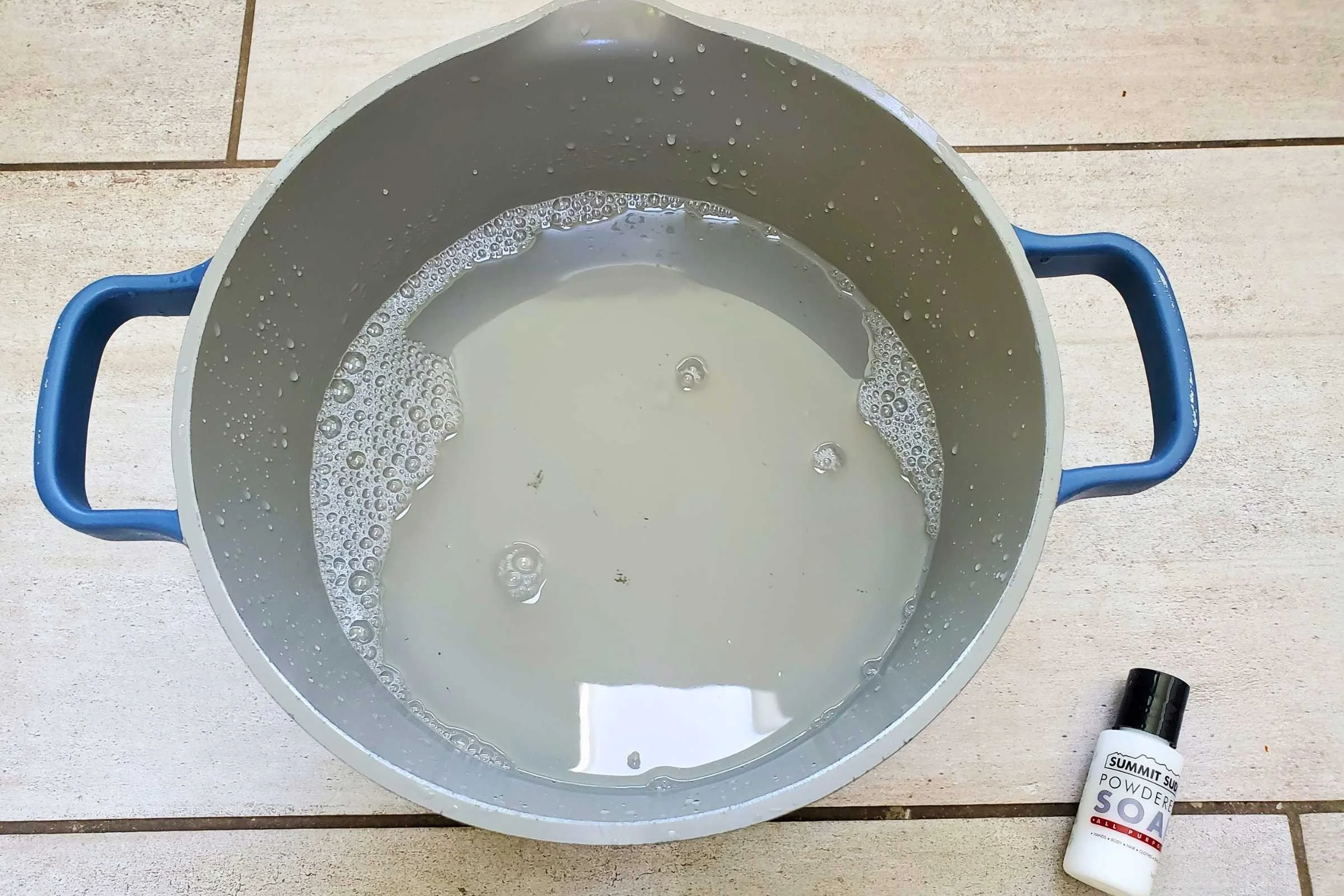
Like all the soaps on this list, Summit Suds doesn’t foam up as much as your dish soap at home, but that doesn’t mean it’s not working!
The ingredient that makes a soap soap is called a surfactant: that is, a chemical that allows water to interact with and remove oils, grease, and dirt that it normally wouldn’t mix with. It does this by reducing surface tension, which is great if you’re washing dishes, and not great if you’re, say, any organism that lives in water or relies on water-based molecules to live.
A soap “biodegrades” when microorganisms eat the surfactant molecules and break them down into simpler, harmless substances. The most biodegradable surfactants (that is, the ones most easily gobbled up by soil microbes) are ones derived from plants or plant oils, often ending in -glucoside, -olivate, or -cocoate on ingredient lists. A common surfactant called sodium laurel sulfate is technically biodegradable, but with a lot of caveats (more on that below).
Other chemicals you might have heard of when it comes to soap are phosphates and phthalates. Phosphates (which would show up in an ingredient list as a long chemical, like “something somethingphosphate”) are pretty uncommon in body and dish soaps these days, because when they get into water systems they massively impact fish populations and other aquatic life.
Phthalates are chemicals that help fragrances last longer; however, there is strong evidence that they can cause hormone problems in humans and non-humans. While many products have been phasing them out because of this, they can easily squeak by in ingredients like “fragrance” and “parfum,” because brands aren’t required to list what’s in their proprietary fragrances. Some good rules of thumb here are to look for products that are “phosphate-free,” “phthalate-free,” or even easier, “unscented” or “fragrance-free” with a short ingredient list.
The most basic soaps will only have a couple ingredients other than the surfactant(s): water, maybe a pH balancer, maybe glycerin or vitamin E (tocopherol) to keep it from drying your skin. More complicated soaps–that is, most soaps—can have LOTS of other ingredients, everything from industrial cleansing agents to something to make them shiny to patent-protected fragrance and other brand-specific stuff.
If you’re looking at ingredient lists for a soap to use outdoors, you can use the below as a helpful mental shortcut:
First 1–3 ingredients in the list = doing the actual cleaning
Middle of the list = texture, stability, preservation (especially in liquid soap)
End of the list = smell, color, marketing
For a soap you’ll use outdoors, you want the shortest possible middle and end (and ideally no fragrance, color, or marketing stuff at all).
Is sodium laurel sulfate (SLS) a biodegradable ingredient?
This is a tricky one! You may have heard of SLS or its similar cousin, sodium laureth sulfate (SLES), which are common ingredients in soaps, shampoos, and other cleansing products. According to best practices for biodegradability (listed above), this is a biodegradable chemical, because it is broken down pretty easily by microorganisms under ideal conditions (i.e., a warm environment with sufficient water and tons of microbes). Because of this, the majority of “sustainable,” “Leave No Trace,” and “biodegradable” soaps for outdoor use, including several market leaders, contain SLS.
On the plus side, SLS is a really effective surfactant: it works in cold water, it’s great at cleaning and degreasing, and it’s less likely than plant-based soaps to go sludgey or solid when it gets cold. On the down side, it’s not quite as biodegradable as the labeling might suggest.
The problem, of course, is that many camping and backpacking scenarios do not meet “ideal conditions” for biodegradation. If you’re outdoors in a season or a place that’s cold, dry, nutrient poor, has fragile soil, or is anything other than warm and moist, your SLS-based soap could take months or even years to break down. Even under ideal conditions, if you’re using a lot of soap, or if lots of people are using and discarding soap in the same general area, there could be negative impacts to the environment.
Our overall winner, Dr. Bronner’s, is one of the only soaps out there that does not contain SLS and also comes in an unscented liquid form. It’s easier to find SLS/SLES-free (often marketed as “sulfate-free”) soaps in solid (bar) form. If you’re using soap somewhere cold, dry, fragile, or otherwise not-warm-and-moist, consider using a biodegradable bar soap, Dr. Bronner’s liquid soap, or a soap-free option like cleansing wipes or rinsing with water.
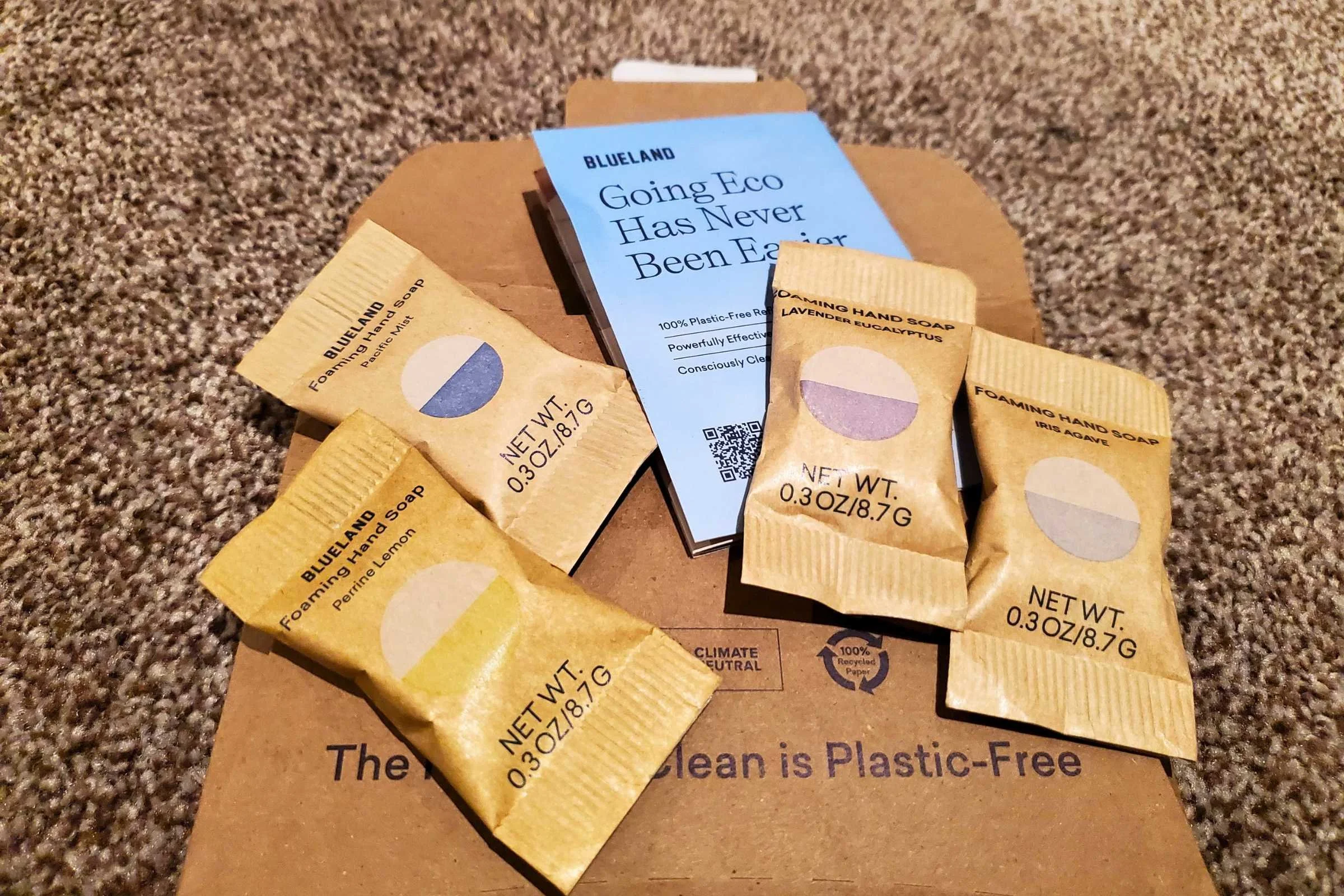
For home use, we love Blueland products for their effectiveness and sustainability.
FAQ
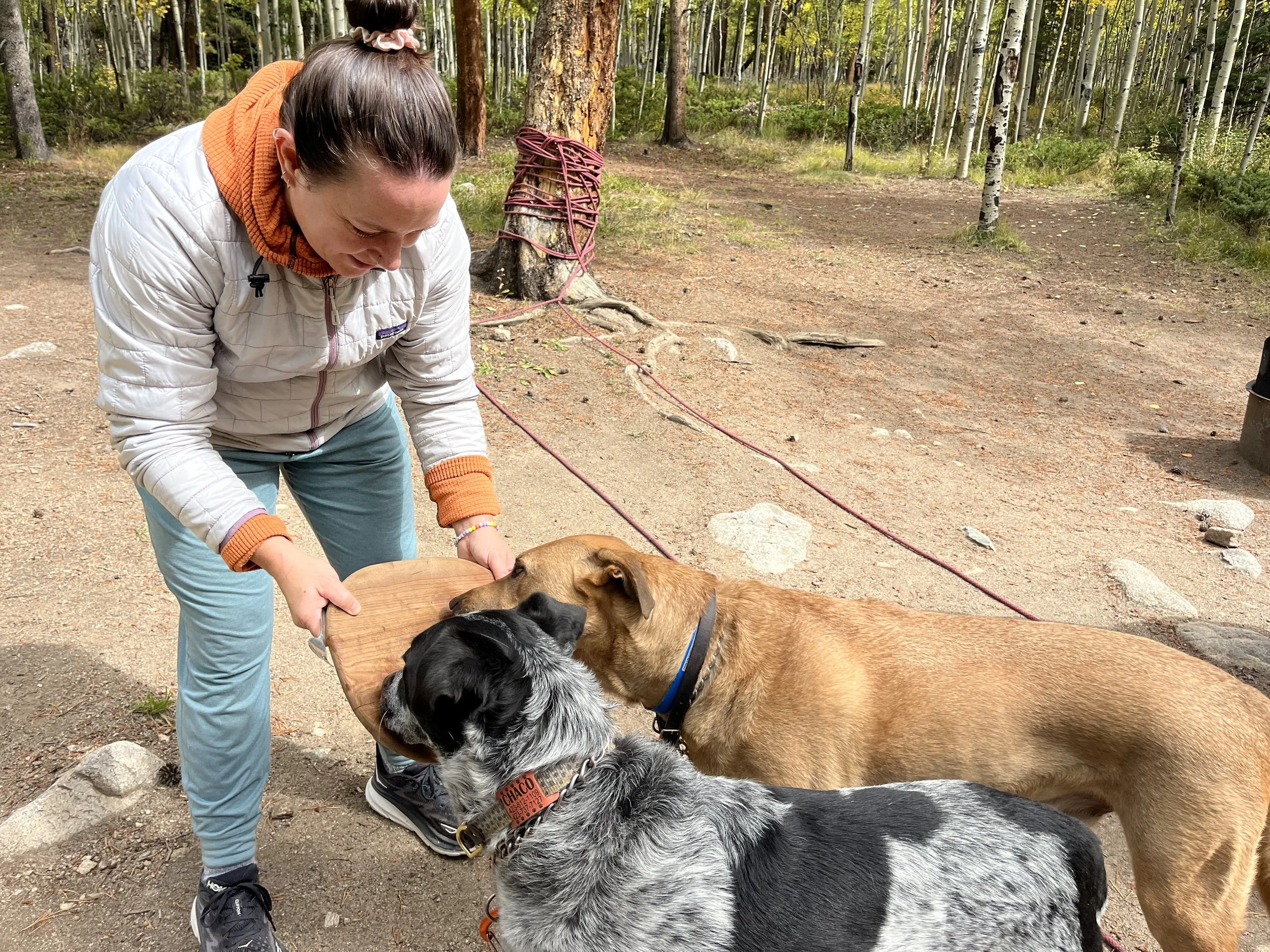
The first step to camp dishwashing is scraping off food scraps, which is much easier with help.
-
No. No matter what kind of soap you’re using, it is not safe to use directly in or next to a water source like a lake, river, or stream. Because soap is designed to lower the surface tension of water (this is what helps it clean things), it hugely affects things that live in water, damaging cell membranes, harming fish gills, decreasing oxygen availability, and otherwise causing negative impacts throughout the ecosystem. Use soap away from water, and dispose of grey (that is, soapy) water properly at least 200 feet from all water sources.
-
We’d advise against it. In our deep dive into ingredient lists, we found that most soaps you’d grab at the grocery store or drugstore and use at home in the kitchen or shower (even those labeled as “biodegradable” or “green” or “clean” or similar claims) contain ingredients that won’t biodegrade quickly or harmlessly under outdoor conditions.
In our research, Dr. Bronner’s and some simple bar soaps are the only ones that meet those requirements and are available in lots of stores as well as online. If you’re in a pinch, we’d recommend one of those two options. If neither is available, look for something that’s labeled as biodegradable, is unscented, and has as short an ingredient list as possible.
-
Not necessarily. Using biodegradable all-purpose soap on your body, hair, and clothes may not be as pleasant as using cleansers specifically made for these purposes, but most people find the differences tolerable in exchange for not having to bring/carry different products.
You may or may not notice that some biodegradable soaps can feel drying to the skin and hair, and the higher pH of all-purpose soaps compared to laundry detergent can make your clothes feel a bit stiff once they dry. Some technical clothes and gear should always be washed with specific soaps or without soap (like down jackets, many woolens, some water-repellent fabrics, etc.). If you’re washing dishes, the fragrances of some soaps may linger in your cookware (another reason we opt for unscented products when they’re available).
If you have particularly sensitive skin, if you have weight and space to spare, and/or if you’re traveling with lots of specialized gear or clothes, it may be worth bringing specific products for different uses. Otherwise, soap is soap and it’ll work!
-
If you’re using and disposing of your biodegradable soap outdoors, it’s important that you use as little as you possibly can. The double benefit of this is that you don’t need much. I took a single bottle of Wilderness Wash with me backpacking across eastern and southern Africa for three months, and I came back with some left in the bottle. Powdered soap is lighter and doesn’t leak but you’ll need more of it; on the flip side, you need less liquid and bar soap but they weigh more.
In our testing, we found the amount of soap needed to get 8 cups of cool (but not super cold) water soapy enough to clean things was between ⅛-½ teaspoon for concentrated liquid soaps, and around a teaspoon for powdered or flaked soaps. If you’re really unsure how much to bring, do a few household tests before you go: use it in the shower, use it to clean dishes, use it to wash a few shirts, see how much you need and calculate from there.
-
The method advocated by Leave No Trace principles and other best practices for dishes is to first scrape your dishes free of all food scraps; if you have the space, a scraper can be really helpful here. Dispose of scraps by throwing them in the trash or packing them out.
Next, collect your water and wash dishes/clothes using as little soap as possible. It’s helpful to use warm water for washing if you can, since it helps the soap work more effectively. Many campers advocate, if possible, a two or three-pot washing system for either dishes or clothes, with one pot of soapy water for washing and a second for rinsing (and, if necessary, a third to extra rinse/sanitize). For clothes washing, a portable clothes washing bag like the Scrubba Wash Bag can be really helpful.
Lastly, strain any food scraps out of the water and put them in the trash or your pack to dispose of later. Dispose of wash water by “broadcasting,” that is, flinging it over a wide area and not directly on any plants. Make sure you’re disposing of soapy water at least 200 feet from any water sources.
-
Although it’s still listed in many places and products, this is an outdated method for grey water disposal. Grey water—that is, water from hand washing, dish washing, brushing teeth, washing clothes, etc.—is not human waste, and often contains chemicals like soaps, toothpaste, and others that affect the environment in very different ways.
Catholes for grey water were the norm back when people in high-use, frontcountry camps were using more soap and had less understanding of cumulative impact. Now, we have better clarity around how this slows decomposition, attracts wildlife, and negatively affects the surrounding ecosystem.
Accordingly, though you may still see catholes mentioned, the norm has shifted away from this method for grey water in most backcountry contexts. Fortunately, many frontcountry camps are incorporating designated dish washing areas or grey water disposal areas.
-
Since “biodegradable” labeling isn’t really regulated, and since it only applies to one type of many potentially problematic ingredients, this is a very good question. Based on our research, if you want to be certain that the products you use at home won’t negatively impact the environment, follow the rules of thumb mentioned above for what to look for in biodegradable soaps. In general, look for “biodegradable,” but also prioritize short, simple ingredient lists and avoid long lists full of unpronounceable chemicals.
Our overall winner, Dr. Bronner’s Liquid Soap, is a perpetually popular option (and in fact has been the body wash of choice in my household for years—many natural food stores and co-ops have refill stations for all Dr. Bronner’s scents, which is wonderful).
Thinking a bit more broadly, packaging is a major source of waste, which is why we like Blueland for products like hand soap, dish soap, laundry detergent, and other household needs. While we don’t love them for outdoor use (all their products contain SLS/SLES), their plastic-free packaging, relatively simple ingredient lists, and sustainable ethos make them perfect for in-home use.
How we researched and tested
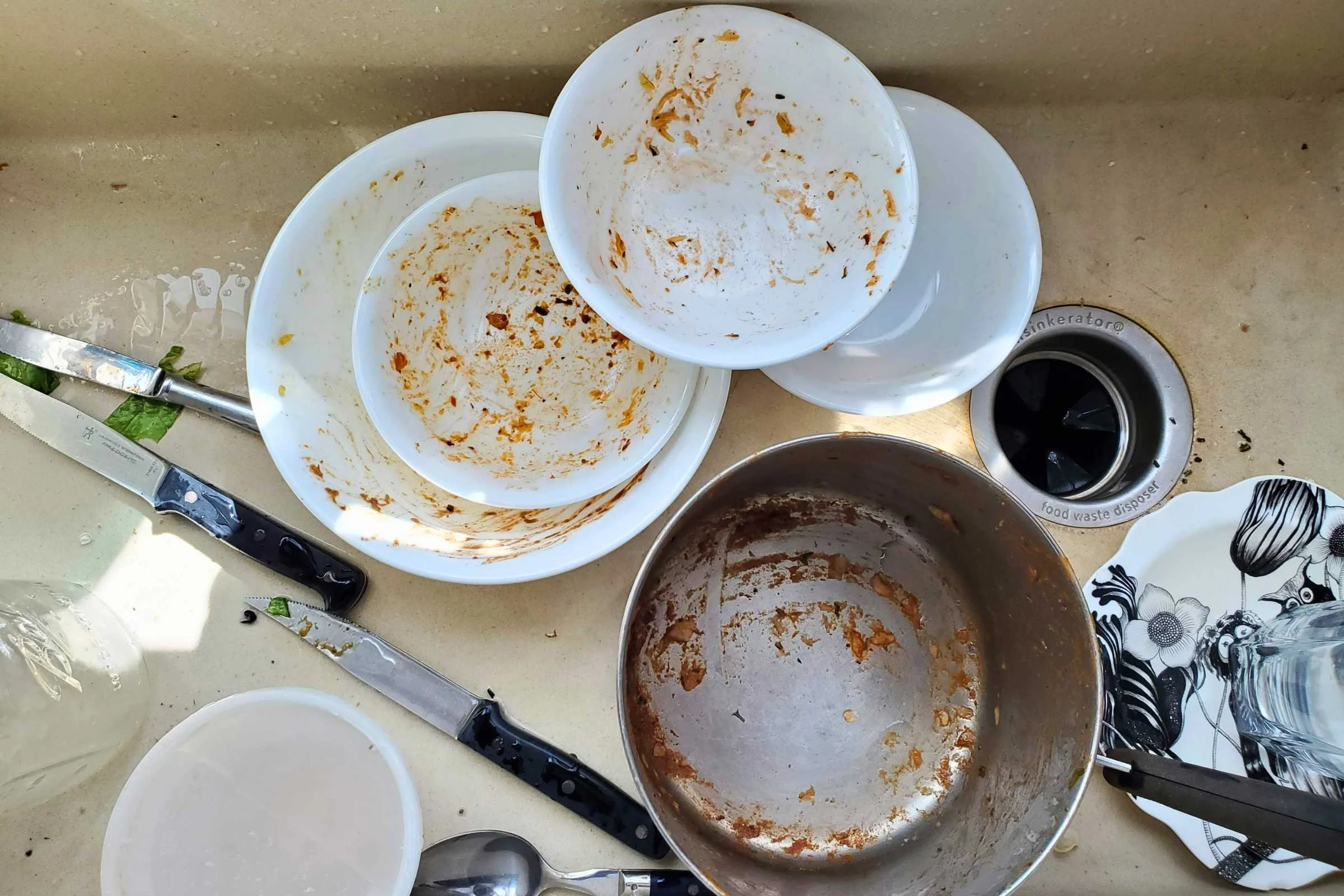
The dirty dishes after spaghetti night were the perfect opportunity to systematically test biodegradable soap functionality.
We began our search with in-depth analysis of soap ingredients, biodegradability, and the reality of how soaps break down in the outdoors. Armed with this knowledge, we reviewed the soaps listed as “biodegradable” frequently mentioned across retail sites, outdoor media, reviews, and expert commentary. Of these we selected the top 18 that were the most highly rated, relatively affordably priced, and widely available.
We tested these first methodically at home (to ensure testing scenarios were as consistent as possible across products) and then in the field (camping, hiking, backpacking, at the beach, at the park, traveling to New Zealand, etc.). We used them to tackle greasy hands, dirty bodies, crusty dishes, sweaty clothes, and campfire-scented hair, all in cool or room-temperature water (with the understanding that colder water would lead to worse soap performance, and warm water would have better performance).
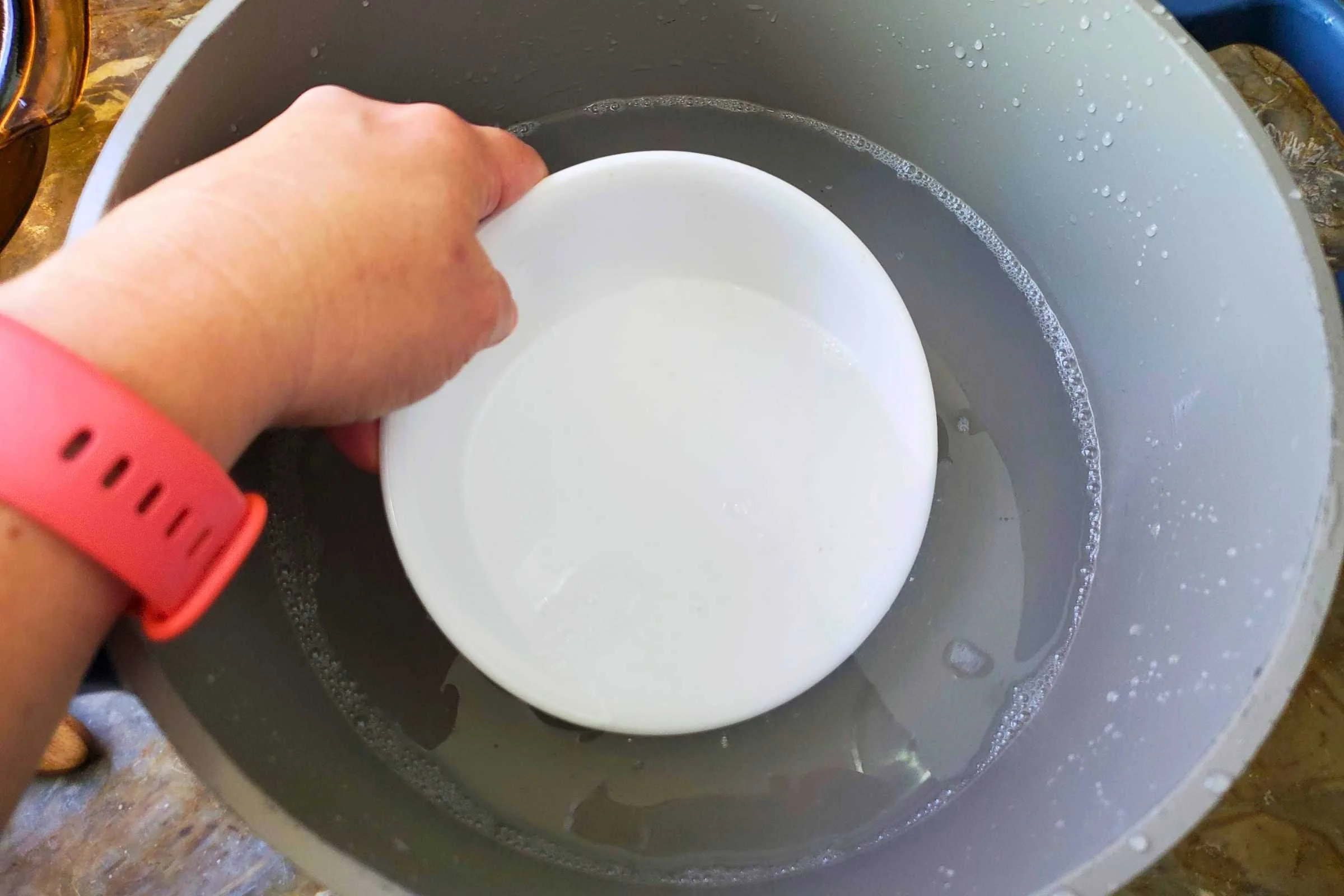
For testing purposes, we employed the two-pot wash method, with a pot for washing and a pot for rinsing.
We noted user experience details, like the amount of product needed, whether it left a residue, whether it was drying to the skin, and whether it worked equally well for all stated purposes. We also reviewed the thousands of customer reviews for these products that exist across online retail sites like Amazon, REI, and others to understand common likes, dislikes, benefits, and drawbacks.
- Systematic at-home testing for consistency
- Field testing while camping & backpacking
- Tested on dishes, body, hair & clothes
- Cool & room-temp water conditions
- Two-pot wash method for dishes
- Biodegradability & ingredient safety
- Cleaning effectiveness on grease & grime
- Lather & residue in cold water
- Skin dryness & irritation
- Packability & leak resistance
Why you should trust us / About the author
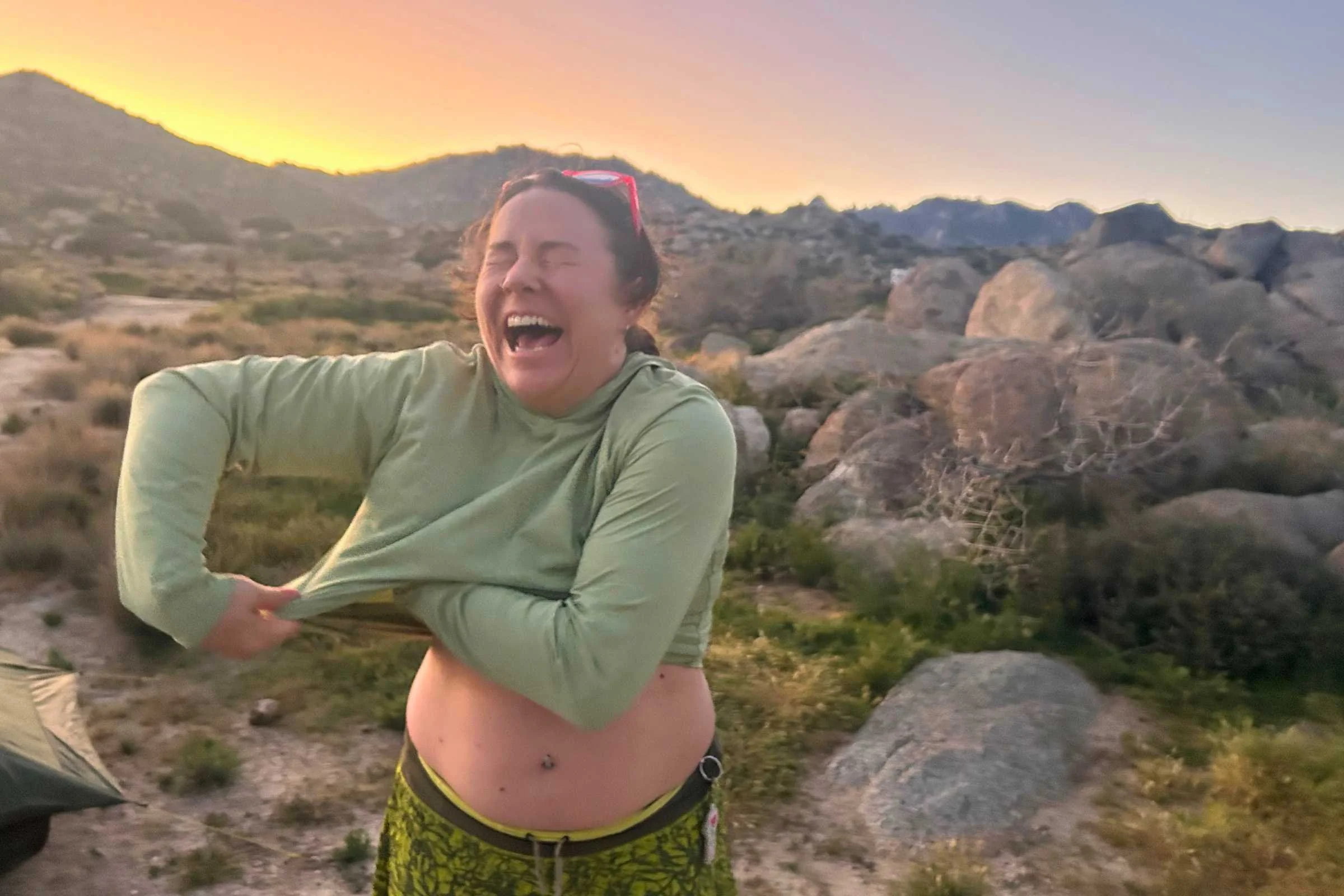
The author did the true dirty work testing biodegradable soaps, wipes, and other camp cleansing products both in the field and in the lab (well, kitchen).
I am an ecologist, data scientist, and lifelong outdoor enthusiast who gets her kicks deep-diving into the abyss of complex and contradictory information around topics few others want to read about for 50+ hours (like soap!). As an environmentalist and passionate hiker, camper, backpacker, and eater of snacks in pretty places, it’s obviously vitally important that I know exactly which product(s) will cause the least ecological damage in any area I am snacking, washing dishes, cleaning my dirty legs, and otherwise trying to keep myself together. With fellow testers from the Treeline community, we did the science and put these soaps through the wringer.
Find more of Katie’s guides on her Treeline Review author page.