Best Winter Socks of 2026
Warm, moisture-wicking wool and synthetic socks for winter outdoor activities
December 14th, 2025
Home → Gear Reviews → Outdoor Apparel
In winter, the comfort of our feet is paramount, and our socks can make or break our wintertime happiness. Choosing the right socks will keep your feet warm, dry, and protected when venturing outside, whether that’s commuting, at work, running, hiking, snowshoeing, cross-country skiing, fishing, hunting, or camping.
In the past, winter socks were made of 100% wool, which has many innate challenges. But now, socks are widely available in merino blends, blending soft wool with durable elastic synthetics, allowing us to machine wash and dry our socks while also benefiting from a softer texture and a streamlined fit. Many modern winter socks also offer mapped cushioning for increased comfort, durability, and blister prevention. And many sock brands have excellent warranties, guaranteeing their craftsmanship.
We tested 15 pairs of socks in shoulder season in the Northeast, where testers faced snow, rain, below-freezing temperatures, and windchill as low as 5 degrees. These socks joined our testers on a wide assortment of activities, from day hikes to snowshoeing, from bike rides to commuting, and from trail runs to evening walks. And these socks were used in a wide selection of footwear, from insulated winter hiking boots to trail running shoes, from formal work shoes to cycling shoes.
We evaluated each pair of socks we tested on these key features: moisture control (including dry time), fit/heel lock, toe seams, cushioning, warmth-to-bulk ratio, odor resistance, durability, warranty, washing instructions, and sustainability.
Our pick for Best Overall is the Smartwool Hike Classic Full Cushion sock. It’s a versatile midweight sock that fits well within boots and shoes alike, made with New Zealand merino wool and recycled nylon. The Smartwool sock fits well and does not slide down, and balances warmth with breathability for a great all-around winter sock.
Read on to learn more about our favorite winter socks, what to look for, activity-specific advice, and more.
We write mission-driven gear reviews. To find the best gear, we combine expert reviews, everyday user opinions, and rigorous independent trail testing—never native ads or sponsored posts. We are 100% reader-supported and may make a small commission from some qualifying affiliate links. Learn more.
Comparison table
| WINTER SOCKS | TREELINE AWARD | WOOL/ FABRIC | WARMTH | ODOR-RESIST | MSRP* |
|---|---|---|---|---|---|
| Smartwool Hike Classic Full Cushion Crew Women's Men's |
Best Overall Read why |
39% merino/ mixed/ nylon | Warm | High | $23 |
| Point6 Core Extra Heavy Crew | Warmest Read why |
77% merino/ nylon | Very warm | High | $34 |
| Darn Tough Hiker Boot Full Cushion Women's Men's |
Best for Hiking Read why |
69% merino/ nylon | Warm | High | $30 |
| Wigwam Woodland Heavyweight OTC | Best for Cycling Read why |
70% merino/ nylon/ acrylic | Warm/ very warm | High | $22 |
| PAKA Thermal Costa Crew | Best for Sweaty Feet Read why |
52% alpaca/ Tencel/ nylon | Warm | High | $28 |
The winners
Best overall winter socks: Smartwool Hike Classic Full Cushion
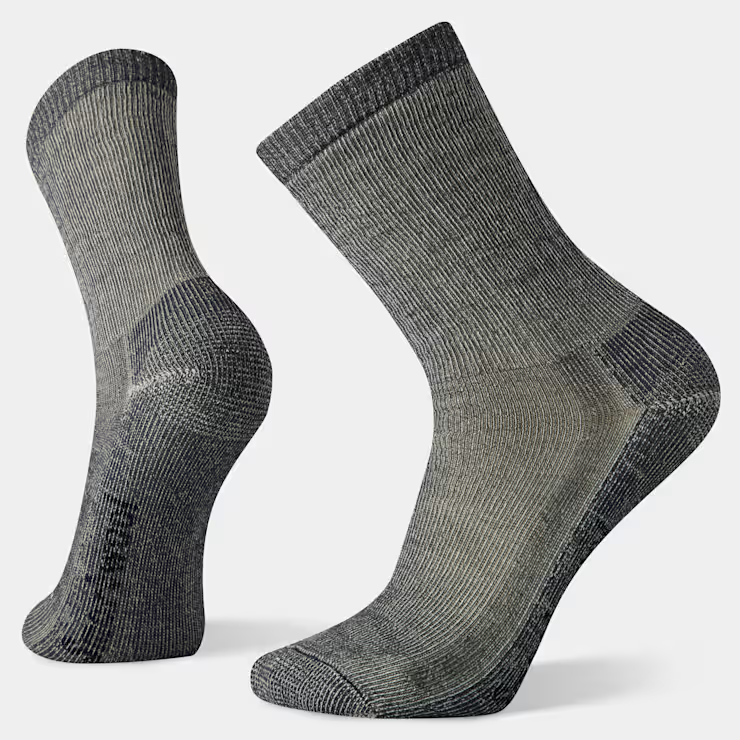
Fabric & merino %: 56% merino wool/31% recycled nylon/11% nylon/2% elastane
Cushioning (ultralight/light/mid/heavy): Mid
Height (crew/OTC): Crew
Warmth level (moderate/warm/very warm): Warm
Breathability (low/med/high): Med
Odor resistance (low/med/high): High
Dry time (fast/med/slow): Med
Durability/warranty (good/better/best): Better
Best for (activity/use case): Commuting, Walking, Hiking, Snowshoeing
Price (MSRP): $27
What we liked: Warmth-to-thickness ratio, durability
What could be better: The sock fit could benefit from tighter compression.
The Smartwool Hike Classic Full Cushion socks win our pick for Best Overall winter socks. They’re a crew sock made in the USA from New Zealand merino wool and recycled nylon. The Smartwool Hike Classic has full cushioning, elasticized arch support, and flat toe seams.
Smartwool Hike Classic Full Cushion
men's
Women's
Elastic in the upper portion of the crew sock keeps the socks from sliding down the leg and bunching at the ankle or underfoot, though it would benefit from more compression for a tighter, more performance-oriented fit. The socks kept their shape through multiple wears and after washing. Smartwool care use instructions allow for machine washing and machine drying using air only or low heat. The midweight full cushion meant the socks fit into mid and high-volume shoes and boots without causing midfoot pressure or crowding our tester’s toes.
These socks balance the many traits of a good all-around winter sock; they’re warm while remaining breathable, soft while remaining durable. They’re highly resistant to odor, and dry out with some time thanks to their mixed fibers. The Smartwool Hike Classic socks kept our tester’s feet warm while commuting, walking, hiking, and snowshoeing.
The Smartwool Hike Classic socks have shown no signs of wear during our testing. Based on our past experiences with Smartwool socks, their socks are durable and also come with a two-year satisfaction guarantee.
While there are other socks better at specific types of activities, the Smartwool Hike Classic socks are flexible winter socks that can do a little bit of everything. If you’re looking for a great generalist winter sock, these are the socks for you!
Warmest socks for winter: Point6 Core Heavy Extra Crew

Fabric & merino %: 77% merino wool, 20% nylon, 3% elastic
Cushioning (ultralight/light/mid/heavy): Heavy
Height (crew/OTC): Crew
Warmth level (moderate/warm/very warm): Very warm
Breathability (low/med/high): Low-Med
Odor resistance (low/med/high): High
Dry time (fast/med/slow): Med-Slow
Durability/warranty (good/better/best): Better
Best for (activity/use case): Snowshoeing, Camping, Fishing, Hunting
Price (MSRP): $34
What we liked: Plush, very warm, durability
What could be better: The sizing runs large
The Point6 Core Heavy Extra Crew socks are our winner for Warmest Socks for Winter. They’re a crew sock made in the USA in the Appalachian Mountains from merino wool with nylon for durability and elastic for fit. The Point6 Heavy Extra Crew has full cushioning, elasticized arch support, and seamless toe closure.
Point6 Core Heavy Extra Crew
These heavyweight cushioned socks maintained their shape through extended wear and the crew section of the sock stayed up well. The Point6 socks can be machine-washed and dried on low heat. These socks worked well in high volume boots, but were too thick for mid-volume boots and shoes. They were very warm and provided extensive cushion due to their heavyweight nature.
For how thick they were, they breathed well, though some moisture did stay within the sock. The warmth offset this issue and moisture was never a problem. They resisted odor over multiple wears and long days. Due to their weight, they dried a bit slower than other thinner socks but faster than our tester anticipated. The Point6 Crew socks excelled at keeping our tester’s feet warm when engaging in lower-intensity or colder weather activities. These socks would be a great fit for snowshoeing, camping, fishing, or hunting.
The Point6 Crew socks have withstood outdoor activities and washing quite well, with no sign of wear. The material is thick and plush, even on day two or three. Point6 also offers a lifetime guarantee for premature wear or dissatisfaction with fit or feel, along with generous discounts to search and rescue, military, police and fire professionals, health and medical professionals, tactical professionals, and outdoor and industry professionals.
The Point6 Crew socks shine in cold environments. This is the sock for those who are looking to spend hours standing in the snow, moving slowly in the cold, or just always have cold feet.
Best winter hiking socks: Darn Tough Hiker Boot Full Cushion

Fabric & merino %: 66% merino wool, 32% nylon, 2% Lycra spandex
Cushioning (ultralight/light/mid/heavy): Mid
Height (crew/OTC): Over the calf
Warmth level (moderate/warm/very warm): Warm
Breathability (low/med/high): Med
Odor resistance (low/med/high): High
Dry time (fast/med/slow): Med-Fast
Durability/warranty (good/better/best): Best
Best for (activity/use case): Hiking, Cross-Country Skiing
Price (MSRP): $30
What we liked: Excellent performance fit, warmth-to-thickness ratio, sustainability, durability, excellent warranty
What could be better: N/A
The Darn Tough Hiker Boot Full Cushion socks are our winner for Best Winter Hiking Socks. Darn Tough socks are well loved by thru-hikers, and various models of Darn Tough socks have been recognized as Treeline Review’s Best Overall Hiking Socks, Best Vegan Hiking Socks, and Best Winter Running Socks. These over the calf socks are made in the USA in Vermont from merino wool, nylon, and lycra spandex. The Darn Tough Hiker Boot sock has full cushion, a reinforced Achilles cushion, and seamless toe closure.
Darn Tough Hiker Boot Full Cushion
men's
Women's
These midweight fine-gauge-knitted socks keep their shape over multiple days of wear. These Darn Tough socks stay up better than any other sock we tested, with no slipping, bunching, or blisters. Darn Tough socks are easy to care for, allowing for machine washing and drying at low heat. These socks balance warmth and cushion with a thickness that reasonably fits in most footwear.
The Darn Tough Hiker Boot socks have the excellent breathability expected of the brand, and dry quickly given the level of cushion. They also have an excellent warmth-to-thickness ratio, all with a soft texture. They have outstanding resistance to odor over long days and multiple wears. With their excellent fit, breathability, and streamlined thickness, these socks are optimal for higher-intensity outdoor winter activities, like hiking and cross-country skiing. They can also be used for cycling on warmer winter days or in higher-volume running shoes on colder winter days.
Darn Tough is renowned for their durability and outstanding warranty. Our tester’s Darn Tough socks look brand-new, despite weathering many tough miles already. Darn Tough offers an unconditional lifetime warranty–no receipt needed with an easy online process and the option to exchange in-store at select retailers. And as one of the few Responsible Wool Standard socks we tested, Darn Tough is committed to animal welfare, sustainable farm and land management practices, and traceability in the supply chain. They’re also invested in sustainability and transparency at all points of production.
The Darn Tough Hiker Boot Full Cushion socks excel at high-output outdoor winter activities. These socks are a great fit for keeping feet warm and dry while winter hiking or cross-country skiing.
Best winter cycling socks: Wigwam Merino Woodland
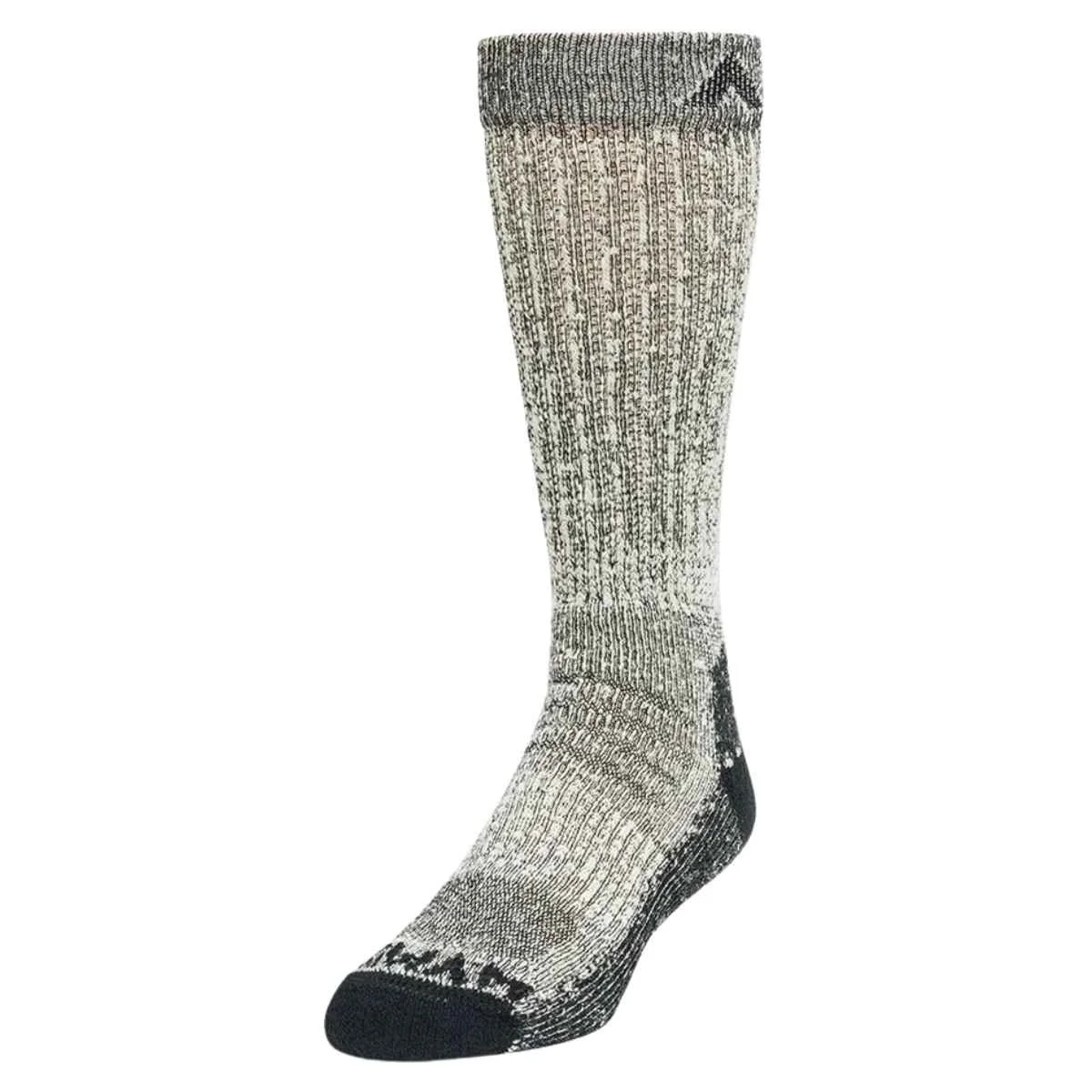
Fabric & merino %: 70% merino wool, 20% nylon, 8% acrylic, 1% spandex, 1% polyester
Cushioning (ultralight/light/mid/heavy): Mid-Heavy
Height (crew/OTC): Over the calf
Warmth level (moderate/warm/very warm): Warm-Very Warm
Breathability (low/med/high): Med-Low
Odor resistance (low/med/high): High
Dry time (fast/med/slow): Med
Durability/warranty (good/better/best): Good
Best for (activity/use case): Cycling, Outdoor Work
Price (MSRP): $22
What we liked: Warmth-to-thickness ratio, breathability
What could be better: Lacking a snug performance fit, limited warranty
The Wigwam Merino Woodland is our pick for Best Winter Cycling Socks. They’re knee-high socks made in the USA in Wisconsin with merino wool, nylon, acrylic, spandex, and polyester. They’re full cushioned with a seamless toe closure.
Due to the lack of a snug fit, we wouldn’t recommend these socks for winter activities where your foot will be moving around more, since bunching and blistering could be a problem, but for cold-weather activities with less foot motion (like cycling), these socks are a great fit. They are warm for their weight, keep the lower leg warm, and fit well into mid and high-volume footwear.
Wigwam Merino Woodland
The heavyweight Wigwam Merino Woodland socks can be machine washed and dried using low heat. They retain their shape fairly well over multiple wears. They don’t have a snug performance fit, though their knee-high fit prevents the sock from sliding down. The Wigwam Merino Woodlands are lower volume than other heavyweight socks we tested, and so they fit more easily in mid-volume footwear. They were thin enough to fit within our tester’s cycling shoes comfortably.
These socks hit the middle ground between midweight and heavyweight, delivering a warm sock with more breathability and quicker dry times than most heavyweight socks. They showed a small amount of wear from multiple washings, but our tester did forget to turn the socks inside out so that issue was due to user error. These socks are odor resistant over multiple days of wear, and have a nice texture similar to cotton.
Wigwam uses American yarn spinners and American wool growers almost exclusively. They also offer a two-year warranty for faulty manufacturing issues, though they require proof of purchase and that the socks were purchased from an authorized dealer (Wigwam sock resellers are not covered–this includes Amazon).
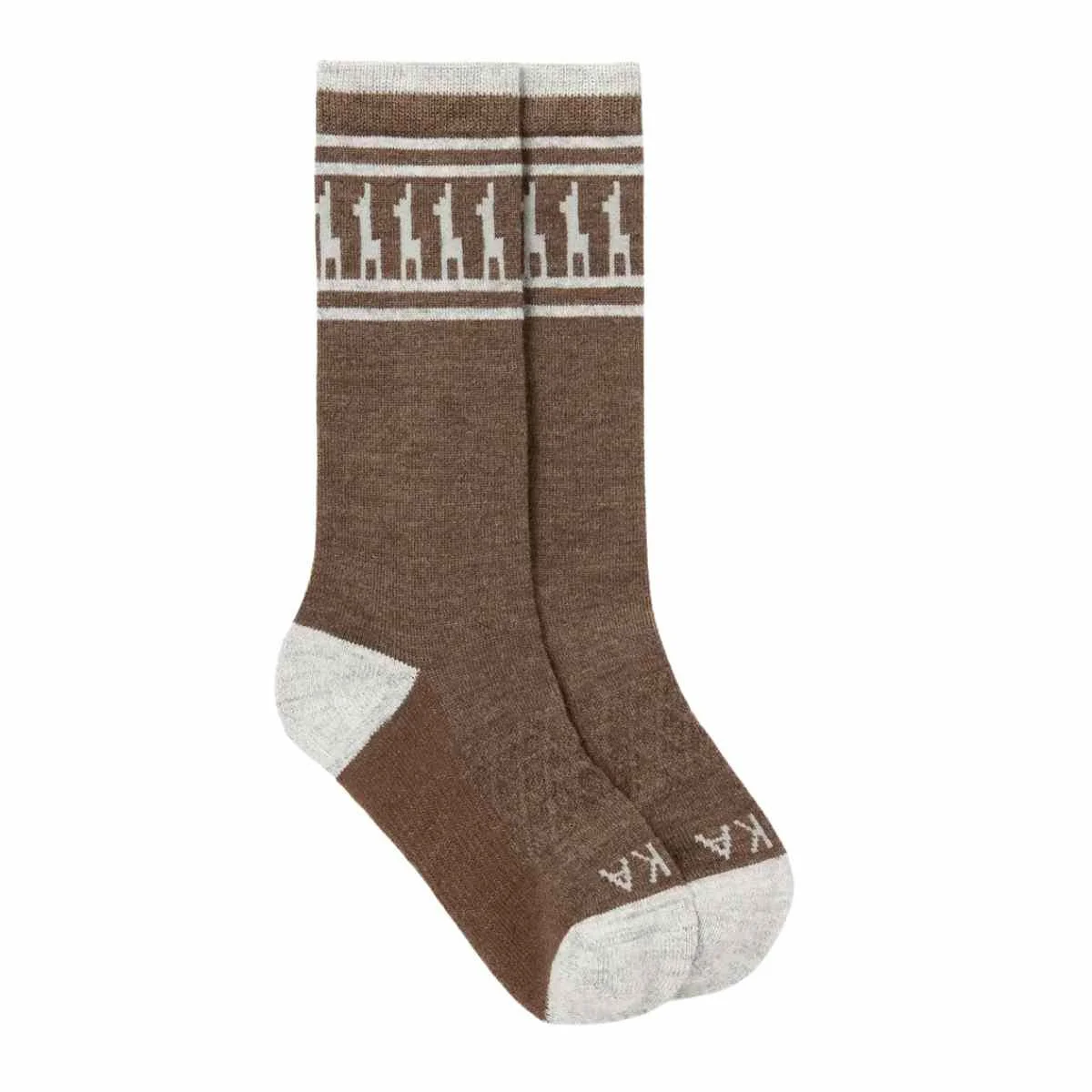
Best winter socks for sweaty feet: PAKA Costa
Fabric & merino %: 52% baby alpaca fiber, 11% Tencel, 36% recycled nylon, 1% spandex
Cushioning (ultralight/light/mid/heavy): Light-Mid
Height (crew/OTC): Crew
Warmth level (moderate/warm/very warm): Warm
Breathability (low/med/high): High
Odor resistance (low/med/high): High
Dry time (fast/med/slow): Fast
Durability/warranty (good/better/best): Best
Best for (activity/use case): Cycling, Cross-country skiing, Commuting, Walking
Price (MSRP): $28
What we liked: Warmth-to-thickness ratio, breathability, soft, moisture wicking, quick drying, outstanding sustainability
What could be better: Consistent care instructions, improved durability
Our winner for Best Winter Socks for Sweaty Feet is the PAKA Costa socks. These crew socks are made in Peru from baby alpaca fiber, tencel, recycled nylon, and spandex, with a triple-sole cushion. Similar to sheep wool, alpaca fibers are antimicrobial and thermoregulating while being three times lighter than wool.
PAKA Costa
Alpaca fibers are also hypoallergenic and very water resistant, only absorbing about 10% of its weight in water. Sheep wool absorbs ~30%, while synthetics absorb 0.5 to 8% depending on the specific type. This feature offers a naturally-occurring fiber that matches synthetic materials for water resistance.
The PAKA Costa socks retain their shape very well, keeping a snug performance fit across multiple days of wear. They have a moderate, all-around cushion, on the lighter side of midweight. They easily fit within most footwear, including low-volume formal work shoes and cycling shoes.
The care instructions recommend hand washing if possible but also note they are machine washable and can be line dried or dried on low heat. One of Treeline Review’s writers noted her past pair of PAKA socks had dramatically shrunk through the use of a low heat dryer, and so she only air dries her PAKA socks now.
PAKA Costa socks are extremely soft and odor resistant, with a quick dry time since they absorb so little moisture. They wick away sweat well, breathe well, and have an excellent warmth-to-thickness ratio.
While these socks have many strengths, the primary issue our tester noticed was durability. After a single 12-hour hike with some snowshoeing over tough terrain, the socks were dry and warm but also shedding 3-inch pieces of fiber and the fabric had begun to felt. While time will tell if this is an ongoing deterioration, this shedding noticeably affected the sock’s thickness and concerned our tester. With this in mind, we would recommend these socks for winter activities that require less durability from socks, and choose a different sock for activities like running, hiking, and snowshoeing.
However, PAKA offers a lifetime guarantee for their socks through an online replacement process. PAKA is also a Certified B Corps, a designation that indicates a business has gone through a process to meet standards of performance, accountability, and transparency, focused on the company's social and environmental impact. They're dedicated to responsible and sustainable practices, including using traceable alpaca, supporting fair-trade weaving, contributing 1% of sales to university scholarship opportunities for Peruvian youth through partnership with a Peruvian non-profit organization, and returning 1% of sales to the International Alpaca Association.
The PAKA Costa socks are warm while being remarkably thin, breathable, and moisture resistant. For folks with sweaty feet, these socks are an amazing addition to the winter sock rotation from a company dedicated to minimizing social and environmental impact and supporting the communities where their manufacturing takes place.
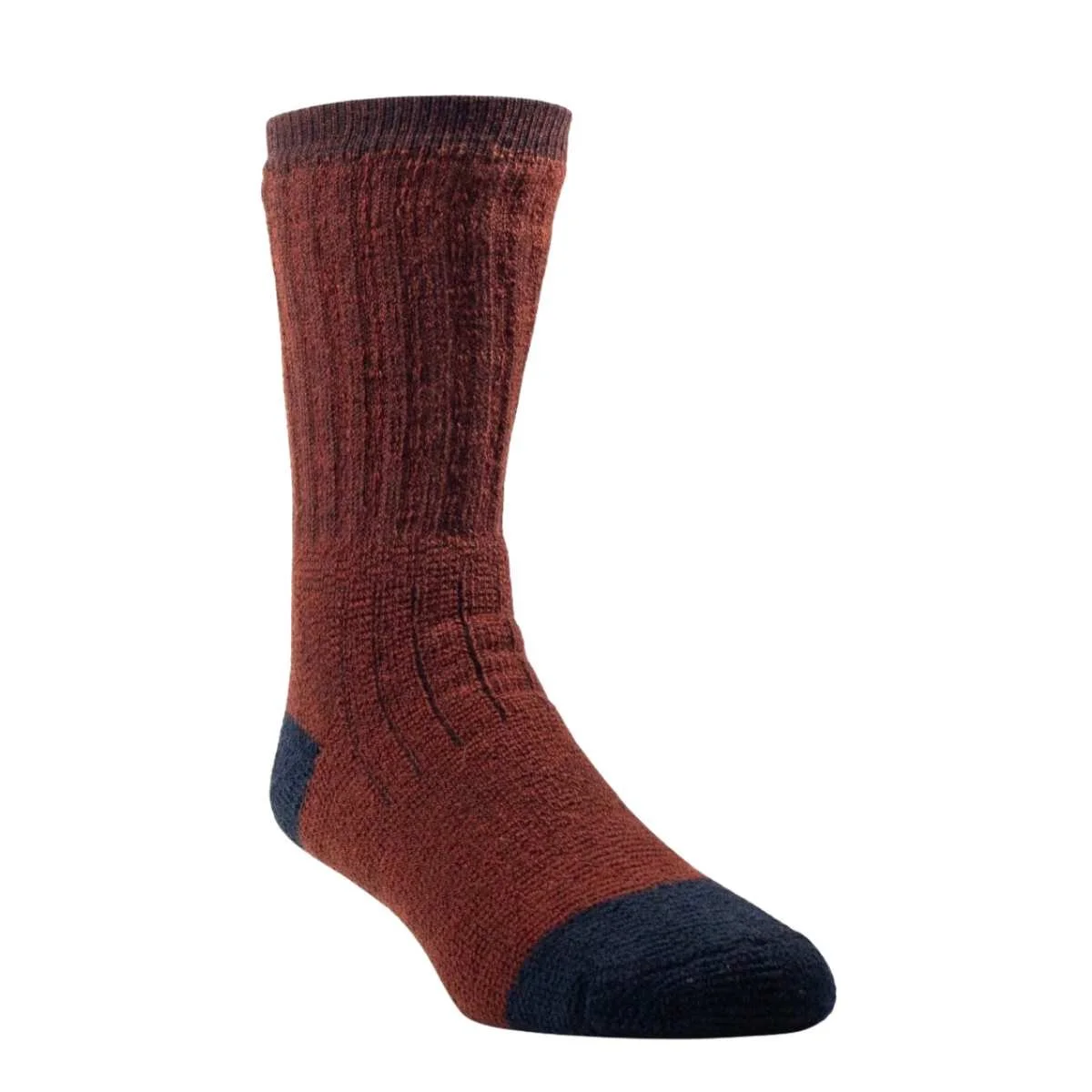
Best socks for winter camping: Farm to Feet Rugged trail denali Full Cushion
Fabric & merino %: 91% US merino wool, 8% US nylon, 1% US Lycra spandex
Cushioning (ultralight/light/mid/heavy): Extra heavy
Height (crew/OTC): Crew
Warmth level (moderate/warm/very warm): Very warm
Breathability (low/med/high): Med-Low
Odor resistance (low/med/high): High
Dry time (fast/med/slow): Med-Slow
Durability/warranty (good/better/best): Better
Best for (activity/use case): Camping, Fishing
Price (MSRP): $33
What we liked: Warm, plush
What could be better: Thickness was limiting, loose toebox
Our pick for Best Socks for Winter Camping is the Farm to Feet Denail Full Cushion socks. They’re a crew sock made in the USA in North Carolina with 91% merino wool, with a small amount of nylon and spandex. They’re fully cushioned with reinforced construction and low-stress seam placement. These socks were developed in collaboration with the Alaska Mountaineering School, and intended for high-altitude mountaineering.
Farm to Feet Rugged Trail Denali Full Cushion
The Farm to Feet Denali socks have a more loose shape overall, but maintain that shape well over many days of wear. These socks allow for cold-water machine washing but limit the use of machine drying to air only.
These socks are fully cushioned. Due to being extra heavyweight socks, they are quite limited in terms of what footwear they can fit within. Our tester tried these with his most spacious winter boots and the fit was so snug it noticeably reduced blood flow to his toes, creating numb spots. Unless specifically using mountaineering boots or very high-volume boots, these socks are too thick for most uses. However, they’re perfectly luxurious for camp socks and sleeping!
These socks are extremely thick and very warm. They breathe well considering their weight, and resist odors. They have a longer dry time, but that is to be expected given the sock’s thickness. They have shown no signs of wear, and are like a cozy blanket for feet. Our tester has used these socks around the house and for winter car camping, as an excellent barrier against cold environments when holding still for prolonged periods of time. They complement a warm sleeping bag and heavyweight base layers for cold sleeping. If these socks fit within the intended footwear, they’d also be excellent for ice fishing.
Farm to Feet is dedicated to a 100% American supply chain, using merino wool from American Sheep Industry ranchers, processed into yarn by companies in North and South Carolina, and then knit into socks in North Carolina. They also source all of their synthetic materials from within the US. Farm to Feet is a member of the Conservation Alliance, and a supporter of the ATC, PCTA, and CDTC. Farm to Feet has a satisfaction guaranteed policy, and will replace socks that do not perform satisfactorily. You can read about them in Our Favorite USA-made Outdoor Gear.
Farm to Feet Denali Full Cushion socks are an extra heavyweight sock that is too thick for most footwear but delivers a plush, extra warm sleeping sock. These socks are a wonderful match for camping outside or in unheated spaces on cold nights.
Best affordable winter socks: MOGGEI Merino Wool Hiking Socks

Fabric & merino %: 70% merino wool, 23% polyester, 5% spandex, 2% nylon
Cushioning (ultralight/light/mid/heavy): Ultralight-Light
Height (crew/OTC): Crew
Warmth level (moderate/warm/very warm): Moderate
Breathability (low/med/high): Low
Odor resistance (low/med/high): Low
Dry time (fast/med/slow): Med
Durability/warranty (good/better/best): Good
Best for (activity/use case): Commuting, Walking, Running
Price (MSRP): $22 (5 pairs)
What we liked: Performance fit, cost
What could be better: The wool can be itchy, durability, warmth, odor resistance
Our pick for Best Affordable Winter Sock is the MOGGEI Merino Wool Hiking Socks. They’re a crew sock from merino wool, polyester, spandex, and nylon, with an unknown origin of manufacture. These socks include compression arch support and flat-toe seams.
MOGGEI Merino Wool Hiking Socks
men's
Women's
MOGGEI socks have a very light overall cushion, in line with other brands’ ultra-lightweight or lightweight no-cushion. They wear snuggly, with a performance fit, though they do size a bit small. They retained their overall shape well through multiple days of wear, though they began to smell after only one day. The care directions include machine washing but do not state what they recommend for drying; based on other wool socks, and our own experience, machine drying using air or low heat is likely acceptable. Because they’re very thin, they fit easily within any type of footwear.
These socks absorbed more moisture than other wool socks we tested. They kept our tester’s feet mostly dry, but the socks themselves quickly became damp and clammy. They dried more slowly than they should have, given their lightweight nature. They’re also thin and the weave is looser and less dense than more expensive wool socks, making them less warm. They’ve begun to show wear on high-tension spots (like the big toes) after multiple days of testing, so durability is a concern. These socks were also itchy; though that issue declined with wear and washing, it was still noticeable and could be a deal-breaker for some people.
Like other Amazon products, the return process if they’re unsatisfactory in the first month or two will likely be fairly easy. However, returns are likely to end up in a liquidator warehouse, being sold as bulk pallets, or in the trash and not returned to shelves or recycled.
MOGGEI socks are not a winter-specific sock, but are instead an inexpensive merino wool sock from Amazon. For those on a budget, these are a reasonable option to obtain lightweight merino wool socks for high-intensity activities like running, or more casual outdoor winter activities like commuting or walking, where snow and cold weather exposure are more limited.
Other winter socks we tested
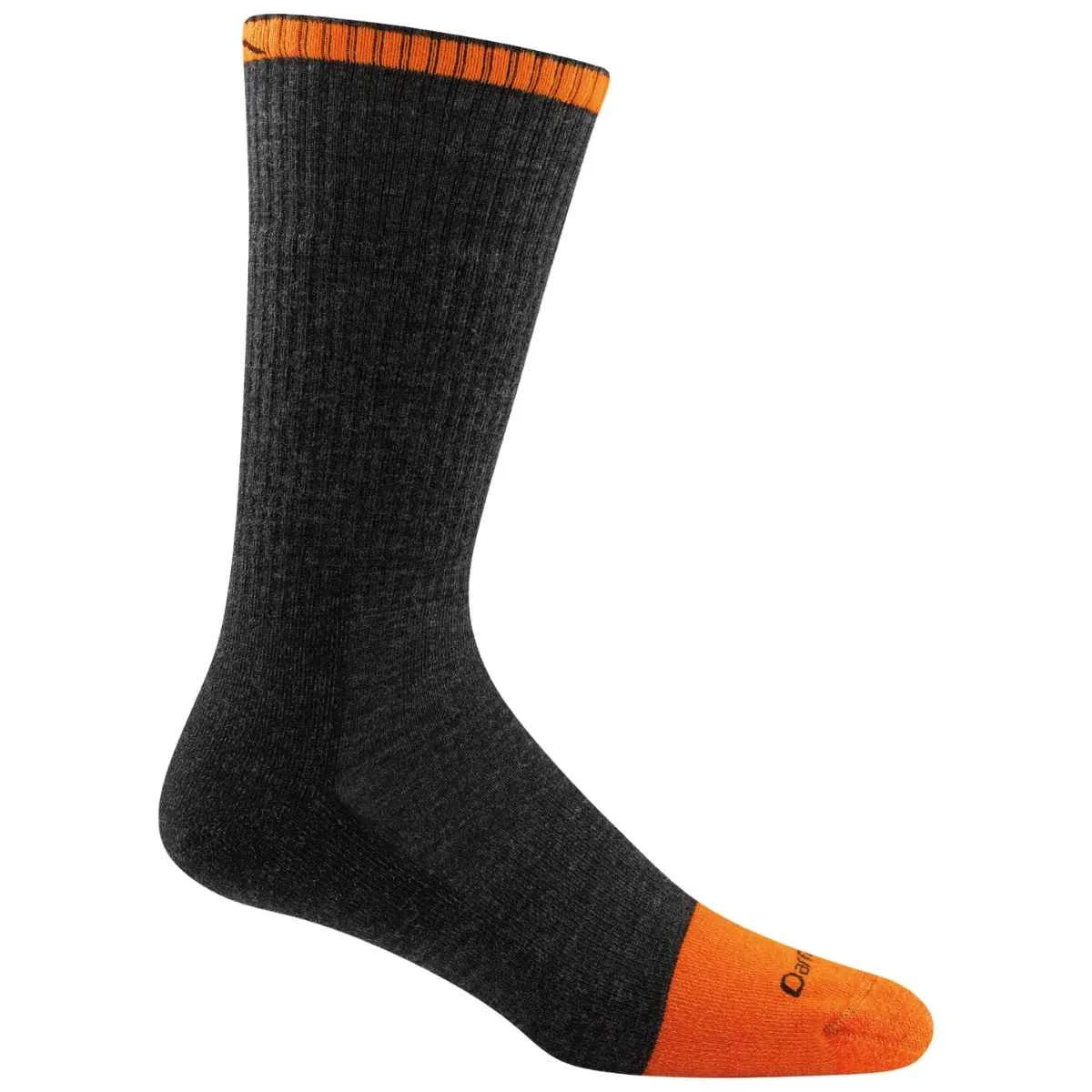
Darn Tough Steely Micro Crew Midweight Work Sock
Fabric & merino %: 56% merino wool/41% nylon/3% Lycra spandex
Cushioning (ultralight/light/mid/heavy): Mid
Height (crew/OTC): Crew
Warmth level (moderate/warm/very warm): Warm
Breathability (low/med/high): Med
Odor resistance (low/med/high): High
Dry time (fast/med/slow): Med-Fast
MSRP: $27
What we liked: Performance fit, warmth-to-thickness ratio, sustainability, durability, excellent warranty
What could be better: Not ideal for activities with more foot movement
These Darn Tough Steely Micro Crew Midweight Work socks, made in the USA in Vermont from merino wool, nylon, and spandex, are specifically designed with steel-toe work boots in mind. The cushioning pattern gives a deeper toe cushion, to fully protect the foot from the pressure and wear that steel-toed boots can cause. They come with all of the amazing perks of Darn Tough socks, like machine washing and drying, performance fit, excellent warmth, durability, and outstanding warranty. These socks fit well within the intended mid to high-volume footwear, and have great breathability and odor resistance. These are a perfect fit for anyone who needs to wear steel-toed boots.
Darn Tough Steely Micro Crew Midweight Work Sock
men's
women's
Fabric & merino %: 79% merino wool, 20% nylon, 1% Lycra spandex
Cushioning (ultralight/light/mid/heavy): Heavy
Height (crew/OTC): Crew
Warmth level (moderate/warm/very warm): Warm
Breathability (low/med/high): Med-Low
Odor resistance (low/med/high): High
Dry time (fast/med/slow): Med
MSRP: $23
What we liked: Plush, sustainability
What could be better: Lacking a snug performance fit, breathability
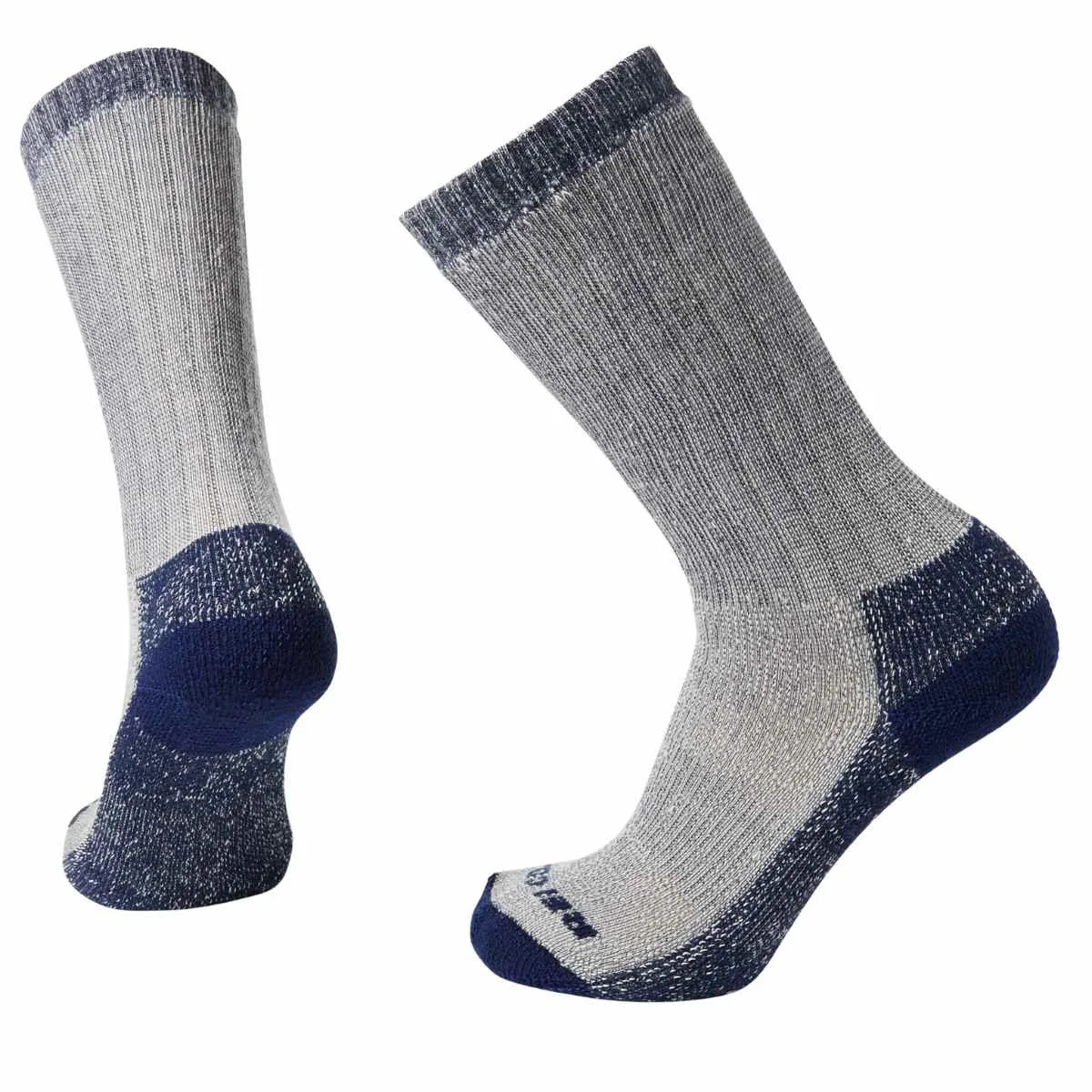
The REI Merino Wool Expedition Crew socks are a heavyweight crew sock made in the USA from merino wool, nylon, and spandex. They’re one of the few Responsible Wool Standard socks we tested, with the certification indicating a commitment to animal welfare, sustainable farm and land management practices, and a traceable supply chain.
These socks are machine washable and can be machine dried on low heat. They have reinforced heels, toes, and soles, with arch bands and a seamless toe closure. They’re odor resistant, fully cushioned, and only fit within high-volume footwear.
They’re somewhat breathable, but our tester’s feet became damp during wear. Additionally, the sock didn’t hold its shape well; the fit was loose, easily sliding down and bunching under our tester’s feet.
Due to the lack of a snug fit plus the mediocre breathability, these socks would be best for more casual wear, like snowshoveling, sledding, or hanging out inside a hut or at home.
REI Merino Wool Expedition Crew
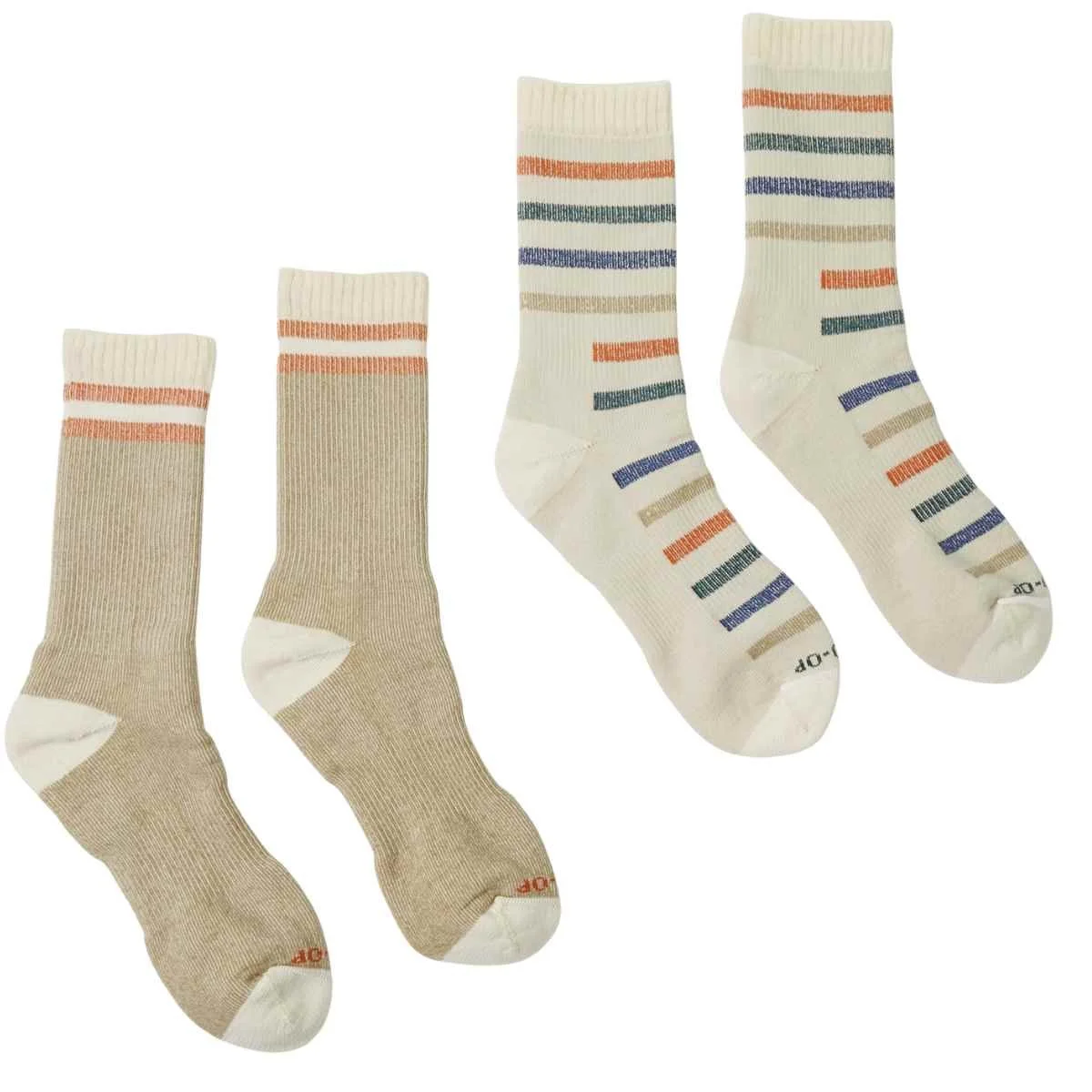
Fabric & merino %: 38-40% merino wool, 30-33% polyester, 26-30% nylon, 1-2% Lycra spandex (varies slightly by colorway)
Cushioning (ultralight/light/mid/heavy): Heavy
Height (crew/OTC): Crew
Warmth level (moderate/warm/very warm): Warm
Breathability (low/med/high): Med
Odor resistance (low/med/high): Med
Dry time (fast/med/slow): Med
MSRP: $33 (2 pairs)
What we liked: Fun patterns, cost
What could be better: Fabric texture, warmth, lack of performance fit
The REI Norseland Merino Wool Crew socks are a heavyweight crew sock made in the USA from merino wool, polyester, nylon, and spandex. These socks are machine washable and dryable on low heat. They have seamless toe closures with elastic arch bands and reinforced toes, heels, and footbeds. They fit within mid to high-volume footwear, but were less thick and less warm than our tester expected given their heavyweight status.
The fit was looser and the upper portion of the crew sock tended to slide down quickly during wear. They also picked up odors more quickly than other socks we tested, and the fabric was noticeably coarse.
These socks are more affordable than most other socks we tested, but some online reviews note a lack of durability. Our tester was concerned about the longevity of the sock, given how thin it was despite the reported heavyweight cushion. This sock would be best for casual use around home and town.
REI Norseland
Smartwool Classic Mountaineer Socks
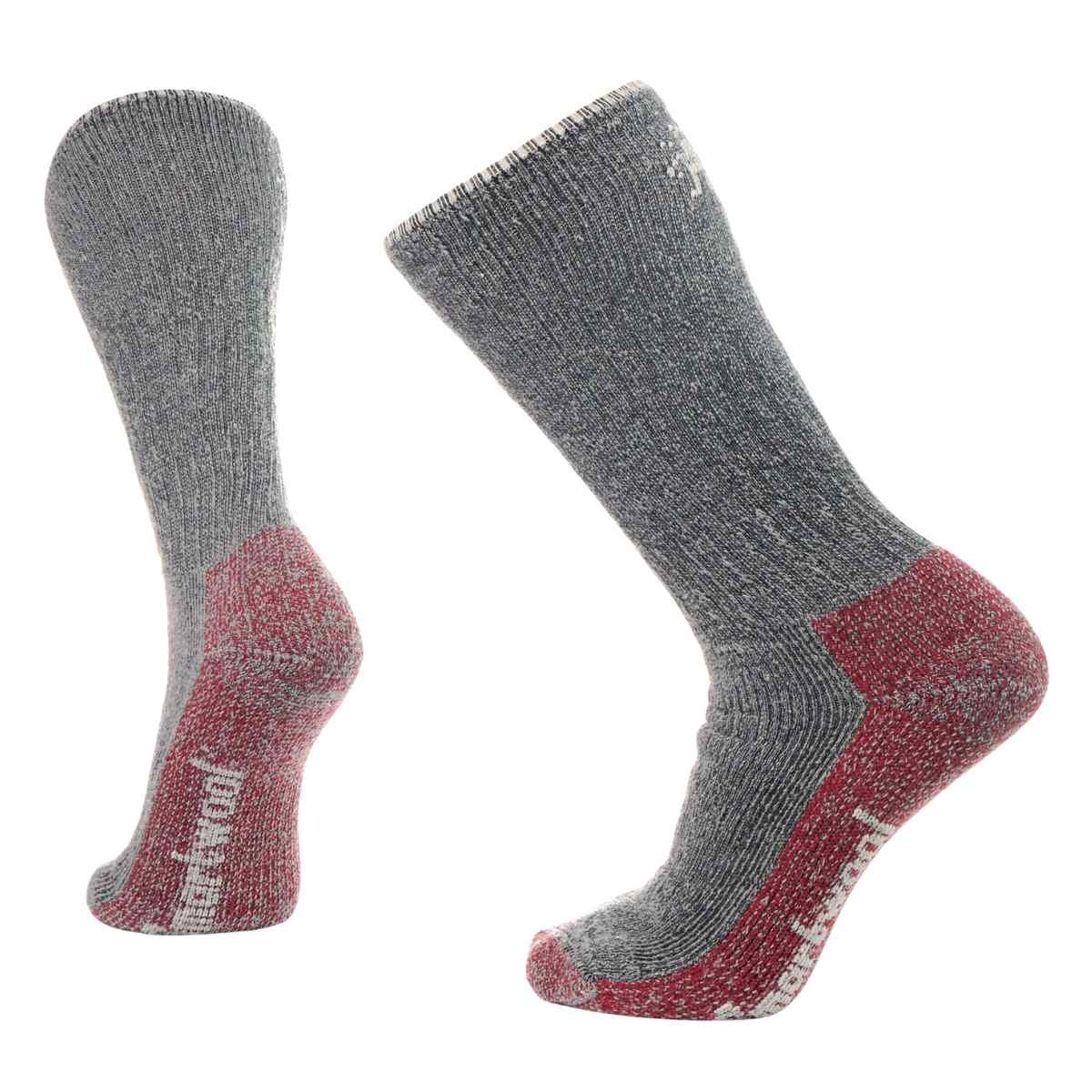
Fabric & merino %: 39% merino wool, 33% mixed fibers, 27% nylon, 1% elastane
Cushioning (ultralight/light/mid/heavy): Heavy
Height (crew/OTC): Crew
Warmth level (moderate/warm/very warm): Very warm
Breathability (low/med/high): Med-Low
Odor resistance (low/med/high): High
Dry time (fast/med/slow): Med
MSRP: $27
What we liked: Sustainability, warmth-to-thickness ratio, plush
What could be better: Lacking a snug performance fit
The Smartwool Classic Mountaineer socks are crew socks made in the USA from New Zealand merino wool and recycled nylon. This sock has full cushioning, elastic arch support, and flat toe seams. These heavyweight socks were plush and very warm, though they’re so thick they only fit within high-volume footwear. Like our pick for Best Overall, the Smartwool Hike Full Cushion, these socks can be machine washed and dried on low heat. These Smartwool socks were durable throughout testing and come with a 2-year satisfaction guarantee.
Their breathability was decent, they wicked away sweat fairly well, and they resisted odors over multiple days of wear. However, their fit was loose and became increasingly looser the longer they were worn. They quickly slid down and bunched underfoot. The lack of a snug performance fit unfortunately limits their utility. These Smartwool Classic Mountaineering socks are best suited for low-intensity activities in high-volume footwear, like hanging out at home in the winter or when outside snowshoveling.
Smartwool Classic Mountaineer Socks
Unisex
Women's
Icebreaker Lifestyle
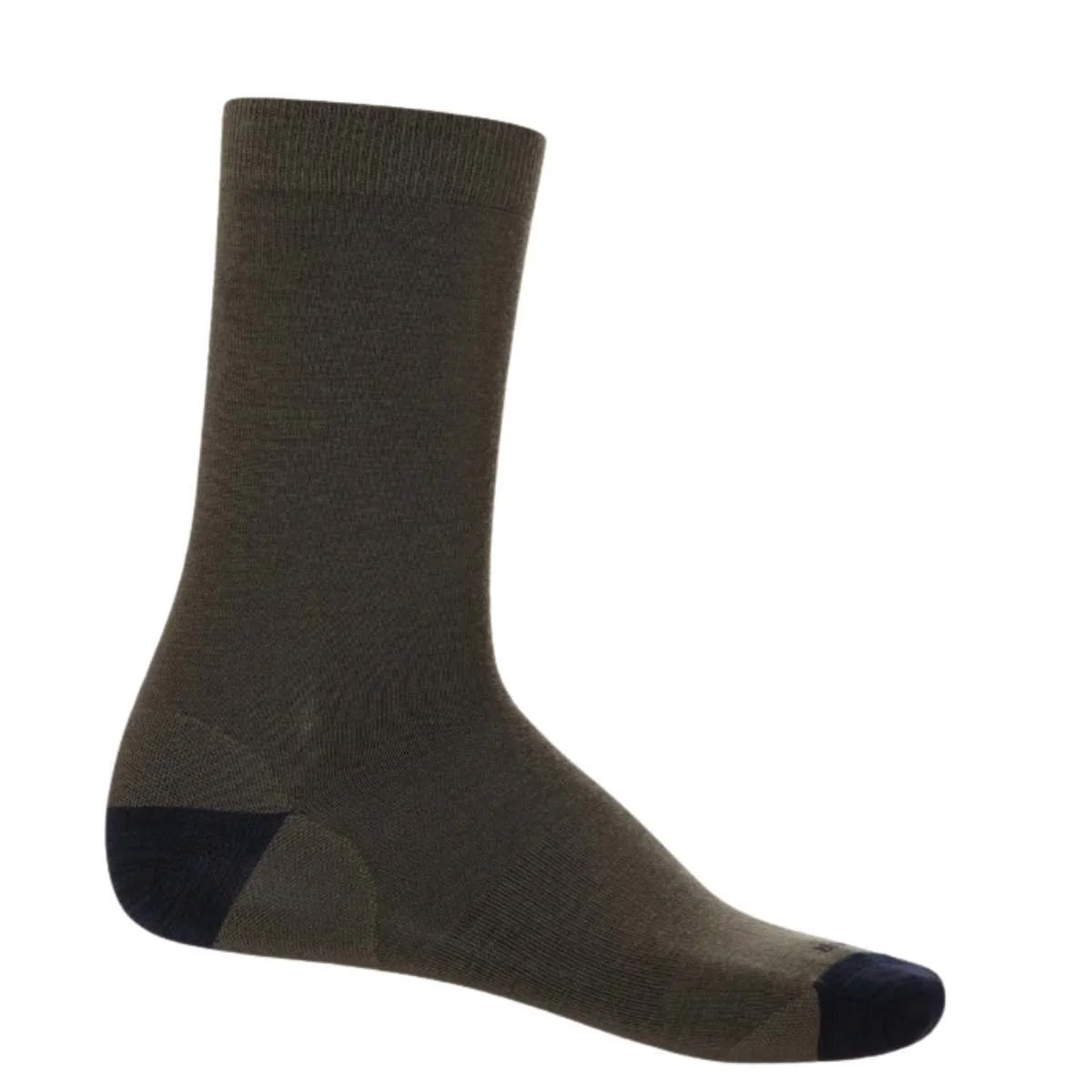
Fabric & merino %: 66% merino wool, 32% nylon, 2% Lycra
Cushioning (ultralight/light/mid/heavy): Ultralight
Height (crew/OTC): Crew
Warmth level (moderate/warm/very warm): Low-Moderate
Breathability (low/med/high): High
Odor resistance (low/med/high): High
Dry time (fast/med/slow): Fast
MSRP: $22
What we liked: Easily fit in low-volume footwear
What could be better: Very thin, durability, drying requirements
The Icebreaker Lifestyle sock is a crew sock made in China with ZQ-certified merino wool, nylon, and spandex. The ZQ certification program aims to ensure all affiliated farms maintain the same standards around animal welfare and health, fiber quality, record keeping, and environmental impact. This sock has a reinforced heel and toe, with ultralight cushion throughout.
The sock holds its shape well, though the fit is oriented to office wear rather than athletic endeavors. It easily fits within low-volume footwear, but on the flip side, it doesn’t provide much warmth or absorption due to its thinness.
Over the course of testing, the socks showed some wear, particularly at high stress points like the big toes. Additionally, Icebreaker’s care instructions allow for machine washing but require the sock to dry flat. This is an additional step that requires attention to detail every time they’re washed. It also takes longer for socks to dry when laid flat versus line dried, though these do dry quickly because they’re so thin.
These socks resisted odors and had a great soft texture. Icebreaker offers a 1-year warranty for faulty manufacturing, with a receipt required. These socks are a fair option for those seeking a thin merino wool sock for formal office footwear.
Icebreaker Lifestyle
men's
Women's
Icebreaker Merino Hike+ Medium Crew
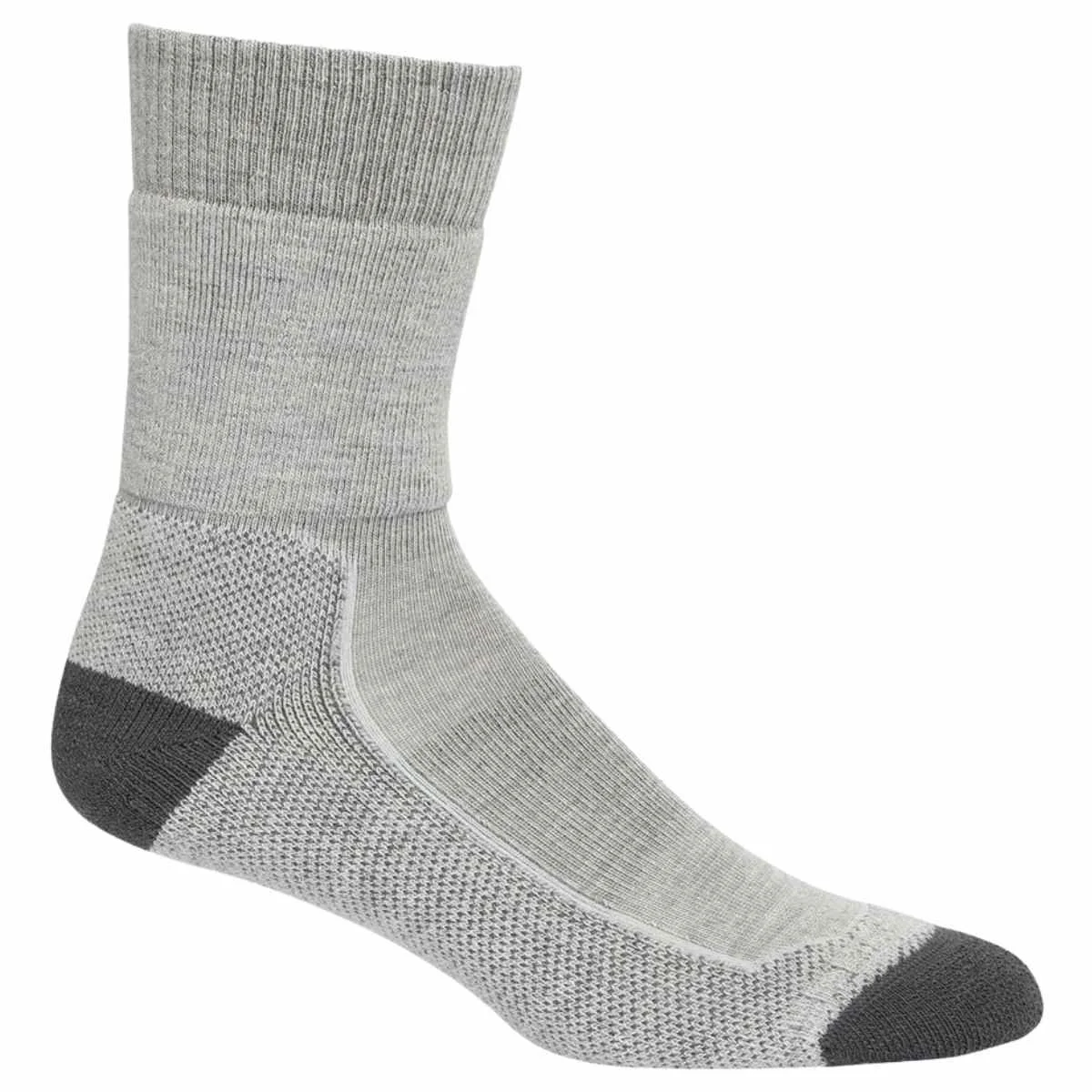
Fabric & merino %: 61% wool, 37% nylon, 2% Lycra elastane
Cushioning (ultralight/light/mid/heavy): Light-Mid
Height (crew/OTC): Crew
Warmth level (moderate/warm/very warm): Moderate
Breathability (low/med/high): Med
Odor resistance (low/med/high): Med-High
Dry time (fast/med/slow): Med-Fast
MSRP: $26
What we liked: Soft, warmth-to-thickness ratio
What could be better: Drying requirements, tighter more elastic fit
The Icebreaker Merino Hike+ Medium Crew sock is a crew sock made in China with ZQ-certified merino wool, nylon, and elastane. The ZQ certification program endeavors that all affiliated farms have the same standards of animal welfare and health, fiber quality, record keeping, and environmental impact. This soft midweight sock has a reinforced heel and toe, with targeted cushioning of the toes, sole, heel, and Achilles.
The sock was warm for its thickness, though it was closer to a lightweight cushion than midweight. The socks fit easily within mid and high-volume footwear due to its thinner nature, and could work for some low-volume footwear. The odor resistance was decent, but not as effective as most other socks we tested. Like the Icebreaker sock above, the Icebreaker Merino Hike Medium Crew requires flat drying, which necessitates attention every wash cycle.
The sock had a decent performance fit to start, but it decreased substantially over prolonged wear. During a long day hike, our tester had to adjust his socks multiple times as they slid down his calves and began bunching around his toes; hot spots developed despite frequent adjustments. These socks would be substantially improved with a more robust elastic fit. These socks would work well for shorter, lower-intensity activities, like commuting, walking, or cycling.
Icebreaker Merino Hike+ Medium Crew
men's
Women's
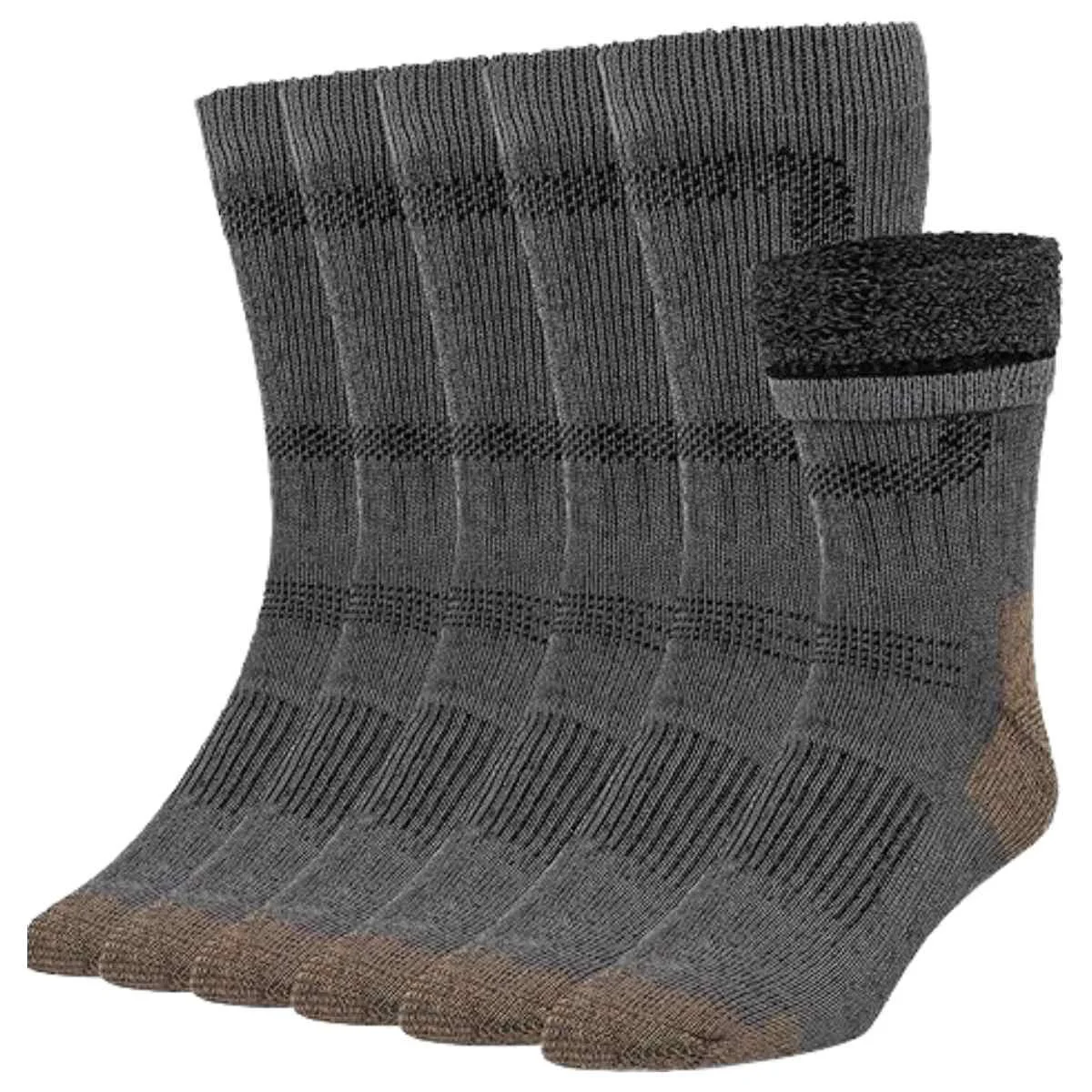
Fabric & merino %: 80% merino wool, 15% polyester, 4% nylon, 1% spandex
Cushioning (ultralight/light/mid/heavy): Heavy
Height (crew/OTC): Crew
Warmth level (moderate/warm/very warm): Moderate
Breathability (low/med/high): Med-Low
Odor resistance (low/med/high): Med-High
Dry time (fast/med/slow): Med
MSRP: $27 (3 pairs)
What we liked: Cost
What could be better: Breathability, the toe seams are substantial and will cause hot spots and blisters for many wearers.
The Alvada Merino Wool Hiking socks are a crew sock made of merino wool, polyester, nylon, and spandex, with an unknown origin of manufacture. These socks include compression arch support and reinforced toes and heels. They’re a heavyweight sock with full cushion throughout. They fit a bit loosely but retain their shape over multiple wears, though the top cuff can be tight on thicker calves. They’re fairly odor resistant, though not as efficient as other wool socks we tested.
Care instructions allow for machine washing and low-heat machine drying. Due to their thickness, they fit best in high-volume boots, though may fit in some mid-volume footwear. The Alvada socks are moderately warm, though not as warm as expected given their bulk. They also don’t breath or absorb moisture as well as similar socks we tested. They began to have an odor after a day of wear.
However, the biggest issue with these socks is the toe seams. They’re extremely noticeable. Without a lot of space within the footwear, the sharp seams press on the toes and quickly cause hot spots. Over a long day, these seams would be very uncomfortable and could cause significant blisters. As with other Amazon products, the return process is simple enough but the environmental impact is concerning, given the likelihood that returns will be trashed or liquidated.
Unfortunately, these socks aren’t a great fit for most types of wear due to the prominent toe seams. These could be an affordable option for merino wool socks to wear around the house in winter, so long as they fit inside your slippers.
Alvada Merino Wool Hiking Socks
Fabric & merino %: 100% Polyester Shell/Primaloft
Cushioning (ultralight/light/mid/heavy): Heavy
Height (crew/OTC): Crew
Warmth level (moderate/warm/very warm): Very warm
Breathability (low/med/high): Med
Odor resistance (low/med/high): Med
Dry time (fast/med/slow): Med
MSRP: $75
What we liked: Warm, water resistant, lightweight
What could be better: The sole provides minimal padding and isn’t robust enough for walking outside
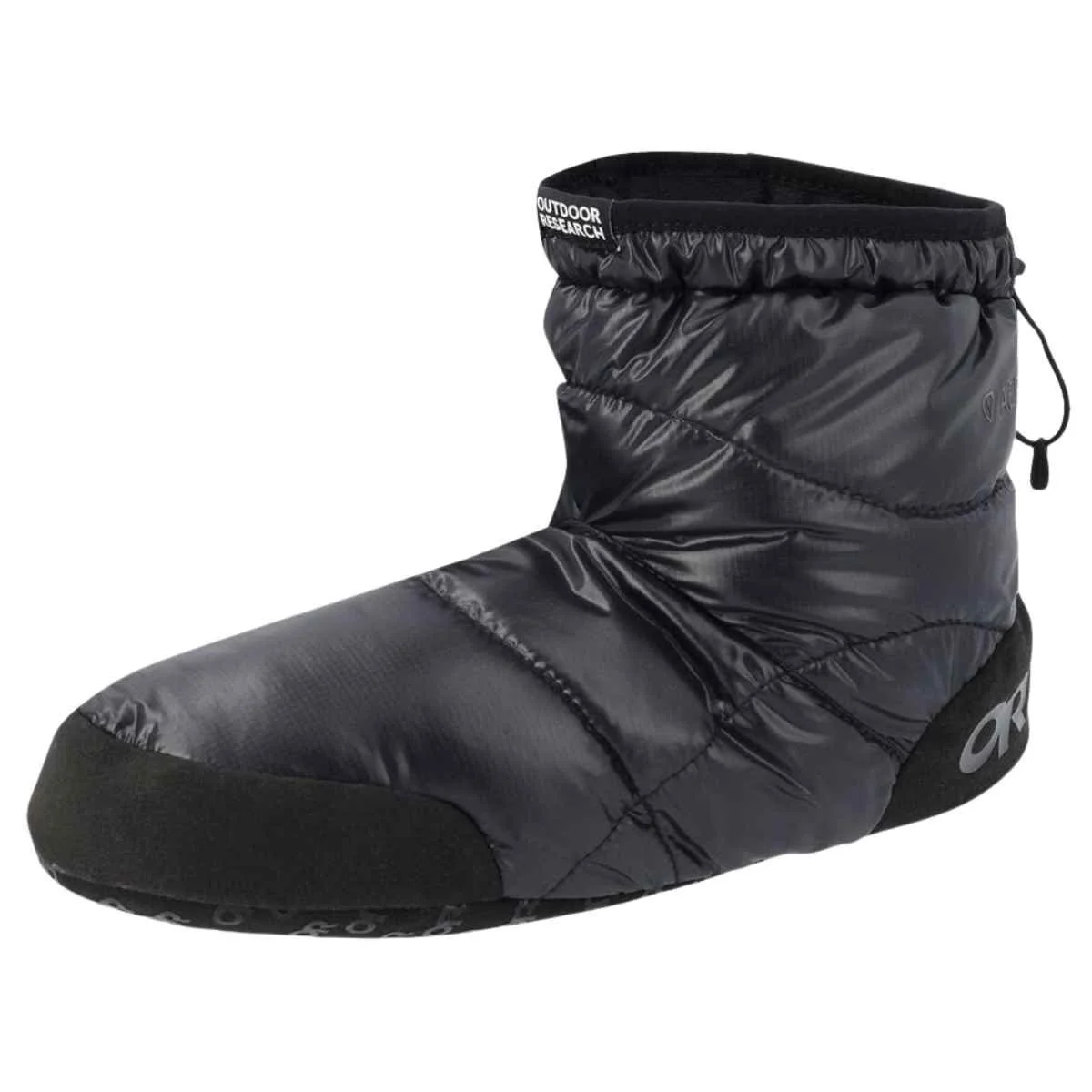
If you’re going to be adventuring overnight in winter and need warm, lightweight slippers, we recommend the Outdoor Research Tundra Aerogel Sock (booties). They’re made with a non-slip sole, polyester shell, and polyester PrimaLoft Gold insulation (which remains warm when wet). The shell is windproof and water resistant, and cinches at the top. Their soles aren’t substantial enough for walking on snow, but they’re perfect for inside a tent, trailer, shelter, or hut (or a chilly house). These booties are backed by Outdoor Research’s Infinite Guarantee for the product’s lifetime. Weighing only 5.3 oz for a pair of mediums, they’re a lightweight option for winter overnight trips!
Outdoor Research Tundra Aerogel Sock
What to look for in winter socks
Crew vs over the calf winter sock heights
Materials, Moisture, and Odor
Winter socks come in a variety of materials. The modern merino wool sock is typically 40-75% wool mixed with synthetic material like polyester, for its durability and quick-drying nature, and nylon or spandex, to provide shape and elasticity. Wool socks are temperature regulating, can absorb up to 30% of their weight in water, resist odors, and continue to provide equal insulation even when wet.
Fully synthetic socks are typically a mix of materials, like polyester, spandex, and nylon. They’re less comfortable in warm conditions, tend to hold onto odors, and not as warm when wet, but they dry more quickly with a 0.5% to 8% water retention rate.
There are also sock blends, such as PAKA’s, that utilize eco-friendly Tencel, recycled nylon, spandex, and alpaca wool–which is three times lighter than sheep’s wool, soft as cashmere, and has hollow fibers that can trap or redirect body heat. Alpaca fiber is almost water resistant, only absorbing about 10% of its weight in water, and highly odor resistant.
Cushioning and thickness
Winter socks are often higher volume, with extra cushioning and insulation, assuming they’ll be worn with spacious boots. This is most common with a mountaineering style heavyweight sock. However, lightweight and midweight hiking socks can be utilized as winter socks, and these may be the right choice for warmer or higher intensity activities and for low-volume footwear. Aim to match your socks to your winter footwear, foot volume, and intended activity.
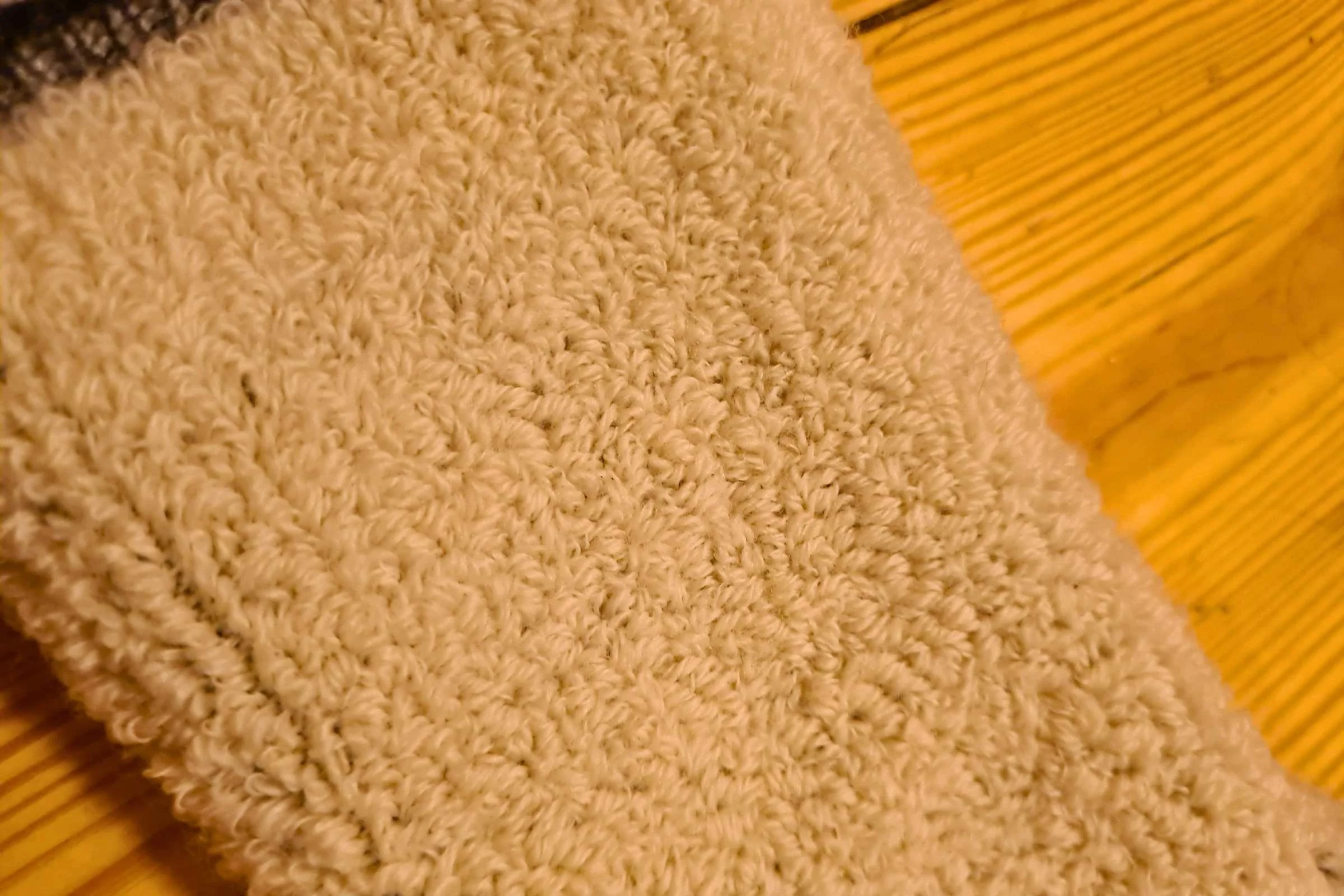
Mountaineering-style heavyweight socks and a few midweight socks feature terry loops on the inside of the sock. These tiny loops of yarn inside the socks add cushion, softness, and insulation, and help wick moisture away from sweaty feet.
Cushioning patterns vary across sock styles, with lightweight socks typically only having cushion at the toe and heel, midweight with more cushion at the toe, heel, and top of the foot, and heavyweight socks have the most cushion with overall bulk and padding.
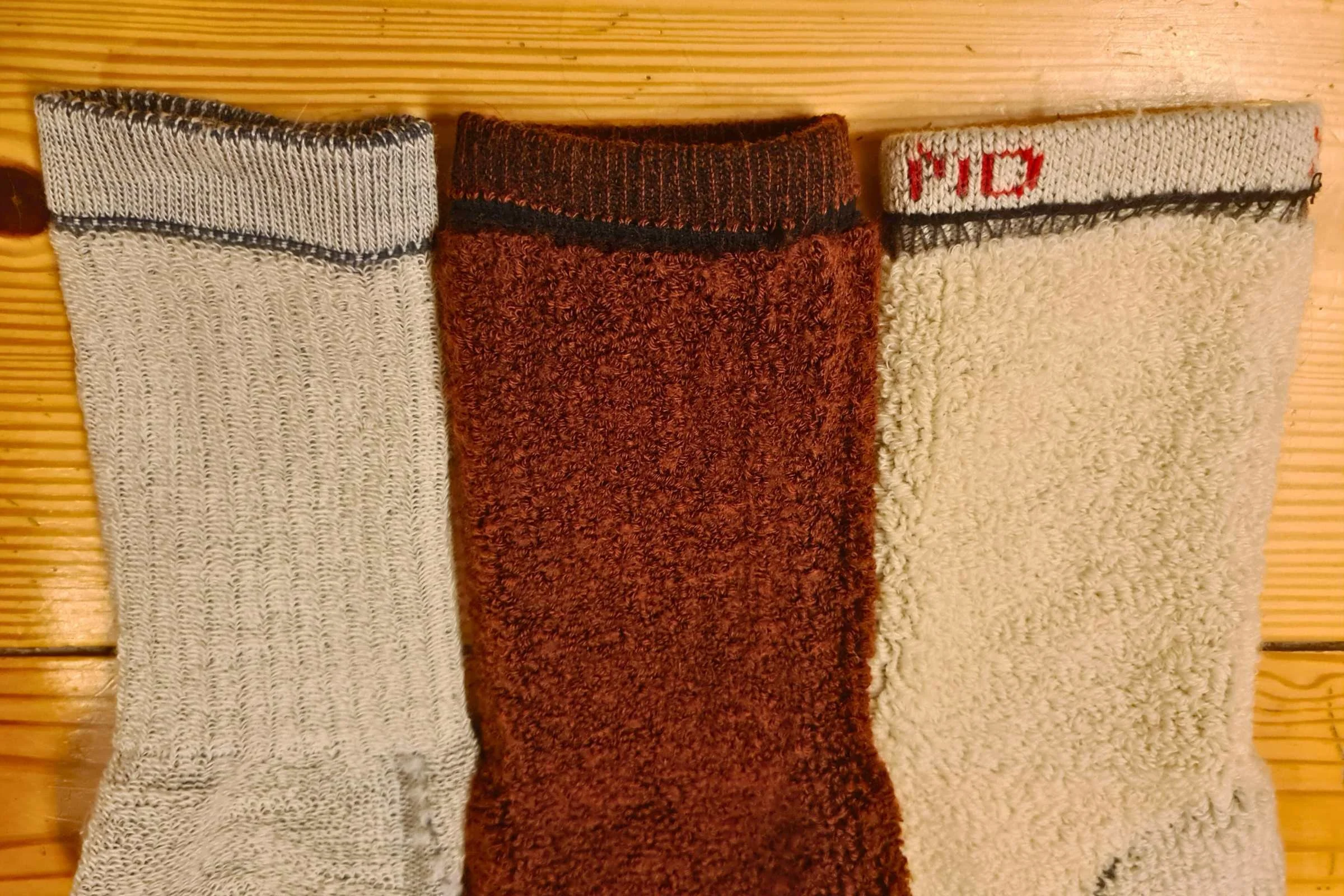
Height
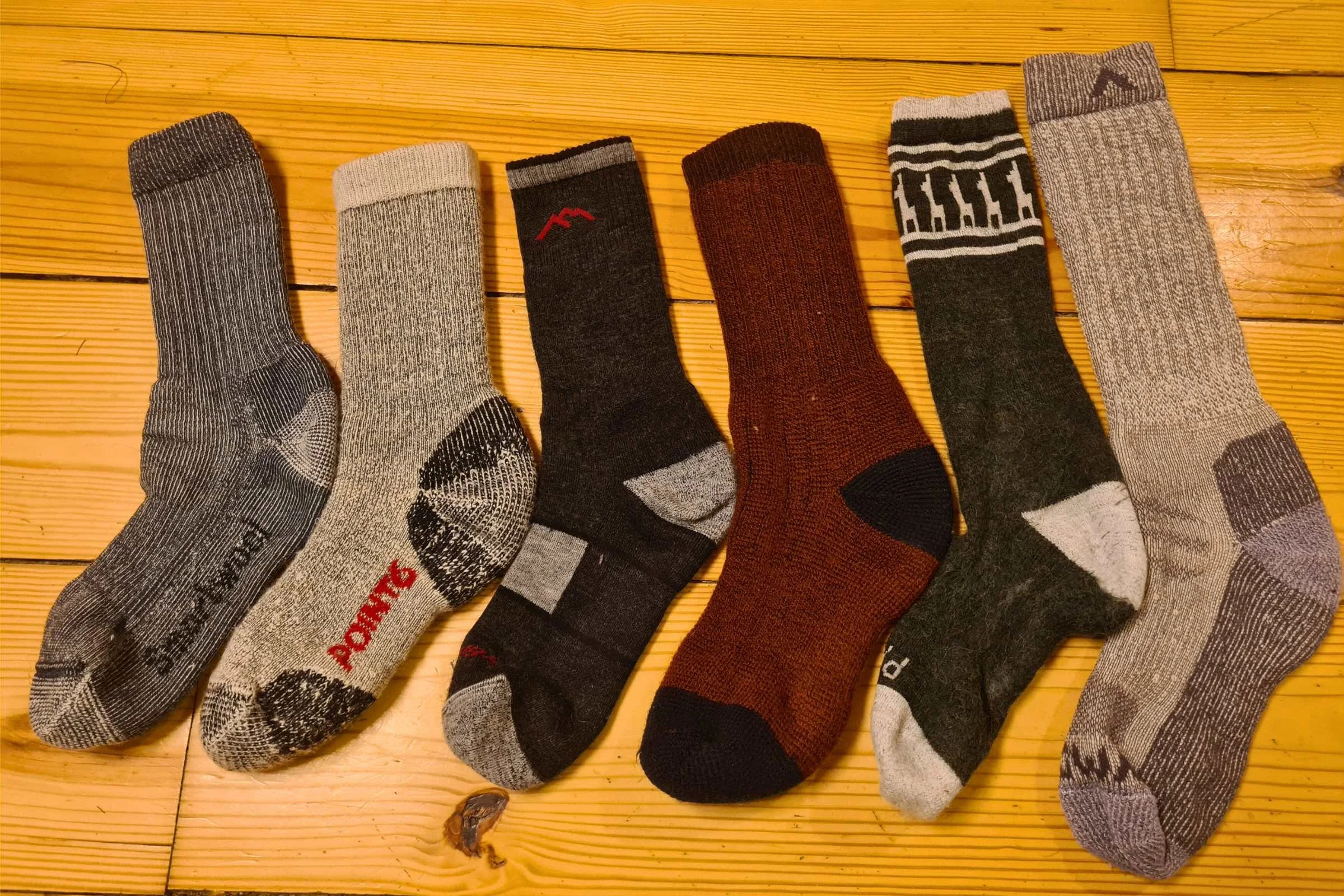
Winter socks come in a range of heights. The two most common styles are crew (at or below the calf) and over the calf/knee-high.
Downhill ski socks are always knee-high to provide full coverage protection of the lower leg against the rubbing and impact of ski boots. For full winter conditions in the mountains, we do recommend an over-the-calf/knee-high sock. It is extremely difficult to adjust socks in the mountains, with socks underneath base layer leggings, soft-shell or hard-shell pants, and gaiters. Removing those layers to access socks that have wrinkled or bunched up can be impossible if the conditions are poor (e.g., low temperatures, high wind, precipitation, low visibility), and blisters will have to be ignored and dealt with later. Higher socks tend to stay in place better, particularly with high boots, though we recommend you test the sock-and-boot combo you’ve chosen before venturing into more extreme conditions.
However, many people will prefer a crew sock for their winter activities. Crew socks sit at or below the calf and are optimal for shoes or mid boots. They are tall enough to provide protection from shorter boots while also offering full ankle coverage from any drafts. They’re less warm than knee-high socks, since they cover less of the leg, which can be desirable for higher temperatures and higher intensity activities. And some people find over-the-calf socks to be uncomfortable, due to things like the sock sitting too high on the knee or the amount of compression on the lower leg.
Fit and construction
A snug fit is key for socks that stay in place. Similarly, in the right size sock, there shouldn’t be extra material in the sock between your toes and heels. Your foot should fit within the heel pocket–if the heel sits high or low, size down or up as needed. You may find you need a smaller size sock than you need shoes (e.g., a men’s size 5–8 size sock when you wear men’s size 9 shoes).
Winter socks should have seamless toe closure, so there’s nothing to rub between your boots and your toes. Some socks feature compression zones, particularly in the arch of the sock.
Durability
Along with fit, durability is important for socks. Our socks see a lot of wear and tear, and it’s important that they can hold up to use over time. When considering the best sock for you, look at the density of the knit, whether there are reinforced areas of the sock, such as the heel or toe, and consider the sock manufacturer’s warranty if the sock breaks down prematurely.
Sustainability
When looking for socks, sustainability and ethical manufacturing are aspects to consider. Some socks we tested utilize recycled wool or synthetic fibers. Some of the socks were Responsible Wool Standard (RWS) certified. The majority of the socks we tested were manufactured in the USA. Additionally, PAKA offers full traceability for many of their products (including the socks we tested), to show the exact coordinates of where the alpaca fiber was produced.
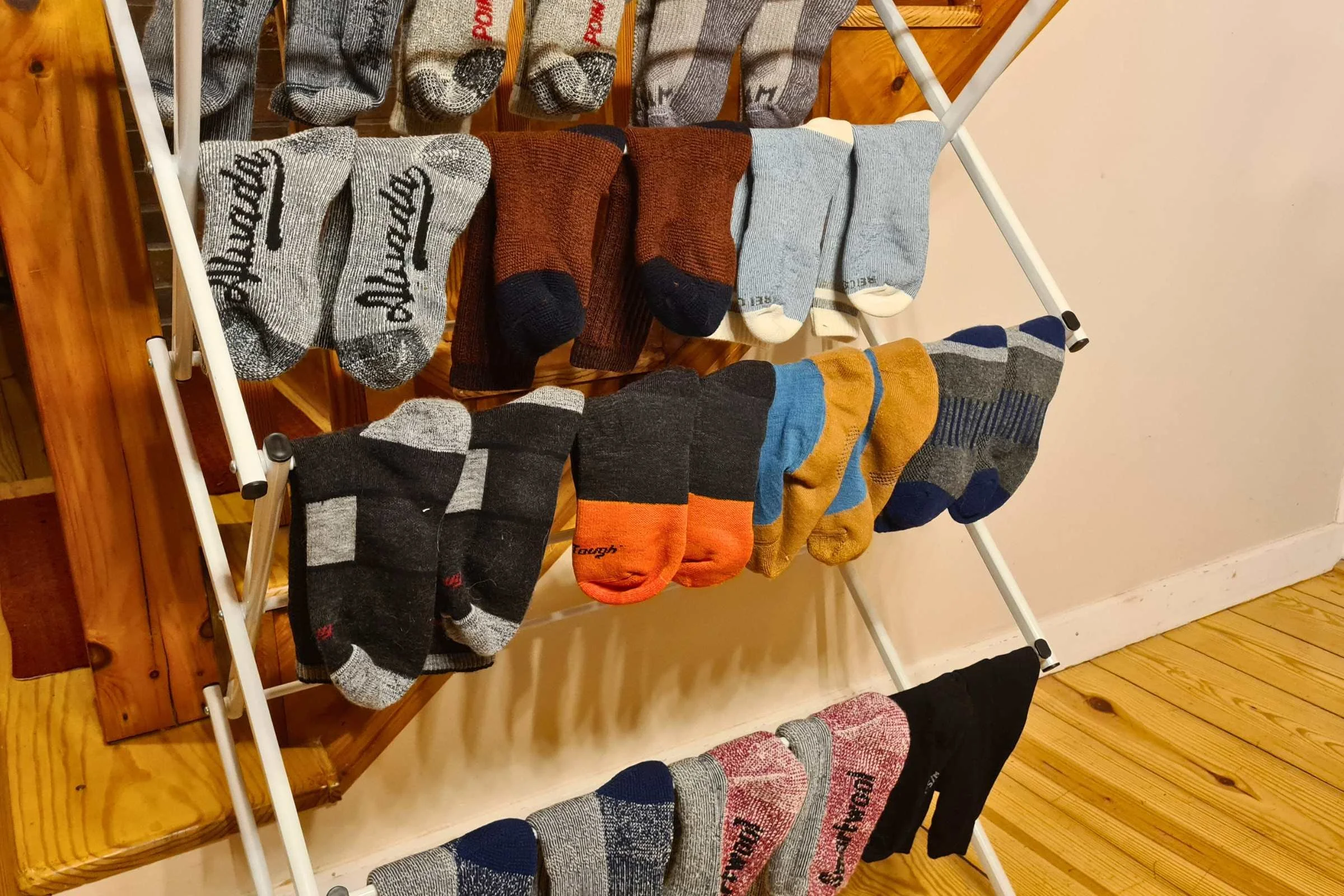
Socks drying on a rack
Why winter sock choice matters
During foot-based winter activities, keeping our feet safe and happy supports us in continuing to move forward.
The right winter socks work in tandem with our winter shoes or boots to prevent cold-related discomfort, including frostnip and frostbite.
Socks can substantially reduce the risk of blisters, including by keeping feet more dry through moisture wicking and breathability.
Modern wool socks give us warmth without unnecessary bulk, offering more options for sock thickness, which improves boot fit and promotes circulation.
Alpaca and merino wool have outstanding odor control (and merino no longer smells like sheep) and can be worn multiple times before needing to be washed. This can make them excellent socks for multi-day wear.
Fit and layering guide
Sock thickness
The single most important aspect of sock fit is matching the footwear and foot volume to the appropriate sock thickness. When choosing the best sock for the job, it’s important to consider how much space exists within the shoe or boot you’d like to use.
Many women’s and men’s winter boots are sized to provide high volume space, assuming that thick socks will be used. If a thin sock is used in a high-volume boot, the fit will be very loose and the friction from frequent foot movement can lead to blisters. If a thick sock is used in medium or low-volume shoes, the toes will be compressed by the shoes and circulation is a concern, along with discomfort and blisters.
Liner and outer sock combos
It is possible to wear liners with winter socks. For multi-day trips when keeping things dry and clean is more challenging, liner socks can be a good option because they dry more quickly and are lighter than socks.
Try-on checklist
Make sure the sock size fits your feet and lower legs well with no wrinkles. The right socks won’t slide down your lower legs, won’t put pressure on your toes, and won’t have any toe seams you can feel. The correct size will match the heel cup directly to your heel, without extra length on the bottom of the sock, resulting in a stable heel lock.
And last, check that the thickness of the sock matches the amount of space available in your boots. It should fit comfortably, with enough space to move your toes around without restriction or compression, but not so much space that your foot slides around.

Sock-to-boot fit demo
Activity-specific advice
Running and Cross-Country Skiing
For winter running and Nordic skiing, we recommend prioritizing socks with high breathability and quick dry. Most runners and XC skiers will be looking for a lightweight or midweight sock; heavyweight socks can cause hot spots and blisters, since running shoes and Nordic boots have less space than winter hiking boots. To be prepared for snowy winter running, we’d advise pairing a running sock with regular or GORE-TEX running shoes, gaiters, and traction.
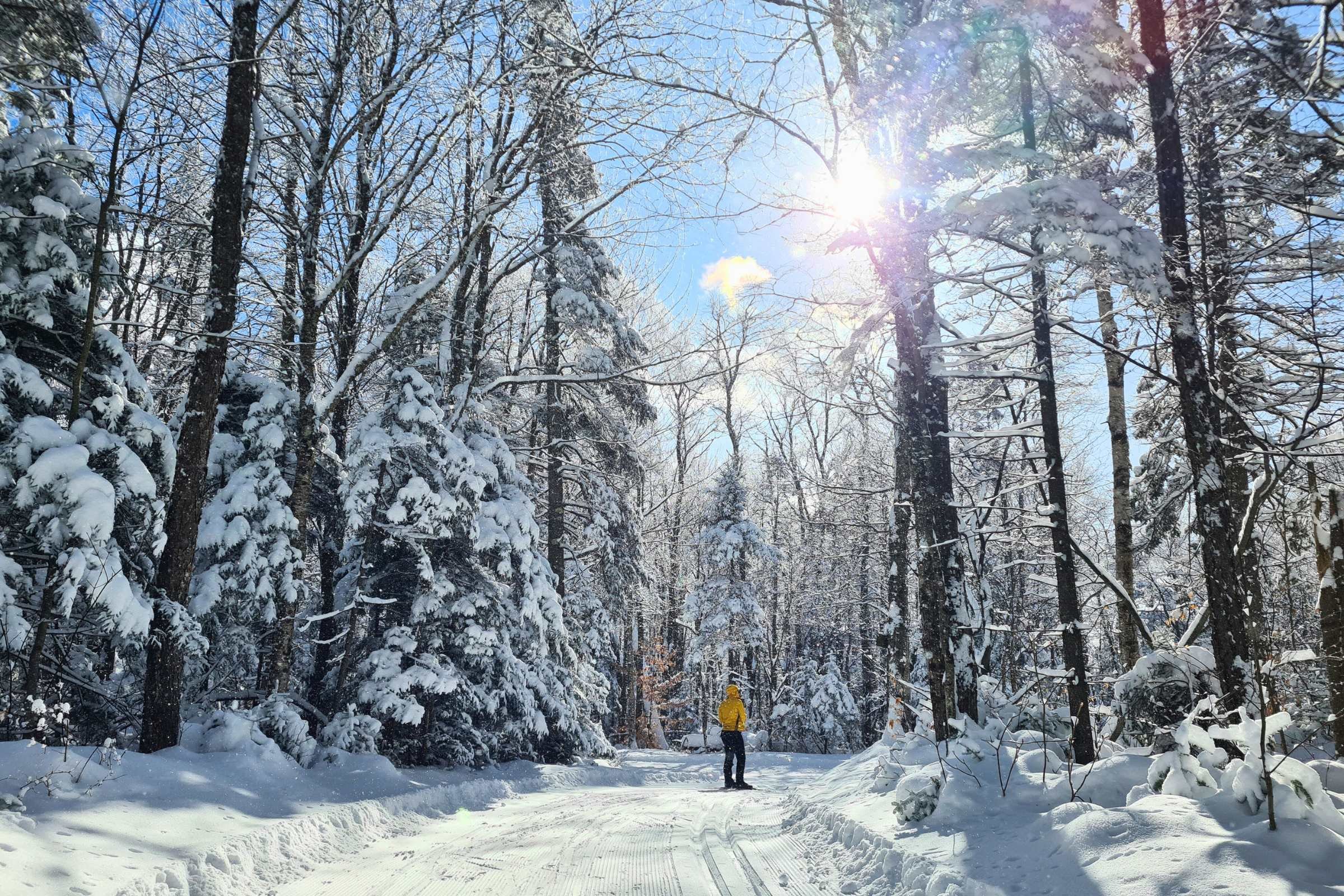
Hiking and Snowshoeing
For winter hiking or snowshoeing, we recommend a midweight or heavyweight sock, based on your boot volume (more space in the boot allows for a thicker sock), temperature (thicker socks can be warmer in cold temperatures), and activity level (if you’ll working hard you may want a lighter sock to reduce the risk of moisture build-up from sweating).
Matching the thickness of the sock to the winter hiking boots you have is important to prevent blisters. It can also be helpful to wear over-the-calf or knee-high socks in winter to reduce the risk of socks sliding down over time and causing blisters from bunching up. It can be much more difficult in winter to stop, remove gaiters, pull up the leg of insulated pants, peel back the base layer, and then adjust the sock, all while wearing gloves.
Consider pairing your preferred sock with your favorite winter hiking boots and your other winter hiking gear. And for soggy shoulder-season hikes, check out our recommended waterproof socks.
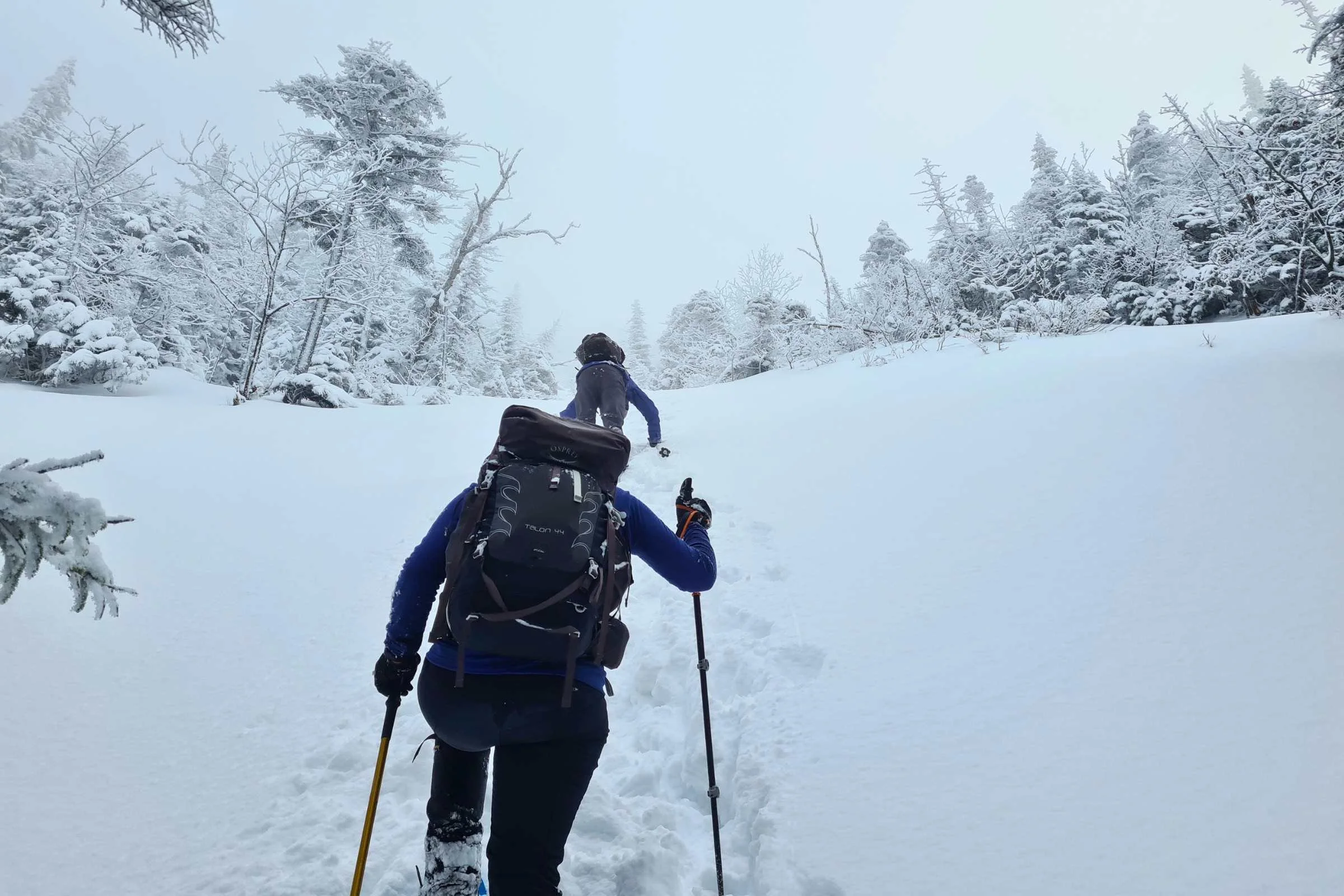
Multi-day wear test
Cycling
For winter cycling, heavyweight socks can be very helpful in keeping feet warm, so long as there is space in the cycling shoe for more volume. Many cycling shoes are fitted assuming a thin sock, so be sure to check your specific cycling shoes. With colder temperatures, crew or over-the-calf socks are also welcome in keeping the lower leg warmer. Shoe covers are another important piece of the puzzle, providing a windbreak for your toes.
Work/Commuting
For heading into work in the winter, thinner wool socks can fit into low-volume work shoes while offering warmth and cushion, durability, and all-day moisture-wicking comfort. And if your job has you working in a colder space or tromping through snow, thicker socks might be a better option.
Camping/Sleeping
For sleeping cold in the winter, we recommend terry-looped or similarly lofted heavyweight socks to keep your feet warm throughout the night. If you’re backpacking or camping, be sure to keep a dry, clean pair in a drybag just for bed to protect sleeping bags from wet feet and to optimize warmth.
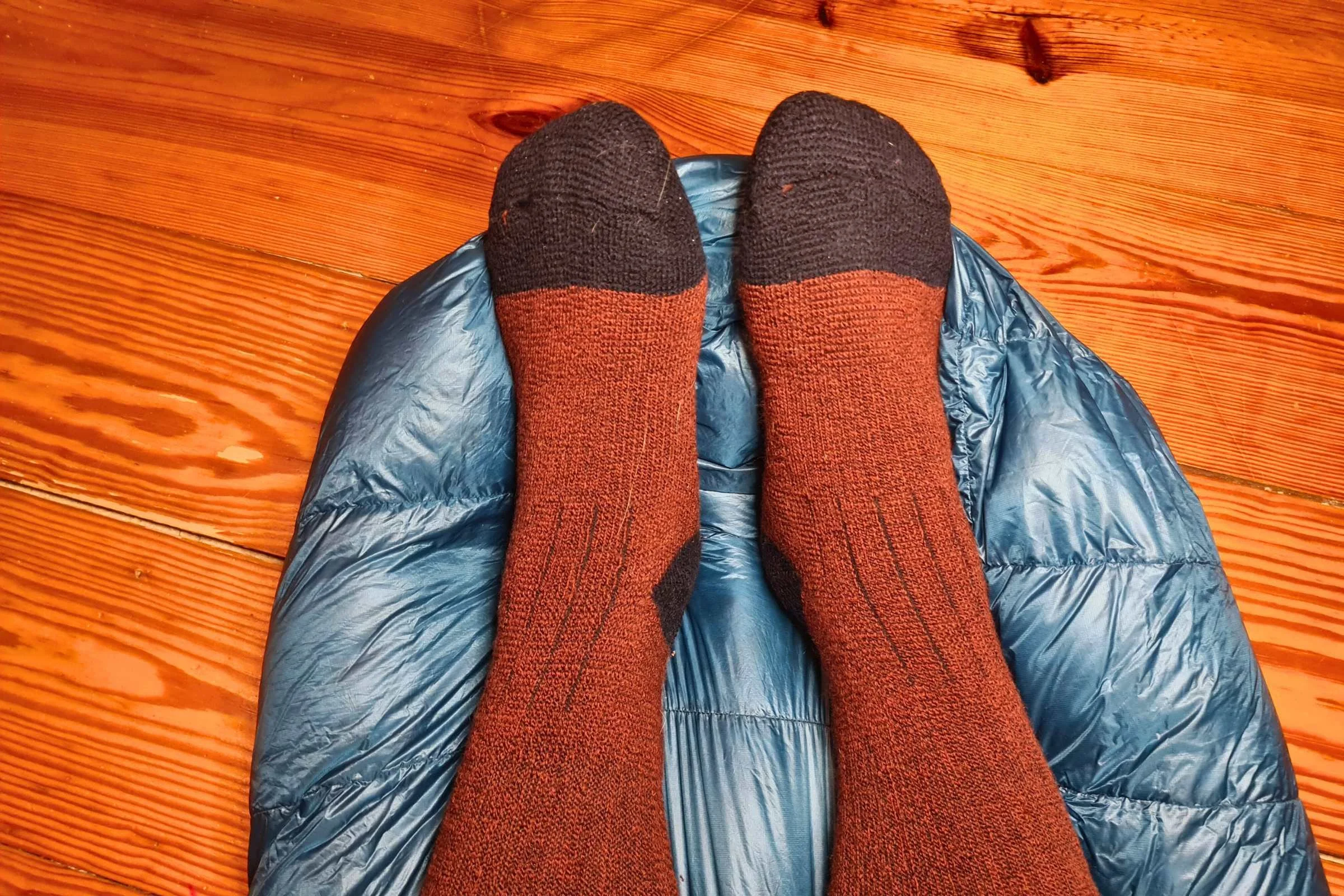
Lofted sleep socks on top of sleeping bag
Care and maintenance
For sock longevity, wear them multiple times before washing them when feasible. Wash them inside out on delicate, with warm or cold water and gentle detergents, and store them folded rather than rolled up into a ball.
Avoid bleach and fabric softener.
Either air drying, tumble dry air only, or tumble dry low is recommended by most brands. Be sure to follow the directions for your particular pair of socks.
Some pilling is inevitable over the lifetime of a sock, but you can reduce pilling by washing your socks in smaller loads of laundry, using a laundry bag, air drying, and following the care instructions.
Wearing the same pair of socks frequently without rest can cause the sock to break down faster (thru-hiking is brutal on socks!). Rotating through a collection of socks can extend the lifetime of your socks.
It’s time to retire socks (or exchange them if they have a lifetime warranty) when they develop holes. It also might be time when cushioned areas have become thin and unpadded.
FAQ
-
Yes, most merino socks can be machine washed using the gentle cycle and warm or cold water. Turn them inside out and avoid bleach and fabric softener. Following care labels helps maintain elasticity and reduce fiber degradation. And consider that merino socks have excellent odor control and can be worn multiple times before needing a wash.
-
Yes, most merino socks can be machine dried on the air-only or low heat setting. Check your individual socks to be sure, but the majority of merino sock brands provide care instructions that allow for tumble dry low.
-
Thicker socks are not necessarily warmer. Thicker socks take up more space within footwear, and pairing a thick sock with a snug shoe or boot can lead to restricted circulation and colder feet. Modern sock fabrics have also improved the warmth-to-thickness ratio, giving us thinner but warm socks.
-
Liners are not necessary under winter socks, but if you prefer them we recommend pairing with thinner socks. Having a comfortable thickness of sock for the footwear you’ll be wearing is most important. If wearing liners is important for you, consider pairing them with a thinner winter sock to avoid an overly snug fit.
-
Most likely, you need a warmer pair of boots if your feet are still cold in winter socks. Socks and footwear partner together to keep our feet warm. Depending on the temperature outside, warm socks alone are not enough to keep feet warm. Precipitation, windchill, low levels of exertion, poor circulation, and standing in snow can each add to the need for insulated boots.
-
Sock height is a matter of personal preference and the height of the boot. Crew socks and knee-high socks are both excellent options for mid boots. For high boots, I’d recommend knee-high socks so the sock is higher than the boot; I’ve had issues with crew socks riding down.
-
Ski socks have a different cushioning pattern than hiking socks. Ski socks typically offer cushioning along the front of the lower leg to protect from shin bang, minimal cushion for the ball of the foot, with some reinforcement of the toe and heel. Hiking socks typically offer cushioning for the ball of the foot, heel, and toe, with minimal cushion for the ankle and shin.
-
Most merino wool socks have 40–75% wool. Synthetic fibers are more elastic, durable, and quick-drying than wool. But wool is soft, thermoregulating, breathable, moisture wicking, and odor resistant. By mixing in synthetic fibers, this allows for optimal elasticity and durability while also having wool as the majority of the sock’s construction.
How we researched and tested
We tested these socks in the field through many different activities, such as hiking, cycling, snowshoeing, cross-country skiing, commuting, and winter car camping. We tested the socks’ warmth both in cold indoor conditions and outside in sub-freezing sessions. We did a timed wet-to-dry test of our socks in a climate-controlled room to equally evaluate how quickly each sock would dry. We evaluated each pair of socks on how well they resisted foot stink, including wearing pairs for multiple days without washing. We examined durability by seeing how the socks handled repeated use, looking for wear and piling, and how they stood up to machine wash cycles. We assessed fit across multiple types of footwear, such as insulated winter hiking boots, trail running shoes, cycling shoes, and work shoes.
Why you should trust us / About the author

Treeline Review’s fabulous writers have previously tested many types of socks, including hiking, running, skiing, and waterproof socks.
Our primary sock tester was Aubri ('Data') Drake. He’s a white queer and transgender hiker, backpacker, ultrarunner, and writer who has hiked thousands of miles in the mountains of the Northeast in winter, always while wearing socks. Last winter, Aubri tested 12 insulated winter hiking boots and 13 hiking gaiters for Treeline Review. He’s also tested many trail running poles and running pants for Treeline as well.
Because 75 mph winds, waist-deep unbroken snow, and ice eyelashes have a strange appeal, Aubri has completed numerous Northeast peakbagging lists in both winter and summer seasons, including the Northeast 111 4,000 Footers and the New England Hundred Highest.
Most recently, Aubri completed the New Hampshire 48 4,000 Footers Grid, hiking each of the 48 peaks in every month of the year (48 x 12) for 576 summits, with about half of those summits being completed in winter or shoulder-season conditions.
You can read Aubri’s Treeline Review stories on his author page.