From Cloud-Level Mist to Sideways Sleet: My Season in the Outdoor Research Foray 3L Rain Jacket
A sustainable, do-it-all rain jacket for cool-weather adventures
December 12th, 2025
Home > Gear Reviews > Apparel
Our verdict
Hikers seeking an effective, do-it-all rain jacket for cooler weather pursuits made from recycled and PFAS-free materials will find a reliable companion in the new edition of the Outdoor Research Foray jacket. The Foray is the first outdoor technical apparel to be certified as carbon neutral by Climate Impact Partners.
The durability, ease of movement, and effective waterproofing of the Foray are its key selling points—it’s a sturdy and reliably waterproof jacket that’s roomy and stretchy enough to accommodate intense activity in all kinds of precipitation, whether hiking or commuting. It’s also the winner of Best for Commuting in our Best Lightweight Rain Jackets guide.
As a ridgerunner along the Appalachian Trail in Maine, I spent approximately 100% of this past season outside and carried this jacket with me for countless hours and miles. During that time, it got to experience everything from chilling at cloud level in perpetual mist to getting slapped with high winds and sleet on summits—I was equally grateful for its presence in my pack in both contexts.
The pit zips on this jacket are of an unprecedented length—from hem to bicep—and are an extremely effective way to dump heat instantly and increase the ventilation since the jacket fabric is not breathable itself. For a jacket with PFAS-free construction, my biggest concern was the potential lack of breathability and the ways that would be dealt with.
Which brings me to the biggest drawback—lack of breathability. If you’re a person, like me, who runs hot, the lack of breathability offered by this jacket is going to relegate it to colder-season use and make it a stifling, sauna-like experience in summer. Though the ventilation zippers helped immensely during those conditions, I’d still prefer a much lighter jacket with as few layers as possible underneath in hot weather.
This jacket also comes in a women’s version, the Outdoor Research Aspire 3L.
If you’re in the market for your go-to cooler and cold-weather rain jacket that’s convenient and pretty packable, look no further—but first see if you can find this fellow on sale! Over the months testing it, I’ve seen it go on sale from a variety of retailers quite frequently; with a market price of $249, any discount is a welcome one. But if you’re looking for an ultralight, super-packable summer rain jacket then continue your search elsewhere—the burly nature of this three-layer jacket means it is not ultralight, not particularly breathable, nor small when packed down.
Men’s Foray
Women’s Aspire
We write mission-driven gear reviews. To find the best gear, we combine expert reviews, everyday user opinions, and rigorous independent trail testing—never native ads or sponsored posts. We are 100% reader-supported and may make a small commission from some qualifying affiliate links. Learn more.
Outdoor Research Foray 3L Specifications
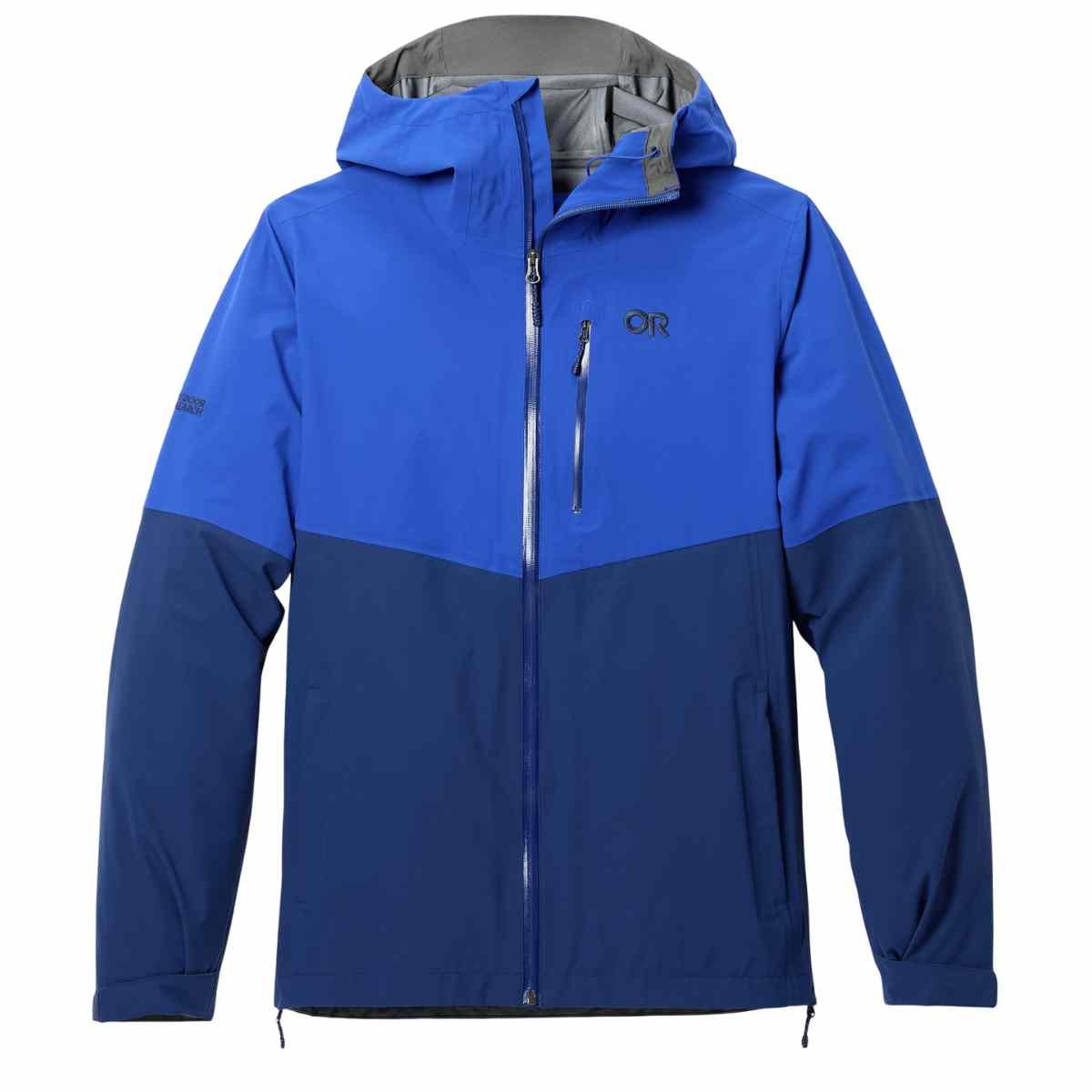
Price: $249
Weight: 15.3 oz (men’s), 13.9 oz (women’s)
Material/membrane: AscentShell Dry 3L
Waterproof rating: 20,000 mm
Available sizes and fit type: S-3XL (men’s), XXS-4XL (women’s)
Back length: 29.5 in (men’s), 28 in (women’s)
Pit zips: Yes
Pockets: 3 (2 hand, 1 chest)
Hood type: Adjustable and helmet compatible
Cuff closure type: Velcro
Packable: Yes
Sustainability features: PFAS free, recycled materials, first certified carbon neutral outdoor technical apparel
Warranty information: Limited lifetime
Comparison table
| MEN'S RAIN JACKET | WEIGHT (OZ) | WATERPROOF MEMBRANE | WATERPROOF RATING | PIT ZIPS | POCKETS | SIZES |
|---|---|---|---|---|---|---|
| Outdoor Research Foray 3L | 15.3 | AscentShell Dry 3L | 20,000 mm | Yes | 3 | XS-XXL |
| Marmot PreCip Eco | 11.0 | NanoPro Eco | 10,000mm | Yes | 2 | S-4X |
| Arc'teryx Beta SL Jacket | 13.9 | 3-layer GORE-TEX | 28,000 mm | Yes | 3 | S-XXL |
| Outdoor Research Helium | 7.0 | Pertex Shield Diamond Fuse 2.5L | 15,000mm | No | 1 | S-XXXL |
| Patagonia Torrentshell 3L | 14.1 | H2No 3L | 20,000mm | Yes | 2 | XS-XXXL |
Best for
Folks looking for an environmentally friendly, do-it-all rain jacket that’ll be as effective on a cold, stormy day hike as on a cool and rainy commute
Day hiking and winter hiking
Anyone who can budget the $249 price for an investment piece they’ll get a lot of use out of
What we liked
The 3L waterproof membrane consists is an effective wind and rain block in all conditions I’ve tested it in
Its full-coverage hood lets you really feel like you’ve hunkered down in it when the precipitation gets aggressive
It’s packable enough that it isn’t overly bulky in your bag of choice, nor is it so heavy that it drags down the feeling of a day pack
Design features such as hem-to-bicep ventilation zips
Easy to move around in as the material has surprisingly good stretch and the cut of the jacket lets you easily extend your arms fully, even with a pack on
What could be better
The new PFAS-free fabric is not breathable
Though the ventilation zippers help to dump heat, when hiking through a storm one doesn’t really want those zippers all the way open since that’s where rain can come in
It took a few weeks of somewhat regular use and washing according to the instructions on the label to get the fabric less stiff, though I am pleased to say that it’s remained just as waterproof as it’s gotten softer and more comfortable with time
Bulky for non-winter backpacking
It took a couple of hours for this jacket to dry once the rain stopped, and took a bit longer to dry than the previous edition of the Foray pants. Disclaimer: I lived at cloud level for most of my time testing this jacket, so I wasn’t putting it in conditions that lend themselves to fast drying times.
How we tested
The Outdoor Research Foray jacket has been a staple jacket in my ensemble for the majority of my season along the Appalachian Trail this year: first while working at a hostel in Virginia and then while being the ridgerunner in the Bigelows along the A.T. in Maine. Through that time it’s seen all kinds of weather and gone on all kinds of errands, from ridgeruns across the Bigelows to emergency trailhead pickups.
The Foray was a constant companion on my days in the Bigelows and probably covered the trails that loop through that mountain hundreds of times, experiencing everything from the mist of a cloud to fending off whipping hail in my last week of the season. Towards the end of my time in the Bigelows, I used it on some of my coldest ridge runs, through hail and sideways sleet up on the summits of West and Avery Peaks. Throughout the season, I wore it on rainy weekends while perched on a rock outside the Horns Pond campsite greeting hikers, or during campsite maintenance and through the Bigelows on drizzly and humid cooler days.
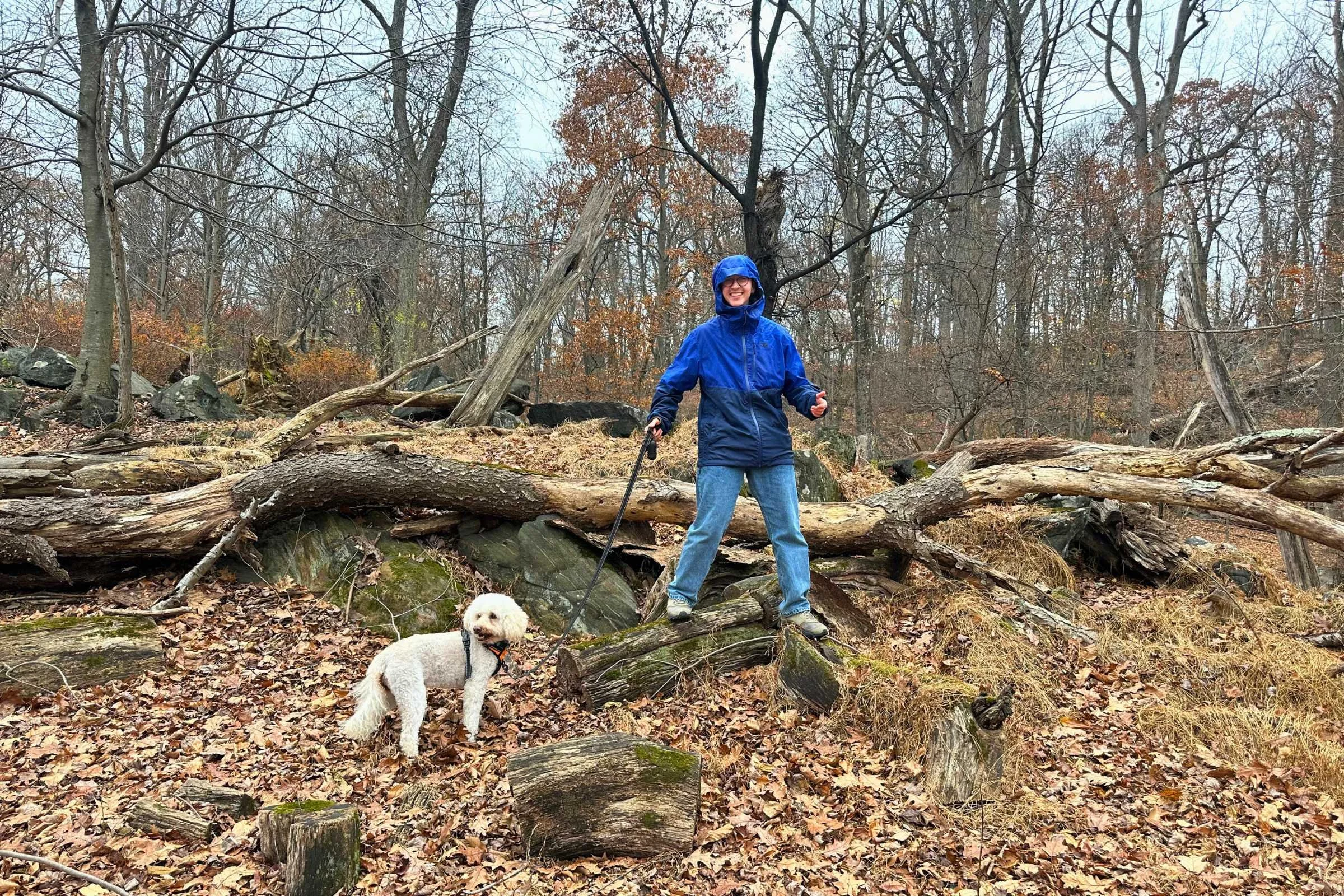
Elliot (the human) out walking Luna (the dog) in a preserve on a rainy day.
When working at a trail hostel, one is pulled in many directions and often on short notice. I always appreciated the Foray’s reliability when looking for an easy, reliable jacket to grab when running out for a last-minute pickup in the pouring rain.
Now off-trail in New York, I’ve continued to test the Foray through this fall in local preserves on day hikes and even in Manhattan. The temperatures I tested the Foray in ranged from mid-70s (Fahrenheit) to the low-20s, and as the seasons changed the conditions ranged from warm and pleasantly breezy to freezing wind and sleet.
Performance in the field
Weather protection
Waterproofing effectiveness in various conditions
From day-long light drizzles and wandering around in the mist of a cloud to creeping downpours and persistent wind that brings frozen rain down at a 90-degree angle, the Outdoor Research Foray jacket has proven itself effective at sealing out external moisture without PFAS in their waterproofing.
DWR performance and longevity
This jacket has been in use from spring to now, with hundreds of miles on the Appalachian Trail in Virginia and Maine, and remains just about as waterproof from external moisture as the first day I took it out of the box. While a wash-in or spray-on DWR restorative is an option, it just doesn’t need it yet—the waterproofing is solid.
Wind resistance
The Foray is an effective windbreaker when all ventilation zippers are closed and the hood is on and secure. In high winds atop 4,000-foot peaks in Maine, even on a cold day in use as my standalone wind and rain protection, I found this jacket an adequate shield from the wind (which was also carrying sleet).
Hood performance and coverage
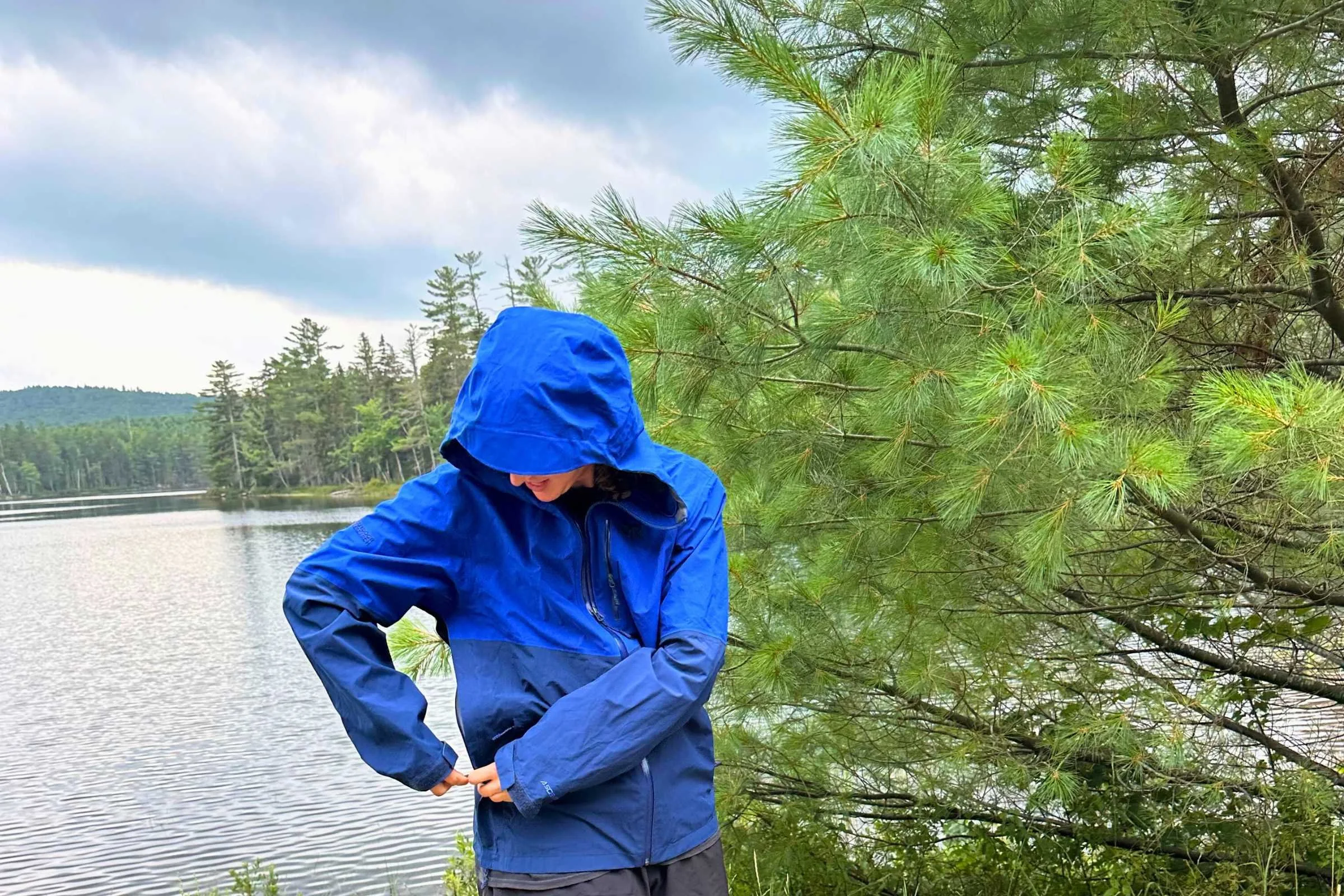
The hood performed admirably in winds of nearly all speeds. It’s spacious enough to accommodate large heads, hair, hats, and helmets comfortably and in my experience has consistently stayed on facing strong winds head on, with a visor that helps steer rain away from one’s face and glasses.
Seam integrity and zipper performance
Thus far, the seams have held up to a full season of not-so-gentle use without failing or developing gaps where water can enter. The zippers, which are sealed to repel water, have proven equally capable of disallowing external moisture to enter.

Breathability and ventilation
Membrane breathability during high-output activities
Ah, the biggest area of possible improvement for the new edition of the Foray. It is just not a breathable rain jacket, meaning that during high-output activities where you’re working hard and generating heat and sweat, if you’ve got the ventilation zippers closed to keep out external moisture, you’ll be soaking in internal moisture (sweat) in no time. It’s decidedly stifling in hot, humid storm showers and the lack of breathability is the reason I did not enjoy using it during summer and would recommend it for the colder seasons.
Pit zip effectiveness
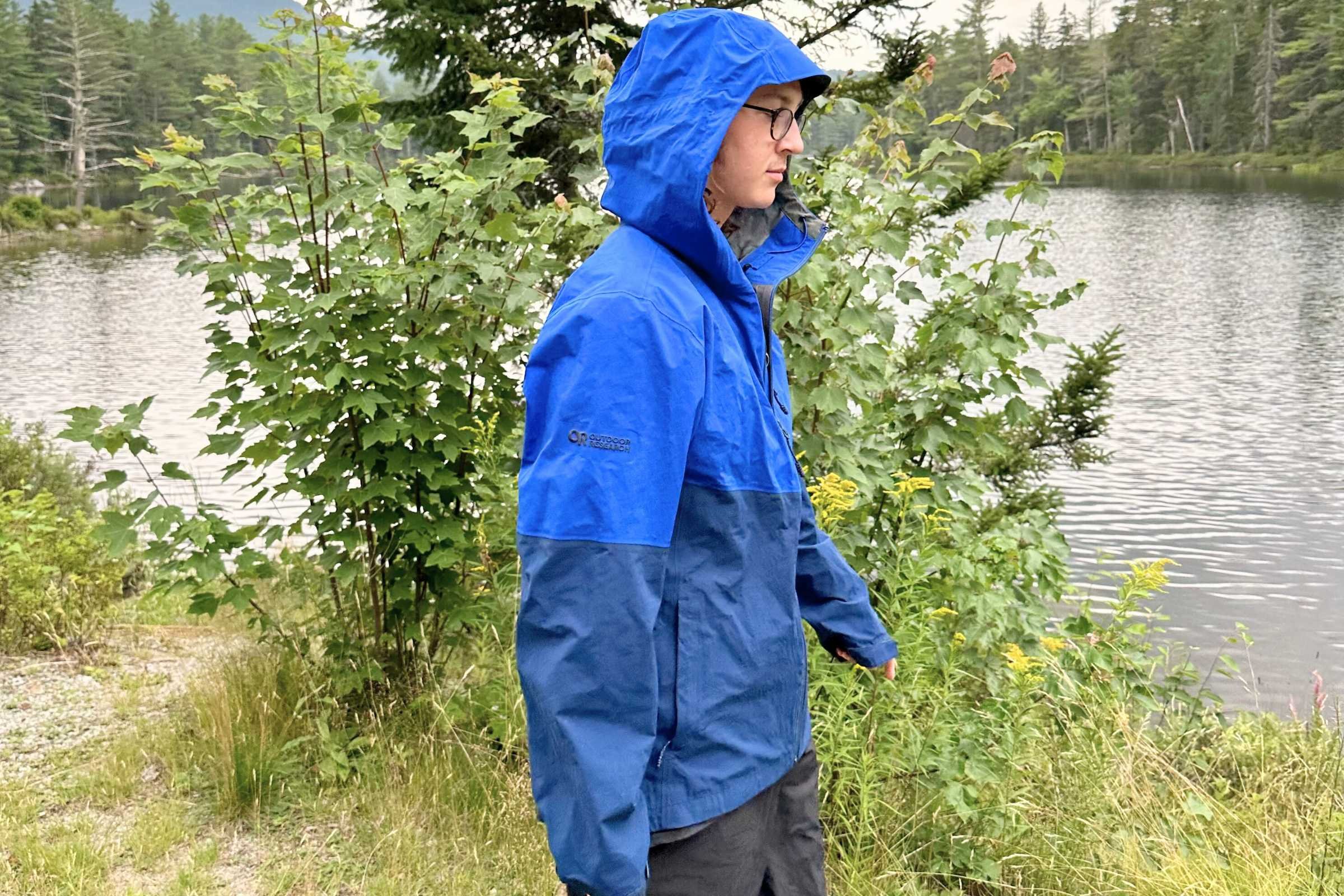
The membrane’s non-breathability is mitigated heavily by the presence of the longest ventilation zippers ever (don’t fact-check that), which go from the hem of the jacket all the way up to the bicep. When unzipped, they provide truly excellent ventilation and made testing the jacket even in the heat in summer almost bearable. During high-intensity hikes in cool and cold weather, I find myself eeking the zipper further and further open as I get warmer; the zips are quite effective at venting heat.
"Wetting out" behavior (internal vs. external moisture)
I’m pleased to say that I’ve not had to deal with wetting out, or external moisture like hard rain in a persistent downpour soaking through the waterproof membrane. While balancing keeping rain out while venting heat and avoiding buildup of internal moisture was sometimes a challenge, the Foray hasn’t yet wet out in my time with it–though it could easily be revitalized with a wash-in or spray-on DWR treatment.
Temperature regulation capabilities
Regulating temperature in this jacket fell largely to the exquisitely long ventilation zippers, which stretch from the hem to the bicep. They were the saving grace of this jacket in warm weather and the only reason it could be worn somewhat comfortably in the summer, though as someone who runs quite hot I’m still not sure I’d recommend it for a summertime pick. Nevertheless, while the lack of breathability can pose a challenge in hot weather, the long ventilation zippers do wonderfully to dump heat quickly and easily.

Elliot by Horns Pond up in the Bigelows in the Foray Jacket on a hot and drizzly day.
Fit and comfort
Sizing accuracy and fit type
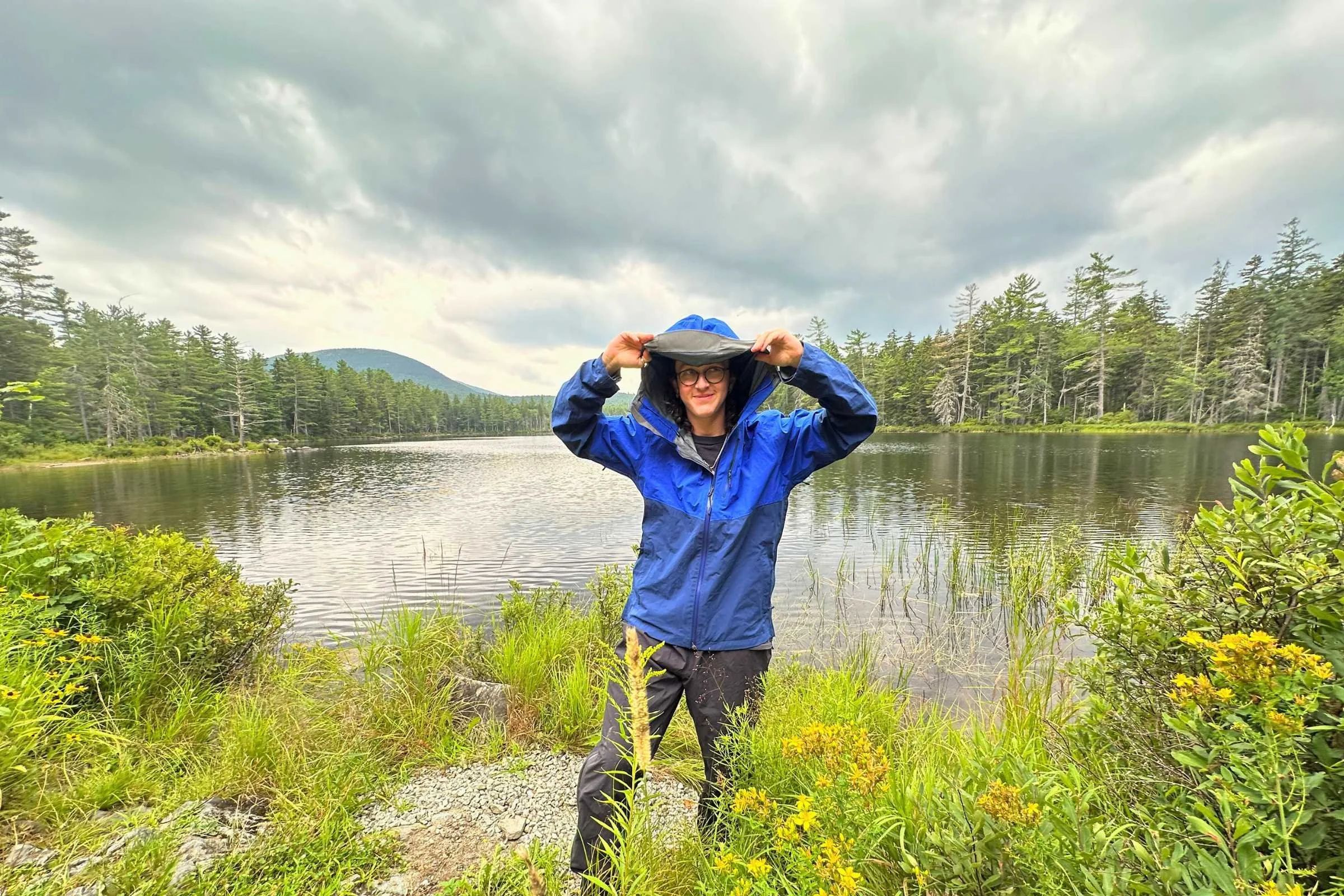
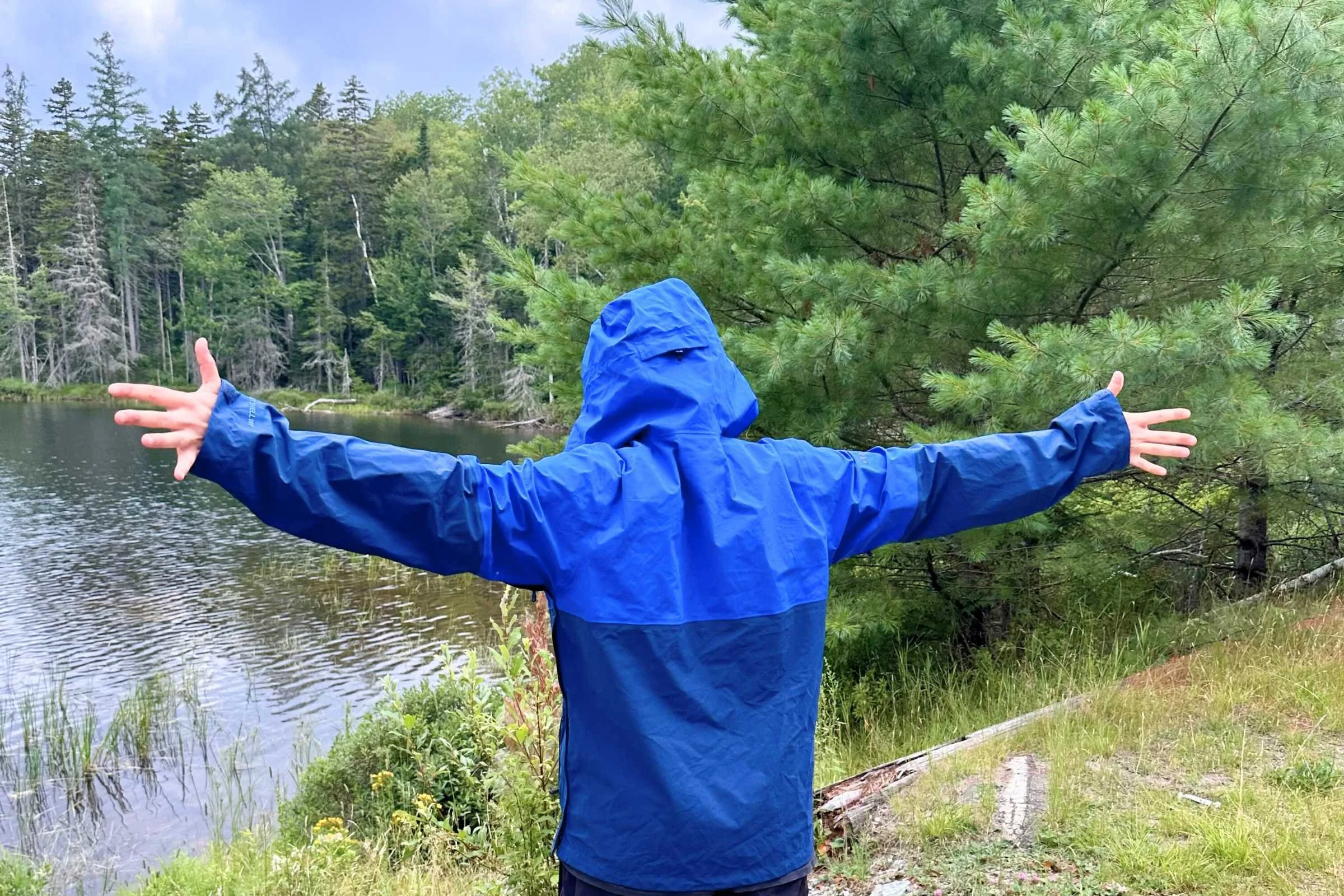
The Foray seems to be true to size and of a standard fit that’s roomy enough to accommodate layering without excessive bagginess. I am 5’9” and usually wear a men’s large, and am pictured in that size here—it fits me perfectly to accommodate layers and use as an active layer (i.e., offers full range of motion) and is slightly loose when worn with no layers underneath.
Range of motion and articulation
I found the range of motion offered by the cut of this jacket to be more than sufficient. I never encountered a situation where I reached for a handhold on a scramble and had to get a second tug to extend my arm all the way with this jacket and a pack on, an experience often had with an ill-fitting rain jacket that shall remain nameless. One should not be restrained by their outdoor clothing, and the Foray provides ample room to stretch and breathe while moving around in the outdoors.
Next-to-skin comfort (liner quality)
The liner is comfortable for a rain jacket: while I never wore this jacket as my only top layer, I hiked in it with only a short-sleeved shirt underneath for the majority of the summer and never found myself annoyed with the presence of the liner on my bare arms. As a person regularly irked by the texture of fabrics, this is a win for the liner of a rain jacket.
Layering capability
This jacket is a wonderful layering item which makes it versatile from season to season. It’s got a roomy enough fit for a fleece and puffy easily but not excess fabric that becomes a hindrance when wearing it as standalone precipitation or wind protection.
Length and coverage (especially with a pack/helmet)
The Foray provides full coverage with either a daypack or backpacking pack and I didn’t experience much, if any, riding up of the jacket while climbing uphill with a pack. There is also a drawcord to cinch at the hem if needed. Customer reviews as well as my impression of the hood being quite roomy (enough for the bulky hood of a sweatshirt, a puffy jacket, a beanie, and then some) indicate that the hood of the Foray fits a bike helmet underneath comfortably.
Packability and weight
Packed down, this jacket is about the size of a lumpy softball or misshapen but decently sized cantaloupe. It packs down enough that it shouldn’t make or break there being room in your pack for all your things.
For the weight and its performance as a multi-season rain jacket, the jacket is quite light! It’s comfortable, fits well, and consistently keeps rain out and wind off the moment you unfurl it.
There is no stuff sack included, but the jacket packs relatively easily into any one of its own hand pockets.
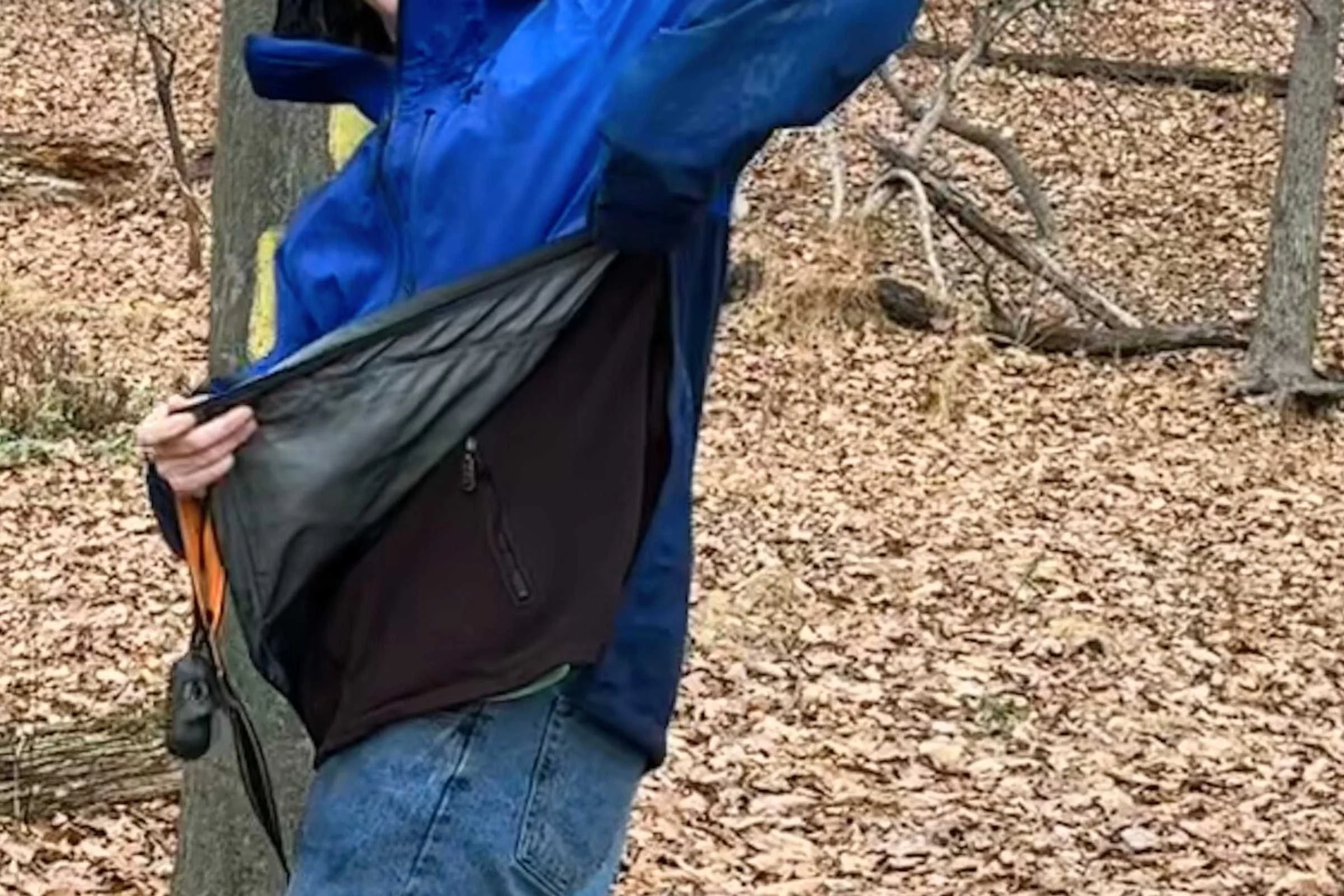
One of the side pockets has a convenient little interior clip for attaching your keys or wallet to. When you pack the jacket down into this pocket, the clip itself—or the loop it’s attached to— becomes a convenient place to clip the jacket to the outside of a pack.
One of the Outdoor Research Foray jacket side pockets features a loop and key clip for those of us who can’t stop misplacing our wallets.
Features
Waterproof technology
Membrane type and construction (two-layer vs. three-layer)
The Outdoor Research Foray is a three-layer waterproofing system, with an outermost 100% recycled 40-denier nylon face fabric, a middle waterproof membrane layer, and an inner layer that’s softer to the touch and improves durability. Often, 3L outerwear is for gear designed to perform in harsher backcountry weather—which doesn’t mean it’s not just as at home being used on a cold and rainy walk or windy bike ride.
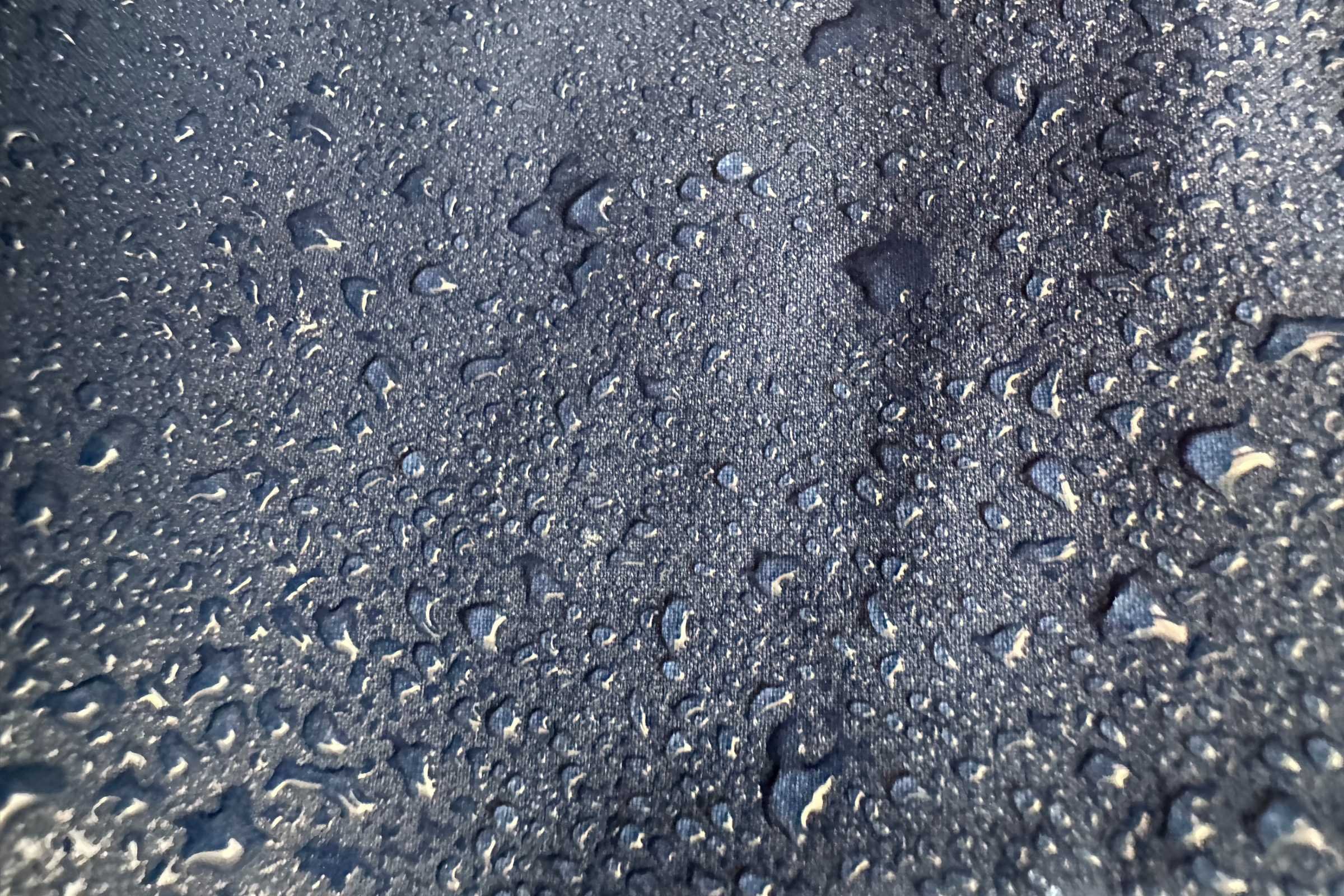
Shows fabric texture and DWR beading
Brand-specific technologies
The Foray features Outdoor Research’s AscentShell Dry technology, which allows breathability and stretch in waterproof fabrics.
PFC-free considerations and environmental impact
Used in the Foray is the Nikwax's Direct.Dry Durable Water Repellent (DWR) coating, which is PFC-free—as are all new Outdoor Research products as of this year. The coating is factory applied here but can also be used to revive waterproof gear that’s seen its fair share of storms and is no longer waterproofing like it used to.
Maintenance requirements
Like all outdoor gear, maintenance requirements will depend on how much your gear is used and how intensely—after a season of pretty consistent use, this jacket doesn’t need another DWR treatment or anything like that, but it might a few seasons down the line.
Hood design
Adjustability options
The hood is adjustable in the back and front, allowing the wearer to easily dial in the fit of their hood to accommodate hair, hats, helmets, or anything else one might have on their head.
Helmet compatibility
The hood is spacious enough to accommodate a standard bike helmet, and was easy to adjust to have room for an easy and full range of motion. In fact, if you have a small head, be aware that the hood is large enough for a whole helmet and note the adjustability options as there will be a ton of extra room!
Peripheral vision
Due to the spaciousness of the hood, I was quite grateful for the adjustability options as otherwise I’d have been totally encircled with no peripheral vision to speak of. Once adjusted to fit the size of your head plus any headwear, the hood shouldn’t block your peripheral.
Storm protection effectiveness
The encircling nature of the Foray’s hood, and the incorporated brim, helps to keep rain from blowing into your face during a storm and diverts it away from your eyes (or more to the point, steers the water away from my glasses so I can still use them to see).
Stowability
The hood of the Foray is not stowable, though when wearing the jacket during gaps in the rain I occasionally just tucked the hood down so it wouldn’t collect water running off trees while I wasn’t using it as actively.
Ventilation systems
Pit zip size and placement
The pit zips on the Foray jacket are truly the longest and most effective heat dumping ventilation zips I’ve ever experienced, thanks to the TorsoFlo venting which lets you unzip the body of the jacket all the way to the bicep.
Additional venting options
While this pit zip is the only ventilation zip aside from just unzipping the jacket for more airflow, it certainly does the trick.
Effectiveness during high-output activities
During high-output activities, the ventilation zip is truly necessary and quite effective—unzipping it all the way is relatively easy on the move, and sweat tends to build up fast if you don’t take advantage of the ventilation options.
Pockets and storage
Number, size, and placement
The Foray has two large zippered hand pockets and a large, but not quite as large, zippered chest pocket.
Accessibility with pack/harness
With many packs that have a hip belt, access to the two hand pockets will be partially blocked by the pack. However, easy access to one of the three available zippered pockets was usually there regardless of the pack–though my backpacking pack’s hip belt blocked the two hand pockets, I could easily get to the chest pocket; while in my day pack I could access the hand pockets but not the chest one.
Water resistance of zippers
The zippers have so far proven excellent at keeping moisture out of the pockets–my usual test for the pockets of rain gear involves dry tissues in the pockets at the beginning of the hike and ideally equally dry tissues in the pockets at the end, and the Foray’s three pockets each protected their relative tissues well.
Adjustability
Cuff closures
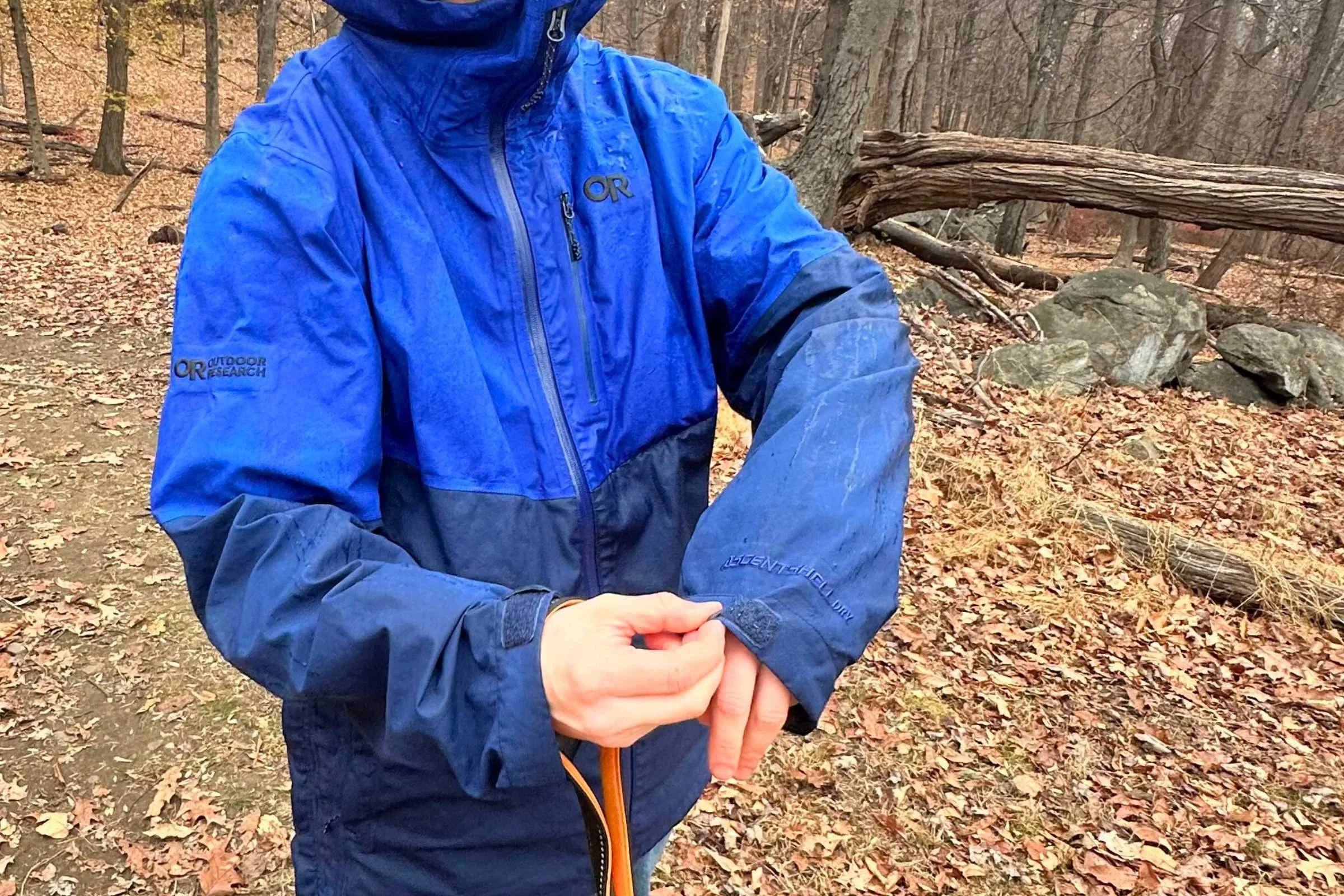
The sleeve cuffs close by way of Velcro and are easy to adjust to accommodate gloves, layers, or rolling.
Hem adjustments
The hem has an adjustable elastic drawcord and is also easy to adjust while on the go, letting you dial in the fit of the jacket overall and helping to keep it on and in place while you adventure.
Hood adjustments
The hood is adjustable in the front and the back which is beneficial for adapting your jacket to comfortably fit a helmet, hat, or even a secret pillow and then hide you from the wind the next moment.
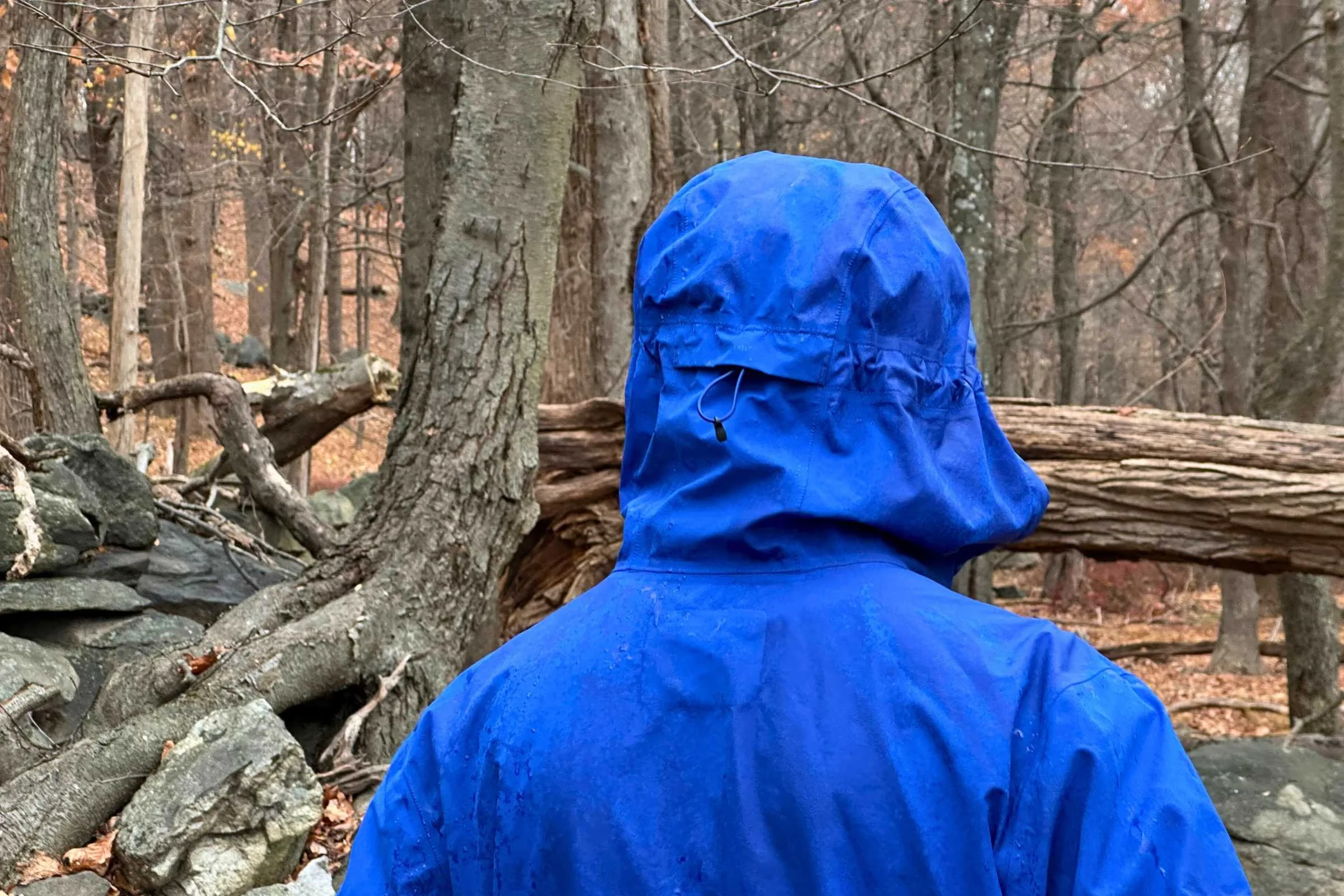
Fit customization options
The Outdoor Research Foray men’s jacket comes in XS to XXXL, and at present is sold only in standard heights, though the fit is true to size and a bit roomy for layering.
Durability
Reinforcement in high-wear areas
The Foray has more robust fabric in areas of high wear, such as under the armpits where the straps of a pack will bring friction over time and wear. Stretch panels with less durable fabric allow for a full range of motion and aren’t in high-wear areas.
Zipper quality and type
The center zipper used in the Foray jacket is the YKK Aquaguard zipper, a water-resistant zipper created by laminating polyurethane onto a coil zipper. It is easy to operate while wearing the jacket and hasn’t snagged or gotten stuck yet, and is effective at keeping rain from entering via the zipper.
Seam construction
The seams are fully seam-taped for extra durability and waterproofing.
Abrasion resistance
The recycled face fabric is 40-denier nylon and is resistant to abrasion for its weight. It’ll hold up well to reasonable wear and tear and has been fine through my occasional instances of crashing through pine boughs on a less-maintained-than-ideal trail.
Sustainability and ethics
Material sourcing
The Foray’s three-layer fabric system is made from 100% recycled nylon fabric.
Manufacturing practices
With its new PFAS-free waterproofing and use of recycled products, the Foray is the first outdoor technical apparel to be certified as carbon neutral by Climate Impact Partners.
PFC-free DWR and environmental considerations
As brands continue their shift away from “forever chemicals” like PFAS and PFCS that pollute the earth and cause health concerns, formerly used in the majority of waterproof technical apparel as well as other manufacturing, new waterproofing technology comes to rise.
End-of-life considerations
If your Outdoor Research Foray jacket is in need of some love, consider looking into repairing or reviving it! See our guide to cleaning and repairing shells. Unless it’s totally destroyed, avoid letting your gear land in a landfill! Repairs are often surprisingly simple and pre-loved gear can find new homes in secondhand retailers or gear exchange groups.
Brand sustainability commitments
Outdoor Research has committed to continuing and developing practices that work to bring the outdoor industry to a climate-positive place. These commitments show up in products themselves: the recycled contents and PFAS-free waterproofing found in the Foray jacket contribute to lowering the impact of new technical apparel on the world we explore while wearing it.
Who should buy the Outdoor Research Foray 3L Jacket?
Buy if you’re looking for a jacket to accompany you through cold and cool weather conditions— whether they be a chill commute to a fight for the summit—the new, PFAS-free edition of the Outdoor Research Foray 3L Jacket could be the one. It’s an excellent wind shell and sheds moisture as effectively as its GORE-TEX predecessor but is not as breathable—making it better suited to cool and colder weather conditions that’ll see it used as an outer layer over a fleece than a pick for warm or breezy spring and summer rains.
Skip if you’re in the market for an ultralight, highly breathable, and super-packable rain jacket, this is not the pick for you! While its weight-to-performance ratio is good, it’s not that light and is certainly not that breathable. A better alternative would be the Outdoor Research Helium jacket— it’s much lighter, packs down tiny, and very breathable, though not as great for extended use in cold and rainy conditions.
Where to buy
The Outdoor Research Foray 3L and Aspire 3L rain jackets are popular, so you have options when it comes to retailers. Here are some of the pros of the retailers.
REI
Pros: 100% satisfaction policy for 1 year; 10% dividend for members.
Amazon
Pros: Free 2-day shipping with Amazon Prime membership
Similar products to consider
Marmot PreCip Eco
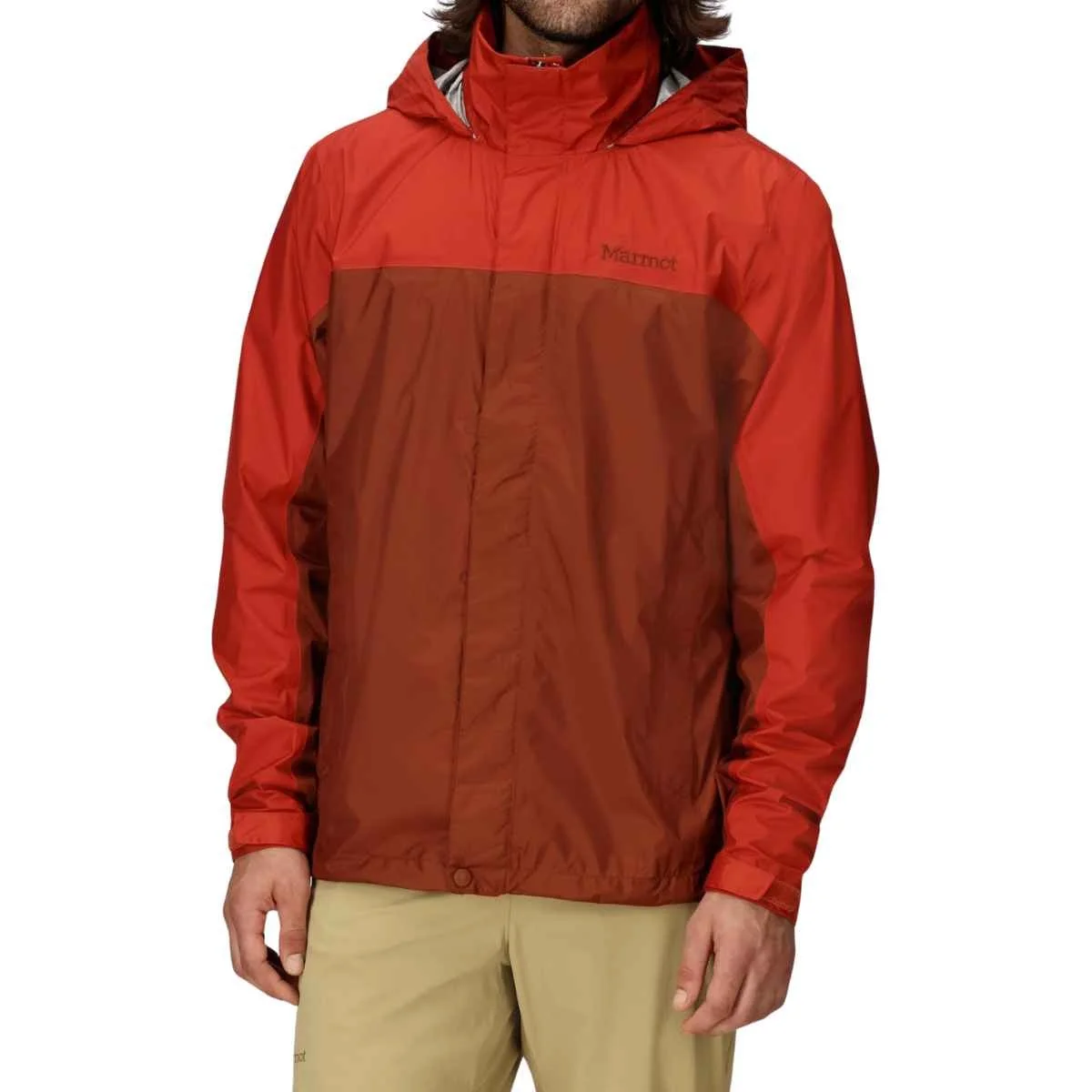
Best for: Beginner hikers or backpackers, people who hike in less wet climates, lightweight hikers and backpackers, just in case rain gear
PFC-free and PFAS-free: Yes
Sizes: S-XXXL
Weight: 10.3 oz (men’s), 8.7 oz (women’s)
Waterproof Material: Nanopro
Waterproof Rating: 10,000 mm
Pit Zips: Yes
Pockets: 2 zippered hand pockets
What we liked: Fits into pocket, budget-friendly, good "just-in-case" rain jacket to always have in your car or day hiking pack, inclusive sizing
What we didn't like: Not as waterproof for downpours as other jackets
The Marmot PreCip Eco is a lightweight, packable, and more affordable alternative to the Foray jacket–capable of keeping you dry during almost any activity and in almost any condition at less than half the price. With a NanoPro 3L construction with 100% recycled face fabric and PFAS-free waterproofing, the PreCip Eco is as environmentally friendly as the Foray as well. However, it’s not as well suited to withstanding intense downpours for an extended period as the Foray.
Marmot PreCip Eco
men's
Women's
Arc’teryx Beta SL
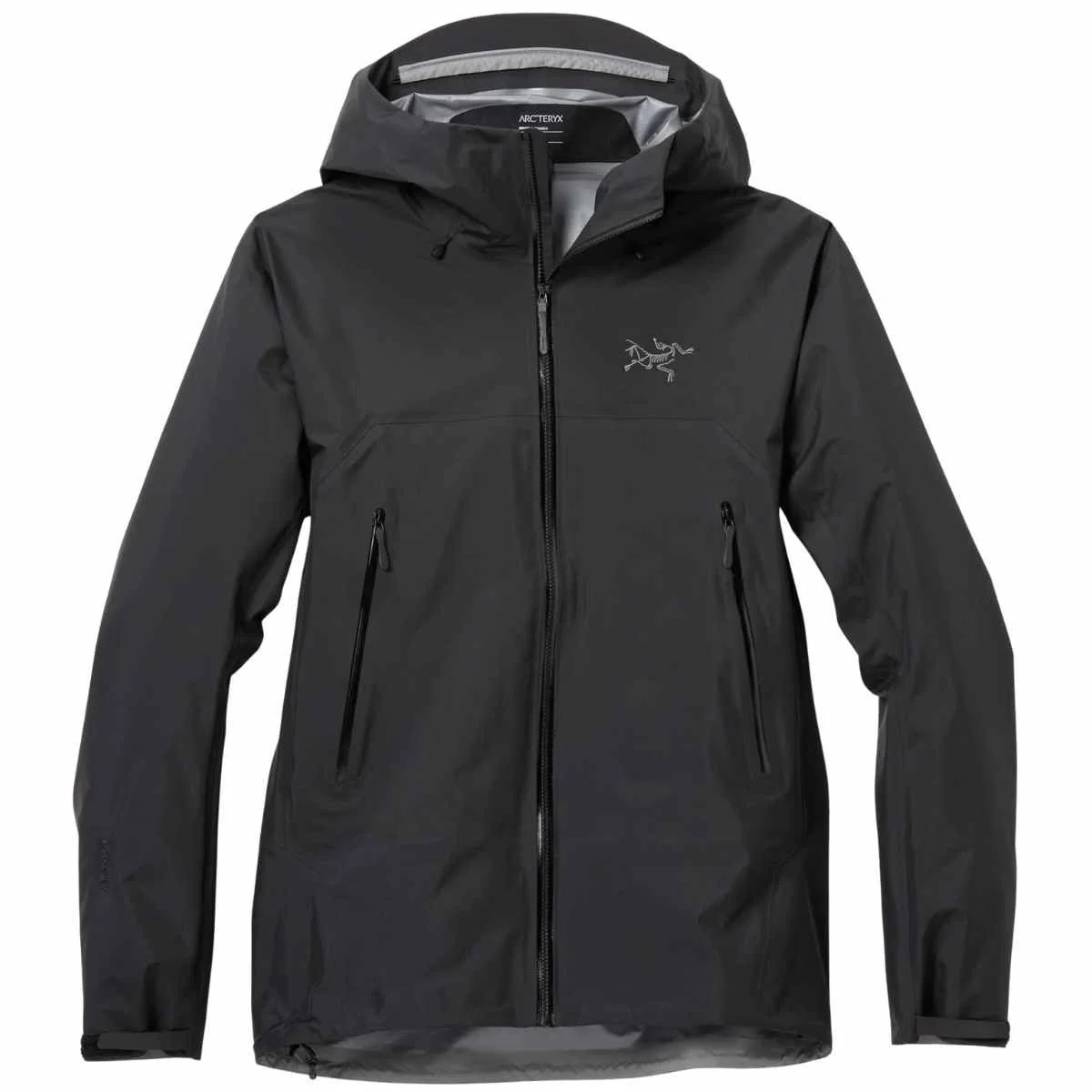
Best for: Backpackers, thru-hikers, lightweight hikers, bikepackers
PFC-free and PFAS-free: Yes
Sizes: S-XXL (men's), XXS-XXL (women's)
Weight: 12 oz (men’s), 10.6 oz (women’s)
Waterproof material: 3-layer GORE-TEX
Waterproof rating: 28,000 mm
Pit zips: Yes
Pockets: 2 zippered hand pockets, 1 internal chest pocket
What we liked: Excellent waterproofing, hood stays on in heavy wind, good length and ventilation, PFAS free
What we didn't like: Price, would like to see more inclusive sizing
For hikers looking for a feature-laden, lightweight rain jacket that can stand just about any conditions you might find yourself in with excellent waterproofing and ventilation, the Arc’teryx Beta SL is a premium pick at a premium price. While also constructed with a PFAS-free 3L design, the Arc’teryx jacket has a GORE-TEX membrane for intense waterproofing and C-KNIT backer for breathability without sacrificing that waterproofing. It’s the winner of Best Upgrade in our Best Lightweight Rain Jackets guide. You can also learn more in our in-depth review of the Arc’teryx Beta SL Jacket.
Arc’teryx Beta SL
men's
Women's
Outdoor Research Helium
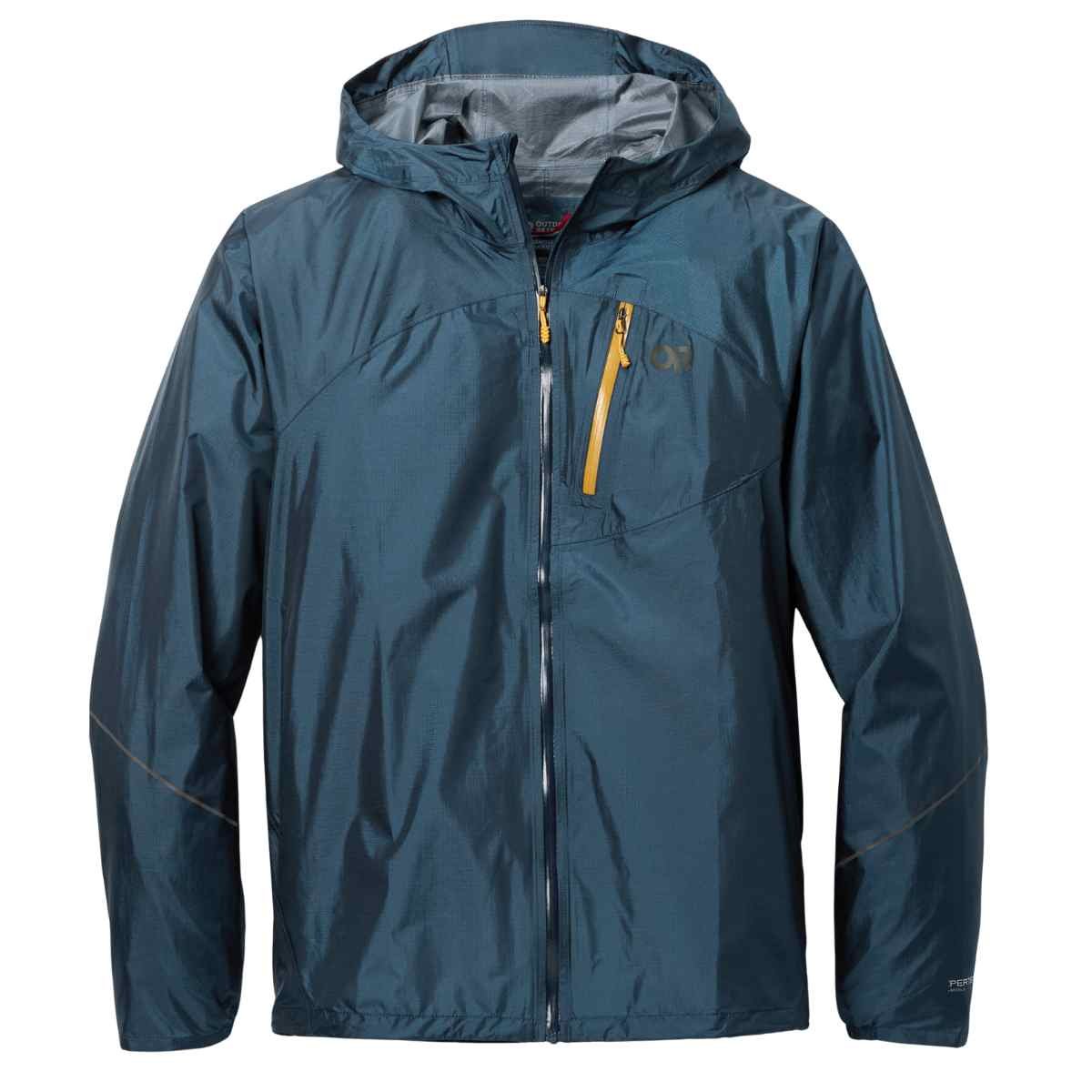
Best for: Lightweight hiking and backpacking, just in case, plus size
PFC-free and PFAS-free: Yes
Sizes: S-XXXL
Weight: 6.3 oz (men’s) / 6.3 oz (women’s)
Waterproof Material: Pertex Shield+ 2.5L
Waterproof Rating: 15,000 mm
Pit Zips: Yes
Pockets: Chest pocket
What we liked: Packability, light weight, size inclusiveness, value for price
What we didn't like: Not the most waterproof
If you’re looking for a significantly lighter weight rain jacket than the Foray, the Outdoor Research Helium rain jacket weighs half that of the Foray and is much more breathable. This comes at the expense of being less water and windproof, with only one pocket and no pit zips. The Helium is much more likely to suit the needs of a hiker or backpacker seeking an ultralight, just-in-case, or warmer weather rain jacket alternative. It’s the winner of Best Packable in our Best Lightweight Rain Jackets guide. If you’re interested in rain pants, check out our in-depth review of the Outdoor Research Helium Rain Pants.
Outdoor Research Helium
men's
Women's
Why you should trust us / About the author

Elliot Koeppel graduated from Tufts University with a B.A. in History in 2023. He began his six-month thru-hike (and first-ever backpacking trip!) of the Appalachian Trail the next week, where he experienced some of the wettest days of his life in the rainiest year the Northeast has seen in many. Since then, he’s hiked the Colorado Trail, worked in trail hospitality, and was the ridgerunner in the Bigelow Mountain section of the Appalachian Trail during the 2025 season.
Koeppel has been testing a range of thru-hiking apparel and rain gear for Treeline Review since 2023. In his free time, you can find him hiking, rockhounding, making jewelry, or listening to Van Halen.