REI Co-op Westward 6 Review: A Tall, Sturdy Tent for Families Who Bring Lots of Gear
A walk-in family tent with a generous covered vestibule
July 1, 2026
Home → Gear Reviews → Camping
Our verdict
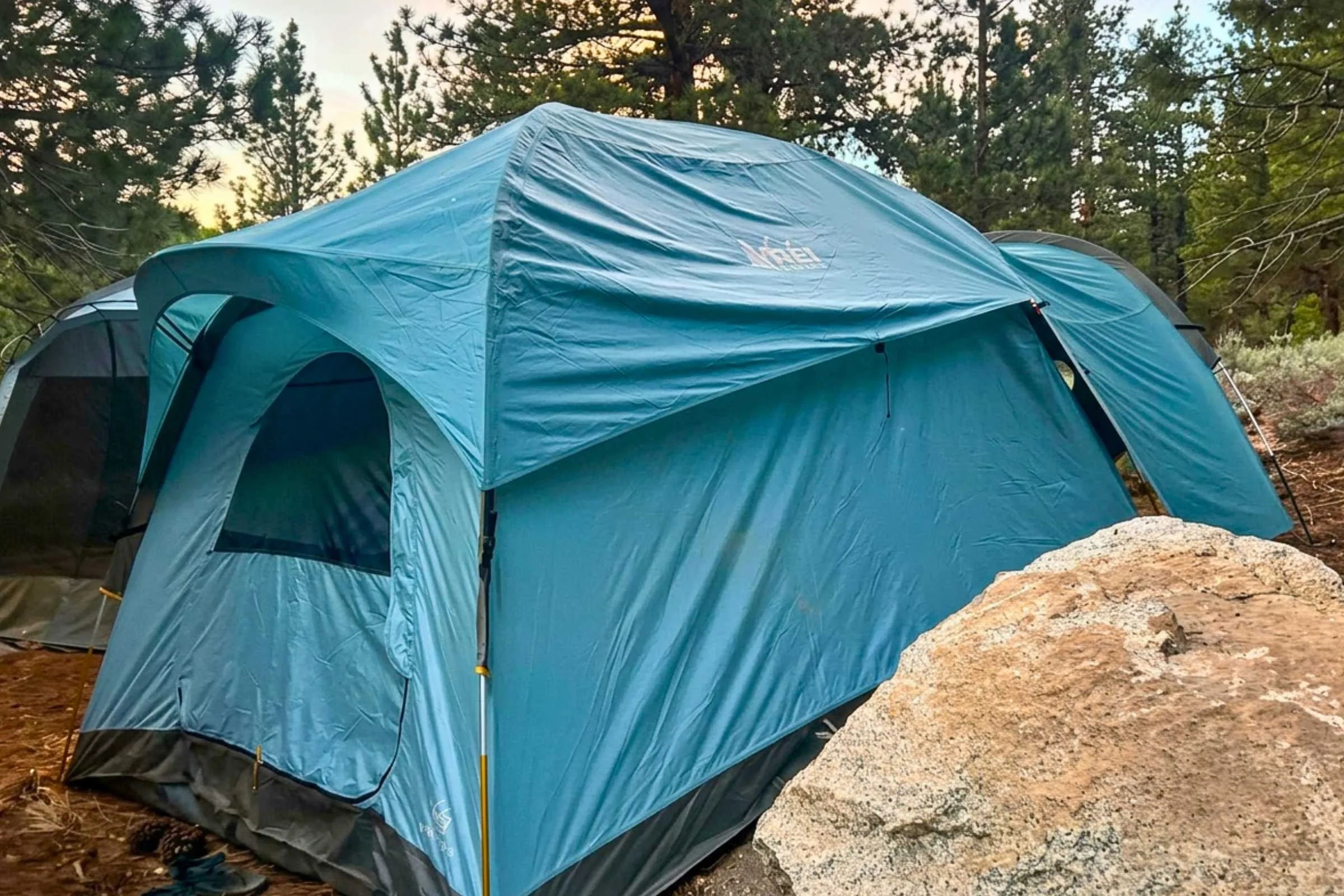
The REI Co-op Westward 6 is a stand-up camping tent with a generous vestibule. Four testers camped in this tent and used it for nearly a month in the Eastern Sierra, setting it up in campsites as diverse as a meadow in an aspen grove, to desert sage, to a pine forest. This tent solves the issue of finding a sturdy and reliable large, family tent with a vestibule big enough to keep bikes, camp furniture, or other gear dry. It has features like an electrical cord pass through port, lots of pockets including door pockets, and an easy way to secure a camping lantern high in the tent for lots of light.
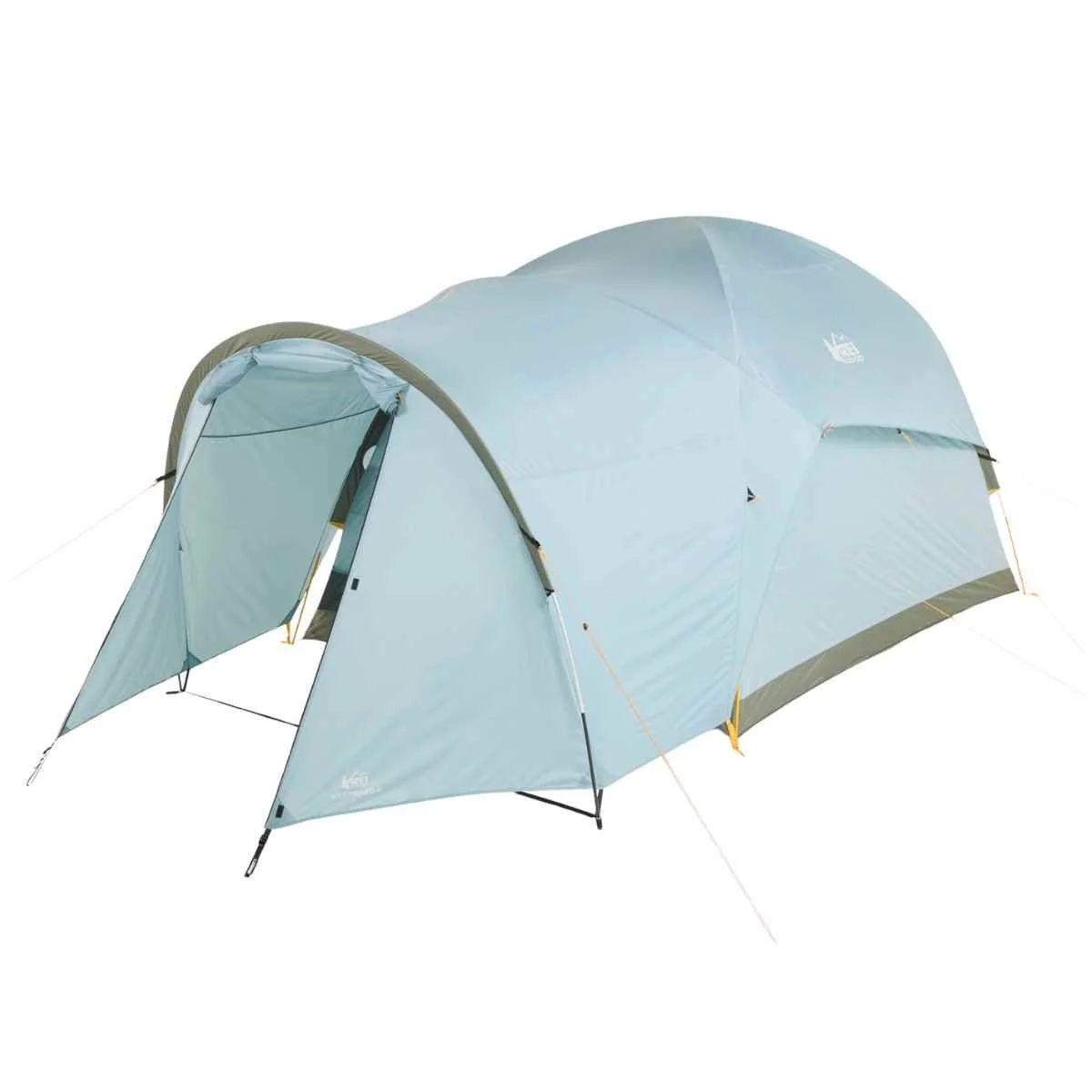
The Westward 6 is tall enough to stand in and change. It is freestanding and double-walled to manage condensation. It's sturdier than many similarly priced tents and is rated a 3-season tent, though we found it less stable in high winds than other similar tents we've tested. The Westward's stand out feature is a pole-supported vestibule that gives you more usable space and height than many similar car camping tents.
REI Co-op Westward 6 Tent
The Westward is a good option for families looking for a reliable car camping tent that is about $100-200 less expensive than similar tents. It's leagues above most budget tents while still remaining easy to set up, durable, and waterproof. Its crowning feature is plenty of vestibule space to keep camp chairs, a bike, or extra gear dry.
We write mission-driven gear reviews. To find the best gear, we combine expert reviews, everyday user opinions, and rigorous independent trail testing—never pop-up or display ads. We are reader-supported and may make a small commission from some qualifying affiliate links. Learn more.
REI Co-op Westward 6 Tent specifications
Price: $549
Seasons: 3-season
Capacity: 6-person
Packaged weight: 19 lbs 10 oz
Packed size: 27.56 x 12.4 x 9.1 in
Floor dimensions: 120 x 97 in
Floor area: 80.83 sq ft
Vestibule area: 35.08 sq ft
Peak height: 77 in (6 ft 5 in)
Doors: 2 (front and rear, each with awning)
Canopy fabric: 75-denier polyester with DWR (front wall/interior upper back); 75-denier polyester with PU coating and DWR (back/sidewalls); 40-denier solution-dyed nylon no-see-um mesh
Floor fabric: 150-denier polyester with PU coating and DWR
Rainfly fabric: 75-denier polyester with PU coating and DWR
DWR: PFAS-free
Design type: Freestanding
Footprint: Not included (REI Co-op Westward 6 Footprint, item #C03297, sold separately)
Windows: Yes (bugproof mesh, with weather protection)
Electrical cord pass-through: Yes
Guylines: 4 reflective guylines included
Stakes included: 8
Storage bag: Wide-mouth with duffel handles
Optional awning extension: Front vestibule door can be extended with 2 tarp poles (not included)
Best for
Families or groups of friends who want a reliable and easy to set up camping tent for use in developed campgrounds
Campers who want a camping tent backed by the REI name and quality
People who want to store their camp chairs or other gear under a vestibule to keep it dry or out of sight while on day excursions
Campers who want to stand up fully and spend time inside the tent on rainy days
People who want a covered lounge area in the vestibule
Campers in a developed campsite who want to run an electrical cord through the electrical cord pass through
Comparison table
| CAMPING TENT | MSRP | WEIGHT | SLEEPS | FLOOR AREA | DOORS/ VESTIBULES | VESTIBULE AREA | FREESTANDING? | PEAK HEIGHT | POLE MATERIAL | PACKED SIZE |
|---|---|---|---|---|---|---|---|---|---|---|
| REI Co-op Westward 6 | $549 | 19 lbs. 10 oz. | 6 | 80.8 ft² | 2/1 | 35.1 ft² | Yes | 77" | Aluminum | 27.5 x 12.4 x 9" |
| NEMO Aurora Highrise 6 | $500 | 18 lbs. 10 oz. | 6 | 83.3 ft² | 2/2 | 47.2 ft² | Yes | 77" | Aluminum | 26 x 9.5 x 9.5" |
| The North Face Wawona 6 | $585 | 19 lbs. 6.4 oz. | 6 | 86.11 ft² | 1/1 | 44.7 ft² | Yes | 76" | DAC Aluminum | 10 x 32" |
| Coleman Skylodge 6 Instant | $345 | 24 lbs. 4.8 oz. | 6 | 90 ft² | 2/0 | 0 ft² | Yes | 74" | Fiberglass | 46 x 10 x 10" |
| REI Co-op Base Camp 6 | $549 | 20 lbs. 11.5 oz. | 6 | 84 ft² | 2/2 | 44 ft² | Yes | 74" | Aluminum | 10.6 x 23.8" |
What we liked
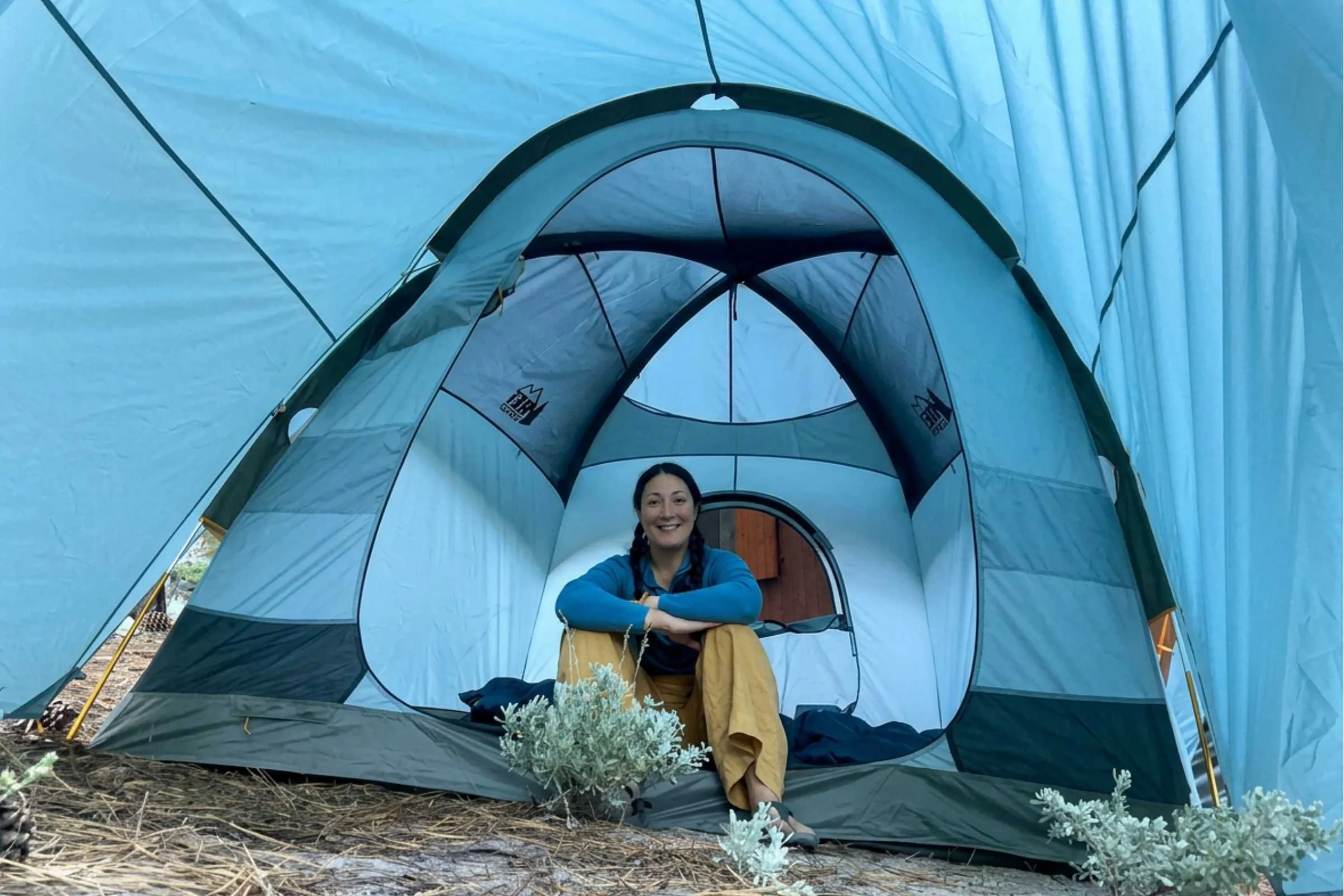
77" Peak height means you can stand up, easily change clothes, or comfortably hang out inside
A pole-supported vestibule gives you more headspace than the typical car camping tent vestibule. That means you can hang out there instead of just storing stuff there.
Color-coded pole architecture made it much easier to see where poles were supposed to go
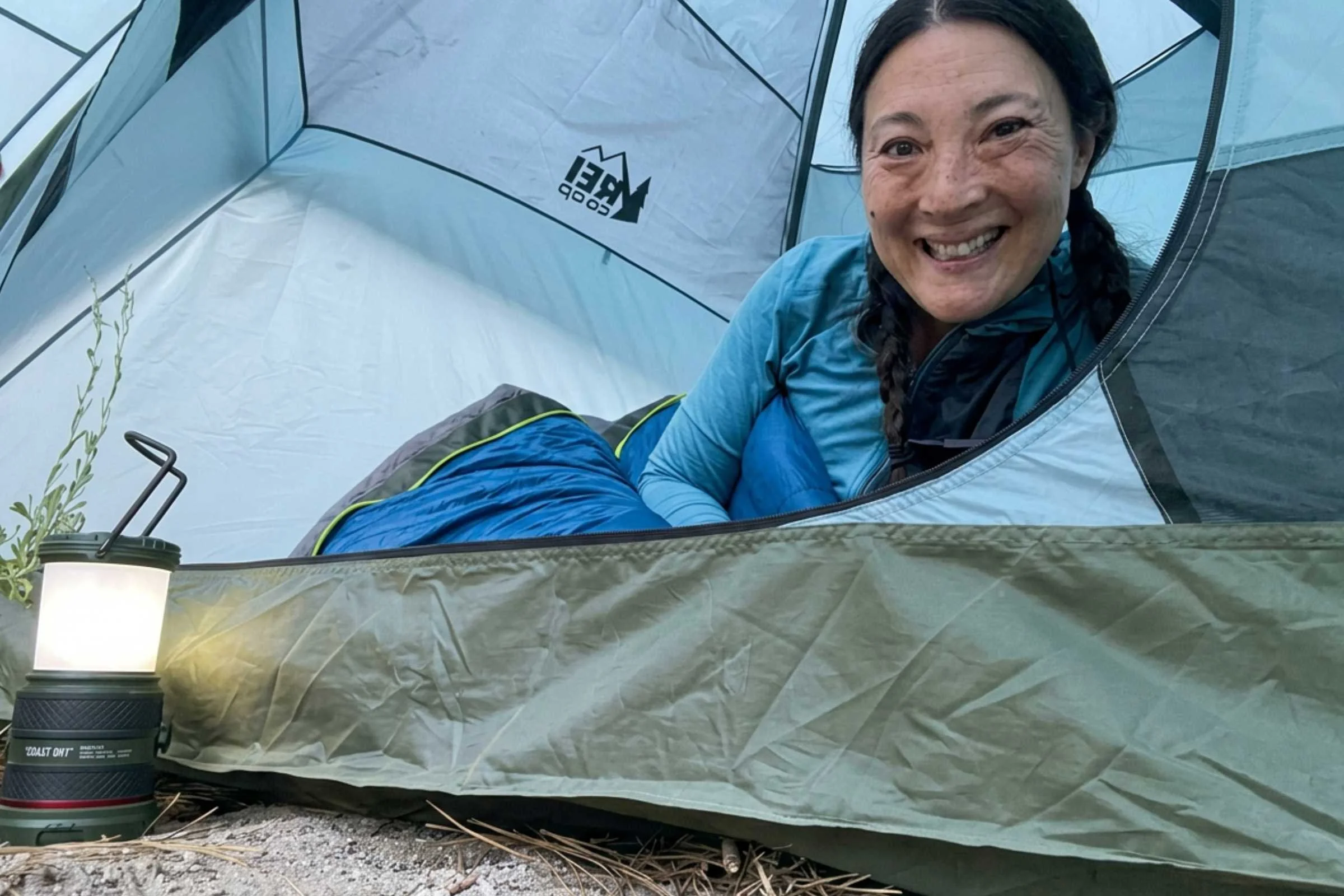
Buckle makes it much easier to secure a camping lantern high in the tent for lots of light.
What could be better
Most of the pockets are too high up to use right before bed
Could be more stable in the wind, especially the vestibule
Only one door has a door pocket
Could be better ventilated
6-people fit is pushing it, especially with gear
Footprint is very large because of the size of the vestibule, making it hard to fit into some campsites
How we tested
Four campers tested the REI Co-op Westward 6 for almost a month straight while camping in the Eastern Sierra. During this trip, we tested the Westward in different campsites with different levels of sun exposure and wind. We camped in an aspen grove and a Jeffrey pine forest and desert sage campsites in temperatures ranging from the mid-30s at night to nearly 90F. We tested in winds averaging around 15 mph with gusts up to 37 mph.
We tested with a group of friends who were about half beginner campers and half experienced campers.
To test this tent, we slept on both inflatable sleeping pads as well as camping cots to test how the tent floor fabric would work with rolling around or hold up to the metal legs of a camp cot. We tested with up to four people sleeping in the tent (everyone agreed any additional people would have been pushing it with gear).
In addition to sleeping in the tent, we also read, did art projects, played board games, hung out, and even wrote part of this article.
We also tested the Westward alongside other camping tents for our Best Camping Tents guide. To keep our review as objective and scientific as possible, those tents were tested in the same campsites during the same time of year in the same weather and temperatures.
Performance in the field
Setup and takedown
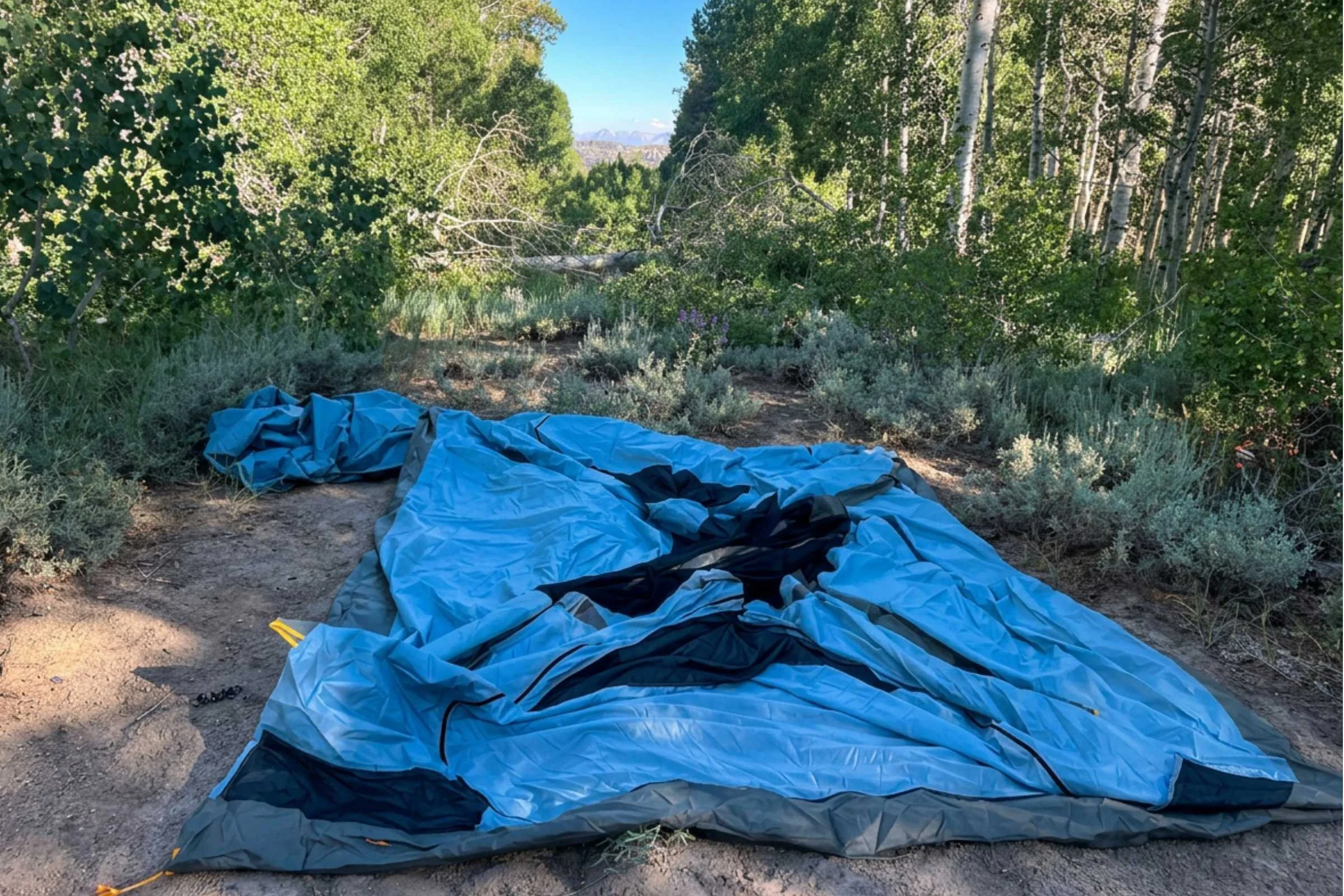
A beginner camper and an experienced camper set up the tent (two people) and had no problems with setting up the inner tent. In fact, we commented on how easy it was to set up and how people who say tents are difficult are exaggerating.
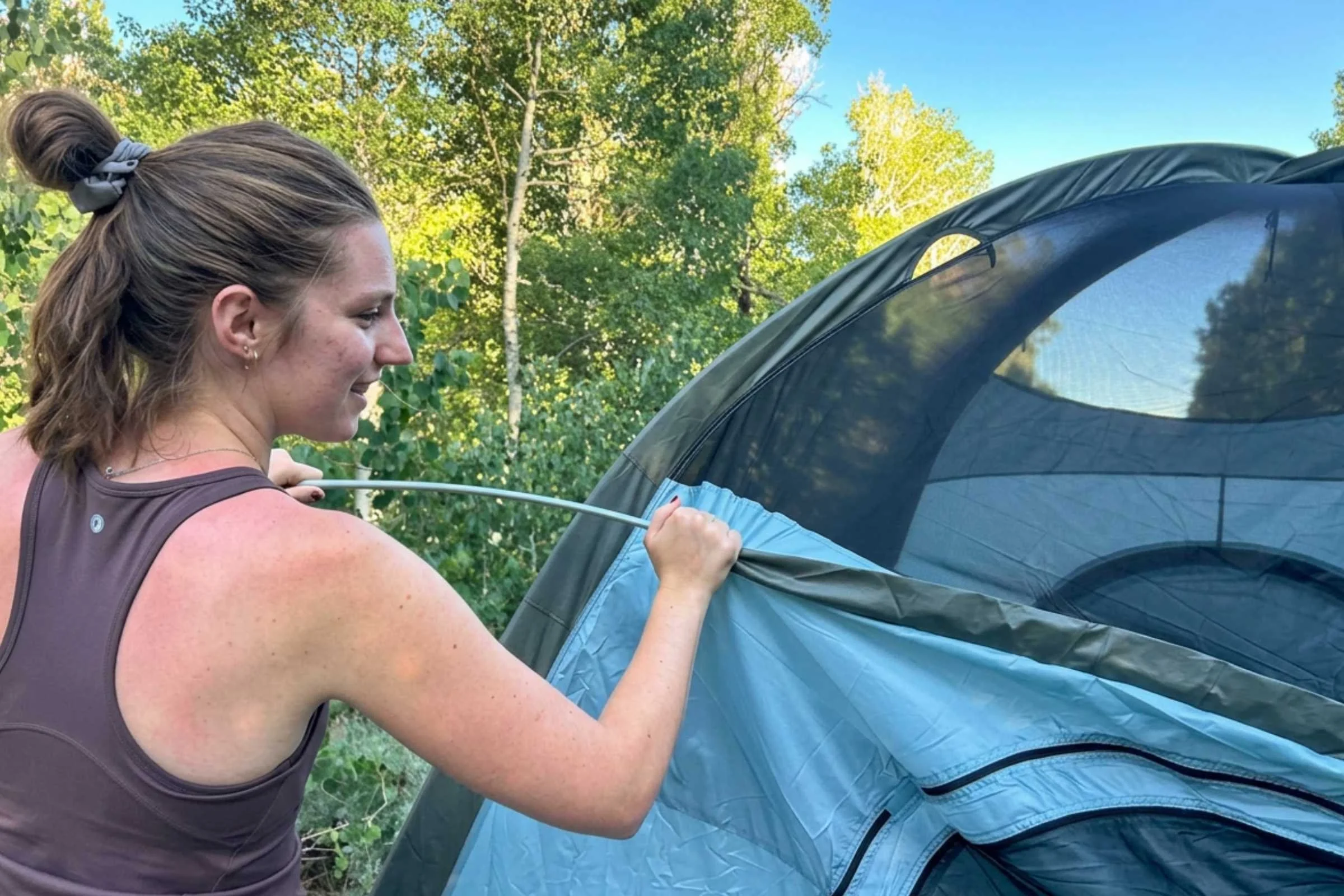
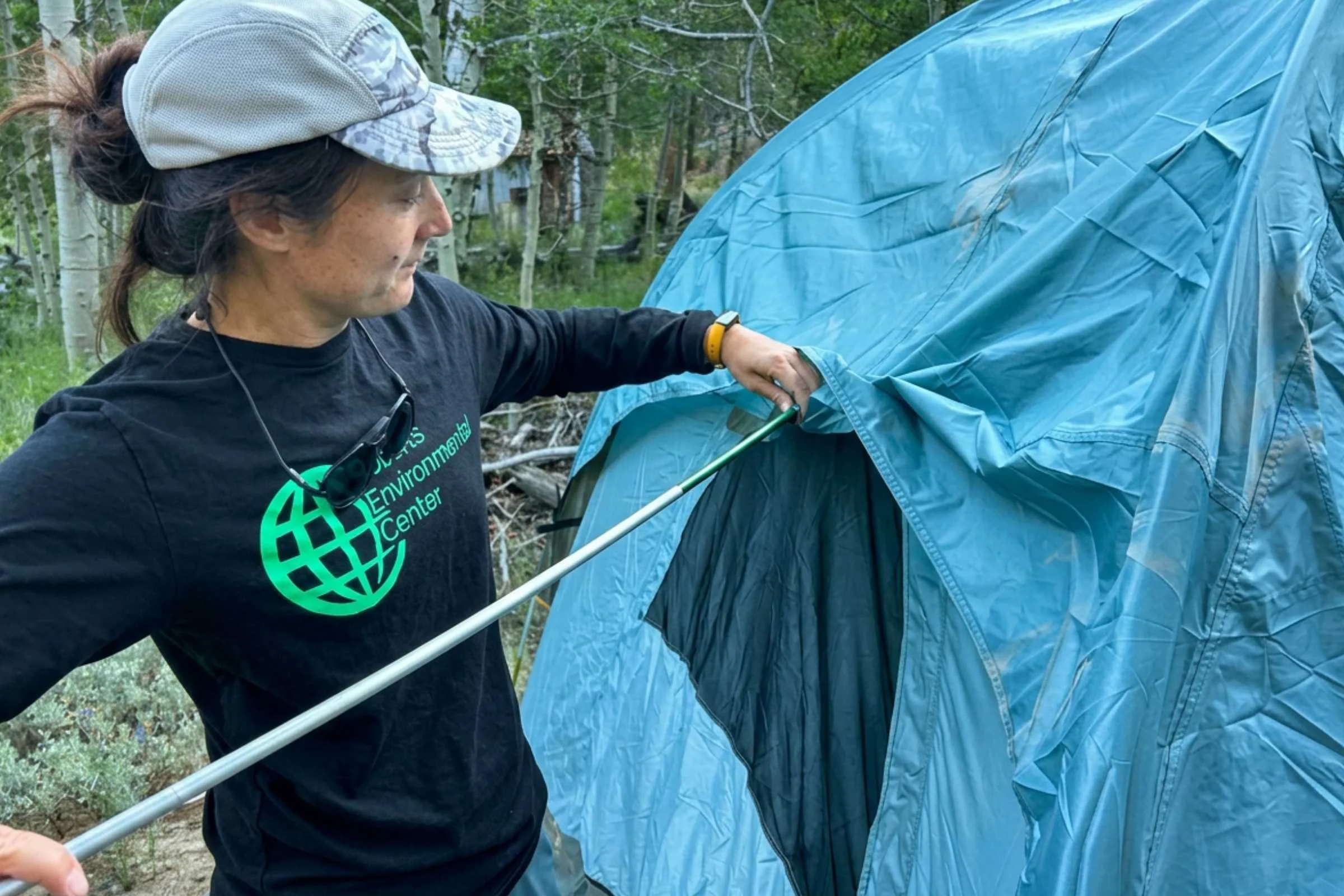
Then came the rainfly with the vestibule brow pole, which was less intuitive. The first time took us fifteen minutes as we struggled to understand the tent's architecture and figure out which pole went where.
After the first setup, we better understood the tent's architecture and could set up the rainfly in five minutes.
As with the Westward Shelter, the tent poles are color coded to match the tent sleeve.
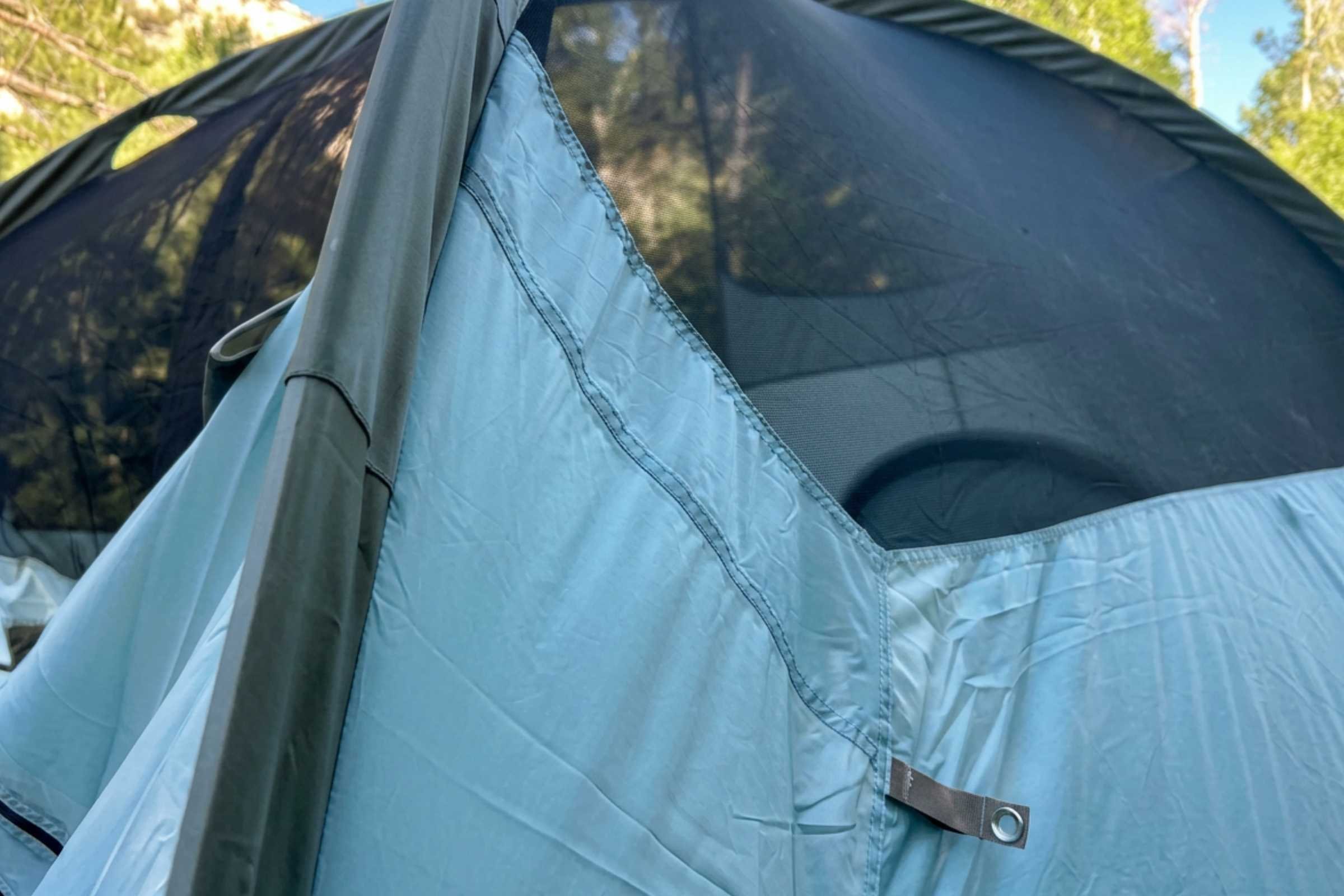
As with other REI tents, we really appreciate that the directions are printed on the tag sewn right into the tent bag along with diagrams (instead of a human, cartoon Bigfoot sets up the tent). Two people could set up this tent and, unlike the Westward Shelter, we didn't think the process benefited from having more people.
The tent is designed so that you can set up the poles horizontally and pop it up, so no one has to be especially tall or reach high to get it to stand up. The tent is 77" tall at its peak, but no one in your group needs to be that tall for the tent to work. The tallest person in our group is 5' 10" and we had no issues getting the tent to stand or getting the rainfly up and over the inner tent.
The wide-mouth storage bag made repacking it easier, requiring less precision when folding and stuffing it in the bag. As long as everything is dry, I actually love taking down tents and rarely find it annoying…except when the bag is too small. That wasn't the issue here.
Interior livability
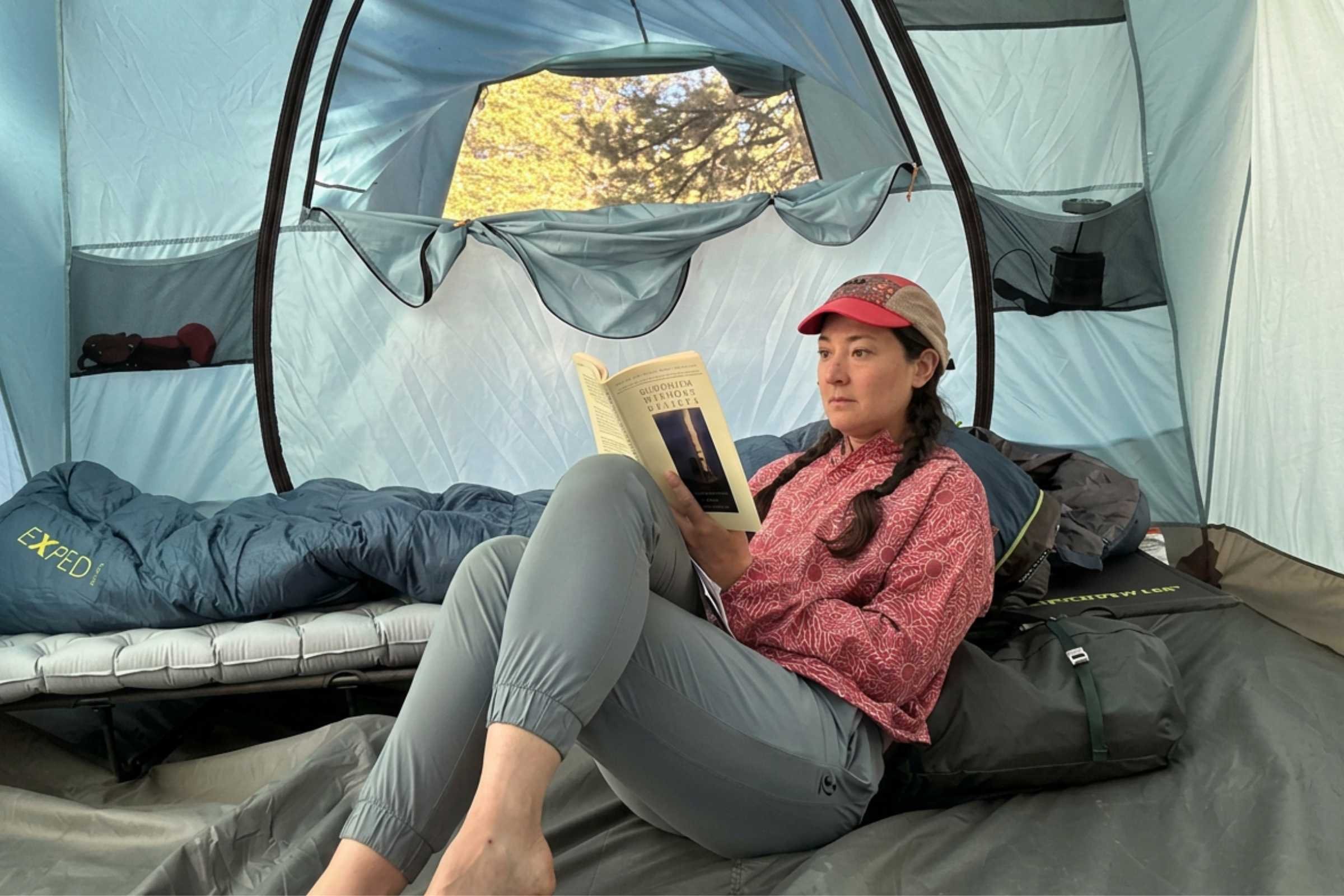
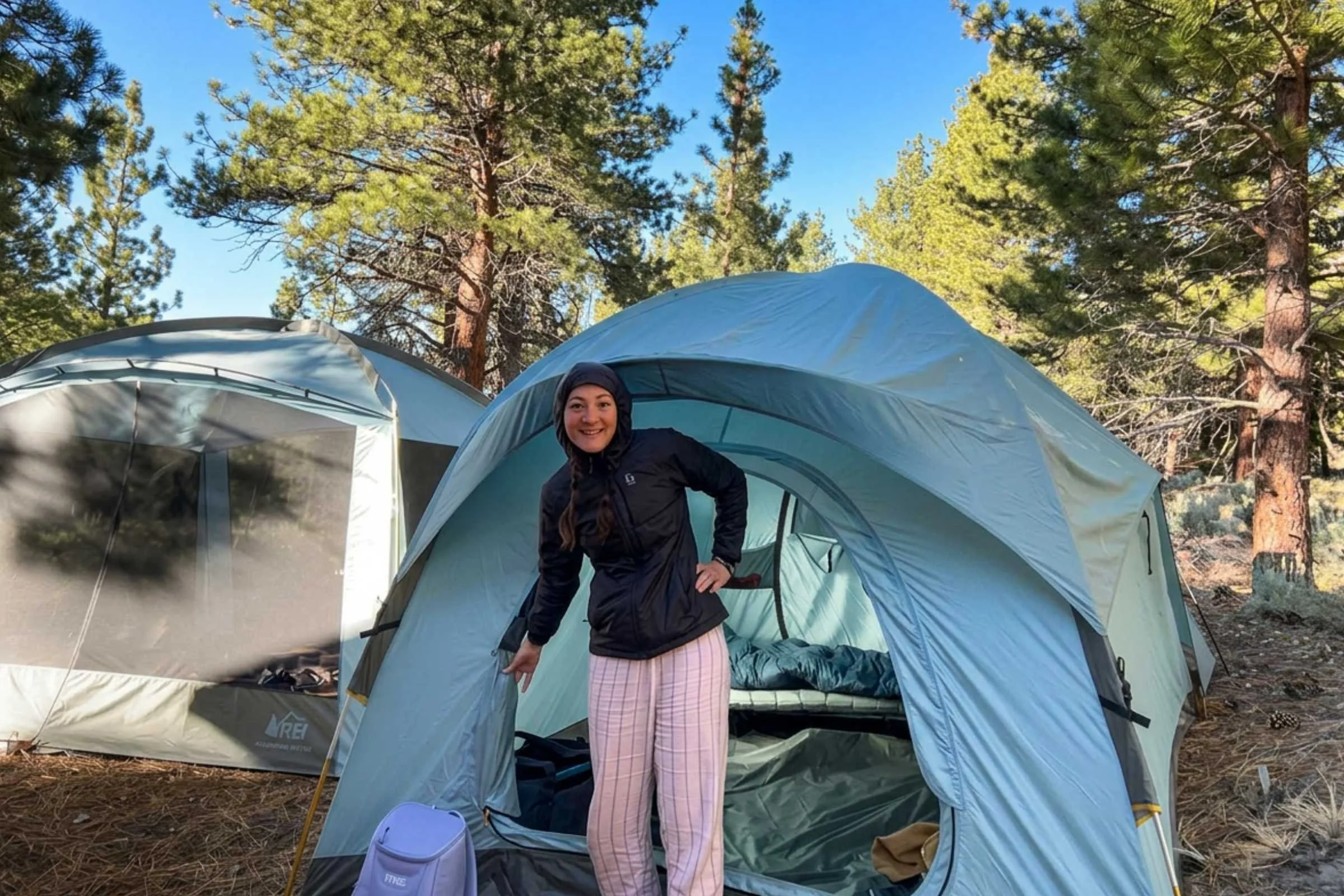
The interior living space of this tent is generous, with plenty of room to change clothes, including putting on pants while standing up. With the 77" peak, everyone could stand up in the tent at the same time.
I never used it, but this tent features an electrical cord pass through.
With sleeping gear laid out, the four of us agreed that it would have been pushing it with another two adults. It definitely could have fit two more kids, and if the ratio had been two adults and four kids, that could fit six as well. Two couples and two adult solo sleepers could have worked. But considering we all didn't know each other that well, it was tight quarters with all of our other gear, including lanterns, clothes, books, and alas, my laptop.
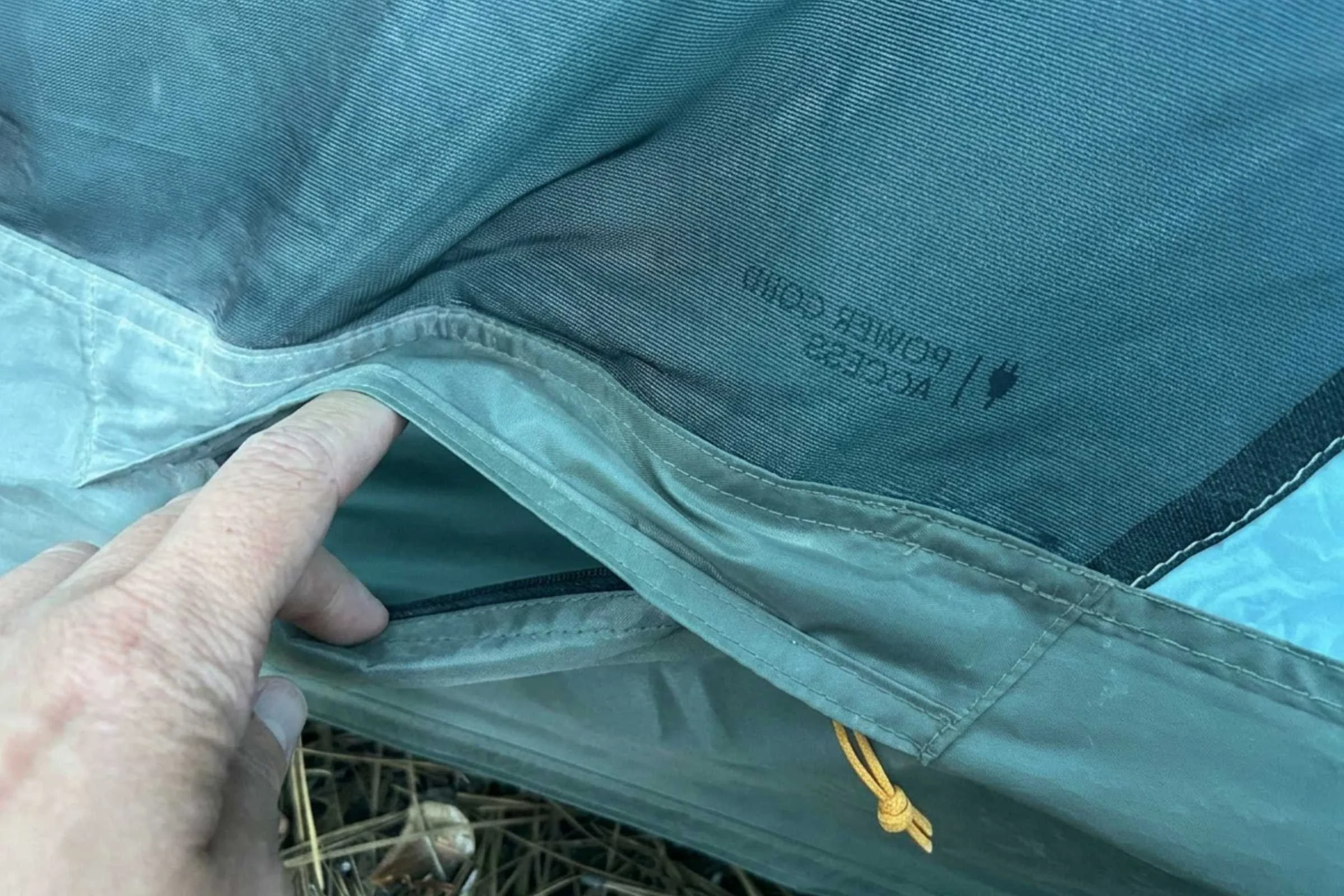
I was stoked to see that this tent has one of my favorite features in a camping tent: door pockets! Instead of having to roll up an entire door when you want to open it up completely, it has a pocket next to the door to stuff all that fabric. It has one for the flap that allows you to just use the half-moon mesh window. When not using those pockets for doors and window "shutters," I stored my wallet, keys, headlamp, mouthguard, and sunglasses in there. I could even fit a lantern.
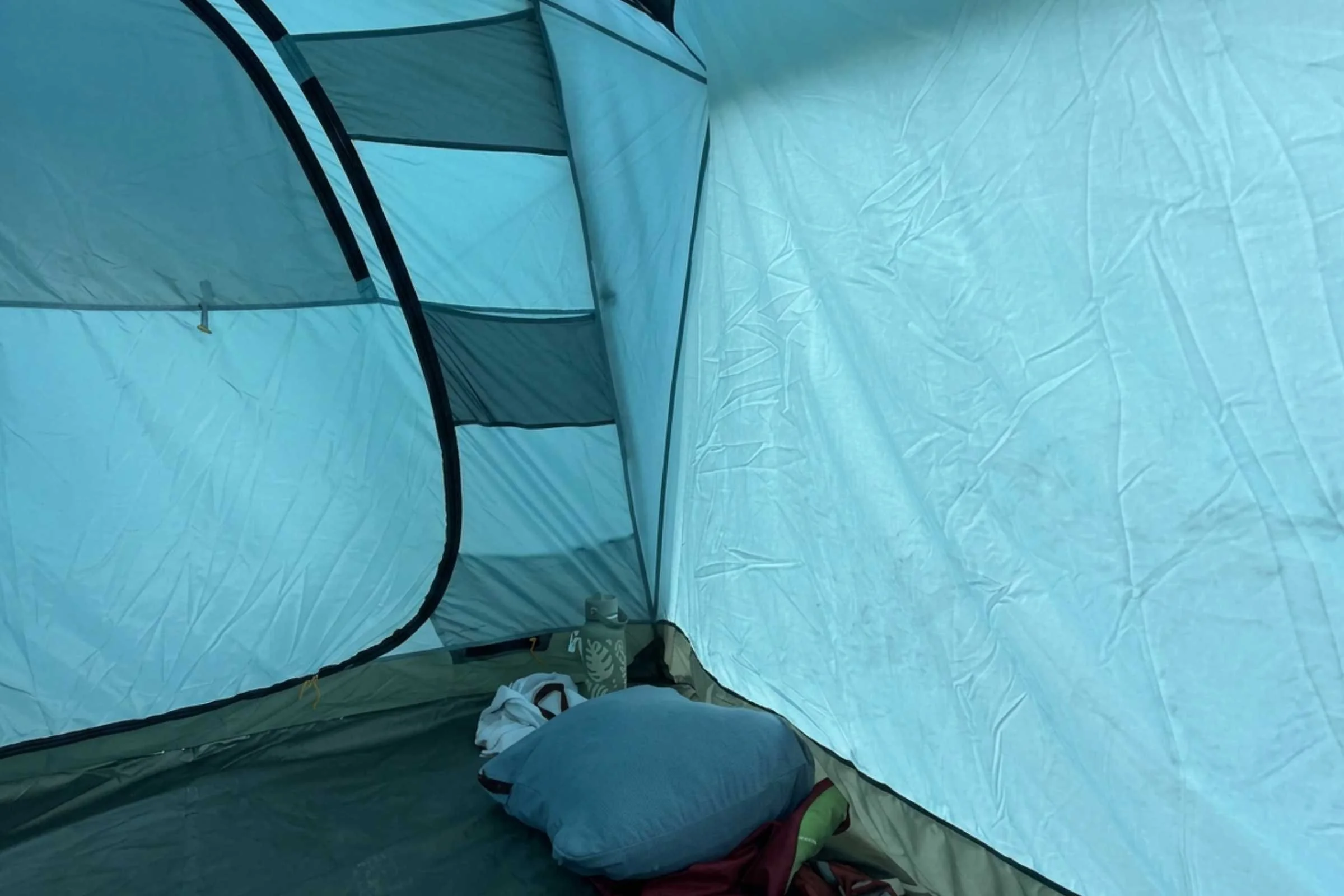
It took me almost a week of sleeping in the tent to discover the other pockets. They're high up above the rear door. There are four of them, and they are generous. However, because they were high up, I worried about storing larger items like a camping lantern in them for fear of hitting my head or it pulling too much on the fabric (not sure why it was less bothersome to put a lantern on the side pocket, but that seemed more sturdy).
The high up pockets are significantly less useful than a low pocket in a camping tent. Putting away my headlamp and grabbing my mouthguard are the last things I do before going to sleep. I want to be able to reach back and do it all in one pocket right by my pillow. I want to treat a tent pocket like my own personal nightstand, and with high pockets, that just isn't possible.
Vestibule and outdoor living space
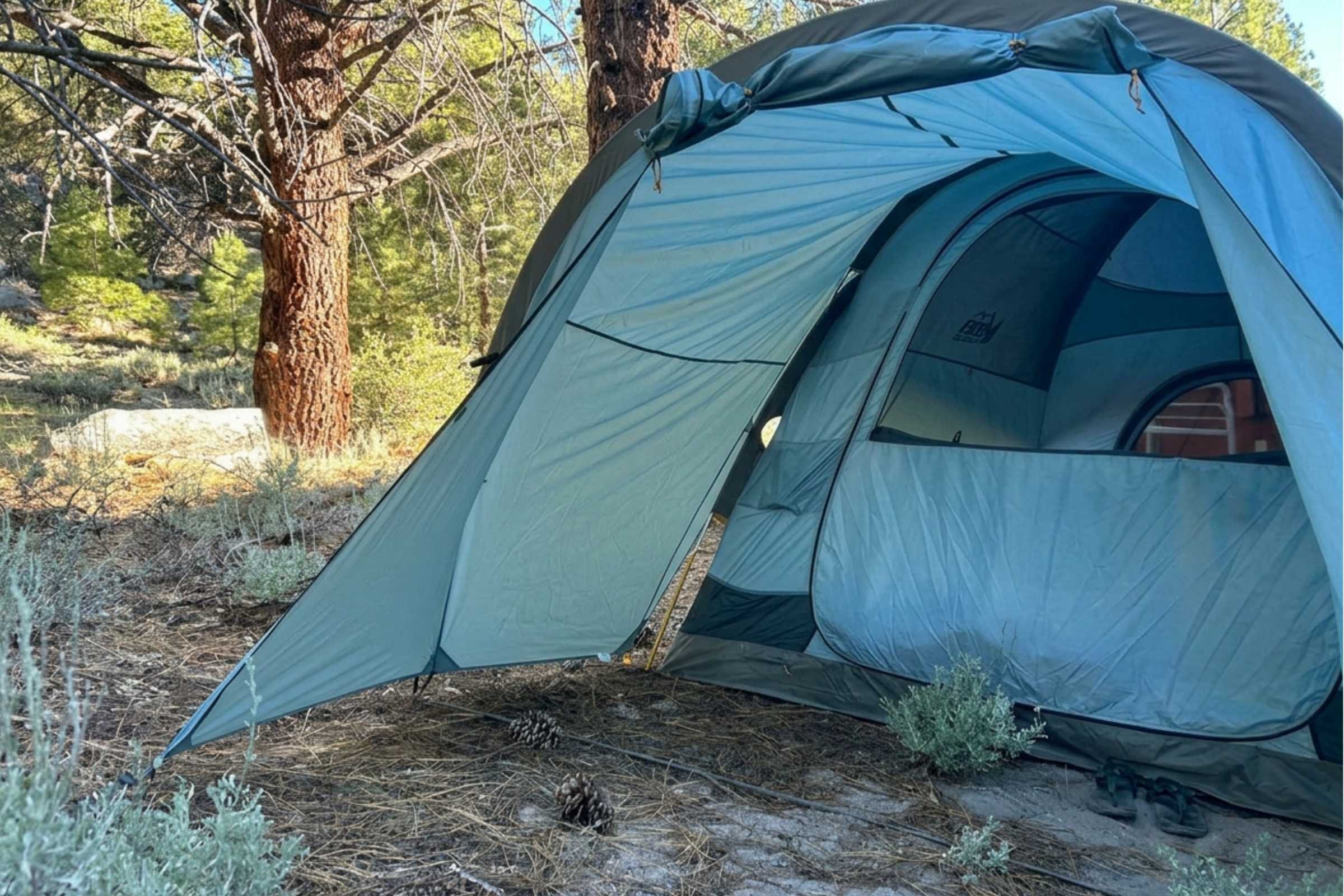
The vestibule on the back of the tent is generous. At 35 square feet, it feels like 2/3 of the tent space (note: it is actually more like 44% of the main footprint). You could definitely fit two camp chairs there, probably a bike, and you’d be squeezing it, but a medium-sized camp table could probably fit there, too. As expected, the picnic blankets we stashed there right before a storm stayed dry and rain didn't come up from the bottom (we didn't use a footprint and even if we did, it doesn't extend through the vestibule). It makes it a reliable place to stash stuff you'd normally leave outside but don't necessarily want to get soaking wet.
The vestibule is supported by a brow pole that holds up the vestibule fabric and gives you more head space than most vestibules on other tents, such as the Snow Peak Alpha Breeze. This is a defining feature of this tent, but it still felt like it needed some work. In the wind, the vestibule moves around. After returning to the tent after a windy day of hiking, we found the vestibule had collapsed into the tent body.
We tried staking the vestibule out at different angles, tautening and tightening it, but never felt like we got it to be as sturdy in the wind as we would have liked. I think it would have been more sturdy if we had tried the optional extension tarp poles.
As awesome as the vestibule size is, it also means the tent's total footprint is very large. This made it hard to squeeze this tent into smaller campsites.
Weather protection
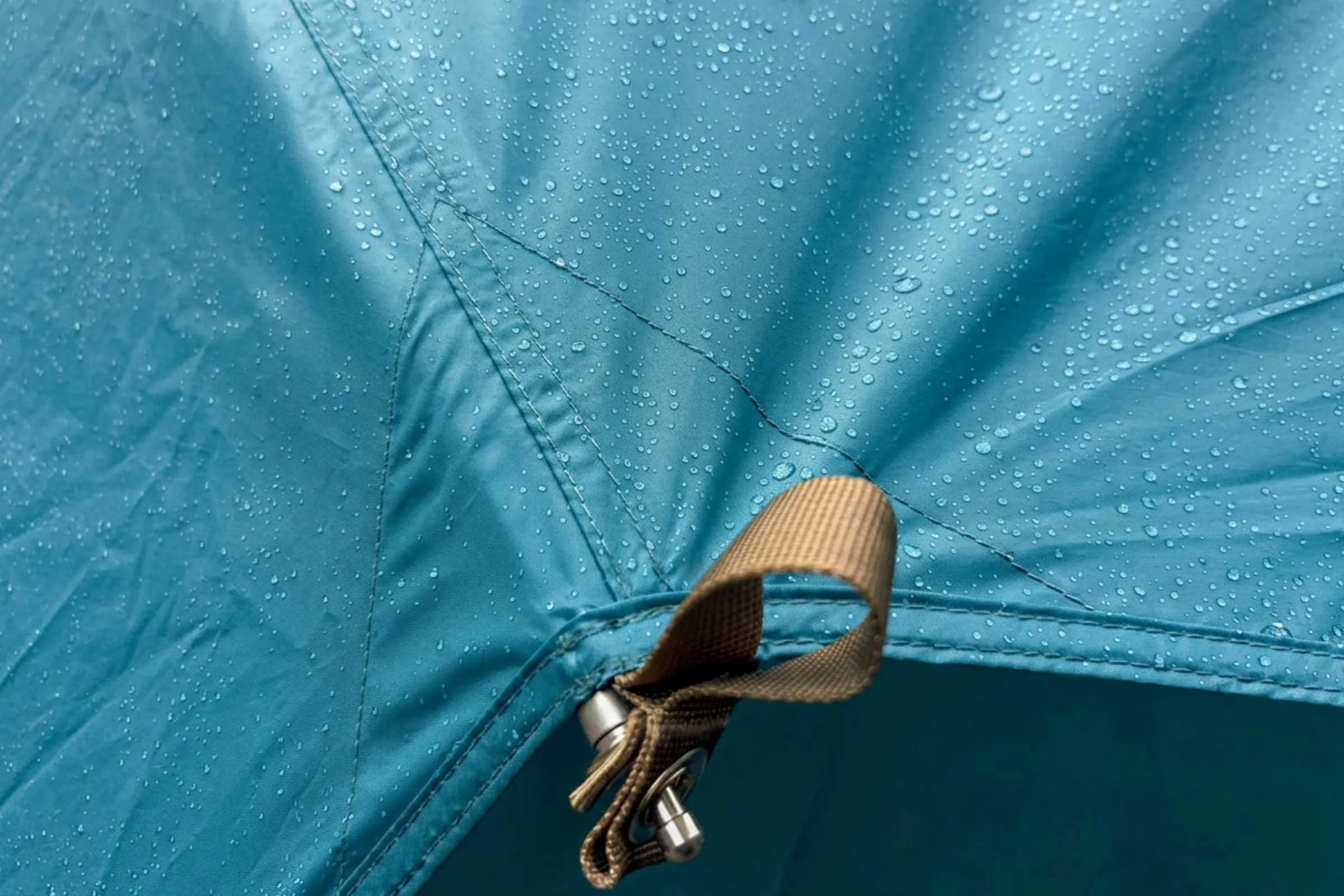
We tested the REI Westward tent in wind averaging 15 mph and gusts up to 37 mph (according to Apple Weather, which we realize isn't the most reliable). We also tested in temperatures as low as the mid-30s and as high as almost 90F. We got a couple of Sierra thunderstorms and the rain beaded up on the rainfly and water stayed out of the vestibule. We were sure to close the mesh window "shutter" flap before the storm rolled in.
Ventilation
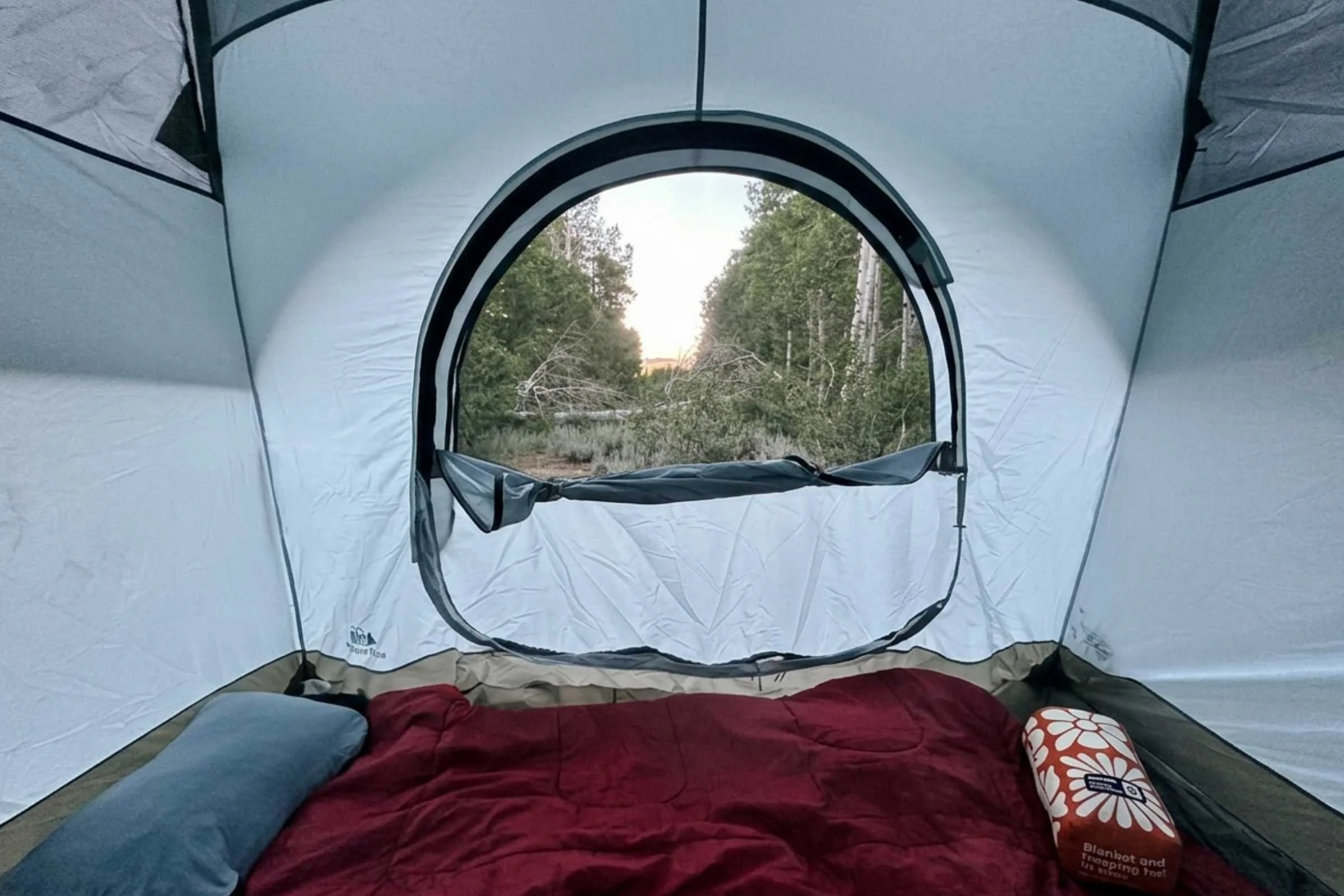
The Westward tent has less mesh paneling than other camping tents we've tested, including the NEMO Aurora Highrise and the Snow Peak Alpha Breeze. Even REI's more 4-season-worthy tent, the REI Base Camp 4 (we reviewed the REI Base Camp 6), has more mesh with extra zip panels to cover up mesh in colder weather.
The Westward has a half-moon mesh door on one side by the vestibule and a half-moon mesh door in the front. There is mesh towards the top, but the walls are all solid. Compared to the 360-degree views of the REI Westward shelter that we set up next to it, I missed the airiness and the views. Afternoon naps in the Westward tent were like a sauna.
That being said, we didn't notice condensation, even when set up in a meadow in the aspen grove near a creek. The Eastern Sierra is relatively dry, so that is about as good of a test as we could run. We also didn't notice condensation after those Sierra thunderstorms or on colder mornings.
Durability
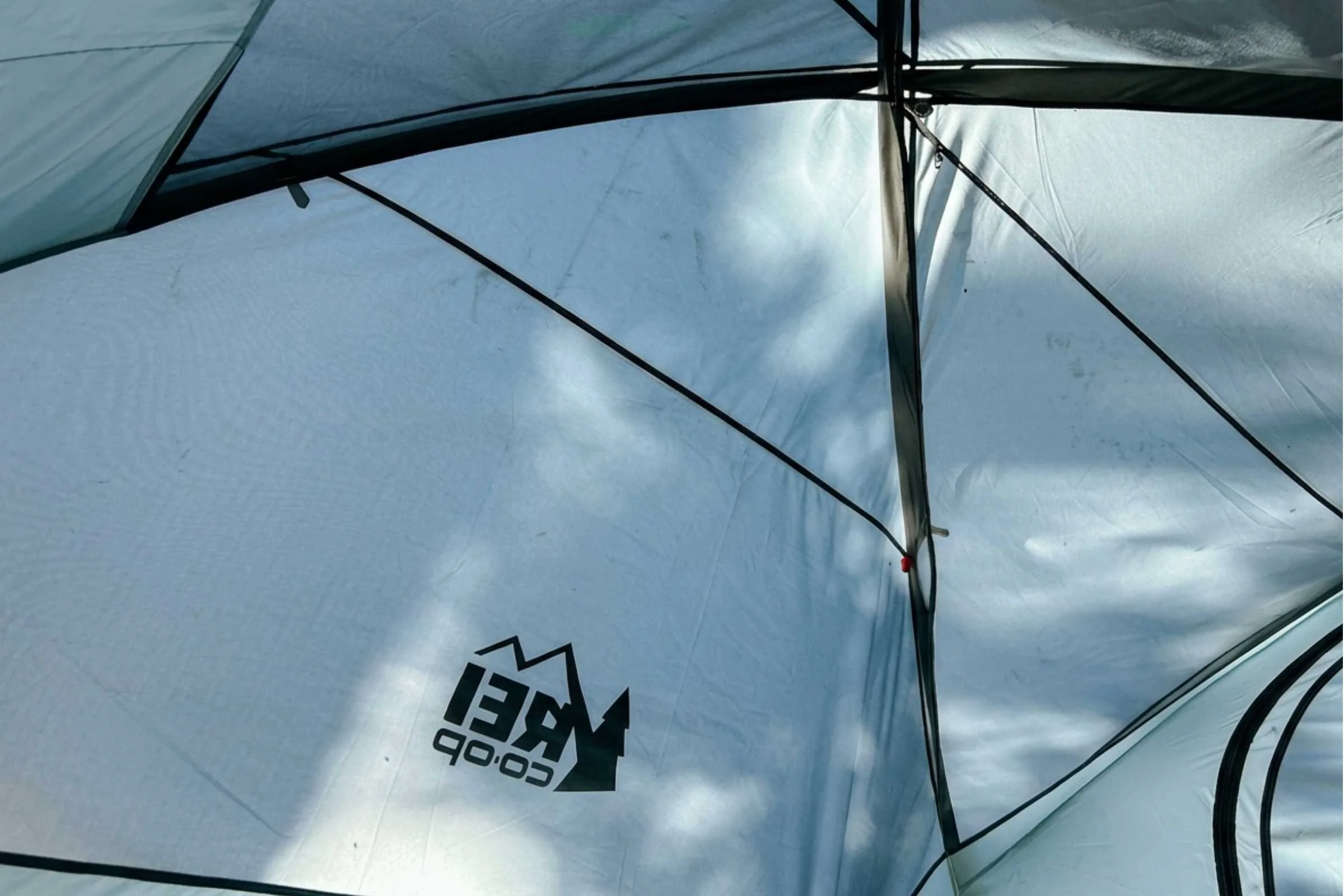
We had the tent up for nearly a month in high winds and daily UV exposure up to 14. We also crab walked the tent between camping areas and set it up and set it down between campsites as well. In my experience, moving tents and breaking down and setting up tents can be some of the most likely times for rips to form and poles to break. We didn't have any of those issues.
Despite my concerns about its wind stability, no aluminum poles broke and the tent didn't go flying away. When Jeffrey pine cones fell onto the tent and the wind rubbed pine branches against the 75-denier canopy, it didn't cause abrasion or holes. Stakes became dislodged from the ground in the wind but didn't twist or break, despite our pounding.
The 150-denier floor was especially impressive. One of our campsites was literally on top of a giant rock that we didn't discover until bedtime. We moved our cot around it and just figured we'd deal with it in the morning. There was no abrasion or hole in the morning. In the spirit of science and getting data, we kept the tent in the same spot for a few more nights after that. We wouldn't recommend setting up your tent on top of a giant rock and it isn't great for the tent fabric, but we never developed a hole. We also set up on top of Jeffrey pine cones (less avoidable) and didn't have issues. Throughout testing, we did not use a tent footprint, though we recommend people use it for the long-term durability of a camping tent.
Features
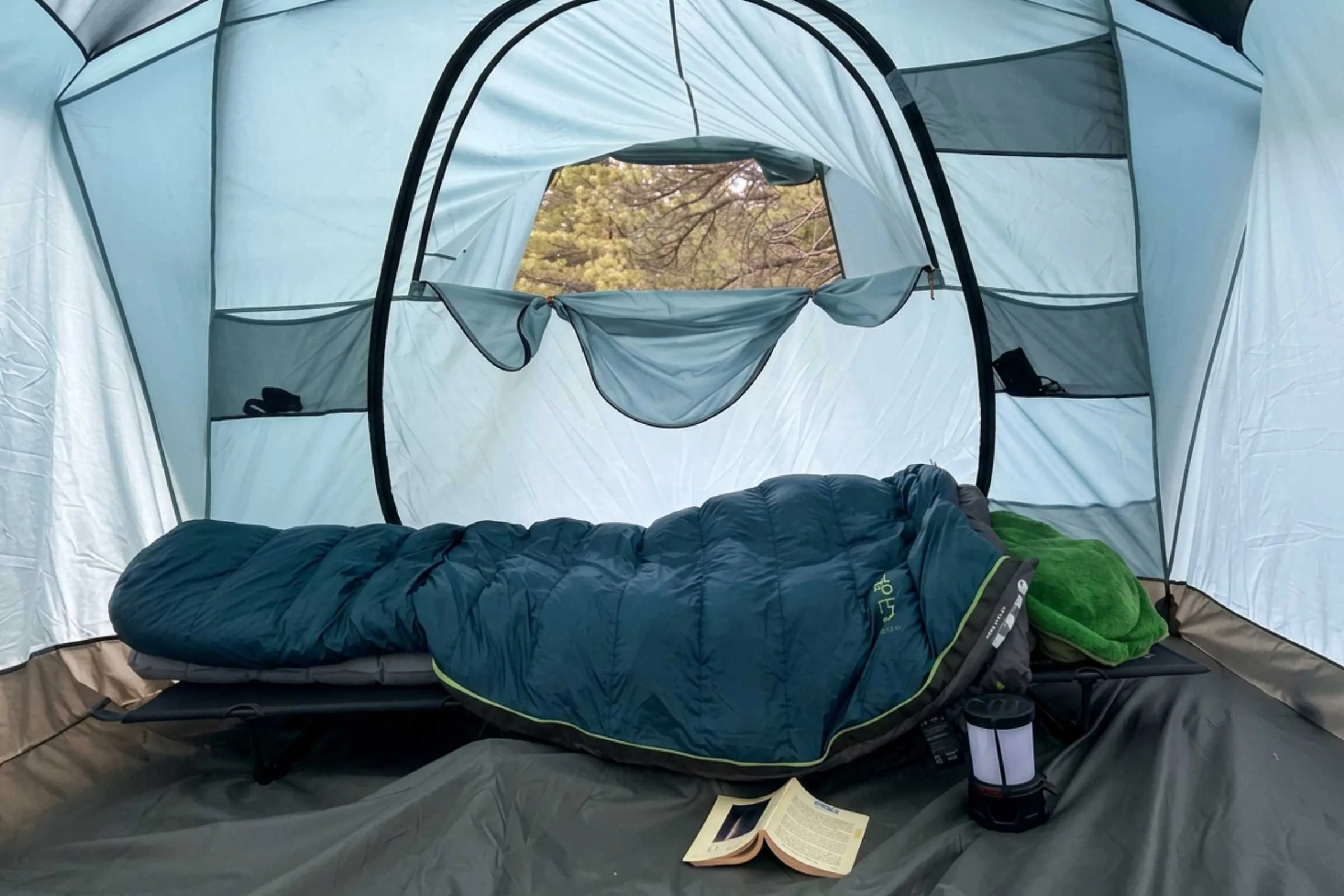
Freestanding double-wall construction: The inner tent is freestanding, though the vestibule needs stakes to stay out.
5-pole aluminum frame: Color coded and generally easy to figure out which matching colored tent sleeve goes with it.
Color-coded pole architecture with sleeve design (no high reaching required)
77-inch (6 ft 5 in) peak height: Can stand up in it
80.83 sq ft floor area
35.08 sq ft pole-supported vestibule: This feels like about half the size of the tent floor itself
2 doors — front and rear — each with awning
Optional awning extension on front vestibule door (requires 2 tarp poles, sold separately)
Front and rear windows with bugproof mesh and weather protection
Bugproof no-see-um mesh paneling on walls, windows, and doors (40-denier solution-dyed nylon)
75-denier polyester canopy with PFAS-free DWR
150-denier polyester floor with PU coating and PFAS-free DWR
75-denier polyester rainfly with PU coating and PFAS-free DWR
Seam-sealed construction
PowerPass electrical cord pass-through
Multiple exterior and interior pockets
4 reflective guylines included
8 stakes included
Pole repair sleeve included
Wide-mouth storage bag with duffel handles
Compatible with REI Co-op Westward 6 Footprint (sold separately)
Climate Label Certified brand
Solution-dyed mesh (reduced water and energy use vs. conventional dyeing)
Similar camping tents
REI Co-op Westward 6 vs NEMO Aurora Highrise 6
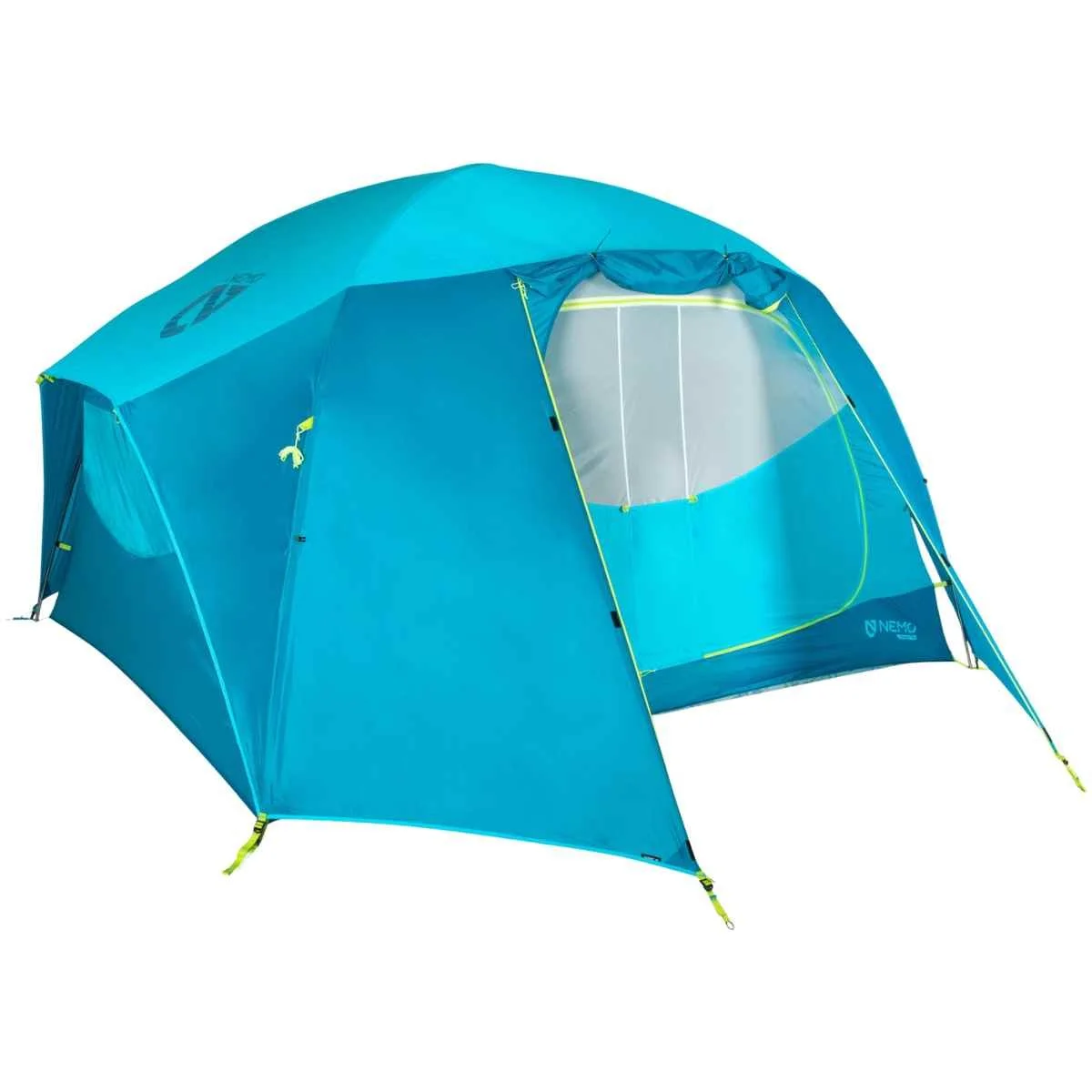
Number of people: 6 (4-person also available)
Floor space: 83.3 SF
Vestibule space: 23.6 + 23.6 SF
Peak height: 75”
Doors: 2
The NEMO Aurora Highrise is a more affordable family camping tent. It's easier to set up than the Westward 6 but lacks the generous vestibule. While the Aurora Highrise has a vestibule, it isn't covered and lacks the vestibule brow that gives you extra headroom. That means it is better for storing stuff and less suited for hanging out. The NEMO Aurora Highrise has lots of pockets all around the base, as well as four large mesh windows with "shutters" that cover for rain protection.
Choose the Westward 6 if you want a covered hangout area and additional coverage, such as if you are in a wetter climate. Choose the NEMO Aurora Highrise if you want more mesh windows and ventilation, such as if you are in a drier climate. Learn more in our in-depth review of the NEMO Aurora Highrise 6 camping tent.
NEMO Aurora Highrise 6
REI Co-op Westward 6 vs The North Face Wawona 6

Number of people: 6 (also available in 4-person model)
Floor space: 86.11 square feet
Vestibule space: 44.7 square feet
Peak height: 76 inches
Doors: 1 on tent body, 2 in vestibule
The North Face Wawona 6 is our overall winner for best camping tent. It has a generous vestibule that can fit a bike or camping table. It's not quite as easy to set up and is more expensive. It has similar peak height and packability but is sturdier in the wind. Learn more in our in-depth review of The North Face Wawona 6 camping tent.
The North Face Wawona 6
REI Co-op Westward 6 vs Snow Peak Alpha Breeze
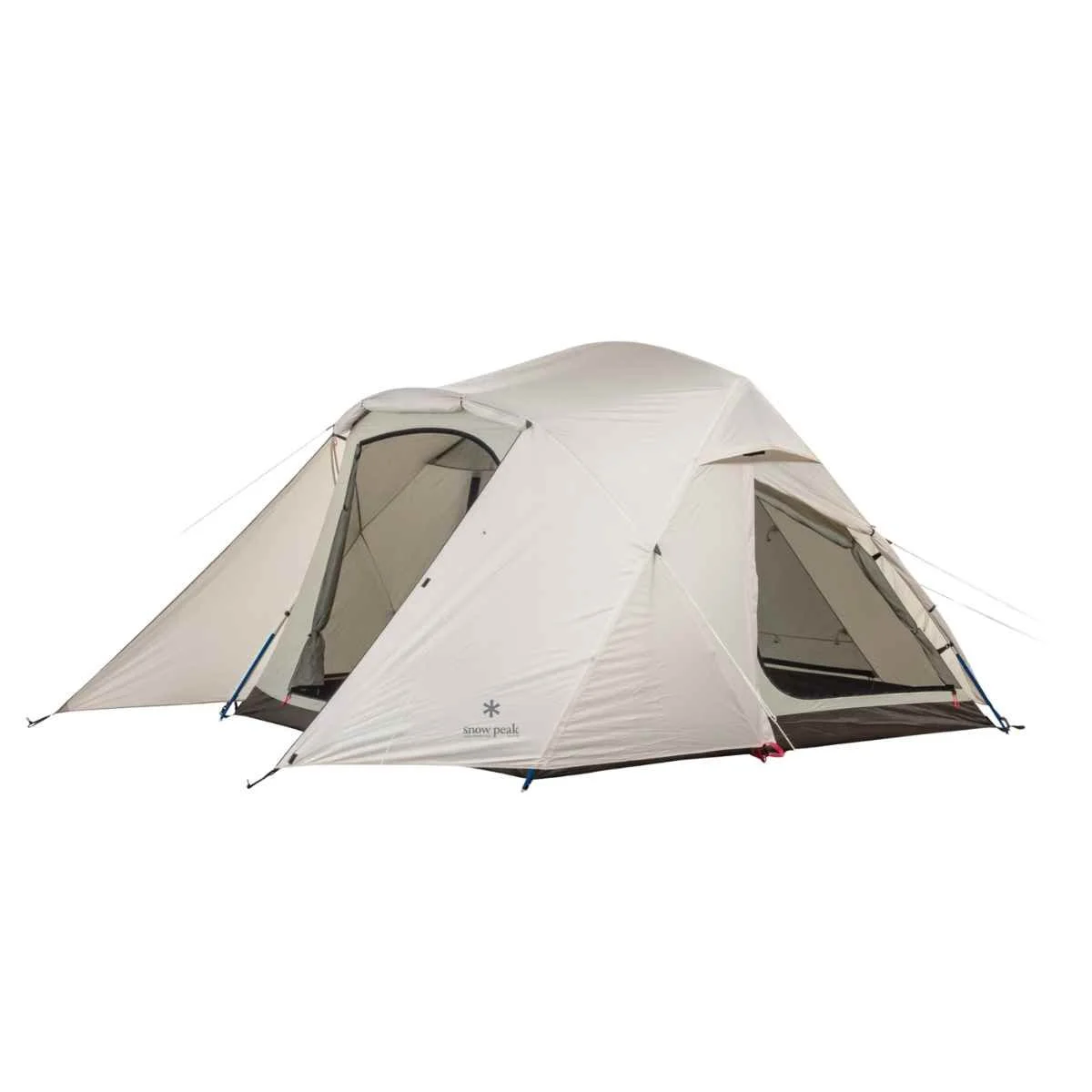
Number of people: 4
Floor space: 77.3 SF
Vestibule space: 45 SF
Peak height: 76.8"
Doors: 4/2
The Snow Peak Alpha Breeze is a 3-season tent that has lots of internal space and headroom and a large covered vestibule that can turn into a covered awning (all parts included, not sold separately). It is made of thicker material and heavier-duty poles, so it is quite windproof and snowproof. It has low pockets inside and 4 mesh doors. The two main doors are the front and rear, and the mesh covers the entire door, plus it has door "shutters" so you can keep it closed off if it is cold or rainy. It also has two smaller doors on the opposite sides so that everyone can exit without crawling over one another. This tent is our best waterproof pick in our Best Camping Tents guide.
Snow Peak Alpha Breeze
Should I buy the REI Co-op Westward 6?
Buy if:
You want a spacious, stand-uppable, walk-in tent
You want covered outdoor space: the pole-supported vestibule functions as a porch, not just a gear dump
You're a regular car camper who wants durable materials and REI's warranty and return policy backing the purchase
You're already in the REI ecosystem and want to pair the tent with the matching footprint and Westward shelter
Skip if:
You're camping with 6 adults and full gear—like most so-called 6-person tents, the realistic comfortable capacity with real gear is closer to 4
Your camping conditions involve extreme weather—this is a fair-weather and moderate rain tent, not a storm shelter
You want more features and can live without the covered vestibules—other tents offer more ventilation or doors, but don't have the covered vestibule
Where to buy the Westward 6 Camping Tent
REI Co-op
As an REI-branded product, it’s available only at REI Co-op. Members get a 100% satisfaction policy for 1 year and a 10% dividend.
FAQs
-
The Westward tent has 80.83 sq ft floor area. In practice, we comfortably fit 4 adults with all their gear and if there are kids, could definitely fit 6. If we had two couples and two solo people, it'd work for 6.
-
The inner tent was very easy for two people under 6 feet tall to set up. The rainfly took some time to figure out what went where, but after setting it up the first time, it got a lot more straightforward and was fast.
-
The REI Westward has standing height and the vestibule as an outdoor play area. With two doors, there are options for getting kids out.
-
The footprint is a custom ground cloth cut to the tent's floor dimensions. It protects the 150-denier polyester floor from abrasion and moisture at developed campgrounds. We didn't use the footprint but recommend using footprints to increase the longevity of the tent.
Why you should trust us / About the author
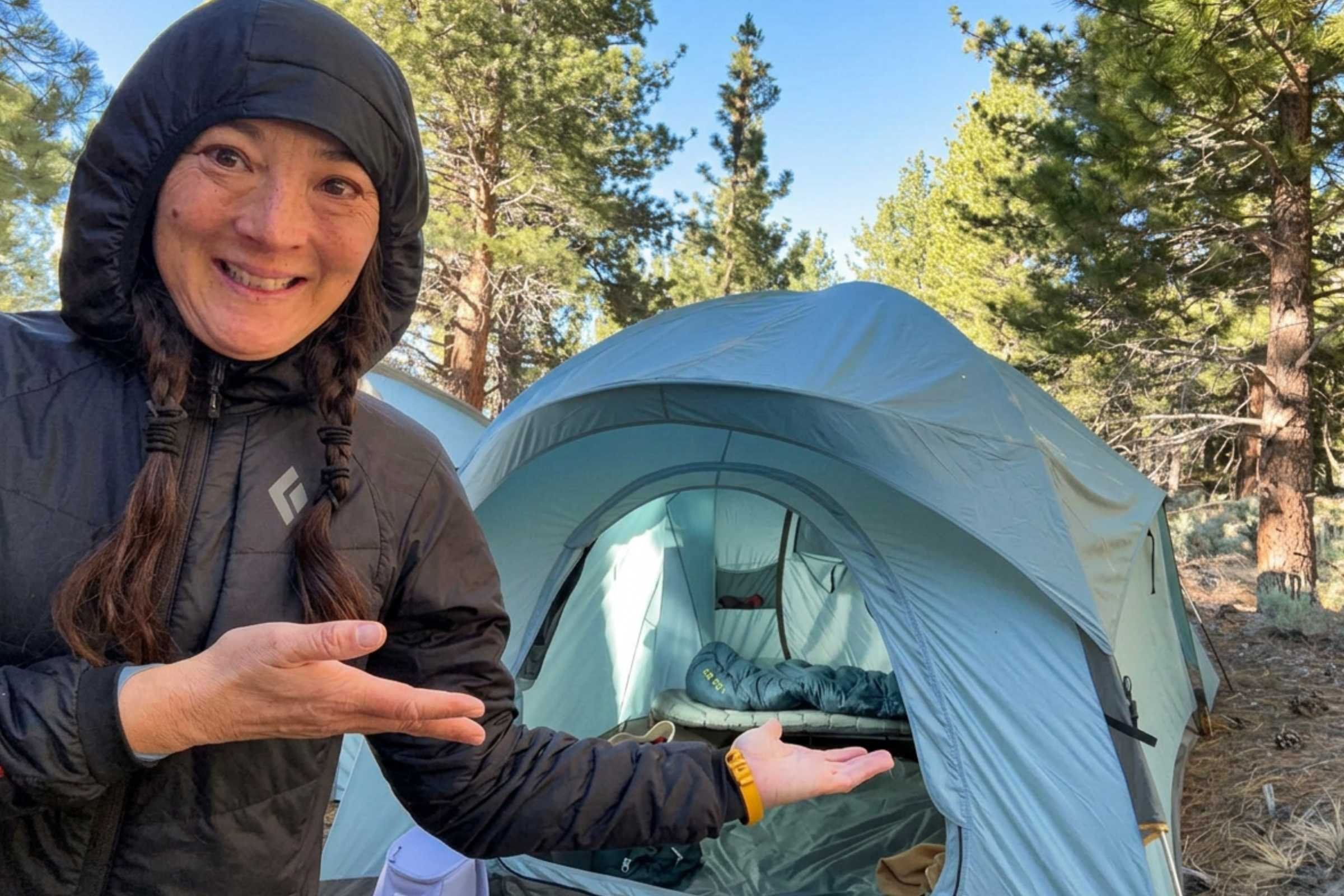
To test the REI Westward Shelter, Liz Thomas quasi-lived in the shelter for weeks in the Eastern Sierra in everything from Sierra thunderstorms to hot summer days and nights and in extreme wind. In addition to Liz testing, four other people hung out in this tent for chatting, snacking, napping, doing art, and playing games. They also added their perspective on ease of set up, spaciousness, ventilation, and windproofness to this guide.
Liz is an award-winning Los Angeles-based writer and Editor-in-Chief of Treeline Review. A former Fastest Known Time (FKT) record holder on the Appalachian Trail, Liz came to Treeline Review from New York Times/Wirecutter, the New York Times’ product review site, where she was a staff writer on the outdoor team.
Liz has talked gear on Good Morning America (TV), in The Wall Street Journal, The Guardian, Buzzfeed, Men’s Journal, Women’s Health, Gizmodo, and Outside Magazine.
You can read more about Liz at her wikipedia page here or on her website. See all her Treeline Review articles on her author page.