Best Running Lights of 2026
The best lights, headlamps, handhelds, and rear lights for running at night

The PowerTap on the Black Diamond Distance 1500 lights up the darkest trails. Photo by Billy Pudoff.
September 15, 2026, updated with a year's worth of testing notes on durability and weatherproofness, to reflect price changes and value, and to remove discontinued products
Home > Gear Reviews > Electronics
Running after dark can be a great way to fit in miles when the days are short or the weather is cooler, but you need enough light to see where you’re going and, especially on roads, to help others see you. We tested running lights for everything from early-morning road runs to dark trail runs to find options that stay comfortable and secure while giving runners the visibility they need.
We tested more than 25 headlamps, handheld lights, wearable lights, and rear visibility lights on roads and trails in nighttime and early-morning conditions. We also tested how securely wearable lights stayed in place, including doing jumping jacks to check for bounce, and used the lights in different weather conditions.
During testing, we compared brightness, visibility to others, battery life, durability, fit, and ease of use. We also paid close attention to comfort while running, how much each light bounced, how well it handled sweat and rain, and whether its beam and battery life made sense for the type of running it was designed for.
Top Pick: The Black Diamond Distance LT 1100 was our favorite overall. Its elastic headband stayed comfortable with minimal bounce in our testing, and the PowerTap setting made a noticeable difference when we wanted to quickly light up more of the trail. We also liked its balance of brightness, battery life, weather resistance, and weight for road runs, trail runs, technical terrain, and longer nighttime outings.
We deem running lights an essential running accessory for running in the dark. If you are getting up early before the sun rises and need an extra light to get started, or running in the evening after work or to avoid the lingering heat, we have you covered so you can see the road or trail in front of you and be seen by others.
We create reader-supported, objective, mission-driven gear reviews independently selected by our editors. This story may contain affiliate links, which help fund our website. When you click on the links to purchase gear, we may get a commission – without costing you an extra cent. Thank you for supporting our work and mission of outdoor coverage for every body! Learn more.
Running lights comparison table
| RUNNING LIGHT | TREELINE AWARD | CATEGORY | TYPE | WEIGHT | MAX LUMENS | VISIBILITY | BATTERY LIFE | BATTERY LIFE INDICATOR | IP RATING | RECHARGEABLE | PRICE* |
|---|---|---|---|---|---|---|---|---|---|---|---|
| Black Diamond Distance LT 1100 | Best Overall Read why |
See | Headlamp | 108 grams | 1100/600 | 125/110 meters | power tap on 1100 and 4.25 hours on 600 | Yes | IP67 | Removable Battery Pack charges with USB-C | $150 |
| Black Diamond Distance 1500 | Best Brightest Read why |
See and Be Seen | Headlamp with Backlight | 213 grams | 1500/800 | 117/95 meters | 1.7 hours on 800 | Yes | IP67 | Removable Battery Pack charges with USB-C | $250 |
| Petzl NAO RL | Best for Ultrarunning Read why |
See and Be Seen | Headlamp with Backlight | 145 grams/5.11 ounces | 1500 reactive/900 standard | 200/140 meters | 2.0 hours for both | Yes | IPX4 | Removable Battery Pack charges with USB-C | $200 |
| BioLite Dash 450 | Best for Visibility to Drivers Read why |
See and Be Seen | Headlamp with Backlight | 2.75 ounces | 450 | 90 meters | 3 hours on high, 60 hours on low | IPX4 | Internal USB-C battery charges in two hours | $70 | |
| Black Diamond Deploy | Best Lightweight Read why |
See | Headlamp | 39 grams | 325/180 | 52/40 meters | 2.5 hours/4.3 hours | Yes | IPX4 | Internal battery USB-C | $70 |
The winners
Best Overall running light: Black Diamond Distance LT 1100

Lumens: 600 max, 1100 Power Tap
Weight: 108 Grams
Battery source: Rechargeable Li-ion battery
Waterproof: IP67
Rechargeable: USB-C
What we liked: Power Tap 1100 Lumens, longer battery life, multiple color modes, highest waterproof rating of the lamps we tested, great balance of weight vs. lumens
What we didn’t like: Price, battery cannot be charged separately from lamp
The Black Diamond Distance LT 1100 is our best overall running light since there isn’t a dark running situation where we would leave this one behind.
This headlamp has four color options: warm white, red, green and blue light. The Black Diamond Distance LT 1100 excels for running on road, trail, highly technical terrain and overnight racing. Of the multiple light colors, red is great for preserving night vision, the green for reading topo maps and the blue for foggy situations. It is also dimmable, and has strobe lighting.
The battery life is about 4.5 hours on high (600 lumens), which is long enough for most regular night training runs, but not long enough for ultras or marathons. The battery meter lets you know when you are getting low so you won’t be stuck running in the dark.
Black Diamond Distance LT 1100


The PowerTap with 1100 lumens is convenient and easy-to-use, especially for those scary “what is that up ahead” moments only to find out it is a tree stump and not a bear. We found ourselves using the PowerTap feature for fun quite a bit just to test it out, and found it makes a huge difference — you can see the whole trail light up with a decent peripheral. PowerTap is useful for unfamiliar areas of trail to get acquainted quickly and to find our car at the trailhead much faster.
The elastic headband is comfortable and holds the headlamp in place with minimal bounce. It does hold sweat and needs to be dried out after a hard run. If it gets really wet it needs to be tightened during the run.
This headlamp has lots of features and it is worth reading the directions to get the most out of this light. For example, the headlamp separates from the battery, but the charging port is on the headlamp, not the battery. So you can’t charge a spare battery on its own without the light attached. This makes it more difficult to get spare batteries charged before a big event.
The Black Diamond Distance LT 1100 headlamp also won best running headlamp in our Best (and Brightest) Headlamps guide.
Best Brightest Running Light: Black Diamond Distance 1500 Headlamp

Lumens: 800 max, 1500 PowerTap
Weight: 213 grams
Battery source: removable battery
Waterproof: IP67
Rechargeable: Battery comes off for charging and extras can be purchased
What we liked: Power Tap to 1500 lumens lights up the whole trail in a second
What we didn’t like: Price, most complicated of all the headlamps we tested
This headlamp is a beast; it has the most features and brightest lumens of all the lights we tested. At 213 grams, it is the heaviest of all the headlamps we tested, but it was shockingly comfortable to wear. One reason we find it comfortable is that it comes with a removable top strap for extra support. We found that we didn’t need the extra top strap for most occasions. During testing it was comfortable to wear with the added top strap and allowed us to feel more secure about not losing our headlamp on a technical trail. We were surprised that the top strap didn’t interfere with our long-haired testers' ponytail.
Black Diamond Distance 1500 Headlamp

The top strap provides extra support on the Black Diamond Distance 1500 and the red light is great for group settings. Photo by Billy Pudoff.
To reach the brightest function of this lamp you literally just tap the side of the light and it gives you full power. It is really fun to play with. We enjoyed it as a way to make the run more fun, power tapping to see what was ahead, and waiting until we ran to the area where the light reached, like a mini fartlek but with light.
We love the different colored light options in this headlamp: red, blue, and green in addition to the white light. Similar to the Black Diamond Distance 1100, the colored lights help with activities beyond running on the trail like group settings and reading maps.
The battery pack on the back of the lamp helps distribute the weight evenly so it feels well balanced when running. Additional batteries are available for purchase and can be charged separately from the headlamp. The pack at the back curves to hold comfortably against our testers’ heads. This was also comfortable for both long hair and short-haired testers. The optional top strap worked nicely with a ponytail or braid. The red rear blinker is off to the side so a ponytail above it is not obstructing the safety lights. We love that it has the rear blinkers built in for extra safety and visibility.
You have to read the instructions that come with this light. It has a lot of features and lighting options that are hard to figure out on their own. Some of the other lights we tested were much simpler to use out of the box. We also love that this headlamp came with its own padded zippered case, convenient for storage and travel. This headlamp is on the heavier side so it can be overkill for shorter runs so it likely won’t be the only headlamp you need in your stash.
Best Running Light for Ultrarunning: Petzl NAO RL

Lumens: 900 standard, 1500 reactive
Weight: 145 grams
Battery source: Removable rechargeable battery
Waterproof: IPX4
Rechargeable: USB-C
What we liked: Reactive Lighting saves battery life, lighter weight than others of similar brightness, rear red light with separate on/off button
What we didn’t like: Harder to wear with ponytail and long hair, no front red light option
Reactive lighting works to conserve battery life and gets brighter when you need it. We had fun testing this by looking at our feet and then the trail far into the distance and watching the light get brighter almost instantly. The reactive lighting is super fast and responsive. And it has a removable battery with extras available for purchase.
The Petzl NAO RL is lighter weight than the other 1500 headlamps we tested, which is great for overnight racing where grams count. Rear light has a red light bar across the battery that has its own switch for on/off/strobe controls. Single button operation in front of light is simple to use. This headlamp has an optional top strap for added support. We found this headlamp to be well supported without the top strap, but it did add some support when we tested it.
Petzl NAO RL


As you cycle through the brightness levels, the headlamp goes into an off mode before coming back on. Some testers did not like that it turned off completely when they wanted to change the brightness, they found it harder to change without stopping or slowing down.
There is not a red light option on the front of the headlamp, making this a less desirable option for some.
As noted above, the rear battery clip is rather tall and may affect long-haired users with ponytails or braids. The lightweight elastic also got stuck in long hair on occasion.
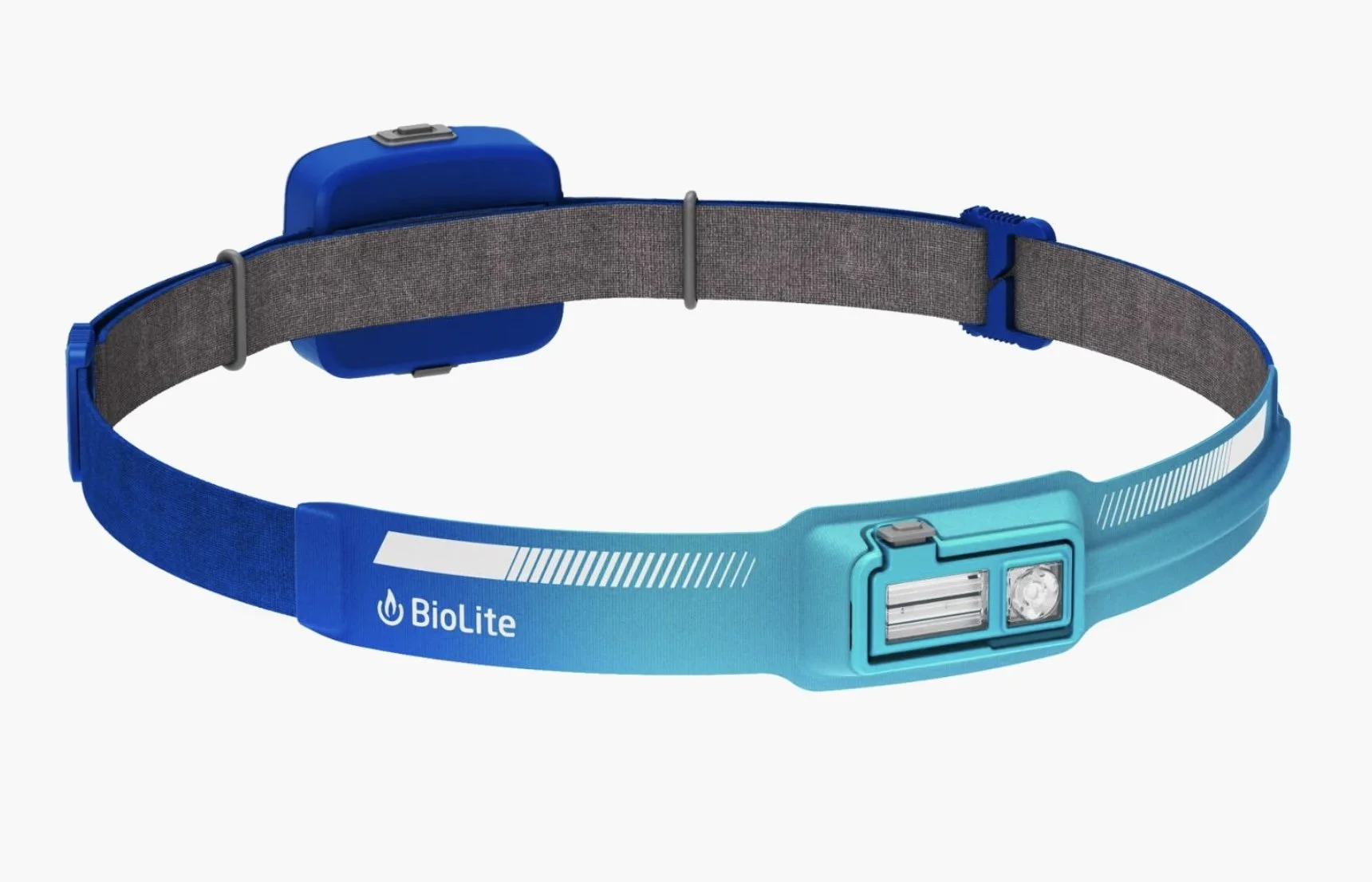
Best running light for visibility to drivers: BioLite Dash 450
Type: Headlamp
Weight: 2.75 ounces
Max Lumens: 450
Visibility: 90 meters
Battery life: 3 hours on high, 60 hours on low
IP Rating: IPX4
Rechargeable? Internal USB-C battery charges in two hours
What we liked: Visibility in front and behind with backlight, well balanced design, lightweight
What we didn't like: Not as waterproof as other models
The BioLite Dash 450 is the best running light for visibility to drivers because it has a rear light and rear battery. We like this model for road running because the rear light helps you remain visible to traffic behind you. The battery pack is well balanced with the light in the front for little to no bounce while running.
We also like that the BioLite Dash 450 is easy to charge with a portable battery pack while you run. Since the charging port is in the back, you can easily tuck a portable battery into a running pack and keep your headlamp and your legs running into the night.
You can read more in our in-depth, long-term review of the BioLite Dash 450 headlamp.
BioLite Dash 450


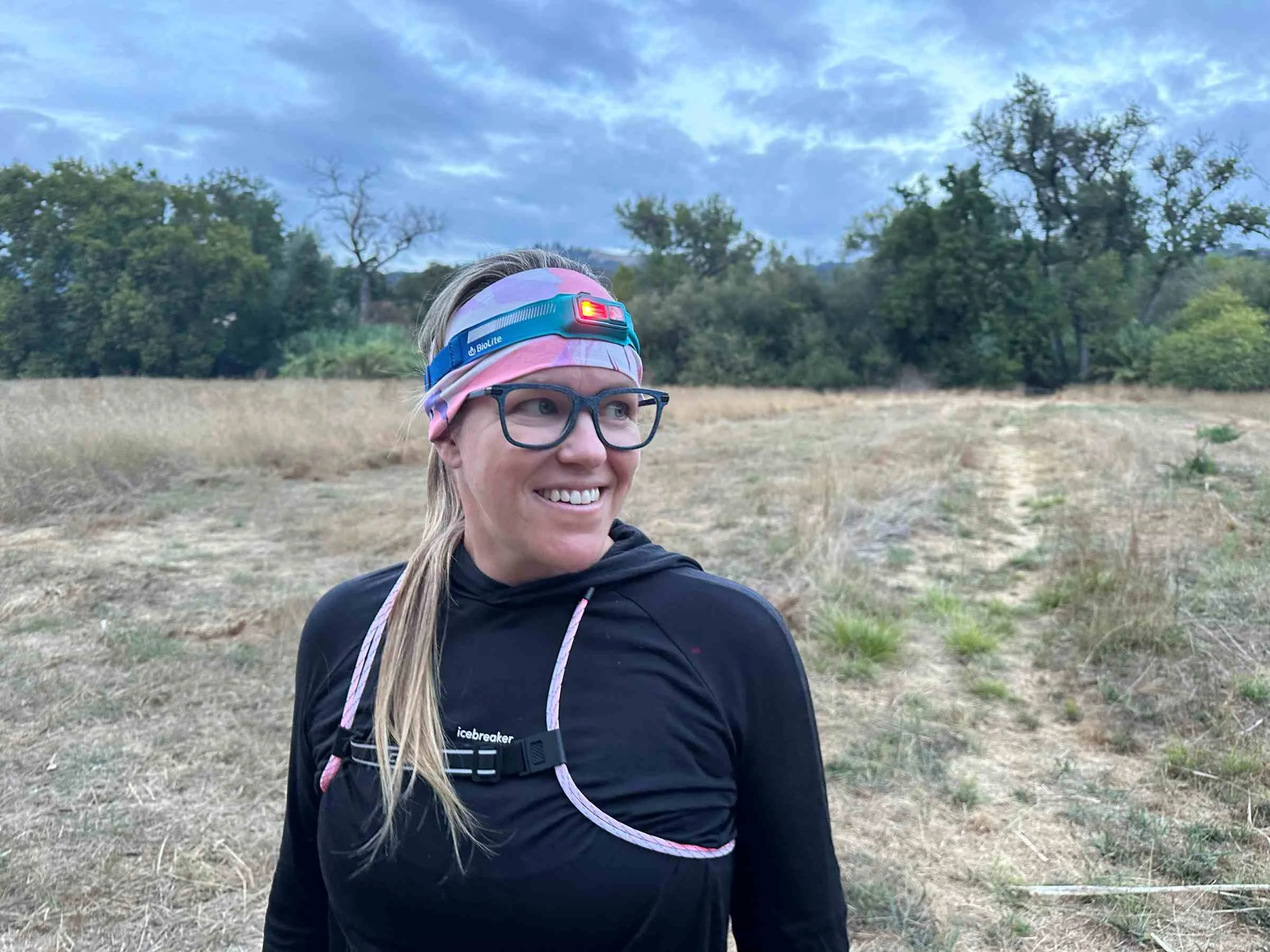
Although both headlamps have back lights, we liked the BioLite Dash 450 more than the BioLite 800 Pro we’ve also tested because it is 2.75 ounces compared to the 5.3 ounces of the 800 Pro, making it significantly lighter and less bulky.
The BioLite Dash light has five angles and lightly clicks into each one. We like that once you choose an angle it stays put until you change it.
Both long-haired testers and testers without hair found this to be comfortable to wear against the skin. The elastic band gets a little more grippy the more you sweat, helping it stay in place on long hot runs. We also appreciate the IPX4 water resistance rating so it can stand up to a bit of rain and sweat.
Overall, with rear light visibility and pass-thru charging, we like this light for running on the road because it is light and comfortable.
Best Lightweight running light: Black Diamond Deploy

Lumens: 325, 180
Weight: 39 grams
Battery source: rechargeable by USB-C
Waterproof: IPX4
Rechargeable: yes
What we liked: Tiny and packable, wearable under a brimmed hat
What we didn’t like: Fewer lumens, shorter battery life
The Black Diamond Deploy is small and mighty. We loved so many things about it we had a hard time running without it. We loved this light for those late afternoon runs where you aren’t sure if you will make it home before dark, or those morning runs where you start out a few minutes before the sun fully rises. It is great for that in-between season where you aren’t always running in the dark.
This light is designed to be worn under a baseball-style hat and nestle right under the brim, perfect for an incognito light once the sun comes up. No one can tell you have it on.
Black Diamond Deploy

The Black Diamond Deploy is designed to fit snugly under the brim of a hat. Photo by Sara Kruglinski.
There is no reason not to stash this light in your running gear, and it is also great as a backup headlamp since it is so light and small. It is very comfortable to wear and does not bounce around. There is a little padding where the light meets your forehead for comfort.
We really liked this light for road runs where you have some streetlights available to help light your way. However, 325 lumens isn’t quite bright enough on its own to be a standalone light on long trails.
The battery life is also shorter than others, but the trade-off is that this is super lightweight.
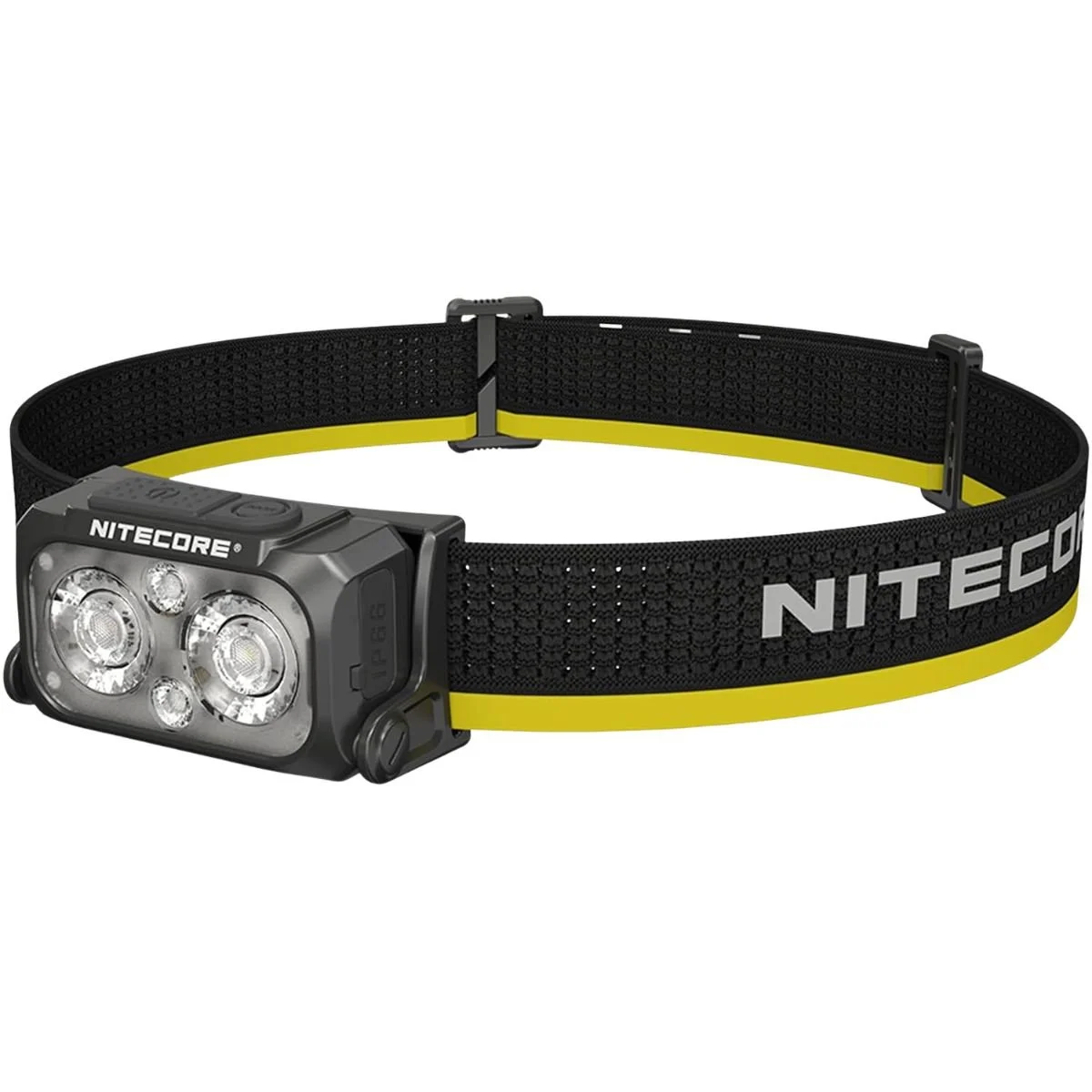
Best Affordable Running Light: Nitecore NU25 MCT 400
Lumens: 400/200
Weight: 50 grams/1.76 ounces
Battery source: Rechargeable
Waterproof: IP66
Rechargeable: USB-C port
What we liked: Lightweight, white/red lights, can switch out the headband
What we didn’t like: No replacement headbands available from Nitecore
The Nitecore NU25 MCT 400 (multi-color temperature) running headlamp is the best affordable running light. Not only is it a fraction of the cost of other running lights, but it has running-specific features that work and make it useful in different kinds of terrain.
The Nitecore NU25 MCT 400 has multiple color temperatures (MCT), improving on the classic Nitecore NU25. The multiple color temperature LED lights allow you to switch between warm, neutral, and cool lights. We like that feature for group runs. Some people find it disorienting and dizzying to run with a group that has a mix of white and yellow lights, so this allows more coordination between runners.
The ability to switch between warm, neutral, and cool lights also gives you more control over visibility in different conditions. For example, the warm light works better in fog and rain. Cool white is better for visibility. Warm, neutral, and cool all come in three different brightness levels and there is also a red light mode.
The white lights can be focused as a spotlight on the right, or a floodlight on the left or both at the same time for maximum output. There is also a solid red light and red strobe mode which is really nice to have in such an affordable model.
You can read our in-depth review of the Nitecore NU25 MCT 400 headlamp here.
Nitecore NU25 MCT 400

We love the red light mode that the Nitecore NU25 MCT 400 offers. Photo by Sara Kruglinski.
This light is very comfortable to wear and lightweight, making it easy to carry for those runs early or late in the day where you get a little bit of sun and darkness. The headlamp is easy to stash in a pocket or wear over your hat, and is easy to forget it’s even there.
This headlamp is also super easy to charge with a USB-C port located on the left side. There is a four-dot battery meter as well so you will know when you need to start conserving power. With an IP66 water resistance we felt confident that this light could withstand any sweaty or rainy run.
There are a few options for headband on the Nitecore NU25 MCT 400 and we tested them all and like the full headband version the best for running. The headband glows in the dark, making this simple to find at night.
The actual light can be unclipped from the included headband so you can wear the reflective headband by itself or clip it to one you already own and like better. Oftentimes the headband with our headlamps can wear out before the light itself and this makes it simple to switch things up.
For a budget option though, the light, modes, and general comfort on the Nitecore NU 25 MCT 400 is great.
Best Chest Running Light: COAST Hi-Vis Lighted Vest LH150 V2

Category: Be Seen
Type: Wearable Rope Light
Weight: 2.4 ounces
Max Lumens: Not stated
Visibility: Not stated
Battery life: 18 hours
IP Rating: IP54 Splash Resistant
Rechargeable? Rechargeable internal USB-C battery
What we liked: 360 degrees of visibility with the wearable rope light, multiple color options
What we didn't like: Not as bright as other lights, may cause chafing if worn without a barrier under it.
The COAST LH 150 V2 vest is wearable lights for running in the dark or low light conditions. We liked this for populated areas where people and cars might be a concern. There are six different colored light settings, including a multi-colored light. The lights follow the length of the rope all around your torso, making them visible from any angle for better safety. The battery life varies for each color.
We like that this vest is a lightweight way to help you be seen by others, and they work well when paired with a headlamp or hand-held light. Some runners may find the lights to cause chafing when worn close to the skin–we found that we were unable to wear them with a tank top or short sleeves for that reason. This vest pairs best with a long-sleeve shirt or jacket. The vest is adjustable and can fit over a running pack or vest for longer outings.
If you’re interested in COAST’s voice-activated headlamp, check out our in-depth review on the COAST FL97R Rechargeable Headlamp.
COAST Hi-Vis Lighted Vest LH150 V2


We like the flexibility to be able to be seen in a variety of running situations. The lights are brightest closest to the battery, which is located on the center of the back when you are wearing them and slowly taper off in brightness towards the front. We didn’t find this to be a deal breaker since we have secondary illumination on the front most of the time anyway in order to see where we are going.
These lights also can work to illuminate a dog, or be worn around the neck like a glow necklace–the adjustability of them allows for some creative applications beyond the intended vest style. The clip lets you clip them onto just about anything–we have even used this vest to light up a tent like a set of string lights.
Overall, with the choice of colors and flexibility of ways to wear, the Coast LH150 V2 vest is our choice for best chest light.
Best Tail running light: Nathan HyperBrite RX

Lumens: 16
Weight: 17 grams
Waterproof: IPX4
Rechargeable: Micro-USB
What we liked: Size and price
What we didn’t like: So small and light it is easy to lose
Not only is the Nathan HyperBrite RX a cute tiny light, it’s also affordable. We love the simple single button operation and it clips pretty much anywhere you need it to go. We even clipped it to one of our headlamps that did not have a rear light.
This light has four modes, and a simple click of the button takes you to the next mode. The three blinking modes help increase visibility to drivers on the roads at night and save battery.
This is a light you wear not for your benefit to see, but to make sure that you are seen from behind. This light does the job. It is bright and lightweight and it is easy to forget that you are wearing it. We have also used these on dog leashes and collars for added visibility for our running buddies.
Nathan HyperBrite RX
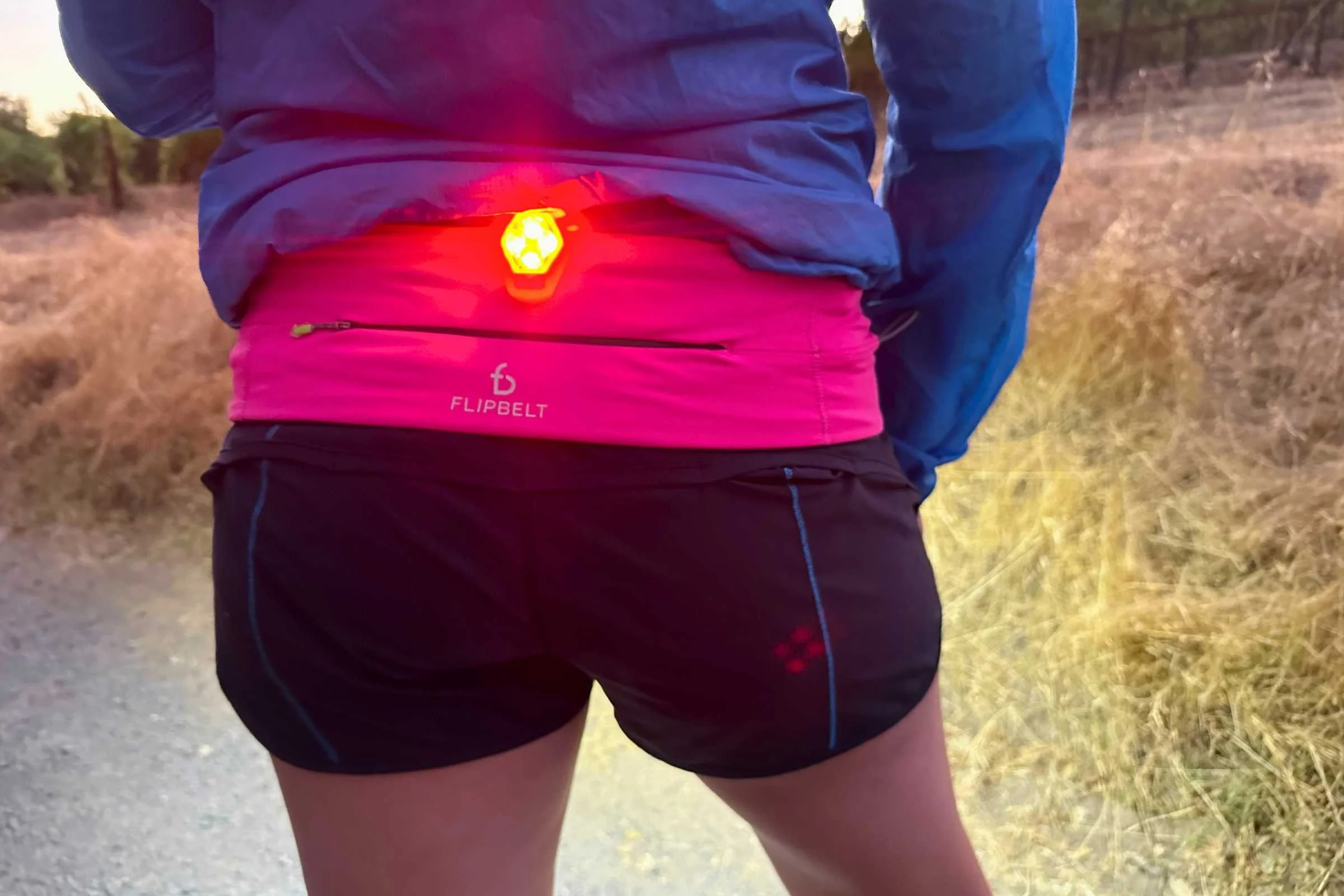
The Nathan HyperBrite RX fits on the back of the FlipBelt for extra visibility. Photo by Billy Pudoff.
Other running lights we tested
Nathan Luna Fire 400 RX

Lumens: 400, 300
Weight: 62 grams with the strap
Battery source: Internal rechargeable by USB-C
Waterproof: IPX4
Rechargeable: Yes
The Nathan Luna Fire 400 RX was our former winner for best chest light. We loved the versatility of the Nathan Luna Fire 400 RX. There are multiple ways to wear this light — it comes with an elastic strap that can be adjusted to fit around your chest, waist, or hips. You can also remove the strap and clip it to your shirt or running vest. One Treeline Review tester even tried it on their hat and it worked there as well.
After another year of testing other options, we decided we liked other chest lights for running better. The Nathan Luna Fire bounced more and has a shorter battery life than most lights. The included chest strap was looser than we liked, but the light can clip on to any strap you already own or a running vest. When we used this on our running vest it was much more stable.
Nathan Luna Fire 400 RX

Adjusting the strap on the Nathan Luna Fire 400 RX chest band running light. Photo by Sara Kruglinski.

Category: See
Type: Headlamp
Weight: 2.6 ounces
Max Lumens: 400 lumens
Visibility: 90 meters
Battery life: 6 hours on high, 200 hours on low
IP Rating: IP67
Rechargeable? Internal USB-C Battery
The BioLite Range 400 has a single light in the front with a quick-charge battery for those times when you forget to charge after your last outing. We love how comfortable this headlamp is to wear–the band is super soft and has no points of irritation, and we were able to wear it against our skin without any issues. You can read more in our In-Depth Review of the BioLite Range 400 headlamp.
Our testers with long hair didn’t report any issues with hair getting caught in the headlamp, it was also comfortable for our tester without hair to wear against the skin and not have any points of irritation.
BioLite Range 400


This headlamp has a well-balanced build for running without any movement from the headlamp. It stays where you need it. The Range has a more adjustable tilt compared to previous BioLite models, like the 800 Pro and the Dash 450. There are five positions that click into place with a little more range between each click.
We also like the quick charge USB-C option. Charging 8 minutes gives you one hour of use on high. This is perfect for those times when the battery is drained and you still want to get a quick run in. By the time you drive to the trailhead, you should be able to get a decent amount of charge on your headlamp for a one-hour run.
This model is also IP67 waterproof submersible, so it is great for those stormy running situations.
The reason the BioLite Range 400 didn’t win any categories is it isn't as bright as other running lights we tested and isn't as affordable or lightweight as other 400 lumen options. We think it is a great hiking and everyday headlamp, but for runners, we think it is worth getting something more specialized. However, this was the most comfortable headlamp to wear long term while running–so comfortable we have even fallen asleep while wearing it–and a worthwhile option to consider.

Lumens: 800, 500
Weight: 150 grams
Battery source: 3,000 mAh Li-ion Rechargeable Battery
Waterproof: IPX4
Rechargeable: yes, and pass-through charging works with included cable
What we liked: Pass-through charging and comfortable band
What we didn’t like: Heavier than others with similar lumens
The BioLite 800 Pro is highlighted in our Best Reflective Gear for Running in the Dark guide. This is a great running headlamp, the band is the softest and most comfortable of all the headlamps we’ve tested. We love how it feels next to our skin — there was no need to add a layer underneath it. The band also reacts well with sweat, increasing in stickiness a bit so we didn’t have to make as many adjustments to it while running and sweating.
See our in-depth review of the BioLite 800 Pro headlamp for more information.
BioLite 800 Pro


We appreciate the large area of rear lights for visibility on the road and trails. The rear light is controlled with a separate button so you can turn it on and off as needed to save battery. Having both front and rear lights is a plus, since that is less gear to remember out the door.
Additionally, we love the pass-through charging on this headlamp, allowing us the ability to run all night with it by connecting it to an external battery pack. We also appreciate how bright this light is and how well it lights up the trails.
This was a contender for best overall, but we found the rear pack a little bulky, especially when you compare it to the Black Diamond Distance 1100 which has more lumens with no rear battery pack. It also isn’t as water resistant as the Black Diamond 1100, which for sweat and rain is an important factor for us.
This light is a solid choice for any runner, it is bright enough for most users and has multiple light modes for types of trail and road.

Lumens: 800, 500
Weight: 74 grams
Battery Source: Removable Battery
Waterproof: IP66
Rechargeable: Yes and AAA batteries can be used in a pinch
What we Liked: Has both warm and cool-toned white light, lightweight for 800 lumens
What we didn’t like: Durability concerns
The Nitecore UT27 800 Pro is bright and lightweight for its 800 lumens. Although it is an Amazon's Choice pick and bestseller, we didn't find it to be as good as other running lights we tested.
It has three color choices for light, a white and a yellow (warm) light in addition to a red light. The two buttons at the top are labeled W for the white light and Y for the yellow light, making it very simple to use out of the box. This was the only running light we tested with two button options for light like this. The yellow (warm) light is designed for rain, snow or foggy conditions. We also liked using the yellow light on open trails. One tester commented that yellow light may be better for those who get migraines or nausea when running with a headlamp.
Nitecore UT27 800 Pro

The battery compartment on the Nitecore UT27 800 Pro headlamp wasn’t the best, but the warm- and cool-toned light options were awesome.
We found the battery compartment difficult to open and not intuitive to use, it feels very flimsy — so much so that we are worried about breaking it and long-term durability. Our testers with larger hands also had a really hard time getting it open.
Also, we needed to wear a barrier between this headlamp and our skin to make it comfortable. The band has a single line of silicone that dug into our forehead and left an indentation after running. Other bands had different patterns of silicone and used different materials, so we didn’t have this issue with others.

Lumens: 500, 100
Weight: 79 grams
Battery Source: Removable Petzl Core Battery
Waterproof: IPX4
Rechargeable: Yes and AAA batteries can be used in a pinch
What we liked: Very lightweight and bright
What we didn’t like: Uncomfortable
The Petzl IKO CORE is extremely popular with trail runners for its ultralight build. It can be worn around the neck or as a headlamp. It has a unique design with a silicone band that holds it in place. One of our testers wore this headlamp on a 100-mile overnight ultramarathon. They really liked the lightweight band and that it did not hold onto sweat as they were running. This headlamp allows for micro adjustments of the angle instead of a few preset clicks. Overall this was not a winner for us but it is still an excellent running light, and very bright at 500 lumens.
Petzl IKO CORE
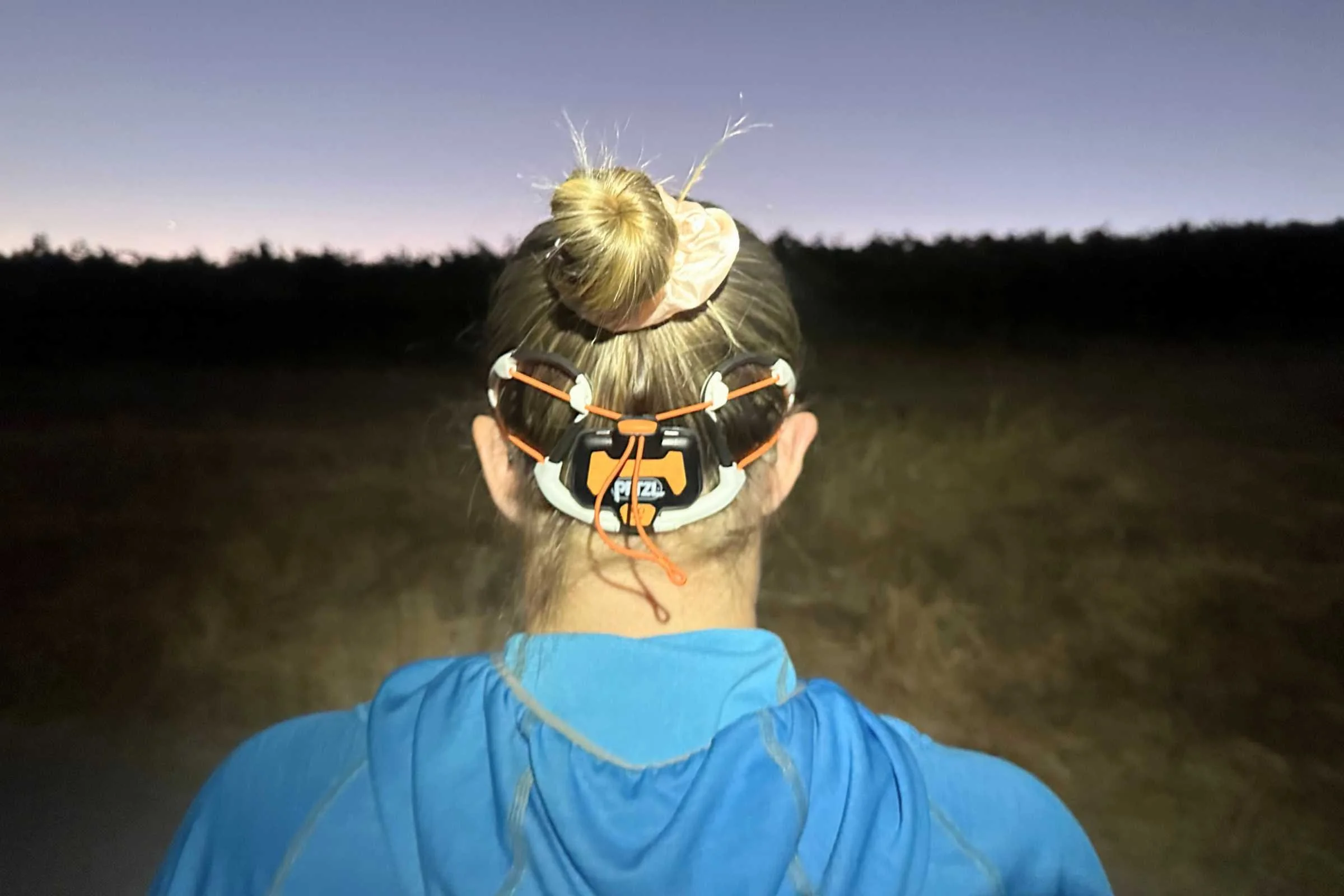
The Petzl IKO CORE has a battery compartment in the back. Photo by Billy Pudoff.
However, our glasses-wearing tester found this really uncomfortable to wear with their glasses. The rear battery pack was also harder for our long-haired tester to wear comfortably without getting hair stuck in the cord.
Another tester noted that after extended wear the band rubbed a raw spot on their ear. Comfort could be a tradeoff for high lumens in this ultralight design.

Lumens: 400, 300
Weight: 134 grams
Battery Source: internal rechargeable battery Micro-USB
Waterproof: IPX4
Rechargeable: Yes
What we liked: Bright, good in snow and rain, red rear blinker
What we didn’t like: Hard to use hands while holding it
One of our testers has an older version of the Nathan Polaris Hand Torch 400 RX running flashlight that they have used for over ten years (and it still charges!). This flashlight has a rear red blinking light and an angled front light. It has a comfortable hand strap so you don’t have to worry about dropping it or gripping too hard while you are running.
Nathan Polaris Hand Torch 400 RX

The Nathan Polaris Hand Torch 400 RX has straps so you can relax your hands a bit while running. Photo by Sara Kruglinski
We love this light during snow or rain storms; the lower angle allows us to see the ground better than headlamps. This new version is brighter with a nice focused beam and was comfortable to run with for testers with large and smaller hands.
For road running we carry this in our street-adjacent hand for extra visibility to cars. The rear blinker light helps increase visibility to drivers on the road. This is a great entry-level light for those who are used to running with a traditional flashlight with the added benefit of a comfortable strap so you can relax your grip.
As much as we love this light, it wasn’t our winner because you are still holding a flashlight in your hand and using this prevents you from being able to easily check maps on your phone or GPS watch like we could with the Knuckle Lights Advanced.

Lumens: 6
Weight: 43 grams
Battery Source: Internal battery Micro-USB
Waterproof: IPX4
Rechargeable: Yes
We liked that the Nathan LightBender RX safety light features three colors of steady or blinking light so we could be visible while running. It also features a larger visible area so when worn around the arm you are visible from more angles.
However, we found this uncomfortable to wear with short sleeves or tank tops and needed to layer a sleeve or jacket underneath it.
Nathan LightBender RX
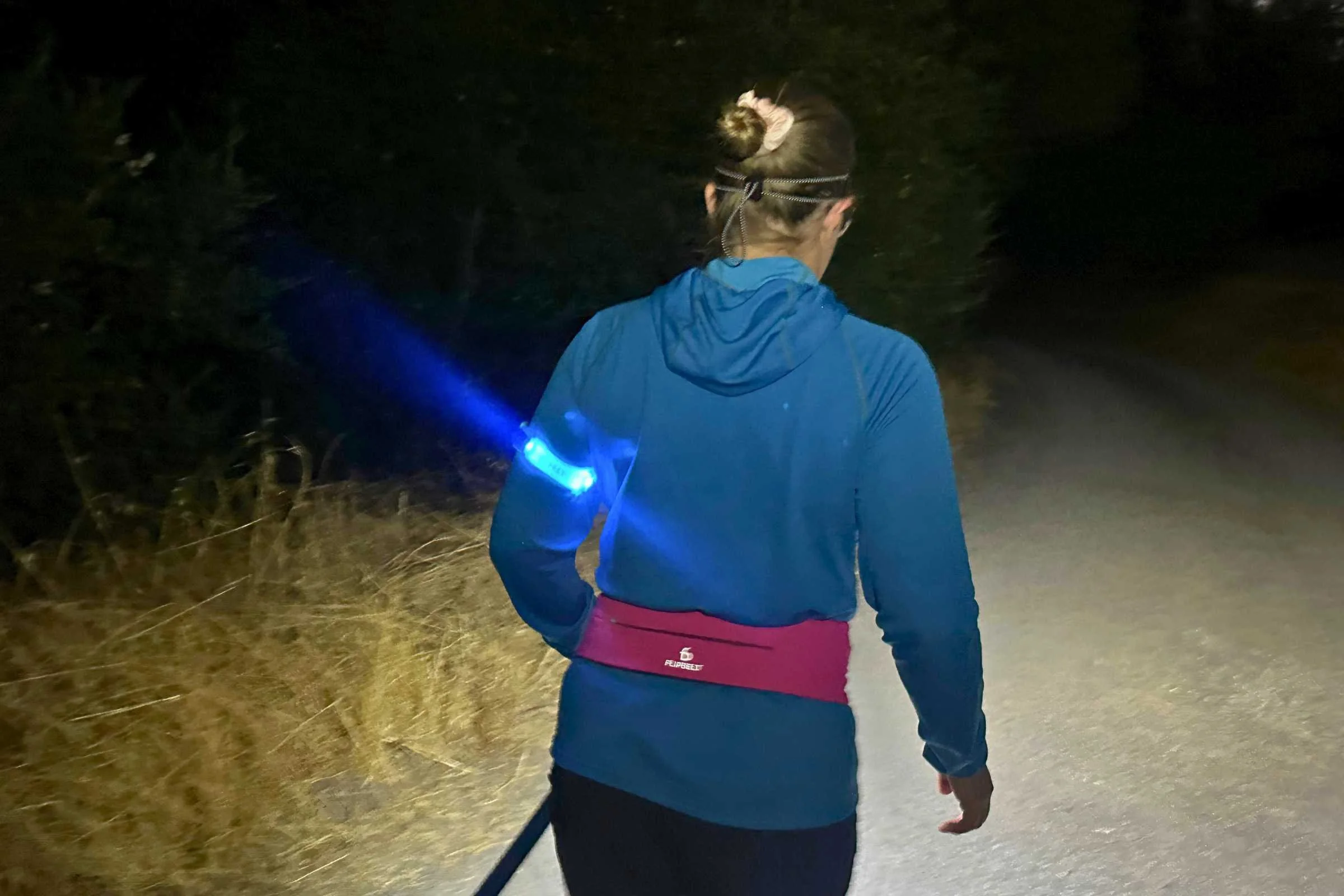
The Nathan LightBender RX has blue, red, and green light. Photo by Billy Pudoff
Lumens: 16
Weight: 23 grams
Battery Source: Coin Battery CR2032
Waterproof: IPX4
Rechargeable: No
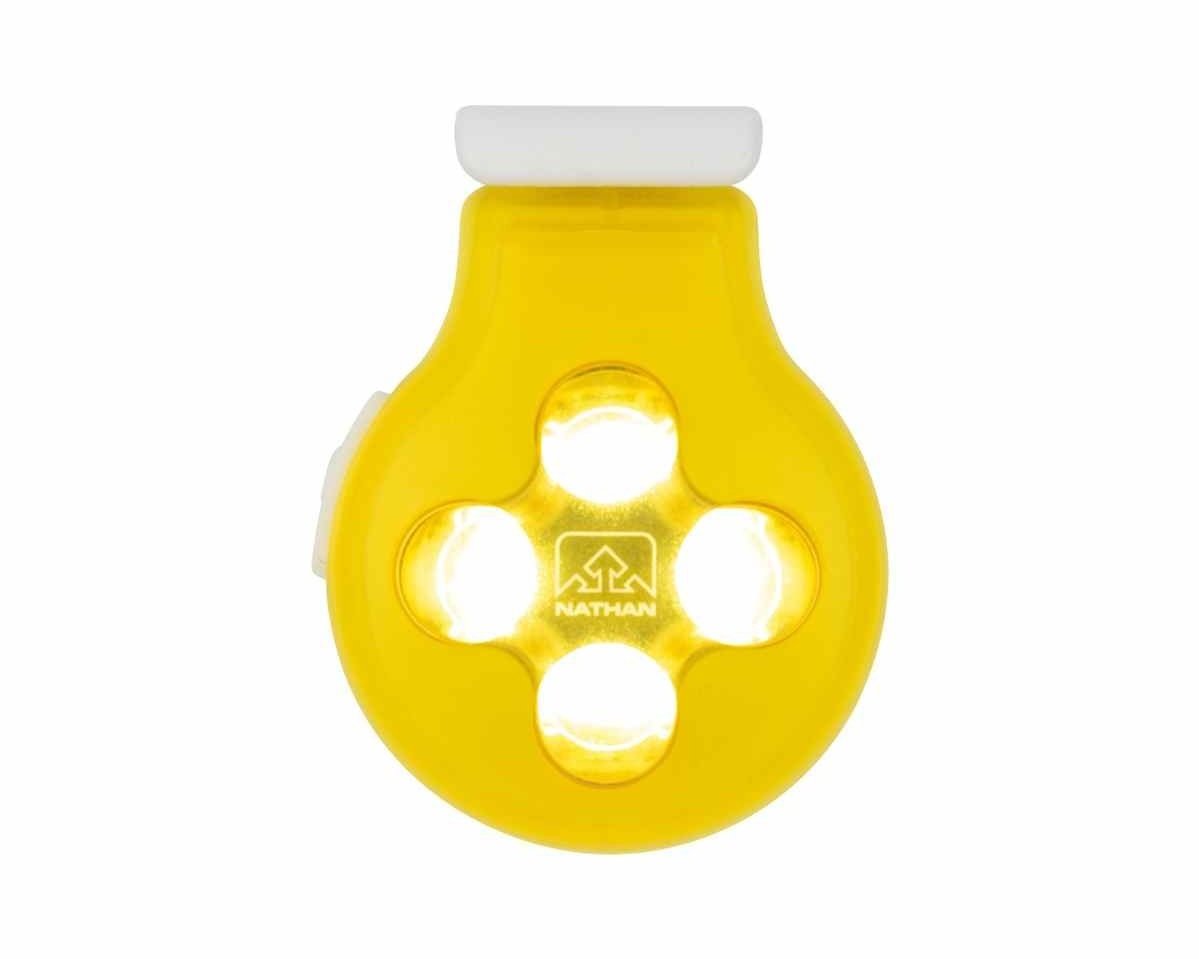
The Nathan HyperBrite Orb Strobe is easy to clip on and affordable. Four light modes allow you to be seen. It can clip onto the back of a waistband, running vest, hip pack, or even a hat.
However, we prefer the newer version with a rechargeable battery.
Nathan HyperBrite Orb Strobe
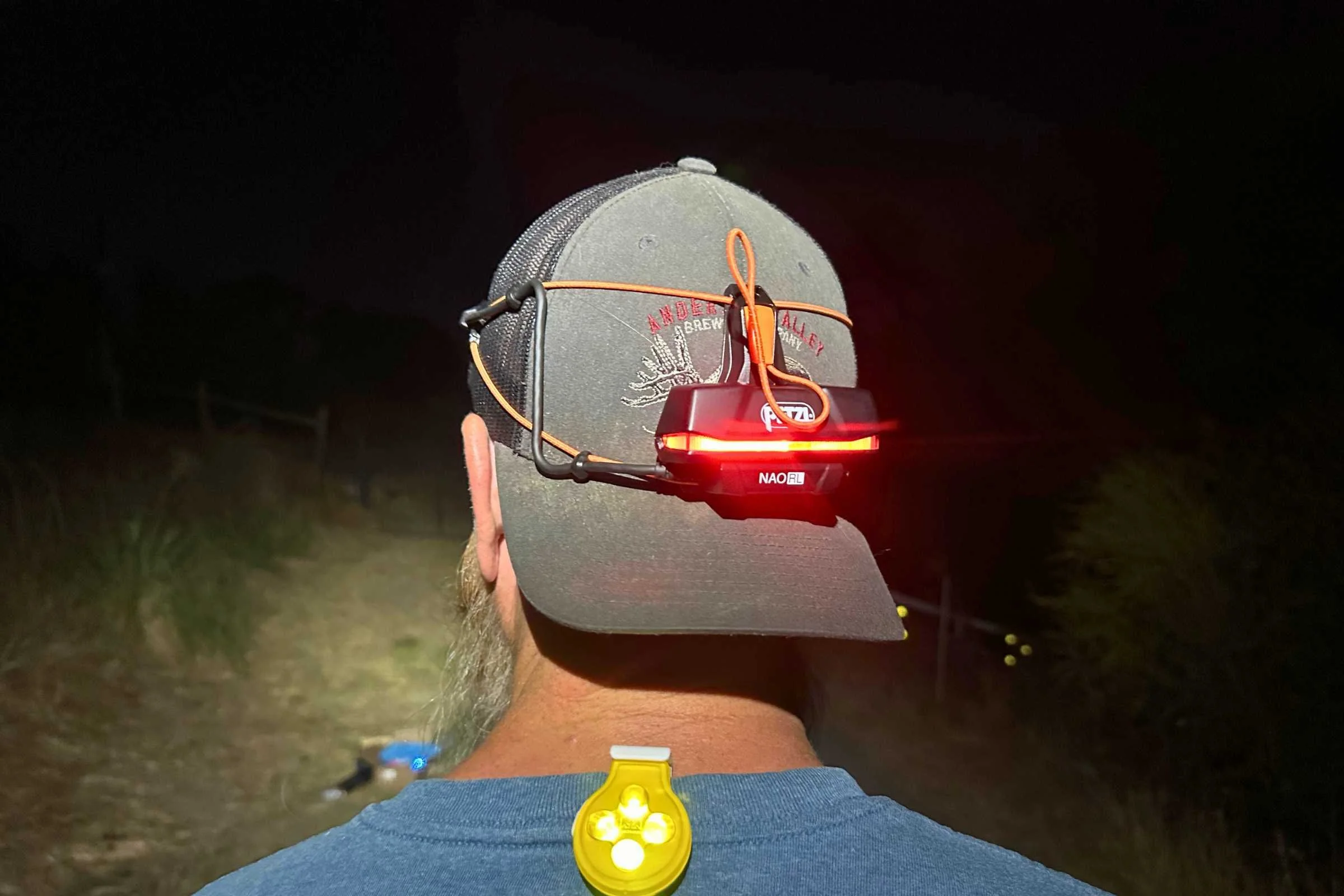
The Nathan HyperBrite Orb Strobe clips to the back of a shirt (or short or jacket) and pairs with the red light from the Petzl NAO RL rear light. Photo by Sara Kruglinski.

Lumens: Unknown
Weight: 19 grams
Battery Source: Coin Battery CR2032
Waterproof: Not stated
The Knuckle Lights Tail Light Safety Blinker is the smallest light we’ve tested. It has a red and white light. This light attaches with a magnet and has a loop which works really nicely on the back of a running vest.
While a great size, we would prefer a rechargeable version of this light. We also felt that it could be a little brighter.
Knuckle Lights Tail Light Safety Blinker
What to look for in a running light
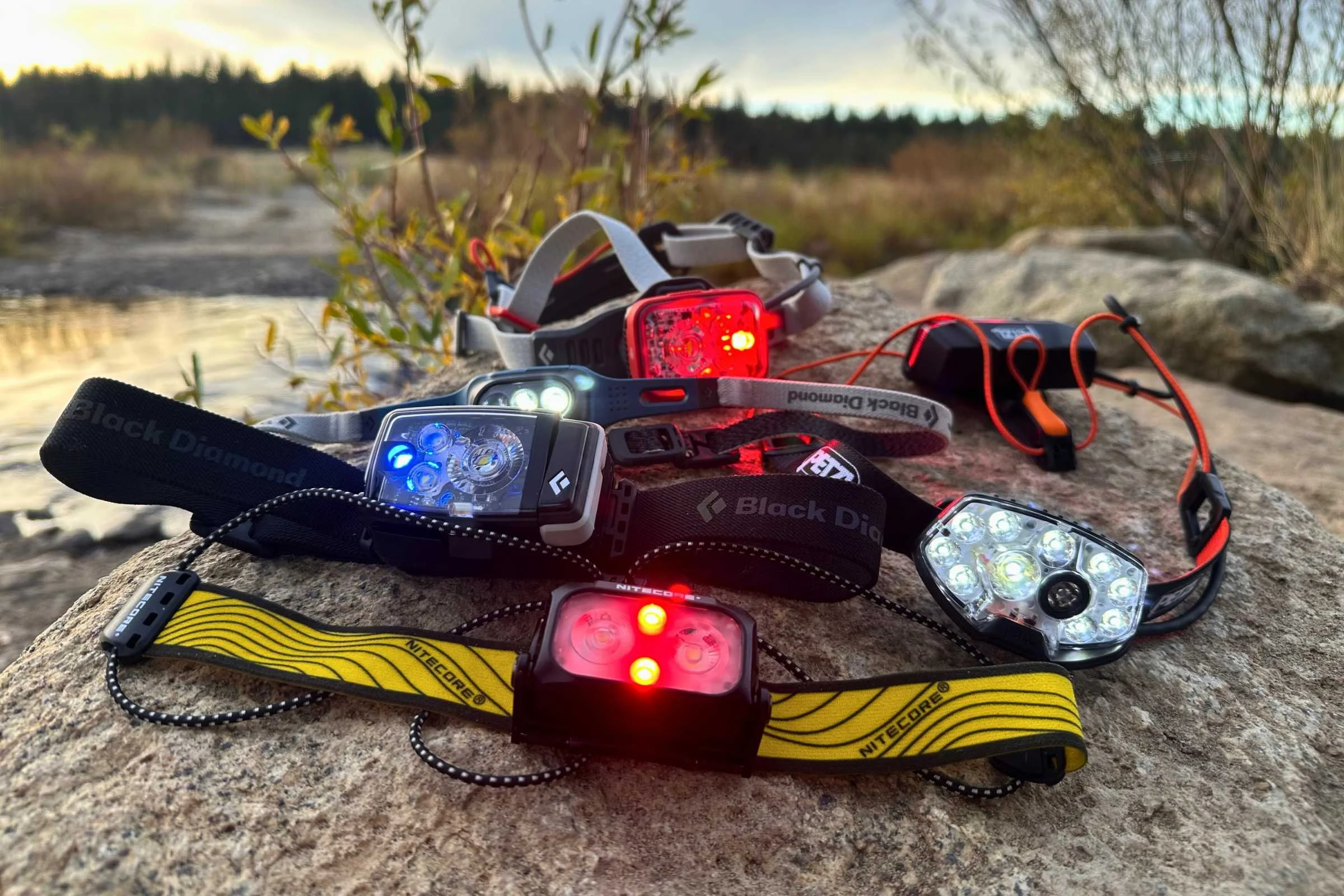
Our top five running headlamps. Photo by Sara Kruglinski.
Brightness (Lumens)
The lumens will dictate the brightness of the light. Runners will want between 300 and more than 500, depending on what time of day they are running, where they are running, and how technical the terrain is.
I like to consider the color of the light. A seemingly white light can be either yellow, white or blue in tone. The color of the light can make a difference especially if you are prone to headaches or nausea. I find that when I am using multiple lights it is best if they are all a similar color, mixing a blue headlamp with a yellow handheld light can make me nauseous.
Some of the lights we tested, like the Nitecore UT27, have an option to switch between white and yellow light. You can then mix the headlight with a handheld or waist light that matches those colors.
Beam pattern
Many of the headlamps we tested have the option for a focused beam or for a floodlight or a mix of both. The focused beam is great for spotting obstacles on the trail directly in front of you but you lose peripheral vision. Using the floodlight allows for excellent peripheral vision and spotting turns on technical trails but you get less intense light right in front. Using both allows for the best of both lights, letting you see your surroundings and see the trail in front of you nice and clear.
The handheld and wearable lights are mostly a focused beam, making them a great addition to a headlamp with floodlighting.
Battery life
One of the most important factors after brightness is the battery life. Some of the ultralight models that we tested lacked long battery life and would not last a full overnight run. This may not matter to a runner whose runs are never longer than the shortest battery life expected on a lamp. Unlike backpacking lights where charging can be a hindrance at night, if you are running and going back to civilization every night it is easy to plug in your lamp and keep it charged for the next run.
Many of the lights we tested have a reserve battery, to prevent you from running out of light during your run. The lights will only go to full power when the battery is above a certain percentage of charge. This is another reason to always keep them fully charged before each run.
Rechargeability
Most of the lights we tested are rechargeable or feature rechargeable batteries. This is an important factor that we consider as disposable batteries have a long-term impact on the environment. There were a few exceptions but those were mostly the tail lights and the nickel batteries last a very long time before they need replacing.
Weight
After considering brightness and battery life, weight is probably the next on the list in terms of importance. The brighter the headlamp and the longer the battery life, the heavier it will typically be, though there are a few exceptions in the mix. You just have to find a balance of these three factors that works for your needs. For example, the Black Diamond Deploy is one of the lightest lights that we tested, but the battery life is also one of the shortest as well as the lumens are some of the lowest.
Comfort and fit
The lights we tested vary in style and considerations need to be looked at as far as how you plan to wear a headlamp, with or without a hat or if you have long or short hair. We tested the headlamps on both long and short-haired individuals and with and without hats to see how they performed.
Weather resistance (Waterproof/Weatherproof)
Most of the lights we tested came with an IP rating of water resistance. If you are someone who perspires a lot or if you plan to run in a lot of rain and snow this is a very important factor to consider. Having the right rain gear for running can help protect you and your electronics. See our tips for running in the rain for more ways you can keep you and your gear safe in wet weather.
Durability
There may be a trade-off between durability and weight in some of the lights, lightweight lights may have more plastic instead of metal components and require more care to prevent breakage.

The Black Diamond Distance LT has many settings, including a blue light. Photo by Billy Pudoff.
Ease of use
One button, two buttons, three buttons, multiple modes… If you don’t plan on using all of the fancy modes that some of the higher-end models come with, a simpler one-button model might be the right choice. For shorter runs we preferred lights that were easy to charge with easy to use basic features.
Visibility features (Reflectivity/Additional Lighting)
The rear lights come with a few different options. You can have a steady light or a blinking light. The blinking light preserves the battery life and also has the benefit of being more noticeable to cars driving by.
We like using the steady light when we are running with a group on a trail and our running mates find the steady light nicer to follow than the blinking lights. On the road, we want to be seen and noticed by fast-moving cars and the blinker is helpful. Most testers were unable to see their own blinky light since it was in the back and were able to run unbothered by any blinking.
To learn more about how to stay visible in the dark, check out our Best Reflective Gear for Running in the Dark guide.

Adjusting different lights in the front and rear to stay visible. Photo by Billy Pudoff.
Adjustability (Beam angle/Brightness levels)
Most of the lights we tested have some way to change the angle and direction of the light. Where you place the light will depend on your personal preference, speed, and terrain. We usually like to be able to see a few seconds ahead of us and depending on how fast we are going that may be a shorter or longer distance ahead.
Size and portability
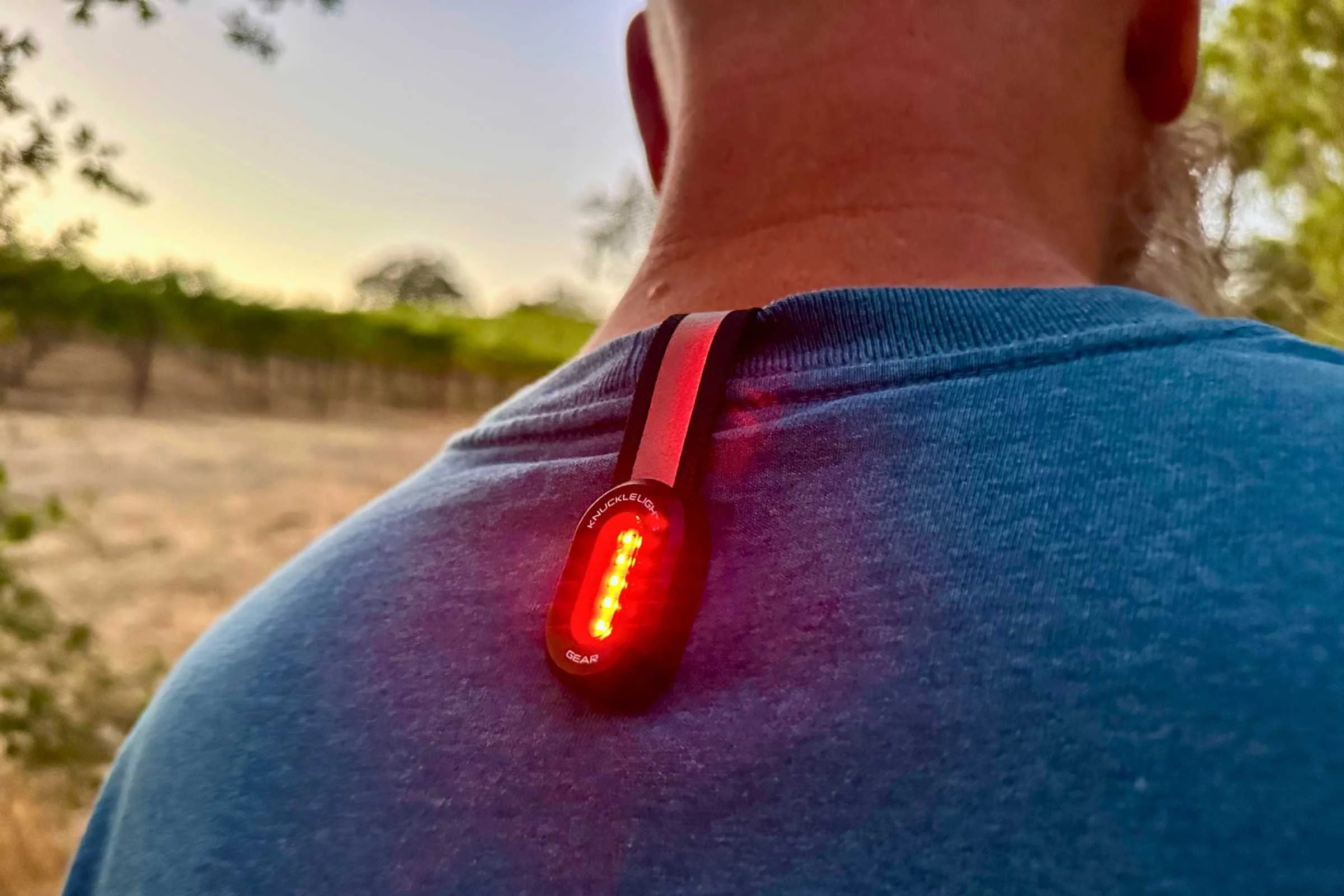
The Knuckle Lights Tail Light Safety Blinker has a magnet loop. Photo by Sara Kruglinski.
These lights are generally sized bigger the brighter they are and the longer the battery lasts. Get the light that makes sense for the type of running you plan to be doing.
One of our testers runs in the morning and only needs a headlamp for about 30 minutes before the sun rises, something less robust like the Black Diamond Deploy is perfect in this situation. Those of us who end up running later in the evening and even starting in the dark need a brighter light, and smaller lights aren’t going to cut it for hours in the dark.
Price and value
Our affordable winner is a great option for any runner, if you aren’t sure that night running is for you, you can start with the affordable winner and then add a waist light or handheld as you get more into it. The ability to add lights to your setup can help keep the financial investment lower.
How to choose a running light

All the lights we tested for this story, worn together to make us extra bright. Photo by Sara Kruglinski.
The best running light for you depends first on where and when you run. A road runner who mainly needs to be visible to drivers has different needs from someone running technical trails in complete darkness. Think about whether you need a light primarily to see, to be seen, or both.
Match the brightness to where you run
You do not necessarily need the brightest light available. For well-lit roads, a lower-output light may be enough, especially if visibility to drivers is your main concern. Dark trails and uneven terrain generally call for more light and a beam that lets you see farther ahead as well as around you.
Adjustable brightness is useful because conditions can change during a run. You may want more light on a technical trail or unfamiliar section, then less once you reach a road, neighborhood, or the first light of dawn.
Think about battery life
Battery life matters most in relation to how long you actually run. A light for short weekday runs does not need the same runtime as one you plan to use for long trail runs or overnight events.
Also pay attention to how easy it is to recharge the light and whether you can carry a backup. I like small backup lights such as the Knuckle Lights One because they are easy to stash in a pocket or pack if I am going to be out for a long time.
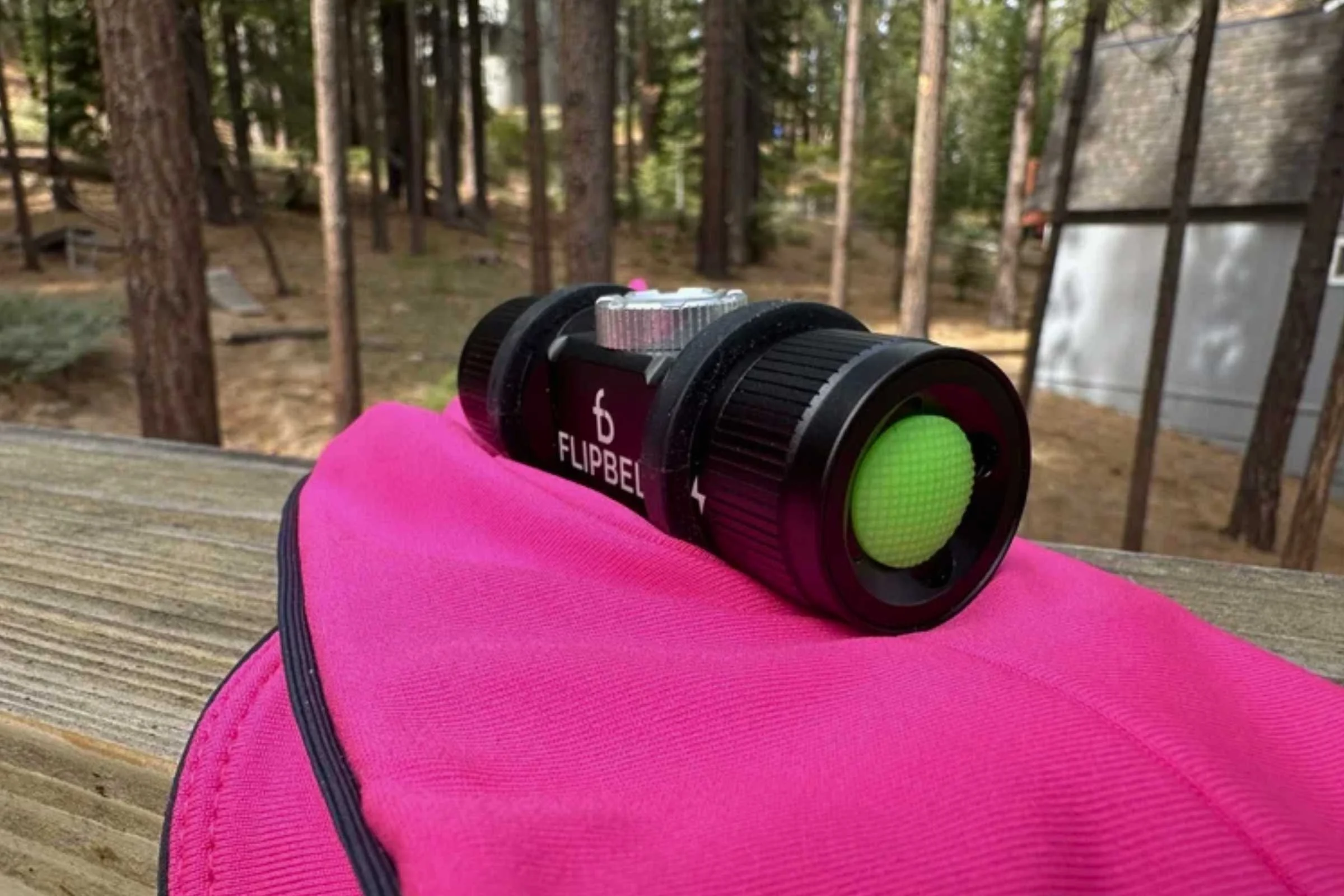
The FlipBelt Running Light has single-button operation for simplicity and ease of use. Photo by Sara Kruglinski.
Check comfort and bounce
A running light can have great specs and still be annoying if it moves around once you start running. Fit matters especially with headlamps and chest lights.
When possible, try moving around in the light before buying it. I have even done jumping jacks to see whether a headlamp stays put. If you run in winter, check the fit over a beanie or hat as well.
Consider sweat and weather
If you run in hot weather, sweat resistance matters. If you regularly run in rain or snow, look at the light’s water-resistance rating and make sure the controls are still easy to use when your hands are cold or wet.
The position of the light can also matter in bad weather. A lower light, such as a handheld, waist, or chest light, may create less glare from rain or snow than a beam positioned at eye level.
Choose a style that fits how you run
Headlamps are convenient because they keep your hands free and point where you look. Handheld lights put the beam lower to the ground and can make changes in terrain easier to see. Chest and waist lights offer another hands-free option, while clip-on and rear lights are mainly useful for helping other people see you.
You may also find that one light does not cover every situation. I use different lights depending on the run, and smaller lights can be useful as backups or for things like late-night dog walks.
Tips for running with a light

The Black Diamond Distance LT with the FlipBelt make a bright combo for running in the dark. Photo by Billy Pudoff.
Position the light properly: It may take a few minutes of your run to figure out the proper positioning for your lights. Depending on your speed, you may want the beam of the light to be farther in front of you rather than focusing on your feet. Think of where you normally look when you run, and start with aiming the light there.
Use multiple lights: There are many advantages to having multiple lights at once. With two lights you don’t have to stress about burning out the battery since you have a backup. Using two front lights like a headlamp and waist light or handheld can increase the depth of field especially for technical trails. I always recommend wearing a tail light so you are visible from behind. They are affordable and lightweight.
Check battery life: Most of the lights we tested only work on full power when they are fully charged and then they go into a reserve mode with lower power as they get closer to running out of battery. This reserve mode is super helpful so you are less likely to get stuck someplace in the dark. To avoid having to use reserve mode at the beginning of your run make sure the light is at full power, if they are locked you can usually tap a button to trigger the battery meter to blink the current charge.
Adjust brightness: This is a fun one. You are either going to be running in the dark and hopefully watching the sun come up, which means you can start with the brightest light and slowly taper it off as the sun rises. This method is also recommended for any runs that start in the full dark sky, start with a bright light as your eyes adjust, it becomes easier to taper off to the lower light levels. Some evening runners will start with a lower light setting as the sun sets and increase brightness as it gets dark on an evening run.
Secure the light for comfort: To preserve the straps on your lights, try to use them on a looser setting and tighten them up as needed. Some of the lights were more comfortable under a headband or clothing.
Test in different conditions: I tested all the lights in a dark bedroom with no mirrors before trying them on a run. I wanted to make sure I was going to have enough light to see the trails once it got really dark. I also tested them in my backyard at night running in place and making sure I was able to see the light and that my hat/hands/knees weren’t blocking the beam.
Carry a backup: If you have two lights you already have a backup. Some of the lights we tested have extra batteries and they are lightweight to carry for long runs.
Mind your pace: Don’t expect to run your usual pace at night, especially at first. It is slower for most people, even accomplished ultrarunners slow their pace at night. It is harder to see, so don’t be discouraged.
Use red light mode: Red light mode is wonderful for preserving night vision, and for pre- or post-run hangouts with your running crew. Red light is also helpful for sneaky off-trail bathroom breaks.

The four lights we tested here are all meant to help others see you while you are running. Photo by Sara Kruglinski.
Stay visible to others: The tail light and rear lights on some headlamps are essential for any nighttime road running so you can be seen. On the trail, the blinky lights can help runners behind you keep track of you and make you visible to SAR if needed in an emergency.
Snow and rain: Handheld and waist lights are generally better than headlamps for snow and rain. The lower angle to the ground helps cut the “Star Wars” effect of the snow or rain falling. Again, clip-on lights can be great for this. Use the focused spot beam instead of the floodlight. Sometimes lower lumens can make it easier to see. Running in snow and rain are usually going to be slower runs, but it can be a really fun experience.
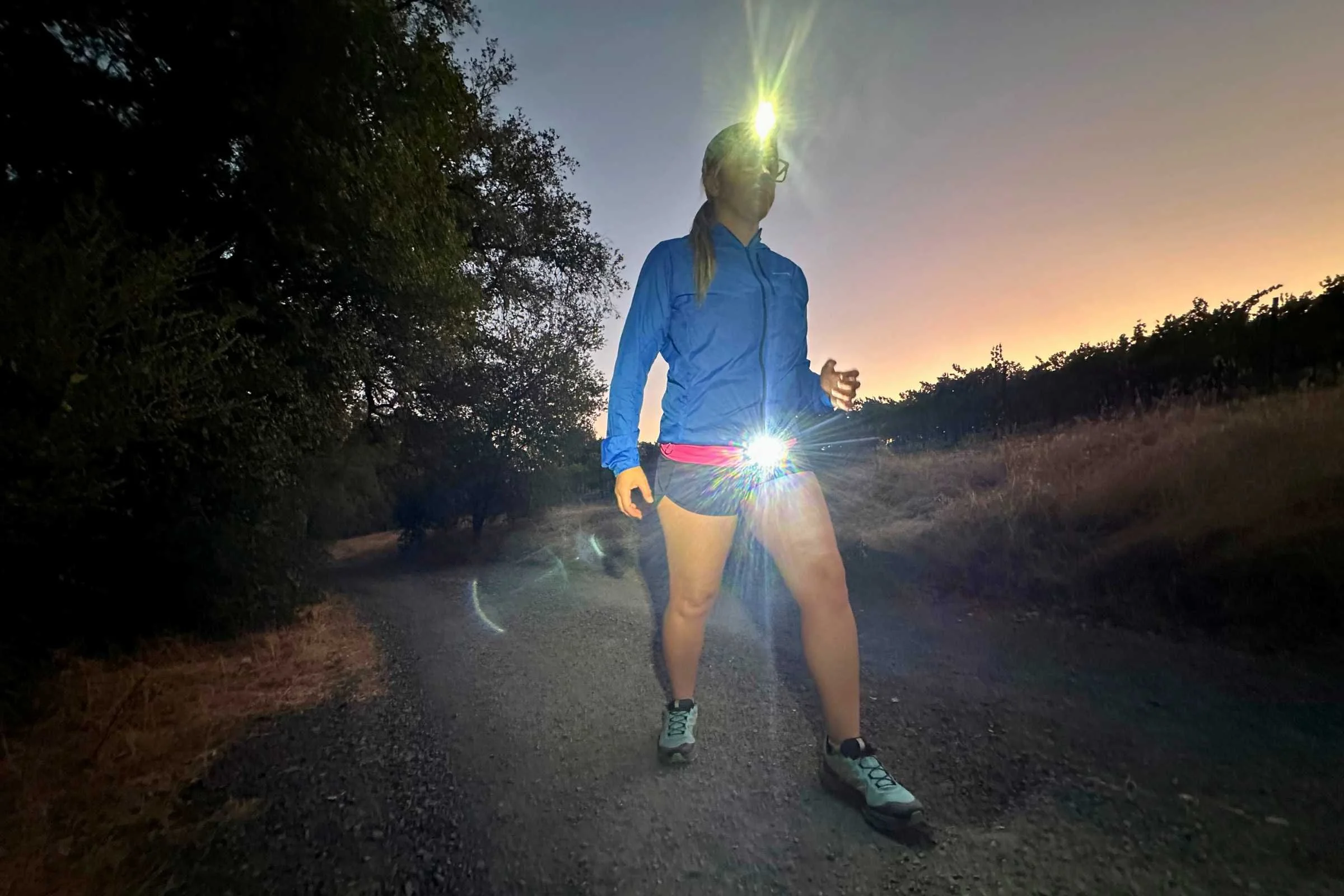
The FlipBelt Running Light adjusts up or down so you can see the trail clearly in front of you, with the Black Diamond Distance LT. Photo by Billy Pudoff.
FAQ
-
Most runners need at least 500 lumens for safe trail running in complete darkness, while road runners can get by with 300-400 lumens. Trail runners tackling technical terrain should aim for 600-800+ lumens for adequate visibility of obstacles and trail features. Road runners benefit from lower lumen lights since they have more predictable surfaces and often some ambient lighting. Consider your typical running environment - urban areas with streetlights require less brightness than remote forest trails.
-
Both can work well, and some runners use more than one type of light. Headlamps keep your hands free and can provide both focused and peripheral light. Handheld, waist, and chest lights put the beam lower to the ground, which can improve depth perception and can also be useful when running in rain or snow.
-
Choose lights with battery life that exceeds your longest typical run by at least 25% for safety margin. Most recreational night runs last 1-3 hours, making lights with 4+ hour battery life ideal. Ultra-runners need 8+ hours or swappable batteries for overnight events. Battery life decreases significantly on maximum brightness, so factor in your typical usage patterns. Many lights have reserve modes that provide dim emergency lighting when the main battery depletes.
-
A spot beam concentrates light farther ahead, while a flood beam spreads light across a wider area. We found both useful for running. A wider flood can help you see more of the trail around you, while a focused beam can help you see farther ahead. Some of the lights we tested let you use both.
-
A rear light can help drivers and other runners see you from behind, which is especially useful for road running. We also like rear lights when running with a group on trails. Some headlamps have a rear light built in, while small clip-on tail lights can be added to clothing or a running pack.
-
Ensure proper fit with snug but comfortable straps and consider your light's weight distribution. Headlamps with rear battery packs typically bounce less than front-heavy designs. Tighten straps gradually during your run as you warm up and sweat increases grip. For chest or waist lights, position them close to your center of gravity. Very lightweight options under 2 ounces rarely cause bouncing issues regardless of fit.
-
Many of the lights we tested have water-resistance ratings and can handle sweat or wet weather, but the level of protection varies by model. Check the light’s IP rating if you regularly run in rain or snow. We also found that handheld, waist, and chest lights can work well in precipitation because their lower beam angle can reduce glare from rain or snow directly in front of your face.
-
Red light preserves night vision and shows courtesy to other runners, but provides less trail visibility than white light. Use red light when approaching other runners, in group settings, or when you need to preserve night vision for stargazing. Switch back to white light for technical terrain where you need maximum visibility. Red strobes work well for rear visibility lights while being less distracting than white strobes.
Running lights care and maintenance tips

Various lights use different types of batteries, charging methods, straps, and ways to wear. Photo by Sara Kruglinski.
Most of the lights we tested have rechargeable batteries. It is important to not “overcharge” the batteries and unplug them once they are fully charged. We like to throw ours on the charger post-run and check back after an hour or two so it is ready to go for the next run.
Your headlamp will probably be pretty sweaty after a good run, so you will want to make sure it is dry before putting it away for storage. Many of the lights we tested came with storage bags. We use the bags to keep everything together and to protect the light from getting scratched or scuffed.
If your light has a lock setting, use it so you don’t accidentally drain the battery before your next run. There is nothing worse than getting ready for an evening run and realizing your lamp is dead. Likewise, if you decide to get extra batteries for your headlamp keep the extras fully charged and check the battery life on your extras before you head out.
Most of these lights have rechargeable batteries that can drain in cold weather. I left a headlamp in my car in winter and found the battery dead, even though I had fully charged it last time after using it. I try to store my lights inside away from extreme temperature swings. For tips on winter running, check out our guide on How to Run in Winter — 13 Tips for Running in the Cold.
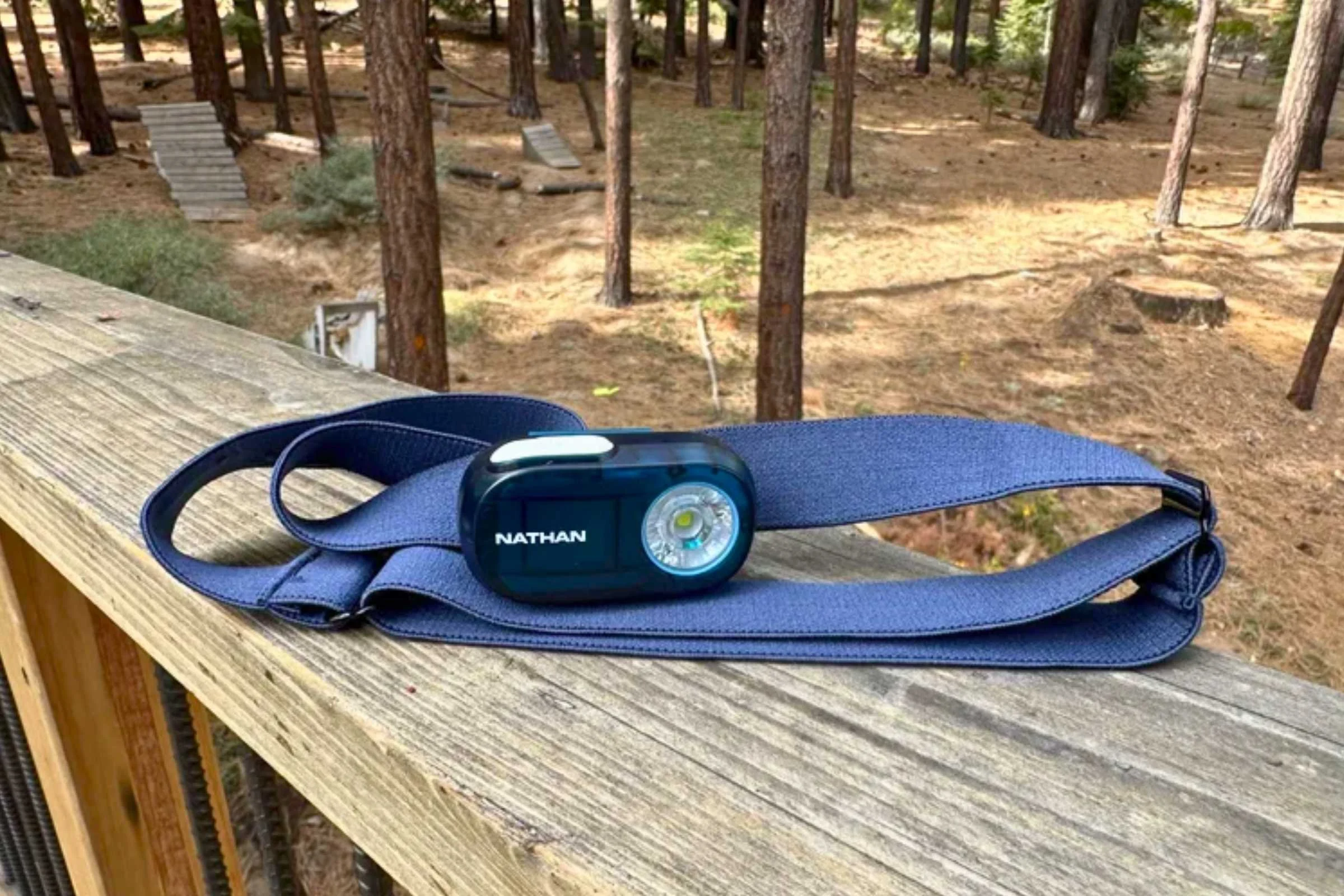
The Nathan Luna Fire 400RX has an adjustable elastic strap. Photo by Sara Kruglinski.
The elastic straps can wear out with excess salt from sweat. Depending on your waterproof rating you may need to spot clean your headband to keep it in top shape. A damp washcloth can do wonders removing sweat and salt. Make sure it is fully dry after cleaning.
How we researched and tested

All the headlamps we tested for this story. Photo by Sara Kruglinski.
We spent hours researching lights for running and narrowed down our list to search for the best running lights. We read reviews on other sites, and talked to other runners, sometimes for hours, about their favorite lights and why they love them. We also considered lights for different types of running, weather, heat and cold, and terrain.
We narrowed down our list to our top running lights, and tested more than 25 running lights over three years. We took lights out running on the trail and road in a variety of conditions and weather. We did jumping jacks with wearable lights to see if they would fall off or bounce around.
We ran mostly in the evening hours into nighttime, getting to enjoy the stars outside, along with getting to see all the nocturnal animals on the trails. We also drained the batteries and charged them back up to see how easy they were to charge.
- Night and early-morning runs
- Road and trail running
- Jumping-jack bounce tests
- Battery drain and recharge cycles
- Different weather and temperatures
- Brightness and beam visibility
- Visibility to other people
- Battery life and charging
- Comfort, fit, and bounce
- Durability and weather resistance

About the author / Why you should trust us
Sara discovered running in high school and never really stopped. What started as a way to spend time with her dad before school in the mornings morphed into a lifelong love for the sport. She loves running marathons and half marathons both on road and trail and has a wall full of finisher medals. A self-proclaimed night owl, she won’t be found running before sunrise unless she has paid for a race entry. Sara has spent many hours running at night. She loves the solitude on the trails and the cooler weather in the summer. In addition to running, she can be found skiing, snowboarding in winter and backpacking or thru-hiking with her dog in summer. As a former member of SAR, she believes that safety should always be a priority in any outdoor adventure and having lights for running, especially in winter when the days are so short, is essential.
To see all of Sara Kruglinski’s stories, check her author page.