The Garmin Enduro 3 GPS Watch Is the Longest-Lasting GPS Watch I've Tested
Industry-leading battery life meets premium features—at a price that undercuts the fenix 8
April 21, 2026
Gear Reviews > GPS & Electronics
Our Verdict
The Garmin Enduro 3 is the best ultra-endurance watch on the market. The Enduro 3 combines industry-leading battery life with 95% of the features of the fenix 8 watch, Garmin’s flagship adventure watch, while costing hundreds of dollars less than the fenix 8.
The Enduro 3 is a significant upgrade from the Enduro 2. It features significantly improved battery life, an enhanced optical heart rate monitor, and a revamped user interface. Additionally, it offers new mapping and navigation capabilities. Despite these upgrades, the Enduro 3 is priced $300 lower than the Enduro 2's original list price.
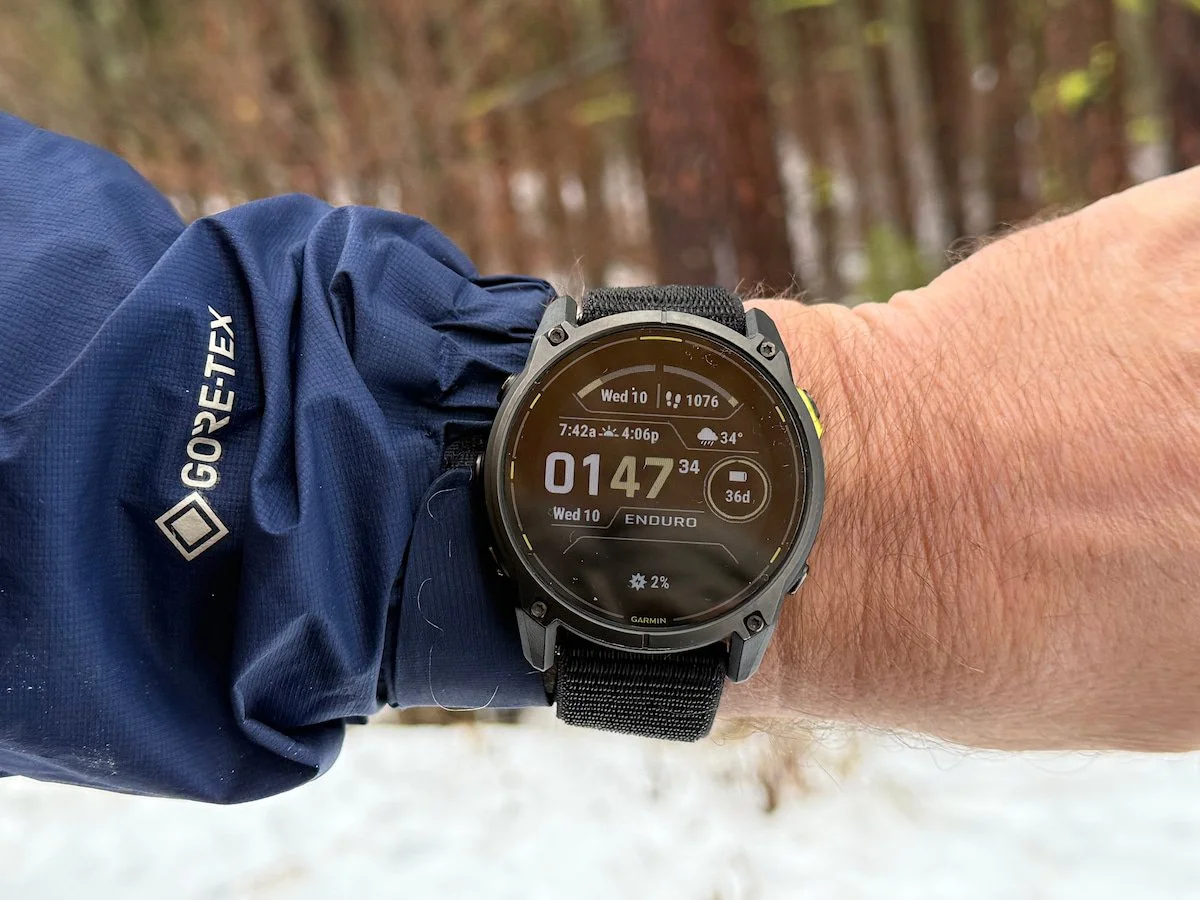
I have used the Enduro 3 for several months, including on a month-long bikepacking trip. The Enduro 3 offers a full suite of smartwatch and activity-tracking features, built-in mapping and navigation, and music storage. It can serve as your everyday watch, but the Enduro 3’s superpower is battery life. I only needed to charge the watch once every several weeks.
The Enduro 3 is not for everyone. It only comes in the large 51mm size, which is too big for many wrists. Nor is it available with the crisp, bright AMOLED screen on the fenix 8. But it’s the perfect watch for ultra-endurance activities, like thru-hiking, that require navigation and exceptional battery life.
Garmin Enduro 3 GPS Watch
We create reader-supported, objective gear reviews independently selected by our editors. This story may contain affiliate links, which help fund our website. When you click on the links to purchase gear, we may get a commission, without costing you an extra cent. Thank you for supporting our work and mission of outdoor coverage for every body! Learn more.
Garmin Enduro 3 Specs

Display: Sunlight-visible, transflective memory-in-pixel (MIP)
Lens material: Power sapphire
Touchscreen: Yes
Solar: Yes
Battery life:
GPS: Yes
Altimeter: Yes
Compass: Yes
Barometer: Yes
Navigation: Yes
Mapping: Yes
Water resistance: 10 ATM
Charging cable: Garmin proprietary
Smartphone compatibility: iPhone, Android
Warranty: One year from purchase
What We Liked
Industry-leading battery life
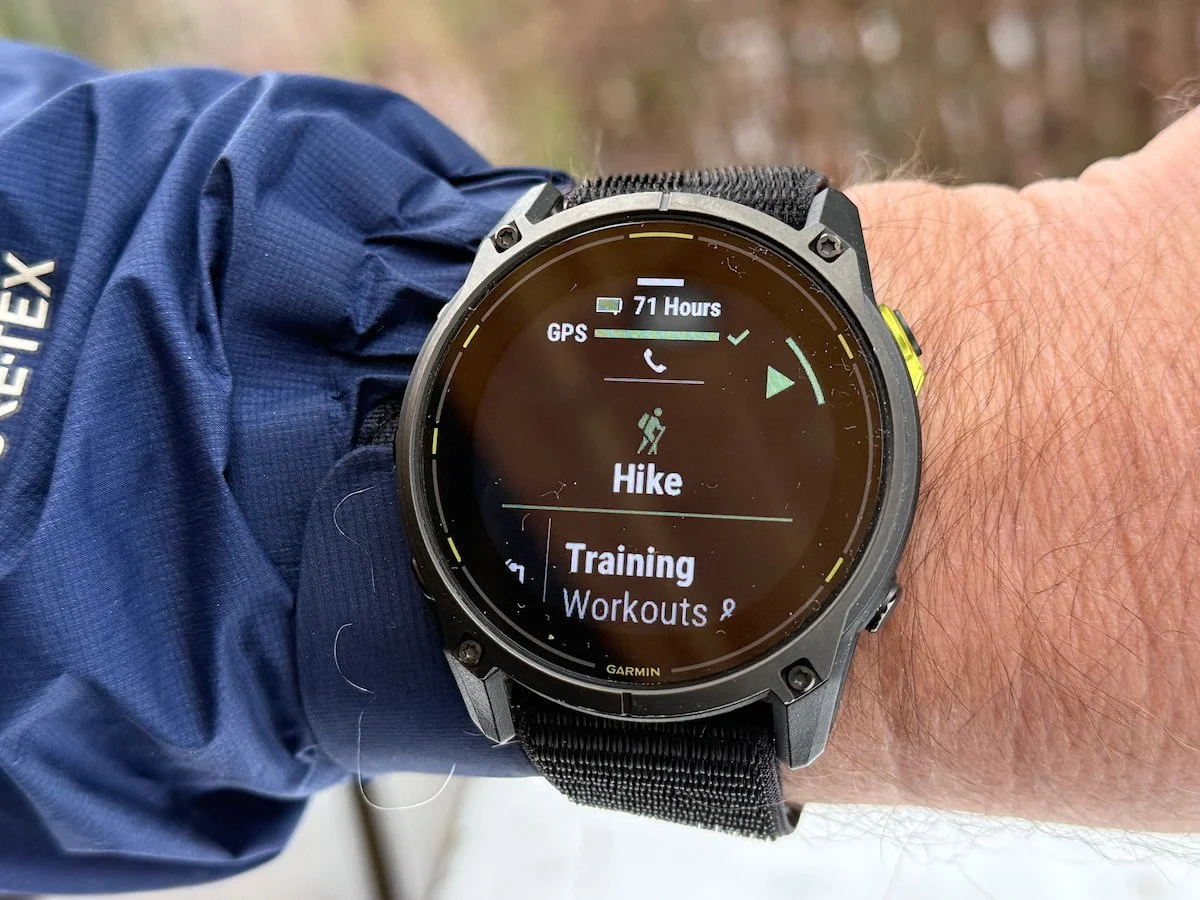
Comprehensive training/navigation features
Lighter and cheaper than its predecessor
Durable titanium/sapphire build
Built-in flashlight
What Could Be Better
Only one (large) 51mm size. We’d like to see a smaller version of the Enduro
No speaker/microphone
The charging cable. Garmin uses a proprietary charging plug that can be easily dislodged
Best For
Thru-hikers, ultra runners, and other endurance athletes
Hikers and backpackers on multi-day trips
Anyone prioritizing battery life over AMOLED display
Athletes who want Fenix-level features at a lower price
Folks who want to wear a large watch
Comparison Table
| FEATURES | Enduro 3 | Enduro 2 | fenix 8 Pro 47 mm AMOLED | fenix 8 Pro 51 mm AMOLED | fenix 8 47 mm Solar Sapphire | fenix 8 51 mm Solar Sapphire |
|---|---|---|---|---|---|---|
| MSRP | $900 | $1,099 | $1,200 | $1,300 | $1,100 | $1,200 |
| Display Type | Sunlight-visible, transflective memory-in-pixel (MIP) | Sunlight-visible, transflective memory-in-pixel (MIP) | AMOLED | AMOLED | Sunlight-visible, transflective memory-in-pixel (MIP) | Sunlight-visible, transflective memory-in-pixel (MIP) |
| Display Size | 1.4" | 1.4" | 1.4" | 1.4" | 1.3" | 1.4" |
| Lens Material | Power Sapphire | Power Sapphire | Sapphire Crystal | Sapphire Crystal | Power Sapphire | Power Sapphire |
| Bezel Material | Titanium | Titanium | Titanium | Titanium | Titanium |
What's New With the Enduro 3
Improved battery life. Garmin has upgraded the solar technology in the Enduro 3. The solar band around the display is thicker, while the transparent solar face across the display has been removed. This improves the watch face's visibility while doubling the Enduro 3's solar charging capability compared to the 2.
Upgraded navigation. There is automatic route recalculation in the event you deviate from your original route. In addition, there is dynamic round trip routing whereby you enter a target distance, and the Enduro 3 will propose up to three routes.
Upgraded heart rate monitor. The Enduro 3 has the new Garmin Elevate Gen5 Optical HR sensor, as is in the fenix 8 series watches. In addition to providing more accurate heart rate readings, it enables ECG and wrist-temperature monitoring.
Redesigned user interface. The widgets, activity profiles, and settings match the fenix 8 interface.
How we researched and tested
I tested the Enduro 3 on thru hikes in New Mexico and Arizona. I also tested the Enduro 3 on the Western Wildlands bikepacking route through Idaho, Montana, Utah, and Arizona. Since I wasn't using the watch to navigate on that trip, my goal was to see how long I could go without charging the Enduro 3. After 20 days of use, most of those days outside, the Enduro 3 was still at an incredible 66%.
Features
Battery Life
Battery life is the Enduro 3’s superpower. The upgraded solar technology doubles the watch's potential battery life. The Enduro 3 has up to 320 hours of GPS-only use. With the Enduro 3, you can navigate multi-day backpacking trips between charges.
I used the Enduro 3 on a month-long bikepacking trip. I didn’t use the Enduro 3 for navigation (I use the Garmin 1040 Solar bike computer). I used the watch to broadcast my heart rate to my bike computer and used the flashlight nightly. After one month of use, the Enduro’s battery was at 70%.
The Enduro 3's solar charging extends battery life dramatically, but you'll still need a charging system for your phone and headlamp. See our outdoor battery strategy guide for how to put it all together.
Battery Life Comparison Table
| Hiking Watch | Smartwatch Mode | Battery Saver Watch Mode (3) | GPS Only | All Satellite Systems | All Satellite Systems + Multiband | Max Battery GPS Mode (UltraTrac) (4) | Expedition GPS Mode (5) |
|---|---|---|---|---|---|---|---|
| Enduro 3 | Up to 36 days / 90 days with Solar* | Up to 92 days / unlimited with Solar* | Up to 120 hours / 320 hours with Solar* | Up to 80 hours / 144 hours with Solar* | Up to 60 hours / 90 hours with Solar* | Up to 210 hours / unlimited with Solar* | Up to 77 days / unlimited with Solar* |
| Enduro 2 | Up to 34 days / 46 days with Solar* | Up to 111 days / 550 days with Solar* | Up to 110 hours / 150 hours with Solar* | Up to 78 hours / 96 hours with Solar* | Up to 68 hours / 81 hours with Solar* | Up to 264 hours / 714 hours with Solar* | Up to 77 days / 172 days with Solar* |
| fenix 8 Pro 47 mm AMOLED Sapphire | Up to 15 days | Up to 19 days | Up to 44 hours | Up to 34 hours | Up to 30 hours | Up to 70 hours | Up to 14 days |
| fenix 8 Pro 51 mm AMOLED Sapphire | Up to 27 days | Up to 34 days | Up to 78 hours | Up to 60 hours | Up to 53 hours | Up to 123 hours | Up to 24 days |
| fenix 8 47 mm Solar Sapphire (1) | Up to 28 days | Up to 58 days | Up to 92 hours | Up to 59 hours | Up to 43 hours | Up to 283 hours | Up to 58 days |
1Solar charging, assuming all-day wear with 3 hours per day outside in 50,000 lux conditions. Outdoor light varies from 1,500 lux on a cloudy day to 100,000 lux on a sunny day.
2Always-on screen mode significantly reduces battery life.
3Battery saver mode mode turns off all all sensors and accessories, including the connection to your smartphone, and uses every battery saving feature (screen time out and no backlight).
4Max battery GPS collects track points every minute.
5Expedition mode collects GPS track points once an hour. To maximize battery life, the device intos low power mode and turns off all sensors and accessories, including the connection to your smartphone.
Sports and Training Features
Activity tracking: Running, cycling, swimming (pool/open water), hiking, multisport
Training metrics: Training load, training effect, performance condition, VO2 max, race predictor
Recovery tools: HRV status, Body Battery, recovery time recommendations
Running-specific: Hill Score, Endurance Score, grade-adjusted pace
ClimbPro: Climb profiles, gradient/distance info on routes
Strength training: New structured plans via Garmin Connect
Navigation and Mapping
Multi-continent TopoActive maps with terrain contours
Dynamic round-trip routing (new feature)
Turn-by-turn navigation, breadcrumb trails, distance/elevation remaining, ETA
Route creation/upload (Strava, Gaia GPS, and Ride with GPS compatible)
NextFork feature, back-to-start, trackback tools
Off-course alerts
Health and Wellness Tracking
Heart rate: Elevate V5 optical sensor (latest generation)
Additional sensors: SpO2, stress, sleep tracking
ECG app: The updated HR monitor is ECG capable. The new Elevate V5 optical heart rate sensor enables the Enduro 3 to provide an ECG monitor. The ECG app uses sensors to record the electrical signals controlling your heart's beats. The ECG app analyzes the recording to get your heart rate and detect signs of an irregular heart rhythm called atrial fibrillation (AFib). The ECG data can be viewed on your watch or in the Garmin Connect app.
Daily insights: Morning Report, Body Battery, recovery recommendations
Smartwatch Features
Garmin Pay (contactless payments)
Offline music (Spotify, Deezer)
Notifications
Garmin Messenger integration
GPS Accuracy
Multi-band GNSS support
“GPS-only” option to maximize battery life
Understanding the satellite options
The Earth has multiple satellite networks; if the network's coverage is global, it's called a global navigation satellite system (GNSS). Most people think of this as "GPS," when in fact GPS is just one of many GNSS networks in the world. The Enduro 3 watches can communicate with the following networks:
Global Positioning System (GPS), owned by the U.S. government
GLONASS, which is Russian
Galileo, created by the European Union
To some extent, you can choose which network(s) your Enduro watch communicates with, which greatly affects battery life.
GPS only
In "GPS only" mode, the Enduro 3 will communicate only with the US GPS network. Positional accuracy is slightly reduced, but battery life is maximized in GPS-only mode. This is the mode I use on a thru-hike when I'm navigating for 12+ hours per day, because battery life is my main concern. I have not had any navigation issues using the GPS-only mode.
All satellite systems
As you'd expect, in "all satellite systems" mode, the watch will communicate with all three GNSS networks discussed above. This mode uses multiple satellite networks simultaneously to determine your location. Because the different satellites are in different locations, environmental interference errors are reduced, resulting in higher positional accuracy.
You'll also get faster positional acquisition using this mode, but it uses more battery than the GPS-only mode. For example, Garmin claims the Enduro 3 GPS-Only battery life is 120 hours (excluding solar), but drops to 80 hours in all satellite systems mode, a 33% decrease.
All satellite systems + Multi-band
The most battery intensive mode is all satellite systems + multi-band. Dual-frequency or multi-band systems not only use all satellite systems, but also use more than one signal from each satellite on different frequencies. In situations where the view of the sky is limited, such as in canyons or heavily forested areas, multi-band GPS proves especially useful. Positional accuracy can be improved from +/- 10 feet to +/-6 feet. If positional accuracy is important, this is the mode you should use.
However, multi-band GPS comes with a serious battery penalty. According to Garmin, using all satellite systems + multi-band mode drops the Enduro 3’s battery life to 60 hours (excluding solar).
Garmin SatIQ
The Enduro 3 models are also equipped with Garmin's SatIQ technology. SatIQ automatically selects which satellite mode to use. For example, it will choose all satellite systems + multi-band if you're in a thick forest or urban canyon, but GPS-only if you're in an open area. This will theoretically preserve battery life while maintaining positional accuracy.
My Favorite Enduro 3 Features
LED Flashlight
The Enduro 3 has a built-in flashlight (like the fenix and Instinct watches). The LED flashlight has four different power levels, a strobe light, and red light modes. Initially, I didn’t think a flashlight would be useful, but after using Garmin watches with flashlights for several years, I've come to consider it a “must have” feature. On the trail, the flashlight is handy at night and in the morning, as I groped for my headlamp. At home, it’s perfect for navigating to the bathroom in the middle of the night without disturbing my partner.
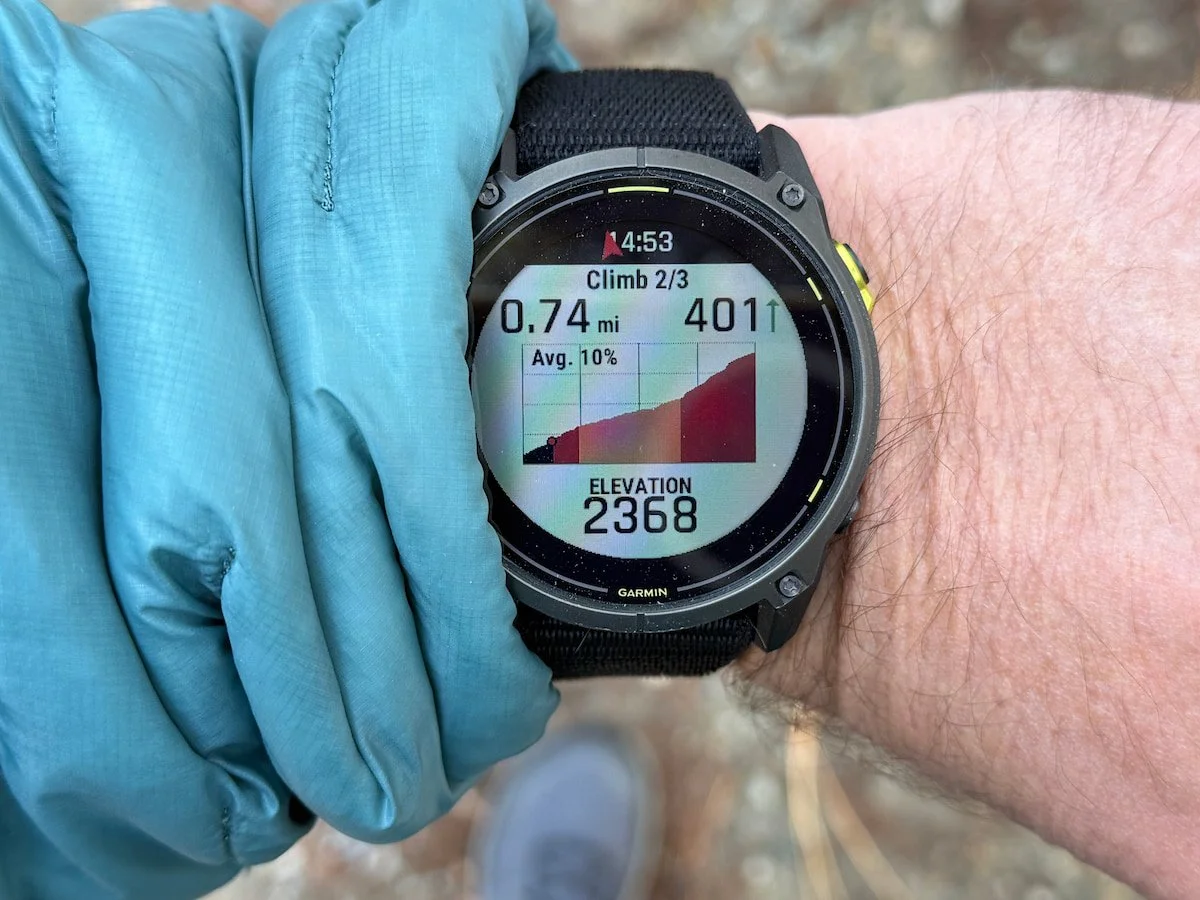
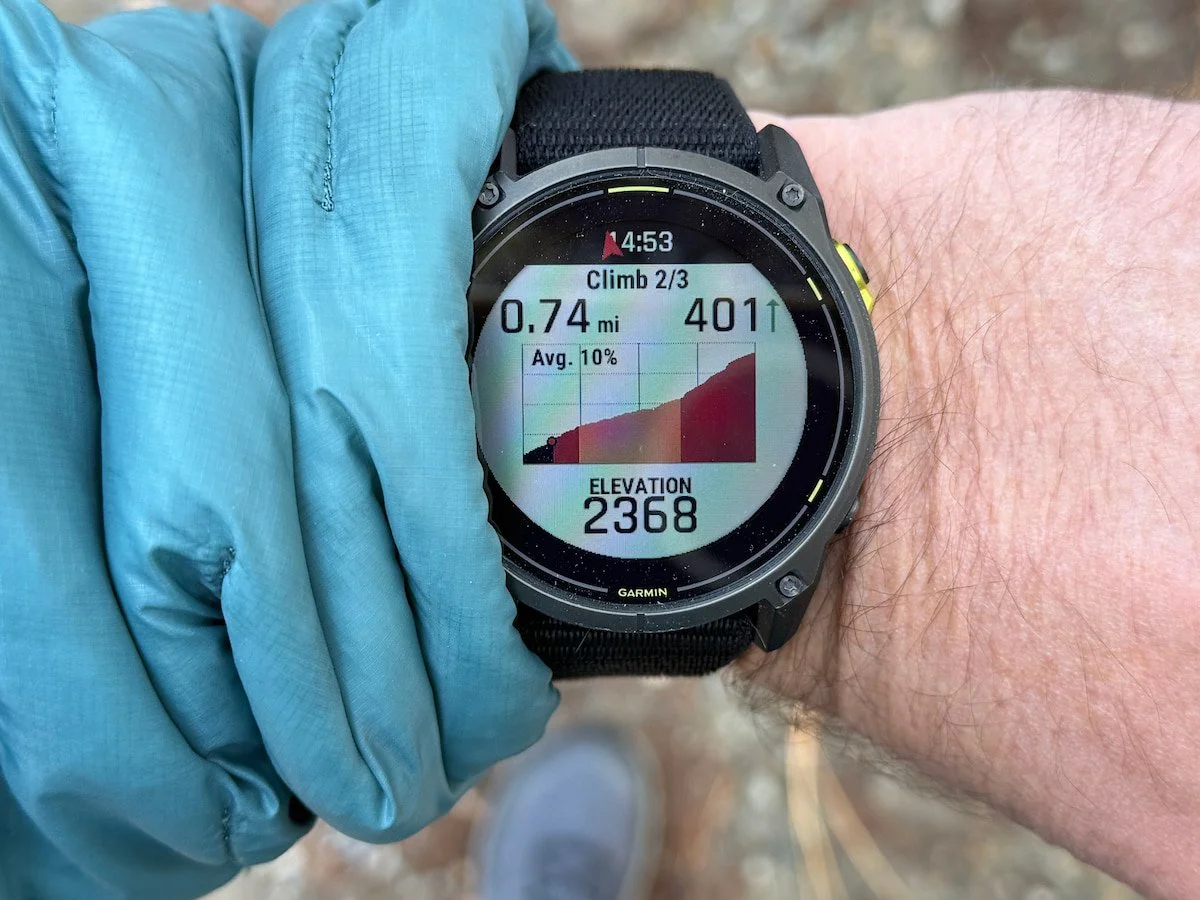
ClimbPro
ClimbPro is a feature that splits individual climbs and descents along a predetermined course. ClimbPro shows the distance, ascent/descent, and grade of each upcoming climb or descent. For example, if your hike, run, or ride has several distinct climbs, the watch will show a graph for each climb while underway. Once a specific climb is completed, the watch will show the details for your next climb.
I have been using ClimbPro on the routes I create in Gaia GPS. I love to watch my progress on big climbs.
Mapping
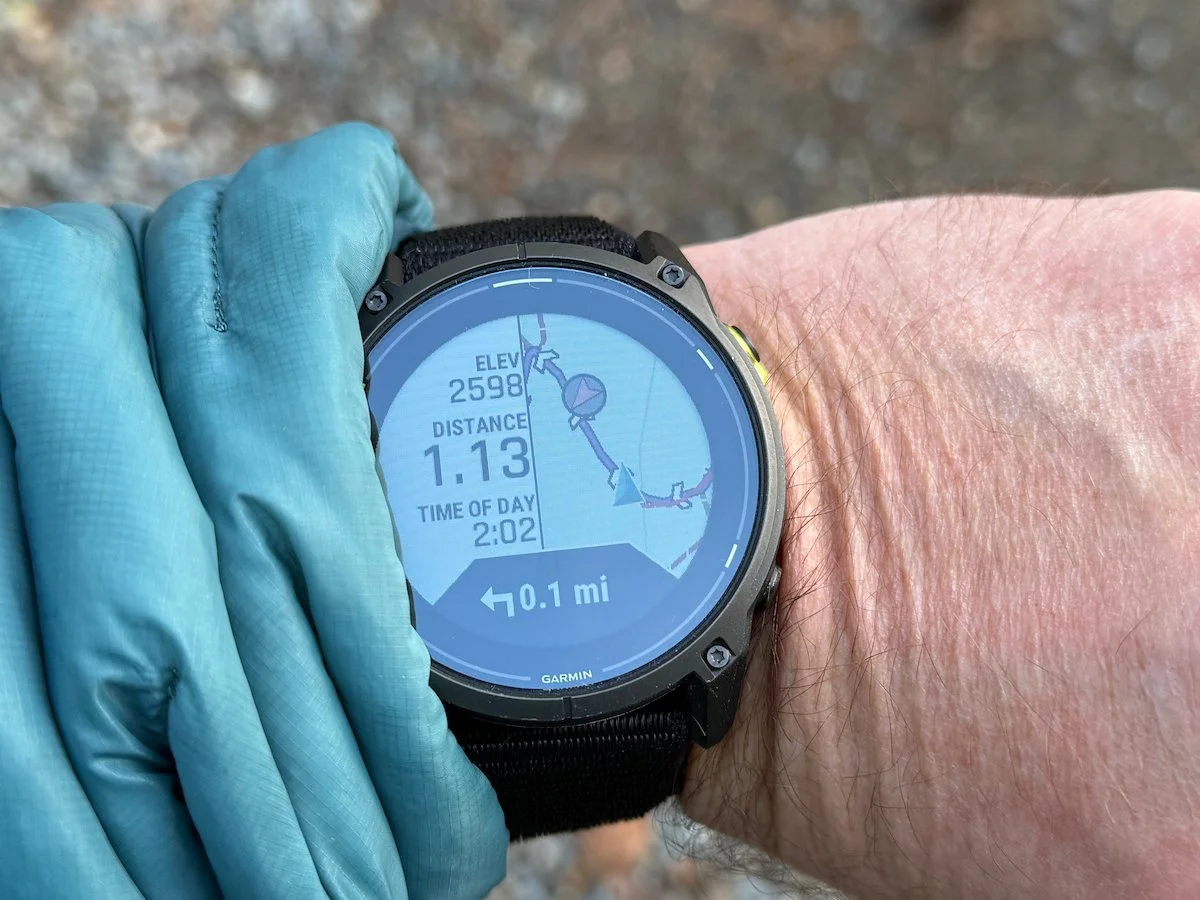
Initially, I didn’t think mapping was an important feature for me. I like to carry a map and compass. Plus, I use the Gaia GPS app. However, while I was on a cross-country section of the Oregon Desert Trail, scrolling through the fenix 6X’s (my 2021 watch) hiking data screens to the compass, I discovered that the pre-loaded base map showed the trail.
Since then, I have been loading long-distance hiking routes onto the watch. The maps are handy on hiking routes that can be hard to follow. If I miss a junction, the watch notifies me that I am off course. I have also started using the “create a course” function in the Garmin Connect app to create walking or running routes in town. When a course is loaded, the watch provides turn-by-turn directions.
_____________
Pro Tip:
I use Gaia GPS to create routes and waypoints. I then load the route and waypoints using the Garmin Connect app. I typically break a long route into 50-100 mile sections to match my resupply sections or significant landmarks. Loading new sections from my phone when in the backcountry is easy. You can also add GPX files directly into the Garmin Connect app. Note: Remember to send the route (course) to the watch.
Should You Upgrade From the Garmin Enduro 2?
The Enduro 3 is a significant upgrade from version 2; however, unless you need the extended battery life (almost double with solar charging), most folks don’t need to upgrade.
FAQ
-
In my long-term testing, the Enduro 3 consistently delivers multi-week battery life in daily smartwatch mode and days of GPS tracking on long trips (with solar charging). Garmin rates it at up to 90 days in smartwatch mode with solar, up to 90 hours in multi-band mode, and up to 320 hours in GPS mode with solar exposure. Real-world numbers depend heavily on how often you're in GPS, how bright your display settings are, and whether you're using music playback, but the Enduro 3 is the longest-lasting GPS watch I've tested.
-
After a year of daily wear and regular GPS use, I haven't noticed meaningful degradation. Like any lithium-ion battery, it will lose capacity eventually, but in the timeframe most users care about — the first year or two — the Enduro 3 performs the same as the day I unboxed it.
-
Yes, more than on any previous Garmin. The redesigned solar ring around the bezel captures significantly more light than older models where the panel sat under the display. On multi-week bike trips in Idaho, Montana, Utah, and Arizona, with consistent sun exposure, I noticed a real extension in battery life — not infinite charging, but meaningfully longer intervals between plug-ins. I went several weeks without charging it. Indoors or under dense tree cover, the solar contribution drops off considerably.
-
No, not comfortably. The Enduro 3 only comes in one size — 51mm — and it's a large, visually prominent watch. If you have a wrist circumference under about 165mm (6.5 inches), I'd recommend trying it on before buying. The nylon hook-and-loop band helps with fit flexibility, but the case itself is what it is. Smaller-wristed buyers should look at the 47mm fenix 8 or the Coros Vertix 2S.
-
Yes, the Garmin Enduro 3 is the watch I'd recommend first for thru-hikers. Multi-week battery life means fewer charges in town, the built-in TopoActive maps work without cell service, the flashlight is genuinely useful around camp, and the Elevate V5 sensor is accurate enough for training data on longer hikes. It charges from near-empty to full in about two hours and works with low-output power banks, which is what you'll actually be carrying on trail.
-
You can swim with it — the Enduro 3 is rated 10 ATM, which covers pool swimming, open water swimming, snorkeling, and diving into water. It even has an underwater heart rate monitor. However, it is not a dive computer. If you want dive functionality, you need the Garmin fenix 8 or a dedicated Descent model.
-
Surprisingly good. The multi-band GNSS mode uses multiple satellite frequencies simultaneously and handles tree cover, canyon walls, and urban environments noticeably better than older single-band receivers. On well-known trail segments I use as benchmarks, distances come in within a tight margin of reference tracks. If you care most about battery life over absolute accuracy, the standard GPS mode is still plenty accurate for hiking and running and stretches battery considerably further.
-
Anyone who wants a smaller watch, a brighter AMOLED display, or dive features should look at the fenix 8. Runners who don't need expedition-length battery life can save significantly with the Forerunner 965 or 265. And if you rarely leave cell service for more than a weekend, the Enduro 3's headline feature is overkill for your use case.
Where to Buy the Garmin Enduro 3
REI Co-op
Advantages: 10% member dividend, free shipping, and a 90-day electronics satisfaction guarantee for REI Co-op members.
Amazon
Advantages: Free 2-day shipping for Amazon Prime members, some sellers offer bundles for less than MSRP.
Garmin
Advantages: The manufacturer may offer a wider range of colors or sizes, free shipping on all orders and free 2-day shipping on orders over $199. In addition, the Enduro 3 may be HSA- or FSA-eligible if you purchase it through Garmin. For more information, read our explanation of how that works.
Similar GPS watches
Garmin fenix 8 Sapphire vs Garmin Enduro 3
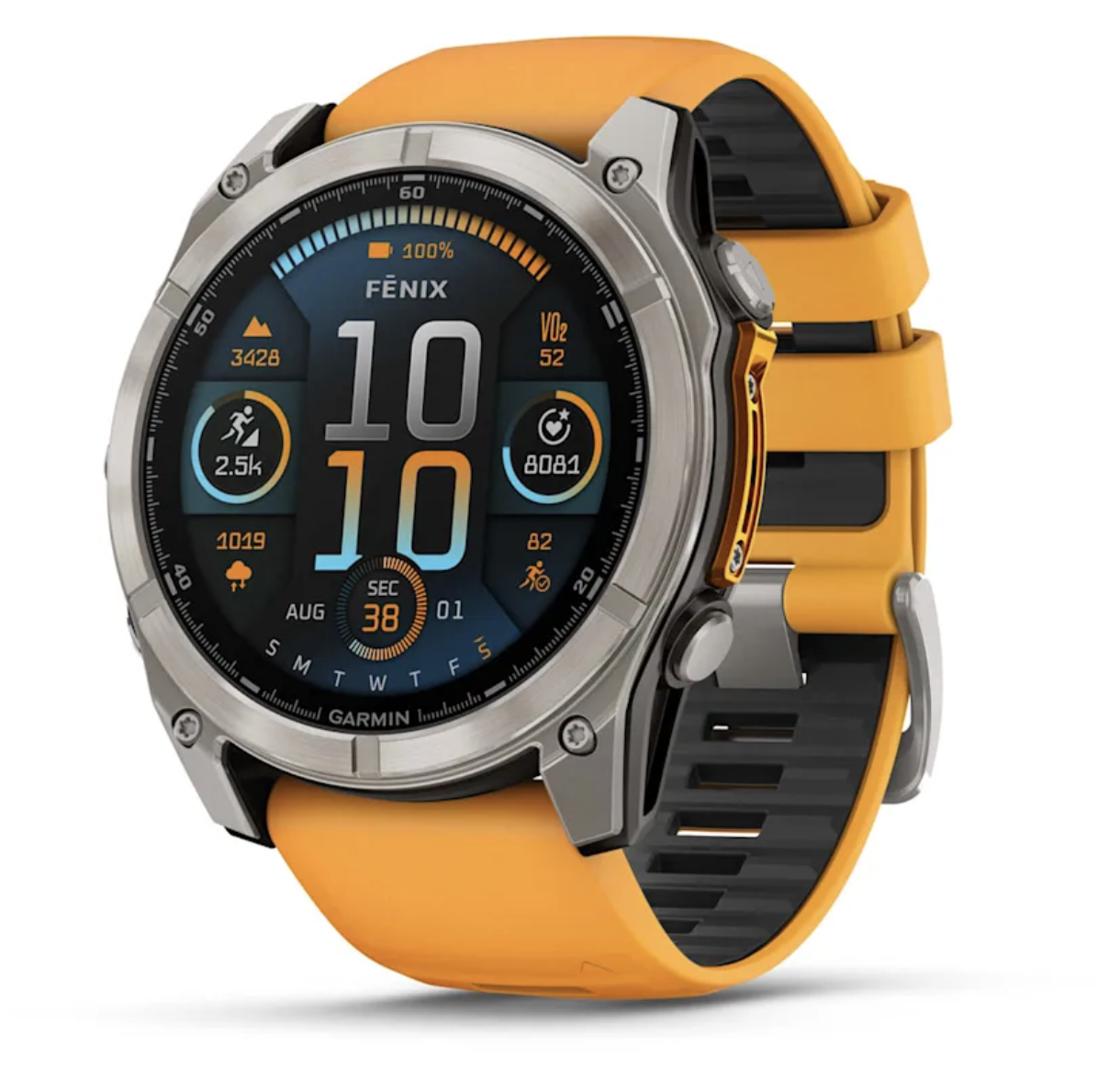
Display: AMOLED, MIP, or MicroLED
Lens material: Power sapphire
MSRP: $1,100 to $1,700
Touchscreen: Yes
Solar: Certain models only
Battery life: Varies by model and size
GPS: Yes
Altimeter: Yes
Compass: Yes
Barometer: Yes
Navigation: Yes
Mapping: Yes
Water resistance: 10 ATM
The Enduro 3 has most of the capabilities of the fenix 8 and significantly better battery life, while being about $200-$400 less expensive (depending on the specific model). The Enduro 3 lacks a speaker/microphone, so there’s no voice assistant. In addition, the Enduro 3 lacks dive features.
Nevertheless, if you can afford the more expensive fenix 8 or 8 Pro, I would recommend these watches over the Enduro 3. The Enduro only comes in the large (51mm) size. This is too big for a lot of folks. There is a warning on the Amazon website that the item is often returned due to a poor fit.
Garmin Enduro 3 vs COROS VERTIX 2S
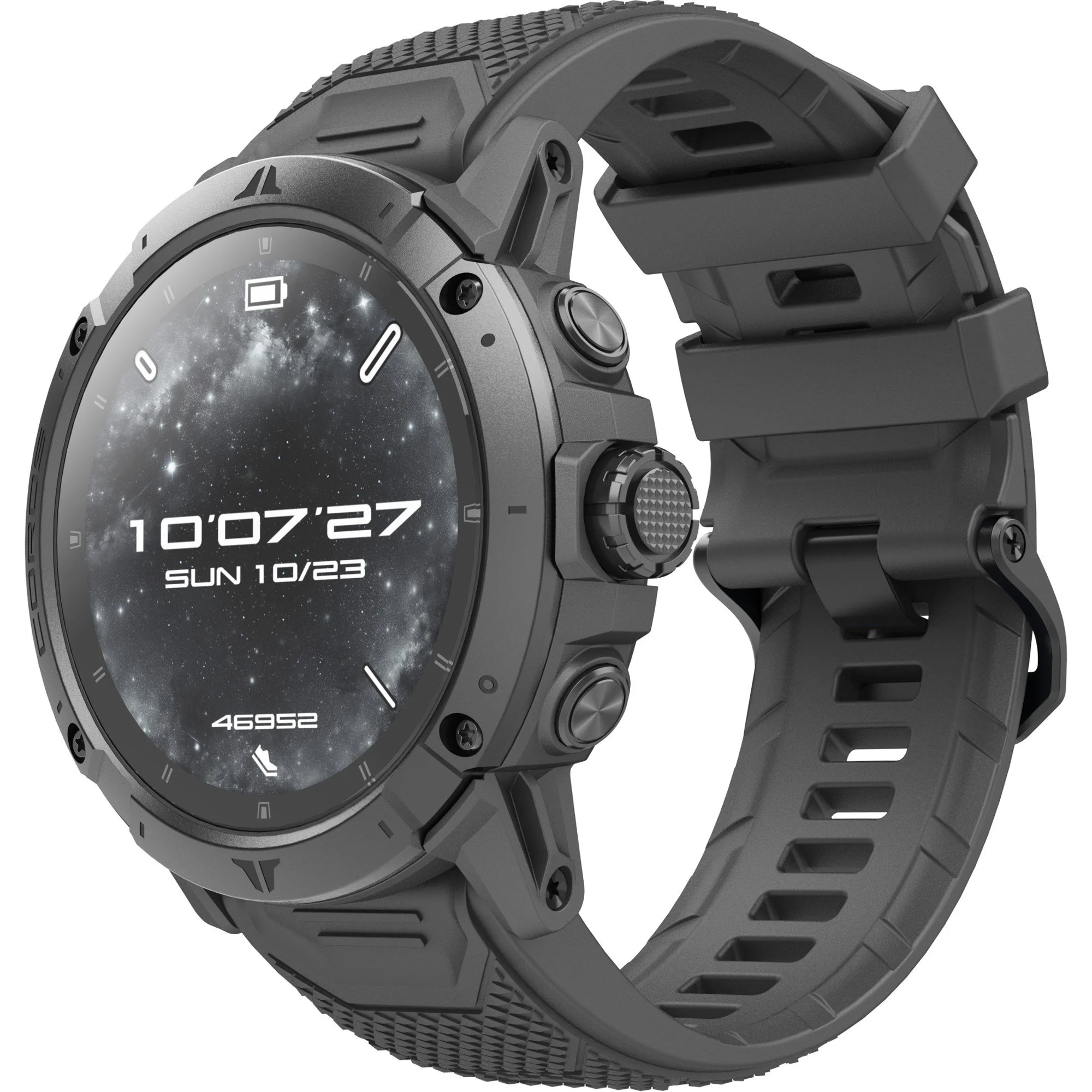
Display: LCD
Lens material: Sapphire glass
MSRP: $699
Touchscreen: Yes
Solar: No
Battery life: Up to 118 hours with standard GPS
GPS: Yes
Altimeter: Yes
Compass: Yes
Barometer: Yes
Navigation: Yes
Mapping: Yes
Water resistance: 10 ATM
The COROS VERTIX 2S may be tempting due to its price, but you do lose some functionality. Specifically mapping. The VERTIX 2S mapping functionality is a step below the Enduro 3, in that the VERTIX 2S's maps are non-routable. Maps are displayed on the watch face, but if you get off course, the watch cannot route you back to your course. You'll get an off-course warning, and you can use the watch's compass to find your way back, but that's about it.
For an extra $200, we think the Enduro 3's additional functionality is worth it.
About the Author / Why You Should Trust Us
Mike Unger left his high-stress corporate job to thru-hike the Pacific Crest Trail in 2006. That experience forever changed him, and he purposefully rearranged his life to allow for as much adventuring as possible.
Today, he’s closing in on 28,000 miles on North American long trails. He is one of a handful of people who are Double Triple Crowners, having hiked the Appalachian Trail, Pacific Crest Trail, and Continental Divide Trail each twice. He’s also hiked more obscure routes like the Ouachita Trail and the Oregon Desert Trail, and was part of the group that set the First Known Time on the Blue Mountains Trail.
He’s also picked up another passion along the way: long-distance bicycle touring, including the 1,850-mile Pacific Coast route and 2,700-mile Great Divide Mountain Bike Route. When he’s not hiking or biking, he’s probably planning his next trip and/or researching gear.
You can read all of Mike Unger's articles on his author page.