Six Moon Designs Lunar Orbiter Review: The Cottage-Brand Freestanding Tent We've Been Waiting For
Six Moon Designs' first truly freestanding tent trades a few ounces for wind stability, sand-friendly setup, and some of the best vestibule space in its class.
May 8th, 2026
Home → Gear Reviews → Backpacking
Our verdict
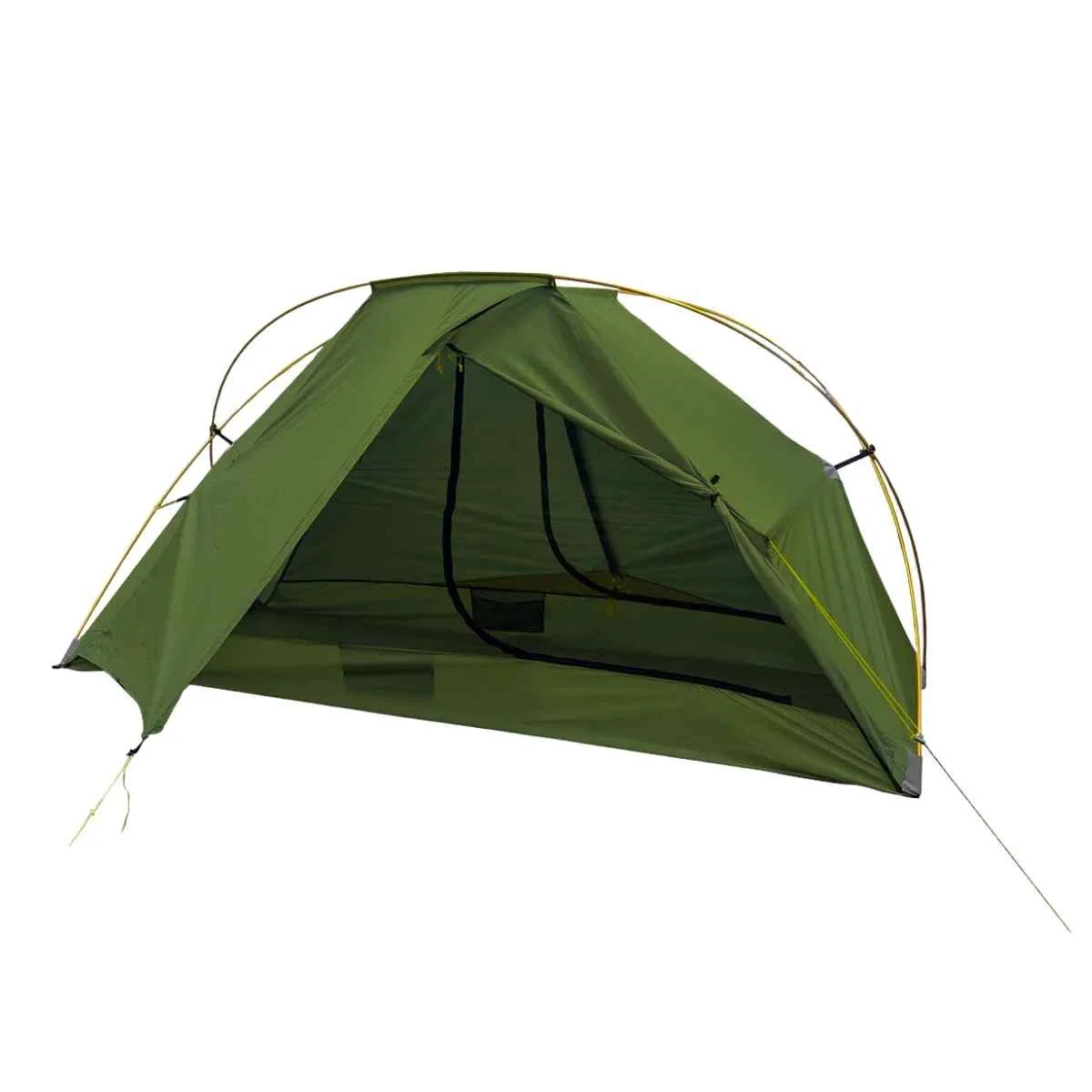
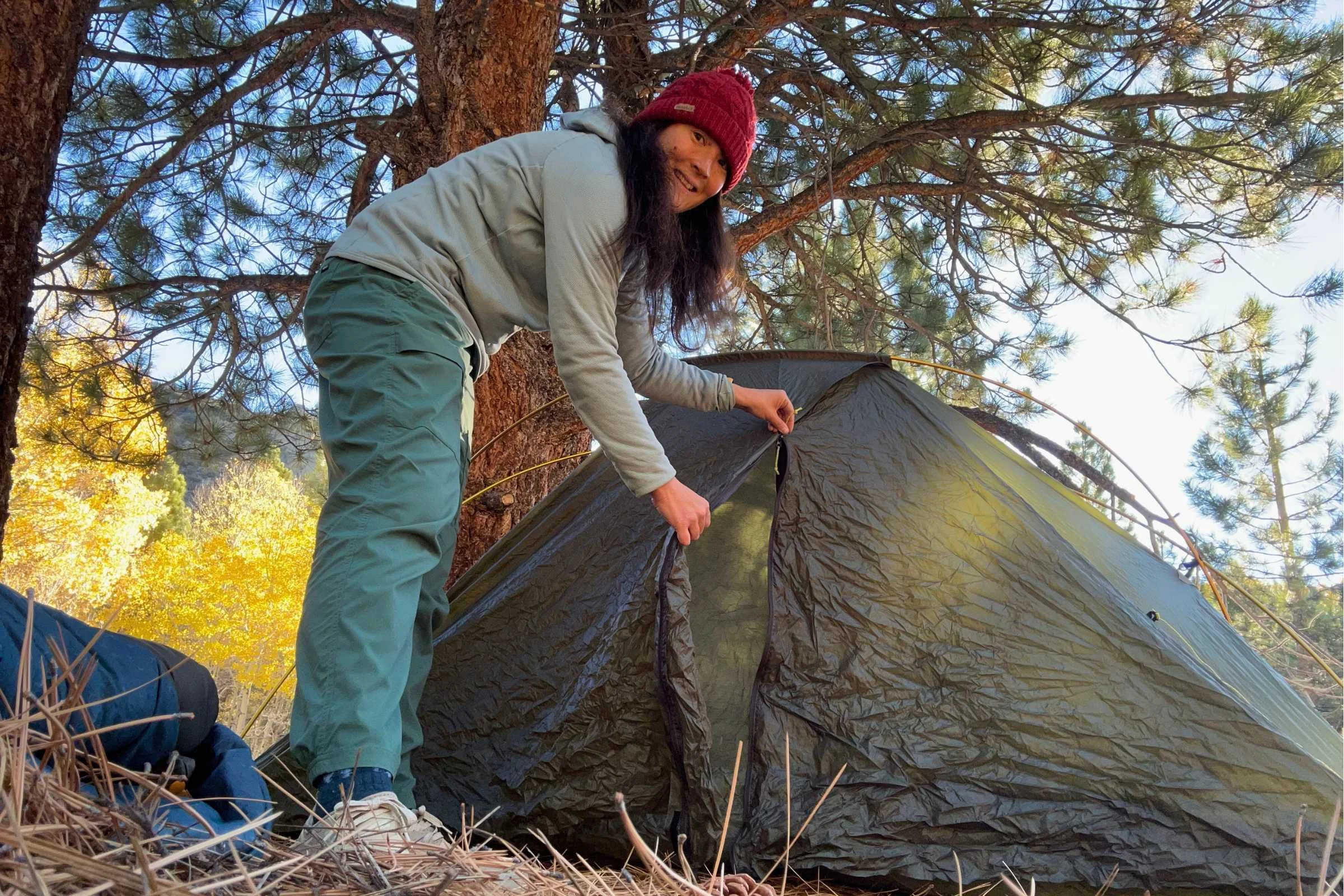
The Six Moon Designs Lunar Orbiter is a lightweight tent for backpacking or thru-hiking, and the first freestanding tent from this ultralight brand. It's cozy with excellent headroom and among the best dual-vestibule storage spaces of any tent in its class. Made with waterproof silicone-coated polyester that doesn't stretch as much as other nylon materials, its dome-like pole geometry makes it among the best performing lightweight tents in the wind and for shedding rain.
With steep walls, this is a tent that maximizes usable space. It has two doors, each with its own vestibule, so you have lots of sleeping space. Seriously, it has almost as much vestibule space as internal space. For organization, it has two internal pockets and a removable gear loft. This tent is very livable and very comfortable.
Six Moon Designs Lunar Orbiter
We tested the Lunar Orbiter in high winds in Anza Borrego Desert State Park in California, a month of camping in the Eastern Sierra during intense windstorms and snow in spring, summer, and fall, two weeks backpacking on the Idaho Wilderness Trail, and for three nights during the "storm of the summer" with heavy rains and winds in the Columbia River Gorge in Oregon. We've also tested it backpacking in the San Gabriel Mountains near the Pacific Crest Trail.
The Lunar Orbiter is truly freestanding, not semi-freestanding like most so-called "freestanding ultralight tents." This makes it an excellent option if you know you want a freestanding tent for the terrain you'll be hiking or if you don't hike with trekking poles. A freestanding tent is generally easier to set up than most trekking pole tents. That makes the Lunar Orbiter a more beginner-friendly ultralight tent option.
While heavier and more expensive than many other ultralight tents, including those by Six Moon Designs, I can't help but admit the Lunar Orbiter has won a place in my heart. I think of it fondly for a cozy night when the weather is windy, wet, and terrible. While it's heavy enough I wouldn't carry it for every trip, if I know the weather will be bad, it's shoulder season, or I'm not hiking very far, there's a good chance the Orbiter will be in my pack.
We create reader-supported, objective gear reviews independently selected by our editors. This story may contain affiliate links, which help fund our website. When you click on the links to purchase gear, we may get a commission — without costing you an extra cent. Thank you for supporting our work and mission of outdoor coverage for every body! Learn more.
Six Moon Designs Lunar Orbiter specifications
Price: $425
Type: Freestanding
Design: Hybrid (double wall sides, single wall ceiling)
Packed weight: 2 lb 12 oz (1,255 g)
Floor space: 90″ × 34″ (21.5 ft²)
Peak height: 48″
Vestibule area: 16 ft²
Materials: 20D SilPoly canopy, 40D SilPoly floor
Packed size: ~15.5″
Doors/vestibules: 2
Capacity: 1-person
Warranty: Limited lifetime
Best for

We tested the Lunar Orbiter in three seasons including in late fall in the Eastern Sierra.
Solo backpackers, bikepackers, or rafters who aren't carrying trekking poles or who prefer tents with dedicated poles
Backpacking trips above treeline where there may be too many rocks to get tent stakes
Solo backpacking in bad weather with generous vestibule space
Beginner ultralight backpackers
River trips or those camping on sand
Fans of Six Moon Designs tents looking for a good freestanding tent
Comparison table
| BACKPACKING TENT | MSRP | FREE-STANDING | WALLS | SLEEPS | DOORS | VESTIBULES | WEIGHT (oz) | LENGTH (in) | WIDTH (in) | PEAK HEIGHT (in) | FLOOR AREA (ft²) |
|---|---|---|---|---|---|---|---|---|---|---|---|
| Six Moon Designs Lunar Orbiter | $425 | Yes | Hybrid | 1 | 2 | 2 | 44.0 | 90 | 34 | 48 | 21.5 |
| Mountain Hardwear Nimbus UL 1 | $420 | Semi | Double | 1 | 1 | 1 | 30.6 | 86 | 28-38 | 38 | 19.7 |
| Six Moon Designs Skyscape Trekker | $275 | No | Hybrid | 1 | 2 | 2 | 26.0 | 103 | 48 | 45 | 23.0 |
| NEMO Hornet Elite OSMO 2P | $700 | Semi | Double | 2 | 2 | 2 | 33.0 | 85 | 42-50 | 37 | 27.3 |
| Big Agnes Copper Spur UL2 | $600 | Yes | Double | 2 | 2 | 2 | 48.0 | 88 | 42-52 | 40 | 29.0 |
| Big Agnes Tiger Wall UL2 | $500 | Semi | Double | 2 | 2 | 2 | 40.0 | 88 | 42-52 | 39 | 28.0 |
| Zpacks Duplex Classic | $749 | No (Yes, with kit) | Single | 2 | 2 | 2 | 18.5 | 90 | 45 | 48 | 28.1 |
| Six Moon Designs Lunar Solo | $260 | No | Single | 1 | 1 | 1 | 26.1 | 90 | 48 | 49 | 26.3 |
| NEMO Hornet OSMO 2P | $480 | Semi | Double | 2 | 2 | 2 | 40.0 | 85 | 43-51 | 39 | 27.5 |
| Big Agnes Copper Spur HV UL2 | $600 | Yes | Double | 2 | 2 | 2 | 50.1 | 88 | 42-52 | 40 | 29.0 |
What we liked
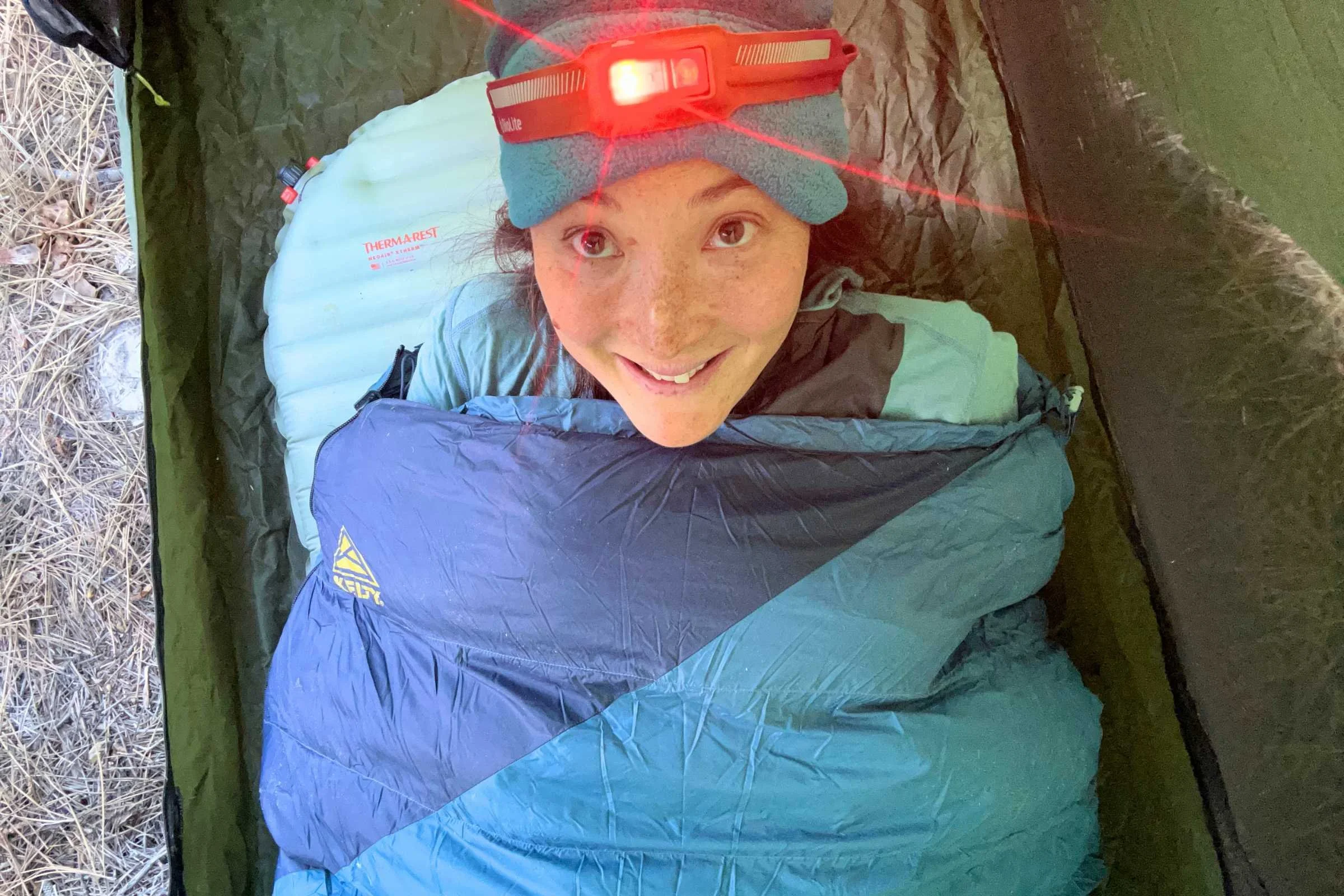
Very cozy (without feeling cramped) and comfortable inside, with 48" of peak height and enough length for taller people
Steep sloped walls mean you don't wake up with your face right next to the sloping ceiling, even if you have a taller sleeping pad
Sturdy geometry means it has impressive wind resistance
Doesn't require stakes for setup so can be used in sand, extremely rocky areas, or above treeline
Freestanding ultralight tent doesn't require trekking poles, so works well for bikepackers, bikepackers, or anyone who doesn't carry hiking poles
Easier set up than many ultralight tents
Truly freestanding, not semi-freestanding like most so-called freestanding ultralight tents
Waterproof sil-poly fabric can withstand sustained rain and has less stretch and moisture retention than sil-nylon fabric
What could be better
It's heavier than most other ultralight tents, which is true for almost all freestanding tents
It's more expensive than many other ultralight tents, especially ones that weigh this much. This is also true for most freestanding ultralight tents.
It isn't as easy to set up as it should be due to the use of tent sleeves vs. clips to secure the poles
Comes in a non-traditional long stuff sack that holds poles and stakes, as it doesn't secure stakes well
How we tested
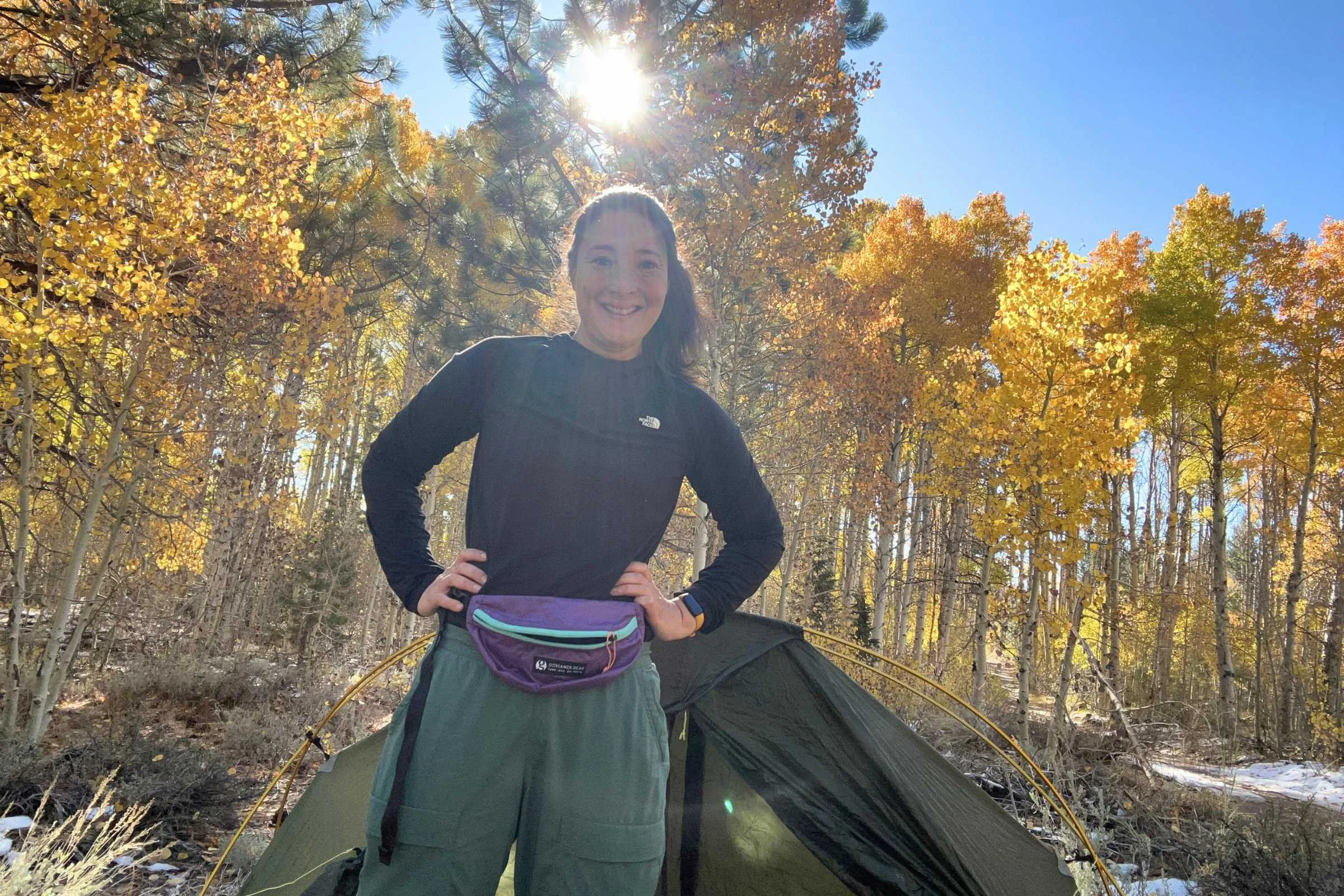
We tested the Lunar Orbiter for nearly two years of backpacking and camping.
First, we tested it over four days and three nights in pouring rain and high winds in the Columbia River Gorge. Then we tested it for a week-long backpacking trip in Idaho.
The bulk of our testing was in the Eastern Sierra. We tested it in spring, summer, and fall in the Eastern Sierra, totaling over 30 nights out in high winds, rain, and snow.
We've also tested the Lunar Orbiter backpacking in the San Gabriel mountains near the Pacific Crest Trail in southern California as well as in extremely high winds in Anza Borrego Desert State Park in winter.
We tested the Orbiter with a 3.5" thick Nemo Tensor sleeping pad. We also tested with the 4" thick Sea to Summit Ether Light Xt sleeping pad.
We also tested the Lunar Orbiter side-by-side with similar tents, including the Six Moon Designs Skyscape Trekker, NEMO Hornet Elite OSMO, and Big Agnes Copper Spur, and Big Agnes Tiger Wall tents as part of our guides on Best Backpacking Tents and Best Ultralight Tents.
Performance in the field
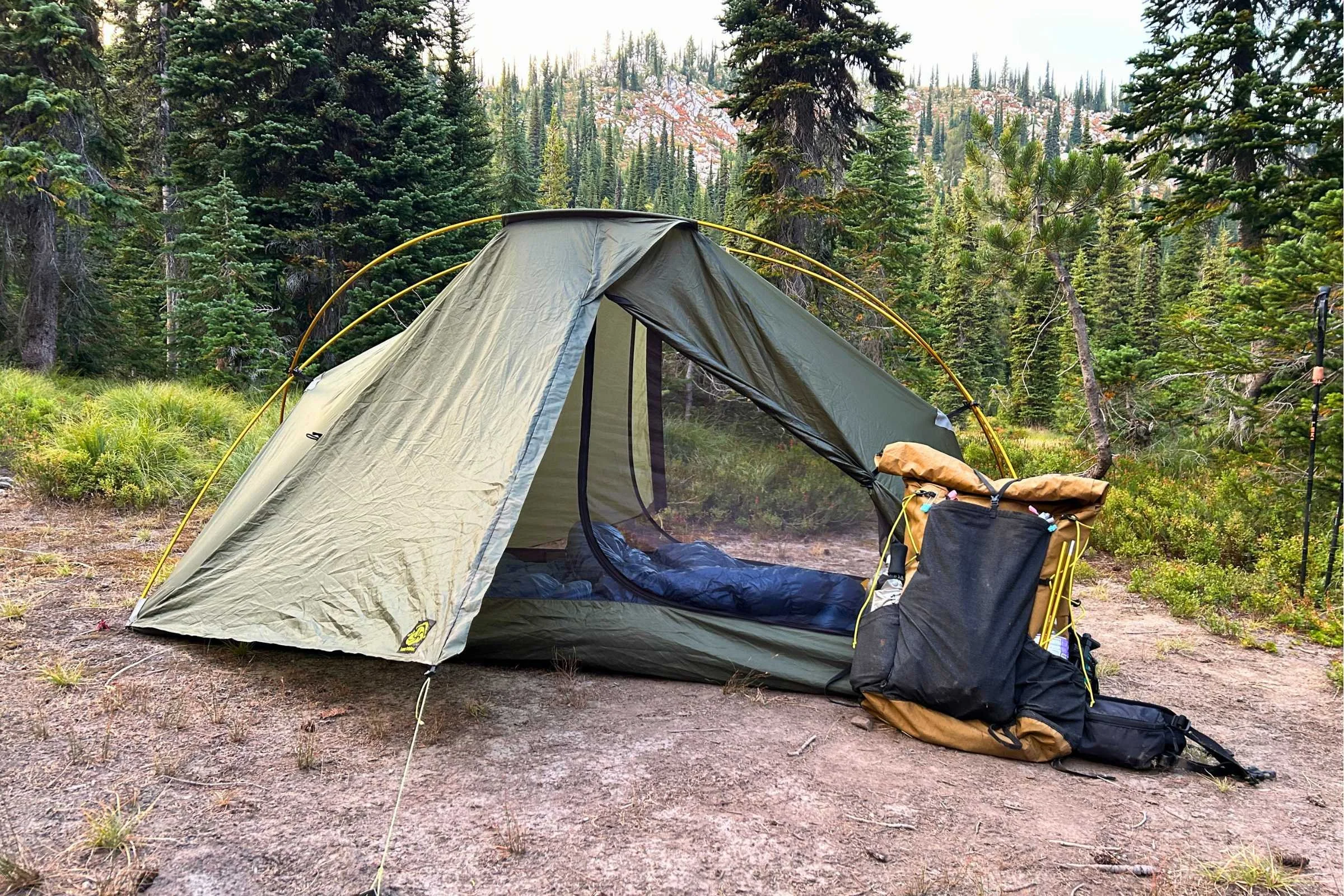
Testing the Lunar Orbiter on the Idaho Wilderness Trail.
Setup and usability
Unlike most ultralight tents, the Lunar Orbiter is quite easy to set up and requires little knowledge of tent geometry. The steps are: Open the poles, slip them into the tent sleeves, and cross them on both sides. Then insert the pole tips into the grommets. You can optionally stake out the corners and the vestibules.
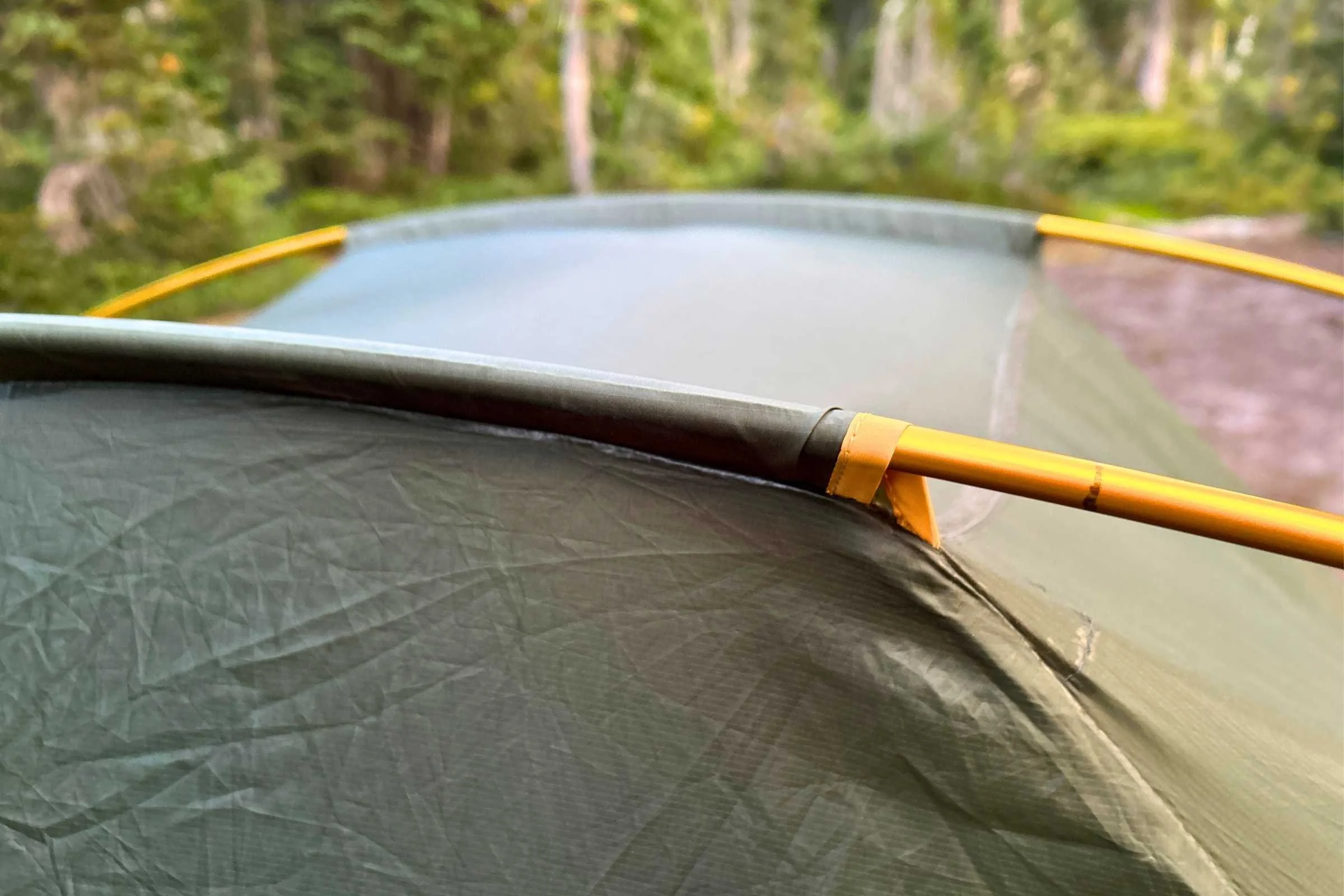
Two included poles keep the roof rigid on the Six Moon Designs Lunar Orbiter.
Since it is freestanding, it is very convenient to set up on windy nights, sandy soil that won't hold a stake, or above treeline where there are too many rocks to get a stake in. We wish the poles clipped in instead of requiring us to find the sewn-in tent sleeves. Finding the sleeves can be difficult in the dark, especially when it is windy and the tent is blowing around.
Interior space and livability
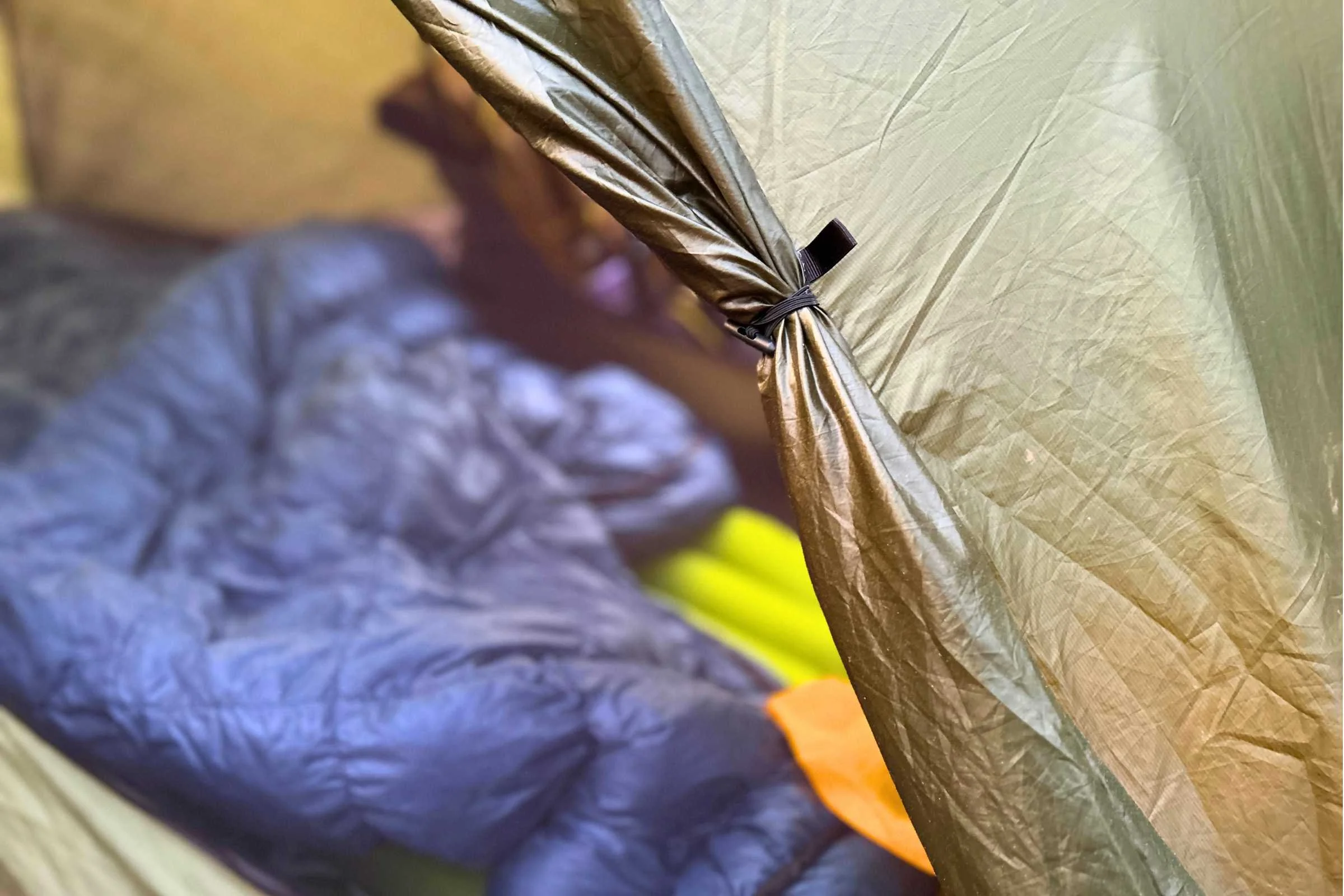
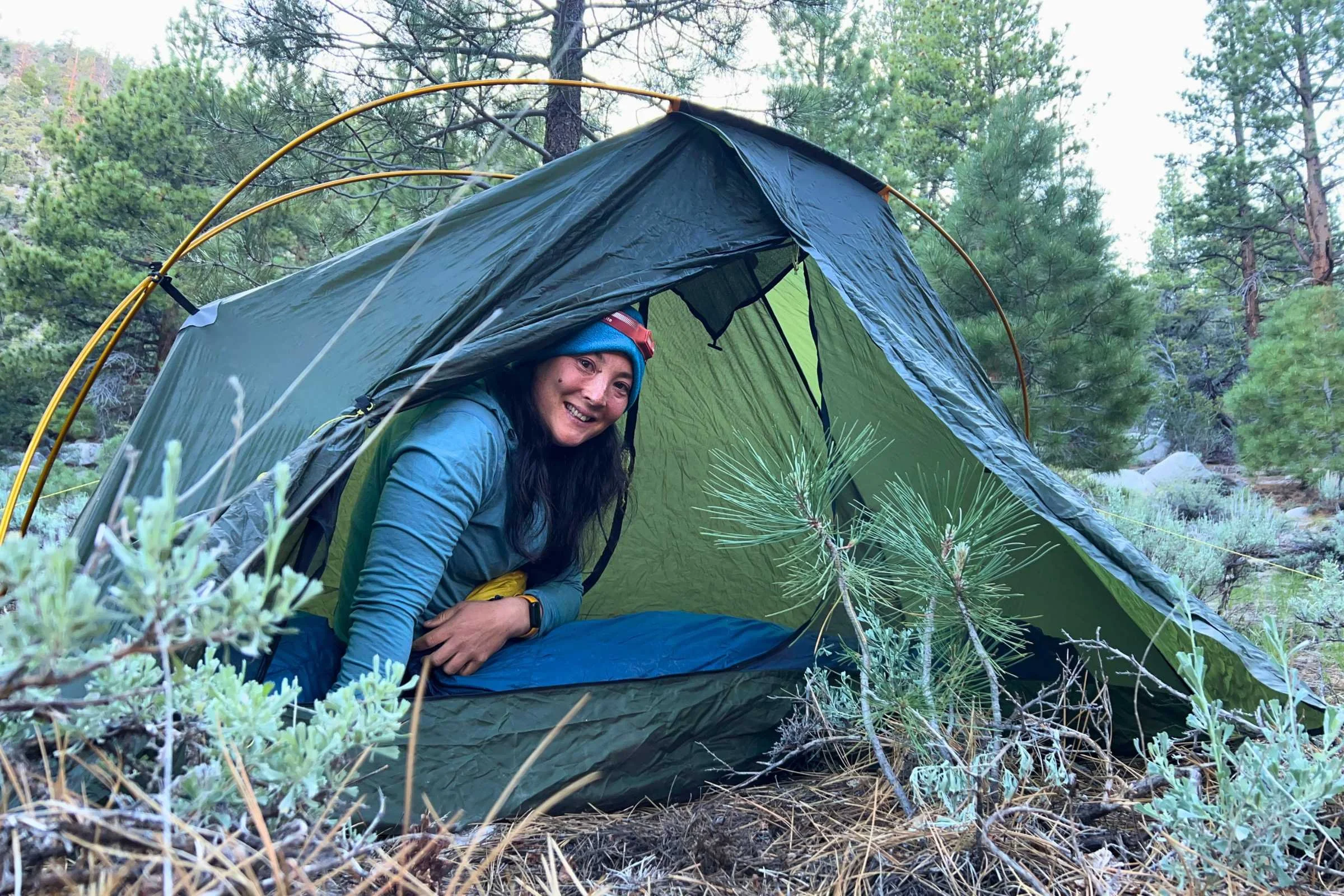
The Lunar Orbiter has a lot of liveable space, especially head room.
The interior room on the Lunar Orbiter is comfy and cozy. It has generous headroom for sitting up and lots of length. Steep walls mean that, unlike many ultralight tents, you don't wake up to find the ceiling of the sloped-wall tent is 3" from your nose. This is true even if you have a 4" tall inflatable sleeping pad.
We LOVED that there is 8 square feet of vestibule space on both sides. This means you can keep your stuff dry without sacrificing your sleeping pad space to make room for your gear or worry about your wet gear getting your sleeping bag wet too.
There are doors on both sides. It's a bit overkill. But I can't even count the number of times I've set up a single-entry tent with the door facing a cliff or someone else's guylines and realize I have to break it all down and reorient it for access. The dual-door Lunar Orbiter eliminates that inconvenience.
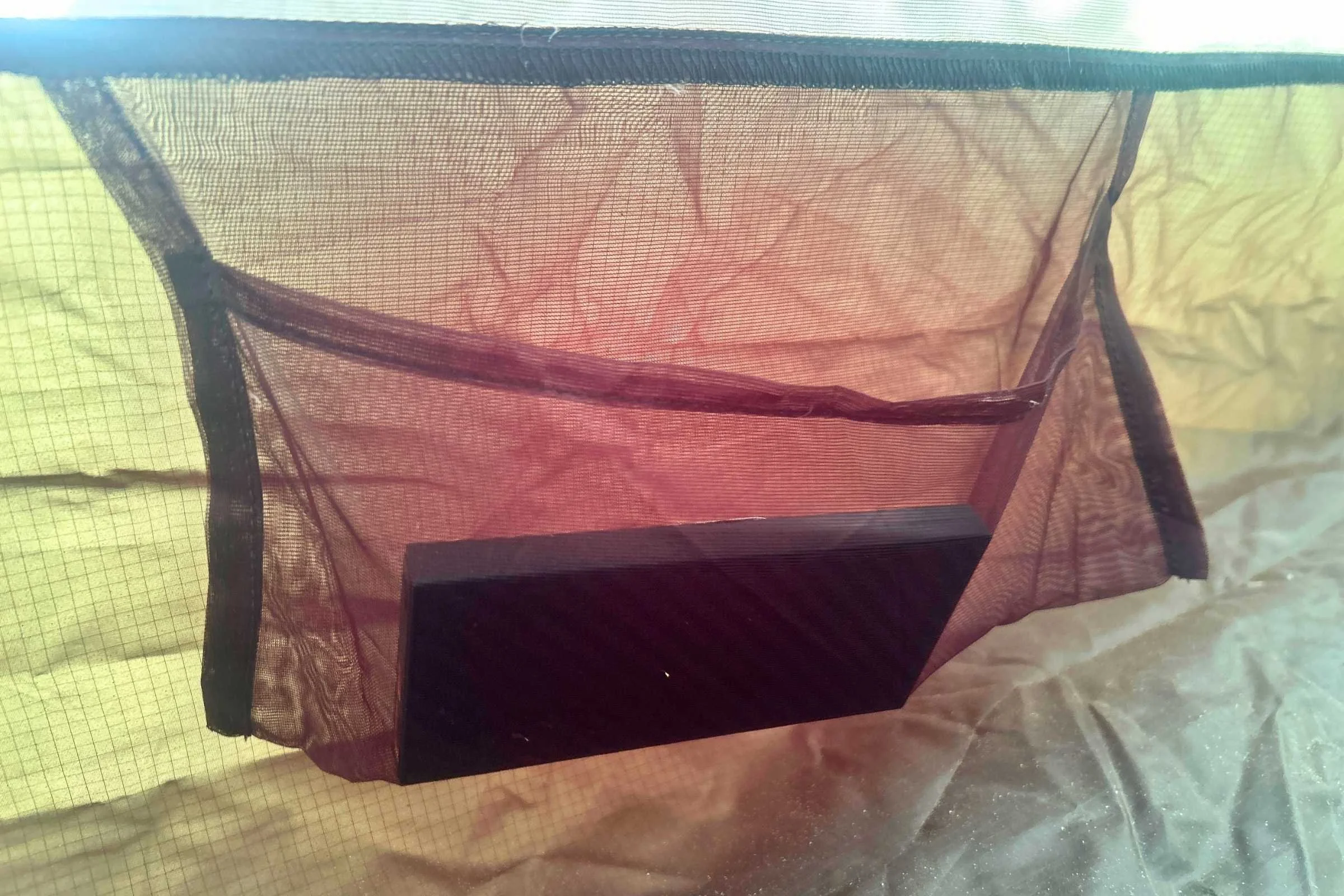
We also like that there are pockets and a gear storage rack.
Weather resistance
The Lunar Orbiter impressed us with its wind stability. We set up in windy conditions in the Eastern Sierra that sent tents twice their size blowing 100 yards across the forest. The Lunar Orbiter stayed put. We also set it up and slept in the Lunar Orbiter during high winds in Anza Borrego Desert State Park, a place notorious for wind gusts. Our friend who slept in his car complained that it rocked all night in the wind. While the Lunar Orbiter would have blown away had we not been inside, the poles didn't break or buckle.
The Lunar Orbiter is made of SMD's silicone-coated polyester, considered among the best in class for ultralight tent fabric that isn't Dyneema Composite Fabric (DCF). It performed well in rain, all-day mist, and light snow (we didn't test in heavy snow). Six Moon Designs reports a hydrostatic head rating of 3,000 mm/24 hour. In contrast, the NEMO Hornet Elite OSMO ultralight tent, a semi-freestanding tent we consider to be in the same class, only has a hydrostatic head rating of 1,200 mm/24 hour.
Silpoly fabric is among the most waterproof of tent fabrics, especially compared to the more common silnylon found in most ultralight tents. It also has less moisture retention, meaning it won't absorb as much water and will dry out faster. Silpoly also has less stretch than silnylon, meaning you won't have to readjust your tent stakes throughout the night to keep your pitch taut.
Durability and construction quality
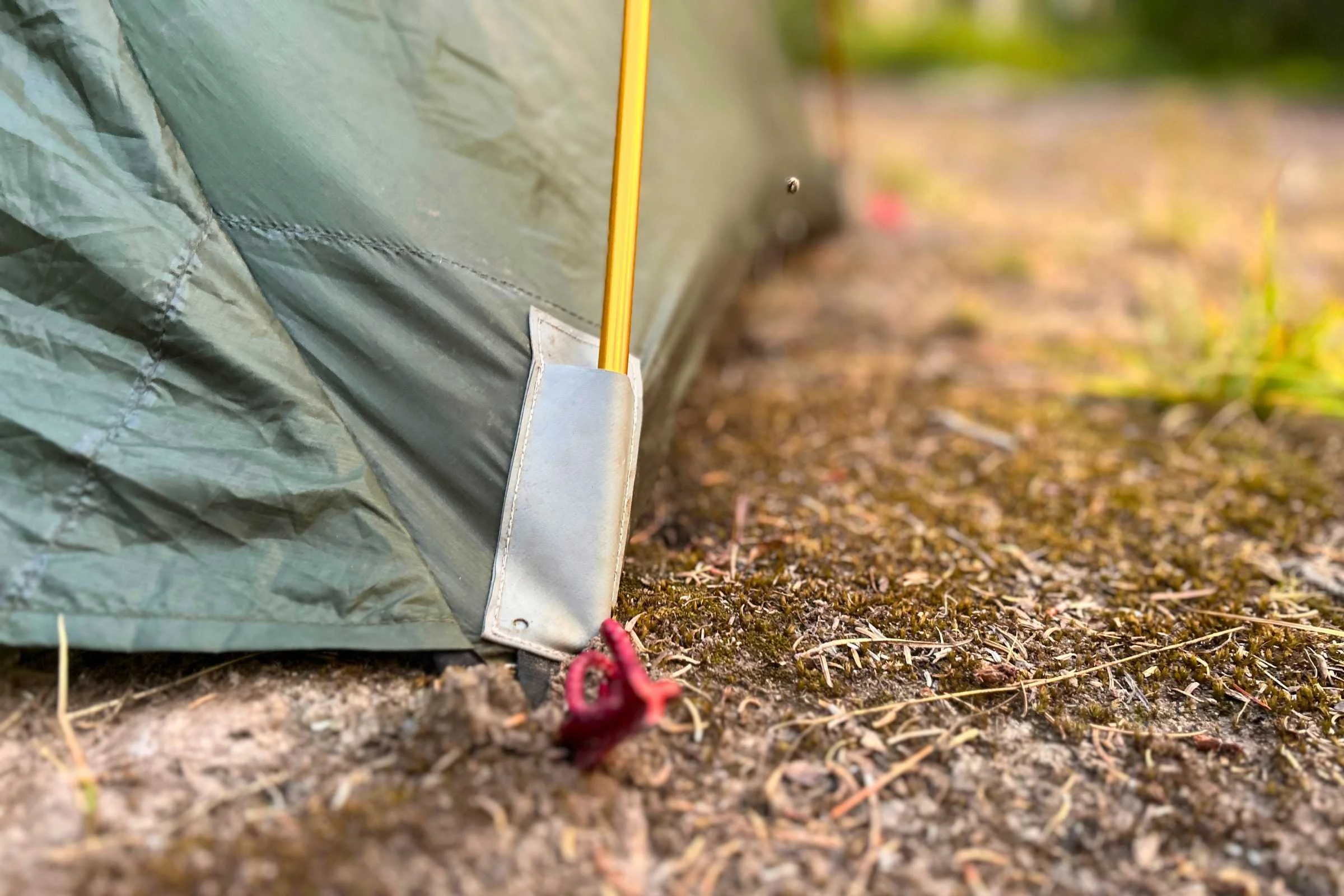
We loved the reinforced pockets that hold the tent poles in place on the SMD Orbiter.
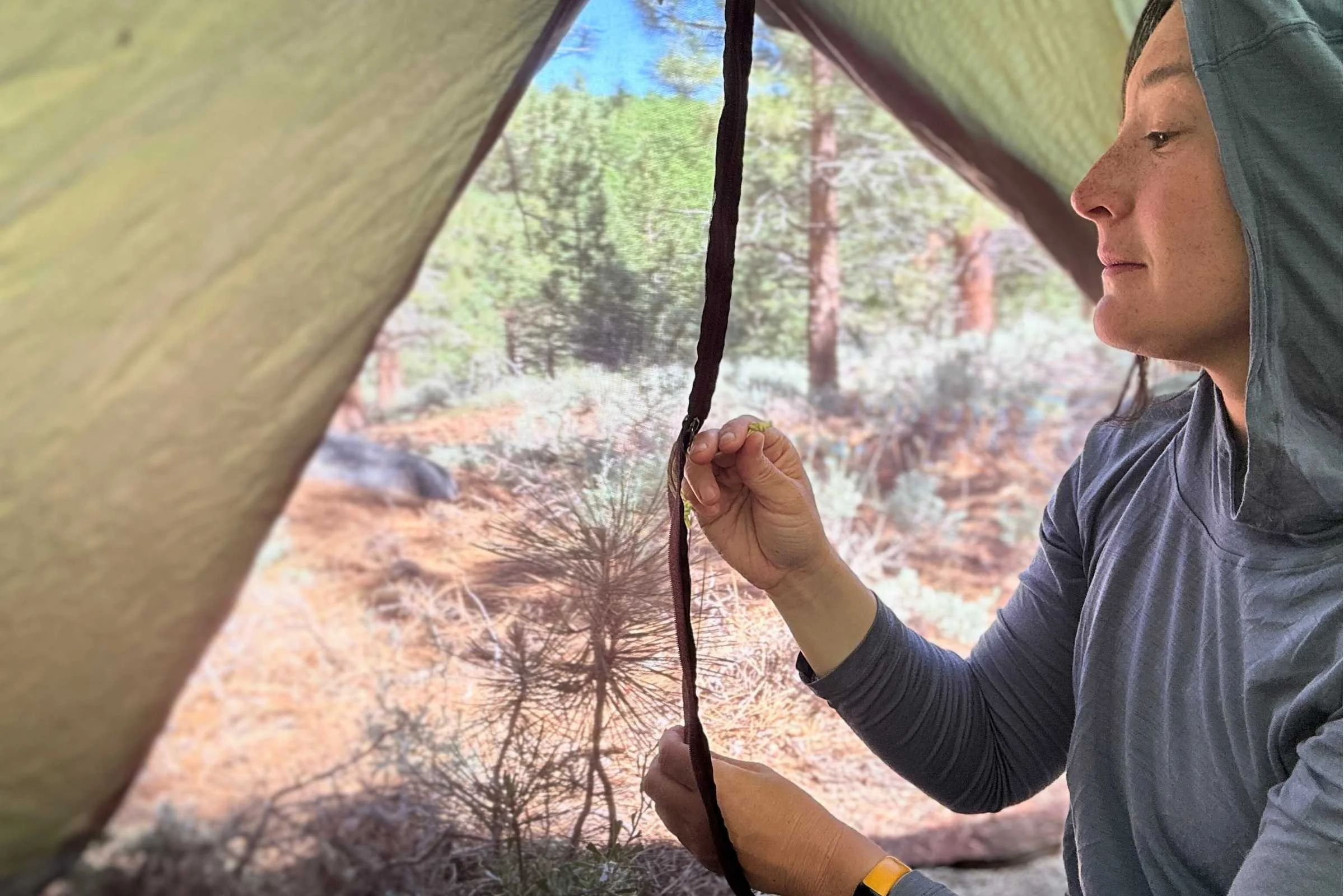
The Lunar Orbiter is made of silicone-coated polyester. The grommets are reinforced. SMD uses extra large zippers on the mesh door to avoid the zipper getting caught in the mesh. The bottom is a 40D Silpoly and we found we could get away without a groundsheet. The rainfly is a 20D Silpoly. I had no durability issues, even when setting up camp in some bushy areas in Idaho and in the spiky-plant filled Anza Borrego desert.
Weight and packability
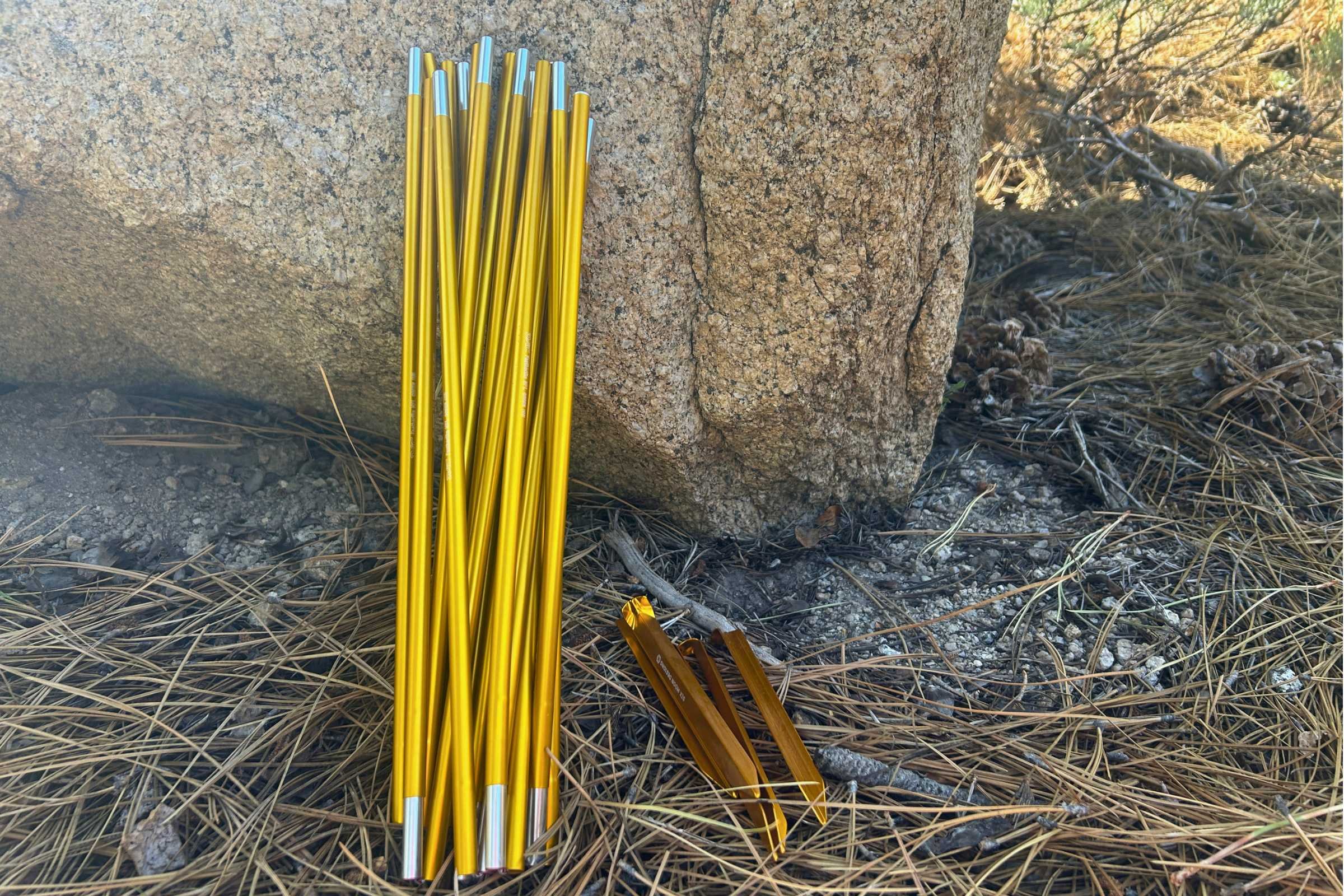
The SMD Lunar Orbiter is fairly packable and comes with its own stuff sack and a separate stuff sack for the poles that fits in the outside mesh of most backpacking backpacks.
It's heavier than most ultralight tents. It's 2 lbs 12 oz, but that weight includes poles, whereas most ultralight tents don't count the weight of your trekking poles with the tent weight.
As far as packability goes, our biggest complaint is with the stuff sack. SMD got creative with this tent bag. It is long and holds tent poles and tent stakes. It seems like nearly every time we set up this tent, a stake falls out of this system. We prefer a separate, small, dedicated stake bag that is more secure.
Condensation
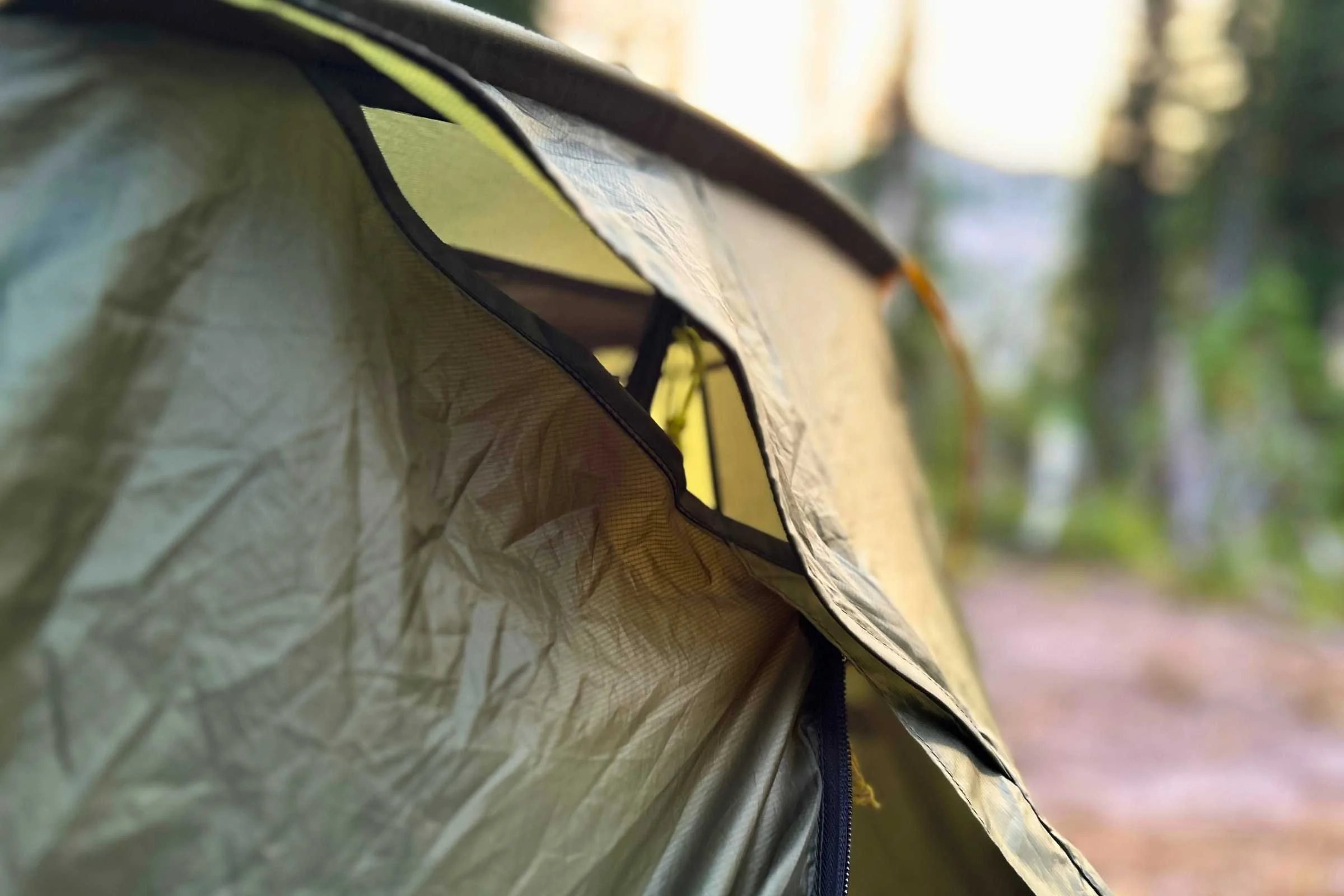
Close-up on one of the vents on the Lunar Orbiter tent.
Because the Lunar Orbiter is a hybrid double wall tent, we didn't notice much, if any, condensation on the inner tent. This is awesome for sleeping in because it meant my head wouldn't rub against a wet ceiling like most ultralight or single wall tents.
Features
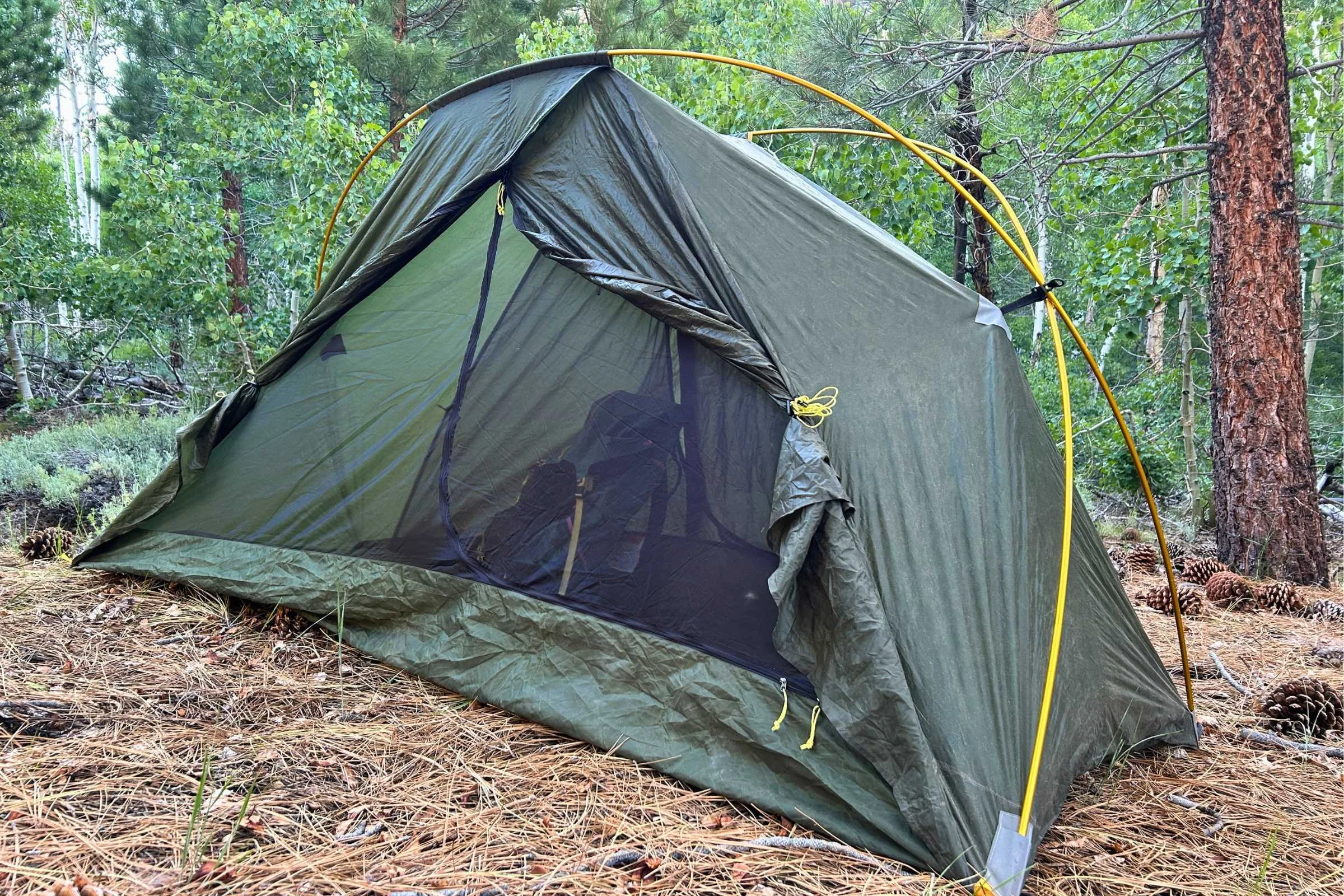
Freestanding geometry: Among the first instances of truly freestanding geometry in a tent made by an ultralight, cottage brand.
Dual doors: You can enter and exit from either direction, which means you don't have to pay attention to which side is the front or back when setting up.
Dual vestibules: The true gem of this tent. There is nearly as much vestibule room as there is sleeping room. You have covered storage in each vestibule so your pack doesn't end up taking all the sleeping room in your tent. You can keep one side for dry entry and one side for gear storage if you are pretty good at planning.
Unique pole architecture: The crossed poles proved quite wind resistant in a variety of camping conditions.
Spacious 90" x 34" sleeping area: Cozy and keeps you separate from your gear.
48" peak height: Plenty of room to sit up and do camp chores.
Compact packed size (~15.5"): Can fit on the outside of a pack easily.
Optimized interior layout: Inner space is quite usable.
20D silicone-coated polyester canopy: An excellent balance of lightweight and durability.
40D silicone-coated polyester bathtub floor: Pretty thick, so we found we could go without a groundsheet. Your experience may be different.
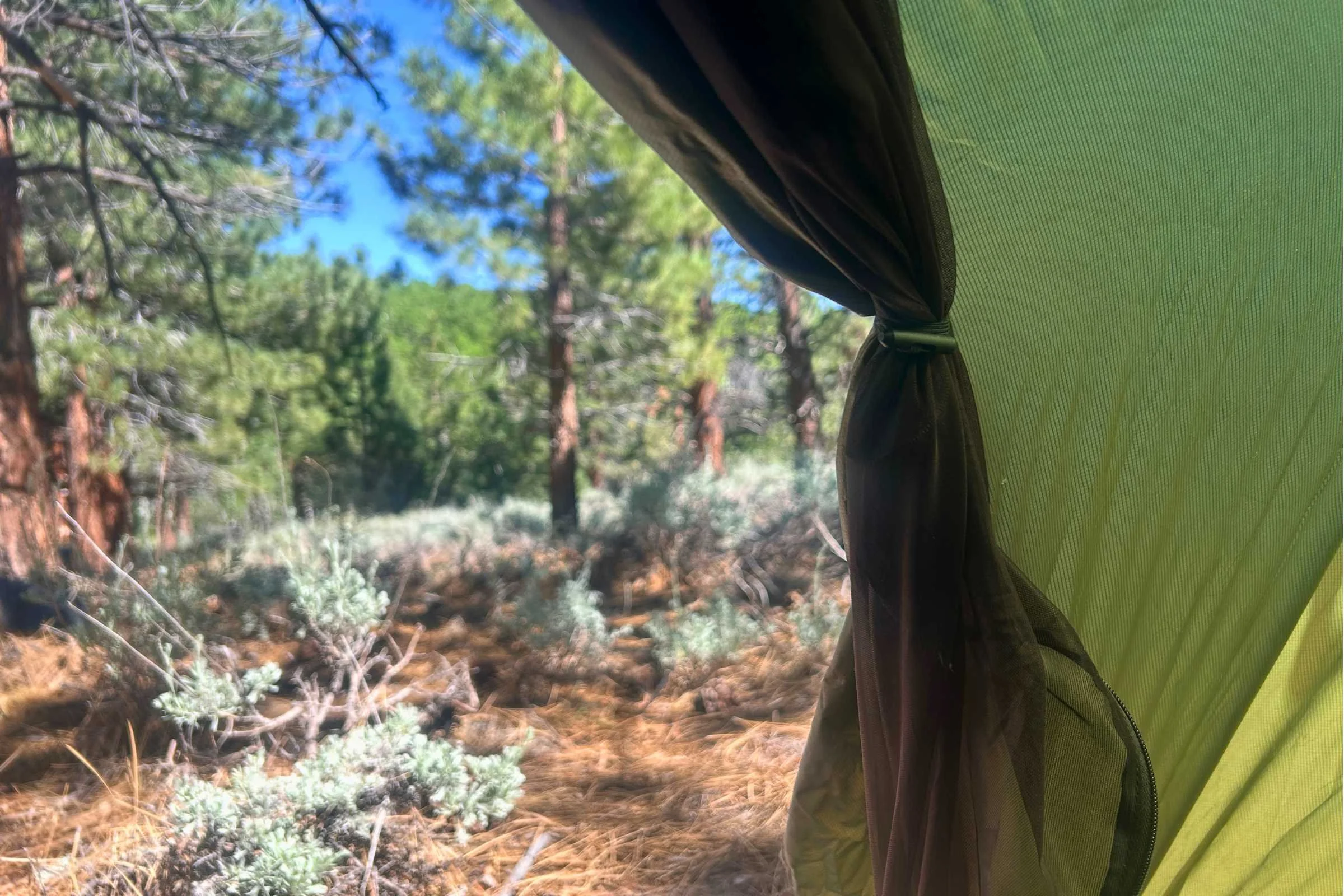
20D No-See-Um mesh: Keeps out mosquitoes and gnats.
Seams: You can seam seal yourself or opt for the seam sealing service
DAC aluminum poles: DAC is considered pretty top of the line for performance and light weight. These poles got expensive with tariffs due to the metal, so likely the cause of the price of this tent.
Steep wall design: This means you get the most usable space out of your footprint.
Cross-ventilation system: Unlike many solo tents, you can open up the doors on both sides to maximize ventilation and reduce condensation.
Color-coded poles and clips: Like many tents these days, it uses color-coded poles and clips which makes setup easier.
Multiple guy-out points: For extra tautness and to prevent the whole tent from blowing away, you can guy out the sides.
Removable gear loft: We used it to store an inflatable lantern, sunglasses, and other items we wanted easy access to but didn't want to accidentally roll over onto at night.
Interior mesh pockets: Handy for a headlamp, Garmin inReach, or lip balm.
Hybrid design: It's not a single-walled or double-walled tent; it's a hybrid of the two. The sides have 2 walls (rain protection and bug netting), and the ceiling is single-walled. It doesn't have a separate rain fly.
Six Moon Designs Lunar Orbiter vs. similar tents
The Lunar Orbiter is only available as a solo tent, and there aren't that many solo freestanding tents. The NEMO Hornet Elite OSMO has a solo version and is semi-freestanding. They both come with poles, but the attachment systems are quite different. Both are pretty expensive and slightly heavier than other ultralight tents.
As mentioned above, the Lunar Orbiter is heavier and more expensive than most ultralight tents, but that is because it comes with poles. The price of your trekking poles isn't included in the cost of your trekking pole tent. The weight of your trekking poles also isn't included in the weight of a trekking pole tent.
It's got more livable space than many ultralight tents, and the vestibule space is one of the best we've tested. With a peak height of 48", it'samong the better ultralight tents for taller people.
The Lunar Orbiter is a good option if you know you want a freestanding tent, especially if you are tall.
Why choose a freestanding tent?
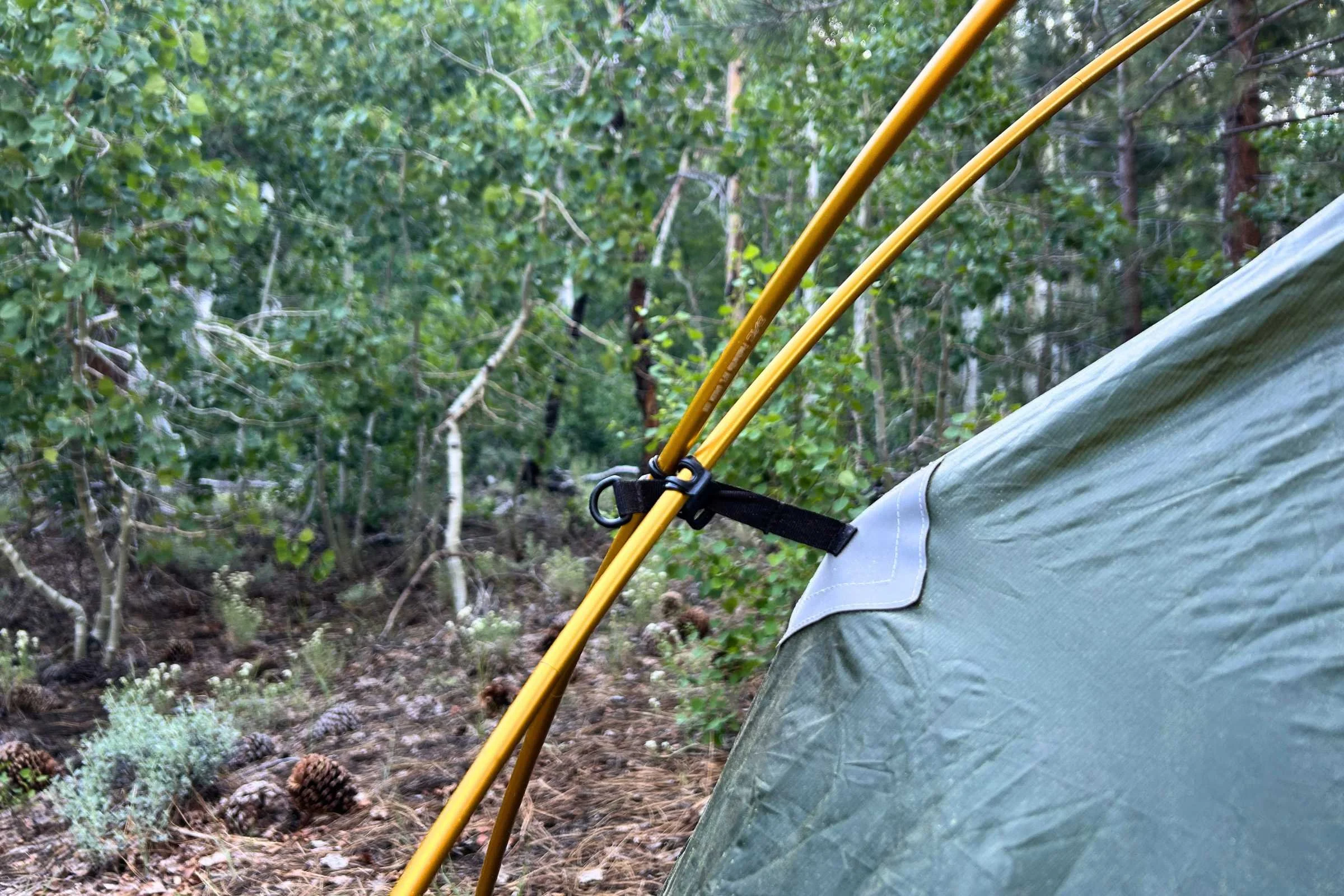
Freestanding tents like the SMD Lunar Solo are held together by the tension of the cross of the poles and the poles in the sleeve.
A freestanding tent uses poles to create its structure, so it can stand up without stakes (except, usually, the vestibules). Trekking-pole tents, like the Six Moon Designs Lunar Solo or Zpacks Duplex, rely on stakes, trekking poles, and sometimes guy lines to hold their shape.
Both freestanding and trekking pole tents have their use cases. So why choose a freestanding tent over a trekking pole tent?
Freestanding tents are usually easier to set up and therefore, they're more forgiving for beginners and tired hikers. Trekking-pole tents and tarps require you to learn some tent geometry, such as getting the pole height right, staking the corners under the right tension, and tightening guy lines until the pitch is taut and not distorted. A freestanding tent has fewer steps and fewer ways to get it wrong. At the end of a long day or when it's pouring down rain, that matters.
They work for people who don't hike with trekking poles, for basecamp backpacking, or for hikers who don't carry trekking poles. Bikepackers, packrafters, canoe campers, and anyone setting up a basecamp for day hikes doesn't have trekking poles to spare. A freestanding tent brings its own structure.
Freestanding tents are easier to pitch in rocky or sandy terrain. Above treeline in the Sierra, I've spent 20 minutes scouting for a campsite where I could actually drive a stake between the rocks. On river trips, stakes pull right out of loose sand (we know someone whose entire tent blew away on a raft trip, including her sleeping bag inside). On granite slabs, they don't go in at all. A freestanding tent solves this — you can pitch it on a tent pad, a gravel pullout, a slab of rock, or sand, and it stands up fine. Stake out the vestibules if you can (use large rocks on top of the stakes if needed); if you can't, the tent still works.
Should I buy the Six Moon Designs Lunar Orbiter?
Buy if:
You want a lightweight tent that is also a freestanding tent
You're backpacking solo
You're a taller person
Backpack in rocky or sandy areas where a trekking pole tent is more difficult to set up.
If you don't carry trekking poles
If you're bikepacking
If you're packrafting
If you're a Skyscape Trekker or other SMD tent fan and want a freestanding SMD tent
Skip if:
You don't need a freestanding tent
You want a true ultralight tent
You're on a budget
You prefer tents made of DCF fabric
Where to buy
The Six Moon Designs Lunar Orbiter is only available at Six Moon Designs, directly from the manufacturer.
Similar products to consider
Six Moon Designs Lunar Orbiter vs. Mountain Hardwear Nimbus UL 1
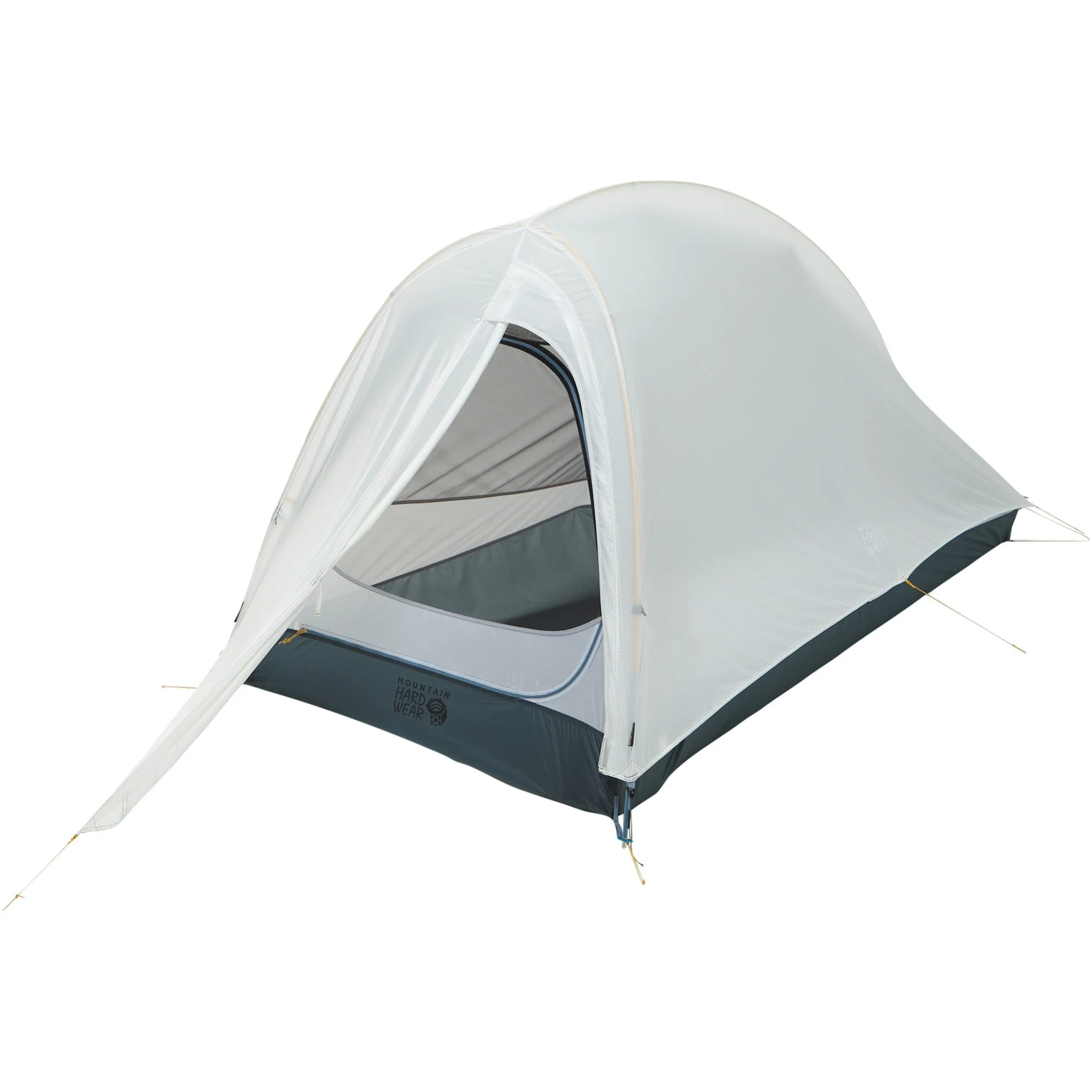
Price: $420
Packed Weight: 1 lb 11.2 oz
Length/Width: 86 / 38”
Floor Space: 19.7 ft²
Peak Height: 38”
Vestibule floor area: 3.9 ft²
Double/Single Walled: Double
Freestanding? Semi
Doors/Vestibules: 1 / 1
At $420, the Mountain Hardwear Nimbus UL 1 costs about the same as the Orbiter but weighs 13 ounces less. The tradeoff: it's semi-freestanding rather than truly freestanding, with a single head-end door instead of the Orbiter's dual doors and generous twin vestibules. It also has less interior space and a lower peak height. Read more in our full review of the Nimbus.
Mountain Hardwear Nimbus UL 1
Six Moon Designs Lunar Orbiter vs. Six Moon Designs Skyscape Trekker
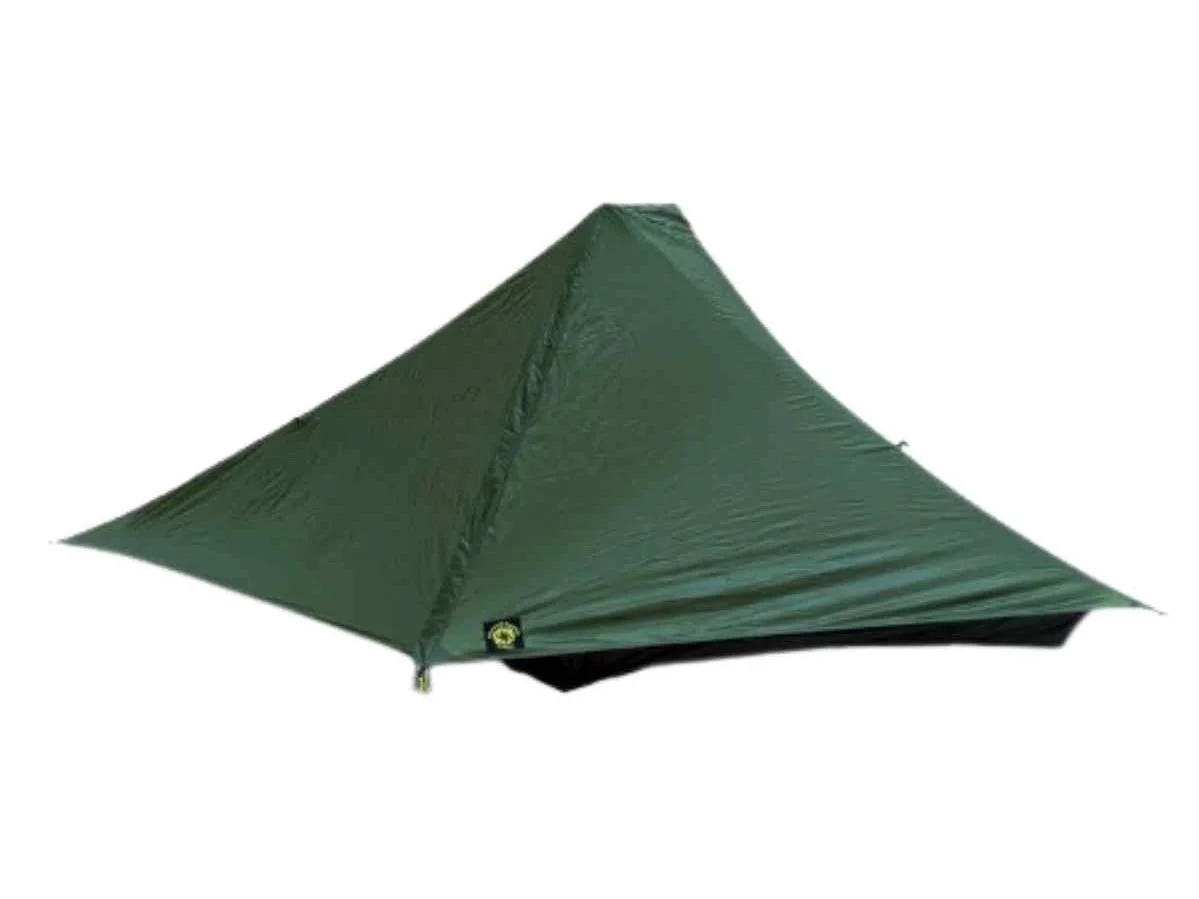
Price: $275
Packed Weight: 1 lb 12 oz
Length/Width: 103 / 48"
Floor Space: 23 ft²
Peak Height: 45”
Vestibule floor area: 16 ft²
Double/Single Walled: Hybrid
Freestanding? No
Doors/Vestibules: 2 / 2
The Lunar Orbiter is similar in design and feel to the Six Moon Designs Skyscape Trekker. Both have dual doors,dual vestibules and a hybrid tent design. Both are great for taller people and maximize the usable space with steep walls. The difference is the Skyscape Trekker sets up with two trekking poles and is not freestanding, whereas the Lunar Orbiter is freestanding.
This tent is our pick for best backpacking tent for tall people. Learn more in our in-depth review of the Six Moon Designs Skyscape Trekker.
Six Moon Designs Skyscape Trekker
Six Moon Designs Lunar Orbiter vs. NEMO Hornet Elite OSMO

Price: $600
Packed Weight: 1 lb 13 oz
Minimum Weight: 1 lb 7 oz
Length/Width: 87 / 40" (head) 32" (foot)
Floor Space: 21.8 ft²
Peak Height: 39”
Vestibule Floor Area: 6.9 ft²
Double/Single Walled: Double
Freestanding?: Semifreestanding
Doors/Vestibules: 1 / 1
The Lunar Orbiter has some similarities to the NEMO Hornet Elite OSMO. Both come with poles, though the NEMO is semi-freestanding, meaning one end of the tent needs to be staked out. Both tents require the vestibules to be staked out.
The NEMO uses all clips for its tent poles, which are secured with a hub at the top. The Lunar Orbiter uses tent sleeves, and you clip the poles into crosses. The NEMO has more mesh throughout the body, and can be set up without the rainfly. Ultimately, the NEMO isn't as great for taller people. The Hornet Elite OSMO comes in a two-person version, whereas the Lunar Orbiter is only a solo version.
The NEMO Hornet Elite OSMO is our pick for best lightweight backpacking tent, best ultralight semi-freestanding tent, and best ultralight bikepacking tent. Learn more in our in-depth review of the NEMO Hornet Elite OSMO.
NEMO Hornet Elite OSMO
Six Moon Designs Lunar Orbiter vs. Six Moon Designs Lunar Solo
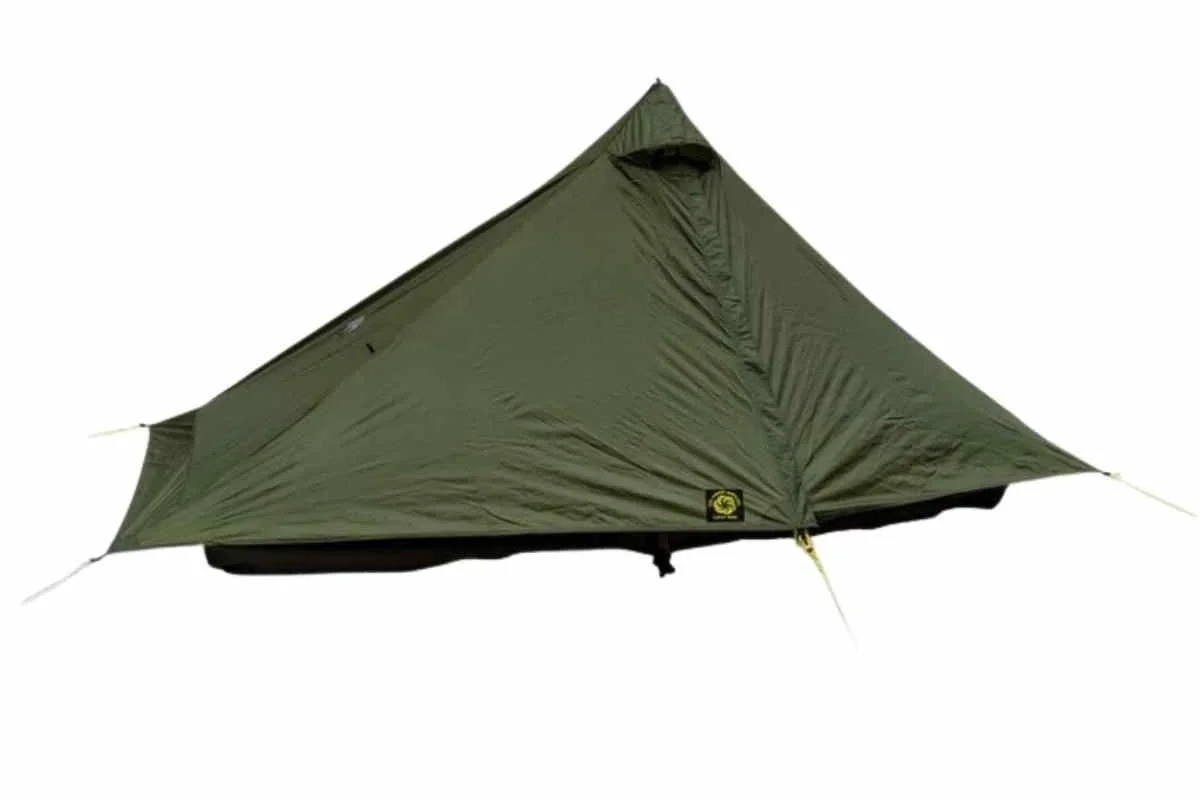
Packed Weight: 1 lb 10 oz
Length/Width: 90 / 48"
Floor Space: 26.3 ft²
Peak Height: 49”
Vestibule Floor Area: 8.5 ft²
Double/Single Walled: Single
Freestanding?: No
Doors/Vestibules: 1 / 1
The Six Moon Designs Lunar Solo uses the same fabric as the Lunar Orbiter and is also a one-person tent. However, the Lunar Solo sets up with trekking poles and is not freestanding. The Lunar Solo has only one vestibule.
The Lunar Solo is arguably the best bang-for-the-buck you can get on an ultralight tent and is a winner in our Best Ultralight Tents, Best Backpacking Tents, and Best Bikepacking Tents guides. It's arguably a better choice for bikepackers because you can set it up with optional 11" carbon fiber poles that fit along your handlebars. However, because it is not freestanding and only uses one pole, it isn't quite as wind resistant or as roomy as the Lunar Orbiter.
Learn more in our in-depth review of the Six Moon Designs Lunar Solo tent.
Six Moon Designs Lunar Solo
Six Moon Designs Lunar Orbiter vs. MSR Hubba Hubba LT 1

Packed Weight: 2 lbs 11 oz
Length/Width: 88 / 32"
Floor Space: 20 ft²
Vestibule Floor Space: 8 ft²
Peak Height: 39”
Double/Single Walled: Double
Freestanding? Yes
Doors/Vestibules: 1 / 1
The MSR Hubba Hubba LT 1 is an ounce less than the Lunar Orbiter and a true double-walled tent, but with some sacrifices:
The Hubba Hubba is both shorter in length and width
The Hubba Hubba only has one vestibule and one door, while the Lunar Orbiter has two of each
The Hubba Hubba's peak height is only 39" compared with the Lunar Orbiter's 48"
The shorter peak height is noticeable, even if you're not particularly tall.
On the other hand, the Hubba Hubba LT is a true double-walled tent, and can be set up without the rain fly for maximum night sky watching and ventilation. For more information, read our review of the MSR Hubba Hubba LT.
MSR Hubba Hubba LT 2
Six Moon Designs Lunar Orbiter vs. Big Agnes Copper Spur UL1

Packed Weight: 2 lbs 6 oz
Length/Width: 88 / 38" head/ 28" foot
Floor Space: 20 ft²
Vestibule Floor Space: 9 ft²
Peak Height: 38”
Double/Single Walled: Double
Freestanding? Yes
Doors/Vestibules: 1 / 1
The Big Agnes Copper Spur UL1 is six ounces less than the Lunar Orbiter and a true double-walled tent, but falls short in some categories:
The Copper Spur is both shorter in length and width
The Copper Spur interior is tapered, such that there is less width at your feet than at your head
The Copper Spur only has one door and one vestibule, while the Lunar Orbiter has two of each
The Copper Spur's peak height is only 38" compared with the Lunar Orbiter's 48"
On the other hand, the Copper Spur uses pole clips rather than sleeves to secure the poles, making setup much easier, especially when your hands are cold or the tent is wet. It's also a true double-walled tent, and can be set up without the rainfly. You can read more in our in-depth review of the Big Agnes Copper Spur Hyperbead backpacking tent.
Big Agnes Copper Spur UL2
Why you should trust us / about the author
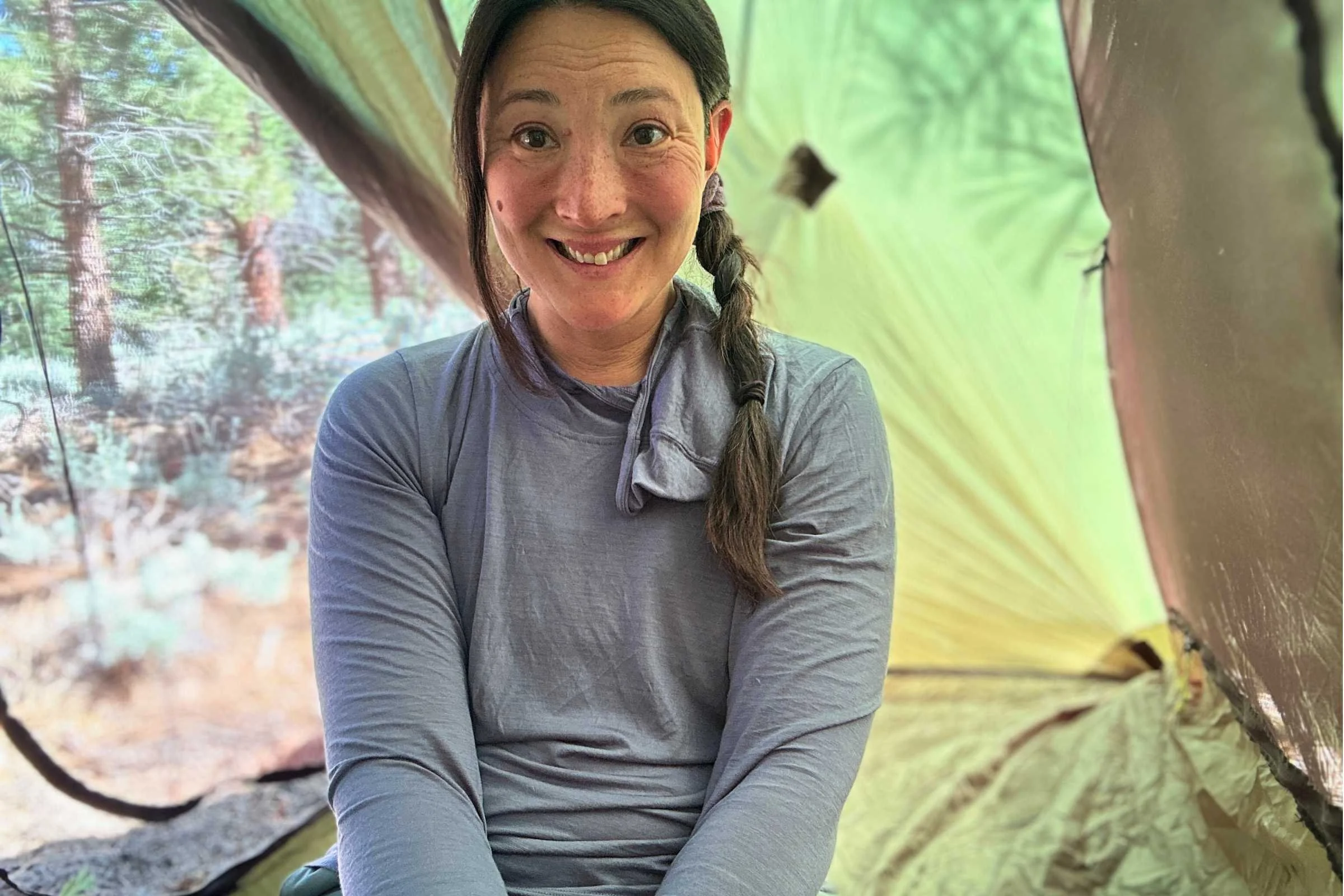
Liz Thomas tested the Lunar Orbiter in three seasons in California, Oregon, and Idaho.
Liz Thomas is an award-winning Los Angeles-based writer and Editor-in-Chief of Treeline Review. A former Fastest Known Time (FKT) record holder on the Appalachian Trail, Liz came to Treeline Review from New York Times/Wirecutter, the New York Times’ product review site, where she was a staff writer on the outdoor team.
Liz has talked gear on Good Morning America (TV), in The Wall Street Journal, The Guardian, Buzzfeed, Men’s Journal, Women’s Health, Gizmodo, and Outside Magazine.
To test the Six Moon Designs Lunar Orbiter Tent, Treeline writers backpacked on the Idaho Wilderness Trail. We also camped for a month in total in the Sierra using the Lunar Orbiter and used it on hikes in the San Gabriel mountains and Anza Borrego Desert State Park in Southern California. We also used it through multiple days of extreme wind and rain storms in the Columbia River Gorge in Oregon.
You can read more about Liz at her wikipedia page here or on her website. See all her Treeline Review articles on her author page.