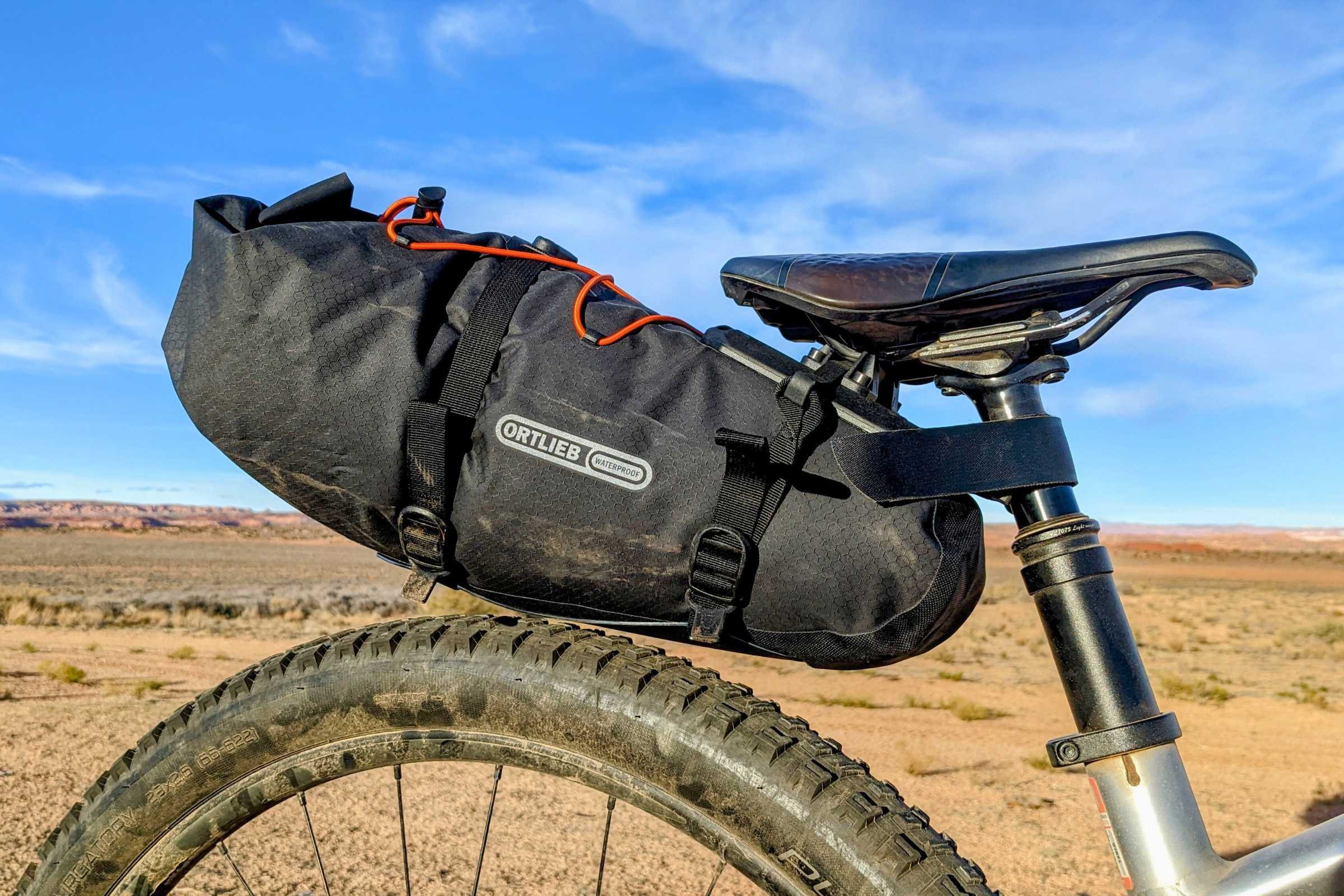
Best Bikepacking Tents of 2026
The Top Bikepacking-specific and Ultralight Backpacking Tents for Overnight Bike trips

Updated April 13th, 2026 to include material updates on the Big Agnes Tiger Wall and Copper Spur and the REI Air Flash 2, details on research and testing
After a long day in the saddle, a tent that pitches fast, keeps the weather out, and gives you somewhere to hang wet gloves and dry your kit is worth more than its weight suggests. Bikepacking shelters sit at a specific intersection of lightweight and packable that regular backpacking tents don't always hit, and the stuff sack dimensions matter as much as the packed weight when you're fitting gear around a handlebar bag or into a frame bag.
I'm a bikepacker and guidebook writer who has spent four years testing bikepacking tents on Colorado routes, both on group rides and solo, comparing models side-by-side with riders of different experience levels. For this guide, I aggregated results from dozens of professional reviews and hundreds of customer opinions, then put the most promising models to the field test. The bikepacking-specific shelter market is still relatively small, dominated by a handful of brands, so we also tested ultralight backpacking tents that bikepackers have successfully adapted for use on the bike.
What separates a good bikepacking tent from a good backpacking tent mostly comes down to pole length and packability for fitting into handlebar or frame bags, plus features like integrated daisy chains on the rainfly and helmet loops for drying gear at camp. From there, the same factors matter: weather protection, interior space relative to weight, vestibule size for storing muddy shoes and wet kit, and how fast the tent pitches after a long ride when you just want to be horizontal.
Top Pick: The Big Agnes Tiger Wall UL Bikepack earns our Best Overall award. It stood out for its shorter pole segments designed specifically for handlebar and frame bag packing, integrated daisy chains and helmet loops on the rainfly for drying gear, oversized internal pockets for bikepacking kit, a fast pitch, and generous dimensions that fit two adults comfortably, plus a new HyperBead fabric that is incredibly waterproof.
This story may contain affiliate links, which help fund our website. When you click on the links to purchase gear, we may get a commission. This allows us to create reader-supported, objective gear reviews, independently selected by our editors— without costing you an extra cent. Thank you for supporting our work and mission of outdoor coverage for every body! Learn more.
Comparison Table
| BIKEPACKING TENT | TREELINE AWARD | SIZE OPTIONS | PACKED WEIGHT* | PACKED SIZE | FLOOR AREA (SF) | HEAD HEIGHT | VESTIBULE AREA (SQ FT) | SEASONS | NUMBER OF DOORS | POLE LENGTH (folded) | PRICE* |
|---|---|---|---|---|---|---|---|---|---|---|---|
| Big Agnes Tiger Wall Bikepack | Best Overall Read why |
1, 2, or 3 people | 2 lb 15 oz | 13" x 6.5" | 28.0 | 39" | 16.0 (8 .0 each) | 3 | 2 | 12" | $550 |
| Big Agnes Copper Spur UL 3 Bikepack | Best Upgrade Tent Read why |
1, 2, or 3 people | 3 lb 10 oz (3-person) | 16.5"x6" | 41 SF | 43" | 18.0 (9.0 each) | 3 | 2 | 12" | $700 (3-person) |
| NEMO Dragonfly OSMO Bikepack Tent | Best for Wet Weather Read why |
1 or 2 people | 2 lbs. 15 oz | 16" x 6.5" | 29.0 | 40" | 17.2 (8.6 each) | 3 | 2 | 14.5" | $600 |
| Six Moon Designs Lunar Solo Backpacking Tent | Best Solo Tent Read why |
1+ person | 1 lb 10 oz (1-person) | 11" x 4.5" | 26.3 | 49" | 8.5 | 3 | 1 | 11" | $260 |
| NEMO Hornet Elite OSMO Ultralight Tent | Best 2-Person Ultralight Tent Read why |
2 people | 2 lb 1 oz | 19" x 4" | 27.3 | 37" | 12.4 (6.2 each | 3 | 2 | 19" | $700 |
*We note any discounts we see on our Deals page, which is updated daily.
The Best Bikepacking Tents
The Best Bikepacking Tent: Big Agnes Tiger Wall UL Bikepack
Sizes available: 1-person, 2-person, 3-person
Packed weight: 2 lb 15 oz (2-person)
Packed size: 13"x6.5"
Floor area: 28 square feet
Head Height: 39"
Vestibule Area: 8 square feet (each)
Seasons: 3
Doors: 2
Pole length: 12”
Bikepack specific features: Stuff sack with daisy chain webbing, helmet and daisy chain loops to dry gear
What we like: bikepacking specific features like daisy chain webbing on rain fly, helmet loops, ability to dry gear, quick pitch, generous height, packability
What we didn’t like: price, can be hard to find at retailers
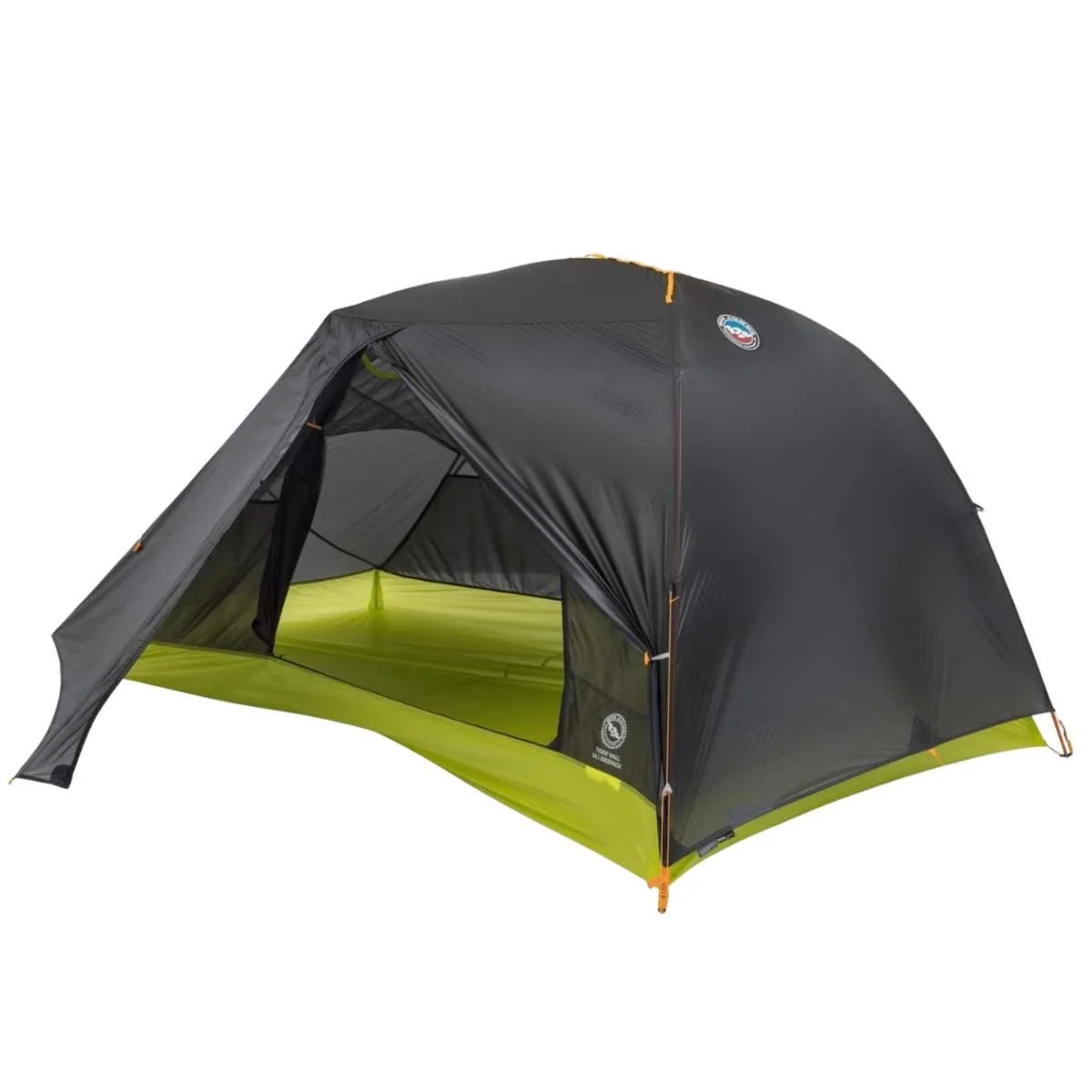
We found that the best bikepacking tent is the Big Agnes Tiger Wall UL Bikepack Solution Dye. Its bikepacking-specific features made it a favorite and a great adaptation of Big Agnes’ existing Tiger Wall line of tents, which are also great tents for bikepacking. We found a lot of value in the large vestibules and additional bikepacking-specific features, like integrated daisy chains on the rainfly, a helmet stash loop, and giant internal pockets to hold gear.
The Big Agnes Tiger Wall UL Bikepack Solution Dye was our favorite overall bikepacking tent. This 3-season tent is designed for road, gravel, and single-track rigors better than any other tents we tested. It’s a semi-freestanding tent with a minimum trail weight of 2 pounds and 7 ounces (for the two-person version).
It’s explicitly designed for bikepacking, pitches quickly and easily, and is capable of a fast fly setup with only the fly ground tarp. For more, read our review of the Big Agnes Tiger Wall bikepacking tent.
Big Agnes Tiger Wall UL2 Bikepack Tent


-
At 86” long and 52” wide at its widest point (42” wide at its narrowest point), the Tiger Wall 2-person version is long enough for all but the tallest adventurers to stretch out in, and it has a peak height of 39 inches, generous enough for someone over 6 feet tall to sit upright.
It’s big enough to sleep two adults comfortably, if not closely, and has two entry doors and vestibules. Still, it’s light enough and compact enough to justify one person carrying it for themselves if they love the extra space.
-
The Tiger Wall Bikepack tent offers a compelling set of bike packing-specific features that make it different from the backpacking version of this much-lauded tent. Features like a shorter pole also transition well to other self-propelled mobile adventures where packing space is at a premium — like multiday packrafting and kayaking trips. The packability of this tent sets it apart from the other tents we tested and evaluated for bikepacking.
The shorter tent pole segments make it much easier to pack on a bike’s handlebars or in the sometimes oddly-sized packs that fit into a bike’s frame (you can read more about choosing a bike frame bag in our How To Get into Bikepacking guide).
-
You’ll still find the Tiger Wall extremely packable, even if you aren’t using the 3-oz daisy chain-covered stuff sack to fit it between your handlebars, under your seat post, or even against your bike’s frame. Its moderate volume can fit in most frame bags, larger handlebar bags, or bikepacking-specific seat pack or saddle bags.
-
The external daisy chains on the rainfly are excellent stow points for sweaty gear, as are the helmet straps on the tent body. Its inner tent mesh pockets are bigger than the pockets on the regular Tiger Wall tents to accommodate additional bikepacking gear.
The 6-ounce tent footprint (sold separately but highly recommended) acts as an extra tarp under both vestibules, making it easier to remove shoes and clothes without getting dirtier. Essentially, it’s like having your own tiny mudroom.
Plus, using the ground cloth will ensure the ultralight tent’s floor lasts longer. In our backpacking tent review, one of the deciding factors in choosing Big Agnes’s Copper Spur Tent over the Tiger Wall was the more robust but slightly heavier ripstop fabric on the Copper Spur’s tent floor. Adding a groundsheet should provide the protection you’ll need.
-
This year, Big Agnes made their premium, limited editionHyperBead fabric technology available in their Bikepacking tent. Previously, it was only in the backpacking version of the tent and in some of their ultralight models, like the String VST 1.5 tent.
Hyperbead is their strongest and most durable fabric that is 6% lighter, 25% more waterproof, and 50% stronger than traditional tent fabrics. Additionally, it doesn't have added PFAS water-repellent chemicals. You can read more about Hyperbead fabric in our review of the Big Agnes Tiger Wall tent with Hyperbead.
-
It’s no wonder that some of the best bikepacking tents come from Big Agnes. Located in Steamboat Springs, it’s near thousands of miles of mountain bike trails, the Continental Divide Trail, and gravel roads that wind through some of the nation’s highest mountains and epic roads. The company’s owners and staff are avid outdoors folk and developed bikepacking tents based on their needs.
The result is three of its most popular ultralight backpacking tents have been adapted for bikepacking:
the Copper Spur (backpacking version | bikepacking version)
the Tiger Wall (backpacking version | bikepacking version)
the Fly Creek (backpacking version | bikepacking version)
All are excellent choices, but we find the Tiger Wall UL2 edged the others for bikepacking. The Tiger Wall UL2 Bikepack is 8 oz lighter than the Copper Spur HV UL2 Bikepack, yet it still has two doors.
The Fly Creek HV UL2 Bikepack is 5 oz lighter than the Tiger Wall. But it only has one door at the head and one small vestibule, making it a little harder to get in and out of than the Tiger Wall, particularly if you’re trying to get out of your sleeping bag without disturbing your snoring tent-mate.
-
All the extra features and the Tiger Wall’s environmentally friendly manufacturing make it a worthwhile investment. At $500 (and $70 more for the correctly-sized matching Big Agnes tent footprint), it is an investment, but it’s one we’d gladly make.
On a price and value basis, the Big Agnes Tiger Wall bikepack outcompetes every bikepacking tent we tested. It’s only downside is it is not a fully free-standing tent like the Copper Spur, Dragonfly, or Hubba Hubba bikepacking tents. But if you're fine with that, we think you'd be hard-pressed to find a better bikepacking tent.
See our most popular bikepacking guides in our Bikepacking gear section:
Best Upgrade Bikepacking Tent for Extra Space: Big Agnes Copper Spur HV UL3 Bikepack Tent

Sizes available: 1-person, 2-person, 3-person
Packed weight: 3 lb 8 oz (2-person), 3 lb 10 oz (3-person)
Packed size: 7"x 13.5" (2-person), 16.5"x6" (3-person)
Floor area: 29 SF (2-person), 41 SF (3-person)
Head Height: 40", 43" (3-person)
Vestibule Area: 18 SF (9 SF each)
Seasons: 3
Doors: 2
Pole length: 12” poles of 9 millimeters aluminum DAC Featherlite NSL
Bikepack-specific features: 12 in. Shortstik pole set for packing onto handlebars, panniers and saddlebags; compression stuff-sack with daisy-chain webbing system; mixed-denier fabric offers extra tear-strength and puncture-resistance without adding weight
What we liked: Shortstik pole length is convenient for saving space, very spacious, more durable, ripstop floor, durability, eco-friendly solution dye
What we didn’t like: durability comes with weight penalty
If you’re looking for plenty of room to spread out your gear and be comfortable, the Big Agnes Copper Spur HV UL2 Bikepacking Tent is the Best Upgrade bikepacking tent. At 90 inches long and 70 inches wide, you could pretty much sleep two 7-foot-tall people in this tent and still have space for a dog in it. We mentioned earlier that on most bikepacking trips, you’re likely to split a tent between two people but aren’t as likely to split one between three. The Copper Spur HV UL3 is your chance to sit up, spread out, and bikepack in luxury with minimal weight.
This was one of the first bikepacking specific tents available. That means that, unlike other bikepacking tent designs, the Copper Spur has had years to be perfected and develop the features that bikepackers want. Like our overall winner, the Tiger Wall Bikepack tent, the Copper Spur it has the same bikepacking-specific features—shortened pole segments, daisy chains for gear, generous mesh pockets in the interior.
While the Copper Spur HV is available as a 1-person and 2-person bikepacking tent, we think it excels in the 3-person version. As a luxury bikepacking tent, the 3-person version has a few more features we really like. With a 43” high roof, this freestanding tent is tall enough for most people to sit up without scraping the ceiling.
The Copper Spur’s vestibules can be set up as awnings for even more gear storage room in the external tent, such as keeping your bike out of the rain. It has extra durability vs other bikepacking tents. Best yet, it’s so spacious that this is one tent where you can really spread out and enjoy your time outdoors.
For more about similar tents, read our in-depth review of the Big Agnes Copper Spur UL2 bikepacking tent and our review of the Big Agnes Copper Spur backpacking tent.
Big Agnes Copper Spur HV UL3 Bikepacking Tent
-
The Copper Spur’s vestibules can be set up as awnings for even more gear storage room in the external tent. For the backpacking version of Copper Spur, our winner for The Best Two-Person Tent, you can use your trekking poles to set up the awning. When bikepacking, you’re usually not carrying trekking poles, so you’ve got to be more creative if you’re setting up the awnings. You might be able to use two bikes’ handlebars for one side, or you guy them to trees or rocks, or bring extra poles, like the Six Moon Designs’ carbon folding bikepacking poles used for the Lunar Solo (which we review below).
-
This year, Big Agnes made their premium, limited edition HyperBead™ fabric technology available in their Bikepacking tent. Previously, it was only in the backpacking version of the tent and in some of their ultralight models, like the String VST 1.5 tent.
Hyperbead is their strongest and most durable fabric that is 6% lighter, 25% more waterproof, and 50% stronger than traditional tent fabrics. Additionally, it doesn't have added PFAS water repellent chemicals. You can read more about Hyperbead fabric in our review of the Big Agnes Copper Spur tent with Hyperbead.
-
Weight
Of course, all this comes with a weight penalty--kinda. The Copper Spur HV UL2 Bikepack has a trail weight of 2 pounds 15 ounces. Not the lightest, by any means, but that still translates to under 2 pounds per person.
Best bikepacking tent for Wet weather: NEMO Dragonfly Bikepack OSMO Tent
Sizes available: 1, 2 (tested)
Packed weight: 2 lbs. 15 oz
Packed size: 16" x 6.5"
Floor area: 29 SF
Head Height: 40"
Vestibule Area: 10 SF X 2
Seasons: 3
Doors: 2
Pole length: 14.5”
Bikepack-specific features: bikepack specific stuff sack, short pole length, daisy chains for drying gear on tent body, Landing Zone gear tub, giant tent pockets
What we liked: included gear tub, generous internal space, great vestibule space, bikepack specific features
What we didn’t like: heavier and bulkier than other options, daisy chains not as large as other options
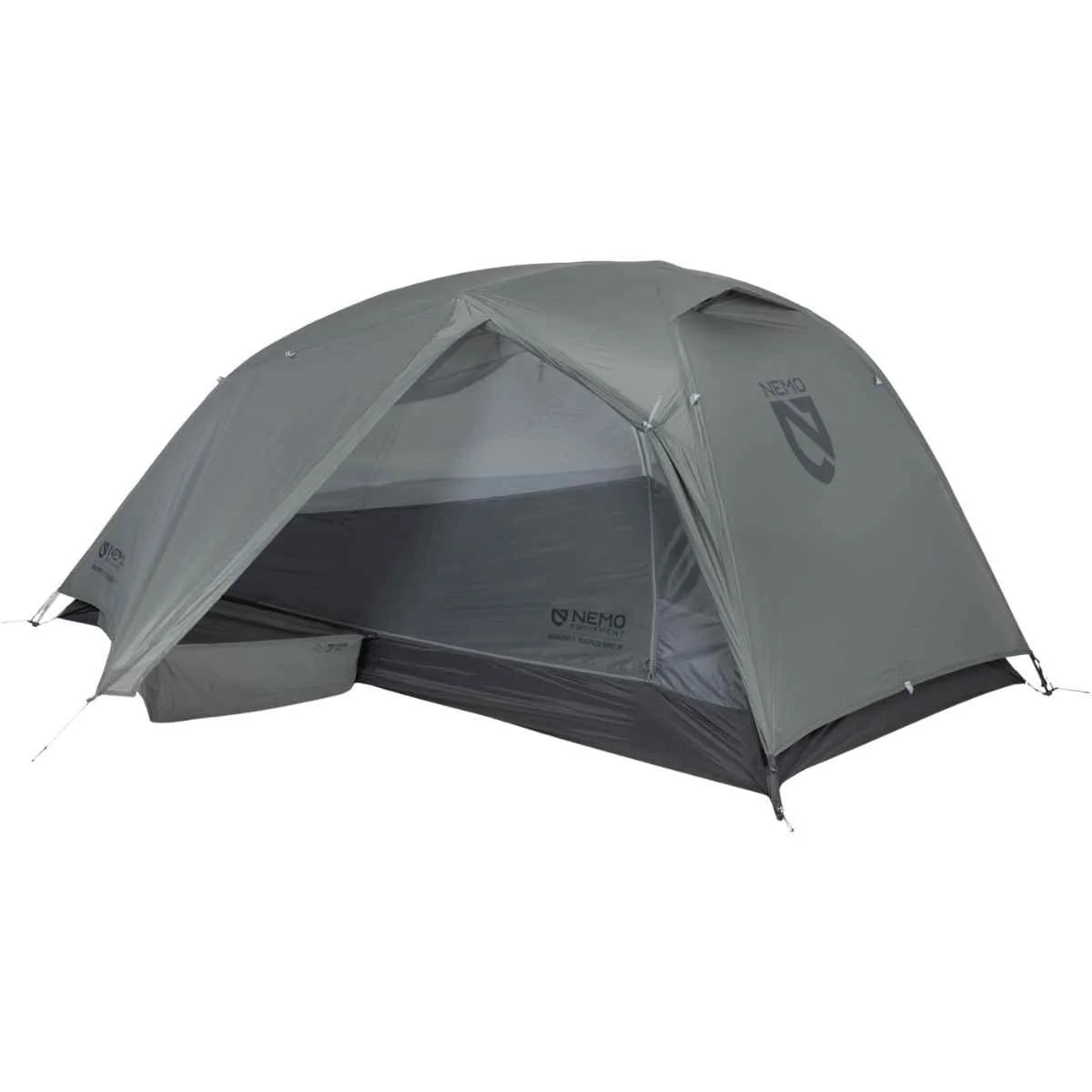
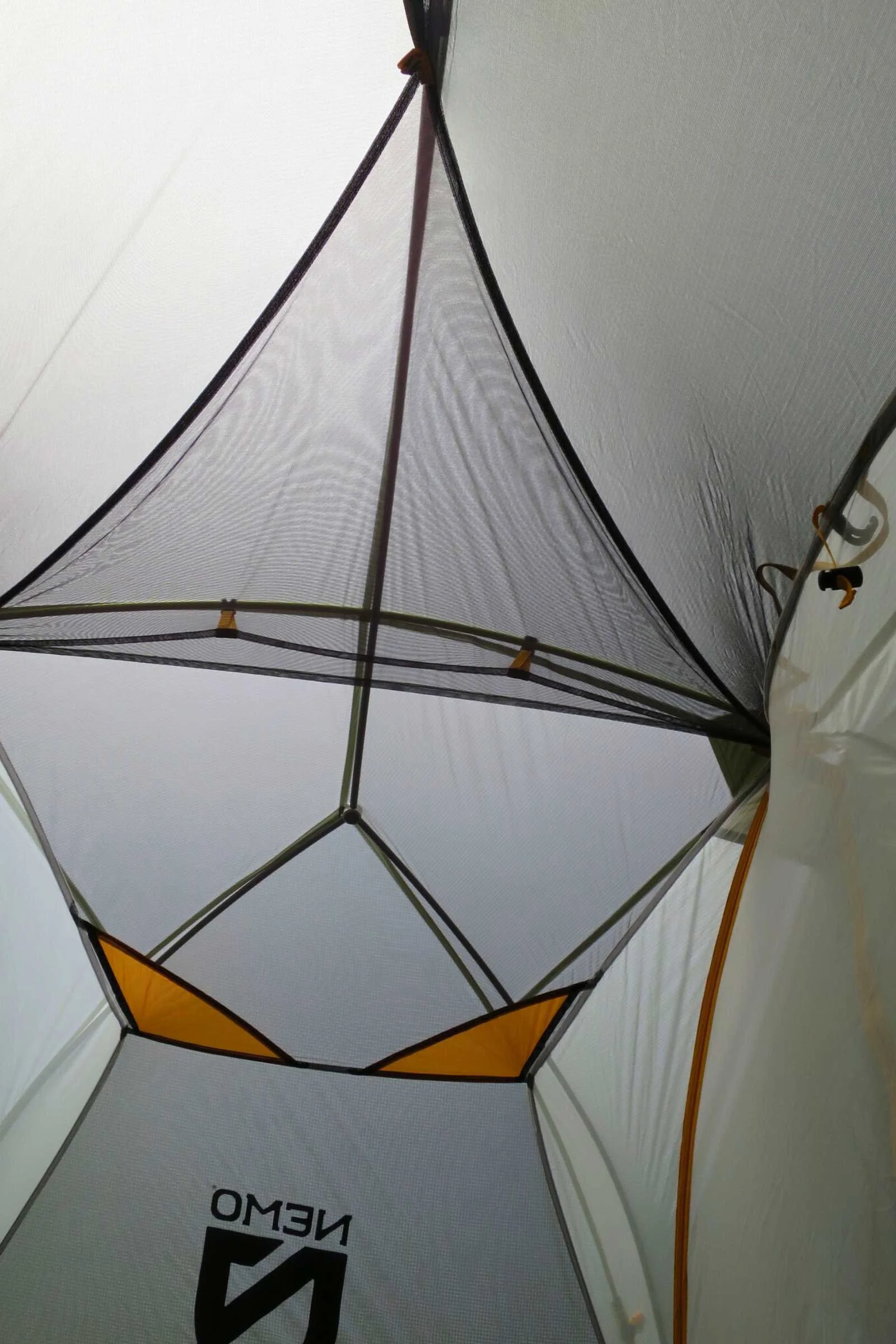
If we’re choosing a bikepacking tent based on a wet climate where we plan to ride, the NEMO Dragonfly Bikepack OSMO is the tent we’d opt for. We tested the 2-person version on Colorado’s Front Range in the summer and not in wet conditions—yet. However, the Landing Zone—a waterproof, fabric tub that secures between the tent body and the rainfly under either vestibule is the killer feature here. It essentially ensures that any gear you place outside of the tent is still protected from the wet ground or any rivulets or puddles if you’re camping in the rain — because no one wants to put on wet shoes or a wet backpack in the morning. We also love the backpacking version of this tent, which you can learn more about in our in-depth review of the NEMO Dragonfly OSMO backpacking tent.
Nemo Dragonfly Bikepack Osmo Tent


-
First set up (without looking at instructions) was easy and came in at under 10 minutes. We loved that there were no plastic bags shipped with the tent and both the stakes and poles came in lightweight, thin fabric bags. The two-toned poles and tabs on either end of the tent made it easy to figure out and the stakes are large and heavy duty. The hardest part was securing the hooks on the Landing Zone gear tub to the fabric loops on the rain fly—a cord or webbing loop would make that easier.
-
As we note in our review of backpacking tents, the Dragonfly is very close to the specs of the Big Agnes Copper Spur—which also is offered in a bikepack version. Like many 2 person, lightweight tents it’s often tight quarters for two people to sleep comfortably in, but it also has generous vestibules and pockets for extra gear storage.
-
The Dragonfly bikepack tent has a rated weight of 3 lbs. 12 oz.—about a half pound more than the Copper Spur and significantly more than the 2 lbs., 15 oz weight of our overall winner the Big Agnes Tiger Wall.
-
Having daisy chain storage between the tent and rainfly means you’ll be closer to the stinky gear you want to air out, but it will keep it dry in between the layers, as opposed to Big Agnes’ design which has daisy chains on the outer side of the rainfly—each of these have their merits and detractions.
Best Bikepacking Tent for Solo Bikepackers: Six Moon Designs Lunar Solo
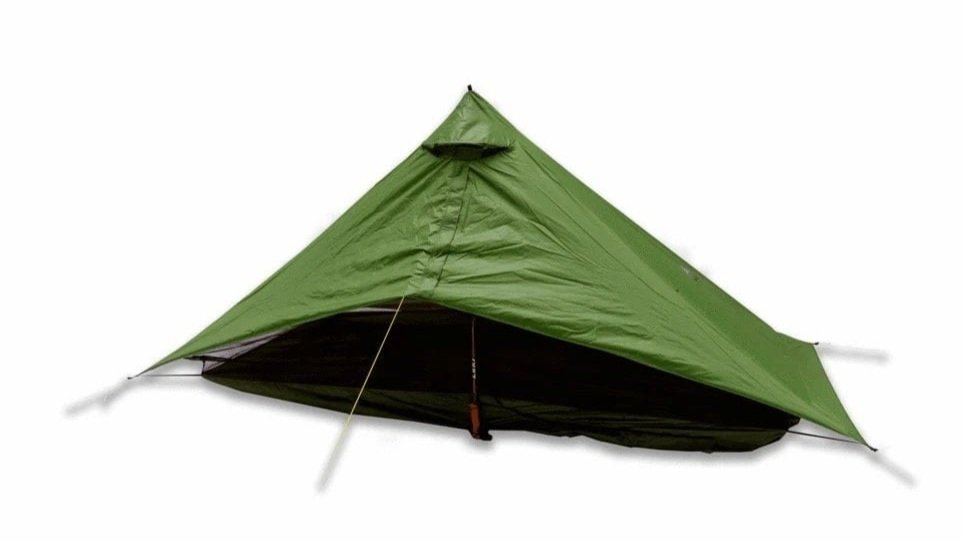
Sizes available: 1+ (Lunar Duo is 2-person)
Packed weight: 1 lb 10 oz
Packed size: 11" X 4.5"
Floor area: 26.25 SF
Head Height: 49"
Vestibule Area: 8.5 SF
Seasons: 3
Doors: 1
Pole length: 11"
Bikepack-specific features: handlebar-compatible pole length, 2-minute setup time, internal gear area
What we liked: incredible value, lightweight, generous internal space
What we didn’t like: price, can be hard to find at retailers
The best tent for a solo bikepacker is the Six Moon Designs Lunar Solo; it’s an impressively ultralight shelter with a generous amount of space for sleeping, and in the vestibule. Made for ultralight hikers, the Lunar Solo was designed to be set up with a trekking pole, but Six Moon Designs tailored the set-up for bikepackers and padders with an ultralight (2.1-ounce) Carbon Fiber 5 Section 49” Tent Pole that’s that is only 11” long.
Given that there aren’t that many bikepacking specific one-person shelters available at this time, it’s no surprise that our winner for Best Solo Backpacking tent and Best Affordable Ultralight Tent, is also our winner for Best Solo Bikepacking tent.
What we like about using this backpacking tent as a bikepacking tent is the stand-out feature: ultralight, 2.1 oz Carbon Fiber 5 Section Tent Pole. The pole collapses into segments that are only 11 inches long, making the pole and the tent easy to stow anywhere on your bike.
As tester and Treeline Review writer Mike Unger knows, all this makes the 1-pound 10 oz Lunar Solo an excellent tent for backpacking, bikepacking, and bike touring. For an in-depth look at this tent, see our long-term review of the Six Moon Designs Lunar Solo tent.
Six Moon Designs Lunar Solo
Six Moon Designs 5-Section Carbon Fiber 49" Tent Pole
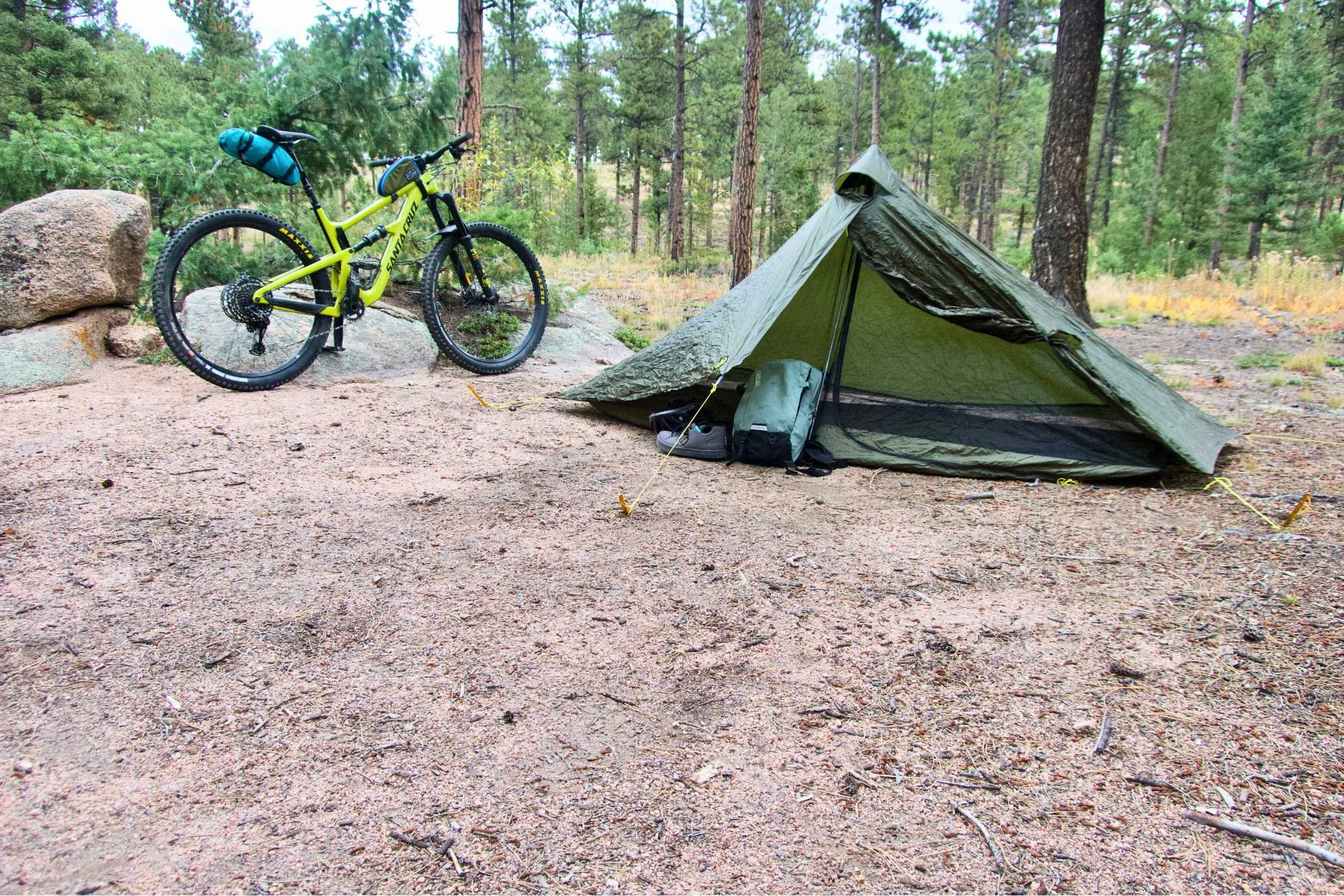
Our Six Moon Designs’ Lunar Solo set up with bikepacking gear.
-
With one pole, the Lunar Solo tent isn’t freestanding, and it doesn’t come with stakes, so you’ll need to bring your favorites.
Other reviewers have dinged this tent because stakes are sold separately, but we find that as a bonus. Many bikepackers already have stakes or want to choose their own for the conditions they’re riding in.
-
The single-wall tent is easy to set up and spacious. There’s plenty of interior height at 90 x 48 x 49 inches to easily sit up in.
It also has an additional 8.5 square feet of vestibule space to help keep your gear dry on rainy nights. Despite lacking windows, thanks to its mesh interior and vent near the top, it breathes well, and the vestibule is easy to roll back or slide up for more ventilation on warmer nights.
-
One stand-out feature of the Lunar Solo is its material: siliconized polyester, which packs down smaller. It also sags less than silnylon, is less likely to trap moisture, and is less likely to delaminate. Silpoly is shaking up the ultralight world and as a smaller brand, Six Moon Designs was one of the first tent brands to innovate with it and is forefront of using this new material.
For extra protection underfoot, consider adding the Six Moon Designs Ultralight Footprint.
See our most popular bikepacking guides in our Bike gear section:
Best Ultralight Bikepacking Tent: NEMO Hornet Elite OSMO UL

Sizes available: 1, 2-person
Packed weight: 2 lb 1 oz
Packed size: 19” x 4.0”
Floor area: 27.3 SF
Head Height: 37”
Vestibule Area: 12.4 (6.2 each)
Seasons: 3
Doors: 2
Poles: 19" DAC 8.7mm Featherlite NFL
What we liked: lightweight, weather resistance, three-season versatility, DAC Featherlite NFL pole is super light and strong, PU/silicone floor and fly coatings for water-resistance, easy and fast set-up
What we didn’t like: price, high demand means hard to get hands on, not as spacious for two people
If you’re looking for an ultralight 2-person tent, we recommend the NEMO Hornet Elite OSMO UL. It has the features we want—like two doors and two vestibules—for no weight penalty. Plus, it’s free standing and made of OSMO, some of the most environmentally-friendly material out there.
It has a minimum weight of 1 pound 11 ounces (that’s 12 ounces lighter than the Tiger Wall and just one oz more than the Lunar Solo), yet it still manages to have two vestibules and doors.
The Hornet Elite OSMO was our winner for the Best Lightweight Tent for backpacking and Best Semi-Freestanding Ultralight Tent in our best ultralight tents guide.
We liked it so much that we wrote an in-depth review of the NEMO Hornet Elite OSMO UL tent on why we think it's such a great lightweight tent.
Nemo Hornet Elite Osmo Ul

NEMO Hornet Elite at a bikepacking camp. Photo by Trist Hogue.
-
The new OSMO fabric has won multiple awards, including from Popular Science as one of the top 100 greatest innovations of the year.
It is made of a 100% recycled checkered weave of water-repelling nylon and moisture-wicking polyester. It optimizes water repellency without fluorinated water repellents (PFAS), nicknamed "forever chemicals."
The combo of the two fabrics means it dries faster than many other tent fabrics. Meanwhile it avoids sag and optimizes water resistance. It meets fire retardant requirements without harmful chemical additives.
-
The NEMO Hornet Elite OSMO UL is a semi freestanding, double-wall tent boasts a minimum trail weight of 1 lb 11 oz. It’s a full 12 ounces lighter than our Overall winner, the Tiger Wall 2-person tent. But it still has two doors and two vestibules. If you’re going for lightweight, the Hornet Elite Osmo 2 is among the lightest two-person tents we’ve seen and is the lightest tent we chose as a winner.
The Hornet Elite OSMO UL 2 is a lighter version of the NEMO Hornet OSMO or even the NEMO Hornet OSMO Ultralight. To cut weight further, the Elite tent uses more gossamer no-seem-um mesh than on the regular Hornet and a 10-denier tent floor fabric rather than the 15-denier fabric on the regular Hornet (already a lightweight fabric). The Hornet OSMO still has some of the same eco-friendly materials, but is less expensive since it doesn't have as much high-tech material.
The 10-denier fabric means it’s less durable, so again, we recommend using a footprint with the tent. NEMO Hornet Footprint is $70 and weighs 7 ounces.
-
Like the Hornet, the Hornet Elite OSMO UL is a tent that uses the term ‘2-person’ tent loosely (or tightly, rather). Though it’s 85” long and 51” wide, testers and reviewers have noted that aggressive tapering from the corners makes for tight sleeping for two; it becomes even more challenging for people over 6’ tall.
Still, if you want the lightest bikepacking tent, this is the lightest tent that still has the features we want in a quality bikepacking shelter.
It’s worth noting that this tent is marketed as a backpacking tent. Still, Bikepacking praised the tent in its review: “It is undoubtedly one of the lightest semi freestanding tents that still offers two doors and two vestibules. Even so, it doesn’t hold back on features that make it attractive and comfortable for self-supported bikepacking. Its simple design makes it easy to pitch, like you’ve practiced setting it up a thousand times before.” The tent was also a top winner from Outdoor Gear Lab and got 4.5 stars on Google Reviews.
If you like the geometry and ensign of the NEMO Hornet Elite OSMO but are ok with a heavier tent to fit better into your budget, give the NEMO Hornet Ultralight a look.
Other bikepacking tents we tested
MSR Hubba Hubba Bikepack 2-Person Tent

Sizes available: 1- and 2-person
Packed weight: 3 lb 12 oz (2-person)
Packed size: 14.5” x 7” x 5”
Floor area: 29 SF
Peak Height: 42”
Vestibule Area: 35 SF
Seasons: 3
Doors: 2
Poles: 2 DAC NSL aluminum
Bikepacking-specific features: Poles fold to 12” segments to fit between handlebars and other tight spaces, waterproof handlebar bag with daisy chain loops for extra gear, removable handlebar spacers help ensure you have access to your cockpit (brakes, grips, shifters, etc.), headtube bungee for stability, extra large pockets, clotheslines for drying gear
What we liked: Fully-featured bikepack-specific handlebar bag, handlebar spacers "float" bag from handlebars to clear brake and shift cables and create room for hands and accessories, great vestibule area on each side, compact, spacious
What we didn't like: pricier than other tents without having as many bikepack features
The MSR Hubba Hubba Bikepack 2 person tent is a comfortable true-2 person tent for bikepacking and other outdoor activities, like packrafting or multi-day kayaking, where space for a tent is at an absolute premium.
If the MSR Hubba Hubba Bikepack 2 tent has a killer bikepack feature, it’s the tent bag. It’s by far the best design for a bike pack tent bag that we’ve seen.
The Hubba Hubba Bikepack is designed to be compact with an impressive 14.5”-long packed size, yet has among the most usable space and the most vestibule space of any bikepacking tent we've tested.
Compare prices of the MSR Hubba Hubba Bikepack 2-Person Tent


-
If we were buying a bikepacking tent based on the stuff sack alone, this is the tent we’d buy, hands down.
The rugged fabric and wide roll-top is really easy to use and has plenty of space for the tent—no need to try and cram everything into the small top opening of a more traditional tent bag.
There are plenty of loops on the outside of the bag for securing extra gear and the separate pole and stake bag makes sure there’s less chance of packing the tent fabric and metal parts together in a way that you could pinch or poke the gossamer fabric of the tent with the any of the metal parts.
We also loved the light foam handlebar spacers, which helped ensure the bag didn’t interfere with our cockpit while riding on trails in Buffalo Creek, Colorado.
-
Like the similar MSR Hubba Hubba backpacking tent, and most other high-end tents in this category, setup was a pretty quick breeze. It took about 5 minutes to set up the tent body and a couple more to install the rainfly.
We particularly appreciated that the only additional material that came with our test unit were the rubber bands that kept the tent poles and stakes organized on first use—no extra plastic bags or things to toss.
-
Unlike most 2-person tents these days, including many bikepacking tents we tested for this story, the MSR Hubba Hubba Bikepack actually feels big enough for two adults.
With walls that rise pretty vertically from the rectangular tent bottom (84”x50”), it has a lot of usable space. In contrast, comparable tents from Big Agnes and NEMO have a tapered approach where it’s broader at the head and narrower at the feet. Still, we’d really want to know the person we’re sleeping next to pretty well to share the tent space with.
The Hubba Hubba felt plenty long for our tester’s 5’10” frame, but those over 6 feet tall may prefer the 88” (over seven feet) length of the NEMO Dragonfly or Big Agnes Copper Spur.
-
As a bikepack-specific tent the tent has the most important and bare minimum requirement for a bikepack tent—shorter tent pole sections.
The tent pole sections on the MSR Hubba Hubba fold down to 12” segments, making them easy to fit on handlebars, a top tube, or even under the seat—depending on how you want to pack the rest of your gear for a bikepack trip.
-
Most bikepack-specific tents we tested include more bikepack-specific features than the MSR Hubba Hubba Bikepack. Usually, these features justify the additional $50 or so you'll be paying for a bikepack-specific tent over a backpacking tent. Aside from the stuff sack (which is exceptional), we didn't see much else to justify the upcharge.
Like the NEMO and Big Agnes bikepack tents, the Hubba Hubba Bikepack also has larger pockets than its backpacking counterpart, which is appreciated.
Other than the stuff sack, the only other real bikepack-specific feature on the Hubba Hubba Bikepack is a clothesline integrated inside the tent. Yet using that can lead to sweaty gear falling on you overnight, or bumping into it when you get up for an unexpected overnight relief session. You can also add a clothesline to the exterior of the tent’s rainfly to dry out more gear, but we’d appreciate it if it was connected from the start.
In the end, those more integrated extra features on both the Big Agnes and NEMO bikepack tents make them a stronger choice for a bikepack-specific tent.

Sizes available: 1, 2, 4 people
Packed weight: 3 lb 6 oz
Packed size: 5.5 x 20"
Floor area: 32.0
Peak Height: 40
Vestibule Area: 16.0
Seasons: 3
Doors: 2
Poles: 20"
The MSR Hubba series of tents are favorites of many bikepackers and backpackers. In a previous guide, we ranked the MSR Hubba Hubba 2 as the Best Luxury Tent in our Best Backpacking Tents guide, for instance.
A few months ago, MSR revamped the Hubba line of tents with a redesign that cuts weight by up to 14 ounces per tent and changed the naming scheme from Hubba, Hubba Hubba, and Mutha Hubba to Hubba Hubba 1, 2, or 3.
As I reported from the summer Outdoor Market Alliance event, MSR is doing their best to reduce the use of other chemicals and waste water in the manufacturing process by moving to solution dye on the mesh and tent body. MSR says the use of solution dyeing in these materials means a reduction of 80% carbon emissions in the manufacturing of them. And yes, the rain flies are PFAS-free and seam-sealed.
This new version of the Hubba isn't yet released in a bikepacking version, though we hope the bikepacking version takes on this lighter fabric and design. For now, see our in-depth MSR Hubba Hubba LT backpacking tent review.
MSR Hubba Hubba LT

Sizes available: 1-person, 2-person, 4-person
Packed weight: 1.3 lb (2-person)
Packed size: 8.5" x 6.0" x 5.5"
Floor area: 63 SF
Head height: up to 64"
Vestibule Area: 0 SF
Doors: 2
Poles: 17" packed Carbon Fiber pole expands between 56.5" to 65.75"
Bikepacking-specific features: Easy set up, only needs one pole, add on UltaMid Carbon Fiber Tent center poles packs to 17"
The Hyperlite Mountain Gear UltaMid 2 Pyramid Tent is a winner in our best 4-season tent guide. It's a single-wall shelter without a bug net and a pyramid-shaped tarp. It has a head-turning 63 square feet of floor space, but that doesn't include vestibules, and the edges aren't really usable space. Still, it's an option that is increasingly popular with minimalist bikepackers, especially tall people who like the 64" of height.
It's also a favorite tent in our Best 4-season tents guide and while we don't expect you to be riding in those conditions, it's always nice knowing your shelter can handle wind and precipitation.
Hyperlite Mountain Gear Ultamid 2
-
Unlike most of the bikepacking tents in this guide, the UltaMid only requires a single pole. The add-on UltaMid 2 pole is made of carbon fiber and packs down to 17". It expands between 56.5" and 65.75" depending on how much peak height you want and how windy it is.
-
However, one downside of the UltaMid is it does not include a bathtub floor or bug netting. Ultimately, even the most ultralight tents in this guide have those features, and the UltaMid 2 does not.
You can add in the optional UltaMid 2 insert with DCF floor, but together, the cost is over $1000. Like all inner tent add-ons, it also adds weight — in this case, nearly 1.4 lbs. HMG has other, cheaper options, such as the half insert ($260 and 14.8 ounces) or the mesh insert with no floor ($105 and 13.6 ounces).
As much as we like the UltaMid 2, we think that the price and extra weight are steep for a tent without bug netting.
Still, if you like the modularity and flexibility of having a tarp that only sometimes needs an inner or like the idea of bikepacking with only one pole to keep track of, this is a much-loved and highly-rated tent that we like a lot for 4-season trips and will perform well during 3-season bikepacking, too.
-
As much as we like the UltaMid 2, we think that the price and extra weight are steep for a tent without bug netting.
Still, if you like the modularity and flexibility of having a tarp that only sometimes needs an inner or like the idea of bikepacking with only one pole to keep track of, this is a much-loved and highly-rated tent that we like a lot for 4-season trips and will perform well during 3-season bikepacking, too.

Sizes available: 2 people|
Packed weight: 4 lb 9 oz
Packed size: 12" x 4" x 1"
Floor area: 28.2
Peak Height: 41.3
Vestibule Area: 19.5
Seasons: 3
Doors: 2
Poles: 11"
Bikepacking-specific features: Poles fold to ~11” segments to fit between handlebars and other tight spaces, waterproof handlebar bag with daisy chain loops for extra gear, gear splits into 3 bags for easier packing, extra large pockets, clotheslines for drying gear
The bikepacking version of Sea to Summit's popular TR2 tent, this tent is designed to be roomy and luxurious. It has promising bikepacking features including poles that fold down to less than 11". It comes with multiple stuff sacks, each with daisy chains, that can be attached via Voile straps to your bikepacking bike. This is part of their FairShare Storage system so that if you're sharing a tent, one person doesn't get stuck carrying everything.
The stuff sacks are made of a more durable waterproof eVent® dry bags, which works well for bikepacking. Like the Copper Spur, you can create a porch in "Hangout Mode" that is spacious enough to cover your tent in a rain storm or get out of the sun.
We've tested the backpacking version of this tent and look forward to testing the bikepacking version. We will report back on our findings.
Sea to Summit TR2 Bikepack Tent
How is a bikepacking tent different than a backpacking tent?

Loading a bike up with gear for an overnight summer trip. With bikepacking, all your gear must fit along the frame of your bike in a way that minimizes obstruction with gears and brakes and that doesn’t snag branches as you ride trails.
The first question you’re probably going to ask is: why should I consider a bikepacking tent? How is it different than a typical backpacking tent? To be honest, most good, ultralight backpacking tents will work as a bikepacking tent or bike touring tent.
But, if you plan on bikepacking a lot, a tent made for bikepacking has some features you won’t find on most backpacking tents, like poles that fold into 12” segments. These features also make them ideal for other multiday, self-propelled activities where your adventure mobile’s width and packing space’s availability influences the gear you need for it (like packrafting and kayaking).
What is bikepacking?
First off, we should explain what bikepacking is. Succinctly, it’s going on a multi-day adventure on your bike. Whether that’s a fat-tire, gravel, road, or mountain bike, the title of bikepacking still fits.
Is bikepacking different than bicycle touring?
A bikepacking trip differs from traditional bike touring, where much of the clothing and other gear is carried in panniers. Though increasingly, some bicycle travelers are choosing to bike tour with a less-pannier focused packing system. While often bicycle touring has you staying overnight in hotels or established campgrounds, bikepacking has you wild camping in the backcountry like you would on a backpacking trip.
How is bikepacking gear different than backpacking gear?
Rather than carrying all of one’s gear on your back, as one does when hiking, bikepacking uses the open space on one’s bike to carry as much gear as possible. This strategy lowers your center of gravity, making it easier to carry the additional weight of gear on the bike and reducing, if not eliminating, the need to ride with a backpack.
If you carry all your camping gear on your back while biking, you’d be carrying a teetering mass of weight above your center of gravity. Thus, you’d be crushing your hip belt into your belly as you ride hunched over your bars. Carrying the mass of weight higher above the bike’s frame makes it harder to stay stable on the bike.
In contrast, bikepacking luggage is designed to take advantage of the entire bike frame. Bike bags make the whole rig narrower instead of taller. Narrow luggage allows you to get further on deeply rutted backcountry roads where side-riding panniers could snag on branches. Wide or tall bags could make it harder to travel through narrow rocky trails. Bike bags, in contrast, don’t add much to your rig’s height or width. To learn more about bikepacking in general, check out our most excellent guide: How to Get Started Bikepacking.
What are bikepacking-specific tent features that aren't found in a backpacking tent?
NEMO’s Dragonfly Bikepack includes the waterproof Landing Zone storage tub that fits under the rainfly to protect gear from overnight elements. The Dragonfly, Big Agnes’ Tiger Wall and Big Agnes Copper Spur bikepack models all have loops on the tent to air out gear overnight.

A side-by-side comparison of the packed width of tents. The longer segments of poles on the MSR tent are more likely to interfere with shifters and brake handles.
What to look for in a bikepacking tent
Now that we’ve got that out of the way, let’s get on to choosing the best bikepacking tents.
Roomy Vestibule
In the larger scope of things, you want a tent with a roomy vestibule (or vestibules) under which you can let some of your sweaty gear dry out a bit while you’re sleeping and relaxing.
Room for you and your gear
We find that in most situations, bikepackers will want to carry tents for up to two people. If traveling solo, they can opt for a 1-person tent or a 2-person tent if they like stretching out. If the gear is split between two bikepackers, they can opt for a 2-person or even a 3-person tent if they want the space. The Tiger Wall, our overall winner, is also available as a 3-person model for those who want a more roomy abode. The 3-person tent has a trail weight of 2 pounds and 13 ounces, just 6 ounces heavier than the 2-person version.
Shorter Pole Segments
Another important thing to look for in a bikepacking tent is shorter pole segments. Most backpacking tents have tent pole segments that are 16” or longer. That makes them too wide to stow on handlebars safely, particularly narrow road bike handlebars, which may only be a couple of inches wider than the full packed width of a tent.
Even on mountain bike handlebars, usually over 2 feet wide, longer pole segments can make even a packed ultralight tent unwieldy and complex to manage while riding. That's because some long poles can be as wide as a bike’s brakes.
Long pole segments are also harder to stow on the top tube or down tube of a bike. Shorter riders with smaller bike frames will especially appreciate bikepacking tents with short pole segments. By comparison, Big Agnes’s bikepacking tent pole segments are only a foot long and make a packed tent narrower and easier to pack on any bike.
Robust Stuff Sack
The stuff sack for most backpacking tents is often made out of the same fabric as the tent. The weakness of this sack is a problem for bikepackers. If the stuff sack is made of lightweight ripstop nylon, it could easily get punctured in a crash and damage the tent inside. Bikepacking tent stuff sacks are usually more robust, burlier, and designed with external attachment points to attach them to the handlebars or tubes of the bike.
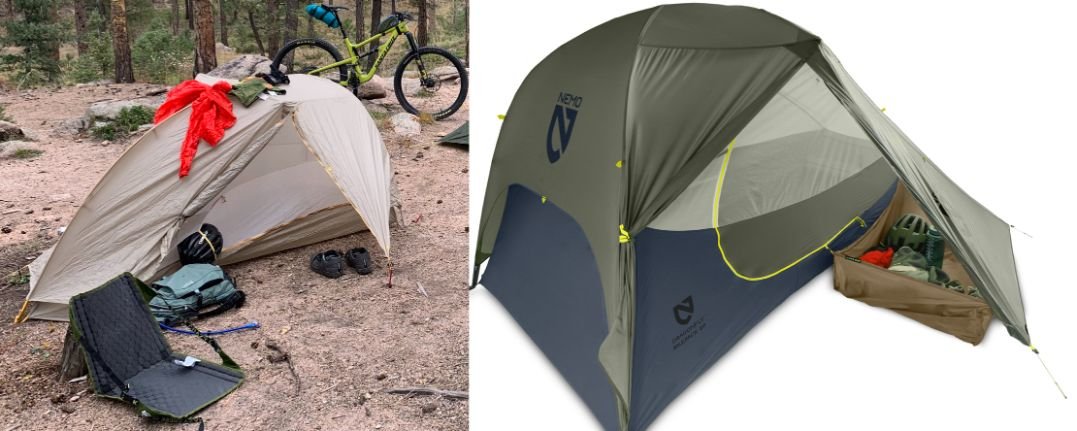
Bikepacking specific features include external daisy chains as seen on the Big Agnes Tiger Wall on the left and storage features like gear storage tubs as seen on the NEMO Dragonfly on the right.
Gear Storage Options
An ideal tent for bikepacking also features extra gear storage than most backpacking tents. These are in the form of daisy chains or even fabric tubs that attach to the tent and rainfly, as offered with NEMO’s Dragonfly bikepacking tent. They make it easier to stash gear off the ground or keep sweaty, wet gear like helmets, gloves, and even chamois elevated so they can dry quickly while keeping them secure.
Since only a few companies are currently making tents like this, some of the products we tested and recommended here are ultralight tents designed for backpacking. When using those types of tents, you can quickly secure them to your handlebars or other parts of the bike with ever-useful, ever-handy ski straps. You may also want to replace the standard stuff sack with something more robust, like a Granite Gear Round Rock Compression Sack.
Durability and Environmentally Friendly Gear Options
Not only was the Big Agnes Tiger Wall Bikepack Solution Dye the best overall, but it is also among the most environmentally friendly tents we tested. In 2021, Big Agnes moved to solution dyeing their tent fabrics, a process the company says increases UV resistance, improves longevity, and significantly reduces each tent’s environmental impact.
The solution-dyeing process dyes nylon yarns as they’re being made rather than dyeing the fabric after it’s woven from the yarns. Big Agnes says the process uses 80 percent less energy and 80 percent fewer chemicals to produce. It can also reduce the water needed to dye the tent fabric by up to 5 gallons per tent.
Both Big Agnes and NEMO are looking for other ways to reduce the impacts of making, shipping, and packing gear. Both companies helped found the Outdoor Industry Association’s Climate Action Corps. MSR’s parent company also is a member of the organization. Member companies report their annual emissions for the first time in 2021 and are actively planning to reduce emissions throughout their manufacturing, shipping, and supply chains.
NEMO has also partnered with bluesign and has worked to certify that its manufacturing processes and fabrics are environmentally responsible. For more information on how these companies are working to reduce their impacts, check out a recent piece from the author here: Ultralight or Eco-Friendly? Now, You Don’t Have to Choose.
Related: Eco-Friendly Gear Swaps to Reduce Your Environmental Impact

Several of the bikepacking tents we tested side-by-side on a bikepacking trip in Colorado this fall.
How to Choose the Bikepacking Tent for You
When choosing the right bikepacking tent for yourself, there are some key things to think about:
Why choose a bikepacking tent instead of a backpacking tent?
Basically, will you do enough bikepacking, pack rafting, or similar activities to justify the additional expense of some of these models? If yes, then by all means, go for it. Conversely, if you’re looking to replace your backpacking tent with something that has more capabilities, then again, yes. The extra expense of the Tiger Wall Bikepack and Copper Spur HV UL3 Bikepack is justifiable.
How many people will you bikepack with?
Even if bikepacking in a group, we suggest splitting a tent between no more than two people. If you’re bikepacking as a small family, we suggest the Copper Spur HV UL3 or even the four-person version, as we do if you relish being able to stretch out and share the tent with another person and a dog.
The Tiger Wall UL2 will sleep two comfortably but closely. It’s also light enough for one person to carry.
If it’s just you, the Lunar Solo has enough space, so you don’t feel claustrophobic or like you’re inside a casket as some people do when they’re in a bivy sack.
How closely are you counting grams?
If you’re an obsessive gram counter but still want the lightest two-person tent for bikepacking, it’s going to be the NEMO Hornet Elite.
Care and Maintenance Tips
With very few exceptions, like using a ruggedized stuff sack when stowing the tent externally on your bike, maintenance for bike pack tents is the same as maintenance for backpacking tents. For more on that, please refer to the section on “Getting the Most Life out of Your Backpacking Tent” from our guide to “The Best Backpacking Tents.”
Additionally, our Cleaning, Repair, and Maintenance section has useful tips for caring for a tent including How to Repair a Tent, How to Wash a Tent, and How to Repair Zippers in Outdoor Equipment.
We want more options for Bikepacking tents

There are still just a handful of tents made for bikepacking; even fewer of those have been around for more than a year. As we stated initially, you can use a backpacking tent for bikepacking, but we’re looking forward to more companies introducing these purpose-made tents.
Additionally, we’d like to see some bikepacking traits, like shorter pole segments, cross over into backpacking tents. Shorter pole segments are better for bikepackers, because they can be strapped to handlebars. One reviewer noted that shorter pole segments are also good for backpackers because they can be stored horizontally inside or on top of a hiking backpack.
Since we started reviewing bikepacking tents, we've seen brands like Sea To Summit and MSR introducing new bikepacking tent models and look forward to seeing how this segment of the outdoor industry grows.
We should also note that some of the roundups we found for the best bikepacking tent or bicycle touring tent while researching this story were from Europe and included brands that aren’t readily available in North America.
If I were making the ultimate bikepack tent at this point, I’d go with the Big Agnes Tiger Wall body, use the MSR Hubba Hubba Bikepack tent bag and, for rainy trips, bring the Landing Zone tub from the NEMO Dragonfly or the Big Agnes bikepack tent footprints (sold separately) that extend to cover the entire footprint of the rainfly—including under the vestibules. Most other footprints only cover the area directly under the tent body. Hopefully, some bikepack tentmaker will read this and build the ultimate tent.

Our two fully loaded bikepacking bikes with tents packed on the handlebars.
Bikepacking Accessories
Since most tents aren’t made specifically for bikepacking, if you end up getting a tent that doesn’t have a ruggedized stuff sack, you might want to look into buying a handlebar bag. We have some excellent choices for handlebar bags here: The Best Bike Handlebar Bags.
We’d also highly recommend bikepacking-specific bags such as a Bike Seat Bag and Saddle Bag and a Bike Frame Bag. Most bikepackers will utilize both kinds of bags to efficiently carry their camping gear without messing with the balance of their bike.
If you’re just getting into bikepacking and need a bike for touring or bikepacking, check out our recommendations for The Best Bikepacking Bikes.
To help you get started, check out our pieces on How to Get Started Bikepacking and our Bike Touring Packing List.
FAQ
-
Absolutely. They’re particularly great for kayak camping, where space is also limited, and the shorter tent pole segments are easier to fit in tighter spaces. Similarly, since they’re a modified version of a backpacking tent, they’re also good for backpacking. When backpacking, you can lighten the overall weight of the tent by not using the burlier, heavier stuff sack that comes with the bikepacking tents.
-
Bikepacking tents are basically the same as backpacking tents and are as easy to set up. We recommend clearing your tent site of anything that can poke through the tent, staking out the groundsheet (if you use one) and tent first, and then erecting tent poles. It’s also a great idea to practice putting it up at home or in a local park before taking it into the backcountry.
-
It depends on how you organize your gear, but unless you’re using a large backpack and want to carry it in that, we recommend using the stuff sack it comes with to attach it to your handlebars or seat post, since most bikepacking-specific tent stuff sacks come with daisy chains and straps to lash it to your bike. You can also store it in a larger handlebar or seat post bag if you have one.
-
That’s up to your comfort level with a non-freestanding tent, like the Six Moon Designs Lunar Solo. They’re among the lightest you’ll find, but they are a little harder to set up than most freestanding or semi-freestanding tents.
If you’re looking for the easiest tents to set up, consider a freestanding tent. They’re also usually better at withstanding serious wind.
-
Just like backpacking tents, most bikepacking tents are intended as 3-season tents. The only interesting feature we saw on a bikepacking tent that might make it more suitable for wetter climates was the Landing Zone in the NEMO Dragonfly Bikepack tent. Essentially it’s a fabric gear tub that sits under the vestibule that could prevent your gear from getting wet in an overnight rainstorm.
-
Most tents will come with stakes and guylines, and in any case you should always have them with you and guylines should be pre-attached to the tent and rainfly. We also recommend ground tarps to protect the floor of your tent. The bikepacking-specific tents we’ve seen often have daisy chains on them to attach sweaty gear to to dry out overnight.
Since we also recommend some tents like the Lunar Solo that don’t have daisy chains, it is nice to have some extra paracord and/or carabiners or clothespins to hang gear out to dry. Other accessories that are a must for bikepacking are extra ski straps or adjustable velcro straps to help tie everything down on the bike.

We got together our bikepacking friends and tested these bikepacking tents side-by-side, checking for packability, ease of set up, and room to store and dry gear.
How we Researched & Tested
We've been testing bikepacking tents for four years, mostly as part of routes in Colorado, where the author also writes bikepacking guidebooks. That background shapes how we look at these tents: not just whether they set up well in a backyard, but how they actually function after a long day in the saddle.

The MSR Carbon Reflex loaded on our bikepacking bike.
For this guide, we gathered a group of bikepackers of different skill levels and tested the most promising models side by side on rides in Colorado's Buffalo Creek Wilderness, Fruita, and other spots along the Front Range. We strapped each tent to our mountain bikes and evaluated them under real conditions, paying particular attention to how each packed onto handlebars, how the stuff sack held up on the trail, and how easy each was to pitch at the end of a hard day when you just want to be done.
We weighed each tent ourselves rather than relying solely on manufacturer specs and compared packed dimensions against actual handlebar widths to assess what would and wouldn't clear brakes and shifters on a real bike. Tents that didn't make the cut were either too heavy, had pole segments too long to pack safely on handlebars, or lacked the vestibule space and gear storage features that bikepackers actually need on the road.
- Strapped to bikes & ridden on trail
- Side-by-side on group rides
- Timed setup & breakdown
- Tested in varied weather
- Evaluated on multiple Colorado routes
- Packability on handlebars & frame bags
- Pole segment length
- Vestibule size & gear storage
- Ease of setup
- Weight & durability

Author Chris Meehan riding his bike in Colorado.
Why You Should Trust Us
As an outdoors writer covering adventure and gear, I have written multiple pieces about bikepacking companies. I have also contributed multiple guides to Treeline Review, Backpacker, and other outdoor publications/organizations.
Growing up mountain biking, hiking, camping, and adventuring in the Appalachian Mountains around Virginia and Maryland in the 90s, I gained a yen for all sorts of activities and exploring the world in different ways. These days, I spend most of my time mountain biking, backpacking, hiking, climbing, and crisscrossing Colorado and the Rocky Mountain region. Bikepacking is a natural graduation of expanding those skills as I push further from traditional camping and biking adventures. I enjoy using all my knowledge of gear and skills to learn about new equipment and how it will benefit me-yes, I’m selfish-as well as Treeline’s readers.
I have authored multiple outdoor guidebooks. My most recent book includes bikepacking trips, where I tested many of the tents in this review. Colorado’s Best Front Range Adventures: The Greatest Hiking, Climbing, Paddling and More From Denver to Colorado Springs and Fort Collins covers some of my favorite bikepacking trips in the region.
I’m also the author of Falcon Guide’s “Climbing Colorado's Fourteeners: From the Easiest Hikes to the Most Challenging Climbs” and edited Justin Lichter’s excellent guide to thru-hiking titled “Trail Tested: A Thru-Hiker's Guide To Ultralight Hiking And Backpacking.” All of this experience has helped me become a first-rate gearhead and product tester.
Overall, I have 20-plus years of exploring, mountain biking, bikepacking, hiking, backpacking, climbing, guiding, and playing in the wild. I worked with National Geographic and their mapping division in developing their Colorado 14ers Map Pack Bundle. I’ve written about hiking and climbing for Elevation Outdoors, including stories about Colorado 14ers and outdoor apps to boost adventures.
I’ve written about countless outdoor companies, outdoor sports, and tested gear with publications including CompanyWeek, Outdoor USA Magazine (print), Elevation Outdoors, 5280, and more.
For this review, we tested multiple tents submitted for review as bikepacking tents, talked with other bikepackers, and spent a lot of time researching tents for bikepacking and other bike packers’ reviews of their favorite tents for two-tired adventures. Special thanks to Cedaero for supplying us with some new bikepacking bags for photos.
At Treeline Review, we strive to offer unbiased reviews to help you find the best product for the price. Treeline Review doesn’t accept sponsored content, native advertising, or paid reviews. I am not sponsored by any companies, nor are any of my family members sponsored by, employees of, or ambassadors of any of the companies in this review.
You can read all of Chris’s Treeline Review stories on his author page.