Best Bike Panniers of 2026
Waterproof and water resistant panniers for bike touring, bikepacking, commuting and groceries

March 16th, 2026, updated with new testing notes and more images of the gear in the field
Home > Gear Reviews > Bike gear
The best bike panniers let you carry more on your bike with less on your back. If you want to ditch the backpack so you can ride farther on your commute or cycling tour, you’ll need a reliable set of panniers. The right setup can completely change how you use your bike — whether that’s hauling bulky groceries home from work, loading up for a weekend tour, or packing everything you need for a long-distance ride.
We tested these panniers while biking around Denver and across the Colorado Front Range, using a Surly Ogre as our main test bike. We took them on bike tours and bikepacking trips. We used them for grocery runs and while commuting by bike in town. From everyday errands to multi-day trips, these panniers were ridden in real-world conditions across pavement, gravel, and mixed terrain.
I've worked as a bike mechanic for over 10 years and have biked over 50,000 miles in the past decade. Our evaluation focused on waterproof construction, secure rack attachment, carrying capacity, durability, and overall practicality. We tested single panniers that can transform a daily commute, massive duffel-sized panniers for hauling everything around town, and setups suited for touring, bikepacking, and gravel riding. We also considered how easy each pannier is to mount, remove, and carry off the bike.
Top Pick: The Ortlieb Back-Roller Classic earns our Best Overall award. It stood out for its fully waterproof construction, secure rack attachment, durable materials, and versatile capacity that works equally well for commuting, touring, and everyday hauling.
Looking for a different bike bag? See our Best Seat Bags guide.
We create reader-supported, objective gear reviews independently selected by our editors. This story may contain affiliate links, which help fund our website. When you click on the links to purchase gear, we may get a commission — without costing you an extra cent. Thank you for supporting our work and mission of outdoor coverage for every body! Learn more.
Comparison Table
| BIKE PANNIERS | TREELINE AWARD | REAR OR FRONT? | BEST FOR | CAPACITIES AVAILABLE | WATERPROOF | CLOSURE | EXTERIOR POCKETS |
|---|---|---|---|---|---|---|---|
| Ortlieb Sport Roller Classic | Best overall Read why |
rear | Overall, Tour | 12.5 L | Yes | Roll-top | None |
| Burley Pannier Set | Best budget Read why |
rear | Commute, Tour | 22 L | Yes | Roll-top | Flat zip pocket |
| Ortlieb Vario PS | Best for commuting Read why |
rear | Commute | 26 L | Yes | Roll-top | Flat zip pocket |
| Ortlieb Back-Roller | Best for bike touring Read why |
both | Overall, Front | 20 L | Yes | Roll-top | None |
| Restrap Pannier | Best front panniers Read why |
both (large=rear, smaller=front) | Overall, Tour, Front | 13 L, 22 L | Yes | Roll-top | None |
| Arkel Signature H Urban Pannier | Best for groceries Read why |
rear | Single, Urban | 24 L | Yes | Roll-top | None |
| Two Wheel Gear Pannier Pack Convertible PLUS | Best single bike pannier Read why |
rear | Commute, Single | 30 L | No, but comes with rain cover | Zipper | Laptop sleeve, zipper pouch, side water bottle pocket |
The Winners
Best Overall Bike Pannier: Ortlieb Sport-Roller

Storage capacity: 12.5 or 14.5 liters
Waterproof: Yes
Closure: Roll-top
Exterior pockets: None
What we liked: Simple, waterproof, secure mounting system, durable, come as a pair, work as front or rear panniers, sustainability
What we didn’t like: No exterior pockets
None of the panniers we tested were as easy to mount nor as easy to use as the ORTLIEB Sport-Roller. These are some of ORTLIEB’s most popular panniers, for good reason–they’re fully waterproof, incredibly durable, and the right size for most people. Most other panniers from other brands attempt to duplicate the Sport-Rollers, and we’ve tried many of these fully waterproof roll-top-pannier-ORTLIEB-clones over the years. But, none are quite as functional as ORTLIEB’s design or as durable.
Ortlieb Sport-Roller



-
We’ve used a set of Sport-Rollers for years for everything from bike touring across southern Colorado to commuting in Denver and grocery runs. We found a pair of these worked better than many single panniers for heavy loads since you can get a more stable feel on the bike while still having a high enough capacity for carrying a lot of stuff.
-
A set of these panniers costs more than some others we tested, but the Sport-Roller comes as a pair and is a better deal than buying two single panniers.
With a set of these, you get the versatility of having two panniers that can go on a front or rear rack, and you can leave one at home if you don’t need the carrying capacity that two panniers allow.
-
The Sport-Roller Classic panniers are made of ORTLIEB’s signature fully waterproof and practically bombproof polyester material. This material is thick and rigid, so it doesn’t sag like some panniers when not fully packed. Its roll-top closure makes packing these panniers a breeze and keeps water out when biking in wet conditions.
-
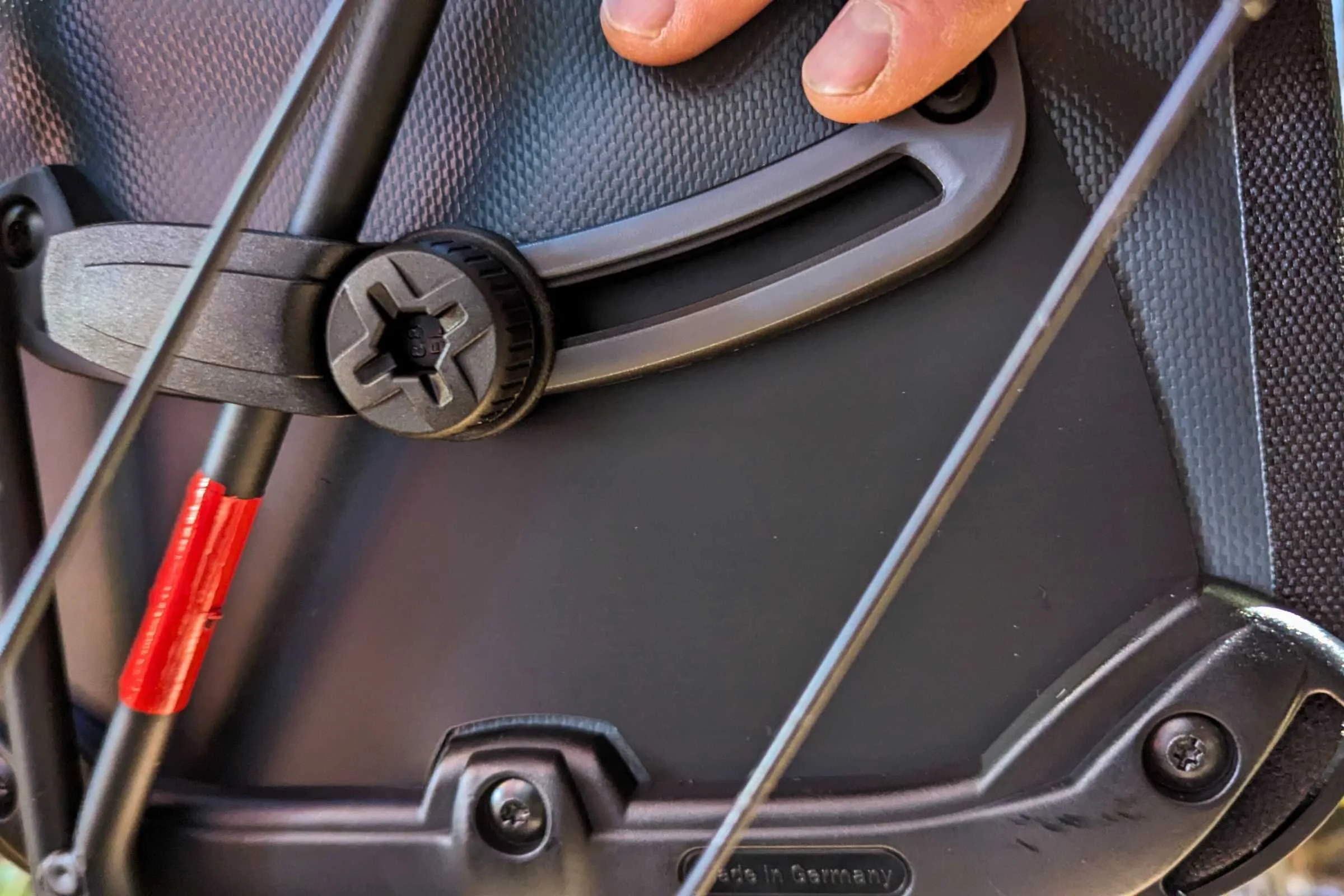
These panniers are also the easiest to mount and unmount from a rack while staying securely attached to the rack when you’re riding, no matter what.
The ORTLIEB rack mounting system hooks completely around any rack. It has a hook that secures underneath the rack tube and retracts when you pull up on the carry handle of the pannier. This prevents the panniers from coming unhooked if you hit a bump without making them challenging to unhook when you want to take them off the bike.
The mounting system also has a moveable hook near the bottom of the pannier so it doesn’t swing out when you hit a bump. This hook is easy to adjust, so you can set it to hook onto the bottom of any shape of bike cargo rack.
-
We’ve used a set of Sport-Roller Classics for nearly a decade. In that time, the design and materials used hasn’t changed. They are the Sport-Roller, after all. The thick material stands up to abrasions really well, and none of the hardware has broken or failed. While our old set of Sport-Rollers look a little scuffed up after years of use, they’ve held up better than most outdoor gear we’ve used over that same time period. Also, all ORTLIEB bags come with a 5-year warranty that guarantees against factory defects, and they sell replacement hardware if anything does break.
-
Beyond making incredibly durable bags, ORTLIEB does a lot in terms of sustainability as well. Their factory in Germany is currently two-thirds powered by solar energy they create themselves, and ORTLIEB aims to create 100% of the energy their factory needs to operate via solar by 2025. Beyond that, ORTLIEB calculates and publishes the carbon footprint of every product they make. And, they will repair any of their products if damaged so you don’t have to buy a new one.
-
There isn’t much about the Sport-Roller panniers that we would change, but some cyclists prefer an exterior pocket. These don’t have any external pockets, but that is to ensure these panniers are completely waterproof. You can add an external pouch to these panniers, but you must purchase that separately.
-
We think the Ortlieb Sport-Roller panniers are an excellent choice for an all-around set of panniers that can take you around the world or across town.
Best Affordable Bike Pannier Bag: Burly Pannier Set
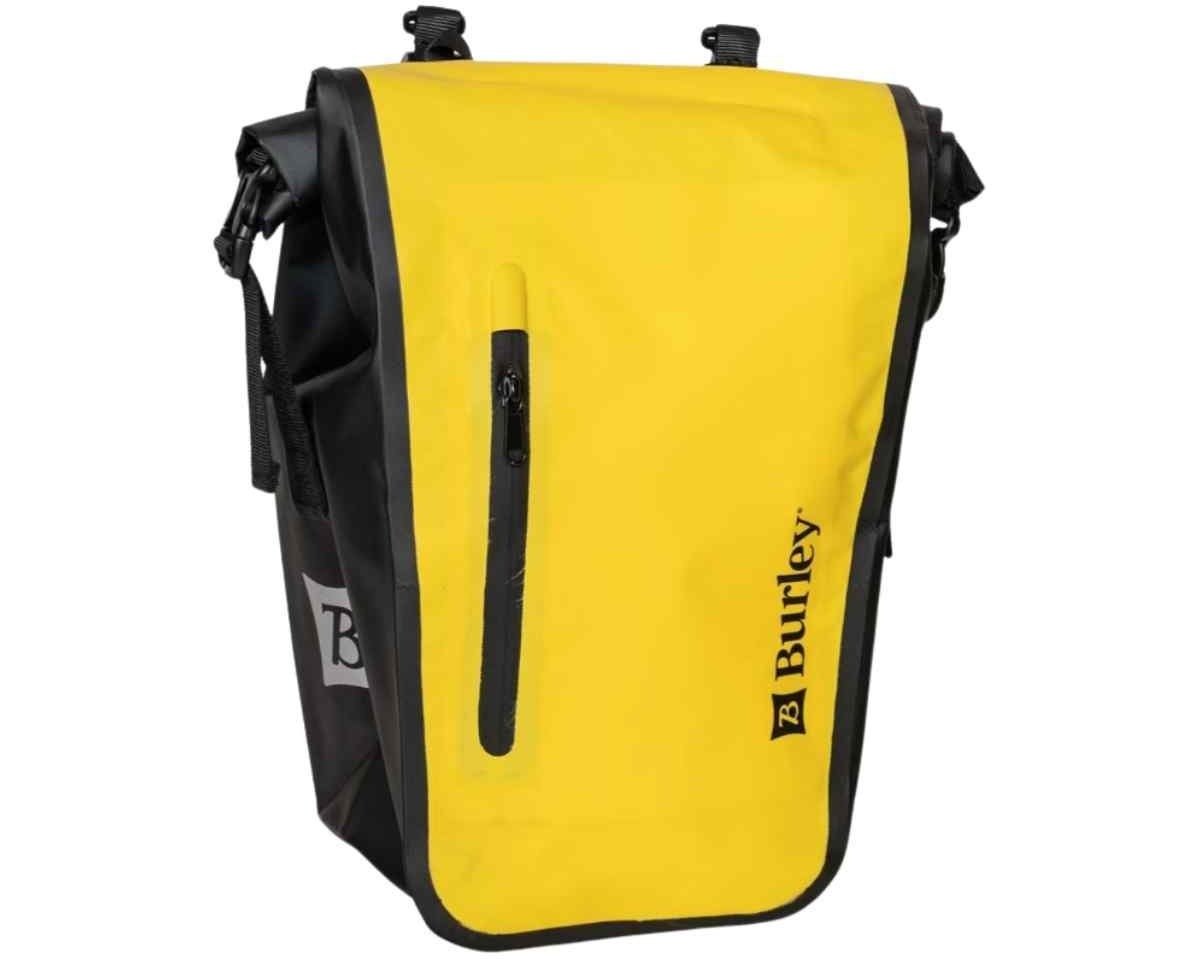
Storage capacity: 22 L
Waterproof: Yes
Closure: Roll-top
Exterior pockets: Flat zipper pocket
What we liked: Come as a pair, external zipper pocket, inexpensive, waterproof, easy to mount and unmount on a rack
What we didn’t like: Mounting hardware doesn’t feel as durable, external pocket is hard to use
The Burly Pannier Set is one of the most affordable pannier sets we tested. Many panniers are sold individually, but these come as a set and cost about the same price as many individual panniers do. We think any panniers that come as a pair are a great value, but the Burly Panniers balance a low price with quality features. They’re waterproof, mount easily to most racks, and unhook from your bike just as easily when you want to take them off.
Burly Pannier Set


-
We tested these panniers while commuting in Denver through all four seasons. We loaded them with food on grocery runs, and used them while we biked around town to carry our daily essentials. We also took them on a bunch of all-day-gravel adventure rides, where we loaded them with lunch, dinner, layers, and tools and set off across the Colorado foothills.
-
These panniers cost significantly less than the ORTLIEB Sport-Roller but work almost as well. They’re pretty similar in design to the ORTLIEB panniers, so if you like everything about them except the price, these will get the job done. They might not last quite as long as the ORTLIEB panniers, nor do they have a 5-year warranty, but they’ll otherwise perform about as well.
-
The Burly Panniers are made of a waterproof tarpaulin nylon fabric that feels similar to the ORTLIEB material. The fabric Burly uses isn’t quite as thick as ORTLIEB’s fabric. And unlike the ORTLIEB material, It isn’t woven with a waterproof coating; instead, it’s a simple laminated nylon. This material doesn’t feel as durable as the ORTLIEB panniers, but it still feels durable enough. The Burly panniers also use a roll-top closure, but they also have an exterior zipper pocket, which is big enough to stash a smartphone, a small wallet, keys, or a couple of granola bars.
-
The Burly Panniers have a secure attachment system that hooks completely around most racks’ tubes. You open the hook by pulling up on the carry handle, so installing and removing these is simple. Much like the ORTLIEB Panniers, the bottom hook is adjustable, so you can move it in place to fit the bottom of your rack and keep the panniers from bouncing off.
-
Burly has been making trailers since 1978, but they’re new to the pannier game. Their trailer warranty is excellent, but they don’t list any warranty covering their panniers.
-
Unlike the other panniers we tested for this story, we weren’t able to get in years of testing (they're a relatively new product, afterall).
But after a years' worth of testing, they seem durable enough for an average cyclist. These wouldn’t be our first choice to ride across the world, but they seem durable enough to ride across town for years. Spare parts are also available directly from Burly, so if the mounting hardware breaks, you can repair these.
-
The Burly Pannier Set has great customer reviews online, and the older version of these panniers also has good reviews for the most part. The main issue with these panniers was the mounting system. But we found in testing that the most recent version has addressed the issues, so we now recommend and think they’re an excellent choice for a pannier set, especially for the price.
Best Bike Pannier For Commuting: Ortlieb Vario

Storage capacity: 20 or 26 L
Waterproof: Yes
Closure: Roll-top
Exterior pockets: Flat zipper pocket, water bottle pocket
What we liked: Secure mounting system, converts to a backpack, waterproof, external zipper pocket, laptop sleeve
What we didn’t like: Backpack isn’t the most comfortable
The ORTLIEB Vario is our top choice for commuting by bike. It works great as a pannier and converts into a backpack for carrying off the bike. This bag features everything we love about other ORTLIEB panniers–an awesome mounting system, a fully waterproof design, and a durable design–all with the added versatility you’d want for commuting to work or school.
Ortlieb Vario


-
We tested this pannier while commuting in Denver. We brought our laptops and lunch to work from coffee shops. This bag is big enough to make grocery store runs on the way home possible, even if you’re buying a lot of food. And if you’re making a lot of quick stops, you can keep wearing it as a backpack rather than constantly attaching it to a rack and then detaching it after you’ve ridden to your next destination.
-
The Vario features the same mounting system as other ORTLIEB panniers. This system is easy to attach to any rack and doesn’t come off on bumpy terrain.
With this pannier attached to a rear rack, we jumped plenty of curbs, and it never came loose.
-
Like other ORTLIEB panniers, this is fully waterproof and has a roll-top closure to keep water out. It also has a few extra pockets: one exterior zipper pocket, a mesh water bottle pocket, an interior zipper pouch, and the laptop sleeve we already mentioned. These pockets are great for staying organized when running around town.
-
When you want to convert this pannier to backpack mode, an external sleeve covers the mounting hardware and unveils a set of backpack straps and padded back panel. The external sleeve folds around to the other side of the bag and hooks in place with a single g-hook to convert from pannier to backpack.
When you want to convert this back into a pannier, simply fold the flap to the other side of the bag to cover the backpack straps. Now, it’s a pannier again. That same flap that makes converting the Vario between uses also works as an external pocket that’s big enough to stow a windbreaker or bike helmet, too.
-
The Vario’s conversion system is pretty intuitive for beginners and only takes about 5 seconds since you only have to deal with one flap. Compared with the Two Wheel Gear Pannier Pack Convertible Plus, which also converts from a pannier to a backpack and is our choice for Best Single Pannier, the Vario takes a full minute less time to convert from a pannier to a backpack.
Since the pannier hardware and backpack straps on the Vario are on opposing sides of the bag, changing it between backpack and pannier only requires folding the exterior flap to cover what you aren’t using. The Two Wheel Gear Pannier uses a more complicated system that requires pulling the backpack straps out from a hidden pocket, clipping the backpack straps to the bottom of the pack, and zipping a flap over pannier mounting hardware.
-
We already discussed all the steps towards sustainability that ORTLIEB has taken in the section above. All the same environmental practices apply to the Vario as well. Every ORTLIEB bag is made in the same on-site solar-powered German factory. Each of their bags has the same quality standard and comes with the same 5-year warranty.
-
We love this bag for a daily commuter who wants a carry-all solution for both on and off the bike.
Best Panniers For Bike Touring: Ortlieb Back-roller

Storage capacity: 20 liters
Waterproof: Yes
Closure: Roll-top
Exterior pockets: None
What we liked: Fully waterproof, awesome mounting system, time tested and durable, available as a pair or single, large capacity
What we didn’t like: No exterior pockets
The ORTLIEB Back-Roller is our top choice for bicycle touring and we think this time-tested pannier is a great all-around option for carrying larger loads. If you like the sound of the ORTLIEB Sport pannier but want even more capacity and don’t care about the option to use your panniers on a front rack, you should check out the Back-Roller. The Back-Roller is the 20-liter version of the Sport-Roller (which is 12.5 or 14.5 liters, for comparison).
Ortlieb Back-Roller


-
The Back-Roller comes as a single pannier or as a set, much like the Sport-Roller Classic. We tested the Back-Roller Design, which is identical to the Classic but comes in more colorful options. The Back-Roller Design only comes as a single pannier, but if you don’t love the traditional ORTLIEB primary color options (red, yellow, or black, anyone?), you’ll be stoked about these colors.
-
We used the Back-Roller for commuting around Denver for a year, riding bike paths, through city parks, and on the city streets. We often took the long way home, adding an extra hour or more to most of our commutes.
-
The Back-Roller is large enough to use as a single pannier packed with a day’s worth of essentials for work, with enough extra room to stop at the store on the way home. It has the same fully waterproof construction with a roll-top closure, internal zipper pouch, and awesome mounting hardware as the ORTLIEB Sport-Roller. If planning to bicycle tour around the world or across our home state, we would choose a set of Back-Rollers for our rear rack and the Sport-Rollers for our front rack.
-
The Back-Rollers aren’t the lightest and don’t have tons of pockets. But that means these panniers will hold up for a long time, and those extra pockets can’t fail.
-
We’ve seen many sets of these panniers literally travel around the world and back. There’s not much more we can say than that.
These panniers are legendary in the world of bicycle touring, and we think they’re an excellent option for any adventure by bike. If you’re planning a bike tour, check out our Bike Tour Packing List.
Best Front Bike Panniers: Restrap Pannier (Small And Large)
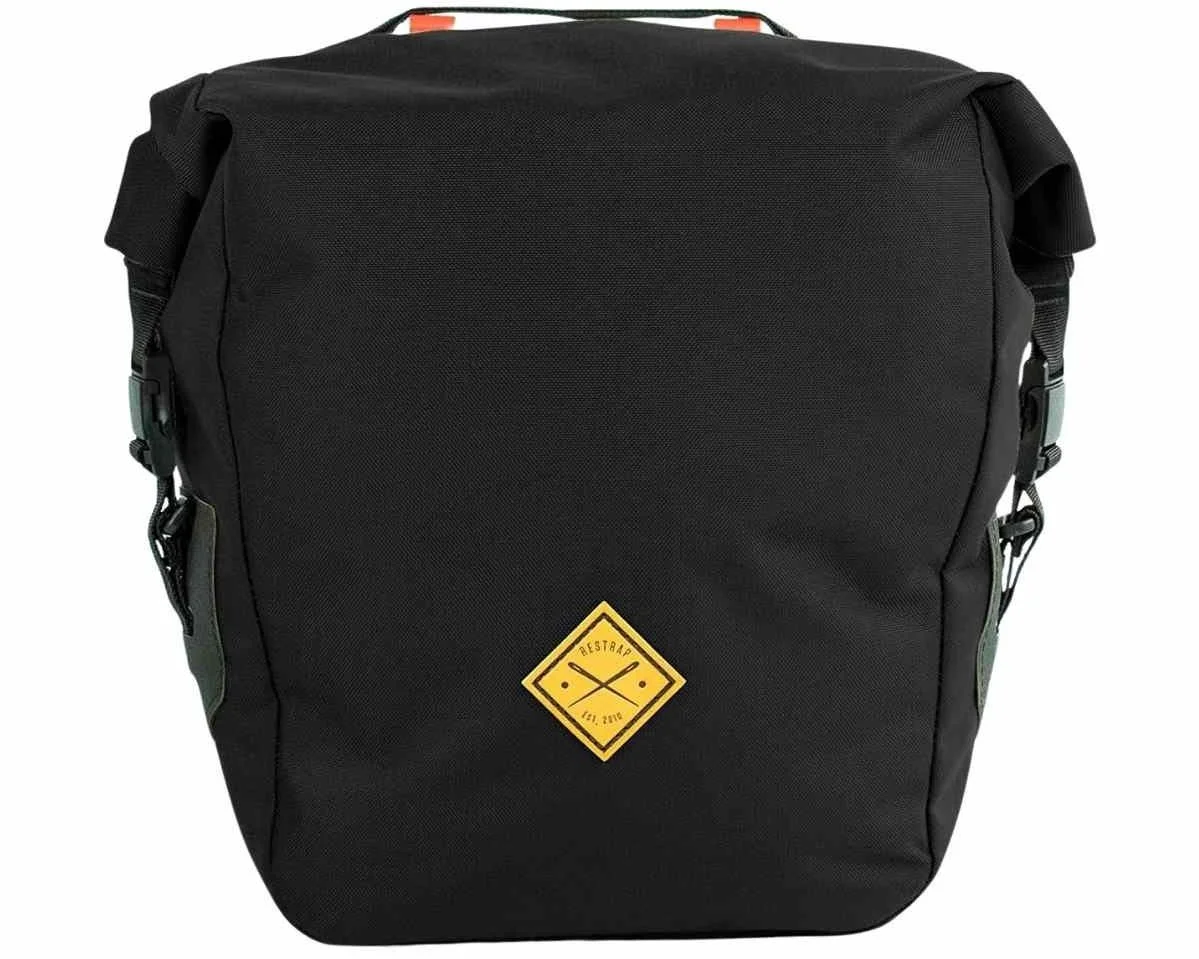
Storage capacity: 13 L, 22 L
Waterproof: yes
Closure: Roll-top
Exterior pockets: None
What we liked: Simple, waterproof, durable fabric, secure mounting system, works as a front or rear pannier
What we didn’t like: No pockets, expensive
These Restrap Panniers come in two sizes, Large and Small. The Large Pannier is 22 liters and perfect for a rear rack on your bikepacking setup. The Small pannier is 13 liters and perfect for the front rack in your bikepacking setup.
Other than size, these two panniers are identical in every way, so we’ll discuss them both here.
We tested these panniers in Denver during the summer and fall along the Colorado Front Range, riding a mix of pavement, dirt roads, and even a little singletrack.
These panniers almost took the Best Overall Panniers award, but aren’t quite as easy to hook and unhook from your rack as the ORTLIEB Sport-Roller.
However, these panniers combine modern mounting hardware with that classic pannier look and feel that some cyclists prefer to the shiny, rubbery look of an ORTLIEB Pannier.
Restrap Pannier


-
The Restrap Panniers are made with highly durable woven polyester and waterproof PU lining. It closes with a roll-top system, which secures shut with buckles on the sides of the bag. Compared to the ORTLIEB fabric, this fabric feels less slippery since it’s only laminated on the interior face. This fabric is more similar to a traditional canvas or Cordura, and is lighter than the ORTLIEB fabric since it’s not entirely coated in rubber.
Even though it’s similar to canvas, the exterior fabric is waterproof, and the lining adds another layer of water resistance, but the bag doesn't have taped seams. This means that while it isn’t submersible, it will keep your gear dry in all but the absolute wettest conditions. If you’re looking for taped seems, you should check out any of the ORTLIEB panniers or the Burly Panniers we tested, but we’ve found waterproof materials without taped seams are generally common in bike bags and usually waterproof enough to keep our gear dry in the rain.
-
The attachment system consists of a set of polymer hooks with a spring-loaded portion that slides around the rack’s rails. The springs press this secondary section of the hook mechanism underneath the rack rails to prevent the hooks from coming off your rack. These hooks are adjustable and slide along an aluminum rail to fit onto your rack.
A moveable hook at the bottom of the pannier to prevent it from swinging away from your rack, too. This system is pretty similar to the ORTLIEB system, but isn’t quite as easy to hook and unhook since you have to manually set or release the spring-loaded security hook underneath your rack’s rails.
-
These panniers are sold individually, and they’re handmade in England. These are some of the most expensive panniers we tested for a pair. And they have no pockets other than the main compartment. These are fantastic panniers, but there are less expensive options.
However, they have a lifetime warranty and are seriously well-made. Restrap does all of its manufacturing in-house. They source all their materials as locally as possible to minimize emissions from shipping. All their products are shipped in recyclable or biodegradable materials. Everything Restrap makes is vegan-friendly, too. You won’t be disappointed if you choose these over the ORTLIEB Sport-Rollers.
Best Bike Pannier for Groceries: Arkel Signature H

Storage capacity: 24 L
Waterproof: Yes
Closure: Roll-top
Exterior pockets: None
What we liked: Massive capacity, easy to carry, loads like a duffle bag, fully waterproof
What we didn’t like: Heel sometimes hits the bag when pedaling, no way to attach the bottom to a rack
The Arkel Signature H pannier is a 24-liter pannier that looks like the fanciest reusable grocery bag we’ve ever seen. This bag is massive. It has a padded shoulder strap and carrying handles to haul this bag off the bike. We tested all the panniers in this story on grocery store trips, and many panniers saw multiple grocery runs. This pannier was the best for grocery runs and hauling a lot of stuff around town. If you want to throw everything in one bag and attach it to your bike, this is the one.
Arkel Signature H
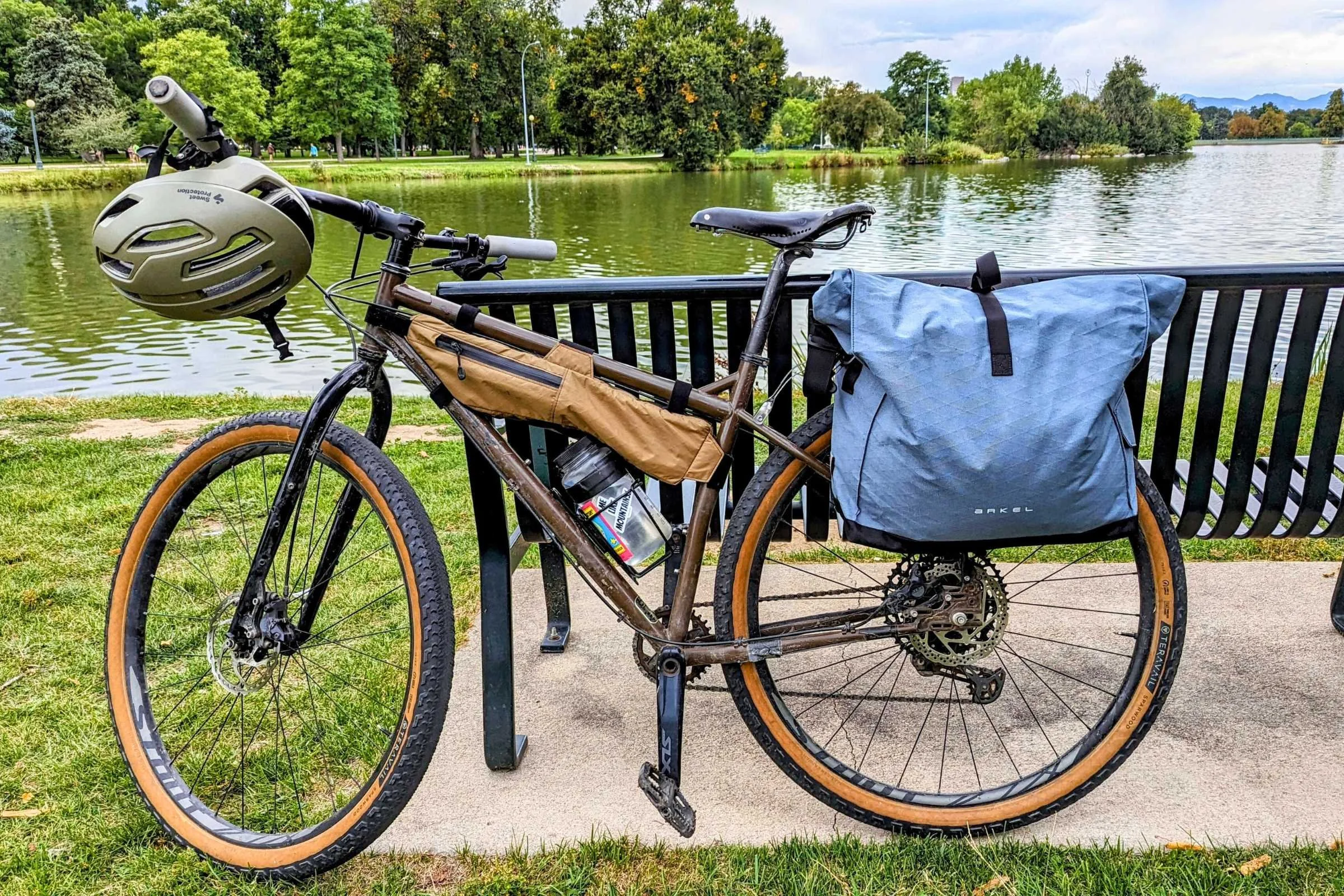


-
Some cyclists use a basket on top of their rack to throw all their stuff in, which is honestly one of our favorite methods for carrying gear while commuting by bike. However, the basket and rack combination isn’t for everyone. This bag is more elegant and bigger than all but the largest baskets we’ve seen mounted to a bike cargo rack. It’s also a shoulder bag you can carry off the bike. You can’t carry a basket off your bike nearly as easily.
-
When stopping at the grocery store on your bike ride home from work, you often have to prioritize what you need to buy that day and avoid buying large, bulky items because they won’t fit on your bike. You can’t quite buy everything in the store with the Arkel Signature H, but you can get a lot more than you can with all the other panniers we tested.
-
The Signature H is made of durable X-Pac X11 material, which consists of sustainably grown cotton. It has a waterproof liner with taped seams. This bag has a roll-top closure with a strap that secures over the top, so if you fill this too much, you can still partially secure your cargo. It’s also available in Cordura fabric that is more durable, but the cotton X-Pac X11 material we tried held up over months of testing. The Cordura option is the same price as the cotton option. You can’t go wrong with either fabric option, really.
-
The mounting system locks onto bike racks with ease. It has two camming rubberized feet that rotate out of the way when you pull up on the pannier’s carry strap, then turn back into place under the rack tubing when you release the strap. This mounting system maintains a firm grip on most sizes of racks over bumpy terrain. It’s also simple enough for less experienced cyclists; once you play with it off the bike once you’ll understand how this attaches. The mounting system doesn’t have a hook for the bottom of the pannier. But since the bag is shorter and wider shaped, it doesn’t need a hook to attach the pannier at the bottom. The top mounting hooks hold this pannier well enough on their own.
-
We found this pannier didn’t work well on bikes with shorter chainstays. Chainstays are the part of the bike that goes from the bottom bracket to the rear dropouts, where the hub attaches to the frame. Chainstay length effectively means the distance from the rear wheel’s center to where the cranks attach to the frame.
When we used this on our medium Surly Ogre, which has 440 mm chainstays, with an Axiom Transit Rack, our heels hit the bag as we pedaled.
This shouldn't be an issue if you have a touring-style bike with longer chainstays or a rack that sits farther back from your frame, but it was for our particular setup.
We had another friend test this pannier on her size Medium Fairdale Weekender with a Planet Bike Eco Rack, and she also had a slight issue with her heel hitting the pannier. Using a rack like the Axiom Streamliner DLX would push this pannier further back and avoid the heel-striking problem, but even with our current setups, it’s not that big of an issue.
-
We think this is an excellent choice for anyone who wants a bag to throw everything inside, hook onto a rack, and go.
Best Single Bike Pannier Bag: Two Wheel Gear Pannier Pack Convertible Plus

Storage capacity: 30 L
Waterproof: No, but comes with rain cover
Closure: Zipper
Exterior pockets: Laptop sleeve, zipper pouch, side water bottle pocket
What we liked: A backpack that converts to a pannier, tons of pockets, subtle design
What we didn’t like: not as easy to attach to racks
The Two Wheel Gear Pannier Pack Convertible Plus is a great single pannier bag for your bike that works just as well as a backpack. If you like the idea of a pannier that converts to a backpack but don’t love the technical, sporty look of the ORTLIEB Vario, this pannier and backpack combination is worth considering. We think this bag is the best for carrying it off the bike of any pannier. It would be great for someone who rides their bike to work or school and then does a lot of walking around with their bike bag.
This bag is best for people who primarily want a backpack that can sometimes be used as a pannier.
Two Wheel Gear Pannier Pack Convertible Plus


-
This bag looks like a traditional backpack—it’s made of canvas and has multiple zipper compartments. This pannier and backpack combo could replace your old Jansport and hook up to your bike. This is the only pannier we tested that isn’t made of waterproof materials, which is a drawback for wet environments. But, it’s also the only pannier that comes with a waterproof rain cover.
-
We tested this bag while commuting in Denver during the summer and fall. We used it as a backpack and a pannier, riding bike paths and city streets, carrying our laptops to coffee shops, and walking around town.
-
The Pannier Pack Convertible Plus has many pockets and organizational features, including an exterior water bottle pocket, laptop sleeve, multiple small zipper pockets, and pen holders. To turn it into a pannier, the shoulder straps and top half of the back panel fold down to reveal a set of pannier hooks. The buckles that you use to clip the shoulder straps to the bag also secure the bottom of the bag onto a rack. The top hooks lock in place with an extra spring-loaded clip in between these main hooks.
-
We’ve used easier mounting systems for attaching a pannier to a rack. This mounting system is certainly secure, but the side-release buckle to attach the bottom part of the pannier to the rack is harder to use than a simple hook.
-
However, this bag works best as a backpack of any panniers we tested, including the ORTLIEB Vario, and those side-release buckles are essential for attaching the backpack shoulder straps to the bottom of the bag.
-
If you’re primarily looking for a backpack, but want the versatility of using it as a pannier as well, we recommend the Pannier Pack Convertible Plus. However, if you mostly plan to use your pannier attached to your bike rack like a pannier, but want an easy carry off the bike as well, then the ORTLIEB Vario is the better option.
Other bike panniers we tested
Axiom Seymour P25

Storage capacity: 25 L
Waterproof: No, water-resistant
Closure: Zipper
Exterior pockets: Zippered pouch
What we liked: Lightweight, exterior pockets
What we didn’t like: Expensive for what it is
The Axiom Seymour P25 is a set of two panniers that hang over your rack like the saddlebags you’d use on a pack mule. This is a very simple design; we like that about these panniers. They’re two panniers with a piece of fabric that connects them, which you hang over the top of your rack. They have an elastic cord with a hook to prevent the panniers from bouncing off your rack and four pieces of Velcro that further secure the flap of fabric draped over the top of your rack. They also have exterior zipper pockets, which is surprisingly rare on panniers. And this pannier set isn’t very expensive.
Axiom Seymour P25

However, even with two panniers, these don’t have much carrying capacity. The zippered top lid makes it harder to pack these as full as you can with a roll-top design. So, their 12.5 liters-per-bag capacity doesn’t feel like enough space even though it’s the same volume as the ORTLIEB Sport-Rollers, which we think are the perfect size for most cyclists.
These panniers also don’t feel very durable–the fabric is thin, and the zippers feel flimsy. Even though we like that this material is made of recycled fish nets, we think these panniers could be improved with thicker material and more robust zippers, or a roll-top instead of that zipper closure.
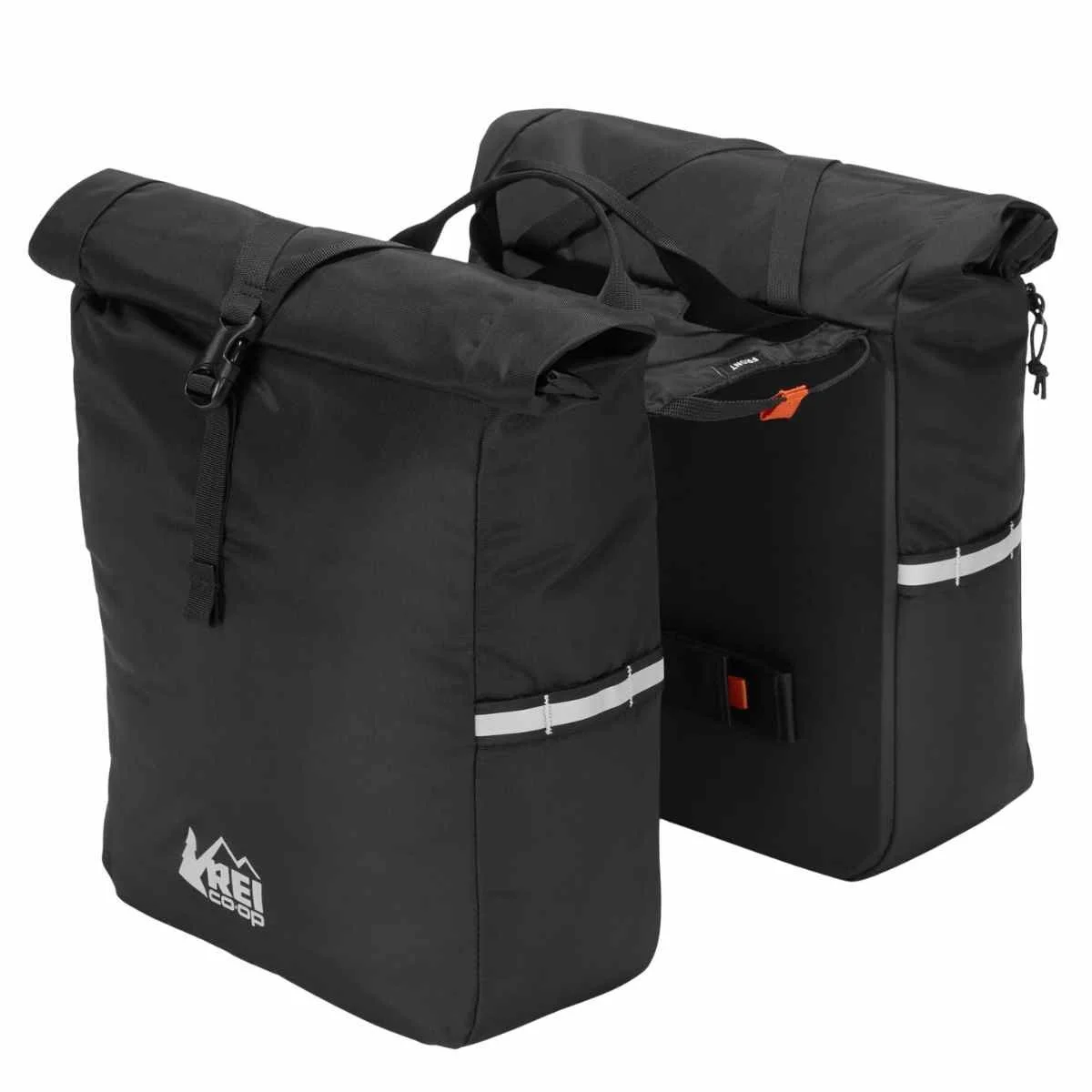
Storage capacity: 36 L
Waterproof: No, water-resistant
Closure: Roll-top
Exterior pockets: Exterior zip pocket
What we liked: Inexpensive, simple mounting system, durable, recycled materials
What we didn't like: Set of panniers can’t be separated
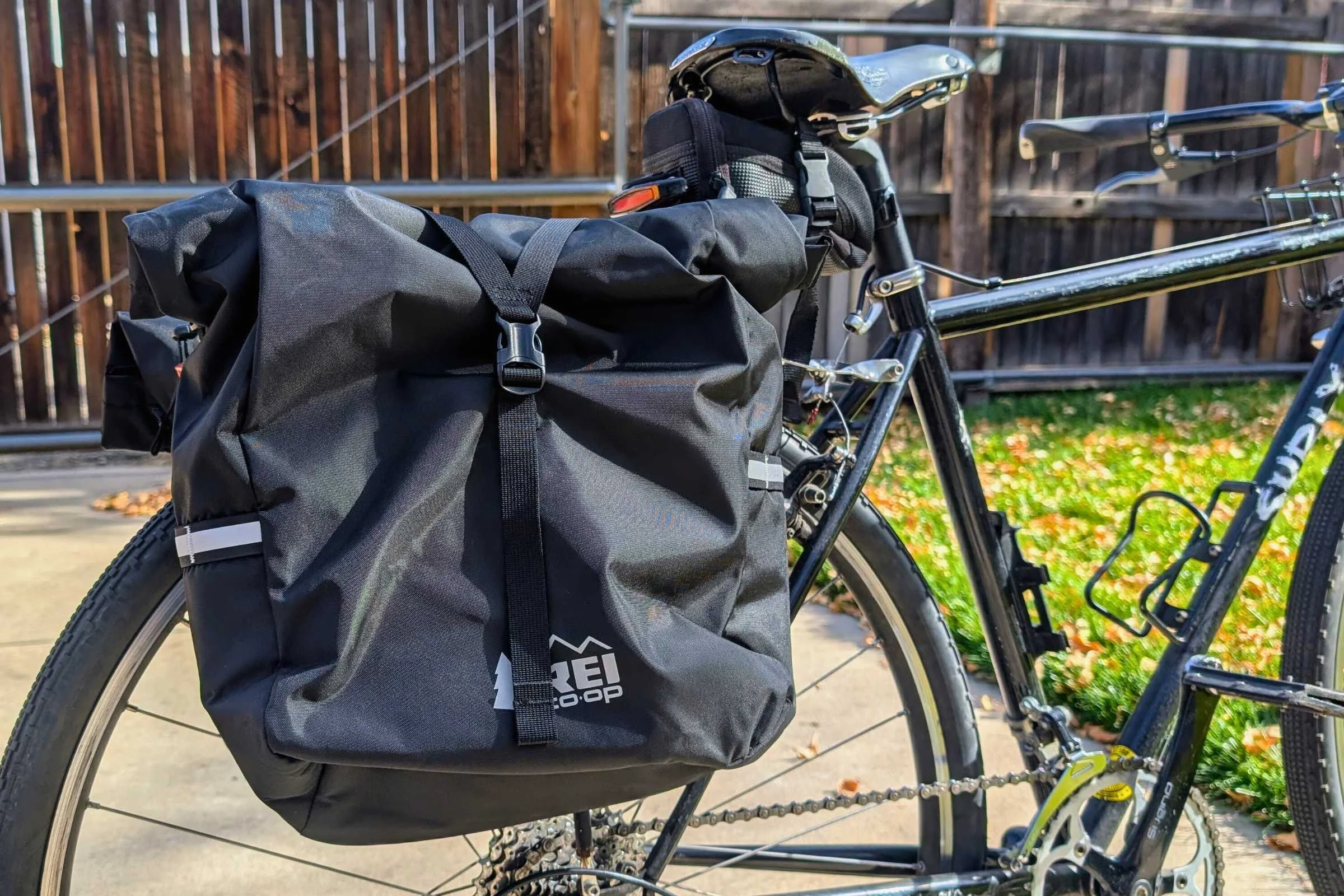
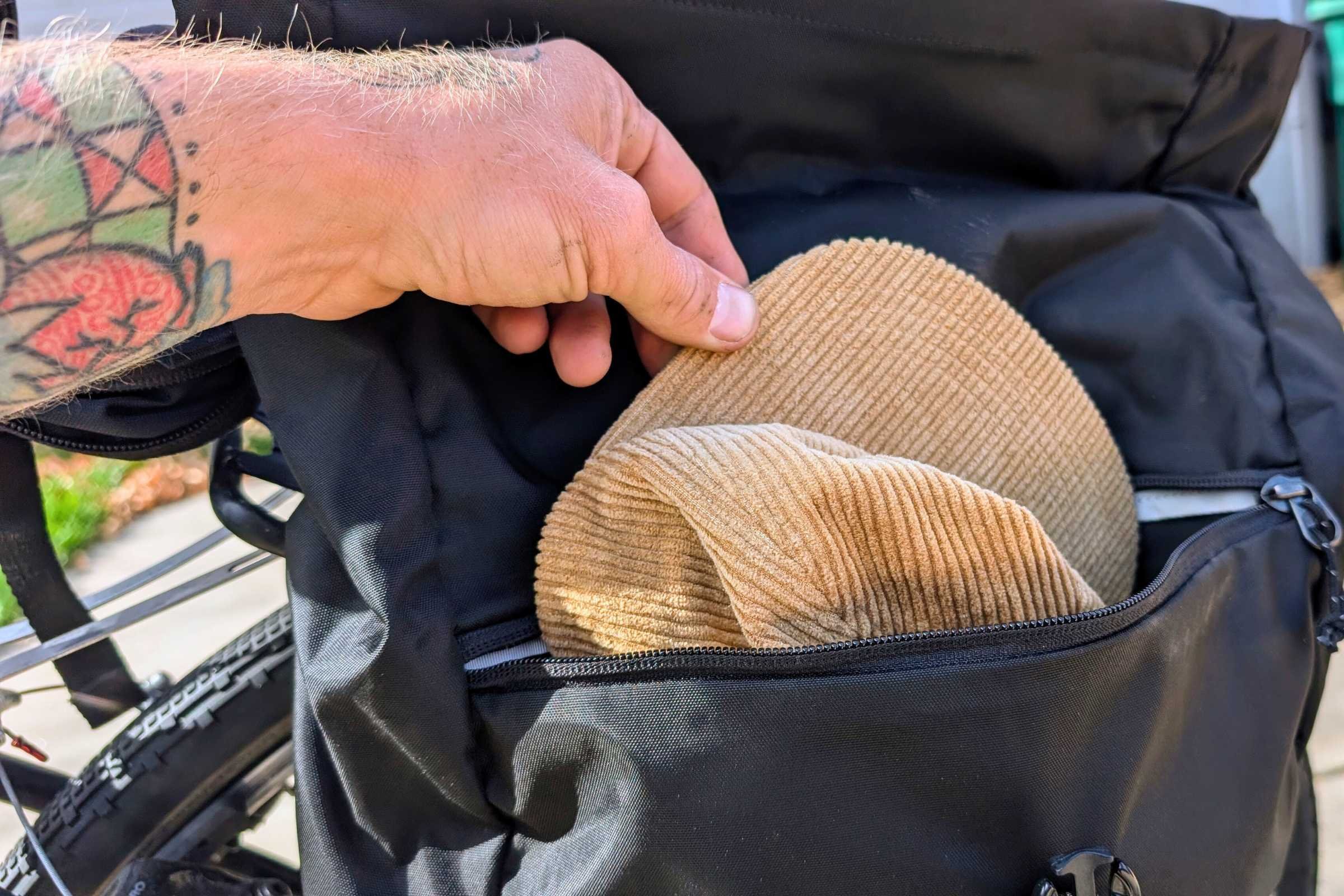
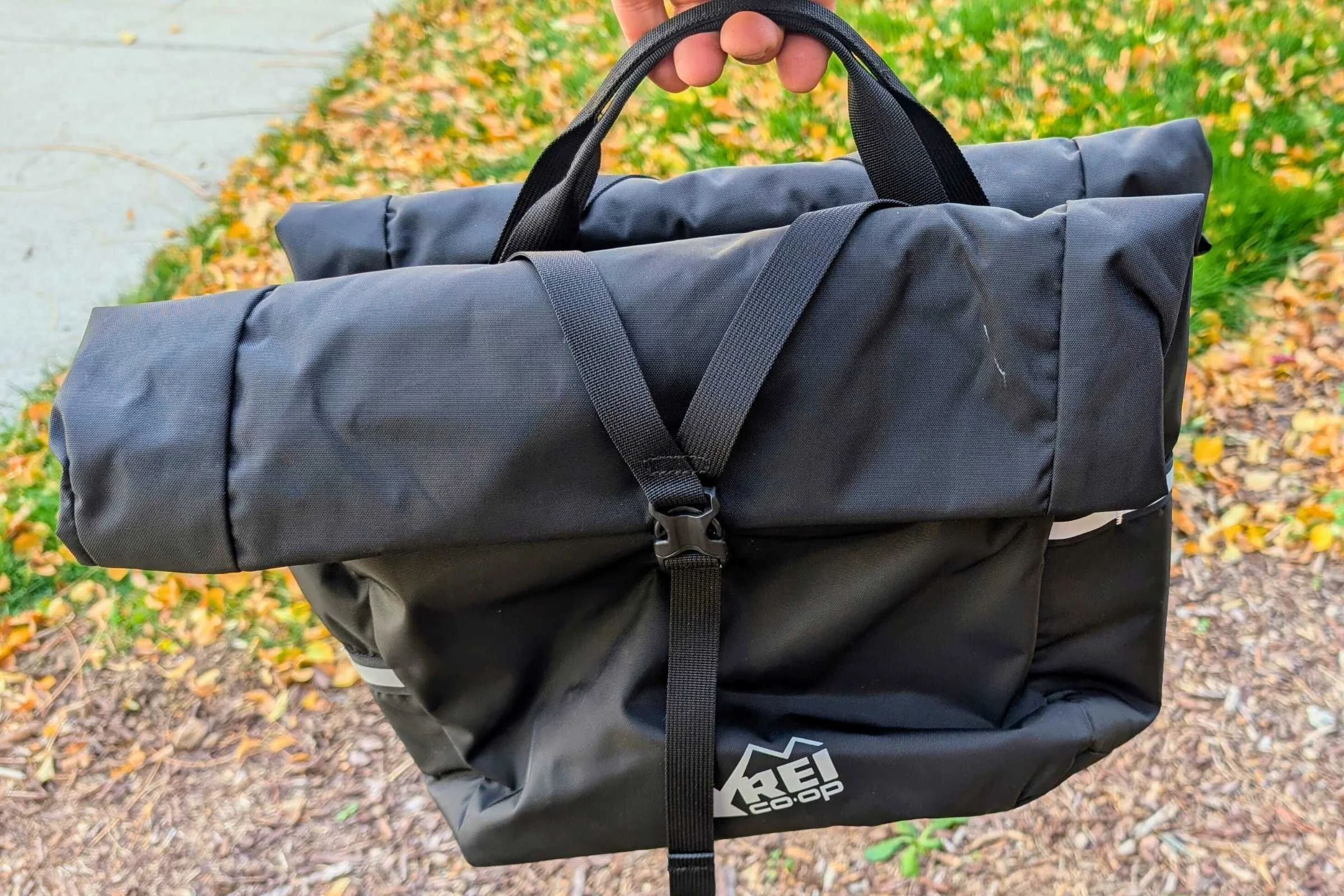
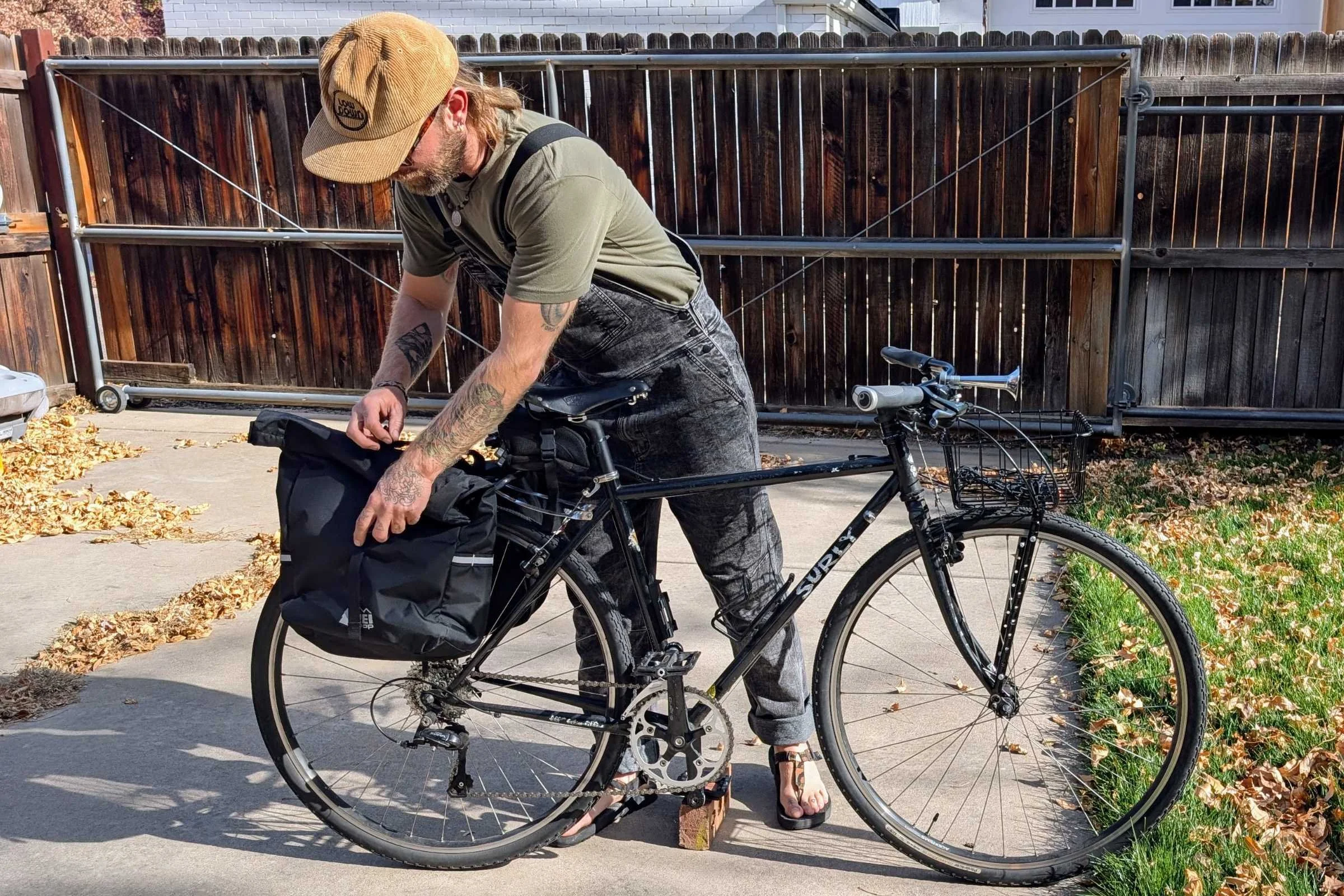
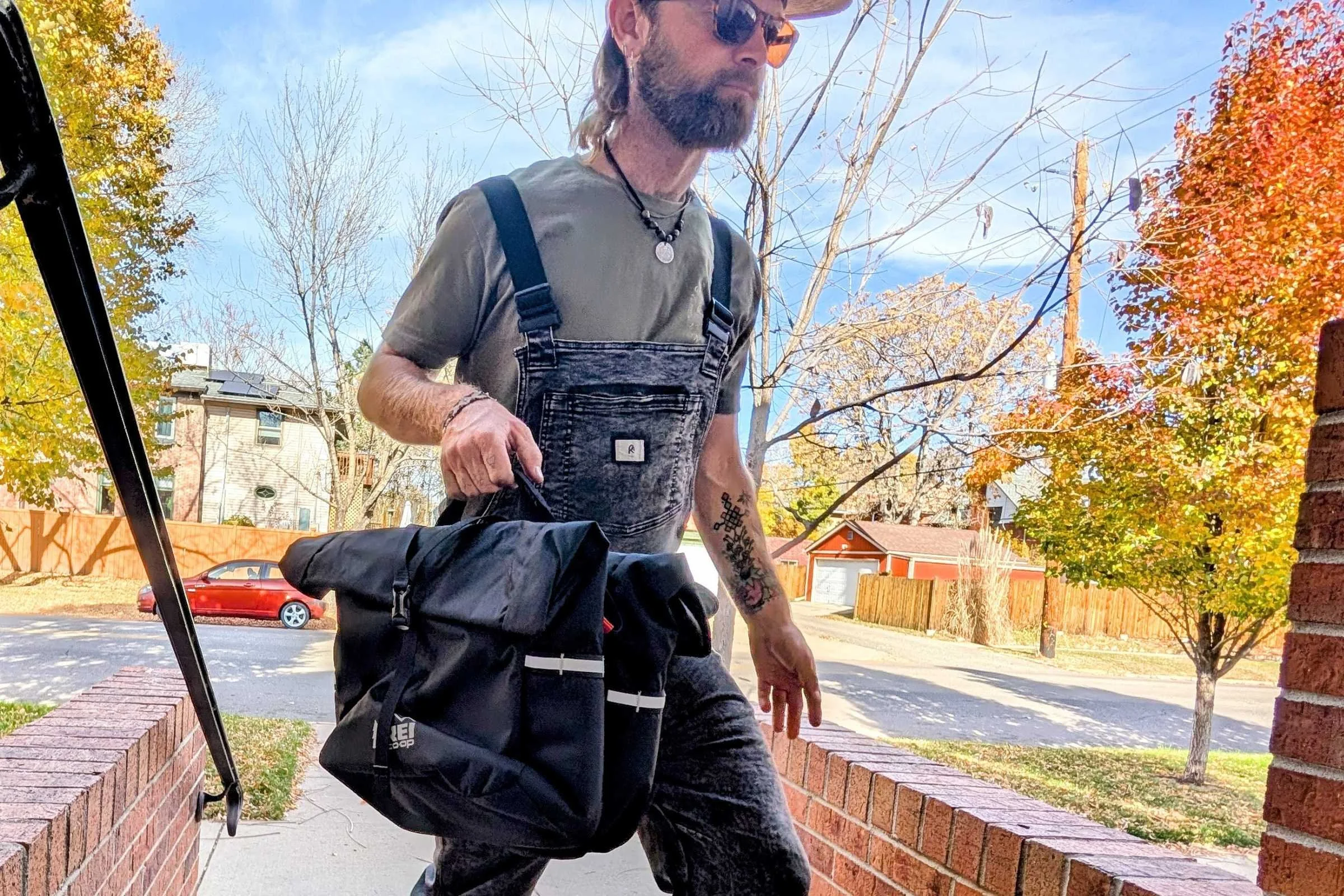
The REI Co-op Junction Panniers use the same design as the Axiom Seymour P25. They are two panniers attached to each other using recycled Oxford nylon, the same material as the panniers. This material is very durable. The durability, combined with the low cost for a pair of panniers, makes these panniers an excellent option for a simple commuting setup. They also have a zippered external pocket, which is rare for budget panniers of this style. They don’t have the highest capacity, though, so if you need to carry a lot of stuff, these aren’t ideal. If you want a set of simple canvas panniers to leave on your bike, these are a good option.
REI Co-op Junction Panniers

What to look for in bike panniers
Capacity and size
The capacity of the panniers you choose should be large enough to fit what you want to carry without being too large that you never fill your panniers. Consider how far you want to go and what you want to carry in your panniers, and then select the pannier size that will work best for that.

Internal storage of Restrap Large, Two Wheel Gear, and Arkel Signature
If you want one pannier to do it all, for everything from bike touring to commuting, we recommend a set of 20-liter panniers. Using them both will give you 40 liters of capacity, which will be enough for most or all of your camping gear. When commuting, you can use one of them to carry everything you need and add the second for hauling even more, like for trips to the grocery store.
Also, consider how many panniers you want to carry when choosing what size to purchase. If you plan to use two panniers, you’re effectively doubling the amount of space you have.

ORTLIEB Back-Roller vs Arkel Signature H
Pannier capacity is usually measured in liters. We think the sweet spot for pannier size is between 10 and 20 liters. This is the average size of a small daypack, for reference. The largest panniers available have a 25 to 30-liter capacity, and two of those will let you carry a whopping 50-60 liters of gear. That’s larger than many popular backpacking packs.
Do you really need the storage that two daypacks provide? The answer is probably yes for hardcore commuters bringing a change of clothes to work and stopping at the grocery store on the way home. But for some of us, the answer might be no. If you’re commuting around town and not planning to carry much stuff, you’ll probably only need a single pannier. You might not even need a single pannier at all, though. If you need less than 12 liters of carrying capacity, a handlebar bag, seat bag, or frame bag is also worth considering.
If you’re touring with four panniers, 15 liters per pannier will give you 60 liters of storage. With touring setups, front panniers are often smaller than rear panniers to fit on smaller front racks and leave room for a front handlebar bag.

Left to right: Arkel Signature, ORTLIEB Vario, Axiom Seymour, Two Wheel Gear, Burly
Material and durability
Panniers made of thicker material will be more durable than those made with thinner material. Bikes and bike bags tend to take a beating, especially in off-road scenarios. If you lay your bike on the ground with panniers attached, those panniers should be durable.
However, thicker materials are also heavier. Durability and weight are often a tradeoff with pannier materials–often, the more durable a pannier is, the more weighs. If you’re prioritizing fast and light, go with a pannier with a thinner material to save weight. If you don’t anticipate being too rough on your panniers, you can get away with using less durable panniers made of thinner material.

Left to right: REI Link, Axiom Seymour, Restrap, Two Wheel Gear
Mounting system
Most panniers use a pair of hooks at the top and a secondary hook at the bottom to mount onto a bike rack. However, not all mounting systems are created equally.

Mounting system of REI Link and Axiom Seymour
Some mounting systems consist of basic metal hooks and an elastic cord with another metal hook on the bottom, like the Axiom Seymour P25. This mounting system is tried and true. You can easily repair it with equipment from most hardware stores. The REI Beyonder Panniers also use simple hooks to attach to your rack and a velcro strap at the bottom. This system can be repaired using materials from a hardware store as well.

REI Link and Axiom Seymour have simpler mounting systems, while ORTLIEB Vario has a mounting system that you can fine tune

Bottom attachment mounting system of Restrap vs. Two Wheel Gear
Other pannier mounting systems are more complex, with specially designed hooks that lock onto a bike rack and a bottom attachment system that requires tools to adjust. Mounting systems like this are the most secure. But if they fail, you’ll have a difficult time finding replacement parts.

Mounting system of (left to right) Restrap, Burly, ORTLIEB
The mounting systems on the ORTLIEB, Burly, Arkel, Restrap, and Two Wheel Gear panniers all have special hooks and other hardware you’d need to source from the manufacturer if something breaks.
During a trip, you can repair the mounting hardware for these panniers using common items found in a hardware store or zip ties. When you get home, you can source replacement parts for your panniers’ mounting system.

Orlieb Vario, ORTLIEB Back-Roller, and Burly Panniers are all 100% waterproof
Waterproofing
Many panniers are waterproof or at least water-resistant. Most pannier materials have a waterproof coating, but not all panniers are seam-sealed for a fully waterproof design. Furthermore, any zippered closures may let water in unless a pannier is made with waterproof zippers. The ORTLIEB and Burly panniers are fully waterproof and seam-sealed with a roll-top closure. The Arkel Signature H has a waterproof liner and waterproof exterior material, so it is also fully waterproof.

Two Wheel Gear Rain cover and REI link water resistant stuff sacks
If you plan to use your panniers in extremely wet conditions, look for panniers made of waterproof materials that are fully seam-sealed and have a roll-top closure. These panniers will be the most waterproof. But, these panniers tend to have fewer pockets to organize your gear.
For bike touring, it’s best to have fully waterproof panniers. You can usually hop on a bus to stay dry when commuting, but that’s probably not an option on a bike tour. You should at least have waterproof covers for your panniers if bike touring, but fully waterproof is better.
If you mostly ride your bike in dry conditions, waterproofing might not be necessary. Your gear will probably stay dry enough in the occasional rain shower with water-resistant panniers.
Another thing to consider is that, over time, waterproof panniers will become less waterproof as you wear out the exterior waterproof coating. We’ve spent hours filling waterproof panniers with water to find leaks in the waterproof materials and patch those holes with seam sealer, only to still end up with wet gear after we thought we repaired all the holes.

Security features
Some panniers have security features to lock the bag shut and prevent a thief from grabbing it off your rack. The ORTLIEB Front-Roller and Back-Roller models we tested can be used with this security cable, which attaches to the mounting hardware to prevent thieves from snagging your panniers.
Security is most important for touring cyclists who want to leave their bikes outside without unloading all their gear. However, these security features usually aren’t robust enough to leave your bike unattended for long periods.
As a rule of thumb, in small towns, we don’t worry much about locking our bags on our bikes or even locking our fully loaded bikes. We’ve never had a thief try to steal a bag off our bike in a small town. But we also never leave our bikes unattended for more than a few minutes, no matter how small of a town we’re in. We never leave a bike with bags unattended in bigger towns, and definitely not in large cities. If there are more than a handful of stoplights in a town, we always bring our bikes inside or leave them where we can see them.

REI Link pannier loaded as a single on a rear rack.
Weight and balance
We find it’s best to balance the weight in your panniers on either side of your rack as much as possible. This is especially important on front racks, where a poorly balanced set of panniers makes steering especially difficult.
If you only plan to use one pannier, always put it on a rear rack. An unevenly weighted rear rack doesn’t affect steering as much, but it will still feel different than two weight-balanced panniers. We like the simplicity of one pannier for commuting, and the weight on a rear rack doesn’t negatively affect the balance enough to outweigh the ease of use that one pannier pannier allows for commuting.

Exterior pockets on Axiom Seymour, ORTLIEB Vario, Two Wheel Gear
Ease of access
Panniers with exterior pockets allow you to access items on the go quickly. Also, zippered panniers make it easier to access the main compartment than roll-top panniers. However, roll-top panniers allow you to dig around inside your pannier, though unrolling the closure and rolling it back down takes more time than simply unzipping and then zipping a pannier shut.

Carry strap of ORTLIEB Back-Roller and Arkel Signature
Versatility and convertibility
Some panniers are versatile enough to mount to a bike rack, ride to your destination, and throw on your back as a backpack or shoulder bag.

Roll top closures or ORTLIEB, Arkel, Burly, Restrap, REI Link
Many panniers convert to a shoulder bag by clipping a strap onto the sides. There are panniers that go farther than this, though. These panniers may have a pair of integrated backpack straps, clip together to make carrying a pair of panniers easier, or fold flat on your rack when not in use.

ORTLIEB Vario and Two Wheel Gear convert to backpacks
Additional compartments and pockets
Some panniers have interior compartments to keep small items from getting lost. Others have additional pockets for snacks, a phone, maps, water bottles, and more outside the bag. The Two Wheel Gear Pannier Pack Convertible Plus has the most pockets of any pannier we tested. This pannier/backpack has a laptop sleeve and multiple small interior pockets along with an exterior zipper pocket and water bottle pocket.
Additional compartments and pockets make staying organized easier, but you may not need that feature if you use other bags on your bike, such as a handlebar bag. Some extra pockets will come in handy for commuters and others who take a streamlined bag approach.
How to choose the best bike panniers for your needs
Consider your needs
When choosing panniers for your bike, consider what you plan on using them for.
Are you going to use them for commuting? Or bike touring? Or do you plan on bikepacking with your panniers? All these uses could warrant different styles of panniers, but most panniers will work well enough for commuting, bike touring, and bikepacking.
Panniers for commuting should be easily removable and easy to carry off the bike. Commuting bike panniers should be durable enough to stand up to pavement, bike racks, and the general wear and tear of daily bike commuting.
Panniers for bicycle touring should be large enough to carry all your gear and probably waterproof. Since you’ll be loading a lot of gear into panniers when touring, we find roll-top panniers are often best for this use. Also, many touring cyclists often use four panniers–two on a rear rack and two on a front rack–so you’ll need more panniers than you might otherwise.
Bikepacking panniers are often smaller and lighter versions of bike-touring panniers. Bikepacking setups often use two panniers on a lightweight rear rack and a frame bag and handlebar bag. You don’t want bikepacking panniers to be too large so that you can fit through tight spaces. Smaller panniers also won’t get in the way while you’re pushing your bike up a steep hill.

Two wheel gear, Restrap Large, restrap small, Arkel Signature, Axiom Seymour, REI Link
Think about the size and capacity
You probably don’t need the biggest pannier available. We’ve seen panniers that are upwards of 30 liters; a set of those massive panniers will be heavy and annoying to carry off the bike. And unless you plan to haul a ton of gear consistently, you probably won’t often fill them. You can always strap extra items on top of your rack if you need a little extra space.
That said, the smallest panniers might need to be bigger if you carry a variable amount of cargo. We think medium-capacity panniers, around 20 liters, hit the sweet spot between versatility, weight, and portability.

Burly vs. Restrap Large vs. Axiom panniers.
Consider the materials
Most panniers are made with durable materials that will last a long time. However, if a pannier is made of cheap materials, it might not.
Also, there are a lot of pannier options made of recycled materials. We think this is important to consider when buying new gear, including when choosing panniers. Recycled materials are just as durable as their non-recycled counterparts but have a smaller carbon footprint.

The water bottle pocket on the Two Wheel Gear pannier-backpack hybrid pack.
Think about the features
Consider the features of a pannier and ask yourself, “Are these features useful for me?” Just because a pannier has 20 listed features doesn’t make it better for your intended use. Some features are super useful, such as extra pockets. Other features, like extra straps and buckles, might not be as useful for most people.

Burly vs. Axiom panniers.
Set a budget
Set a budget when you start to shop for panniers. Consider how much you can afford to spend, and find some panniers that fit within your budget. Panniers are expensive, but remember they usually come in pairs. You’re often getting two bags for that price. Some panniers are sold individually, though. If you only need one, this is an excellent way to stay within your budget.

Bike touring on a tandem bike with ORTLIEB Back-Rollers used as front panniers.
Front vs rear panniers
Technically, any pannier on a front rack is a front pannier, and any pannier on a rear rack is a rear pannier. You can often use front and rear panniers interchangeably, but there are some differences between front and rear panniers.
Placement and weight distribution
Front panniers: Front panniers work best on a low-rider style front rack, which centers the bag's weight on the bottom of a bike’s front fork. They will negatively affect how your bike handles if you don’t balance the weight between a pair of panniers evenly. Front panniers are best used as a pair because a pannier on one side of a front rack will constantly pull your steering in that direction.
Rear panniers: Rear panniers fit on any standard rear bike rack that attaches to your bike above the rear wheel. It isn’t as important to balance the weight between two rear panniers because the uneven weight on a rear rack won’t adversely affect your steering. For this reason, you can use a single rear pannier.
Carrying capacity
Front panniers: Front panniers are usually smaller, often 10-15 liters.
Rear panniers: Rear panniers are usually bigger and range in sizes from 15-30 liters.
Impact on bike handling
Front panniers: When used as a pair, front panniers will make your bike handle slower. Since there’s more weight to turn, turning will initially feel more difficult. But you’ll get used to it. If you have a pair of unevenly weighted front panniers, you’ll have to fight with the handlebars to keep them from turning to the side of the heavier pannier.
Rear panniers: Rear panniers make your bike feel more sluggish when starting, but only because the bike is heavier than you’re used to. Handling is mostly the same with rear panniers as it is without rear panniers, but it will feel different than your bike feels without panniers.

A rear pannier with an exterior pocket.
Accessibility and organization
Front panniers: You can reach your front panniers without getting off the bike, so it’s convenient to put items you need to access quickly in exterior pockets or at the top of your front panniers. We recommend putting things like a rain jacket, snacks, and maps in your front panniers.
Rear panniers: Rear panniers can hold more weight, so we recommend putting heavier items in your rear panniers. You can’t reach your rear panniers as easily, so don’t put anything you want to grab quickly in a rear pannier unless it’s your only option. If a rear pannier has exterior pockets, those pockets will be harder to access while on the bike and will be impossible to access while riding.
Riding style and terrain
Front panniers: We recommend using front panniers for roads and smoother off-road terrain. Front panniers affect the handling of your bike and sit closer to the ground. If you’re using front panniers on rough terrain, they could snag on rocks or debris and cause a crash.
Rear panniers: Rear panniers sit higher off the ground, so they’re more versatile. For this reason, we think rear panniers can work for offroading or on roads. Another benefit of rear panniers when offroading is you can use a dropper post with a rear rack and pannier setup. This is helpful because you can’t use most bike seat bags with a dropper post, especially the larger ones used for bikepacking.

The Restrap Pannier large used as a rear pannier. We like the Restrap pannier small as a front pannier.
Combination use
Using a pair of front and rear panniers allows you to distribute weight across your bike evenly. This keeps your bike feeling as agile as possible and doesn’t put excess weight on any one part of your bike.

Mounting systems on the Axiom Seymour, ORTLIEB Vario, Two Wheel Gear, ORTLIEB Back-Roller
How to attach panniers to your bike
1. Choose the right bike rack
Most bike racks will work with standard panniers, but ensure the rack you’ve chosen will work with panniers.
2. Prepare the panniers
Load your panniers with gear. You can also wait to load your panniers until after you’ve mounted them on the rack.
3. Position the rack
Mount the rack on your bike. Double-check that every mounting bolt is securely tightened.

Close up on the mounting system on the ORTLIEB Back-Roller panniers.
4. Check the mounting system
Examine how the panniers attach to a rack. You might have to adjust parts of the mounting system to fit your rack.
5. Attach the panniers
Hook the top part of the pannier’s mounting system first, then the bottom portion.
6. Balance the load
The more evenly balanced you load your panniers, the better it will handle.

Restrap Pannier large mounted so that it won’t fall off during riding.
7. Check stability
Give your bike a good shake. Lift it by the rack and let it fall a few inches. You want to make sure those panniers aren’t going to fall off while riding.
8. Secure and adjust
If anything doesn’t seem secure, adjust it so it passes your stability tests.
9. Test ride
Take it for a quick spin in a quiet place without much traffic.
10. Make final adjustments
Recheck the stability and make any needed adjustments. Now you’re ready to ride!
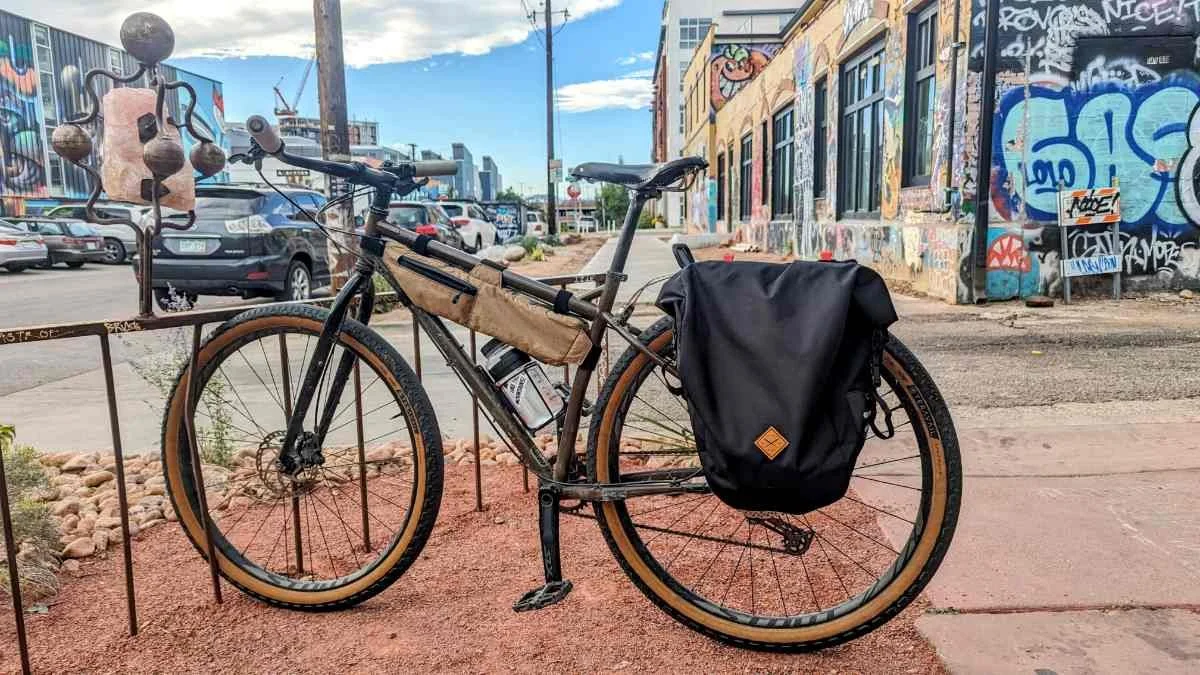
Restrap Pannier large in Denver.
How to pack bike panniers
We find it’s easiest to pack panniers before you put them on the bike, just as you would a backpack or stuff sack. It’s best to put heavier items in rear panniers and smaller, more compact items in front panniers.
Some people prefer to use packing cubes or other stuff sacks when packing bike panniers. While you don’t need to use packing cubes to keep things tidy in your pannier, it is an effective way to keep organized and add an extra layer of protection to your most important cargo. We most often use the pannier itself as a stuff sack to save weight and simplify packing, but we always use a waterproof stuff sack for our sleeping bag. If your panniers aren’t waterproof and you’re bike touring in a wet climate, you should definitely use waterproof stuff sacks or dry bags to keep your gear dry.
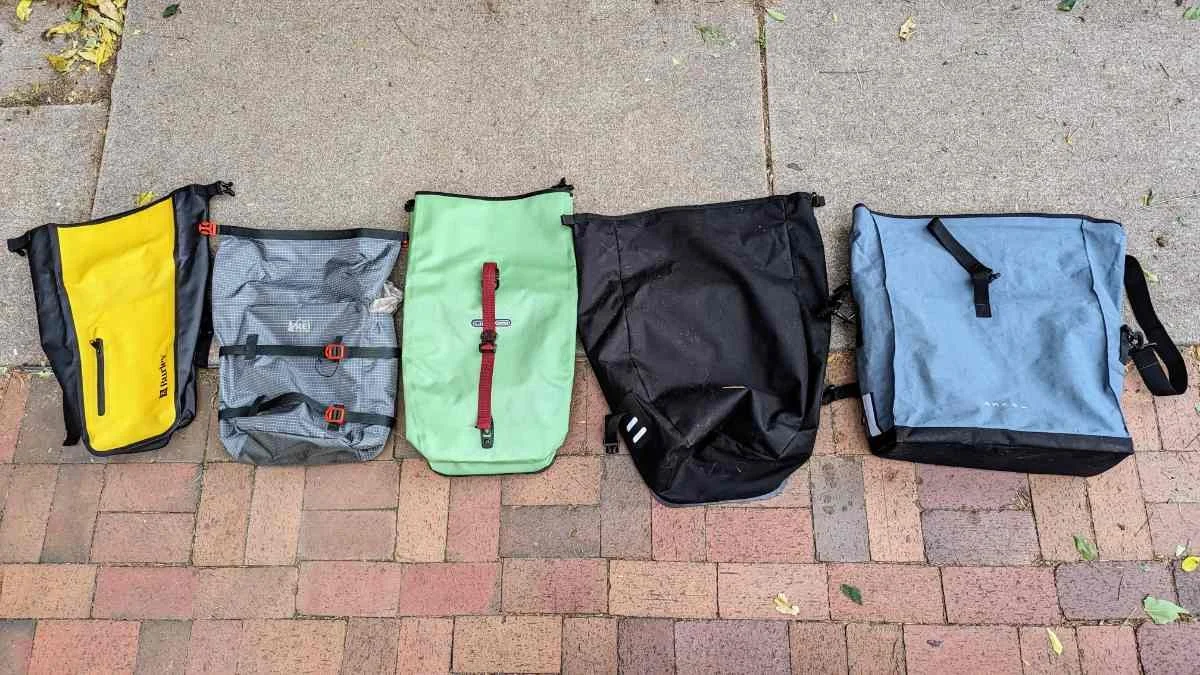
Left to right: Burly, REI link, ORTLIEB Back-Roller, Restrap large, Arkel Signature
Care and maintenance
Cleaning
Most bike panniers are water-resistant and easy to wipe down, but occasional spot cleaning helps extend their lifespan. Use mild soap and water to remove dirt, and pay special attention to zippers and mounting hardware, where grit can cause premature wear. For heavier buildup, hand wash in a sink or hose them off and let them air dry.
Drying
Always air dry panniers completely before storing. Avoid using a clothes dryer, as heat can damage waterproof coatings and fabrics.
Waterproofing and repairs
If your panniers seem less waterproof than they once were, spray a coat of Nikwax TX Direct Waterproofing Spray onto them. This will add a new layer of water-resistant coating to your panniers. For fully waterproof models made from rubberized materials, small holes can be repaired with seam sealer or repair tape. Many brands also sell replacement mounting hardware, and universal hardware kits are widely available for quick fixes.
Repair kits
You can repair minor tears and rips in the fabric on your panniers with Noso Patches or Tenacious Tape repair tape. You can also purchase replacement mounting hardware from many companies that make panniers. If a company doesn’t sell replacement hardware, you can buy universal pannier hardware to repair them. You can also field repair most issues with pannier mounting hardware with a few zip-ties as well.
Lubricate zippers
Keep all zippers cleaned and lubricated. After an especially dirty trip, clean and lubricate zippers with zipper lubricant.
For more on zipper maintenance, check out our guide to fixing zippers on outdoor gear.
Inspection and storage
Regularly inspect fabric, seams, and mounting hooks for wear, especially along the bottom edges and contact points. Replace worn hardware before it fails, as a broken mounting hook can cause a crash. Store panniers clean and dry, and avoid folding rigid panels or creasing structured materials.
Weight and surface protection
Do not exceed your rack’s weight capacity, as overloading can damage both the rack and panniers. Avoid resting them against abrasive surfaces like brick or stone, which can wear down fabric over time.

Riding in a local park using the Axiom panniers.
FAQ
-
Bike panniers are compatible with most bikes as long as the bike has a rear or front cargo rack installed. Panniers attach to racks rather than directly to the bike frame, so compatibility depends on whether your bike supports rack mounting and whether the rack tubing works with the pannier’s hook system. Road, gravel, touring, hybrid, and many e-bikes typically work well, while some mountain bikes may require alternative mounting solutions.
-
No, traditional bike panniers require a cargo rack to mount securely. If your bike does not support racks, you’ll need to consider rack-free options such as frame bags, handlebar bags, or saddle bags, which attach directly to the bike frame and are commonly used in bikepacking setups.
-
Yes, you can use both front and rear panniers together on the same bike. This setup is common for bike touring because it increases total carrying capacity and helps distribute weight more evenly across the bike, improving stability compared to loading everything onto the rear rack alone.
-
Yes, bike panniers can reduce speed because they add weight and increase aerodynamic drag. The effect is more noticeable at higher speeds or in windy conditions, but for commuting and touring, most riders find the added carrying capacity outweighs the minor loss in efficiency.
-
Yes, panniers can affect balance and handling, especially if the load is uneven. A well-balanced setup with equal weight on both sides minimizes steering changes, while riding with only one pannier or poorly distributed weight can make the bike feel less stable, particularly during climbs or descents.
-
The right pannier size depends on how much gear you plan to carry and how you use your bike.
For daily commuting or light errands, smaller panniers in the 10–20 liter range per bag are usually sufficient, while grocery runs or overnight trips may require 20–35 liters. Multi-day bike touring often calls for larger combined capacity across front and rear panniers. Choosing the right size means balancing storage needs with weight and handling, since larger panniers encourage heavier loads.
-
Bike touring panniers are designed for durability, weather protection, and high capacity, while commuter panniers prioritize organization and everyday convenience. Touring models typically use rugged materials, waterproof construction, and roll-top closures to withstand long-distance travel and harsh conditions. Commuter panniers often include laptop sleeves, internal pockets, and quick-release systems for easy on-and-off use during daily rides to work or school. The best choice depends on whether your focus is extended travel or daily transportation.

The author on one of many testing trips from late summer to early winter.
How we researched and tested
We tested bike panniers racks biking in Denver, Colorado, and along the Colorado Front Range. We also tested panniers while bikepacking in Utah, bike touring in Colorado’s mountains, and riding across town on closer-to-home adventures.
We mounted all these panniers to our size medium Surly Ogre with an Axiom Transit cargo rack, noting how easily they attached. Then, we filled these panniers with gear and started riding.
We also tested these panniers on many other bikes: modern e-bikes, vintage road bikes, a size extra-small Surly Ogre, and a Fairdale Weekender gravel bike to see how each pannier felt on a variety of kinds of bicycles.
We noted how easy it was to pack each pannier, how durable they felt throughout everyday use, and how easy every bag made it to stay organized. We looked at pockets, mounting hardware, and replacement parts for each pannier.
OUR TESTING PROCESS
We tested bike panniers around Denver and across the Colorado Front Range on tours, commutes, grocery runs, and mixed-terrain rides using a Surly Ogre as our main test bike.
How we tested
- Rode panniers around Denver and the Colorado Front Range
- Used them on bike tours and bikepacking trips
- Tested them for commuting and grocery hauling
- Rode in real-world pavement, gravel, and mixed terrain
What we evaluated
- Waterproof construction and weather protection
- Rack attachment security and ease of mounting
- Carrying capacity and off-bike practicality
- Durability for commuting, touring, and hauling

About The Author / Why You Should Trust Us
Sam Schild has biked over 50,000 miles in the last decade. He is an avid bike commuter and has extensively ridden road, mountain, and gravel bikes. He has bike toured and bikepacked over 10,000 miles — across the United States, on the Kokopelli Trail, Colorado Trail, and all over the American Southwest.
He has also worked as a bike mechanic for over ten years. Between his experience as a bike mechanic and his own cycling experience, he’s seen more panniers than he can count. He has sorted through piles of donated bike panniers at bike co-ops, designed and sewn his own bike bags, and even used a pair of bike panniers he made himself when cycling across the United States. You can see his guide to Bike Tire Pumps, Bike Frame Bags, Bike Cargo Racks, and Bike Saddle Bags at Treeline Review and more on his website.
You can read more about Sam on his author page.