Best Men's Windbreaker Jackets of 2026
Windproof, water resistant, lightweight, windbreakers—for hiking, camping, running, cycling, skiing

November 29th, 2025 with a new winner for best running windbreaker and best waterproof windbreaker, to remove discontinued products
Home > Gear Reviews > Apparel
We’re blessed with a lot of high-performing windbreakers available these days. Windbreakers have become more popular for casual use as an extra, lightweight, compressible layer that you can stash in a pocket or bag when heading outside. Many people are also discovering how versatile they are for hiking, running, cycling, and skiing—those moments when a base layer isn’t enough, but a fleece or insulating puffy is too much.
To find the best men’s windbreakers, we tested these jackets in the Eastern Sierra at about 5,000 feet during fall and winter when snow levels were high and sunshine was abundant. We ran, hiked, ski toured, gravel biked, and walked around town to see which jackets actually broke the wind, which breathed well during high-output efforts, and which ones fit comfortably over layers or a helmet. We also looked closely at fabric feel, packability, durability, and how each jacket handled that “just enough” warmth gap when the shade hits or when you’re descending on a windy day.
During testing, we found big differences in breathability, wind resistance, and fit. Some jackets let a little—or a lot—of wind through. Some were more stripped down and ultralight, while others included more features. The jackets that performed best balanced wind protection with breathability, resisted light moisture, and packed small enough to bring everywhere.
Top pick: The original Patagonia Houdini is our Best Overall Windbreaker Jacket for Men. Long-term tested since 2019 across humid and dry environments, it’s unmatched for its combination of fit, feel, durability, coverage, weight, and value. It has become a go-to “just in case” layer for running, cycling, hiking, skiing, and daily use—precisely because it consistently delivers the right amount of protection in the widest range of conditions.
Looking for women’s windbreakers? See our Best Women’s Windbreakers guide.
We create reader-supported, objective, independently-selected gear reviews. This story may contain affiliate links, which help fund our website. When you click on the links to purchase gear, we may get a commission, without costing you an extra cent. Thank you for supporting our work and mission of outdoor coverage for every body! Learn more.
Windbreaker jackets comparison table
| WINDBREAKER | TREELINE AWARD | PRICE* | SIZES | FIT | FABRIC | WEIGHT |
|---|---|---|---|---|---|---|
| Patagonia Houdini | Best Overall Read why |
$109 | XS - XXXL | Standard to slim | 1.2oz 100% nylon | 3.7 oz (M) |
| Black Diamond Distance Wind Shell | Best Lightweight Read why |
$199 | S - XL | Standard | 100% ripstop nylon | 3.5 oz (M) |
| Mountain Hardwear Kor Airshell Hybrid Hooded Jacket | Best Running Read why |
$190 | S - XXL | Trim | Pertex® Quantum Air™ 20D Coated Ripstop | 6.2 oz (M) |
| Ultimate Direction Ultra II Jacket | Best Waterproof Read why |
$220 | S-XL | Slim | 100% nylon | 6.56 (M) |
| Cotopaxi Teca Half-Zip Windbreaker | Best Affordable Read why |
$85 | XS - XXXL | Regular | 100% polyester | 4.35 oz (M) |
The winners
Best windbreaker jacket for men: Patagonia Houdini (Original)

Available sizes: XS - XXXL
Fit: Standard to slim
Fabric: 1.2 oz 100% nylon
Weight: 3.7 oz (medium)
Best for: Everyday use indoors and out, aerobic activities
What we liked: Tremendous value. Well-rounded and versatile use for those looking to own a single windshell
What we didn’t like: Can fall short on breathability for high-output activities, but it may be a sweet spot for many users
The original Patagonia Houdini has classic status at this point. For the price, it’s unmatched in terms of fit, feel, durability, adjustability, coverage, weight, and volume; the finish is what we’ve come to expect in quality gear from Patagonia. We’re confident that the Patagonia Houdini is the best windbreaker jacket for men, especially those looking to use it in various applications.
We’ve tested this men's jacket since 2019, and it’s seen us across humid and dry environments across the US for running, cycling, hiking, and lots of casual use. While living in Colorado at elevation, it was often the perfect layer to cut the chill outside, and we found ourselves wearing it almost daily.
You'll find the Houdini listed as one of Treeline Review's top gear items ever in our Treeline Review Writers Share their Favorite Gear for the PCT. It's also in numerous guides to thru-hikes, including the Pacific Crest Trail, John Muir Trail, and Arizona Trail, as well as bike touring packing lists for trips like the Great Allegheny Passage.
Patagonia Houdini (Original)


-
The original Houdini has a more casual, softer fabric than other windbreakers. Specs can be more nuanced than a simple number, especially if the only specs reported are the actual weight of the fabric.
-
As far as breathability, the Houdini is average to above average. For harder runs in temperatures above 40°F, it may not be enough. That’s around where we notice more sweat build up in the creases of our elbows and the upper back under where the hood rests when not worn. However, the original Houdini rises to the occasion when hiking, cycling, or wearing a jacket around town above 40 °F, up to about 70°F.
-
The Houdini uses a PFC-free, Durable Water Repellent (DWR)—referring to per-fluorinated and poly-fluorinated chemicals (why this matters). Patagonia recognizes that given the current technology of DWRs, those that include PFCs are the only ones that meet the highest performance requirements for water-resistant and weather-resistant garments. So yes, the Houdini water resistance would benefit from a PFC DWR treatment, but it’s not meant for the most technical of pursuits.
However, it is worth noting that we did not find the Houdini unacceptable for the water protection one should expect from a non-waterproof garment.
-
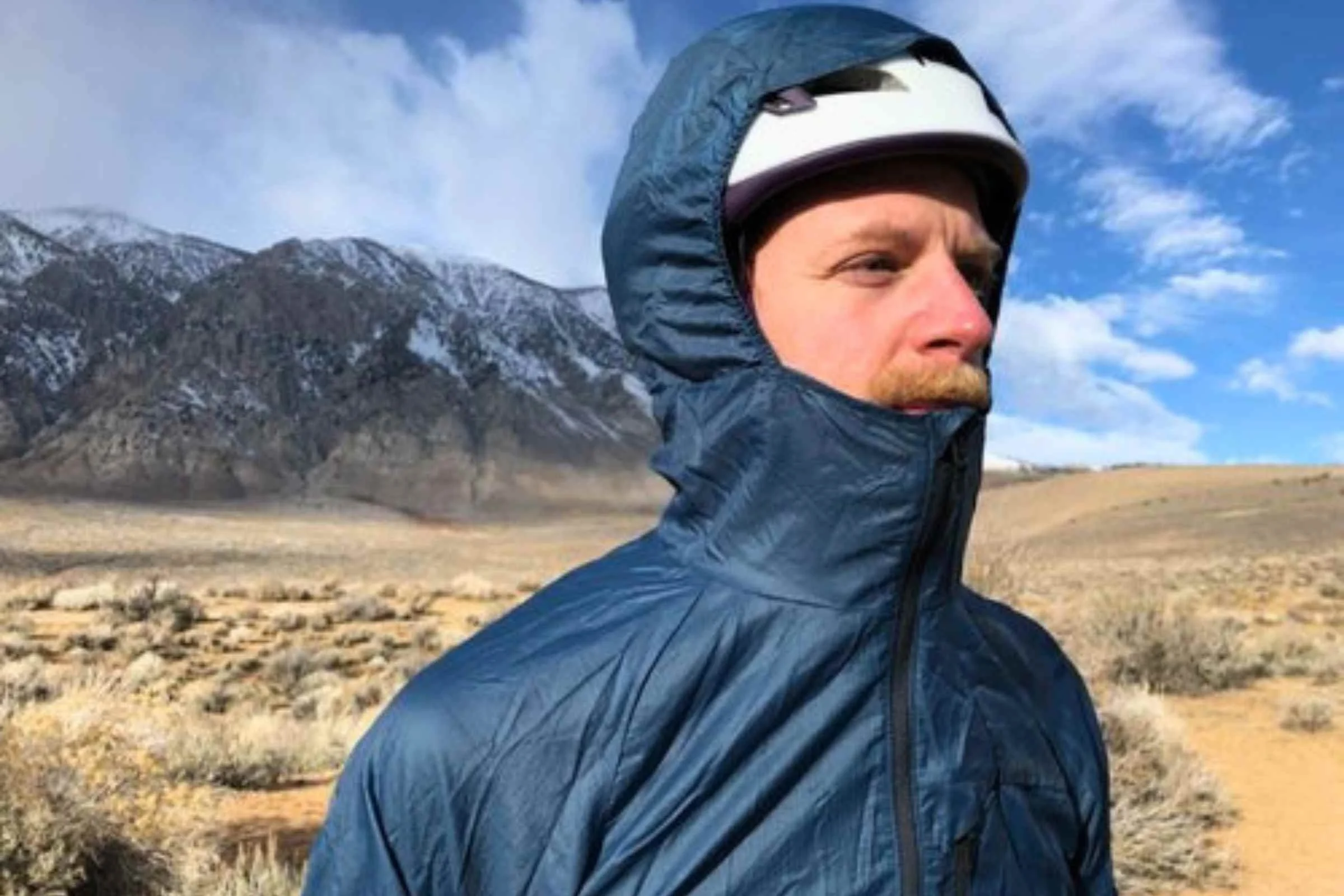
The standard Houdini fits slightly smaller than other windbreakers. We couldn’t quite pull it over our climbing helmet without some force, which can put tension on the zipper and cause damage to the fabric or zipper over time. However, Outdoor Gear Lab found that the Houdini fit over a climbing helmet, so either Patagonia may have reworked the latest model, or that reviewer’s helmet could be smaller than ours. This factor is no knock to the Houdini, though. In our eyes, this keeps with the Houdini's more casual, versatile build.
More on the hood—we love its simple cinch to remove some volume on the crown for a secure seal around the face. Wearing a typical billed hat, it’s a perfect, unrestricting seal. The wrist cuffs have elastic on the underside only, which we like because it creates a balance of security and airflow and allows us to slide the top part back over our watch easily.
-
The Houdini has a slightly dropped hem, which is nice for coverage, especially when bending over. Lastly, for those who like to pack things neatly or are also looking to clip a lightweight jacket to their climbing harness, the Houdini has a chest pocket that the jacket stuffs into, using the zipper to close everything up.
-
We commend Patagonia for sizing offerings on the Houdini, offering a range from XS-3XL. Patagonia claims a slim fit for the Houdini. We would mostly agree, though it’s not a tight-fitting garment.
-
One review mentioned that the men's jacket didn’t hold up well in the wash, by that may depend on exactly how the jacket was cleaned. For reference, we've had no problem in 5 years. We’ve always hand washed it once a season, but when summer comes, we’ll give it a proper machine wash following Patagonia instructions, which suggest cool water on a gentle cycle and drying on low heat.
The only thing the Original Houdini lacks is specificity. We don’t think that’s a fault, as it still does plenty, and really well. Its build construction, performance, and the name behind it give us the confidence to recommend the Patagonia Houdini as the best overall windbreaker. And don’t forget; it’s backed by the same well-known warranty and customer service. For many of us, it’s the only wind jacket we’ll need.
-
Reviews point to most people using the Houdini for hiking, running, cycling, and casual wear, which is what we spent most of our time doing while wearing it. Some reviewers don’t find it the most breathable jacket, but it’s also not particularly stuffy. Some reviewers with more broad shoulders say their usual size fits a little snugly, but sizing up solved the problem without the jacket being too baggy elsewhere.
Best lightweight windbreaker jacket: Black Diamond Distance Wind Shell

Available sizes: S-XL
Fit: Standard
Weight: 3.3 oz (medium)
Fabric: 100% ripstop nylon
Best for: When weight, compactness, and wind protection over helmets are a priority
What we liked: Excellent wind protection for such a small and light garment
What we didn’t like: Not the best DWR out there
For what you’re carrying, the Black Diamond Distance pulls its weight in spades. It keeps the wind out, breathes well, and helps trap heat when used in a layering system. It’s one of the most technical-looking wind shirts we tested, akin to the performance fabric look of nylon hiking shelters, sleeping bags, and other lightweight outdoor gear. If we’re heading out into a challenging, dry, but cold day like running and skiing (and beyond), we want the Black Diamond Distance on our backs, and that’s why it’s our winner for the best lightweight windbreaker.
If you’re commonly out in chilly, high, or persistent winds, consider the Black Diamond Distance Windshell. It's an excellent windshell for those who run cold and want to keep the chill away while also keeping down the weight and volume of gear.
The Black Diamond Distance Windshell is similarly wind resistant as our best overall jacket, the Patagonia Houdini, and it packs the smallest of our test jackets at a minimal 5.75” x 3.75, which you could further compress for smaller compartments. That's one reason the women's version is also a winner in the Best Women's Windbreaker Jackets guide.
Black Diamond Distance Wind Shell


-
Once we had a few runs, hikes, and skis in each of our top-performing windshells, we made it a point to wear them on a run the evening before a snowstorm near home when the winds were blowing in. Temperatures were just below freezing, with gusts that made us want to stop and turn our faces away. Our other jackets relieved some of the bitter cold winds, but the BD Distance was our top defense.
-
The hem on the BD Distance is on the long side compared to our other test jackets. We found this a pro for additional weather protection, but the zipper does feel pretty far away when reaching for it!
The overall fit of the Distance shell is standard to slim or “athletic”—wider in the shoulders and tapered slimmer at the waist. We were worried that the lack of stretch compared to some jackets would result in a restrictive feel, but the extra space up top where the articulation happens paired with the slick fabric makes for a well-articulating jacket.
-
The hood has a low profile elastic binding on the front hood edges, an intuitive rear barrel lock, and an elastic shock cord for securely bringing the hood around the head and face. Once we found where we wanted the shock cord set, the elastic edges on the hood allowed enough give in the hood to stretch it over our running hat and around the face. We didn’t have to worry about re-adjusting with gloved hands, which is nice because removing gloves in exposed cold areas is something we try to avoid.
The Distance jacket also has a locking zipper, which we found helpful when pulling the hood over when cinched, as it can otherwise come down and remove the seal, an issue we ran into testing the Brooks Canopy and the Arc’teryx Squamish.
-
While you can find a lighter, more compact windbreaker out there, but for the versatility, windproofness, and features, the Black Diamond Distance is the best light windbreaker we tested.
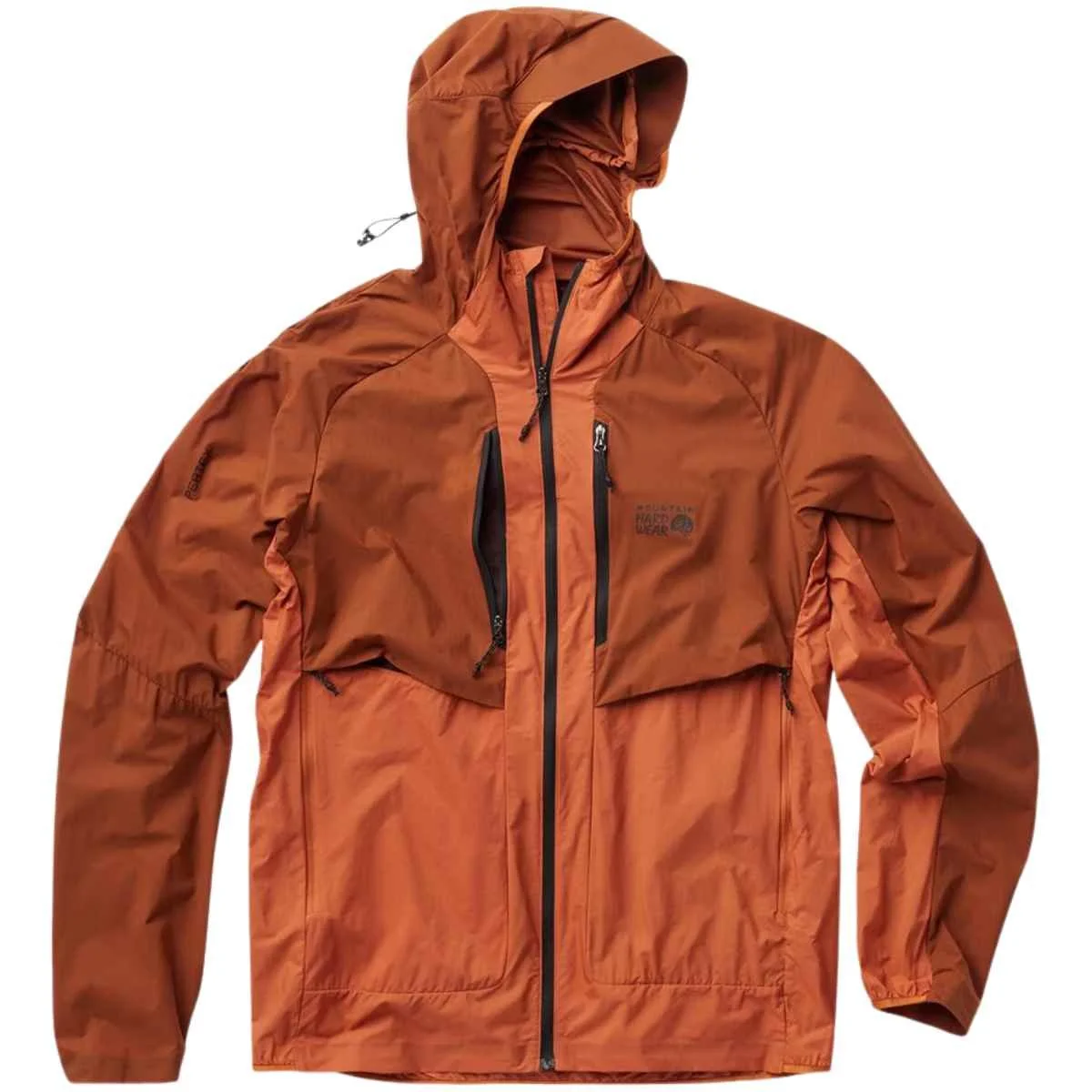
Best windbreaker for running: Mountain Hardwear Kor Airshell Hybrid Hooded Jacket
Available sizes: S - XXL
Fit: Trim
Weight: 6.2 oz (M)
Fabric: Pertex® Quantum Air™ 20D Coated Ripstop
Best for: when breathability is a priority
What we liked: balances comfort, breathability, weather-resistance, and packability, highly adjustable hoods
What we didn’t like: heavier than other windbreakers
The Kor Airshell Hybrid Jacket is our favorite windbreaker for running because it balances comfort, breathability, weather -resistance, and packability better than any jacket in its class. It has four pockets, a highly adjustable hood, and is very comfortable. It also packs into its internal pocket to store it when the wind isn’t blowing as much.
It’s made of two different types of Pertex Quantum Air ripstop nylon—a more wind-resistant one on the tops of the shoulders, sleeves, chest, and hood, and a stretchier and more breathable one on the back, lower torso, and underarms. This creates more weather resistance where you need it, while building in stretch comfort everywhere else.
We tested the Kor Airshell Hybrid Jacket during winter in Arizona, where temperatures dropped below freezing. This jacket, combined with a thick base layer, is warm enough for winter running down to 20 degrees. And if you layer it over a fleece, it will keep you warm even far below 20 degrees.
This versatile all-around windbreaker looks great and is suitable for a wide range of activities, from long mountain runs to casual walks around town, hikes, backpacking, and climbing. This is the best windbreaker for running available.
It’s also versatile enough to be worn casually and can serve users for hikes, neighborhood walks, mountain biking, climbing, and other outdoor activities where you just need a little extra warmth.
Mountain Hardwear Kor Airshell Hybrid Hooded Jacket


-
The fit on the Kor Airshell is loose but not baggy. The fabric is soft and doesn’t feel clammy when you sweat. It’s comfortable enough to wear over a short-sleeved shirt, which we often do. The stretch material on the underarms, lower torso, and back allows you to move in any way you’d want. This allows you to wear it while trail running, scrambling, biking, climbing, and more. It also looks stylish and non-techy enough to wear around town.
-
The Kor Airshell Hybrid Jacket uses a thin,Pertex Quantum Air 20-denier coated ripstop nylon material on the hood, chest, shoulders, and top sides of the sleeves. It uses a Pertex Quantum Air 20-denier stretch ripstop nylon on the underarms, lower body, and back panel. The coated Pertex material is more wind- and water-resistant than the stretch Pertex, providing extra weather protection where you need it most while enhancing comfort and breathability with the stretch material.
It features mesh vents below the chest pockets. Even though the fabrics used in its construction are very breathable, these vents add even more breathability to the jacket. It also has a single snap closure near the top part of the chest, allowing you to unzip the jacket for added ventilation without it flapping around. When running in variable conditions, we don’t ever overheat in this jacket unless we’re really working hard and it’s actually warm enough for a shirt-sleeved shirt.
During a frigid and windy day in Arizona, a thick layer of clouds prevented the sun from reaching the ground, making the 50–70 mph winds feel that much colder. But the sun did occasionally poke through between fast-moving clusters of clouds, and during that time, we thought we’d feel overdressed with this jacket on. However, it’s so breathable that we never had to stop running to take this jacket off.
-
For those who like to pack things neatly or who are also looking to clip a lightweight windbreaker to their climbing harness, the Kor Airshell Hybrid Jacket packs into an internal pocket that doubles as a stuff sack. When stuffed into this pocket, it’s just larger than a 12-ounce can.
This isn’t the most packable jacket, primarily due to its four pockets. If it didn’t have zippered hand and chest pockets, then it would likely be a couple of ounces lighter and pack down slightly smaller. However, it only weighs 6.2 ounces and packs down small enough to fit into a running vest or belt, making it light and packable enough for all but the most discerning ultralight enthusiasts. It practically disappears in your backpack.
-
The Kor Airshell Hybrid Jacket has a full-coverage hood with a brim. It features an elastic material around the face opening and a built-in shock cord, allowing you to tighten the hood around your head in windy conditions. We went for a run in Arizona’s Petrified Forest Wilderness on one of the windiest days we’ve ever experienced, and this shock cord kept our hood securely planted on our head (and also kept the wind from whipping away the hat we had on under the hood).
-
The sizing offering is typical of many windbreakers with an S-XXL range. It fits about as you’d expect, but isn’t too tight either.
-
While not a rain jacket, the Kor Airshell will keep you relatively dry in light rain and snow. It has a PFAS-free DWR coating on the ripstop material used on the hood, chest, shoulders, and top sides of the sleeves. In areas less likely to be hit by rain—the undersides of arms, below the chest, and lower back—it uses a slightly less water-resistant stretch ripstop material. This provides enough protection in drizzly, misty conditions, or short rain storms, but it won’t keep you dry in a persistent downpour.
-
The Kor Airshell Hybrid Jacket weighs 6.2 ounces for a men’s size medium. While this is relatively light, it’s not as light as some ultralight running and windbreaker jackets. However, the extra weight comes with added hood adjustability, mesh vents, and two chest pockets.
-
The Kor Airshell is a great windbreaker because it provides a stellar balance of breathability, warmth, comfort, and weather resistance. It packs small, doesn’t weigh too much, and always makes it into our running belt or running hydration vest when heading out on a run.
Best waterproof windbreaker jacket: Ultimate Direction Ultra II Jacket

Available sizes: S-XL
Fit: Slim
Fabric: 100% nylon
Weight: 6.56 (M)
What we liked: Integrated waterproof mittens, excellent hood with visor, vented armpits, breathable, lightweight
What we didn’t like: Visor stiffener gets bent over time, expensive
The Ultimate Direction Ultra Jacket is our winner for Best Waterproof Running Jacket for its excellent balance of weather protection, packability, and breathability. Like all rain jackets, a running rain jacket will be a 2, 2.5, or 3L jacket—but it stresses breathability and ventilation more than the typical rain jacket. For those looking to carry their rain jacket in a running belt or running vest and potentially racing with it, the 2.5-layer Ultra Jacket is ideal. It weighs 6.6 ounces, packs into its own interior stretch pocket, and is much more storm-worthy than many rain jackets for running.
Ultimate Direction Ultra II Jacket


-
It has built-in waterproof mittens, which is pretty unique in a rain jacket and helps you save even more weight. These integrated waterproof mittens for your hands. On extremely cold, wet days, these are a godsend because they keep your hands slightly warmer and drier without the need for waterproof gloves. The mitts are sewn into the wrist cuffs and fold into the sleeves when you don’t need them. They don’t have a separate place to put your thumb, but we keep our thumbs in with our other fingers for warmth anyway.
-
The Ultra Jacket has an excellent hood with great adjustability. You can tighten it around your head laterally, around your face, or both when you want to batten down the hatches. The hood has a bill with a stiffener along the edge as well. You can even fold the stiffened bill over a ball cap, which holds the bill in place and keeps your hat dry while keeping water off your face. As you can see in the photos, this bill stiffener can get bent over time—our Ultra Jacket is three years old—but it still keeps the rain off your face, even if it is a little bent.
-
It’s a 2.5-layer shell, which means it consists of two layers of fabric—an exterior face fabric and breathable waterproof membrane—plus an interior coating for durability. This is the most common design for a lightweight jacket, and with a 30,000mm water entry pressure, it meets the waterproof standards required by UTMB (Ultra Trail du Mont Blanc, considered the most competitive trail ultramarathon in the world).
Some users aren’t impressed with the waterproofing of this jacket, and after prolonged rain, you won’t be completely dry. But, we find the waterproofing on this jacket is enough to stay comfortable in cold rain, and that says a lot. We’re not going to go and replace our mountaineering hardshell jacket with this, but this jacket keeps you dry enough, and the breathability keeps the inside from becoming soaked with your sweat.
-
It’s also very breathable. It has what Ultimate Direction calls “peristaltic” armpit vents. These aren’t full-on zippered vents, which would add extra weight. Rather, in the armpit area, two pieces of fabric are sewn to overlap each other, letting air in and out as you move your arms. If we get hot while wearing this jacket, we raise our arms in the air to allow for maximum airflow.
One drawback of the jacket is the stiffener in the hood’s bill. As we mentioned above, after two years of use, packing and unpacking this jacket, the lightweight wire has developed a crease that we can’t unbend. This isn’t a big deal, but it does make the jacket look goofy. But who doesn't need a laugh when it’s pouring rain? So maybe this is a good thing.
-
If you’re looking for ways to make running in the rain more comfortable or need a lightweight layer to keep you protected on mountain runs and backcountry adventures, this is a great option for you. This rain jacket is breathable enough to run in and has built-in rain mitts, a stellar hood, plus packability features, and it’s not even very expensive. See our guide to Best Women's Running Jackets or Best Men's Running Jackets for more of our best running jacket picks.
If you’re looking for ways to make running in the rain more comfortable or need a lightweight layer to keep you protected on mountain runs and backcountry adventures, this is a great option for you.
Best affordable windbreaker jacket: Cotopaxi Teca Half-Zip Windbreaker

Available sizes: XS - XXXL
Fit: Regular
Fabric: 100% polyester
Weight: 4.35 oz (medium)
Best for: Casual use and hiking
What we liked: Affordable, kangaroo pocket, wind resistance
What we didn’t like: Overbuilt for some uses, breathability is lacking
$80 is an attractive price for a lightweight windbreaker in 2024; the Cotopaxi Teca Half-Zip windbreaker offers value for the full amount. This windbreaker is casually styled with some versatility for uses beyond your daily jacket. When measured primarily on the metric of wind resistance, the Cotopaxi excels. It’s also packable and lightweight compared to many other bulky and heavier jackets that we tested, even with some extra external features found on the jacket. Plus Cotopaxi’s Teca collection is made of 100% recycled materials or remnant materials.
After testing the Cotopaxi for daily wear, neighborhood walks, day hikes, and running, we found the Cotopaxi in its element during more casual activities, plus day hiking. It’s not the best running gear, but if you’re using this jacket primarily for lower-output activities with a lesser emphasis on breathability, consider the Teca Half-Zip from Cotopaxi.
As a bonus, Cotopaxi is a certified B Corporation, scoring well beyond the requirements for the certification as they practice their original mission to reduce poverty and make “Gear for Good’. The Teca Half-Zip is the best for the price, so we’re giving it our best affordable windbreaker title. You'll find it won our Best Affordable Running Jacket award in our Women's Running Jackets guide.
Cotopaxi Teca Half-Zip Windbreaker

-
The Teca Half-Zip is made from 100% repurposed polyester taffeta and ripstop with no specific details provided regarding denier. It’s not the thinnest nor most robust jacket fabric, but it does inspire durability.
Overall, this fabric feels and sounds (swish!) like the primary fabric found on the Smartwool Merino Wool UL jacket, our winner for the best cycling windbreaker. The Cotopaxi is 100% polyester as opposed to the nylon shell of the Smartwool jacket, though, and slightly less breathable overall. You can’t always tell by looks and feel alone! A deep dive into testing often reveals product nuances that help explain price differences.
-
The zipper on the Cotopaxi is the biggest of all the jackets we tested, and we’re not complaining. It comes with an equally large zipper pull and some nylon cord tied on to keep finding and operating the zipper just as easily with or without gloves. Removing gloves with a heavy wind blowing isn’t optimal, and thoughtful zippers like this don’t go without some appreciation.
-
The pockets are the most unique of any of the jackets we tested. Rather than two handwarmer pockets found on most windbreakers, the half-zip design allows a complete pass-through, “kangaroo” style tunnel pocket so your hands can rest relaxed and share warmth. Layered over that kangaroo pocket is a generously-sized zipper security pocket for keys, gloves, a warm hat, or any other lightweight item you want to store inside. A phone easily fits and works well when walking, but it will hang away from you a little when cycling and bounce while running.
The cuffs on the jacket are fully elastic around the wrist. Cotopaxi strikes a good balance on our smaller wrists, but we can see it being snug on larger forearms. However, the sleeves' fit are neither baggy nor slim. This fit follows the general cut of the jacket, on the looser side compared to some of our other more technical jackets, but by no means a baggy fit. We approve. -
Lastly, the hem also has a fully-elastic, non-adjustable design. This feature creates a nice seal without constricting, and there’s no hardware to break. We also found that it encourages the fabric to billow just slightly over the hem—it looks great and avoids a technical look for wearing around town and as everyday wear.
-
There are a couple of drawbacks to consider when checking out the Teca Half-Zip. It’s not the most breathable jacket on our list, scoring somewhere on the average to below-average scale. For casual use, this is fine because it means more warmth for a lightweight, packable garment. For higher output activities where sweating is inevitable and you’re producing excess heat, the Teca doesn’t excel in managing it. Lastly, while we love the zipper, we did find that it tends to catch at the very top of the zipper when it hits a chin guard flap sewn into the inner fabric. This flap keeps the zipper off your face, but to avoid catching it, you’ll need to pull out, then up, when zipping it fully. We got used to managing it and don’t think it’s a big deal.
-
Despite some minor complaints, we’re blown away with the jacket we get for the price. It’s a company devoted to social and environmental responsibility, has one of the more inclusive sizing offerings, is a beautiful, functional jacket, and does its primary job of cutting the wind perfectly. There’s no question that it’s the best affordable windbreaker that we tested.
Other windbreaker jackets we tested
Rabbit Treeline

Available sizes: S-XL
Fit: Standard
Fabric: 66% nylon, 34% polyurethane
Weight: 6.4 oz (medium)
One thing we liked about the rabbit Treeline is that it has the best reflective detailing out of all tested jackets, with a bright reflective detail down the entire front of the zipper. This detail is ideal for those going out in low-light conditions or near road traffic.
We like the length of the Treeline, with a slightly longer hem, similar to the Arc’teryx Squamish and Black Diamond Distance jacket, compared to other jackets of the same size, which will better protect your back from mud and more in messy conditions. We found the hood less comfortable when fully zipped than other adjustable hood systems, especially under the chin and neck below the ears.
Rabbit Treeline

The reflective zipper on the Rabbit Treeline is a nice touch and reminds us of the need to be seen when among traffic. Photo by Sasha Hashemipour
We weren’t sure at first if the rabbit Treeline was a wind shirt or a rain shell due to its sealed seam construction and low-waterproof rating. The lining material was not nearly as comfortable as on other jackets.
Despite having no mechanical venting, the Treeline is on the breathable side for a rain jacket, and this may have something to do with the low-end waterproof rating of 10k. At that level, you can expect to stay dry from most rain storms, but if you ever wear a pack over it, the pressure from the pack may be enough to force the moisture through the membrane onto your back. It’s a well-performing 2.5L jacket with clear limits, but it’s a great contender option for many fans of the reputable rabbit brand.

Available sizes: S-3XL
Fit: Standard
Fabric: 100% polyester
Weight: 11 oz (medium)
Before anything else, we noticed how visible we felt wearing the Baleaf Hooded Windbreaker in the color we tested, making it an attractive layer for traffic-adjacent running. The low ~$50 price, especially compared to other jackets in our lineup, and the extensive sizing range made us hopeful that we had a budget winner.
Unfortunately, the Baleaf Triumph is a windbreaker with the comfort of a heavy, high-volume rain jacket. Though the price is attractive, we decided it’s worth saving for a higher-performing jacket if you can swing it.
Baleaf Light Hooded Windbreaker

Closing out an even final mile near the trailhead after having the Baleaf on the trail in the eastern Sierra, CA. Photo by Sasha Hashemipour

Available sizes: XS-XXL
Fit: Standard to Slim
Fabric: 100% recycled polyester
Weight: 5.3 oz (medium)
The Brooks Canopy was a frequent choice for our runs and walks near home on evenings when the sun was starting to set, and a simple base layer just didn’t quite cut it. The more we used it, the more we liked it.
In some ways, the Brooks Canopy is reminiscent of the traditional Patagonia Houdini (not the Air version). The difference is that it breathes better with a sacrifice in wind protection. The Brook’s Canopy is actually our Best Affordable Running Jacket, but it is almost too breathable for many outdoors people who don’t want a running-specific windbreaker. We encourage you to check out our running jacket guide if you're mostly running. If you're looking for more versatility in your windbreaker for hiking, climbing, or hanging out, we think our other winners will serve you better.
Brooks Canopy

The Brooks Canopy jacket has hood storage to keep the hood in place when not used, which stops the hood from flapping loosely! Photo by Sasha Hashemipour
Available sizes: S - XXL
Fit: Standard
Fabric: 100% Nylon Pertex Quantum Diamond Fuse
Weight: 5.3 oz (medium)
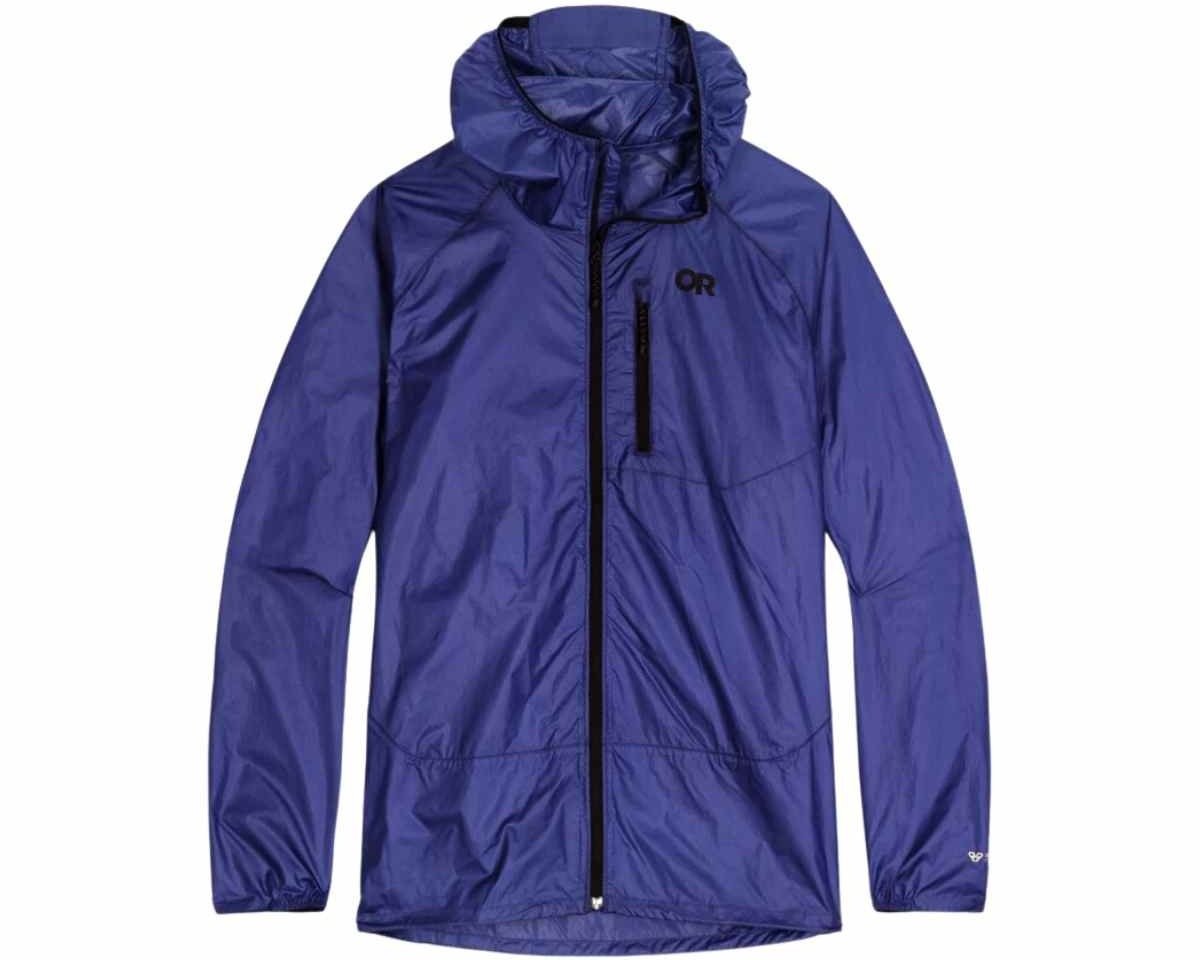
The Outdoor Research Helium Wind Hoodie is the windbreaker counterpart to the lauded Helium Rain Jacket. We enjoyed running, hiking, and skiing with the OR Helium Wind Hoodie. However, we couldn’t place it as a category win among its closest company, the Patagonia Houdini series, where the breathability and wind resistance, much like the Arc’teryx Squamish, rests.
The Pertex Diamond Fuse fabric is frequently the recipient of much praise, and our reviewer has used many quality products from Pertex. We instantly stained this jacket, though, possibly from sunscreen or other balms we use outdoors. Despite heavily sunscreening ourselves on every outing at altitude, this is the only jacket that is stained like that. If you’re a fan of the Helium series (we can’t blame you!), consider going for one of the darker colors, just in case.
Outdoor Research Helium Wind Hoodie

The casual shuffle in the OR Helium Wind Hoodie. Photo by Sasha Hashemipour
What to look for in a windbreaker
Fabric
Like most outdoor gear, synthetics are the main fabric choices for wind-resistant jackets. The main choices are polyester and lightweight air-permeable nylon fabrics for windproof jackets. You may also find jackets with a blend of other fabrics, such as elastane and spandex, which might be added to give the garment more stretch in particular places or throughout the jacket. The best windbreakers use high quality materials that cut wind while reducing the chance you will overheat during exertion.
In our testing, we also saw Smartwool use merino wool panels on the back and under the arms to add venting to the windshell.
Some manufacturers will design jackets with similar panels for breathability on wind-resistant jackets but typically use a light grid fleece or super thin nylon.

Some fabrics have a habit of staining. Not usually a problem if it’s just for sport use, but may be a bigger deal if for social applications. Photo by Trey French
Fabric Weight
Fabric weight is a broad spectrum for windbreakers; some wind jackets are as light as 2 oz or even less, and others weigh as much as 6 oz or more. Weight also depends on features such as pockets, zippers, flaps, elastic bindings, and elastic cuffs. Most manufacturers won’t list the actual weight of the fabric, reported in square meters or yards. Instead, they will report the overall weight of the jacket only.
Once jackets start incorporating fleece panels and heavier fabrics, the windbreaker's overall weight (and volume) will creep up. One thing we’ve noticed is that sometimes, a jacket's overall weight can indicate how much weather protection you get (almost none from featherlight wind shells). In contrast, heavier rain jackets not covered in this review might protect in a downpour.
Fit and sizing
When shopping for a windbreaker jacket, you may run into terms of slim, standard/regular, and athletic fit.
SLIM
Slim fit is straightforward; it will fit the most tightly around your body. The jacket will likely flap around less, and it will generally be more lightweight, but it will also be less versatile and allow for less layering underneath.
You might find that layering is an asset if you’re in variable conditions. Layering helps with being able to add and subtract layers, while the aerodynamics of a slim jacket will likely go unnoticed.
STANDARD/REGULAR
Standard/Regular fits will be the most common. These suit many people’s tastes and allow for layering underneath without being baggy. Standard fits will typically have the same straight fit throughout the arms, shoulders, and jacket body with little to no tapering.

The fit on the Black Diamond Distance allowed for plenty of room throughout the jacket to layer over a base layer and fleece for ski touring. A synthetic puffy fits under there on us, too! Photo by Sasha Hashemipour
ATHLETIC FIT
Regarding athletic fit—firstly, athletic is not a body type. Athletes come in all body compositions. That said, athletic fit typically refers to a particular jacket tapering. This fit might mean broader shoulders and underarms for mobility in a men's jacket. It might also mean that the jacket accommodates more mass up top while tapering at the arms and waist to save weight or keep a particular aesthetic.
EU AND ASIAN FIT
Lastly, while shopping from brands originating in European, Asian, or other countries, you may see garments described with alternative sizing charts. These garments may run smaller in all dimensions than a North American sizing rubric. Some companies go by an EU or “Asian Fit,” which may also have a bearing on the hem length or general dimensions and fit of a jacket.

We took the Houdini Air (now discontinued) on runs in California’s Bishop, Mammoth, Alabama Hills, and San Diego. Given its excellent breathability, we also tested it in Tennessee on rainy runs and steep uphill ski tours. This photo shows us testing this running jacket in the Eastern Sierra. Photo by Sasha Hashemipour
Wind Resistance
The fundamental function of a windbreaker is wind resistance. Wind often removes body heat faster than we want, so we use a lightweight, compressible garment like a windbreaker to slow that process down. Windbreakers balance between wind resistance and waterproofness.
Water resistance
When you’re reading the marketing details of a jacket and see the terms “water resistant” and “water repellant,” just know that you’re still going to get soaked in a downpour.
These terms typically apply to wind shell jackets meant for warmth without protection from sustained precipitation other than what a durable water repellent (DWR) can provide. DWR coating is a synthetic hydrophobic coating that helps water bead up and roll off of fabric rather than soak through instantly.
DWR coating can only do so much, and they also wear off over time, with mixed results when washing a DWR coat back into the garment.
We can get away with DWR water-resistant wind shell in a faint mist or light, dry snow. A windshell should be used primarily to hold warmth in cold temperatures or cut wind on exposed mountain ridgelines. You should not expect it to do much more to repel moisture.
Breathability
Wind shell jackets will have varying levels of breathability. For the truly curious, you could deep dive into CFM ratings, or how much of a 30 mph wind penetrates the fabric, measured in cubic feet per minute (CFM). You could also blow through the fabric and see how much goes through it.
These are both scientific and not-so-scientific approaches to seeing if the air will get through the fabric, which translates to how much heat will be contained in the jacket and how well you’ll be defended from ripping winds. You want a balance of heat retention and breathability to keep the sweating to a minimum and keep your base layer dry.
Sometimes more breathability at the cost of some wind resistance is preferred for aerobic, lower-speed activities like hiking and running. You may sacrifice more breathability for wind protection for skiing, cycling, or anything sustained in an alpine environment.

Temperature can be tough to manage. Sometimes we just open up a windshell completely when we’re not getting enough breathability out of it, but a base layer isn’t enough on its own. Photo by Sasha Hashemipour
Stretchability
Many windbreakers will have a little stretch incorporated into the fabric design. The stretch could be mechanical (ex/ using gussets and panels like the Arc’teryx Squamish). Stretch can also come from alternative fabrics like the merino wool in the Smartwool Merino Sport UL Jacket. Having some stretch can help produce a comfortable, non-restricting garment, which is good for casual wear at a minimum, but can also be critical for technical movements in sports like rock climbing. Windbreakers won’t stretch like fleece or your base layer, but they’re usually not static, either.
Packability
The beauty of windbreakers is that they’re likely the most packable layer you’ll carry.For the weight and volume, they may be the best value out of all the layers you carry in your pack. Many of them won’t even pack up to 1L in size (the size of a Nalgene water bottle). Many windbreakers have a pocket that the jacket packs down into, usually found on the chest pocket, or an internal hip pocket with a carabiner loop for convenience.
These pockets are handy if you need to keep the jacket neat for something like rock climbing. Still, for most applications, we’re okay with simply stuffing the jacket loose somewhere or storing it in a dry bag with other items if it needs protection from rain and other moisture. You can store them in a running pack, running belt, clipped to a climbing harness, in another ski jacket pocket, and even in many running short pockets if they’re on the larger side.
Reflectivity
This may be a minor emphasis for some and major for others, depending on where and when you’re wearing your jacket. None of the jackets we tested are flashy in the reflective sense, except for the Rabbit Treeline. In our experience, it’s a minor emphasis in the windbreaker world. If you need something reflective, we get more into that in our Best Men's Running Jackets guide. If visibility is a central concern, we’d recommend incorporating additional reflective elements like a reflective tape from Gear Aid or wearing a reflective vest when needed. Alternately, stick with your windbreaker of choice and see our Best Reflective Gear for Running in the Dark for other gear items like hats and socks that can do the trick.

The now discontinued Houdini Air’s raised grid double weave material from Pertex® seems to create just enough air pocket separation between the base fabric and the skin, or base layer, along with some slight stretch. Photo by Sasha Hashemipour
Care and maintenance tips for windbreaker jackets
Taking proper care of your windbreaker jacket is essential to ensure it remains a reliable companion during windy and rainy days. Here are some care and maintenance tips tailored to help you keep your windbreaker in top-notch condition:
Regular cleaning
Cleaning your windbreaker will help maintain the material’s integrity, since dirt and oils can wear down the effectiveness of the materials. We recommend Nikwax for cleaning shells, but first read the manufacturer’s care instructions prior to use. To learn more about cleaning your windbreaker or other shells, check out our How to Clean and Repair Gore-Tex and Other Shells guide.
If you want to use a washing machine, first be sure your windbreaker is safe to machine wash, and follow the manufacturer’s instructions. Try to use a front-loading washer without an agitator, and use the correct cleaning agent. Do your best to remove all the residue from other agents prior to washing since these can impact breathability of technical fabrics.
Zip up and turn inside out during washing
Prior to washing, zip the zippers all the way closed and turn the windbreaker inside out. This will help prevent damage to the zippers and any reflective elements or decals that are heat sensitive. Use warm water on a gentle cycle, unless otherwise noted in the manufacturer’s instructions.
Stain Removal
Do not use stain removers, since those can compromise the material of the windbreaker. If you need to remove a stain, use Nikwax or a similar technical wash.
Avoid fabric softeners
Don’t use fabric softeners when washing your windbreaker, as they compromise the effectiveness of the membrane.
Thorough rinsing
Leftover residue from cleaning agents can wear down the material, so be sure the windbreaker is thoroughly rinsed out after cleaning.
Air dry
While some windbreakers allow for low heat tumble dry, we recommend air drying them to keep them in their best shape for longer. If you air dry, hang or lay it down flat somewhere out of direct sunlight. Some jackets have a small loop at the back of the neck for easy hanging.
Reapply water repellent coating
Over time, the durable water repellent (DWR) on your jacket can wear off, so we recommend periodically reapplying a coating. A sign your jacket could use a touch up is when it starts “wetting out,” which is when water spreads across the fabric and becomes less breathable and effective. Find more tips for reapplying DWR to your windbreaker in our How to Clean and Repair Gore-Tex and Other Shells guide.
Proper storage
Hang your windbreaker or lay it flat when not in use. Also try to keep it out of direct sunlight and extreme heat as much as possible, as that can compromise the material’s effectiveness.
Minimize abrasion
Abrasion occurs when the fabric rubs against itself, or against something else. You can’t avoid abrasion entirely–it’s a normal part of wearing your windbreaker in the outdoors. You can, however, try to minimize unnecessary abrasion by avoiding scrunching up your windbreaker and stuffing it in a pack with other items, or by taking off your pack when you don’t need to wear it. Any way you can reasonably reduce abrasion will improve the longevity of your windbreaker.
Inspect seams and zippers
To keep your windbreaker in good shape for as long as possible, examine it regularly to look for signs of damage. In particular, check along seams, zippers, pockets, and anywhere that rubs against a hydration pack.
Special features
If your windbreaker boasts special features such as removable hoods or liners, check the label to see if there are specific care instructions for those components.
FAQ
-
A windbreaker, often called a wind jacket or windshell, is a low-volume, water-resistant (but not waterproof) garment. It is worn primarily for protection against wind and cool temperatures. You can wear it over a base layer or all of your insulating layers as an additional defense against the elements. The best windbreaker jackets are more breathable and lower weight than a rain jacket, though it’s not as effective at protecting against rain.
The best windbreaker jackets will also be more packable than a synthetic or down insulation layer. However, it doesn’t provide as much warmth in a static setting, like sitting at camp, belaying your climbing partner, taking a break on an alpine run, or transitioning on a ski tour.
-
Technically, a windbreaker is not an insulating jacket. However, its primary purpose is to preserve the warmth you create from your body by shielding it from convective cooling, which happens when moving wind steals your heat.
-
You should wear a windbreaker whenever you need just a little more insulation than your base layer can provide. It’s a great “just in case” layer to bring on almost any hike, run, climb, ski, or neighborhood walk when unsure whether your shirt will suffice to keep you comfortable. Wind jackets prove their worth in windy conditions by protecting your body heat, but sometimes they simply take off the edge in somewhat chilly conditions.
You can use a windbreaker to supplement other layers by layering it over a fleece, under a synthetic puffy, or over your layers as a shell.
-
Many windbreakers' care tags suggest machine washing on a gentle cycle on cold and either tumble drying on no heat or hang drying. We recommend zipping up the pockets and the jacket itself to prevent zipper snags or any other part of the jacket snagging in the machine. To extend the life of the jackets, we like to wash ours in Nikwax Tech Wash to avoid harming the DWR on the jacket with traditional detergent. We often wash the jacket in the sink instead of the washer, rinsing it several times to ensure the detergent is washed out. A hang-dry works well and ensures your dryer doesn’t overheat the garment.
You might think that forgoing washing it altogether, or rarely washing it, would make the jacket last longer. This is not the case. DWR coatings often degrade or, at minimum, don’t function as well when the jacket is clogged with environmental dirt and body oils.

Some jackets we tested used elastic under the cuffs and not on the top. The Houdini Air (now discontinued) balances warmth retention and mechanical breathability with this. It also aids in accessing watch data without fuss by being able to pull the fabric back. Photo by Sasha Hashemipour
Windbreakers vs. Softshells, Running Jackets, Rain Jackets, and Hard Shells
Windbreakers block the wind and hold a little bit of body heat in while softshells might be better suited for when you need actual down or synthetic insulation. For instance, windbreakers might be more suitable for when you’re moving while softshells may be better suited for static use like when you’re resting during an activity, or your car camping. Softshells are usually more bulky and weigh a lot more, but they also provide a fair amount more warmth. See our Best Softshell Jackets guide for more information on this highly mobile jacket.
All windbreakers can be running jackets, and we see more windbreakers come from running companies than any other. A close second is in the backpacking and hiking world along with cycling. Sometimes running-specific windbreakers will value higher breathability over max wind protection. See our Best Men's Running Jackets guide for more information.
Rain jackets do function as windbreakers, but to make them rainproof they must also have extra layers of fabric built in to stop the water from coming through the jacket. Windbreakers that aren’t waterproof are typically a single layer of fabric while rain jackets are 2-3L layers of fabric. The result is that windbreakers that aren’t waterproof weigh less, pack smaller, and breath better. Rain jackets offer more weather protection, but at the cost of weight, volume, and breathability. To learn more about lightweight rain jackets – the kind that is closest to a waterproof windbreaker – see our Best Lightweight Rain Jackets guide.
A hard shell is like a rain jacket but with even more weather protection. These are typically reserved as “3 layer jackets,” which means that they have a liner, a waterproof membrane like Gore-Tex, and face fabric that is coated with a durable water repellent. They’re usually used in wet climate backpacking, skiing, alpine climbing, and other uses where rain and water protection is paramount for warmth and safety. They are also usually heavy and have are high volume for packing. You can learn more about these kinds of jackets in our Best Men's Ski Jackets guide and Best Women's Ski Jackets guide.
How we tested

We tested windbreakers in the Eastern Sierra (about 5,000 feet elevation) during fall and winter when snow levels were high and sunshine was abundant. We ran, hiked, walked around town, ski toured, and gravel biked. We found which windbreakers breathed and didn’t, which jackets broke the wind the best, which hoods fit over our helmet, which ones held up against rain, and which jackets were more comfortable or technical. Some let a little or a lot of wind through. Some fit slim vs more standard to roomy. Some were more stripped to the essentials while others were feature rich.
About the author / Why you should trust us

Wind blows, literally. It won’t leave you alone on solitary summits, pushes you backward going downhill on a bike, and frosts fingers on ski tours. It seems like tailwinds are always in lower supply than headwinds, but at least there are windbreakers to ease the stress. Our reviewer always carries one unless it’s 80°F or above with no relief in the forecast.
Around 9,000 miles of combined running and hiking miles, some time sliding around on skis, two-tired bike trips, and some casual climbing with buddies inform his approach to gear testing—from hikes of the Continental Divide Trail, Pacific Crest Trail, Long Trail, and other self-made routes, to runs across the Grand Canyon, trail races, and obscure lines drawn on a map up or down the side of a mountain. Trey firmly believes that a piece of gear should facilitate experiences rather than discourage folks from getting out the door. Keep it simple, keep it functional, and keep it fun!
Based above Bishop, CA, at 5,000ft, Trey adventures in all seasons—for mental health, fitness, and preparing a base for big mountain adventures, come the spring melt.
You can read more of Trey's work at his blog or on his author page.