Best Life Jackets for Kids of 2026
Keep Your Kids Safe On the Water With Our Top 5 Coast Guard-Approved Life Jackets
June 18th, 2026, updated with new testing notes, care and maintenance
Home > Gear Reviews > Water Sports
Getting kids on the water safely starts with the right life jacket, and with children the stakes of getting it wrong are higher than with any other gear decision. Coast Guard approval is the baseline, but within approved jackets the differences in fit, adjustability, and safety features matter enormously for kids who move unpredictably, grow quickly, and don't always cooperate with buckles.
We researched and tested the top-rated kids' life jackets and PFDs across infant, child, and youth sizing, reading hundreds of consumer and professional reviews and testing the top contenders on real kids in real water conditions. All picks in this guide are Coast Guard approved. No piece of gear can save a child in every situation on the water, and we recommend taking a boating safety course before heading out.
What separates a genuinely good kids' life jacket from one that fails when it matters comes down to how securely it fits across a range of body shapes and sizes without gaps, whether it includes a crotch strap to prevent the jacket from riding up and slipping off, how easy it is for an adult to buckle correctly under pressure, and whether it has a handle for lifting a child out of the water quickly.
Top Pick: The Mustang Survival Lil' Legends (infant, child) earns our Best Overall award. It stood out for covering kids from 8 to 90 pounds across a single model line, which means adults and kids learn one buckle-up protocol from infancy through youth rather than relearning a new system every time the child outgrows their current size. It also features a collar pillow to keep a child's head above water, a heavy-duty handle for lifting, bright colors for easy spotting, and a Type II Coast Guard rating designed for open and rough water.
Remember, no piece of gear—no matter how highly rated— can save you in all life threatening situations on the water. You are responsible for your own safety and the safety of any children under your care. Take a course on boat safety before heading out.
Related: Best Life Jackets and Personal Flotation Devices (for adults)
We create reader-supported, objective gear reviews independently selected by our editors. This story may contain affiliate links, which help fund our website. When you click on the links to purchase gear, we may get a commission, without costing you an extra cent. Thank you for supporting our work and mission of outdoor coverage for every body! Learn more.
Comparison Table
| KIDS' LIFE JACKET | TREELINE AWARD | CHILD WEIGHT RANGE | COAST GUARD RATING | # OF BUCKLES | # ADJUSTABLE STRAPS | ENTRY | PRICE* |
|---|---|---|---|---|---|---|---|
| Mustang Survival Lil Legends | Best Overall Read why |
0-30 lbs (Infant), 30-55 lbs (Child) | Type II | 2 (front & crotch) | 3 (2 on side, 1 crotch strap) | Front zip | $75 |
| Stohlquist Youth Escape | Best Kids' Life Jacket for Kayaking Read why |
50 to 125 lbs | Type III | 1 on front | 3 (2 on the side, 1 crotch) | Front zip | $89 |
| Stohlquist Infant | Best for Infants Read why |
8 to 30 lbs | Type III | 3 | 6 (3 on each side) | Front buckle | $70 |
| Stohlquist Child | Best Toddler Life Jacket 30-50 pounds Read why |
8 to 90 lbs | Type II | 3 | 6 (3 on each side) | Front buckle | $70 |
| Stearns Youth Boating | Best Budget Read why |
50 to 125lbs | Type III | 1 (waist) | 8 (6 side, 2 shoulders) | Front zip | $31 |
Interested in water sports? Check out our most popular water gear guides:

Inflatable flotation devices like that shown in this photo are not Coast Guard-approved Life Jackets or Personal Flotation Devices. In this story, we review the safest ways to get kids into the water.
The Best Children's Life Jackets

USCG Approval Rating: II
Weight Range: 8 to 90 lbs (Infant: <30 lbs , Child: 33-55 lbs)
Number of Buckles: 2
Number of Straps: 3
Entry: Front Zip
What we liked: size choices, bright colors for visibility, safety features, collar pillow to keep a kid's head above water, heavy duty handle
What we didn't like: not all sizes come with crotch strap, sizing runs small
We chose the Mustang Lil’ Legends as the Best All-Around out of its competitors based on the range of sizes for growing kids, the safety features, and bright color options, all of which are key to a jack-of-all-trades children's life jacket.
One reason the Lil' Legends won as best overall is because one model covers kids 0 to 88 pounds, from infant to youth.
This is important because safety devices work best when you have the same buckling up protocol every time. Switching models every time a kid outgrows increases the chance that an adult or kid will make a mistake. By having the same model from infants to big kids, it ensures that the adults and kids both really know how this PFD works and put it on right every single time.
Compare Prices Of The Lil' Legends Life Jacket
Infant
Child


-
As a Type II PFD, the Lil’ Legends is designed for coastal and off-shore water activity (aka, in situations where rescue may or may not be imminent). It's designed for more open water or rough water than other options, though make sure to assess your kids' abilities before taking them into those conditions.
-
As a true “life jacket,” the Lil’ Legends features a collar-pillow to keep your child's head above the surface. It also has safety precaution features such as a heavy-duty handle to pull your child up, bright colors for easy spotting, and a crotch strap to keep your child from slipping out the bottom of their life vest.
-
What consumers found most appealing was the range of sizes available—Infant, Child.
Infant size is designed for children up to 30 lbs.
Child size is designed for children 30-50 lbs.
As most kids’ PFDs that we reviewed came in only one specific weight range, 2 size options for one PFD was a welcome respite for one raft-guide mama from searching for different PFDs for 4 different kids: “I bought one of each size for my kids, and have been able to let them all grow up through the sizes.”
-
As a PFD designed for situations when it could take a while for the kid to get rescued, the Lil' Legends has some safety features that make it more expensive than bare bone options out there.
All things considered, the Lil' Mustangs is mid-range for a Kids' PFD, as far as price. If you are looking for something a little more affordable for situations where you feel confident there will be life guards closely on hand, see our Best Budget Kids’ Life Jacket.
Best Kids' Life Jacket for Kayaking: Stohlquist Youth Escape Life Jacket

USCG Approval Rating: III
Weight Range: 50-125 lbs
Number of Buckles: 1 on front
Number of Straps: 3 (2 on side, 1 crotch)
Entry: Front zip
What we liked: low profile design, size range, value, easily adjustable, chest pocket
What we didn't like: doesn't work as well for smaller kids
We chose the Stohlquist Youth Escape because of its low-profile design, size range, and value.
The Stohlquist Youth Escape features a front-zip entrance, with an adjustable belt-line quick release buckle to ensure that the PFD won’t ride up their torso.
A total of 3 adjustable straps on each side (including the belt-line buckle) make for easy adjustability, no matter the size.
Wide shoulder straps add comfort with impeding mobility for paddling or rowing kids, and they also feature an adjustable strap on each shoulder pad. A large chest pocket allows for easy storage on the water, too.
Compare Prices Of The Stohlquist Youth Escape Life Jacket
-
The exterior of the Stohlquist is made of 200-denier nylon for abrasion-resistance and hardiness, while the inside is made out of a softer 200-denier Oxford liner. Kids were comfortable in this lifejacket all day long.
-
The Stohlquist Youth Escape is a great introductory PFD for kids getting into watersports, who can’t quite fit into an adult size. It's designed to be ergonomic and comfortable for growing children. It has an adjustable waist buckle for a more secure fit and so it doesn't ride up as your child gets bigger. Skinny and huskier kids both found this PFD to be comfortable and secure with taller and skinnier kids finding the fit better.
It is designed to be a lower-profile design with a more contoured fit. The goal is to have there be a lot of mobility for kids paddling, swimming, or otherwise trying to move around in the water. The wider neck on the life jacket means the child's head won't be squeezed.
-
The Stohlquist Youth Escape comes in two sizes—Youth (50-90 lbs), and Youth L/Adult XS (75-125 lbs).
For $90, you can find a hardy PFD for your child that won’t break the bank, and they (hopefully) won’t grow out of overnight. While not the cheapest option on the market, for the quality of construction and peace of mind that comes with it, $90 is a great investment for your child’s safety.
-
There are a few things to note—this PFD does not come with crotch-straps, which parents should take into account if their child is not comfortable on the water, or is smaller and prone to “swimming” in most PFDs. There is an adjustable waist strap.
For smaller kids, this PFD may be uncomfortably bulky. (They may simply need a smaller size, or a more streamlined fit—we recommend a favorite from our Contenders list, the O’Neill’s Superlite Youth Life Jacket). For bigger kids, we found the fit to be streamlined enough for paddling.
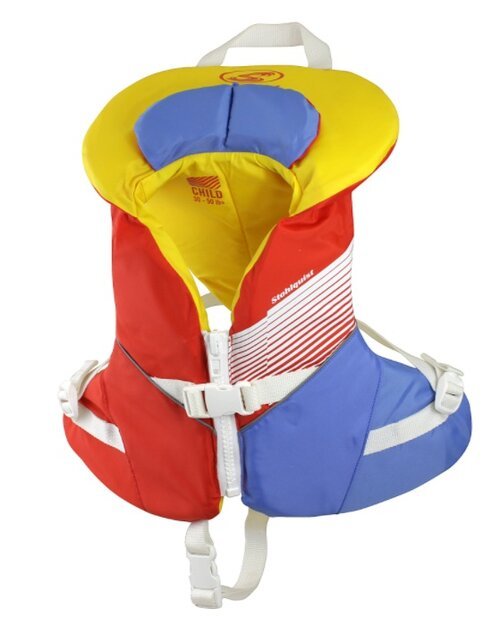
USCG Approval Rating: II
Weight Range: 8 to 30 lbs
Number of Buckles: 3
Number of Straps: 6 (3 on each side)
Entry: Front Buckle
What we liked: double collar construction, flotation design, adjustability, keeps infants on their back instead of pushing them towards their face, T-shaped leg strap
What we didn't like: price, zipper may rub against sensitive skin
We chose the Stohlquist Infant Life Jacket as our Best Life Jacket for Infants because of the double-collar construction, flotation design, and adjustability.
Originally known as the Nemo Life Jacket, Stohlquist renamed their designs to the Infant Life Jacket and the Toddler Life Jacket. They’re still the same design (they were simply two different designs under one name before), but now they’ve been renamed and separated into two differently designed life vests.
Infants certainly aren’t going to be swimming on their own, but if the worst should happen, it’s crucial to find a design that will keep an infant on their back, rather than pushing them forward onto their face. Stohlquist took that key safety feature, and built a life jacket around it. TheStohlquist Infant Life Jacket is designed for infants from 8-30 lbs and has a flotation weight of 7 lbs 6 oz.
Compare Prices Of The Stohlquist Infant Life Jacket
-
Rated as a Type II, the Stohlquist Infant Life jacket has almost the same design as the Stohlquist Child Life Jacket, with more flotation around the head and neck. They both have most of their flotation foam on the front and around the neck, leaving the back with a triangular foam piece and wide armholes for both adjustability and comfort. (Many children aren’t huge fans of life jackets, and this one takes away the irritation and restriction that many others can cause.)
-
The T-shaped leg strap goes around the back and through the legs, with adjustable tabs on both sides and by the crotch-strap buckle. This way, an infant has fewer chances of slipping through the life vest (thanks to the crotch-strap), and parents can make sure that it’s got a comfortable snug fit. A front-zip entry and quick release buckle over the zipper make for easy put-on/take-off flexibility. And a rescue grab strap, attached to the top of the collar, is a great peace-of-mind for parents. Should they ever have to rescue their infant, this grab strap gives them an easy way to pull them out of the water.
-
The most lauded feature of the Stohlquist is the double-collar. A smaller, raised collar fits close to the back of the head, giving an infant the extra support their neck may need, if they’re not fully able to hold themselves up. The second, larger collar (or head pillow) is designed to keep their heads floating above water in case of emergency.
We also liked how it has 3 high-visibility colors.
The handle was easy to grab for taking kids in and out of the water.
-
Some kids found that the zipper on the neck can chafe right under the chin. Bigger kids had no issue.
Best Toddler Life Jacket 30-50 pounds: Stohlquist Child Life Jacket
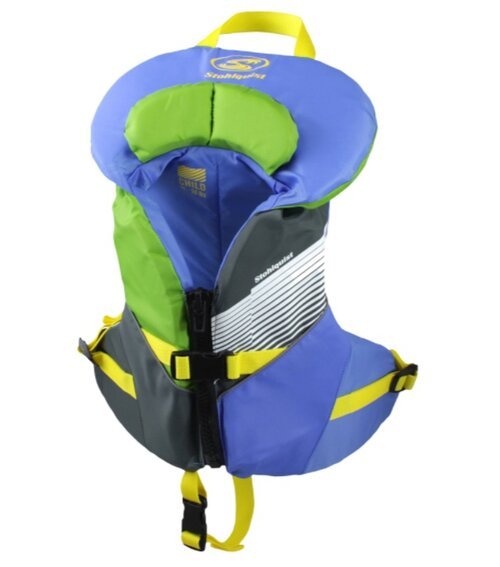
USCG Approval Rating: II
Weight Range: 8 to 90 lbs
Number of Buckles: 2
Number of Straps: 3
Entry: Front Zip
What we liked: double collar construction, design, comfort, adjustability
What we didn't like: price
We chose the Stohlquist Infant Life Jacket as our Best Life Jacket for Infants because of the double-collar construction, flotation design, and adjustability.
We were impressed by the double-collar (especially its help in holding up younger children’s heads), and the adjustability that allows kids to use this PFD for years.
Originally known as the Nemo Life Jacket, Stohlquist renamed their designs to the Infant Life Jacket and the Toddler Life Jacket. They’re still the same design (they were simply two different designs under one name before), but now they’ve been renamed and separated into two differently designed life vests.
The Infant Life Jacket can still be found widely and we believe it's the best choice for kids 8-30 pounds–as long as you can get your hands on it.
View The Stohlquist Child Life Jacket


-
The key difference between the Infant version and Child version is that toddlers most likely won’t be swimming on their own. But if the worst should happen due to toddler curiosity, it’s crucial to find a toddler life jacket that is designed to keep your child on their back, rather than pushing them forward onto their face.
Of course, toddlers will have more control of their body than an infant, but you still don’t want them face-down in the water! Stohlquist took that key safety concept and built a toddler life jacket around it. The Stohlquist Child Life Jacket is designed for toddlers from 30-50 lbs, and has a flotation weight of 8 lbs 6 oz.
-
Rated as a Type III, the Stohlquist Child Life Jacket has the same general design as the Infant Life Jacket, just made for differently weighted children. Just like the Infant Life Jacket, the Child Life Jacket has most of its flotation foam on the front and around the neck (but less bulk in the flotation cushion), leaving the back with a triangular foam piece and wide armholes for both adjustability and comfort. (If your toddler isn’t a huge fan of life jackets, this one takes away the irritation and restriction that many other, more constricting life jackets can cause.)
-
The T-shaped leg strap goes around the back and through the legs, with adjustable tabs on both sides and by the crotch-strap buckle. This way, a toddler has fewer chances of slipping through the life jacket (thanks to the adjustable crotch strap), and parents can make sure that it’s got a comfortable snug fit.
A front-zip entry and buckle over the zipper make for easy put-on/take-off flexibility. And a rescue grab strap, attached to the top of the collar, is a great peace-of-mind for parents—should they ever have to rescue their child, this strap gives them an easy way to pull them out of the water.
-
The most lauded feature on the Child Life Jacket of these life jackets was the double-collar. A smaller, raised collar is raised towards the back of the head (but not as close as the Infant’s), giving a child extra support if they’re not fully able to hold themselves up. The second, larger collar (or head pillow) is designed to keep their heads floating above water in case of emergency.
-
We kept seeing the Stohlquist Nemo show up on “Best Of” lists but couldn’t find it in stores.
We contacted Stohlquist to get the real skinny on what happened to the Stohlquist Nemo, a highly rated and much-beloved children's life jacket.
Their customer service was quick to answer that the Nemo Life Jacket is the old name for the new Stohlquist Infant and Stohlquist Child Life Jackets. The only thing that has changed are the names. We found that the same features that people loved about the Nemo are still in the Infant and Child Stohlquist jackets.
-
Infants certainly aren’t going to be swimming on their own, but if the worst should happen, it’s crucial to find a design that will keep an infant on their back, rather than pushing them forward onto their face. Stohlquist took that key safety feature, and built a life jacket around it. The Stohlquist Infant Life Jacket is designed for infants from 8-30 lbs and has a flotation weight of 7 lbs 6 oz.
It fits low away from kids' faces and it has lots of mobility, especially for a PFD not designed for paddling.
Best Budget Life Vest: Stearns Youth Classic Vest
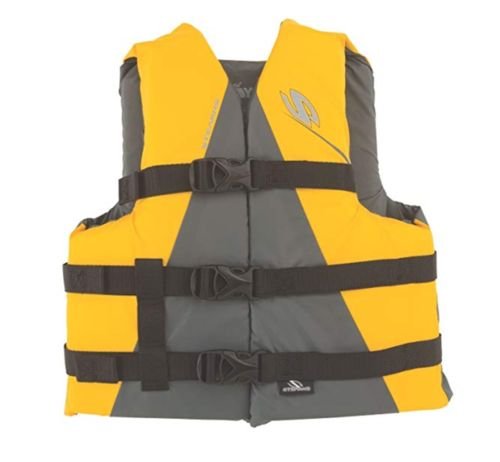
USCG Approval Rating: II
Weight Range: 8 to 90 lbs
Number of Buckles: 2
Number of Straps: 3
Entry: Front Zip
What we liked: mobility, easy put on/take off, adjustable, buoyancy for flat water, white water, offshore boating
What we didn't like: no head pillow, is a personal flotation device (not a life jacket), bulky
We chose the Stearns Youth Classic as our Best Budget Life Jacket because of the price and construction. This life jacket comes highly recommended by those who used it across a wide gamut of sports—from motorized water activities to calmer paddlesports. It’s hard to beat a life-saving flotation device that costs less than a trip to Chuck E. Cheese, and weighs less than a pound!
Stearns Youth Classic Vest

-
The Stearns Youth Classic is a Type III life jacket, which means that it is designed for a wide variety of activities. It has enough buoyancy to take on flatwater, whitewater, and offshore boating adventures—but, again, we stress that this does not have a head-pillow, and is a Personal Flotation Device, not a “life jacket.” Kids should be closely monitored while in the water.
-
The Stearns Youth Classic was lauded as a great Personal Flotation Device for canoeing, flatwater kayaking, tubing, and fishing for those who want to stay under budget. We also think it is a good choice for kids just getting into watersports, and great for families with lots of kiddos to suit up. The hardy nylon exterior is easy to clean, and the 1” webbing straps are study, withstanding years of rough wear and tear from kids (and adults, alike).
This Stearns is also the perfect, affordable back-up PFD; loan to friends, wear for swimming lessons in the lake, or pull from under your car seat when you left your primary PFD hanging on the drying line.
-
With a front buckle system, this life vest is easy to put on/take off, with adjustable side straps to create a snug fit on most body types. This PFD tends to run small, so make sure to measure your child’s chest size before committing.
-
The one drawback of the Youth Classic is that it is bulky and not designed for particularly active sports. Those who used it for paddling sports (especially kiddos trying to learn to kayak) complained that it could be cumbersome, but did not impede activity too greatly. The pros outweighed the cons on this one.
To be clear: this is a Type III PFD, which is more of an “aid” than a “life preserver.” So keep this in mind when deciding what type of PFD you need.
-
The overall reaction towards this life vest placed it at the best value for a flotation device, especially for those who are just beginning to play with water sports, or who are looking for a little added security during lower-risk water activities (i.e., canoeing across a calm lake).
Other kids life jackets we tested
Full Throttle Child
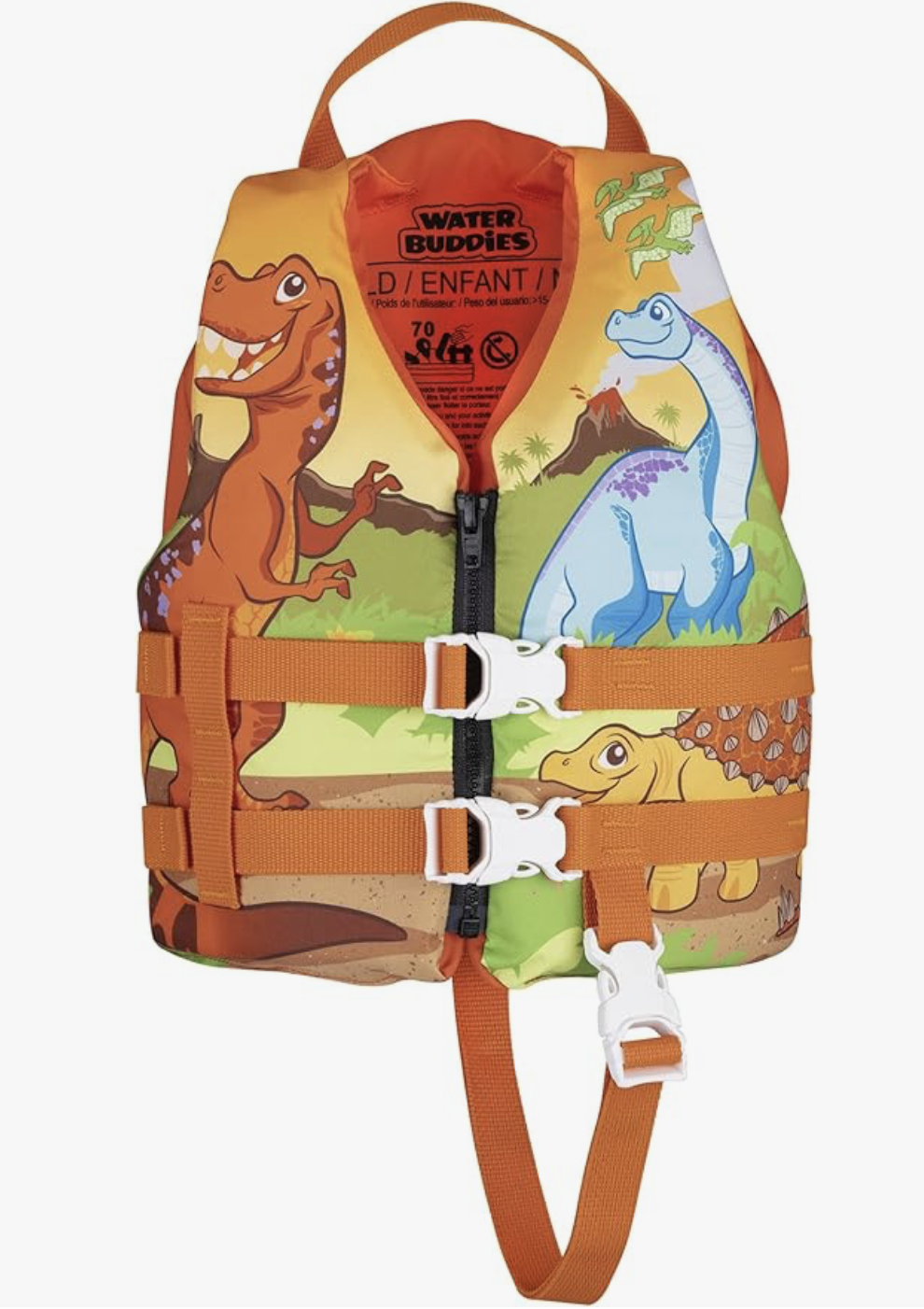
USCG Approval Rating: III
Weight Range: 30 to 90 lbs
Number of Buckles: 3 (2 front, 1 leg strap)
Number of Straps: 5 (4 on side, 1 leg strap)
Entry: Front Buckle and Zip
We don’t want to leave out some additional great Life Jackets on the market that didn’t quite make our cut. The Full Throttle Youth Life Jacket came with good reviews (4.7/5 on Amazon), but didn’t have the overwhelming praise and demand that the Stohlquist Youth Escape had.
On that note, the smaller version we tested, the Full Throttle Water Buddies for Infants had such good ratings, it came almost neck-and-neck with the Stohlquist Infant Life Jacket that we recommend, except for multiple comments about the design forcing infants onto their faces. While we didn’t experience that issue in our testing, that was enough of a safety concern we decided to eliminate it from our recommended life jacket list.
View The Full Throttle Child

USCG Approval Rating: III
Weight Range: 50 to 90lbs
Number of Buckles: 1 on front
Number of Straps: 6 (2 side, 2 shoulder)
Entry: Front zip
We're looking forward to testing the NRS Youth PFD. Designed to be lightweight and flexible to increase mobility and move with your kid, this is a promising option for more active bigger kids.
With a 400-denier nylon fabric, it is also designed to be more durable than many of the PFDs we considered.
NRS is a major brand in the rafting community and an NRS PFD is the overall winner in our Best Life Jackets and PFDS (for adults) guide.
View the NRS Vista Youth PFD

USCG Approval Rating: III
Weight Range: 33 to 55lbs
Number of Buckles: 1 on front
Number of Straps: 5 (1 front, 4 side)
Entry: Front zip
We're looking forward to testing the NRS Crew PFD. Designed to be a more pared down version of the NRS Vista Youth PFD, this is a more affordable kids' PFD that is higher craftsmanship than many flatwater PFDs. It looks like a promising option for closer-to-shore boating and we're hopeful that it could be more comfortable than similar PFDs.
View the NRS Crew Youth PFD

USCG Approval Rating: approved (does not state rating)
Weight Range: 30 to 50 lbs
Number of Buckles: 3 (2 front, 1 leg strap)
Number of Straps: 3
Entry: Front Buckle and Zip
Costco’s Hyperlite Child Life Vest also scored good reviews (4.7/5 on the Costco website)—especially calling out the affordability, comfort, and quality for the price—but as you have to be a Costco member to purchase, it didn’t make our list.
However, it is recently also available at Amazon in select sizes. Other retailers, like Evo have started to stock it as well. Since it's so affordable, it's worth checking to see if it's in stock.
Compare prices of the Hyperlite Child Life Vest
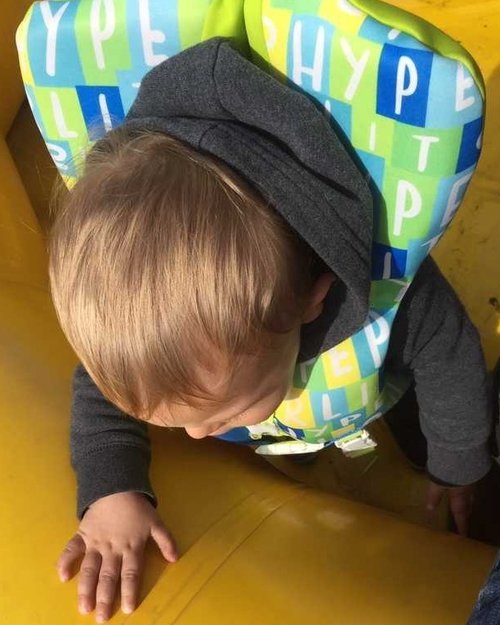
The Hyperlite Kids’ and Infant Life Jacket is an affordable option for many families. Photo courtesy Seamus Daniels.
Life jacket vs. PFDs (personal flotation devices)
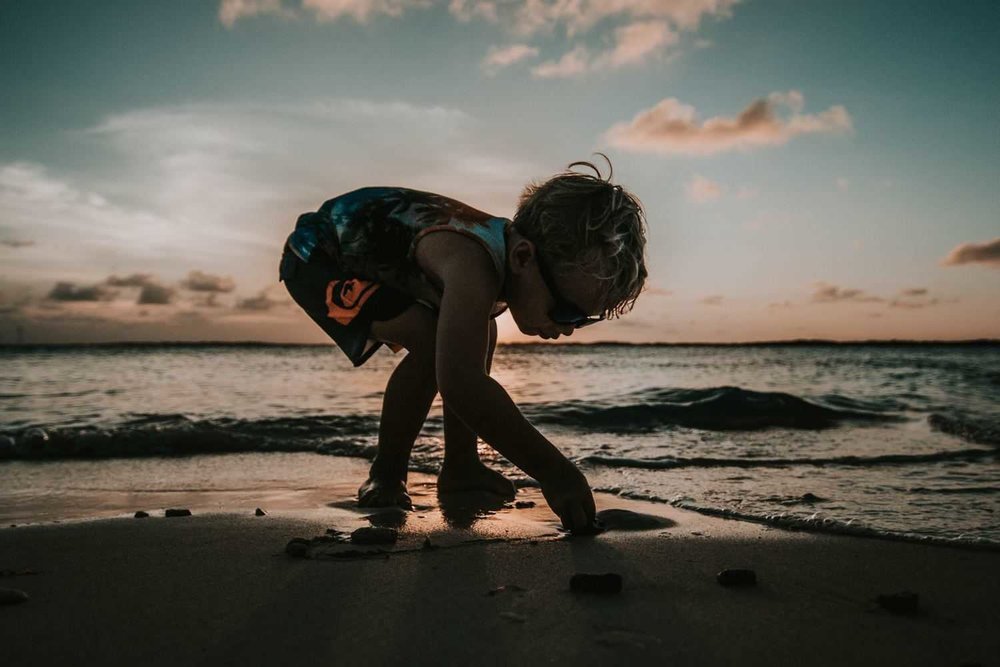
Our advice: Put your children in a life jacket and watch them near the water.
There are dozens of ways to get your kids out on the water, but they all require one essential piece of safety equipment—a flotation device.
There are too many stories of injury, tragedy, and catastrophe around water sports and participants not wearing PFDs—especially kids. I cannot stress this enough—put your children in a life jacket or life vest, and watch them like a hawk.

Growing up in a whitewater boating town, I am well aware of how important it is to keep your kids in life jackets and PFDs.
Growing up in a whitewater boating town, I heard too many first-hand stories from my father (a member of the volunteer fire department who assists Search and Rescue on river emergencies) about victims who weren’t wearing life jackets when they flipped in a rapid, or weren’t cinched in properly and slipped out of their flotation devices once they hit the water.
I’ve seen parents and grandparents at the takeout, waiting for rescuers to deliver unspeakable news. The accidents involving children were the hardest to swallow, but that’s what motivated my conservatism in guiding. “Let them have fun, but stay safe” became my professional motto.
A PFD has saved my life more than once, and I’ve seen clients go into the water who may not have come back out if they hadn’t been wearing a PFD. From guiding Boy Scouts on Class III rapids in British Columbia to taking 8 elementary school children down a Class II stretch of water to floating my younger brothers down the Arkansas River, I’m no stranger to children in life jackets. I make it a point of pride to teach every single one how to put on their life jacket properly.
It is up to you to make sure your kid has the appropriate life jacket for their activity and for their body shape and size. This guide is a recommendation based on what we have observed and researched. Treeline Review and its authors, editors, or staff are not liable for any results. Your kids’ safety is your responsibility.
Lastly, federal and state regulations may require children under 18 to wear life jackets. Check your local jurisdiction.

Type I (right) and Type V (left) PFDs on the Klehini River, Haines, Alaska. Photo courtesy Aaron Henry.
What Are The 5 Different Types Of Coast Guard Approved Pfds And Life Jackets?
How Do Federal And State Requirements Impact Life Jacket Requirements ?
Coast Guard regulations state a minimum inherent buoyancy for different classifications of flotation devices. Coast Guard approved life jackets are rated I to V. We did a hard dive into the buoyancy classes and classifications of PFDs in our section on How to Choose a Life Jacket and PFD. The Coast Guard classifications are the same for adults and kids.
Regulations require every person in a boat to wear (if a child) or have access to (if an adult) a flotation device. Individual states also have their own regulations on life jackets, too. While motorized boats have a different set of rules, for this guide we focused on the human-powered water sports.
A note on Coast Guard approval. Every life jacket, life vest, or PFD for a child should be Coast Guard Approved. We don't recommend getting anything labeled as an inflatable pfd, inflatable life vest, or inflatable life jacket--all which are less trustworthy.

What to look for in kids life jackets
There is a large set of features to consider when it comes to a piece of gear designed to save kids’ lives—or, at the very least, to keep you afloat. We narrowed our selection criteria down to these 7 most important.
Price
While we think that a life-saving device for your child is not an area to skimp, we weighed the expense versus the durability of each PFDs feature to select the best options. After all, kids do grow out of PFDs, so knowing you may need to buy a few, we think it’s reasonable to be price sensitive. We also included our Best Budget Life Jacket, with kids’ sizing and price as considerations.
Coast Guard Rating & Flotation Weight
While every PFD, life vest, and life jacket we reviewed had to be Coast Guard approved, we also took the flotation weight (or the amount of buoyancy added) into account. In general, the more flotation weight, the better. But flotation devices with higher flotation weights tend to be bulkier, losing the mobility benefits of a slimmer PFD for certain activities, or for older, more active kids.
Swim Vest Vs. Life Jacket Vs. Puddle Jumper
It's important for parents to note that a swim vest is NOT a life jacket or PFD. It's a swim aid. A swim vest has less buoyancy. Swim vests are designed for calm water, like pools. They have more mobility than a life jacket (great to practice swimming in a pool), but aren't the safest option for kids on lakes, rivers, or other bodies of water.
A puddle jumper is a combo of life jacket, swim vest, and swim aid. It's got water wing-like arm =floaties in addition to the vest/life jacket section over the chest back. It's designed for kids in the 30-50 pound range. While still Coast Approved as a type iii jacket, a Puddle Jumper has more mobility than some life jackets. The Stearns Puddle Jumper has dominated this market. Stearns Puddle Jumper is also known for kid-friendly designs, a plus (for a premium price) vs. the more affordable Stearns Youth Life Jacket we recommend as our budget pick.
Adjustability
This was a no-brainer, but arguably the most important point. Adjustability in a PFD allows for one piece of equipment to fit a wide array of body shapes and sizes, which is crucial for kids. Adjustability allows for life-saving, close-fitting PFDs, which are the only useful and functional kinds of PFDs. We looked for PFDs with multiple adjustable straps and other features to allow for a greater range of consumer fits
Comfort
Little Johnny won’t go out on the water if his life jacket is uncomfortable. We made sure to find PFDs that were comfortable both on and off the water for even the pickiest of kids.
Design (“Life Preserver” Vs “Pfd”)
Obviously, we want our kids to be safe as possible. But the question of comfort and mobility comes into play when you’re choosing a safety device for your child. While life jackets are designed to keep a child's head above water and bodies afloat, a Type II life preserver may hinder an older child’s abilities in the water. To read more about what Type I and Type II mean, see our stories on Life Jacket vs. PFDs and What are the 5 types of Coast Guard approved life jackets and PFDs?
Choosing whether you should get a life preserver or a PFD comes down to knowing your child, knowing your activity, and knowing your involvement with your child in the water. You may want the full precaution of a Type I or II, or may want the mobility of a Type III. If you're only going to be in a pool, a swim vest may be a better option (but we don't recommend taking a swim vest to a lake, river, or natural body of water). Know your desired design before you purchase.
Durability
A PFD that wears out quickly isn’t worth much. We researched PFDs with hardy materials—read: kid-proof—to make sure that what we chose could stand the test of time (and tumbles!).
Sizes
We all have different body types and body weights, but with how fast kids grow, a range of sizes is key. We researched PFDs that provide a wide array of available sizes to accommodate all of our little water enthusiasts, no matter what age or size. Read below for more on how to size a child’s life jacket.
Visibility and Reflective Features
Depending on where you’re using your life jacket, having reflective material or other visibility features can be important. This is especially true for open water, when you want to be visible by boats and other watercraft, and in case a rescue is ever needed. Most life jackets designed for use in the ocean will have at least some reflective detailing, while this is less common on PFDs made for rafting or other river sports.

How to Choose a life jacket for your kid
Whether you’re kayaking, canoeing, swimming, packrafting, or more, there’s a life jacket or PFD for what your kids are doing. PFDs are much like t-shirts—anyone can hand you a “good” t-shirt, but only you can find that favorite-everyday-tee. Knowing how to get a proper fit on your PFD makes it more likely that you’ll find a new favorite.
At the end of the day, only you can pick the life vest or Personal Flotation Device (PFD) that works for you and your kid. You know what kind of water you want to be on, your activity level, and your size range. These tips will guide you to make a more informed decision for you and your kids.
Get the right size life jacket for your kid
Kids PFDs are designed to fit within weight ranges--not ages. An older kid that is skinny and tall child may use a toddler-sized PFD longer than his top-heavy, younger friend.
To get a proper fit, take into account the weight ranges suggested by the manufacturer, but take chest measurements to confirm accurate sizing. And, once again, look for an adjustable PFD; kids grow fast, and they might be a different size pre-season than they are post-season.
Get the right pfd for the water activity you’re doing
Are you a flatwater kayaker looking to get your kids into whitewater? Are you a canoe-r who’s about to embark on a friend’s rafting trip down the Grand Canyon? Are you looking for something to wear on an inner tube down the lazy river, or swimming in the local pond? Take into consideration the highest level of activity that you might participate in.
For example, if you’re a flatwater kayaker who wants to get into running rivers with your children, look for a low-profile Type III PFD (depending on age). They’ll have plenty of buoyancy to paddle the river or rough water, while maintaining enough mobility (and lack of bulk) to continue kayaking on flat water. If you’re looking to take your SUP out on the lake with your kids, then a budget-friendly Type I may be perfect for you all
How Often Will Your Kid Be Wearing A Pfd?
If you’re going to be on the water more than a handful of times in a summer, it may be worth it to upgrade from a basic life vest. For the avid weekend warrior, a $100 PFD may be the perfect intersection of price point and performance. For a vacation-only water-lover, a budget pick might just be the ticket.
Look at the design. Will your child be active in the water, or hang out fishing in the back of the boat? Are they a confident swimmer, or nervous on the water? Is an adjustable crotch strap necessary, or not?
Are often cold or headed to cool waters? You may want to invest in Neoprene, which is more expensive but a useful comfort upgrade for most folks. (And kids need more insulation than we do!)
Check safety standards
Before purchasing a life jacket you should ensure that it meets all the safety standards and regulations. Any good life jacket, no matter what sport you’re using it for, should have the Coast Guard’s stamp of approval and this should be clearly marked somewhere on the PFD. As long as your life jacket has this designation, you should be assured that it is a good one and from there, select which specific type is best for your needs.
How To Fit Kids’ Life Jackets And Pfds (Personal Flotation Device)
It’s all well and good to own a PFD, but it’s pointless to wear one if it’s not fitted properly.
We recommend PFDs of different sizes to accommodate infants, toddlers, children, and youth. Our recommendations cover kids from 8 to 30 pounds, 30 to 50 pounds, 50 to 90 pounds, and 90 to 110 pounds.
NRS, a popular PFD brand, released a blog post explaining how to get a proper fit on a child’s PFD.
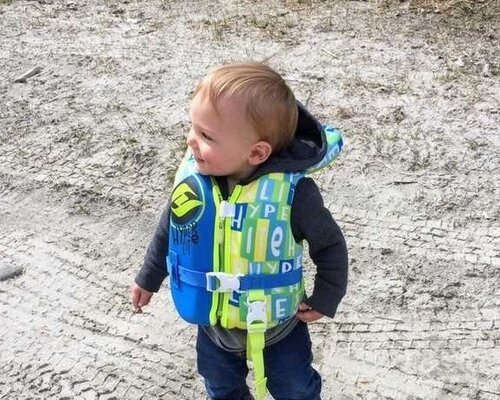
Every PFD we reviewed had to be Coast Guard approved. Photo courtesy Seamus Daniels.
1. Check the size
Ensure that the life jacket is the proper size for the child. It should fasten snugly but not uncomfortably tight, and it should not ride up, fall off, feel overly bulky, or move around too much.
2. Adjust the straps
Loosen the straps of the life jacket before putting it on to make the process easier.
3. Put on the life jacket
See the instructions on how to your model is supposed to go on. Make sure that the zipper is in the front and all straps, including leg straps, are in the proper position.
4. Buckle the straps
Fasten the buckles and adjust the straps as necessary. It should be snug without being constricting, and should allow for range of motion in the arms and neck without being loose or moving around.
5. Check the fit
First, test the fit of the life jacket by having the child lift their arms straight up, then lift the life jacket gently from the shoulders. The life jacket should not slip off or ride up. If the zipper comes up to the nose or is easy to slip up and down, then it is too loose and needs to be tightened.
Another way to check if the life jacket is fastened correctly is by gently tugging it at the shoulders from one side to the other. The jacket should more or less stay in place. If it moves around a lot from gentle tugs or regular movement, then it is either not fastened tight enough, or it’s too big.
Next, check for both comfort and mobility. If a life jacket is uncomfortable, it is more likely that it’ll be taken off and left on the boat or at shore. Always make sure that the life jacket is comfortable to wear. You also want to ensure proper arm mobility. If the life jacket is so bulky that it limits arm or neck movement, then it is too big.
Lastly, check the fit of the life jacket around the neck. It should not be constricting, pressing on the throat, and it shouldn’t limit head and neck movements.
6. Final adjustments
Make any adjustments necessary after checking the fit of the life jacket. If it was too loose, adjust the straps so that it fits snug and properly.
how to test your kids’ pfd
After you buy your PFD, test it at home before getting the water. Here’s the process we use:
Check the manufacturer’s sizing charts and/or recommendations. PFDs are sized by chest circumference, with most difference in sizes lying only with the lengths of straps.
Loosen all of the straps on the PFD before putting it on. Buckle, zip, or pull on your PFD. Then, work from the bottom up—tighten your lowest strap first, and work your way up to your shoulders. This way, you avoid strapping the PFD too high on your chest (which happens when you start from the neck, and work your way down).
When purchasing a PFD, you want to make sure you have some extra length left on the straps for layering on colder days. If you don’t have room, you may need to size up. If the straps are too long, you may need a smaller size.
To test the fit, use the buddy system. With your child’s arms raised, tug the shoulder straps up, as if you were pulling them up and out of the water. (You might have to, one day!) If it slides up, tighten the torso straps again. If it continues to slide up, you may need to choose a different size. If a smaller size doesn’t cut it, you may need to look for a different PFD altogether.
The final test—pretend you’re on the water! Take your kids to a pool (or the bathtub, if they’re small enough!) to practice. Move their arms, grab a paddle and pretend they’re taking on their next rapid. Reach around and make sure they can adjust, twist their torso, and sit down comfortably. If your child is an infant or a toddler, see how they do on their back with your child's head floating on a pillow. Better to take a few minutes and practice than be uncomfortable for hours on the water!

Care and maintenance
A life jacket that's falling apart won't save anyone. Kids are tough on gear, and PFDs take a beating from salt water, chlorine, sun, and the general chaos of being used by children. Keeping them in good shape is part of keeping your kid safe.
Rinse after every use. Salt water and chlorine both degrade materials over time. A quick rinse with fresh water after every outing takes thirty seconds and meaningfully extends the life of the jacket. At the end of the season, do a more thorough wash: a bucket of warm water and dish soap, dunk the jacket repeatedly, rinse in clean cold water, and air dry. This keeps mold, mildew, and the particular brand of river funk from taking up permanent residence.
Dry completely before storing. Never put a damp life jacket away. Hang it somewhere shaded with good airflow. Direct sunlight degrades fabric and fades colors faster than use will. Don't use a dryer or leave it near a heat source like a campfire or radiator.
Inspect before every trip. Run through the jacket quickly before you get to the water, not at the put-in when you're already juggling gear and excited kids. Check for frayed or severed straps, ripped material, exposed foam, damaged buckles, and zipper failure. Zippers are usually the first thing to go. Also check for compression or crumbling of the foam itself, which reduces buoyancy even when the jacket looks fine from the outside. If you find any of these, replace the jacket before getting on the water.
Store it properly. Between trips and over winter, store life jackets flat or hanging in a dry place away from heat, chemicals, and sunlight. Don't stack heavy objects on top of them. Compressing the foam over months distorts it and reduces buoyancy.
Don't modify it. No patches, no alterations, no creative adjustments to improve fit or add a pocket. Any modification can compromise the buoyancy rating or void Coast Guard certification.
Know when to replace it. PFDs don't have an official lifespan but should be inspected at least once a year. If the foam has lost flexibility, if there's visible water damage or mildew that won't wash out, if buckles or straps are compromised, or if your child has simply outgrown it, replace it. A life jacket that no longer fits properly is not a life jacket.
One more thing worth repeating from the Coast Guard's own guidance: don't sit or kneel on PFDs. The foam compresses under body weight and loses buoyancy over time. Keep them off the floor of the boat when they're not being worn.
FAQ
-
Any child on the water should be wearing a life jacket, including babies (there are life jackets made specifically for infants). The law varies by state as far as the age when a life jacket is required, but generally all children should have one on when on the water.
-
Many people choose inflatable life jackets for low profile comfort. These work well in many situations, but they are often not the best choice depending on your location and your ability level as a swimmer. If you are not a confident swimmer, or you’re in territory where rescue is far off, a foam life jacket is better. And generally, kids should always use foam PFDs instead of inflatable ones.
-
Swim vests can be helpful for children to learn to swim in safer, more controlled environments, like a swimming pool. But these do not offer the same protection or flotation as life jackets and should not be used in situations where a life jacket is necessary.
-
The fit should be checked each time you put the life jacket on to ensure it’s fastened correctly. As far as sizing goes, you should check the fit each year as your child grows to determine if a new life jacket is needed.
-
You should always have a proper-fitting life jacket for your child. If the life jacket is too large it will not do its job as well as one that fits snugly. Ensure that you’re getting the right size life jacket for your child and replace it as necessary as they grow. While this can be more expensive, this is the most important piece of safety equipment when you’re on the water.
-
You can wear a life jacket over clothing, just ensure that it still fits properly and does not move around or slip off. It should pass all of the fit tests just the same with clothing on underneath in order for it to be safe and comfortable.

We liked life jackets and PFDs for kids that were available in multiple sizes. That makes it easy for parents and guardians to not have to familiarize themselves with different models every time the kid gets better. Simply get the same model in multiple sizes.
How We Researched and Tested
For this story, we first interviewed professional boaters who make their living on the water and teaching it to their kids).
After hearing from the professionals, we checked what everyday users had to say on platforms such as REI, Backcountry.com, Outdoor Play, and Amazon. From these latter sites, we verified reviews against FakeSpot, a site which flags falsified or tampered reviews, to verify authenticity.
Then we tested the most promising looking infant, child, and youth life jackets and PFDs in all kinds of water. We tested with parent-rafters in Colorado, Alaska, and Maine. We tested with parent-boaters on the Great Lakes. We tested with active children paddling themselves as well as infants staying safe while their parents paddled, sailed, or motored.
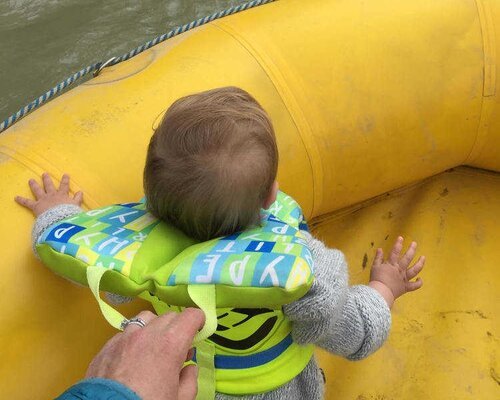
An infant or child wearing a life jacket or PFD still requires adult supervision. Photo courtesy Seamus Daniels.
To be considered for this article, we measured each PFD against standardized criteria. The PFDs had to be:
Kid-specific affordable
Durable
Comfortable
Adjustable
Coast Guard approved
From there, we narrowed our criteria to our specific categories—for example, with our all-around pick, we were looking for an option that gave Mom and Dad a break from searching. Three sizes, adjustability, comfort, and color options were key, and our pick ticked all four of these necessities.
- Parent-rafters in Colorado, Alaska & Maine
- Parent-boaters on the Great Lakes
- Active children paddling independently
- Infants in PFDs while parents paddled
- Verified reviews against consumer databases
- Fit security across body shapes & sizes
- Crotch strap to prevent riding up
- Ease of buckling under pressure
- Handle strength for lifting a child out
- Durability & adjustability across growth stages

The author guides trips in Southeast Alaska, British Columbia, and the Yukon. Photo courtesy Aaron Henry.
Author’s Expertise
why you should trust us
Since the blistering-hot Colorado summer of 2014, I’ve been obsessed with water. I started on the rapids of the Arkansas River, then moved up to Alaska to raft glacially-braided rivers in 2016. After two years, I managed our hiking and rafting program based out of Skagway, Alaska, and guided the rivers surrounding Southeast Alaska, British Columbia, and the Yukon. We paddled with Boy Scouts through high-walled canyons, and rowed through heavy headwinds through braided, silty channels.
Personally, I’ve paddle-guided Class IV sections with clients who had never seen a rapid (much less boated through one) and rowed a raft of twelve cruise ship passengers alongside the historic Chilkoot Trail (including kiddos as young as 7!).
I’ve also trained guides who had never held an oar before how to navigate rivers, rescue swimmers, set up boats, and row through tricky and potentially hazardous situations—including Stellar sea lions blocking our channel, and 100+ foot spruce trees gliding down the river alongside the boat.
As a volunteer with local fire departments in both Alaska and Maine, I’ve trained and participated in swiftwater and lake-based rescues. I have maintained a Swiftwater Rescue Level IV certification throughout my river-guiding career, building haul systems to rescue boats, and plucking swimmers out of numerous rapids.
Last year, I bought my own boat (with the help of two other water nerds), and have continued to teach others the joys of water navigation throughout the West while I heal from a shoulder surgery. Even a busted wing can’t keep me off the water!
You can read more about Josette at her website or on her Treeline Review author page.