
Best Running Hydration Vests of 2026
Top-rated running vests & running packs with reservoirs and water bottles for men & women

June 2nd, 2026, updated with a new budget winner, new winner for best for ultralight marathons, best for running at night, with 5 new vests tested
Home > Gear Reviews > Running
A running hydration vest sits in a specific sweet spot that handheld bottles and shorts pockets can't cover — enough water and gear for a long effort, in a format that moves with your body rather than bouncing against it. The difference between a vest that fits and one that doesn't is something you notice within the first mile, especially once you load it up with two liters of water, a layer, and a handful of gels.
We've been testing running hydration vests for years across trail runs, mountain efforts, local road long runs, and everything in between, with testers of different body types and torso lengths putting the same vests through the same conditions side by side. We've tested every major iteration of our top picks as new versions have been released, which gives us a longer view of how these vests hold up over time rather than just on first impression.
What separates a good running hydration vest from one that ends up in the back of a closet comes down to how the harness system conforms to the ribs and chest without creating pressure points during sustained effort, how well the vest stays put when loaded versus nearly empty, how accessible the pockets are without breaking stride, and whether the fit works across a range of body types rather than just one.
Top Pick: The Salomon Adv Skin 12 (men's and women's) earns our Best Overall award. It stood out as the most comfortable vest we tested across body types, with an Adv Skin mesh that conforms around the ribs better than any other vest in its class, a Quicklink bungee system that adapts well to different chest sizes, performance that holds up equally well empty or fully loaded, and five years of consistent testing across every model update that has only reinforced our confidence in it.
Looking for something more minimalist? See our guide to Best Running Belts
Looking for something with more capacity? Check out our Best Running Packs guide
We create reader-supported, objective gear reviews independently selected by our editors. This story may contain affiliate links, which help fund our website. When you click on the links to purchase gear, we may get a commission — without costing you an extra cent. Thank you for supporting our work and mission of outdoor coverage for every body! Learn more.
Comparison Tables
Men’s
| RUNNING HYDRATION VEST | TREELINE AWARD | PRICE* | HYDRATION INCLUDED | CAPACITIES AVAILABLE | WEIGHT | SIZES |
|---|---|---|---|---|---|---|
| Salomon Adv Skin 12 | Best overall Read review |
$165 | Y, 2 bottles | 5 L, 8 L, 12 L | 9.5 oz (12L) | XS-XL |
| REI Co-Op Swiftland 5 Hydration Vest | Best budget Read review |
$110 | Y, 1.5 L reservoir | 5L | 9.5 oz (L/XL) | S-XXXL |
| La Sportiva Ultra Trail Vest 10L | Best for ultra running Read review |
149 | N | 10L | 7 oz (M) | S-L |
| Deuter Traick 9 SL | Best lightweight Read review |
$145 | N | 9 L | 6 oz | S-L |
| CamelBak Circuit Run Vest | Best for beginners Read review |
$99 | Y, 1.5 L reservoir | 5.5 L | 12.7 oz (includes reservoir)/6 oz (without reservoir) | One size |
| Osprey Duro 15 L | Best run-hike hybrid Vest Read review |
$165 | Y, 2.5 L reservoir | 15 L | 12 oz | S/M, L/XL |
| Nathan Pinnacle 12 L Hydration Vest | Best with bladders Read review |
$110 | Y, 1.6 L reservoir | 12 L | 12.5 oz (with bladder)/6.5 oz (without bladder) | XS-XL |
| Nathan HyperNight QuickStart 3.0 | Best for night running Read review |
$110 | Y, 1.5L bladder | 4L | 12.5 oz (with bladder) | One size |
Women’s
| RUNNING HYDRATION VEST | TREELINE AWARD | PRICE* | HYDRATION INCLUDED | CAPACITIES AVAILABLE | WEIGHT | SIZES |
|---|---|---|---|---|---|---|
| Salomon Adv Skin 12 | Best overall Read review |
$165 | Y, 2 bottles | 5 L, 8 L, 12 L | 9.5 oz (12L) | XS-XL |
| REI Co-Op Swiftland 5 Hydration Vest | Best budget Read review |
$110 | Y, 1.5 L reservoir | 5L | 9 oz (M) | XS-3X |
| La Sportiva Ultra Trail Vest 10L | Best for ultra running Read review |
$149 | N | 10L | 7 oz (M) | S-L |
| Deuter Traick 9 SL | Best lightweight Read review |
$145 | N | 9 L | 5.5 oz | XS-M |
| CamelBak Circuit Run Vest | Best for beginners Read review |
$100 | Y, 1.5 L reservoir | 5 L | 12.7 oz (includes reservoir) | One size |
| Osprey Dyna 15 L | Best run-hike Hybrid Vest Read review |
$165 | Y, 2.5 L reservoir | 15 L, 1.5 L, 6 L | 15.5 oz (15 L) | XS-M |
| Nathan Pinnacle 12 L Hydration Vest | Best with bladders Read review |
$110 | Y, 1.6 L reservoir | 12 L | 12.5 oz (with bladder)/6.5 oz (without bladder) | XXS-XL |
| Nathan HyperNight QuickStart 3.0 | Best for night running Read review |
$110 | Y, 1.5L bladder | 4L | 12.5 oz (with bladder) | One size |
* We note any discounts we see on our Deals page, which is updated daily.
The Best Running Hydration Vests
Best overall running hydration vest: Salomon Adv Skin 12
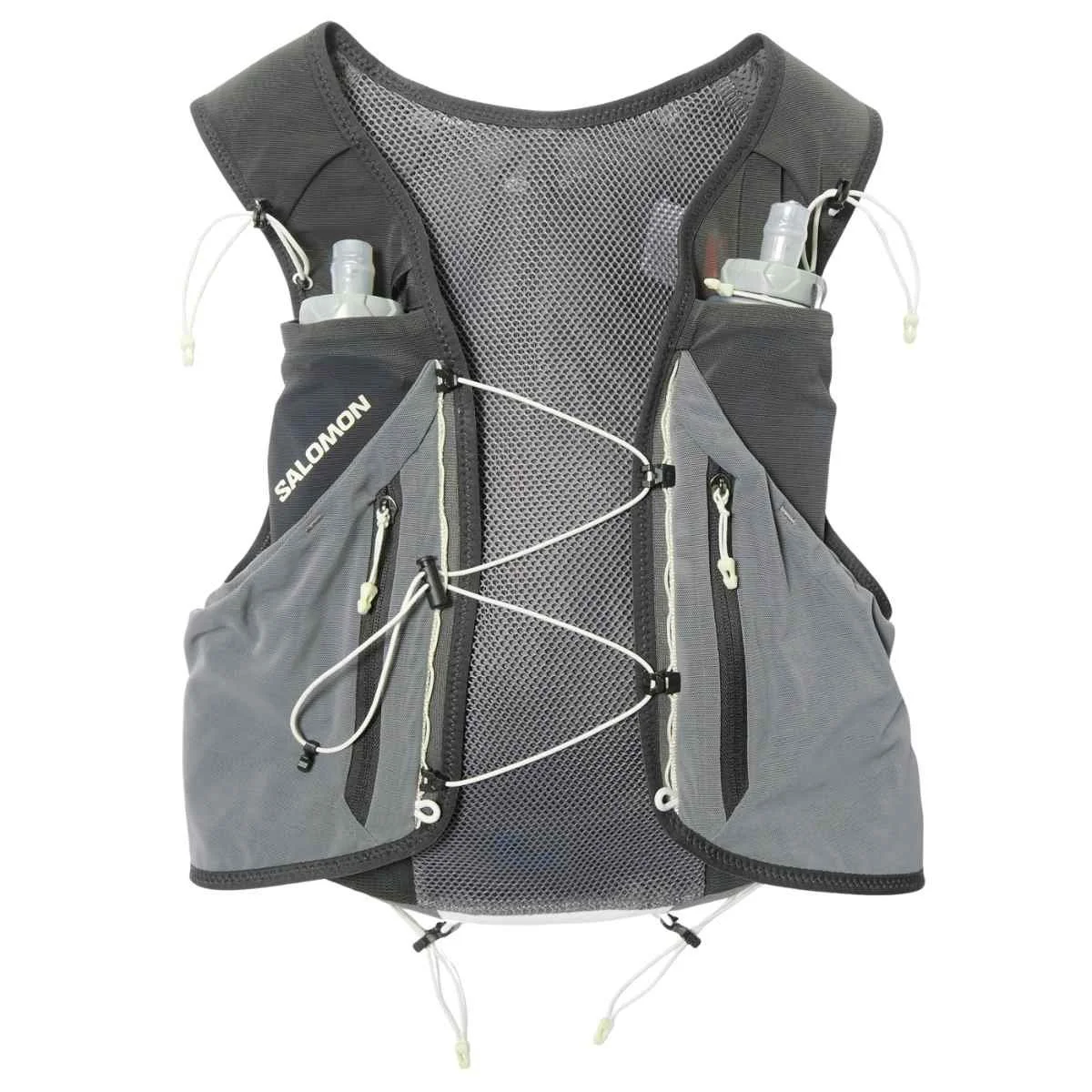
Capacity: 12L
Other capacities available: 8 L, 5 L
Included hydration: Yes
Women's-specific fit available: Yes
Weight: 9.5 oz (12L)
What we liked: Performs equally as well empty as full. Dialed fitting system
What we didn’t like: Some small plastic pieces that can break
Salomon is a big name in trail running, and the Salomon Adv Skin 12 vest lives up to it. With a storage capacity of 12L, it’s in the middle of the capacity range among our other vests, and it carries all 12L of gear just as well as it does when the pack is nearly empty. We’re confident that this is the most comfortable hydration pack we tested.
Salomon “Adv Skin” mesh balances breathability, durability, and stretch. This pack won our award for best hydration pack because it is notably the most comfortable. Of the packs we tested, it conforms the best around the ribs, where a lot of oddly shaped gear (food, headlamps, layers, etc.) usually ends up. This discomfort is a common flaw in the running pack category. The Salomon Adv Skin's mesh kept everything in place so we could run comfortably.
We’ve been testing this hydration vest since 2020 and have tested every iteration since, including the newest version.
For an in-depth review, see our long-term review of the Salomon Adv Skin 12.
Salomon Adv Skin 12
Men's
Women's
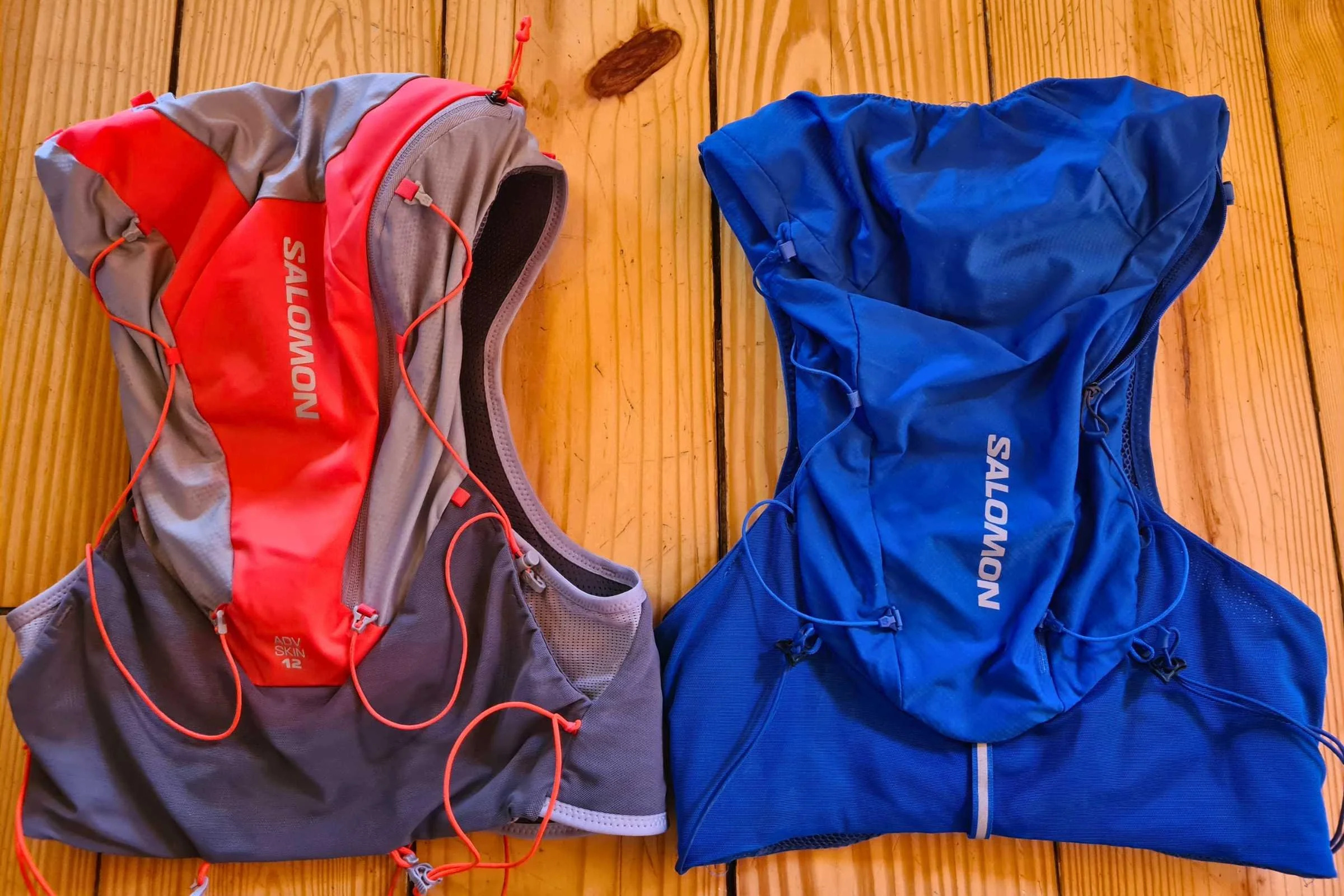



-
The Adv Skin fabric creates a supreme fit around the ribs and chest.
The newest version updated the fabric to be softer. The inner vest front and sides are now a smoother texture, meant to decrease possible chafing.
It has enough stretch to accommodate heavier water carries and other heavy gear while not being quite as stretchy as our other top pack, the Nathan Pinnacle 12L. Having that balance of static and stretch works for comfort on the Adv Skin. It also means the Salomon hydration pack will have more longevity than packs with other designs. Unlike other packs, it won't permanently stretch out quite as fast.
Another fit detail we liked is the bungee “Quicklink” style of adjusting the hydration pack up front. Found in all Salomon running vests, this criss-cross bungee allows for excellent stretch and better conforms to various body types compared to many vests—which tend to use the more common dual sternum strap.
-
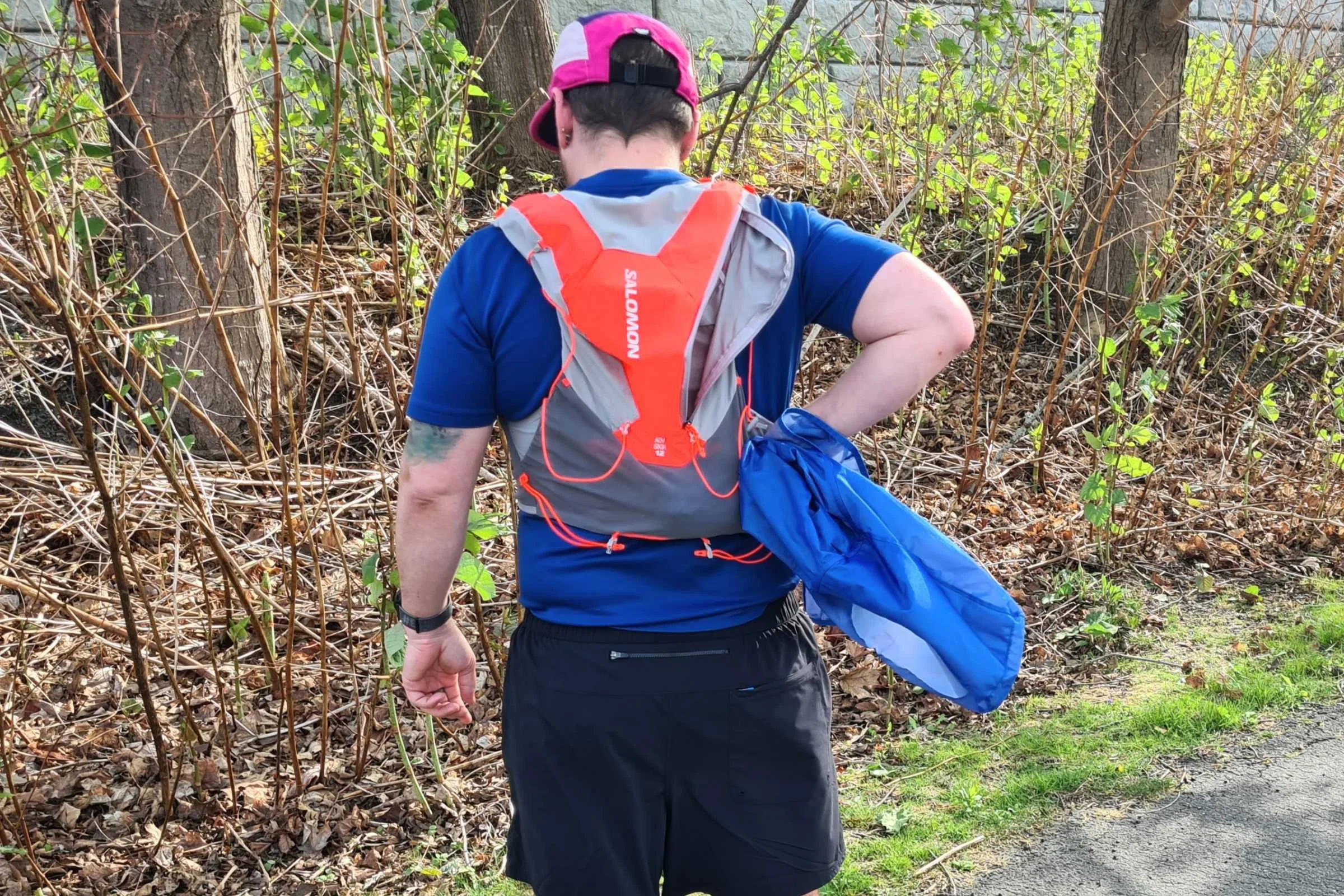
Another highlight of the Adv Skin 12 is the pocket design. While the Salomon Adv Skin 12 has no shortage of pockets, the 2025 version uses a less stretchy material which reduces capacity and impacts comfort compared to the previous version.
-
For hydration, the Adv Skin comes with two 500ml soft flasks, equating to about a $40 value. We found that to help offset the initial sticker shock on this vest, which isn’t the most affordable on the list (but we do think it is a great value). Although it doesn’t come with a bladder, we dropped the included bladder from our Nathan Pinnacle 12L Vest into the Adv Skin bladder pocket. We’re confident that you could carry a 2L bladder in the back and 1L in the soft bottles up front if you really want to. There’d still be plenty of room for layers, and food and electronics up front.
-
The front adjustment Quicklink system is adaptable to different body types of the vests we tested. It allows some comfortable stretch, but adjusting the placements of the contact points can be tedious.
In the newest version, the Quicklink system was updated to a thicker but much less elastic shock cord; in the field, this restricted sizing and increased compression of one of our tester's chests.
As a result, we found most people will need to size up from their expected size, especially compared to the previous model.
-
Salomon uses small hardware plastic pieces that are difficult to unclip and move up and down the hydration pack. Our advice is to be patient with it because once you find where you want the hardware, you won't have to adjust it again. Also, with all the small plastic pieces, there’s more opportunity for something to break. But it hasn’t happened to us yet.
-
The newest version of the Adv Skin 12 had some major changes, compared with years past. Many of these changes seem small, but we found they have changed the user experience and performance in the field. In general, the pack is several ounces lighter, but may require runners to size up.
First the good: The newest version updated the fabric to be softer. The inner vest front and sides are now a smoother texture, meant to decrease possible chafing that some of our testers found in the last model.
One update we really like is that the zippers have been updated to a more robust #5 YKK zippers, fixing an issue we've had with the previous model.
An update we didn't like as much is that the trash pocket, tunnel pocket, side pockets, and extra back panel pocket were removed. The fabric on the front zippered phone pocket is less stretchy making it more difficult to fit our Samsung S20 phone. Instead, the shoulder pockets overlap to more securely hold items.
The shock cord elastic has been updated to be thicker. It's less stretchy, which sometimes keeps things more secure but in the case of the Quicklink system, can feel more restrictive. However, we found that it makes carrying running poles easier as there is less elasticity and therefore less bounce. The new cord is also more durable.
-
Despite some changes, the 2025 Salomon Adv Skin 12 is still the running vest that is going to work the best for most people. We're still big fans and while we miss some of the pockets, still find this to be the most comfortable and user-friendly vest out there.
Interested in running? Check out the Running Gear section:
Best Affordable Running Hydration Vest:
REI Co-Op Swiftland 5 Hydration Vest
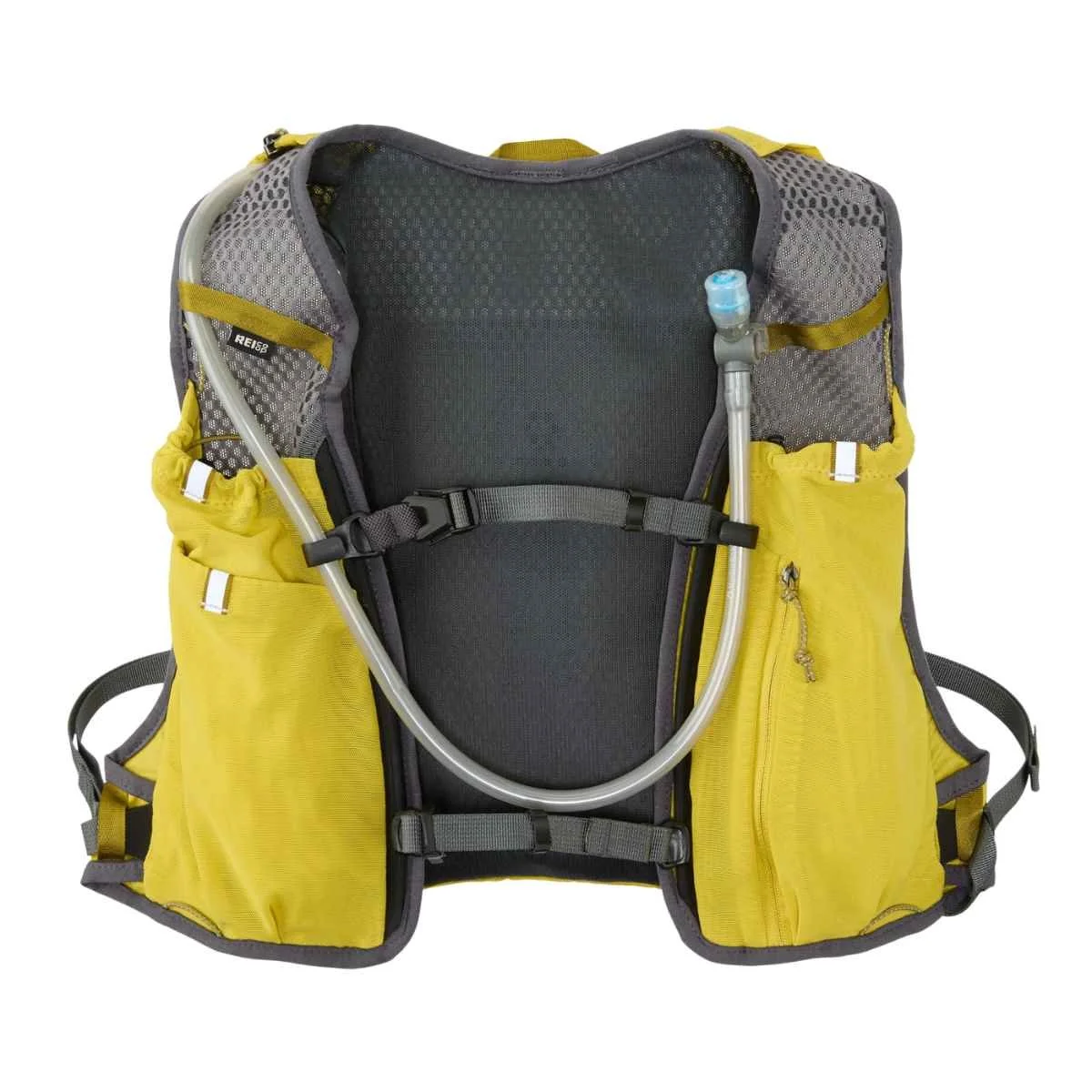
Capacity: 5L
Included hydration: Yes, 1.5 L reservoir
Women's-specific fit available: Yes
Weight: 9.5 oz (men's L/XL)
What we liked: Affordable, durable, carries weight well, comes in accessible sizing, 1.5L water bladder included
What could be better: Webbing straps feel outdated, not many accessible pockets, sternum strap clips are difficult to use
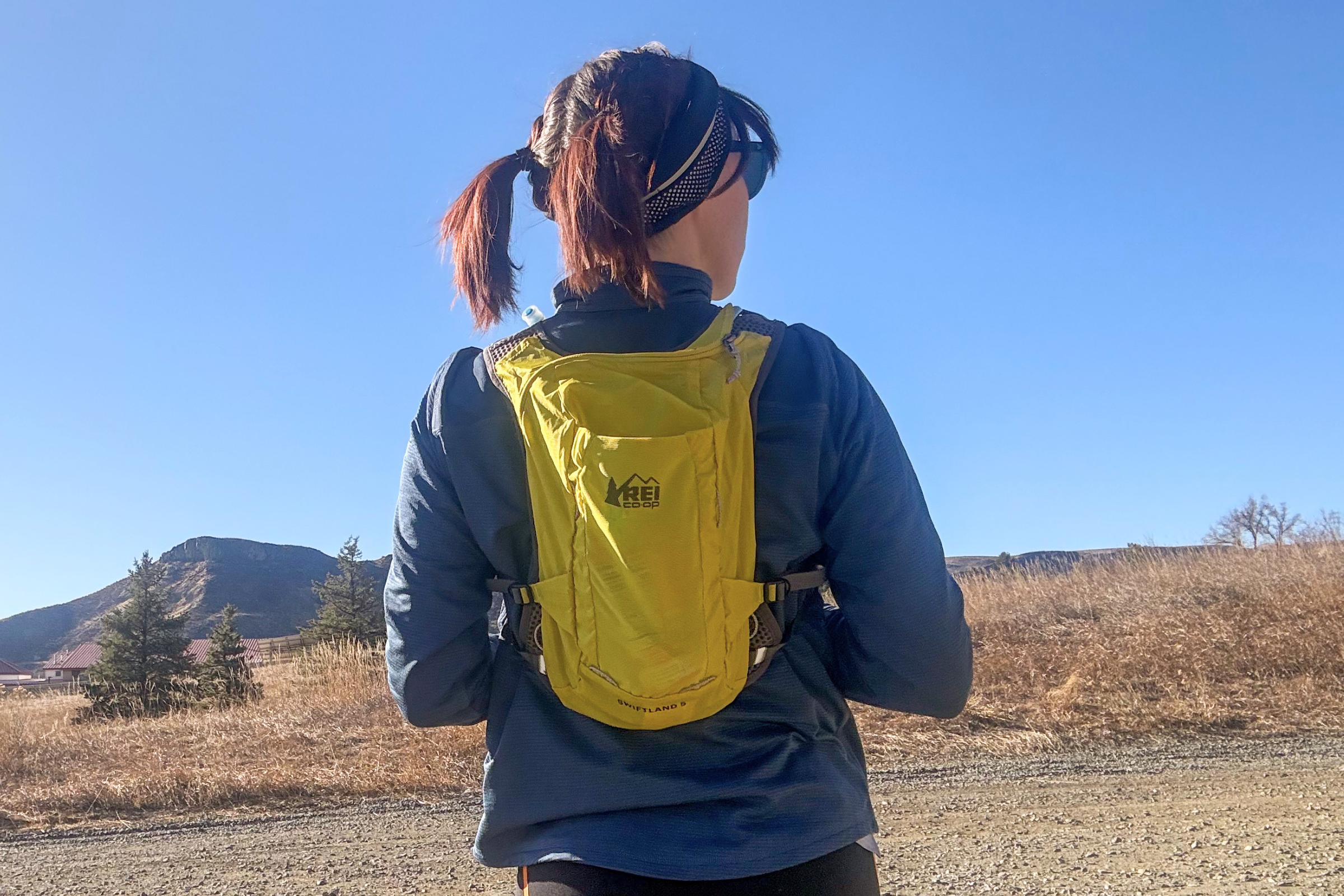
The men's and women's REI Co-Op Swiftland 5 Hydration Vest is an affordable running vest that can handle heavier loads, like long water carries. It comes with a 1.5-liter hydration bladder and is compatible with 500 mL softflask bottles, which fit into stretch pockets on the shoulder straps. In total, it can carry 2.5 liters of water, food, your phone, and a warm layer without bouncing as you run.
We’ve worn this vest for running on road and trail, but we’ve also worn it for hiking and mountain biking, and it works well for all of those uses. We also like that the Swiftland 5 Vest is available in the most inclusive size range of any running vest we’ve found—size S through XXXL.
You can read our in-depth review of the REI Co-op Swiftland 5 hydration running vest here, which also made the cut as one of our favorites from the Swiftland collection.
REI Co-Op Swiftland 5 Hydration Vest
men's
Women's



-
We tested the men's and women's Swiftland Hydration Vest in Arizona during the winter and spring. We wore it for long training days in southern Arizona, where carrying enough water for hours at a time is very important. We wore it for long runs, quick spins on local trails, and all-day mixed surface runs on pavement, gravel, and dirt roads. We also tested the vest in the Colorado Front Range.
-
The biggest standout feature of the Swiftland Vest is its stability when carrying a lot of water. Many hydration vests are made of stretch mesh, which causes the pockets to bounce as you run. The Swiftland is made from non-stretchy, breathable mesh and features side webbing straps to secure it tighter or looser around your torso, creating a solid, bounce-free fit. This allows you to carry more water and other gear comfortably, without the pack sliding up and down on your body, which can cause chafing.
-
However, the Swiftland Vest doesn’t have as many accessible pockets as some of our favorite running vests. Some vests, like the Salomon Adv Skin and Deuter Traick, have up to 9 accessible pockets, while the Swiftland has only 4 that you can reach without taking the vest off. And while we didn’t have any issues with chafing, we suspect some people won’t find the webbing straps that run across your rib cage very comfortable.
-
If you’re looking for an affordable running vest that comes in a wide range of sizes that can carry a lot of water, the Swiftland Hydration Vest is worth considering.
Best hydration vest for ultra running: La Sportiva Ultra Trail Vest 10L
Capacity: 10L
Included hydration: No
Women's-specific fit available: No
Weight: 7 oz (unisex M)
What we like: Less expensive than other premium vests, great pockets, very comfortable, comes with soft flask bottles
What we didn’t like: Bounces in the back when carrying a hydration bladder
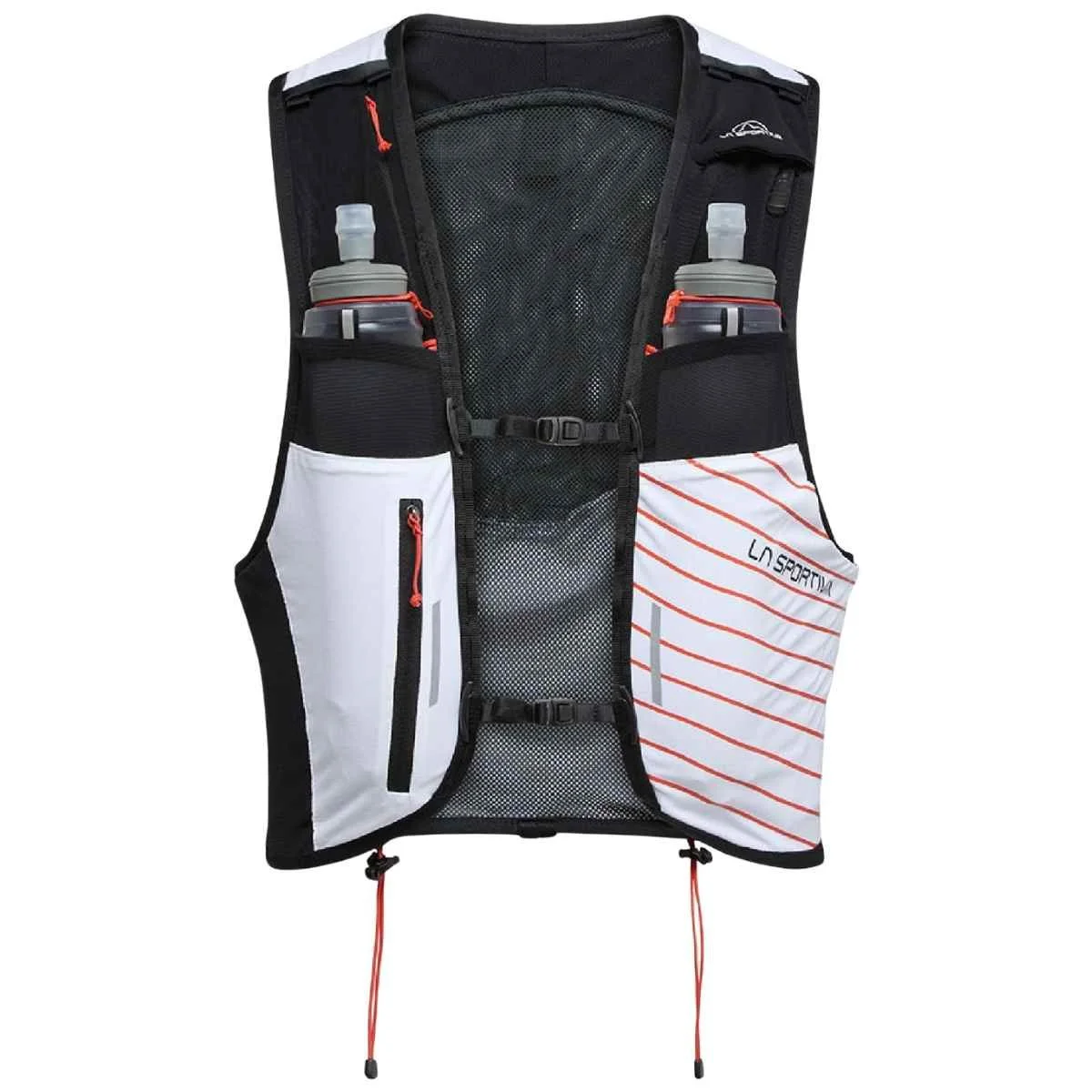
The La Sportiva Ultra Trail Vest 10L is a great all-around hydration vest that’s comfortable, lightweight, and has excellent pocket layout. This vest has all the pockets you need with nothing extra. And, it costs less than the Salomon Adv Skin and Deuter Traick.
We tested the Ultra Trail Vest while trail running in Arizona, Utah, and Colorado, for everything from peak-bagging missions in Colorado and Arizona to all-day trail runs in southeastern Utah. And honestly, this would still be our go-to vest to this day if we hadn’t left it at a friend’s house. (Hopefully we get it back soon!)
It’s made of super comfortable stretch mesh, with breathable mesh on all the areas that touch your body. This vest feels more like a piece of clothing than a backpack, which is exactly what you want in a running vest.
La Sportiva Ultra Trail Vest 10L
-
It has a similar pocket design as our favorite vests, with quick access front stretch mesh pockets and zippered pockets overlayed on top of soft flask pockets. It also has a large pass-through pocket along the bottom of the back that extends to the rib cage area. This pocket is ideal for a light jacket, gloves, or a third 500 mL soft flask bottle. It does have one unique pocket, though: a small zippered pocket on the right shoulder, positioned above the soft flask pocket. We like to store our lip balm and a small tube of sunscreen here.
This vest has all the pockets you need with nothing extra. It’s also great for carrying running poles along the back of the vest. It has detachable shock-cord loops that let you attach folded poles parallel to the vest’s bottom hem.
The only drawback of this vest is that if you want to carry a lot of water, a water bladder will bounce in the rear pocket. This vest is great for carrying 3 500 mL bottles, but once you add a bladder it bounces more than we’d like. But, we run far into remote corners by ensuring we always carry a filter bottle as one of the three soft flasks we carry. So while this vest isn’t the best when you load it with a water bladder, we don’t think that’s really much of an issue for every person. It might be for you, though, if you prefer bladders.
La Sportiva does a great job of making real gear for real athletes, and this running vest is further evidence of that fact.
best lightweight running vest: Deuter TraiCk 9

Capacity: 9 L
Other capacities available: 5 L, 9L
Included hydration: No
Women's-specific fit available: Yes
Weight: 6 oz (men’s), 5.5 oz (women’s)
What we liked: comfort, value, adjustability, pockets
What we didn't like: not as featured as more expensive packs, sizing can be tricky due to stretchiness
The Deuter Traick 9 is the best lightweight running vest. Being so lightweight means it is a remarkably comfortable running vest with some of the best adjustability and stretch of any running vest we’ve worn.
Surprising for a lightweight running vest, it also has great pockets. This vest is less expensive than the Salomon Adv Skin, but has most of the features we love about the Adv Skin. It has pockets on the shoulder straps and a pass-through pocket across the back of the vest. These pockets make it easy to access just about anything you’d need on a long run and the comfort makes it so you don’t feel like you need to take it off either.
Deuter Traick 9
Men's
Women's


-
It’s made of some of the softest and stretchiest material we’ve felt on a running vest—even stretchier than the Salomon Adv Skin (our overall winner, see review above). The stretch material is very soft as well. The interior mesh is softer than the Salomon Adv Skin, which is the other softest mesh material on a pack we tested.
Also like the Salomon Adv Skin, it has a zig-zag stretch cord attachment system, but the hooks are on the sternum strap stretch cord segments rather than on the shoulder straps, as they are on the Advanced Skin. Placing the hooks on the cross-chest cords makes it easier to hook and unhook them. More importantly, though, it makes it easier to adjust where the hooks attach to the shoulder straps. Since there is a simple daisy chain cord sewn into the inside edge of the shoulder strap, you can attach the zig-zag sternum strap cord wherever you want to. We love how easy this makes it to adjust the fit and spent probably too long trying to fine-tune what was already comfortable.
-
It has awesome front pockets – four per shoulder strap, including one zipper pocket that fits a smartphone. The shoulder straps pockets are all layers on top of each other so you can use each one individually, even when the others are stuffed full.
Each shoulder strap has a zippered pocket, and the right zippered pocket has a key clip. Both of the zipper pockets fit a smartphone for when you want to keep it very secure, but we often keep our phone in the front pocket that sits just below the soft-flask pockets so we can grab it quickly.
It also has a rear pass-through pocket underneath the main back pocket. This pocket is perfect for stashing a jacket you might need on your run, and makes it easy to grab that jacket without taking off the vest.
In the back of the vest there is a large drop-in pocket large enough for a 2L water bladder and extra layers. Since the entire vest is made of stretch material, the rear pocket can fit a lot more than you’d expect. There is also a secure zipper pocket on the rear of the vest, which is great for storing items you don’t want to lose when you’re digging around in the main back pocket.
-
The vest comes with two 500 mL soft flasks with a twist-lock closure so you don’t accidentally squirt water on yourself when you’re digging in the pockets or lashing your trekking poles onto the vest. We found it easy to drop the included soft water bottles into the pockets and didn’t have to wrestle with them as much as we do with some running vests.
-
Our only complaint about this vest is that it’s maybe a little too stretchy. This isn’t an issue if you size down, but we were between sizes and got the larger of the two. As a result, when the rear pocket isn’t stuffed full, the front of the vest bounces and sags down as we run with a full liter of water in the front pockets. If the rear pocket is full this isn’t an issue. But, when the rear pocket is empty and the front pockets are full of water, a phone, and other goodies, the stretch material feels too stretchy.
-
If you’re looking for a lightweight, ultra-comfortable running vest with great pockets that’s surprisingly affordable, this is a great option.
Best Running Hydration Vest for Beginners: Camelbak Circuit run vest
Capacity: 5L
Included hydration: Y
Women's-specific fit available: Y
Weight: 12.7 oz (includes reservoir)/6 oz (without reservoir)
What we liked: Light, vents among the best of any vest, intuitive to use, made with recycled silver for a more sustainable silver anti-odor treatment, trekking pole attachment
What we didn’t like: Bladder somewhat difficult to remove, and sizing not the most inclusive
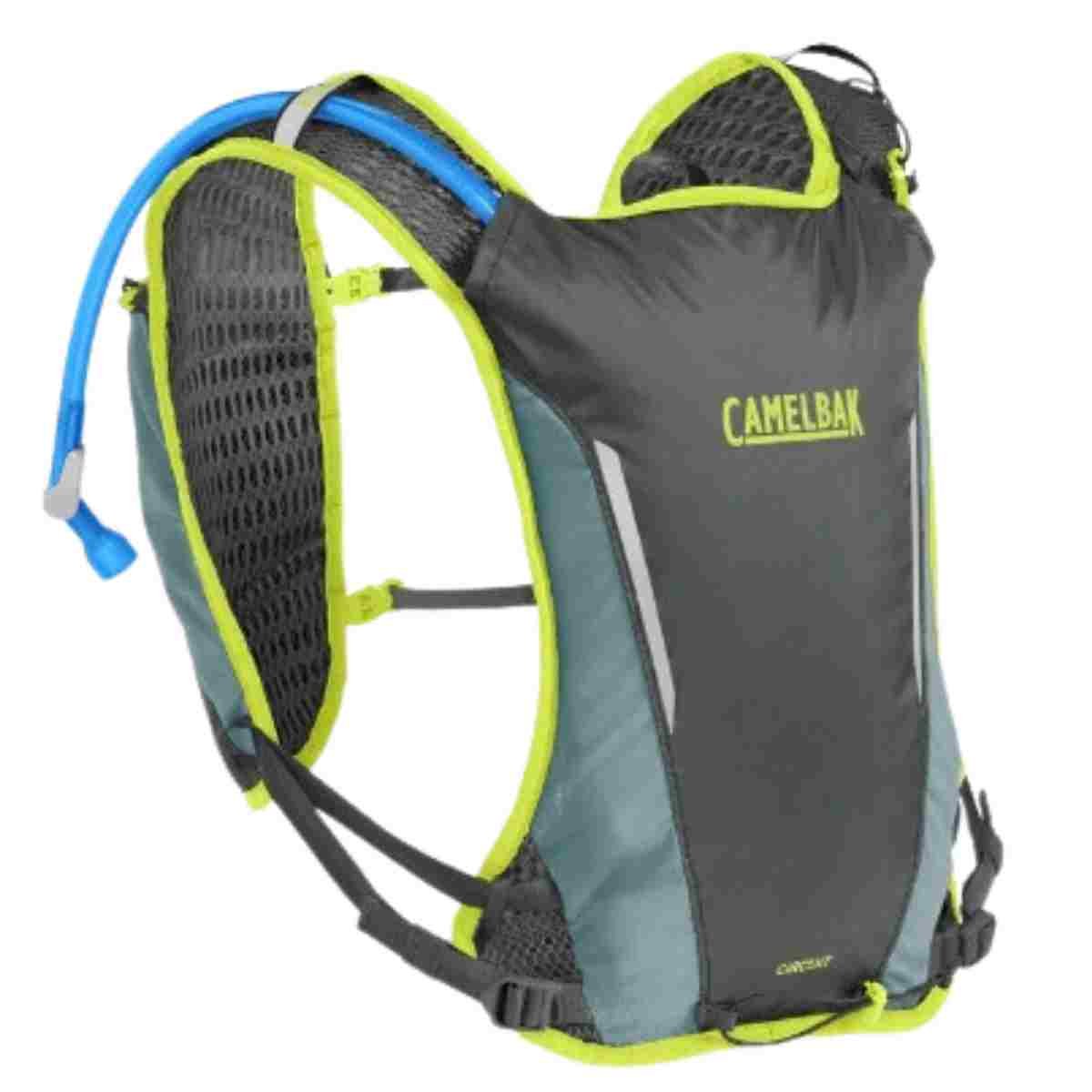
We were especially excited to use the CamelBak Circuit hydration vest due to its simple design, lightweight construction, and big, easy-to-access pockets. Its straightforward yet useful design makes it the Best Running Hydration Vest for Beginners.
We found the CamelBak Circuit vest in its element on hotter days in the front country when water is the premium, and there aren’t any refills along the way. With a 1.5L bladder, it’s enough for most runners to go for 1 ½ to 2 hours. The newest version uses repurposed recycled silver as an anti-odor treatment, among the first brands we’ve seen to take on sustainability in silver..
Camelbak Circuit run vest
Men's
Women's

-
While you could technically supplement the front of the vest with additional water, none of the soft flasks we had fit the CamelBak pack. The tall, slender flasks we own were too tall. The shorter, wider half-liter flasks fit securely but sat too low to use without loosening a cinch cord to remove the flasks.
Similar to the magnetic hose clip on the Nathan vest, the CamelBak uses a plastic clip to connect the hose to the front right shoulder strap. The hose isn’t as easily removed from the clip as on the Nathan. But we didn’t find this to be an issue, as we simply left the hose uncut, and had enough excess to pull it to our mouth without the hose getting in the way from being too long.
The main issue we had was with the bladder. While not painfully slow, the bladder can be a little tougher to remove and insert than other top-loading bladder vests on our list due to it being a flap closure.
-
Being that the CamelBak Circuit has less surface area on the sides, it uses 3D Micro Mesh to allow heat to escape. 3D Micro Mesh is similar to spacer mesh that you might find on a seat in your car. It breathes just as well as any vest on our list, if not the best. This vest especially shines for runs in hot weather.
-
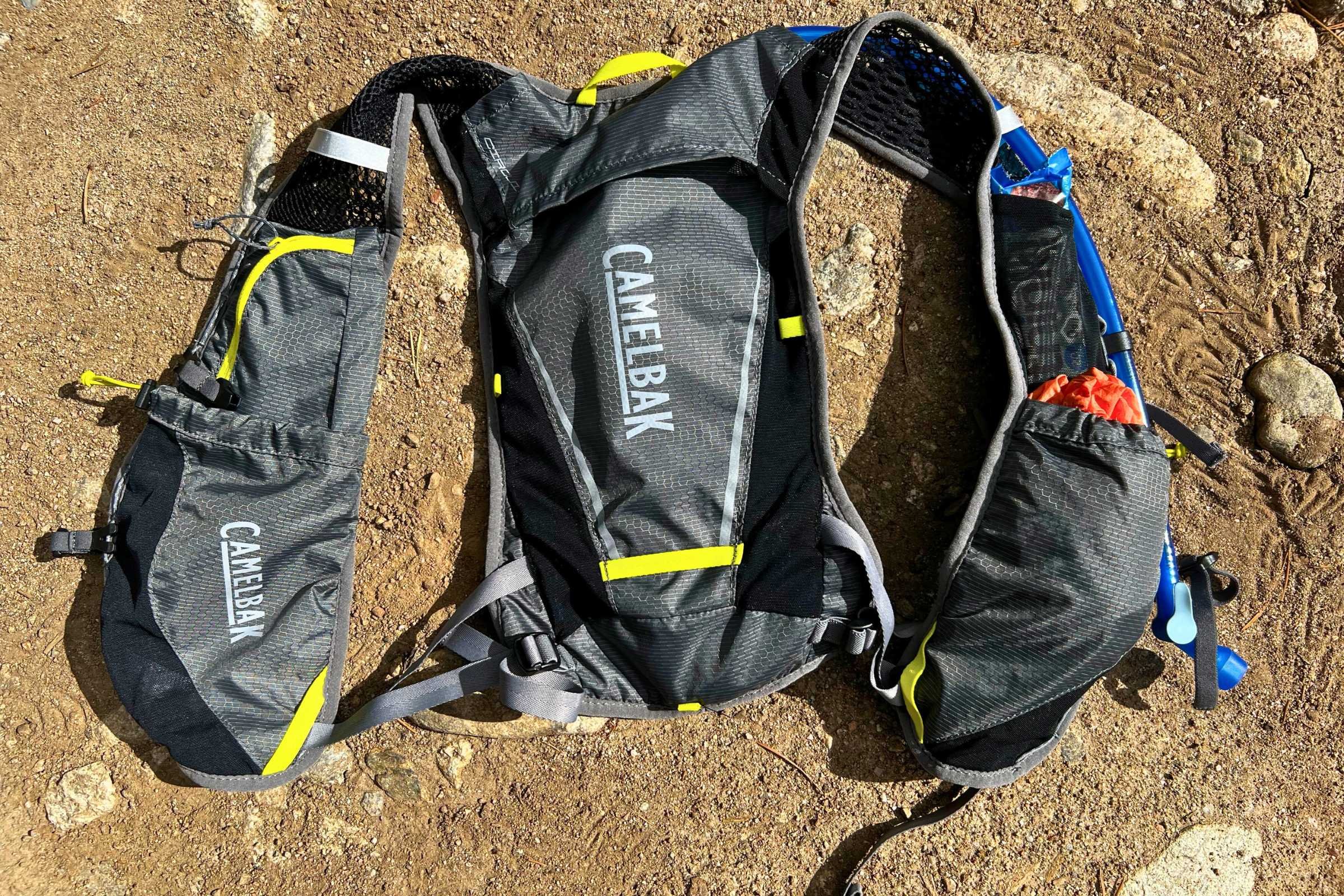
There are five total pockets on the CamelBak Circuit 5 L vest, including the large rear pocket. Since we prefer to use the bladder on the CamelBak, all of our other gear goes up front. Our reviewers iPhone SE in a Lifeproof case fit in the secure zipper pocket up front, but with not much room to spare. If you have a larger phone, it likely won't fit in the up-front pocket, but it should fit with no issue in the lower front cinch closure pockets. We found those pockets to be secure as well.
There’s a stated 3.5L of capacity up front on this vest and slightly more in the women’s version. We found that to be plenty of room for our phone, keys, chafe balm, sunblock, and snacks. We didn’t carry much else in the CamelBak Circuit, but if you wanted to stash a wind shell and gloves, and other small items, there’s room for those, too.
-
Reviewers speak highly of the Circuit, both about the men’s and women’s versions. One female tester found the men’s version to be a better fit, as she found the longer torso of the men’s version more suitable for her torso.
A few downsides to the Circuit vest are that it's a one-size-fits-most. While the men’s sizing accommodates chests from 28-50”, which may not cover some larger chested runners. The women’s size accommodates chests down to 24”.
-
Some testers found the Circuit not only to make a great running vest, but to be a useful tool for mountain biking and walking, too.
We think this may be because the Circuit has an intuitive, easy-to-use design. Every pocket is simple, nothing gets lost, and it houses the basics.
Best hiking/running hybrid vest: Osprey Duro 15L/Osprey Dyna 15
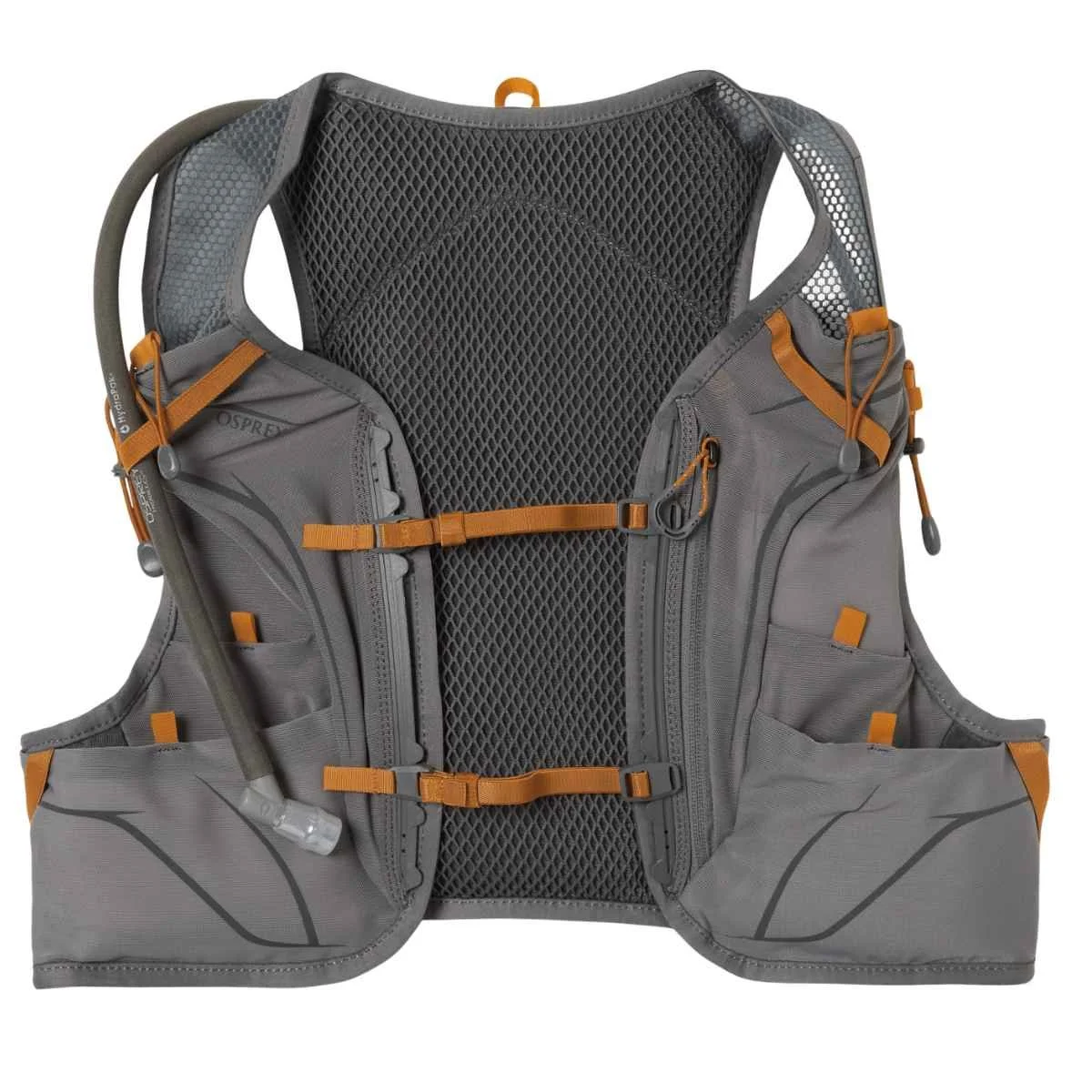
Capacity: 15L
Other capacities available: 1.5 L, 6L, Belt
Included hydration: Bladder
Women's-specific fit available: Dyna
Weight: 12 oz (men’s), 15.5 oz (15 L) (women’s)
What we liked: It’s a versatile, tough, workhorse, lifetime warranty
What we didn’t like: It’s not a running-specific design, runs hot
The Osprey Duro 15L and Osprey Dyna 15 L is what some might call a “bomber” pack. It’s a durable vest built with static and tough fabrics. Compared with other running vests we tested, it has heavier-duty zippers and hardware. It even incorporates a hipbelt.
Some runners may say it is overbuilt for a purely running vest, trail or not. But we think that design serves the needs of a certain group of users: outdoors people who want one pack for hiking, running, or alpine ascents. That's why we award the Osprey Duro the Best Hiking/Running Hybrid vest.
Osprey Duro 15L/Osprey Dyna 15
Men's
Women's


-
We found the Osprey Duro a suitable vest for someone who’s into day hiking on trails, and who might be running-curious. It's also a good option for someone looking for a trustworthy, comfortable, durable summit pack, especially if more technical scrambling is needed.
-
This vest is what we would consider high volume for the type of gear it is, carrying 2.5L in the rear bladder with enough space left for carrying the standard day hiking essentials.
-
It runs a little too hot with all of the surface area and thicker fabric for sustained running. But that thicker fabric makes it a good option for adventurers whose trip involves a mix of running, climbing, and hiking. It does a good job of reducing bounce, so it rides comfortably during the run sections of your trip.
Some customer reviewers suggest other use cases like using it for bike commuting, or run commuting (yep, that’s a thing), where they used it to carry a pair of shoes!
-
Some reviewers found the Osprey Dura vest to lack adjustability. But for us, we had no issue getting the fit dialed in.
Similar to traditional Osprey backpacking packs or Osprey day packs, it has a hipbelt adjustment and adjustments at the back of the hips. Plus the dual sternum strap on an adjustable height rail helped everything get dialed in. The rear hip adjustment is awkward to adjust at first. But once we got the sweet spot set, we could leave it alone and rely on the chest strap to deal with weight fluctuations in the pack.
-
We found the front soft bottle pockets to be on the narrow side. While we were able to store our skinnier bottles in there, they stood a little tall out of the top of the pocket.
Like some of the other vests we tested, the Osprey Duro has elastic clips that go around the top to secure the bottle. Osprey mentions that the pockets are designed for Osprey Hydraulics 500ml soft flask, which fits more naturally in the pocket than the soft bottle we had lying around.
-
Osprey says it’s built to last, and we don’t doubt them. Best yet, it comes with Osprey's Lifetime Warranty, which is good for repairs and returns.
-
While the Osprey Duro 15L isn’t the pack we reach for when going out for a trail run, it undeniably has its merits for the right person and adventure. If you’d like an alternative to a standard backpack for hiking, need some supplemental storage on your bike, or want to explore a little bit of trail running on your hiking days, then we highly suggest the pack.
Best hydration vest for using bladder reservoirs: Nathan Pinnacle 12L

Capacity: 12L
Included hydration: 1.5L Insulated bladder
Women's-specific fit available: Yes
Weight: 12.5 oz (with bladder)/6.5 oz (without bladder)
What we liked: Ships with an insulated bladder. Bladder design.
What we didn’t like: The most expensive vest on our list.
The Nathan Pinnacle 12L has the best bladder design and hydration system of the running vests we tested. It ships with a 1.5L Hydrapak insulated bladder, insulated to help keep water cold on the hottest summer days. The shape of the actual bladder is tapered in the middle, creating an hourglass shape, which we found helped with the sloshing problem inherent with many running vest bladders.
Nathan Pinnacle 12L
Men's
Women's


-
The hose, like many, is meant to be cut to length, and we found this especially important on this vest, as Nathan incorporates a magnetic hose clip that keeps the hose out of the way, and secure against the right shoulder strap. With Nathan's system, we experienced no flopping and it’s always in place for you to take a drink. We can’t emphasize how much we like this magnetic feature for the hose.
Using the bladder does seem to be the focus of this pack, as the soft flask bottle holders are looser than the other packs we tested, but not to the total detriment of function. The soft flasks are easier to get into place on this pack than a lot of vests, but also can tend to sink down, or flop over depending on the bottle you’re using.
One easy fix is to add a bungee cord attachment yourself, similar to what’s found on all of our other hydration packs to hold the soft flask tops. There’s a tab sewn onto the bottle pockets to make this easy enough. For the price, it’d be nice if Nathan could include these with the vest as an optional attachment.
-
Apart from the water storage design, Nathan also takes a different approach to the rear pockets. Instead of making a full tunnel rear pocket from one end to the other, Nathan keeps the dual access points, one entry on the left and right, but routes the pockets upward towards the top of the hydration pack, making them two separate pockets.
By separating the pockets, Nathan eliminates the possibility of pushing one item out of the left side of the pack when reaching into the right side and vice versa. They’ve even added small velcro tabs on each of the closures, and while they aren’t the most robust closures, it’s one more step to ensure the security of your items on the trail.
Another pocket feature we like is that there are two zipper pockets, one on each shoulder strap, that’s big enough for a phone, just like the Salomon Adv Skin 12L. You can keep less frequently accessed items that need security in the right one, under the hydration hose.
-
For downsides, we don’t have any major gripes with the Nathan Pinnacle 12L. It’s built with seemingly the thinnest materials out of all of the vests we tested and does raise some durability concerns. There were a couple of reviews highlighting some tears, but we’re unsure of the context that these users were using it in, as overloading a vest is always possible. The material is also the most stretchy, so there could be some premature wear in creating a permanently stretchy material. So far, none of these concerns have been validated during our testing.
Best Running Hydration Vest for Night Running: Nathan HyperNight QuickStart 3.0
Capacity: 4L
Included hydration: Yes, 1.5L bladder
Women's-specific fit available: No
Weight: 7.5 oz (without bladder), 12.4 oz (with bladder)
What we liked: excellent visibility from reflective elements, can be seen in low light
What we didn’t like: not a lot of pockets or storage so not as suited for longer runs
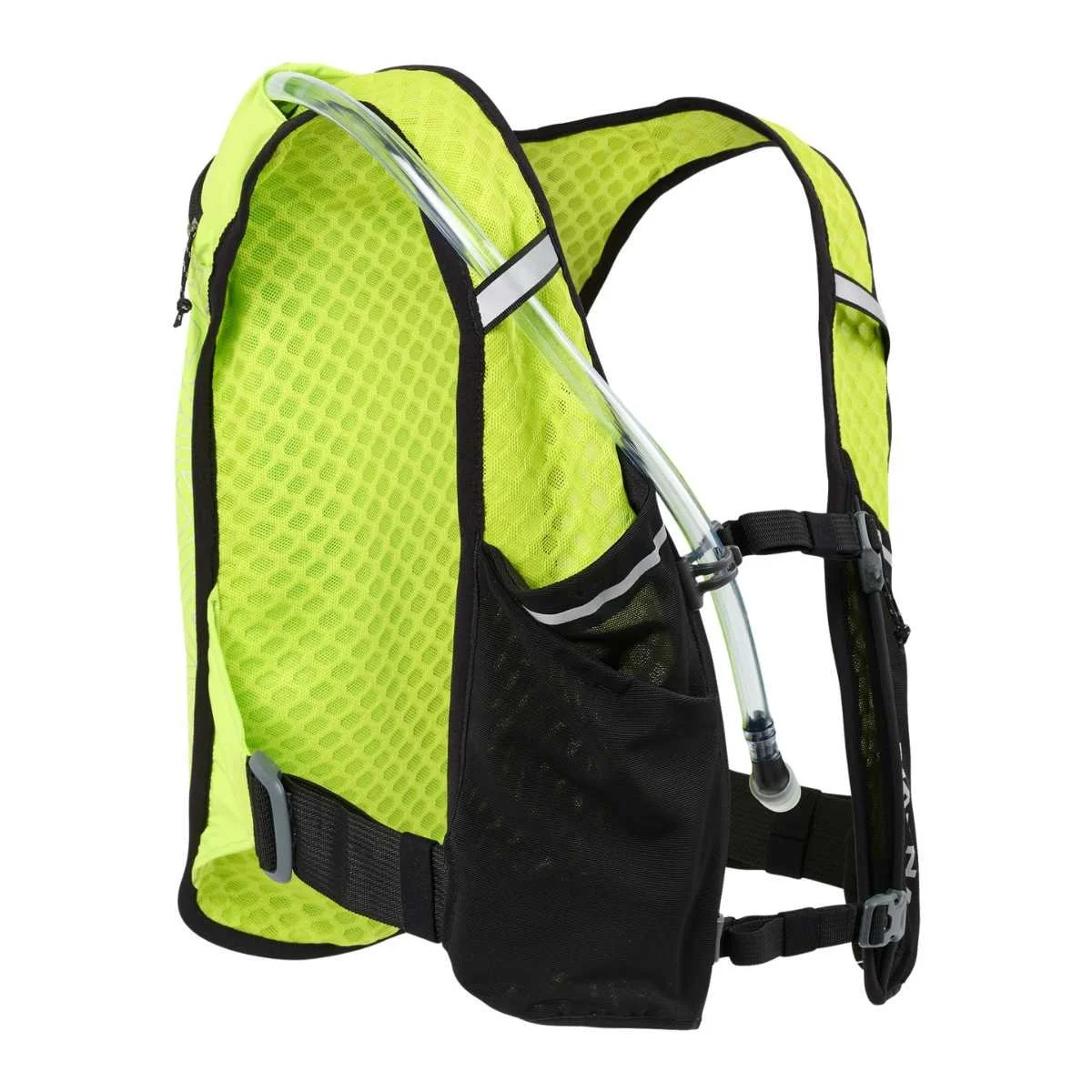
The Nathan HyperNight QuickStart 3.0 hydration pack quite literally shines at night with a reflective hex pattern all over the back of the pack, and other reflective elements throughout to keep you visible in low light. If you do a lot of your running in the dark, whether on roads or on trail, this hydration pack is worth considering.
The design of this pack is simple, so you do not have a lot of pockets or storage options. What you get is a 4L capacity pack with a 1.5L bladder, three mesh pockets in the front, including one that can hold a 550mL soft flask (not included), and 360 degrees of reflectivity.
Nathan HyperNight QuickStart 3.0
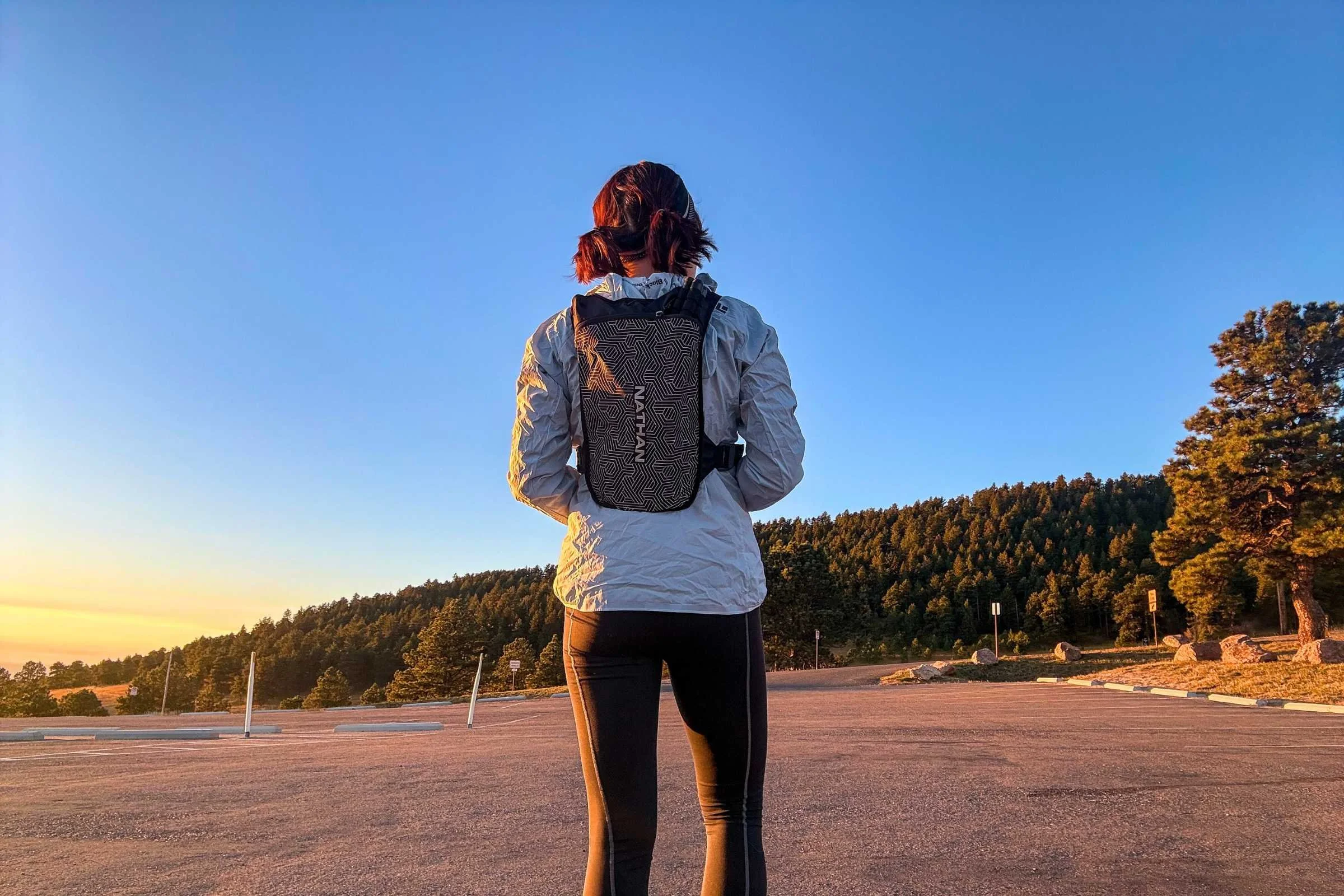


While not as feature-rich as the Nathan VaporAir/VaporAiress, this Nathan hydration pack stands out with adjustable straps at the sides for a more personalized fit, and the bladder straw fits more securely in its latch. However, the side straps flap around and can be really annoying—we had to tuck them in so they wouldn’t flap against us when we ran.
This is not a flashy hydration vest—well, it is almost literally flashy, but it doesn’t have the bells and whistles of other packs. The Nathan HyperNight QuickStart 3.0 is a simple hydration pack that will get the job done if your priorities are carrying water, fuel, and a small amount of gear while staying highly visible in the dark.
Other running hydration vests we tested
Nathan VaporAir / VaporAiress 4.0 8L Hydration Vest
Capacity: 8L
Included hydration: Yes
Women's-specific fit available: Yes
Weight: 10.7 oz with bladder
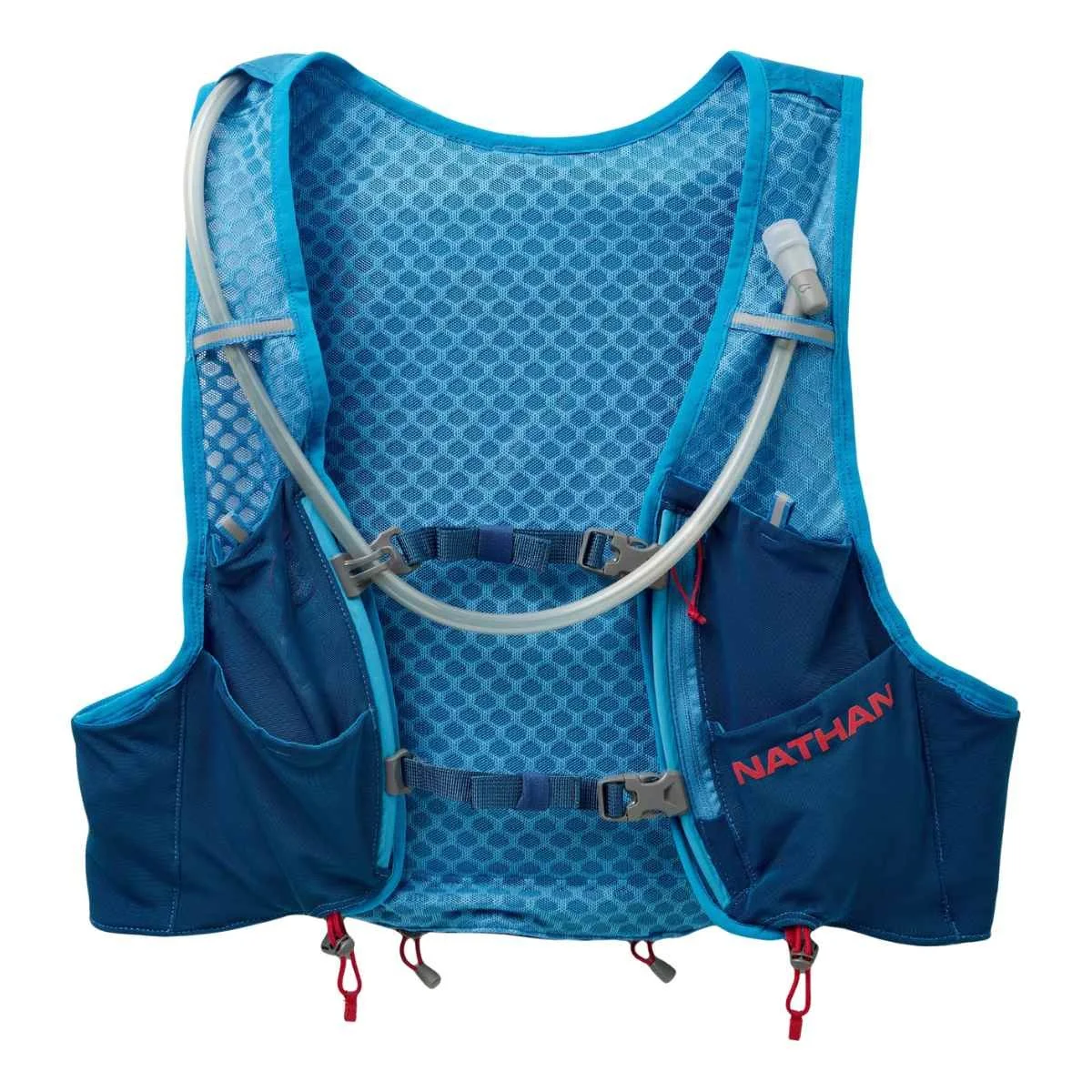
What we liked: Comes with 2L water bladder, 6 accessible pockets, adjustable at sternum straps and ribs
What we didn’t like: Not as comfortable as our favorite vests
The men's Nathan VaporAir 4.0 and women's Nathan VaporAiress 4.0 are 8-liter hydration vest with a great pocket layout that’s very similar to our favorite running vest, the Salomon Adv Skin. It has two pockets on each shoulder strap plus an extra phone-sized zipper pocket on the left shoulder. And it has a reach behind pass-through pocket along the back of the pack that extends to underneath your ribs.
Learn more in our in-depth review of the Nathan VaporAir/VaporAiress 4.0 8L hydration vest.
Nathan VaporAir / VaporAiress 4.0 8L Hydration Vest
Men's
Women's


We tested this vest while trail running in southern Arizona, where we used the included 2-liter bladder and two 500 mL soft flasks to carry enough water for a long day on the trail. We also tested this vest on trail runs in Colorado and while pacing a friend during the Cocodona 250 race in Arizona, which included 37 miles of the 250-miles race and meant having to carry lots of water, fuel, clothing layers, nighttime running gear, and safety gear. We like that it comes with a hydration bladder, and found it carries 3 liters of water and everything we need better than we expected.
This vest isn’t quite as comfortable as our favorite vests that use this pocket design and style. The webbing sternum straps and side tension adjuster cords feel overly tight, and since they don’t stretch we can’t seem to adjust them to a tension that feels tight enough to prevent the vest from bouncing without feeling overly restrictive. The women’s version, the VaporAiress, is comfortable, but our women’s tester also wished she could adjust the fit better to reduce bounce with the right amount of tension.
Also, this vest is barely less expensive than the Salomon Adv Skin 12 and costs more than the La Sportiva Ultra Trail. So while it’s a good option, we think there are hydration vests that offer better value (and maybe fit) at a lower cost.

Capacity: 7L
Included hydration: 2 x Hydrapak soft flasks
Women's-specific fit available: No
Weight: 9-10 ounces (size XS to XXL)
The REI Swiftland TT was a former winner for best affordable hydration vest. It retails for $140 and ships with 2 x Hydrapak 500ml soft flasks, valued at around $40-$45. Ultimately, we think REI's other vest, the Swiftland 5L, is a better option for runners looking for an affordable hydration vest. But the Swiftland TT is still a great option.
REI Swiftland TT


For adjustability, the Swiftland TT uses a stretchy velcro strap along with sides around the ribs to cinch the vest down to accommodate varying body sizes. We found it easy to cinch down during a run as needed. Up front, the hydration pack uses two fixed, static sternum straps, non-adjustable in height.
The main downside to the REI Swiftland TT is breathability. The fabrics used on this hydration pack are on the heavier side and seem to trap heat a little more than the other packs we tested. Still, with that heavier fabric, the pack could outlast some other packs in terms of durability and avoiding tears.
While it doesn’t have the most sophisticated and nuanced design out of the vests we tested, for the price, the Swiftland TT checks all our boxes for what we look for in a pack regarding carrying comfort, pockets, and ventilation. It’s a great value, and worth considering. REI customers, by and large, review it positively and we recommend it as well for folks looking to spend less than $150 for a running pack set-up.

Capacity: 1 L
Included hydration: 1.5L reservoir
Women's-specific fit available: Yes
Weight: 6 oz
This is a good option if you only want to carry water on a hike, bike ride, or casual run. Besides the main back compartment for the included 50 oz (1.5 L) water bladder, it only has one rear zipper pocket. This second zipper pocket is large enough for a phone and some snacks, and the main zippered water pocket can also fit a light jacket. However, this pack definitely bounces when you run with it, so it’s not the best for running. It’s great for biking or hiking, though.
Camelbak Hydrobak Light 50 oz

Capacity: 7 L
Other capacities available: 12L
Included hydration: Y, 2 L reservoir
Women's-specific fit available: Yes
Weight: 7 oz (11 oz with bladder)
This running vest is similar to the Nathan Pinnacle, but slightly smaller capacity. It has three small shoulder strap pockets, but if you fill the two larger shoulder pockets with 500 mL soft flasks there is nowhere to store a smartphone or many snacks. This isn’t a problem if you use the included 2 L water bladder, but sometimes, we prefer to carry our water up front because it’s more accessible.
This option is less expensive than even our top pick for affordability and works well to carry water in a bladder and more on a run, but we wish the shoulder pockets were better. If you don’t mind less accessible pockets while you’re wearing the vest, this is worth checking out.
Nathan Trailmix 7L

The differently shaped soft flask bottles that we used in our vests. Photo by Trey French
What to look for in running hydration vests
Hydration capacity and compatibility
Water is often the heaviest item you’ll carry in a running vest. Organizing the water for weight distribution, ease of access, and the ability to remove, refill and re-insert all come into play in a vest design.
If your pack doesn’t come with a bladder, flasks, or other bottles, you’ll need to purchase them separately. Manufacturers will sometimes make bottles for the hydration pack in question or guide you in the right direction. Pockets typically incorporate a stretch mesh into the pocket design for front bottles and will be forgiving for differently-shaped bottles, but it’s worth checking with a manufacturer to see if they recommend a particular bottle style for their vest.
For comprehensive guidance on choosing the right water bottles for running, see our Best running water bottles guide for top recommendations.
Hydration Bladders
Some vests come with hydration bladders hanging from a harness inside a sleeve. This is all situated inside a large rear pocket on the back part of the vest.
Collapsible Flasks
Recently, the most popular design for running vests focuses on designs where the water is stored in two soft, collapsible flasks (and, less common, even a hard-sided bottle).
Learn more about staying hydrated in our Hydration Tips for Trail Runners and Tips for Staying Hydrated During Your Runs guides.
Storage capacity
Vest designs range from minimal storage (3-8L), do-it-all running vest storage (8-12L), and multi-day running packs (15+L). The multi-day packs are less like running vests and more like day-hiking packs, bike commuting packs, or travel bags.
Running vests are designed to carry a range of items comfortably, but they aren’t limited to running. Some are designed for running a few miles from home on city streets, and others are built for all-day outings in the mountains.
Some vests can carry a liter of water and the essentials (phone, wallet, and snacks), while others may be able to accommodate more (first aid kit, personal locator beacon, battery pack, rain jacket, etc.). You might even want to be able to store collapsible running poles or an overstuffed burrito!
If you need a pack with larger capacity, see our guide to Best Running Packs or Best Fastpacks.
Pocket functionality
While you may be able to store all the gear you want to carry with you inside the hydration pack, some packs are designed with pockets that range in security and accessibility while on the go. For instance, let’s say you have a running vest with no zippers. That means, for storage, you'll be relying only on an elastic mesh. The tension you create by wearing the vest around your body may cause you to worry about items falling out.
However, open mesh pockets are often easier to access, making these hydration backpacks more appropriate for racing or trips when speed and efficiency are the top priority. Having at least a couple more secure pockets for important items can bring peace of mind and allow you to interact with nearby pockets for snacks without worrying about unintentionally removing other items.
Most running vests will have a larger rear pocket for bulkier items like clothes and sandwiches (plus the water bladder), and some will have one or two in front.

The rear big pockets on the Nathan Pinnacle 12L are smart pocket designs, opting for two separate pockets—one on the left and one on the right—and designing the items to push up into the pack rather than one side to the other. Photo by Justin Walker
External organization and easy access
No matter the hydration pack, if they have pockets in the front of the vest, they’re usually pretty simple to reach, as they require no contortions of the arm or unnatural, awkward reaches.
Accessing gear in the back is a different story. It’s unlikely that you’ll be able to access the gear in any large, rear zippered pocket without removing the vest. Thus, it’s best to store less frequently used items back there, like a rain jacket or a first aid kit.
Accessing items in side pockets can also be a challenge depending on your flexibility, how high on your back the pack fits, or how it interacts with your body. Tunnel pockets on the lower rear, like those found on the Salomon Adv Skin 12, are among our favorites, especially given the pack's modest rise for reaching back.

Comfort & Fit
More than the hydration style, storage capacity, and pocket design and placement, comfort and fit is arguably the thing you must get right with a running vest. Otherwise, the vest may deter you from getting out the door in the first place.
One of the joys of running is being outdoors — interacting with your neighborhood, park, trail, or mountains. A hydration pack with oddly placed webbing, cords, sternum strap, or other fabric causing chafe or discomfort detracts from those experiences.
While running vests usually don’t have a hipbelt, they can still squeeze or hug in places like the lower back, chest, ribcage, or shoulders in a way that leaves us with sores, sore spots, or chafing. Ensuring that you get the proper vest for your chest circumference is a good place to start.
“One of the joys of running is being outdoors — interacting with your neighborhood, park, trail, or mountains. A hydration pack with oddly placed webbing, cords, sternum strap, or other fabric causing chafe or discomfort detracts from those experiences. ”
Another consideration is to get a pack that will comfortably accommodate your gear. If you buy a 4L pack with full mesh construction and stuff in 6L of heavy gear into it, you may find that it bounces, has a sloppy feel, or stretches out over time. Unfortunately, you may find out only with use over time if a pack truly fits you perfectly. One benefit of vests is you can easily add on a running belt if you find you need a little more capacity.
Like a hiking backpack or a pair of running shoes, you can usually spot any critical red flags as soon as you put them on.
Ensure that you don’t have to squeeze into the vest with the vest fully expanded. You’ll always want some room to adjust to accommodate body weight and gear weight fluctuations, layering clothing, and cinching the pack down if your gear loadout gets smaller during the day. What you’ll carry and how tight you’ll pull the vest will vary depending on how much weight is in the pack.
Get a pack that you want to wear, and go from there. And for more anti-chafe solutions, check out our Best Anti-Chafing Cream for Hiking, Running, and Biking guide.
Ventilation
The thicker the fabric or the more fabric a pack has, the hotter the vest will run. Most modern packs address ventilation by incorporating a lot of breathable mesh in the pack. This ventilation differs from traditional backpack construction, where thick nylons and polymers are used for durability and stiffness. A minimal 4-8L vest with less surface area will better ventilate than a larger pack. Still, a larger pack can excel at venting — if it has the right amount of breathable mesh materials.
Weight
Most running vests are under a pound. When the vest is already in that sub-pound weight range, a few ounces difference isn’t a big deal for most runners. The weight of the vest may be more noticeable when you're comparing packs designed for high-volume gear if it doesn't have great ways to cinch down what you're carrying. For example, if you're trying to run with a heavier, larger pack in the +12 L range that has large open pockets, you may notice stuff bouncing around!
Reflective details and visibility
Like shorts, shirts, hats, running shoes, or anything you’re wearing while running, features like reflective detailing in stitching or a stripe or patch on a panel can increase visibility. Visibility may not be your primary concern if running on trails during the day. Still, it can help to have increased visibility when wearing running vests in busier urban areas, especially after dark.
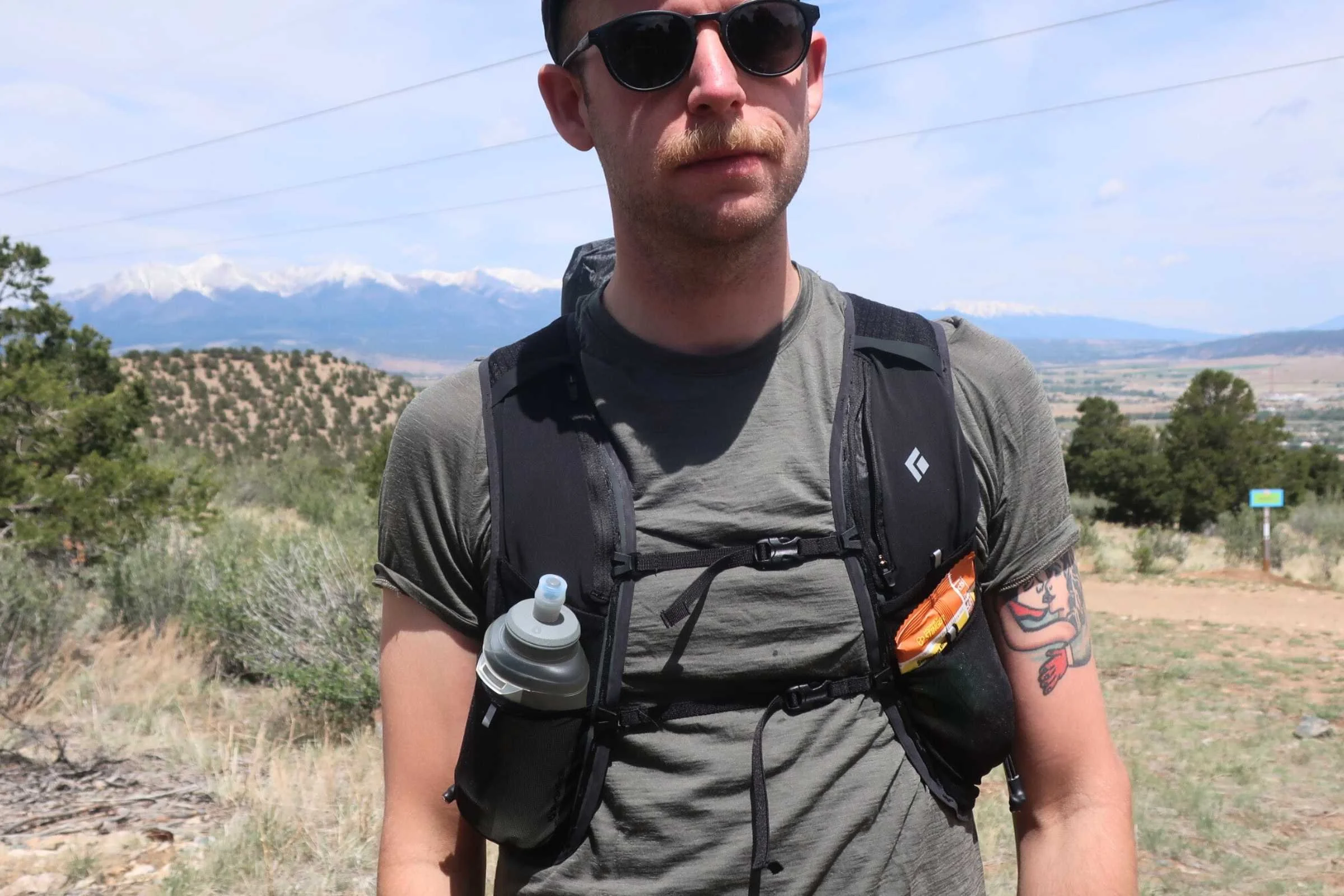
The front harness pockets on the Black Diamond Distance 15 running backpack. Photo by Justin Walker.
Versatility
It’s up to you how much you ask of your running vest. A minimal vest may only work for short runs with lots of places to grab food and water nearby. A vest designed for racing may not carry your phone, Personal Locator Beacon like a Garmin InReach Mini 2, or two liters of water the most comfortably, but may excel in providing easy access to nutrition and lightweight clothing layers.
A large vest may be too hot or have too much space to be efficient for shorter outings. Suppose you’re a trail running-curious day hiker, someone who is curious about longer runs on the road or running on trails. In that case, you might consider a pack that’s 12+ liters to carry most of your usual hiking essentials and still secure everything comfortably close to your body. That way, you can run when you feel the urge.
Remember, if you run at any point during your walk, you’re on a run! Ask ultra runners; they walk A LOT. Consider versatility first, then maybe specificity later on if you’re unsure.

The volume and shape of the Black Diamond Distance pack make it suitable for overnight backpacking trips, summit climbs that require extra gear, and bigger runs with no aid stations or means to get more water and food. Photo by Justin Walker.
Running hydration vest vs. backpack
Backpacks are meant primarily for walking, maybe even long distances, overnight, and beyond. Running vests are built to solve the problem of how to comfortably carry gear when you're going from a walk that may turn into a run.
Usually, but not always, running vests are built for less than a day outside. For example, running vests carry less gear, but they hold that gear more comfortably close to your body to have a bounce-free or minimal bounce experience while running. When our feet leave the ground, things move!
Sure, we can carry all the layers in the closet in a backpack. But when we try to run, having all that space and gear may impede us from being comfortable as we run. Did you ever try to catch the school bus as it was about to pull away? Books might have jostled around and jabbed into your back. A running vest is designed to reduce the bounce and discomfort so that you can run faster, farther, or just more comfortable.
If you prefer the convenience or feel of a backpack or are headed on ultralight overnight trips, you may prefer a running backpack or fastpack.
These packs are designed for running and hiking and are often designed by the same brands that make hydration running vests. They often have larger capacities. See our guide to Best Running Backpacks for our recommendations.

Treeline Review writer Katie Brown at the Speedgoat 100 ultra marathon race. She’s wearing the Nathan Vapor Howe women’s vest.
Women's-specific running hydration packs
Some running companies understand that unisex just doesn’t cut it for everyone. Often women’s running vests are designed with the assumptions that women generally have shorter torsos, will have different places prone to chafing, require differently tapered vest straps for different chest sizes, and may want an alternative bottle design.
For the shorter torso length, some of the pocket designs may also vary between a men’s and a women’s pack to account for the lost volume on the back of the pack from the shorter torso design, making some other pockets larger on the side, or front.
For the chest straps, it can be similar to some women preferring an “S” strap style vs a “J” strap style on hiking backpacks. For the bottle design, they’ll typically be shorter and wider and are fitted towards the bottom of the front shoulder straps, using a hose similar to what’s often found on a hydration bladder reservoir.
As always, sometimes marketing is simply gendered without major differences beyond the color, unfortunately. Remember that above all, it’s best to choose which vest fits your body regardless of how you’re targeted as a consumer. You know yourself best.
Treeline Review recognizes that there are more genders than just men and women but works within the reality that gear sizes and shapes are categorized this way. Choose the vest that best fits and feels comfortable to your body, regardless of how the brand may have labeled the item.

The author using a hydration vest on a trail run.
How to choose a running hydration vest

The REI TT Swiftland Vest has a Vecro pocket and water bottle holders we liked. Photo by Justin Walker.
As always, consider what sort of experience you’re looking to facilitate with your gear. Check for the features like bladder or water bottle compatibility.
If the vest includes bottles or not, consider how much capacity the vest holds versus what you plan to bring and if the vest uses breathable materials (lots of mesh).
If you’re a fan of trekking poles, you can also factor this into your decision-making, but running vests have never excelled at carrying poles. The pole must be collapsible to start, like the Ultimate Direction FK Ultra Poles, to have a chance at fitting somewhere on the vest. Even then, poles will typically have some degree of play and bounce when stored.
Here are some questions you can ask yourself that can help you point you in the right direction:
What kind of running will you be doing?
Are you running in the neighborhood, on local trails, racing an ultra, or on an all-day or multi-day mission in the mountains? Smaller volume hydration packs will probably do the trick for things close to civilization. These packs will have just a few pockets for food and water, plus the essentials like your phone, keys, and wallet.
Seek out those larger volume packs that can accommodate more gear, food, and water for longer days.
How much do you want to spend?
Some hydration packs will have more value to you than others, even if their monetary cost is less than some other packs. Why spend more if you don’t need all that storage for that larger pack? If you don’t want a minimal vest based around no-zip pockets, designed for racing, with exceedingly technical material choices, consider looking for a vest with more secure pockets and more capacity. The latter and less expensive choice might be the right move for you.

Justin on the trail with the Salomon Sense Pro 10. Photo by Trey French
Hydration vest care and maintenance tips
A little regular maintenance goes a long way with a running vest. After runs, rinse off sweat and salt buildup — both can damage fabric and zippers over time. For a full wash, follow the manufacturer's instructions. Most vests call for hand washing with a non-detergent soap, though some can go in a machine on a gentle cycle with a mild sport detergent. See our Best Sport Detergent guide for recommendations.
Always air dry your vest completely before storing it. Store it out of direct sunlight and heat, with zippers closed. Inspect the fabric and zippers periodically for snags, small tears, or dirt buildup. Catching damage early is much easier than repairing it later. If a zipper sticks, a small amount of diluted dish soap can help free it — see our Zipper Maintenance guide for more detail. If straps stretch out over time, retighten them before your next run. A vest that fits too loosely will bounce more than one that's properly cinched down.
For hydration bladders, pull the bladder inside out and wash it with mild soap and warm water, then rinse a second time to clear any soap residue. Keep it inside out while drying. For the tube and bite valve, disconnect both from the reservoir and clean them separately by hand with a straw brush. Let all parts dry fully before reassembling. Store dry bladders in a cool place — some runners keep theirs in the freezer to prevent mold growth between uses.

Trail running is often hiking. The author is climbing a steep incline with a running hydration vest. Photo by Justin Walker
FAQ
-
If you’ve found yourself carrying items during runs, you will probably benefit from a running vest. If you consider yourself a hiker but are running curious, a vest could change your experience with the outdoors. If you’re doing laps around the block, at the track, or running road races with frequent water stations, then you may not benefit as much from a vest.
Check out more running accessories you may find beneficial to your running journey in our Best Running Accessories guide.
-
The vest should fit snug against your body everywhere the pack makes contact with it. It should have enough room to expand the vest for body and gear weight fluctuations and wear additional layers.
It's a good sign if the pack fits comfortably snug like a good hug when it's empty.
But you’ll want to leave a little room for cinching tighter, as you may find yourself cranking down a little during some parts of runs when you're carrying a lot of water weight that would bounce with a looser fit. Check out the manufacturer's guidelines, which usually use chest circumference. As long as there’s no hipbelt, that's usually the best bet for finding a running vest that fits.
For more information, see our whole section on running vest comfort and fit above.
-
Most running vests will use both water bottles and bladders. There are advantages to going with one over the other, if not using both simultaneously based on water needs and availability while out on a run. We dedicate an entire section below to the pros and cons of water bottles and of water bladders.
-
Bouncing is almost always a fit issue. A vest that is too loose, too large, or not loaded correctly will bounce noticeably during running. Start by cinching the vest snugly against your body with straps tightened at the chest and sides. Distributing weight evenly between front and rear pockets helps too, since a heavily loaded rear with an empty front is a common cause of bounce. If bounce persists after adjusting fit, the vest may simply be the wrong size for your body.
-
The most common chafe points are the sternum straps, the lower edges of shoulder pockets, and anywhere hard plastic hardware contacts bare skin. Choosing a vest with soft mesh construction and smooth hardware reduces the risk significantly. Applying anti-chafing balm to known problem areas before long runs provides additional protection. If a specific seam or strap consistently causes irritation, athletic tape over the problem area is a quick on-trail fix.
-
For runs under two hours on routes with water access, a 5 to 8 liter vest with front soft flasks is usually sufficient. For longer trail runs, full-day efforts, or remote routes without resupply, a 10 to 15 liter vest provides room for extra water, food, layers, and safety gear. A useful rule of thumb is to match vest capacity roughly to the duration and remoteness of your typical run, then size up slightly if you run in variable or unpredictable conditions.
-
Yes, and many runners do. Running vests work well for hiking, particularly on technical trail or fastpacking trips where pack weight and bounce control matter. The tradeoffs compared to a dedicated hiking daypack are less back panel structure, fewer external attachment points, and less padding on shoulder straps. For shorter day hikes or trail-to-run days, most running vests handle the transition comfortably. For full-day hikes carrying heavier loads, a run-hike hybrid vest or running pack with a hipbelt offers more comfort.

Drinking from the included reservoir tube on the Nathan Pinnacle. Photo by Justin Walker.
Should I use a bladder or water bottles with my running vest?
Soft Flasks
Soft flasks have become the most popular choice for runners because the water sits right on your chest and is easy to access on the move. Like traditional hiking water bottles, you can carry different liquids in each bottle — plain water in one, something like Tailwind in the other. You can see how much you have left without stopping. But the benefit of a soft flask over a water bottle is you can drink hands-free if you use your soft flask with many vests using a straw.
The main downside is that soft flasks can be awkward to stuff back into their pockets mid-run, especially when the rest of the pack is full. Most vests use a toggle around the bottle mouth to keep flasks from sinking or flopping over, which adds one extra step at refills but is worth it. Front flasks also max out at around one liter total, which can be a limiting factor on longer runs without water access.

Justin opts for a bladder reservoir rather than soft flasks up front. The pack seems to be designed around the front bottles, calling for some DIY work to keep the hose secure. Photo by Trey French
Hydration bladders give you more total water capacity, typically an extra 1.5 to 2 liters in the rear pocket, and free up front pocket space for food and gear. The tradeoff is that you can't see how much water you have left, refilling requires removing the pack entirely, and a bladder sitting against your back reduces breathability. Sloshing is another issue — the more you drink, the more the water moves around, which can affect your balance and gets louder as the bladder empties. Some vests address this with tapered bladder designs, like the Nathan Pinnacle 12L, which helps but doesn't eliminate the other downsides. Bladders also require more thorough cleaning than soft flasks, especially if you're using a drink mix with sugars.
Most runners settle on soft flasks for races and shorter efforts where access and visibility matter, and add a bladder for longer days when carrying more water is the priority.

The bladder that ships with the Nathan Pinnacle 12L. Its shape is tapered to cut down on sloshing, and it is insulated to keep liquids cold. Photo by Trey French

We tested the Salomon Sense Pro 10 backpack (shown here) on a 100-mile ultra marathon race. Photo by Trey French.
How we tested
We tested our hydration vests across a series of mountain ranges, including the foothills of the San Isabel National Forest and Bureau of Land Management land, Sangre de Cristos, the Buffalo Peaks Wilderness, and the lower sections of the Sawatch Range of Colorado—Ute land.
We encountered temperatures between 45°-85° degrees through a windy mountain spring. We wore some of our winners, the Salomon Adv Skin 12L, and the REI Swiftland TT, in the broadest range of conditions that included on and off trail pursuits with a mix of hiking, scrambling, and running from 1 ½ to 5 hours or more.
We even took our Salomon Sense Pro 10L through a 100-mile race, racking up well over 30 hours of test time on it.
We packed the vests with puffy jackets, wind shells, up to 2L of water, food, our phone, keys, and other essentials. We managed to even get a minimal overnight kit in our larger Black Diamond Distance 15L to make sure that it handled the load well enough.
- Runs of 1.5 to 5+ hours in Colorado mountains
- San Isabel NF, Sangre de Cristos & Sawatch Range
- 100-mile ultra marathon race
- Hiking, scrambling & mixed pursuits
- Loaded with up to 2L water, layers & essentials
- Harness fit & comfort across body types
- Bounce control when loaded & nearly empty
- Pocket accessibility without breaking stride
- Breathability & ventilation
- Hydration system usability

Trey wearing the REI Swiftland TT Vest and Tracksmith VanCordlandt short in Colorado. Photo by Justin Walker
About the author / Why you should trust us
Working with variable conditions is a constant in Trey’s outdoor life — from trail outings starting and ending on NYC trains; to Colorado multi-sport front door-to-door outings that might start with cycling and lead to trail running; to long-distance thru-hikes (on trails like the CDT, PCT, and Long Trail).
Trey gravitates toward accessible outdoor activities like hiking, running, and cycling, with an interest in human-powered, carless travel with the occasional assistance of public transportation or a friendly hitch.
Based out of Salida, CO, at 7,000ft, Trey runs in all seasons — for mental health, fitness, and preparing a base of fitness for big mountain adventures, come the spring melt. After a winter of getting by with handheld water bottles and running waistbands, the late spring and summer bring long days of projects in the mountains. This season also beckons the need for a vest to cram more food, water, an emergency satellite beacon, and other items into one’s running kit.
Around 9,000 miles of combined running and hiking miles inform his approach to gear testing — from hikes of the CDT, PCT, Long Trail, and other self-made routes, to runs across the Grand Canyon, trail races, and obscure lines drawn on a map up or down the side of a mountain. Trey firmly believes that a piece of gear should facilitate experiences rather than discourage folks from getting out the door. Keep it simple, keep it functional, and keep it fun!
You can read more of Trey's work at his blog or on his author page.


