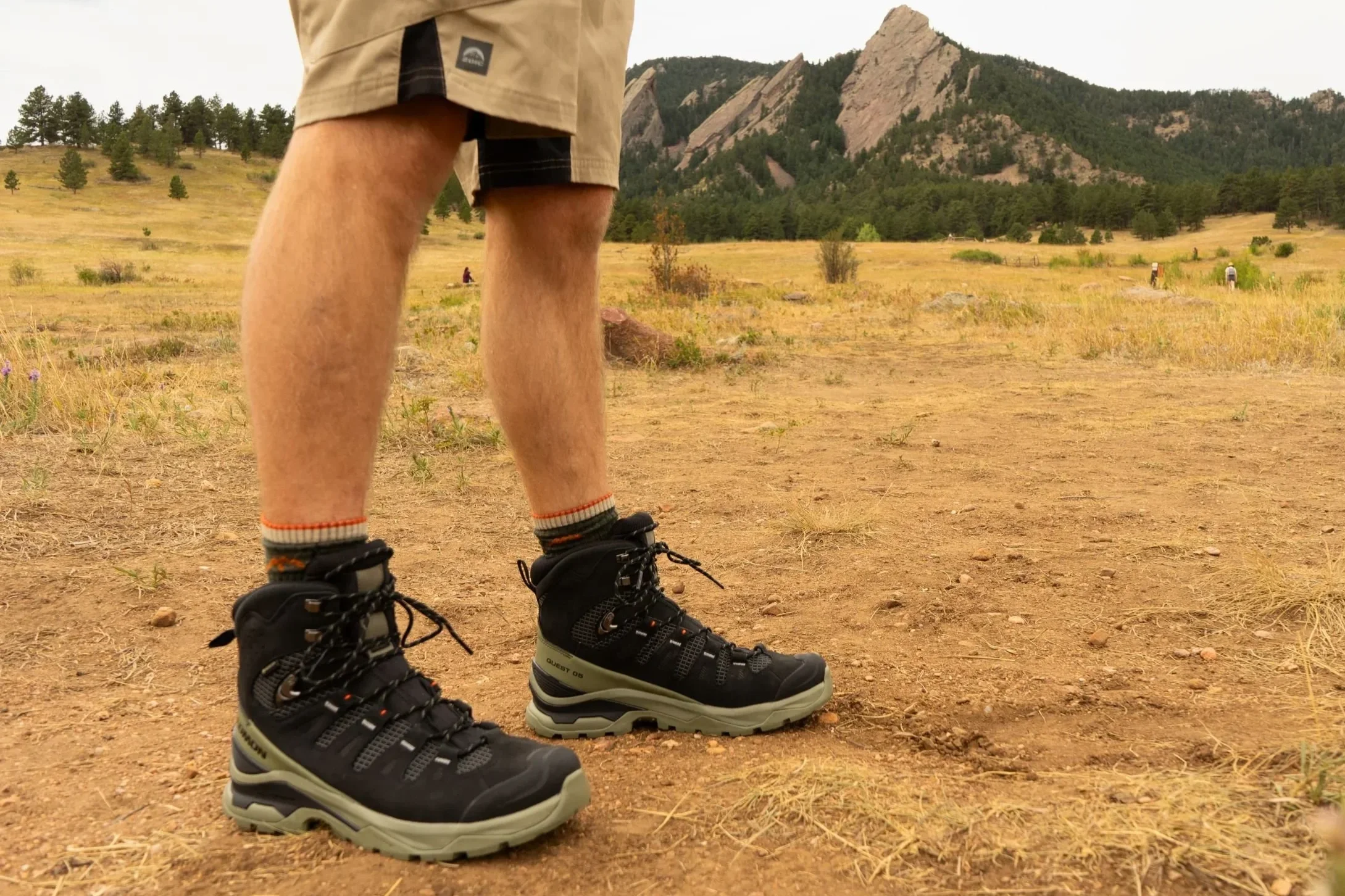
Best Trekking Poles of 2026
The Top Hiking Poles for All Adventures and Abilities

July 2nd, 2026
Updated with the Gossamer Gear FT3, new winner for best for thru-hiking, new winner for best aluminum trekking poles, best women's trekking poles, and best for beginners.
Home > Gear Reviews > Hiking
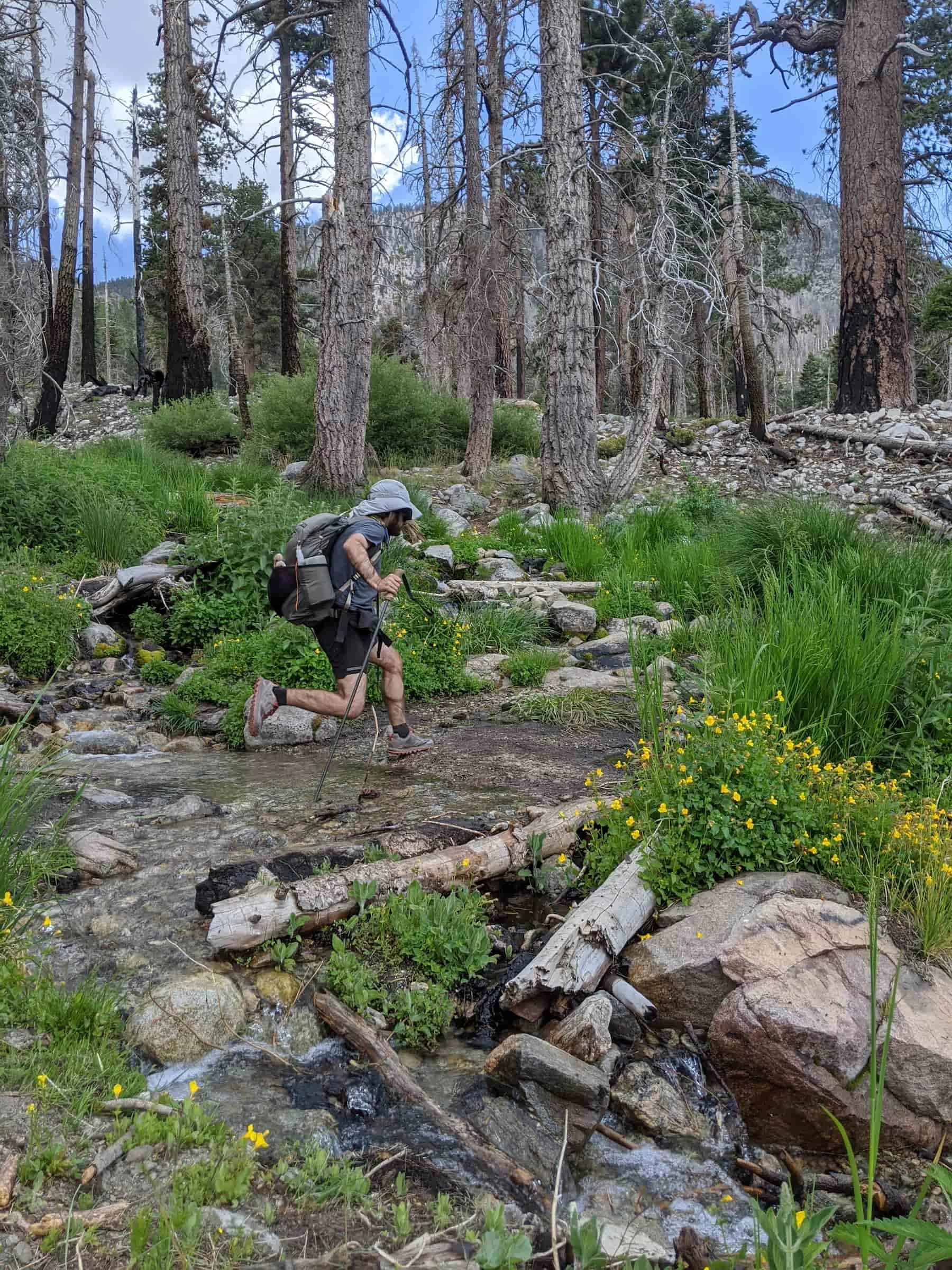
Trekking poles are one of the most genuinely multi-purpose pieces of gear you can carry into the backcountry. They make river crossings safer, protect your knees on long descents, improve balance on uneven terrain, and double as tent poles for a lot of ultralight shelters. Some hikers resist them for years and then wonder why they waited.
Over the past six years, we tested dozens of trekking poles over thousands of miles of hiking trails across the world, with testers of different sizes, heights, and hiking styles putting the same poles through the same conditions side by side. I'm a thru-hiker, former Backpacker Magazine thru-hiking correspondent, American Hiking Society Next Gen Trail Leader, and board member of the American Long Distance Hiking Association.
What separates a good trekking pole from one that fails you at mile 400 comes down to a few things that matter more over long distances than on a day hike: how reliable the locking mechanism holds under sustained load, how comfortable the grip is when your hands are sweaty or cold, how well the collapsed length stows on or in a pack, and whether the pole can be adjusted in the field without pulling out additional tools.
Top Pick: The Black Diamond Pursuit earns our Best Overall award. It stood out for a built-in hex tool that solves the longstanding problem of field-adjusting telescoping poles, a cork grip with foam extension that lets you grip lower on steep terrain without stopping to readjust length, a FlickLock+ locking mechanism that holds reliably under full body weight, and durability across both maintained trails and rugged off-trail terrain.
Looking for poles for trail running? You may find better options in our Best Running Poles
Looking for poles for snowshoeing or winter hiking? You may find better options in our Best Ski Poles guide
We create reader-supported, objective, independently-selected gear reviews. This story may contain affiliate links, which help fund our website. When you click on the links to purchase gear, we may get a commission — without costing you an extra cent. Thank you for supporting our work and mission of outdoor coverage for every body! Learn more.
Comparison Table
| TREKKING POLES | TREELINE AWARD | PRICE | WEIGHT PER PAIR (ounces) | COLLAPSED LENGTH (CM) | MAX LEGNTH (CM) | SHAFT | GRIP | LOCKING MECHANISM | PACKING METHOD |
|---|---|---|---|---|---|---|---|---|---|
| Black Diamond Pursuit | Best Overall Read why |
$170 | 16.4 or 17.6 | 57.8 or 63 | 125 or 140 | Aluminum | Cork with EVA foam extension | FlickLock+ | Telescoping |
| Black Diamond Alpine Carbon Cork | Best Carbon Fiber Trekking Poles Read why |
$230 | 17.1 | 61 | 130 | Carbon Fiber | Cork | Lever Locks | Telescoping |
| Gossamer Gear LT5 Three Piece | Best Ultralight Read why |
$195 | 9.8 | 60 | 130 | Carbon Fiber | Cork-like EVA Foam | Twist Lock | Telescoping |
| Leki Legacy Lite | Best Aluminum Trekking poles Read why |
$110 | 18.0 | 66 | 135 | Aluminum | Cork & rubber | Lever Lock | Telescoping |
| Black Diamond Distance FLZ | Best Running Poles Read why |
$160 | 13.7 - 15.8 oz | 34 -41 cm | 95 - 140 cm | Aluminum | Foam | Quick lock | Folding |
| REI Flash Carbon Compact Trekking Poles | Best Lightweight Trekking Poles Read why |
$189 | 12.9 | 58 | 120 | Carbon Fiber | Foam | Lever Locks | Telescoping |
| Gossamer Gear FT3 Trekking Poles | Best for Thru-hiking Read why |
$245 | 12.4 | 38 | 130 | Carbon Fiber | Cork-like EVA Foam | Lever and quick lock | Folding |
| Black Diamond Distance Carbon FLZ | Best Folding Trekking Poles Read why |
$240 | 11.6 or 12 | 34 or 40 | 110 or 125 | Carbon Fiber | EVA foam | Lever Locks | Folding |
| Cascade Mountain Tech Carbon Fiber Quick Lock | Best trekking poles for beginners Read why |
$65 | 16.0 | 76 | 132 | Carbon Fiber | EVA foam or cork | External quick locks | Telescoping |
The Best Trekking Poles
Best Trekking Poles: Black Diamond Pursuit

Shaft construction: 7000-series aluminum
Locking mechanism: External lever lock
Grip material: Cork with EVA foam extension
Adjustable wrist straps included: Yes
Weight per pair: 16.4 oz (S/M), 17.6 oz (M/L)
Maximum length: 125 cm (S/M), 140 cm (M/L)
Packing method: Telescoping collapsible shafts
What we liked: Built-in hex tool, durability, cork grip with foam extension, locking mechanism
What we didn't like: Collapsed length can be an issue (although the folding Pursuit FLZ are much more compact)
The Black Diamond Pursuit are our favorite poles because of their durability, comfortable cork grip with foam extension, reliable locking mechanism, and built-in tool for in-field maintenance. We've used these telescoping poles on hundreds of miles of well-maintained trails as well as rugged off-trail pursuits. They're tough and dependable, even on uneven terrain and with people who lean into their poles.
One of my long-standing complaints about trekking poles is that they are hard to adjust in the field – especially when you're out in the backcountry for an extended period, such as a thru hike. [In fact, in our review of the Black Diamond Trail Ergo poles, the predecessor to the Pursuits, one of our criticisms was that they were difficult to adjust in the field. It's almost as if Black Diamond read our review?]
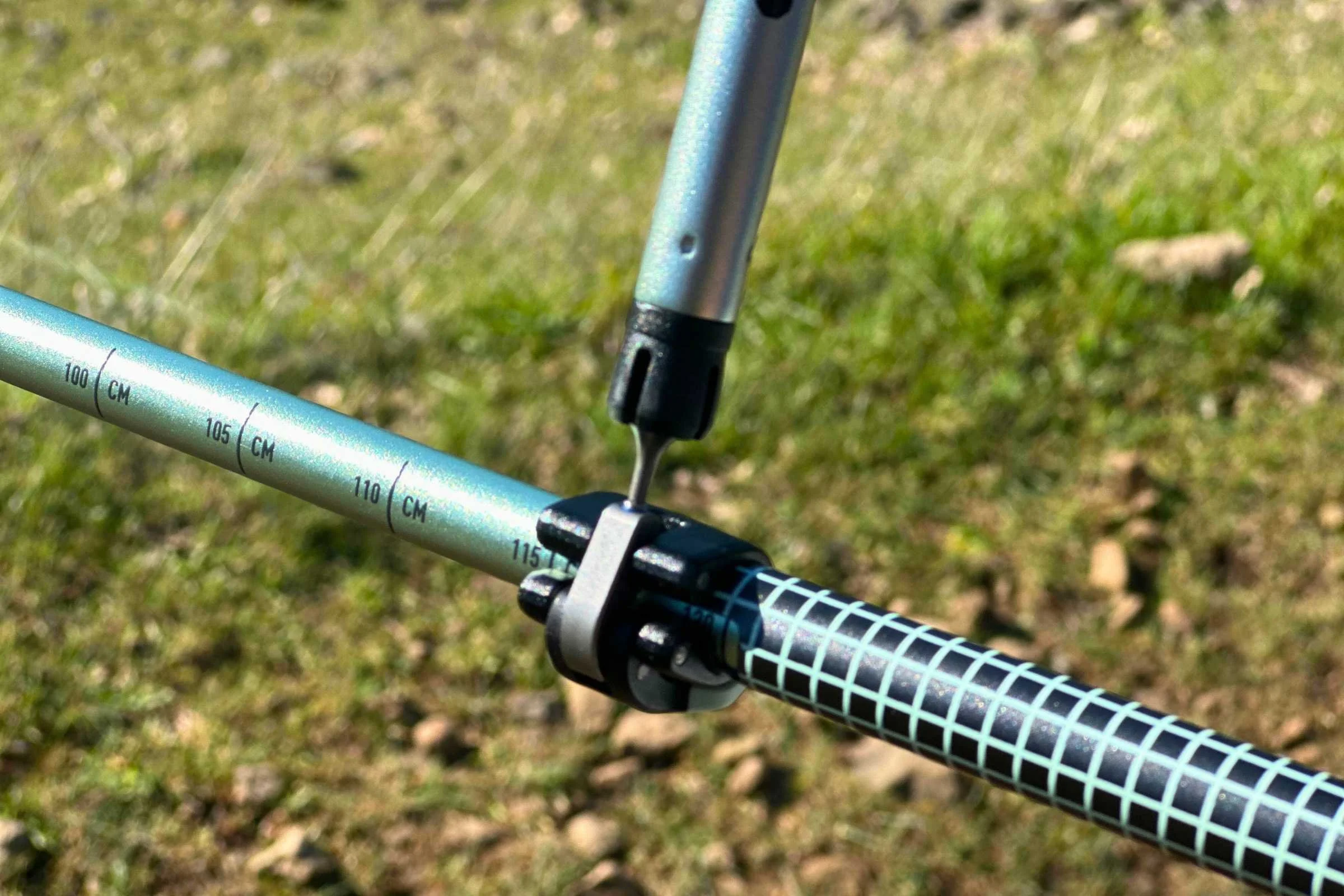
Black Diamond has solved this with a built-in hex tool. The tool is in the top of the bottom section of one pole. You need to completely pull the pole out of the top section in order to use it. Tightening the locking mechanism is a cinch with the hex tool.
You can read more in our in-depth review of the Black Diamond Pursuit Trekking Poles.
Black Diamond Pursuit
Black Diamond Pursuit



-
The Black Diamond Pursuit poles are the successor to our previous favorite hiking poles – the Black Diamond Trail Ergo – and we're happy to report that the Pursuit are an improvement over the Trail Ergo in just about every way:
They're lighter
They collapse smaller
They come in two sizes
The locking mechanism is better
The ergonomic grip is more comfortable
The wrist straps are more comfortable
They have a built-in hex tool for in-field maintenance
-
In our tests, we found a stand-out feature of the Black Diamond Pursuit are the thoughtful grips. The cork material is comfortable and easy to hold—even when our hands were wet from rain or sweaty from the sun. Over time, the cork molded to our hands.
The Pursuits also come with foam grip extensions that wrap around from the handle to the shaft of the pole. The foam extensions are useful because in snowy conditions or on tricky or technical terrain, you may need to grip lower on the pole. In most of those situations, you would readjust the length of your pole. But the foam extension lets you do this without stopping to adjust. You can simply grip the foam lower on the pole.
Another advantage of the Pursuits is the ease of tailoring it to your adventures. They have compatible snow baskets that are easy to take on and off as conditions change on your hike. Snow baskets keep your poles from getting torqued, providing extra support for you in deep snow.
They also come with trekking baskets, which can help reduce noise, improve grip on rock, and reduce the impact on rocks.
-
Flick locks can be notoriously finicky, but we’ve found Black Diamond's "FlickLock+" soft-touch locking mechanism to be remarkably sturdy but easy to use. With other poles, if the locks are tight, sometimes you have to really press them to get them to lock. Not so with the FlickLock+. It was easy to shorten them when we preferred to carry our poles or for packing up. They also don't collapse when holding up all of your weight.
-
Another criticism we had with the Pursuit's predecessor, the Trail Ergo, was the collapsed length. We thought the Trail Ergos were too long when collapsed. We're happy to report that Black Diamond delivered by reducing the collapsed size from 29" to 22.8" (S/M) or 24.8" (M/L). This is a HUGE difference. In fact, the only telescoping poles we tested that collapsed more were the REI Traverse.
If they’re still too long, we recommend checking out the Black Diamond Pursuit FLZ—the folding version.
-
The Pursuits come with a built-in hex tool to adjust the locks in the field. We're not sure if this is the first of its kind, but it's still pretty innovative. You simply remove the bottom section of the pole from the top, and the tool is at the top. Adjusting the locks with the tool is easy and simple. Anything that makes our lives easier while we backpack, without adding weight, is a huge win!
-
The Pursuit poles are for the frequent hiker who wants a versatile, long-lasting trekking pole. They're our choice for the best trekking poles because they provide the best balance of comfort, reliability, and features for most users.
Best Carbon Fiber Trekking Poles: Black Diamond Alpine Carbon Cork
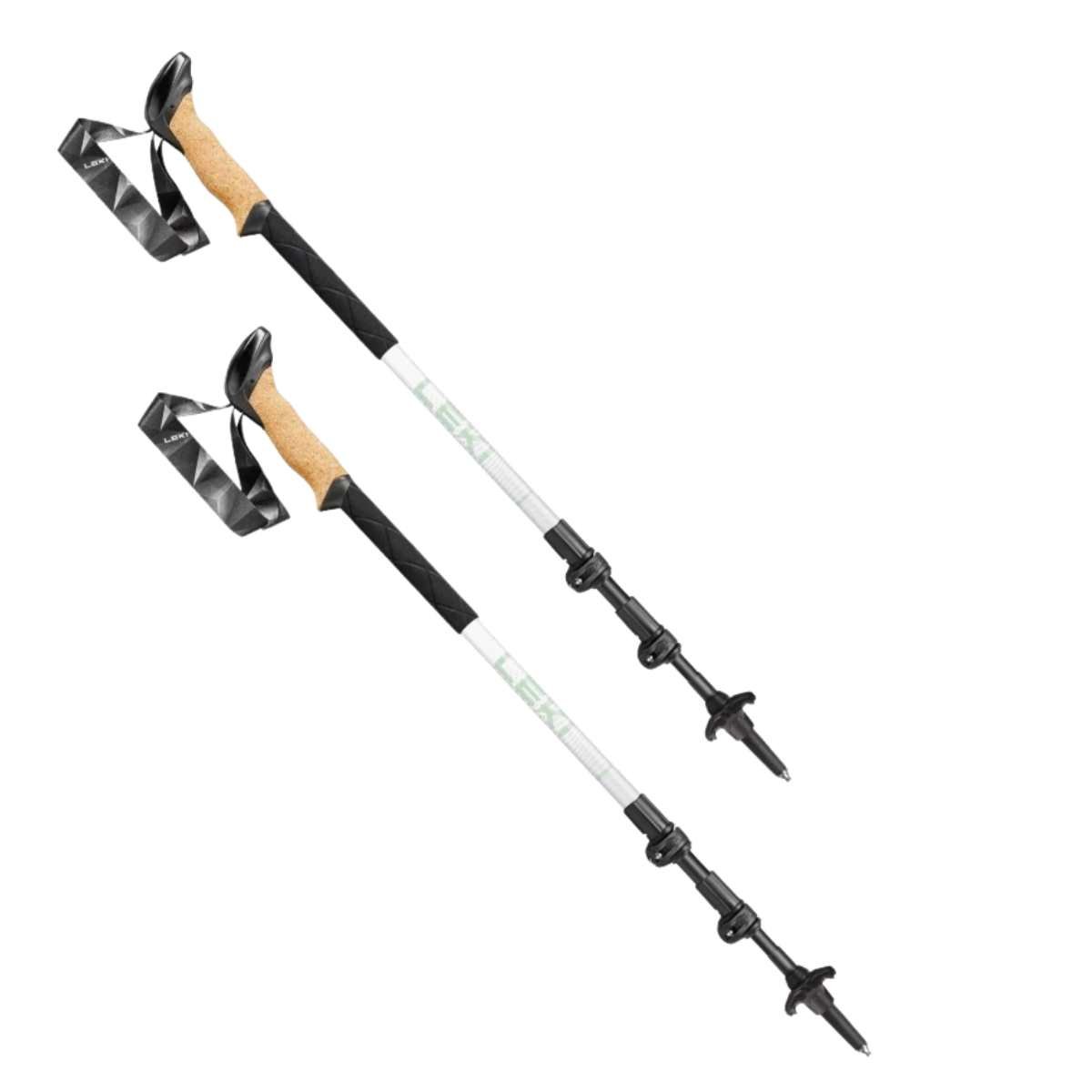
Grip material: Cork
Weight: 17.1 oz (pair); 16.8 oz (women’s)
Maximum length: 130 cm; 125 cm (women’s)
Shaft construction: Carbon fiber
Locking mechanism: External lever lock
Adjustable wrist straps included: Yes
Packing method: Telescoping collapsible shafts
What we liked: grip, durable, comfort, lightweight, quality easy-to-adjust flick locks
What we didn't like: not the lightest for carbon fiber, price
If you’re looking for a carbon fiber trekking pole that's durable, comfortable, and lightweight, we think the Black Diamond Alpine Carbon Cork are the best choice.
With a comfortable cork grip and metal flick lock lever locks, the Alpine Carbon Cork is the most reliable telescoping pole on the market. It takes the dependable features of the Black Diamond Pursuit, such as easy-to-adjust flick locks, and puts them into a carbon fiber pole.
Black Diamond Alpine Carbon Cork

-
What makes us favor the Alpine Carbon Cork over other carbon poles on the market such as the REI Flash Carbon Compact poles is the grip. First, we like the cork material on the Black Diamond better than the foam on the REI Carbon Flash. Cork better molds to the shape of your hands. Cork also absorbs sweat better and allows for a better grip. Second, the Alpine Carbon Cork has more secure grips than the Flash Carbon Compact.
-
One thing to note is that the Black Diamond Alpine Carbon Cork poles are heavy for carbon fiber: 17.1 ounces for the unisex pair compared to the 12.9-ounce REI Flash Carbon Compact poles.
For the absolute lightest carbon fiber trekking poles, a few of our staff exclusively use the Gossamer Gear LT5 (see review below). However, fair warning: those poles need some care and aren’t recommended for people who crank on their poles. That’s why we think the Black Diamond Alpine Carbon Corks are the best option for everyone who wants carbon poles—even if you put a lot of pressure on your poles. They’re light but can take a surprising beating for carbon fiber.
-
From our own testing, we think the Alpine Carbon Cork can hold up better on off-trail adventures than other carbon poles, especially in the snowy terrain.
As with other carbon fiber poles, be aware that this material can get brittle in the cold. Therefore, it isn’t our recommended pole for sub-freezing temperatures. We also wouldn’t recommend using a carbon fiber pole in the snow (see our best winter hiking poles for a pole designed for cold temperatures).
Best Ultralight Trekking Poles: Gossamer Gear LT5
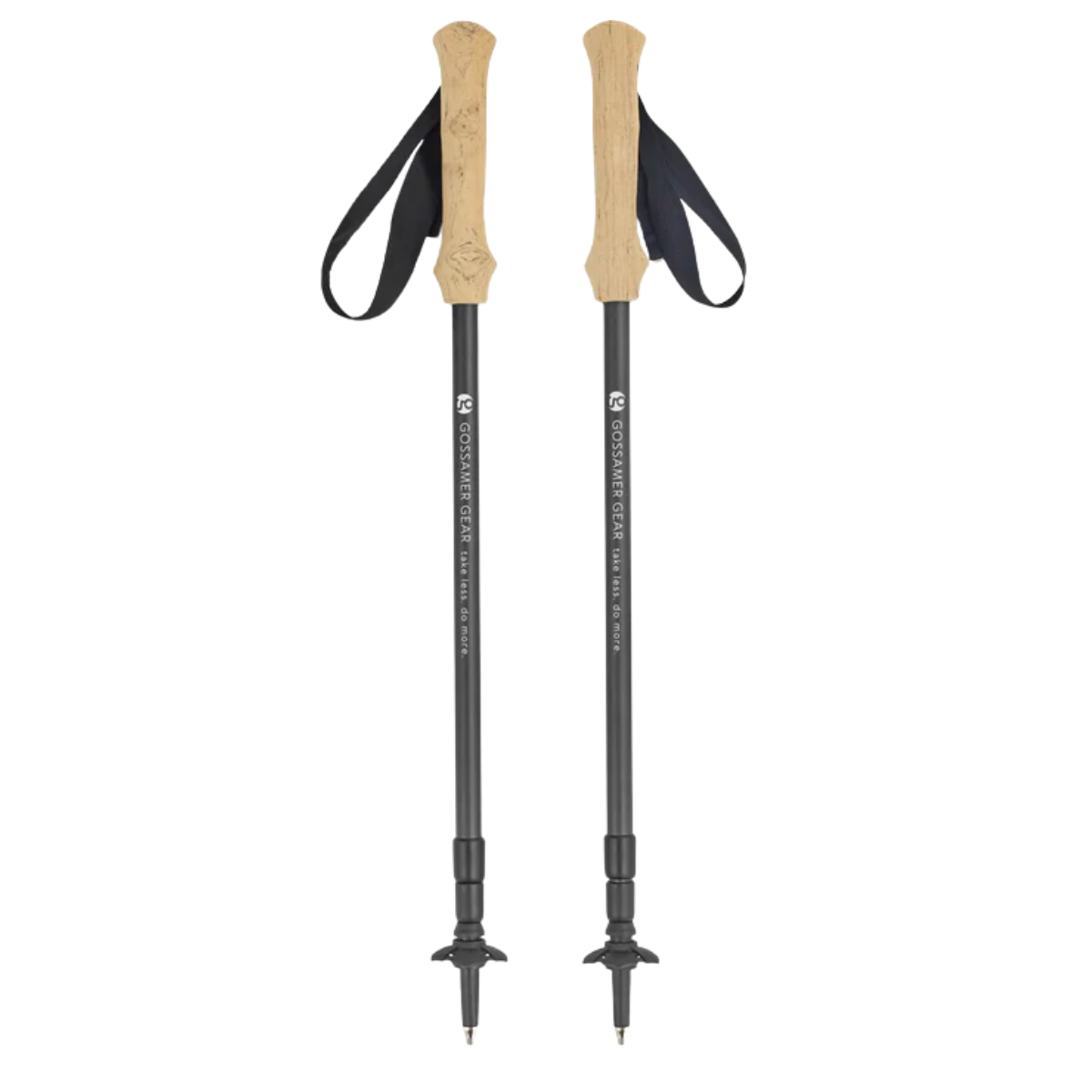
Grip material: Cork-like EVA Foam
Weight: 9.8 oz (pair)
Maximum length: 130 cm
Shaft construction: Carbon fiber
Locking mechanism: Twist lock
Adjustable wrist strap: Yes
Packing method: Collapsible shaft
What we liked: Weight, can purchase just one pole
What we didn't like: Durability, price
By far the lightest trekking poles on the list are the Gossamer Gear LT5. While we originally dismissed these poles as a winner because they have such a specialized audience, we decided to add the LT5s back because they boast the highest customer reviews of any poles we looked at (5/5 stars with 200+ reviews-including from people who say they’ve broken these poles!). We’ve personally thru-hiked thousands of miles with these poles and these are our go-to poles for smoother trails.
While we don’t think these poles are for everyone, we’ve used the LT series for more than a decade. Popular with thru-hikers like ourselves, the 4.9 oz per pole LT5s are among the lightest trekking poles on the market. You can make them even lighter by opting to remove the wrist strap. The wrist strap has been updated to be placed in a more ergonomic position but is no longer removable. Cutting off the wrist strap saves 0.5 oz.
Gossamer Gear LT5


-
We’ve logged thousands of miles with the LTs without an issue and enjoy handing them to other hikers and seeing the shock on their faces at how light these poles really are.
The advantage we see of going with the Gossamer Gear over those other carbon fiber trekking poles is that the LT5s are half the weight of the competition.
If you are concerned about breaking your poles, go with a Leki pole because they come with a one-year warranty for shaft breakage. But if your primary concern is weight, you should opt for the Gossamer Gear instead.
-
The Gossamer Gear LT5s are a great option for folks who are traveling on terrain that requires a mix of scrambling and pole work, like the Appalachian Trail. Because they are so light and fold up nicely into a backpack, they are ideal for treks where you know you’ll have to carry your poles at least part of the time.
The LT5s are also the best option for folks who prefer to use poles only on river crossings or downhills to protect their knees, but otherwise don’t want or need the extra lift poles can provide on uphills.
The LT5s are lastly a great option for folks who use trekking poles to support an ultralight tarp or backpacking tent but otherwise aren’t big trekking pole users. While it’s possible to purchase ultralight poles to hold up tarps, their weight is similar to the LT5s and they aren’t multi-functional.
-
Trekking poles must balance weight, durability, and ease of use. In the most recent version of the Gossamer Gear LTs, a twist-lock mechanism gives it all the functionality of a heavier pole. It even telescopes down to 23.5” or 60 cm (shorter than our carbon winner, the Black Diamond Alpine Cork). While we prefer a flick lock to a twist lock, we understand that much of the weight savings from these poles come with that compromise. You’ll still have to check these poles according to TSA, but with poles that telescope down this small, it’s easy to stick them in your pack when you need hands for scrambling.
-
The Gossamer Gear LT5 are the only poles we recommend that use a twist-locking mechanism to adjust height. They tighten by turning clockwise. We've found that twist-locking mechanism has a learning curve and without precise care, can be less secure than some of the flick-lock systems. We recommend reading the directions and testing at home before you leave on a trip.
-
As with earlier models, the replaceable rubber caps protect surfaces from scratching (and tips can be replaced as you use them). Gossamer Gear has the most customizable replacement part store we’ve seen, meaning you can fix your poles without having to wait on the phone or go back and forth on email with customer service. There are replacement tips, snow baskets, and pole sections (including the cork top section, should an animal take to munching on them).
-
Looking to reduce weight even more? The Gossamer Gear LT5s are the only pole we considered where you have the option to buy only one pole. The trick is to leave a note that you’d only like “one pole” in the comment section of your order and they’ll refund you 50%.
Best Aluminum Trekking Poles: Leki Legacy Lite

Grip material: Cork and rubber
Weight: 18.2 oz (pair)
Maximum length: 135 cm
Shaft construction: Carbon fiber and aluminum
Locking mechanism: External lever lock
Adjustable wrist straps included: Yes
Packing method: telescoping collapsible shafts
What we liked: durability, price, warranty, quality flick locks
What we didn't like: weight
The Leki Legacy Lite are the poles we recommend for someone who always breaks their gear. They are the updated version of our favorite aluminum trekking poles, the Leki Legacy, which was a gold standard for many years. These poles are affordable, durable, and come with a lifetime warranty with time-tested proof they can withstand years and thousands of miles of abuse.
We purchased and relied on the Legacy on a 200-mile section of the Continental Divide Trail through the San Juan Mountain range in Colorado in 10 feet of snow. We found these poles to be heavy-duty, affordable, and surprisingly light for all they can handle.
Leki Legacy Lite


-
The Leki Legacy Lite weighs just over 17 ounces each. While this update makes the Legacy about an ounce more than previous models, we think it's worth it for the durability, price, and ease of use. Although these are affordable poles, they still come with Leki’s signature “Speed Lock” system, which allows you to adjust each lock by hand.
The Leki Legacy Lite has optional snow and mud baskets, which allowed us to gain extra leverage while walking. Should the tips on the Legacy break or wear out, replacement tips are widely available.
-
On our San Juan Mountains traverse, we relied on the Leki Legacy Lite with the snow baskets. The strong aluminum shaft on the Legacy felt at times almost more like a ski pole-designed for the kind of torque and twisting associated with rugged terrain. The snow baskets allowed us to lift off of the snow more and get the most out of using poles in that kind of terrain.
One minor concern with the Leki Legacy Lite is that the top of the cork and rubber grip is flat rather than rounded, limiting the type of comfortable hand placements for these trekking poles.
-
Although it’s possible to find less expensive aluminum poles, one of the best reasons to choose any aluminum pole by Leki is that they are guaranteed for life (for shaft breakage only). We interviewed Junaid Dawud, part of the team who traversed all the Colorado 14ers (14,000-foot peaks) on foot as part of a thru-hike. He reported positive customer service at Leki (Dawud is not sponsored or an ambassador or employee of Leki). Leki’s customer service is well-recognized within the hiking community to work with you should any issues arise with your poles.
Best Running Trekking Poles: Black Diamond Distance FLZ

Pole material: Aluminum
Grip material: Foam
Adjustable? Yes
Length: 110-125 cm
Weight: 420 g per pair
What we liked: Durable, adjustable, mid-range price
What we didn’t like: The foam grips and wrist straps can be uncomfortable over long days
If you plan to do any running during your hikes or are dabbling with trail running, we think the Black Diamond Distance FLZ is the best option. These poles are great for fastpacking and light and fast backpacking trips.
The Black Diamond Distance FLZ poles are the best trekking poles for running and the overall winner in our best trail running poles guide.
The Black Diamond Distance FLZ are lightweight but they’re a great day-to-day workhorse. They offer robust support and do well with weight and stress, which allows them to survive in technical terrain where other running poles break quickly. Because of this more forgiving nature, they’re also beginner-friendly.
Note: The Black Diamond Distance FLZ is being discontinued. While it is still available, we recommend these poles, which you can still find at a discount at some retailers.
Black Diamond Distance FLZ

Treeline Review writer Aubri Drake using the BD Distance FLZ during a fastpacking trip in New England. Photo courtesy Aubri Drake.
-
They do equally well chugging along on smooth doubletrack paths as they do scrambling up a steep mountainside. They’re easy to stow in a running pack or a running vest, with low-profile foam handles.
They’re also adjustable for uphill and downhill travel, making them optimal for setting up fastpacking tents and tarps that require poles (if you don’t need this feature, consider the BD Distance Z). They also come with snow baskets that can easily be added to the tips.
-
The poles are aluminum and adjustable, which adds to their weight relative to other running poles on the market. However, compared to most hiking trekking poles, it is still quite light.
-
The grip is made of a firm, inflexible foam that quickly grows slick with sweat. The wrist straps are nylon with roughness on some edges, and can cause chafing in high humidity or for runners with a high sweat rate. We wish these poles were available with a cork grip, but none of Black Diamond's running poles have that option right now.
-
For the cost and performance, the Black Diamond Distance FLZ are perfect for faster paces in tougher terrain and everyday runs.
Best Lightweight Trekking Poles: REI Flash Carbon Compact Trekking Poles
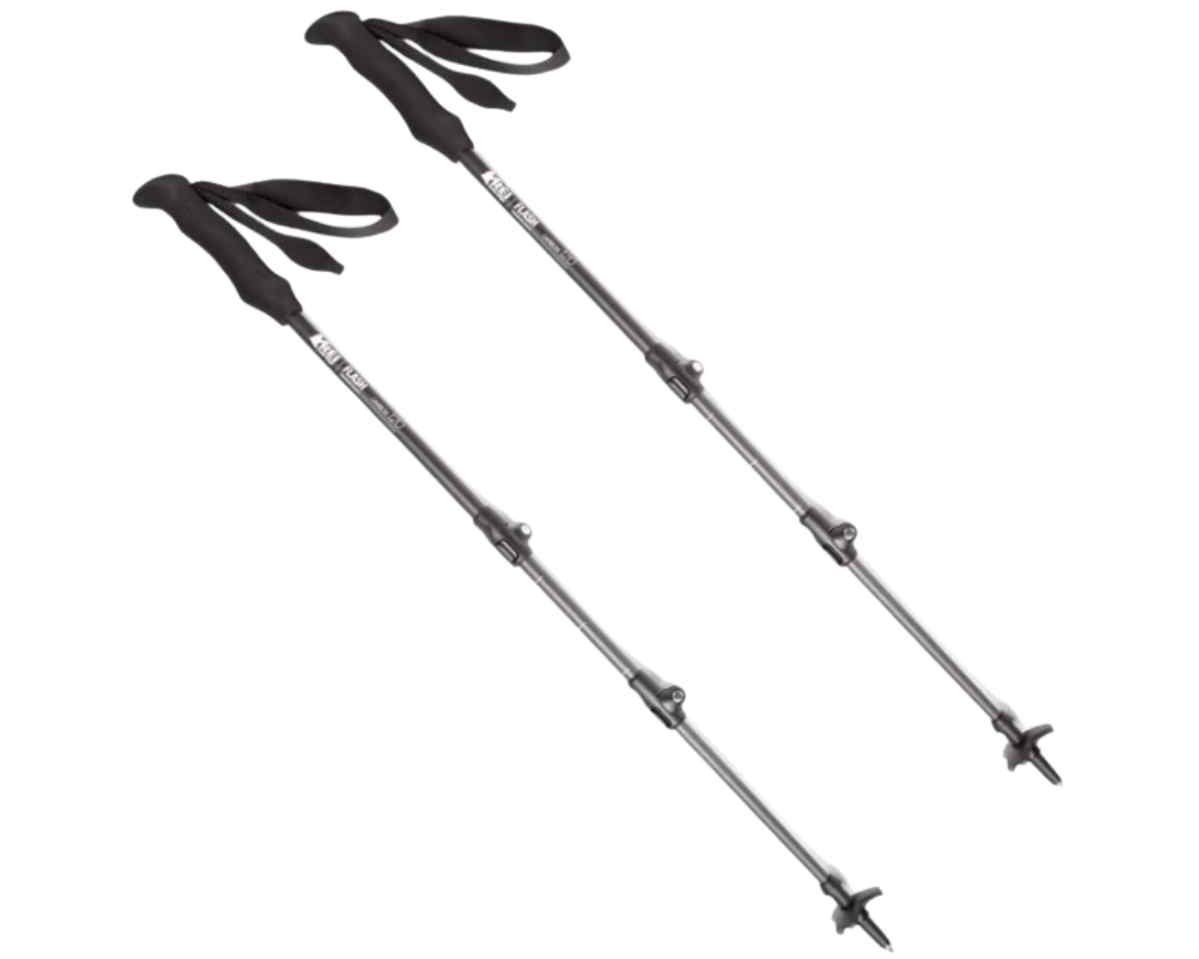
Weight: 12.9 oz
Maximum length: 120 cm, folding poles also available
Shaft construction: Carbon and aluminum
Grip material: EVA foam
Locking mechanism: External lever lock
Adjustable wrist strap included: Yes
Packing method: telescoping collapsible shafts
What we liked: value for the price, weight, warranty, easy for travel
What we didn't like: grips, not good for cold temperatures
The REI Flash Carbon Trekking Poles are among the most highly rated hybrid carbon-aluminum poles available. REI’s #1 best-seller balances weight, price, durability, and ease of use. The newest version reduced the weight of a pair of poles down to 12.9 oz–among the lightest poles we tested. Paired with REI’s warranty and ease of returns, these are a great lightweight pole considered to be a solid pick among outdoors people.
Rei Flash Carbon Compact Trekking Poles


-
The Carbon Fiber Compact makes travel easy. These collapse down to 23 inches-small enough for a carry-on size suitcase (but official TSA regulations say it’s still a no-go to for carry-on). TSA rules sometimes require poles to be checked, so it is nice to be able to fit these poles in a suitcase you likely already own.
-
Pro tip: We found these poles among the most adjustable of any we tested. To adjust the height, extend the bottom length fully and use the middle section to shorten and lengthen. If you’re concerned about measurement markings wearing off, use a Sharpie pen to mark your desired lengths or wrap duct tape around your poles at your desired height.
Some reviewers had some issues with keeping the poles locked. The external lever lock system must be fully tightened and locked and we found that over time or when throwing them in the back of a car, they can loosen up. Make sure you check to have the right locking tension before you begin your hike.
-
Another thing we liked about the Flash Carbons is the menu of options available. There’s traditional trekking pole and the compact version. There used to also be a women's trekking pole—which we used to recommend for most people who are 5’10” and under. Unfortunately, it appears to be discontinued. The women’s trekking pole weighed almost an ounce less.
As with other carbon fiber poles, be aware that this material can get brittle in the cold, so isn’t our recommended pole for sub-freezing temperatures. We also wouldn’t recommend using a carbon fiber pole in the snow.
As with the other poles we recommend, we find that adding rubber tips to the REI Carbon Flash poles can give you a better grip when you’re hiking on rocky surfaces. Rubber tips also are less likely to leave scars on the rock and dirt.
-
The best part of the REI Co-op Flash is that they come with REI’s one-year return warranty, so you can easily return them if you find they aren’t right for you.
Best Trekking Poles for Thru-hiking: Gossamer Gear FT3 Trekking Poles
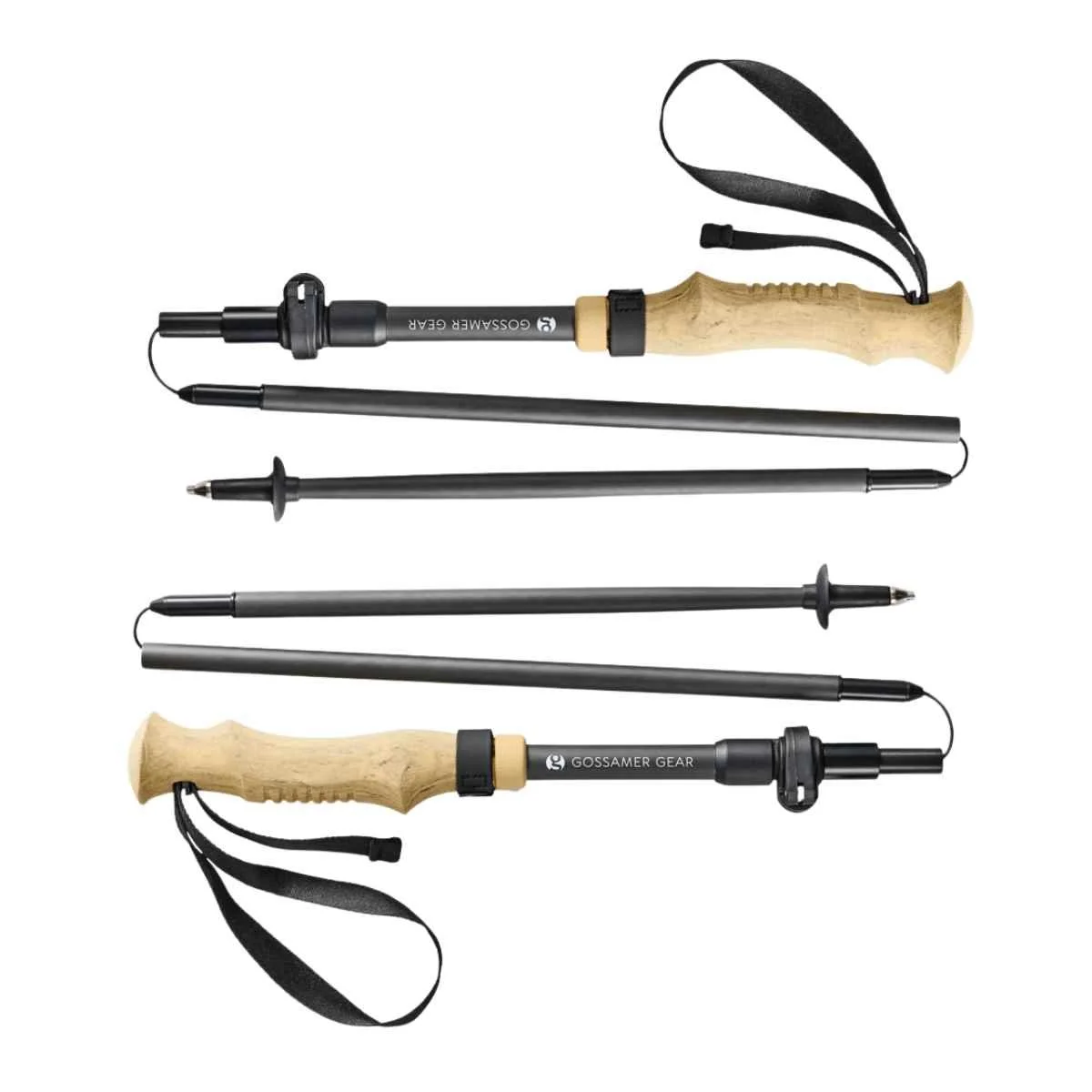
Grip material: Cork-like EVA Foam
Weight: 12.4 oz (pair)
Maximum length: 130 cm
Shaft construction: Carbon fiber
Locking mechanism: Lever lock with quick button
Adjustable wrist strap: Yes
Packing method: Three-piece folding
What we liked: Stability, ease and speed of adjusting poles, weight, pre-calibrated for setting up shelters
What we didn't like: Durability, price
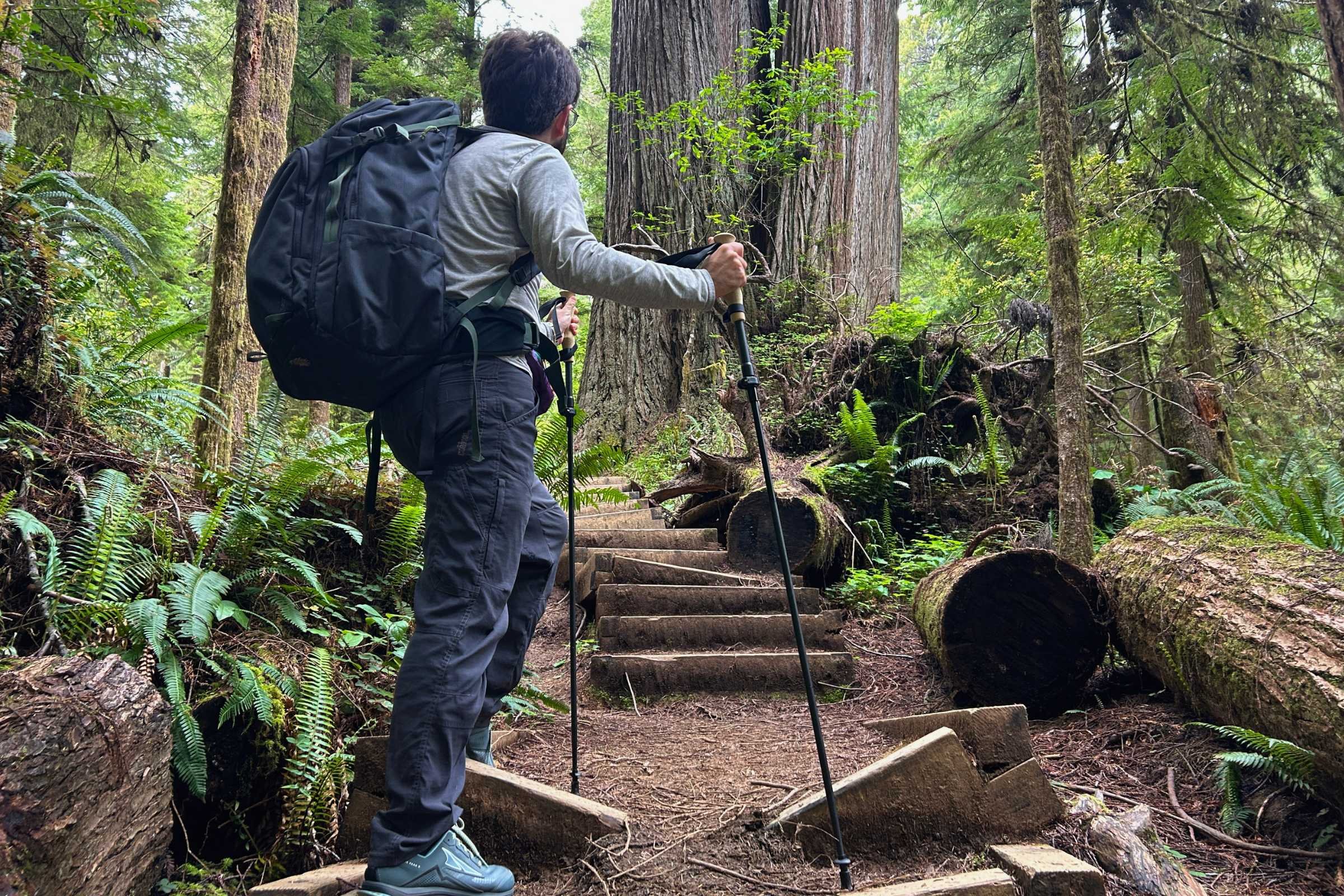
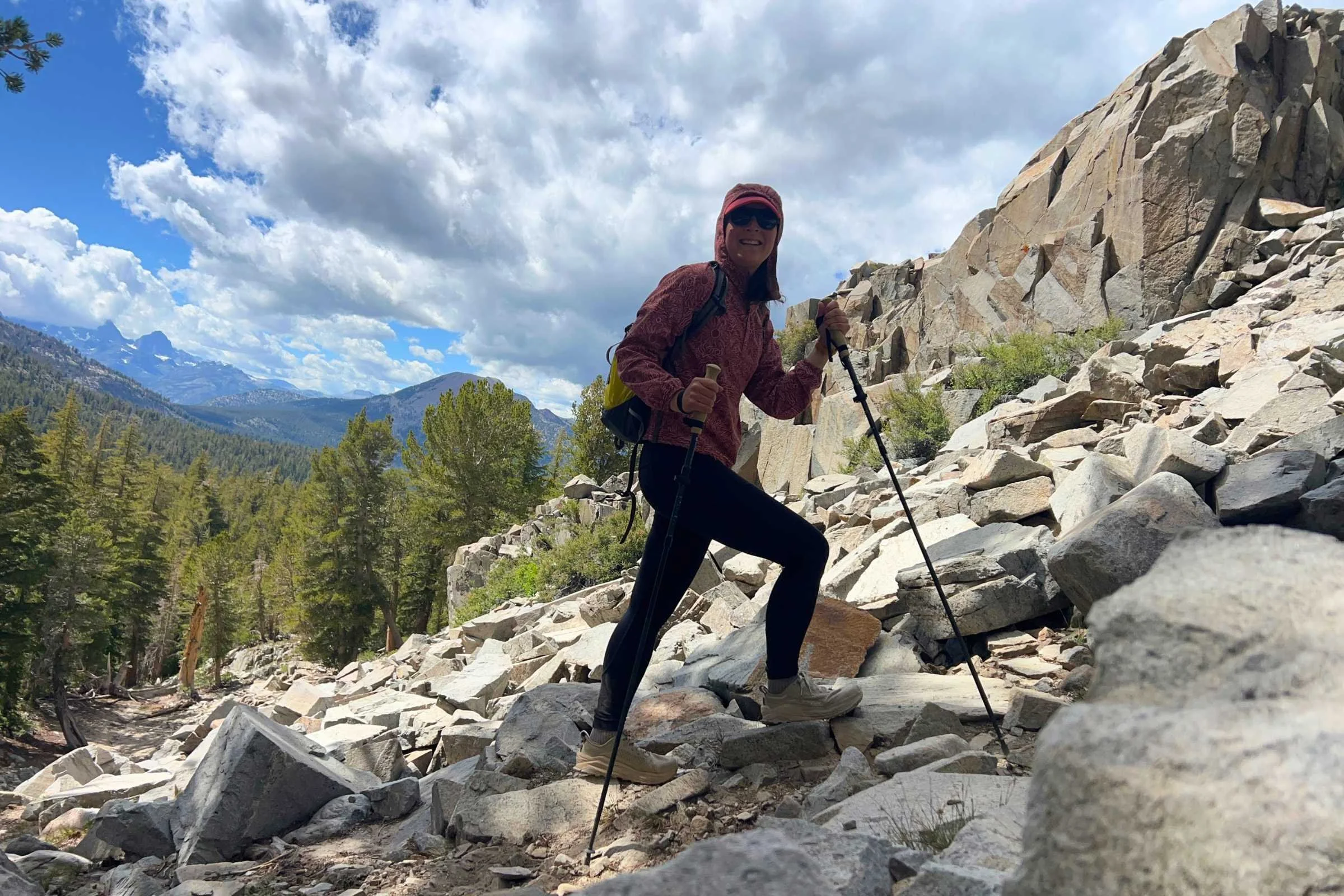
The new Gossamer Gear FT3 are the best trekking poles for thru-hiking, especially on trails like the Pacific Crest Trail or Tahoe Rim Trail, where ultralight poles are a must. The Gossamer Gear FT3 have all the ultralight features we love of the LT5s but with the speed of quick button systems.
Our editor in chief, Liz Thomas, has hiked thousands of miles with every iteration of the Gossamer Gear trekking poles and says, "The FT3 is hands down the best." The locks never buckle under weight and it's the easiest to adjust of any of the poles. They fold down to 15", so it's easy to stow away for sections of trail where you may be carrying an ice axe or umbrella (and even easier to reach around back and grab them). All three sections are connected by a cable, so when stowed away, you won't lose a section (this happened to our editor while thru-hiking the Arizona Trail).
All this adds up to no-fuss, ultralight poles that have the convenience of heavier hiking poles without the weight penalty.
Gossamer Gear FT3 Trekking Poles
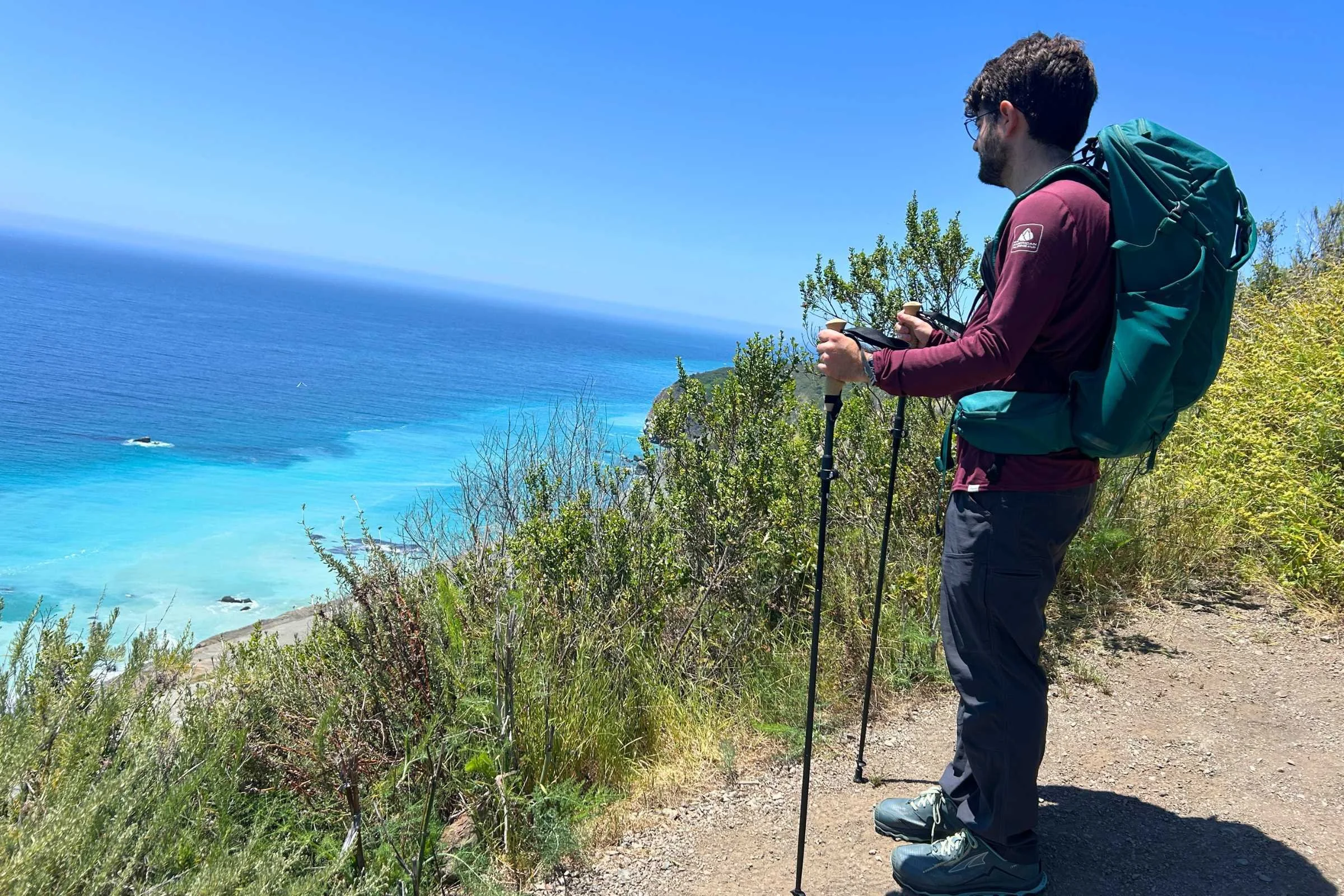
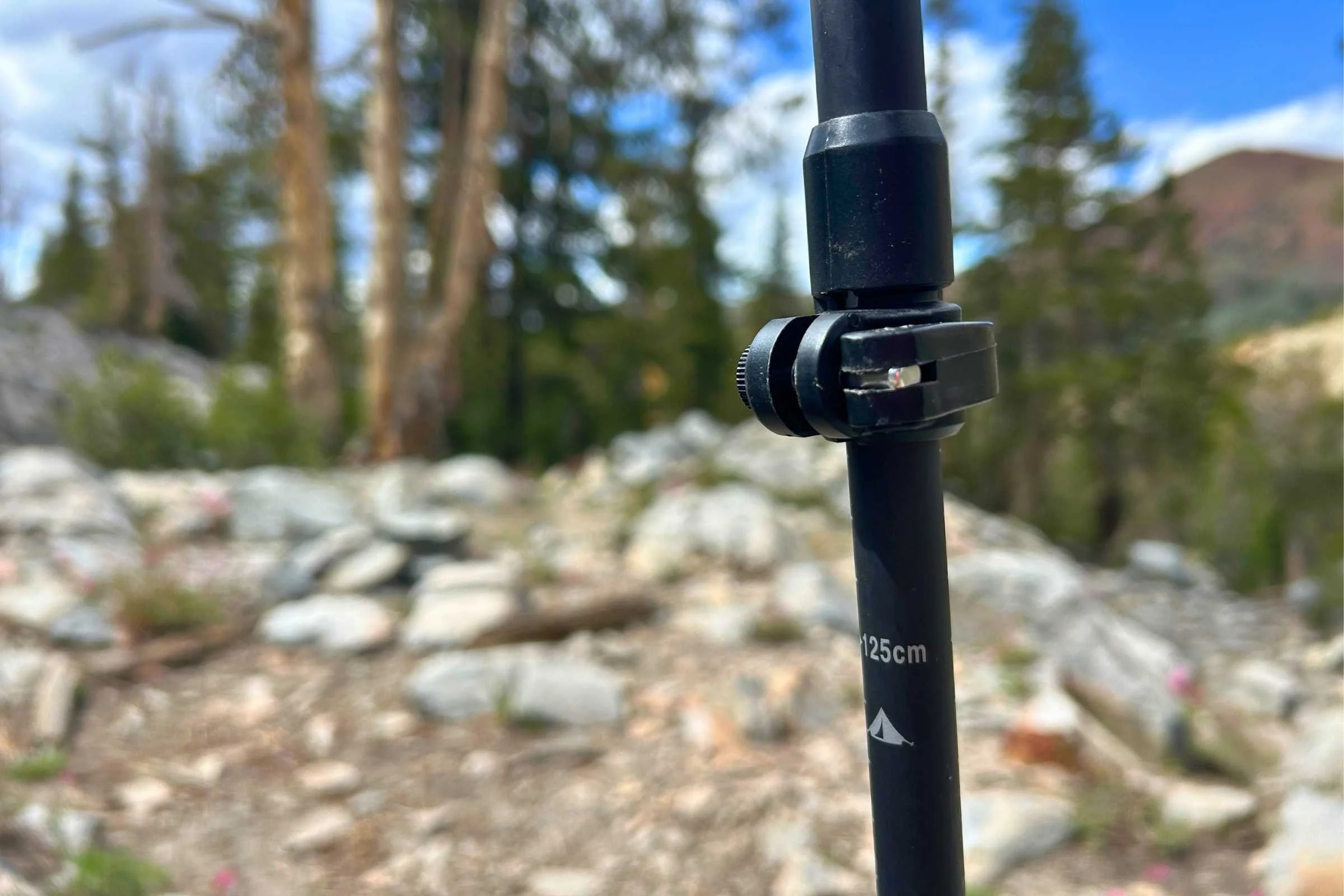
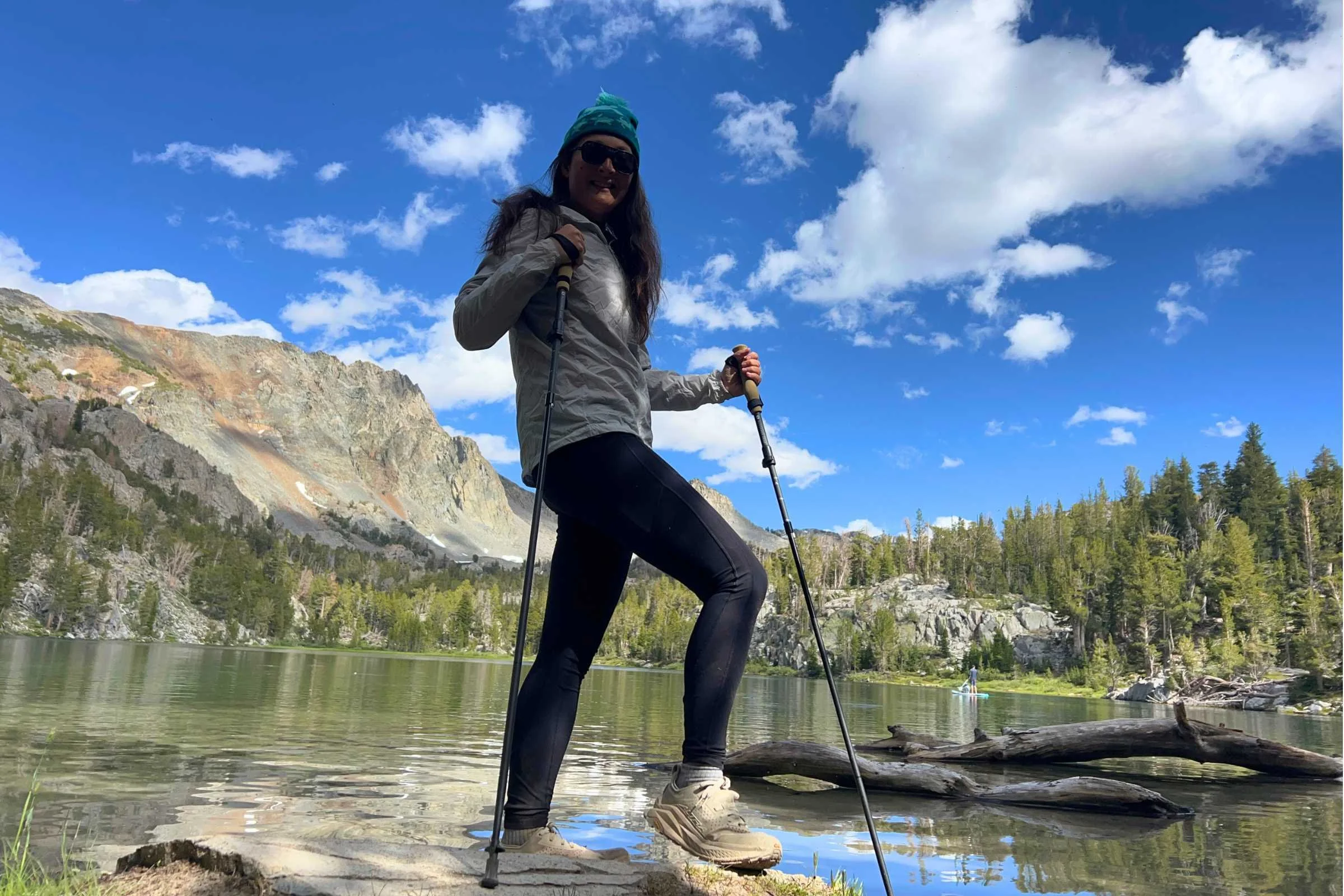
-
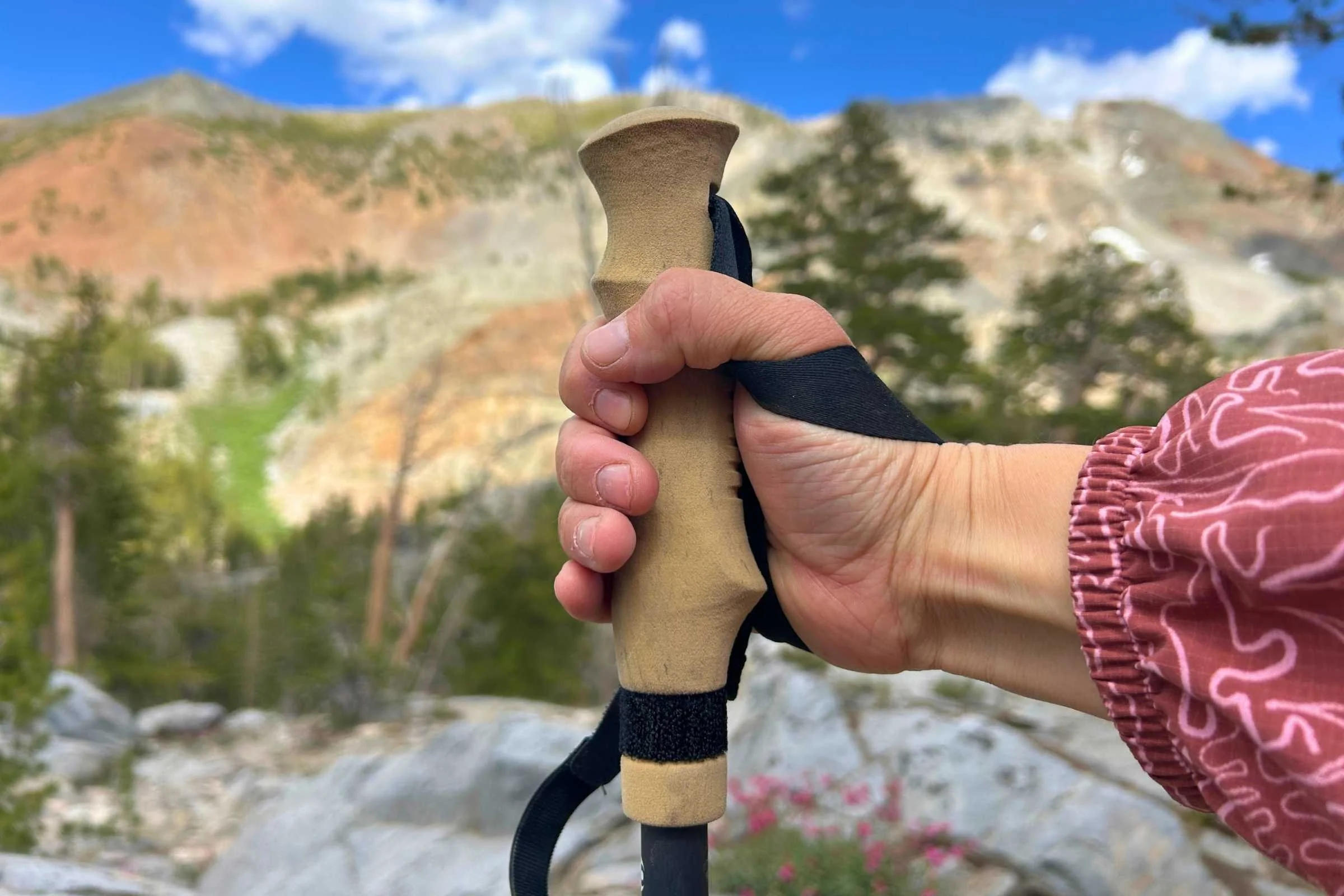
The Gossamer Gear FT3 trekking poles are the easiest to use lightweight poles we tested. A simple button springs the three segments into a durable shaft. A lever lock allows you to adjust the height further. This mechanism is similar to what we found in the Leki Makalu FX Carbon and Leki Cressida FX Carbon, but the FT3 are more than 5 oz lighter.
-
We tested many models of poles that fold down into three pieces but the Gossamer Gear FT3 folded to the among the shortest lengths of them all. This is convenient for fitting in a fastpack or running pack, which has less room for longer items. This also will work with ultralight packs for thru-hiking like the Pa'lante V2 pack, which has minimal room for fitting poles.
-
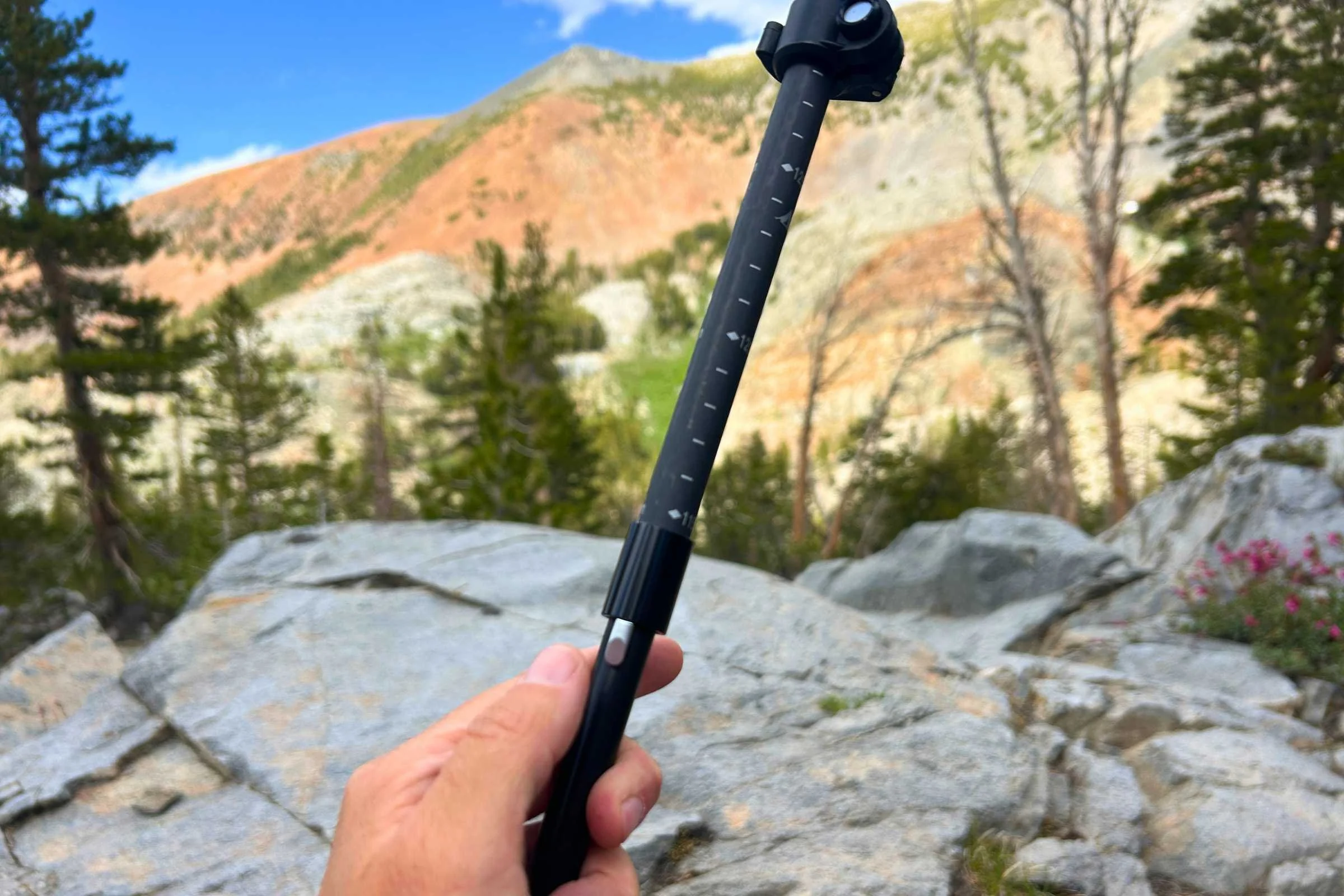
We also like how the FT3 trekking pole has marks on it specifically to show you the length to set up trekking-pole supported ultralight shelters. On thru-hikes, it is easy to forget the exact height of the pole you need for set-up. Many hikers mark their poles with duct tape, which is sticky and messy. Gossamer realized hikers want that height and printed it right on the pole.
-
When you're on a thru-hike, you have little energy and patience for fiddling with gear that isn't straight forward. The FT3 poles are no fuss, fast to set up, fold down small so they don't get in the way, and help make shelter set up much easier. At the end of a long day thru-hiking, that is all you can ask for.
Best Folding Trekking Poles: Black Diamond Distance Carbon FLZ Trekking Poles

Grip material: EVA foam
Weight per pair: 11.6 or 12.0 ounces
Maximum length: 110 or 125 cm
Shaft construction: Carbon fiber
Locking mechanism: FlickLock Pro
Adjustable wrist strap: Yes
Packing method: Foldable z-design
What we liked: Easy to switch between rubber and carbide tips, lightweight, compact
What we didn’t like: The tips are not durable, foam grip is not as comfortable as a cork grip for extended daily use
The Black Diamond Distance Carbon FLZ are the best trekking poles if you want folding trekking poles that are very compact. They are excellent for day hikes and urban walking because they are more compact and lightweight than other poles due to the carbon fiber shaft. This makes them an excellent option for international travel, such as to Europe, where you may want to do a combination of city walking, sightseeing, and hiking that requires poles.
The Distance Carbon FLZ fold down into three parts with a collapsed length of 13 inches (small) or 15 inches (large)—the most compact of any pole we considered.
Black Diamond Distance Carbon FLZ Trekking Poles

-
Tester Mike Unger used the Black Diamond Distance FLZ for approximately 1,500 miles, including thru-hikes of the Oregon Desert Trail and Mogollon Rim Trail. Trekking poles have been an essential piece of gear for tester Mike Unger since he started long-distance hiking 16 years ago. He bought and tested the Black Diamond Distance FLZ because, while still aluminum, they were lighter and packed much smaller than the Pursuit.
-
The Distance FLZ comes with interchangeable tech tips. Rubber or carbide tips can be easily screwed into the base of the poles. This is great for folks who use rubber tips around town but want carbide tips for trail use.
These poles weren't designed for long-distance use. We recommend using a pair with more durable tips for thru-hiking. For example, the Black Diamond Pursuit (and most Leki trekking) use carbide flex tips. In testing, we consistently would get 1,500+ miles of use on the carbide flex tips before replacing the tips.
However, the Distance FLZ interchangeable tips needed to be replaced after only 750 miles. The screw-on tip system broke after about 1,000 miles. We were able to replace the screw-on tip with a Black Diamond Flex Tip to keep using the poles, but we still think the Pursuit or Leki tips are better for longer-distance adventures.
-
The unique feature of the Distance Z and FLZ series is that the poles can be folded into three sections instead of collapsing into themselves like most trekking poles (like the Pursuit). This makes the Distance Z more compact when broken down. The Black Diamond Distance Z series comes in several models. The medium collapses down to 15", which is the most compact of any pole we considered.
-
The Black Diamond Distance Z is a fixed length and Distance FLZ are adjustable poles. Both the Distance Z and FLZ come in aluminum and carbon fiber models. The Black Diamond Distance Carbon Z has the same advantages of the Distance Z, but are more lightweight.
Best trekking poles for beginners: Cascade Mountain Tech Carbon Fiber Quick Lock
Shaft construction: Carbon fiber
Locking mechanism: External quick lock
Grip material: EVA foam or cork
Weight per pair: 15.6 oz
Maximum length: 137 cm
Adjustable wrist strap: Yes
Packing method: telescoping collapsible shaft
What we liked: price, durability
What we didn’t like: weight, locking mechanism
If you’re not sure if trekking poles are for you, the Cascade Mountain Tech Carbon Fiber Quick Lock is a cheap way to find out. The Cascade Mountain Tech is among the top five best-selling trekking poles on Amazon. They are also available at Costco and are a favorite of budget hiker Paul Magnanti, who covered them in his “Outfitted by Costco” story. We purchased and tested these trekking poles for 500 miles on the PCT and have continued to use them off-trail, on-trail, and everything in between. We've found the Cascade Tech poles to be intuitive to adjust and incredibly sturdy.
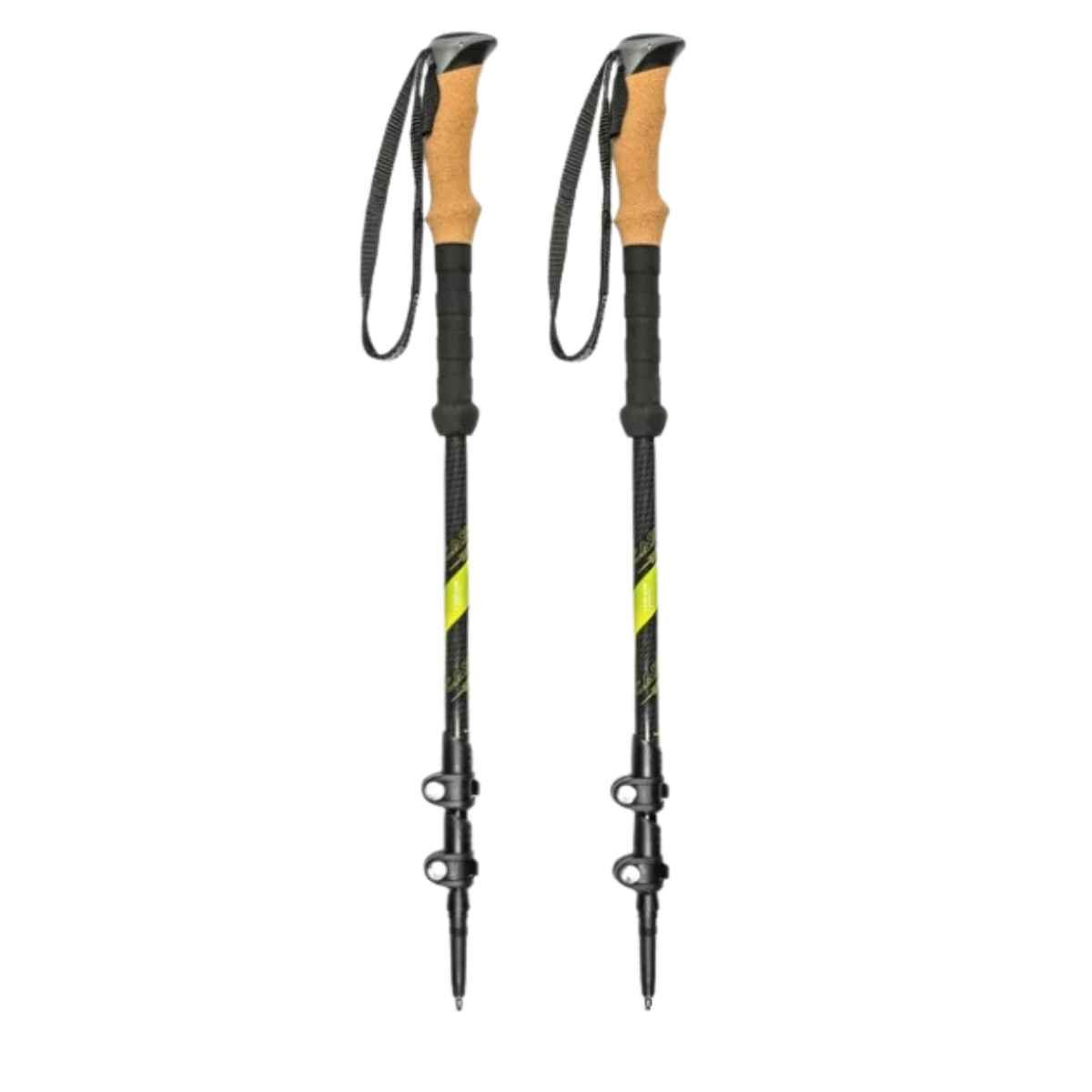
Cascade Mountain Tech Trekking Poles


-
The Cascade Mountain Tech poles beat out the frequently recommended and similarly priced Montem Ultra Strong due to reports of better durability and relatively easy repair. At 15.6 ounces, they’re not particularly light for carbon fiber. But for the price, they can’t be beaten. While they come with either a cork handle or EVA foam grip, multiple sources mention durability as the reason to choose a foam grip from this manufacturer. To round them out, the tungsten carbide tips provide a nice grip on slick rock.
The Cascade Mountain Tech is mentioned often in guide Paul Magnanti’s budget gear lists, who believes it is possible to get quality hiking gear at Costco. It’s his go-to budget carbon fiber pick in his Sub-$300 Gear List guide. These Costco poles are also a budget pick of guide Andrew Skurka.
-
We purchased and tested a pair of the Cascade Mountain Tech for a 500-mile section hike of the Pacific Crest Trail. As we anticipated, we were initially surprised by the weight of the poles given that they are carbon fiber. However, we became accustomed to that weight over time and by the end of the 500 miles, didn’t notice it at all.
-
We found the Cascade Mountain Techs incredibly easy to adjust right out of the box and in the field. This was handy when using the poles to hold up a tent and needing to adjust the tent height in snowstorms. They’re incredibly durable and handled all sorts of abuse that we wouldn’t normally recommend, like throwing the poles in the back of a truck. We were quite impressed with how they performed, especially with the budget price tag.
-
These Cascade Mountain Techs poles are available with a cork handle or a foam handle. We tested the foam (it was all that the store had) but wished we had gone with a cork handle. The foam doesn’t mold as nicely to the hand as cork. It also doesn’t absorb sweat as well. We relied more heavily than usual on our wrist straps to avoid touching the grip. As with all poles we considered, we recommend using a cork grip.
The Cascade Mountain Techs seem to be universally beloved in the “Budget Trekking Pole” category. While it’s possible to get lighter poles or more durable poles, the Cascade Mountain Techs really are among the more impressive budget items we’ve tested for their ability to perform despite a budget price tag.
Best trekking pole for women: Leki Cressida FX Carbon
Shaft construction: Carbon fiber
Locking mechanism: External lever lock
Grip material: Foam
Weight per pair: 17.8 oz
Maximum length: 130 cm
Collapsed length: 40 cm
Adjustable wrist strap: Yes
Packing method: Folding
What we liked: folds down the smallest of any poles we tested, warranty
What we didn’t like: Price
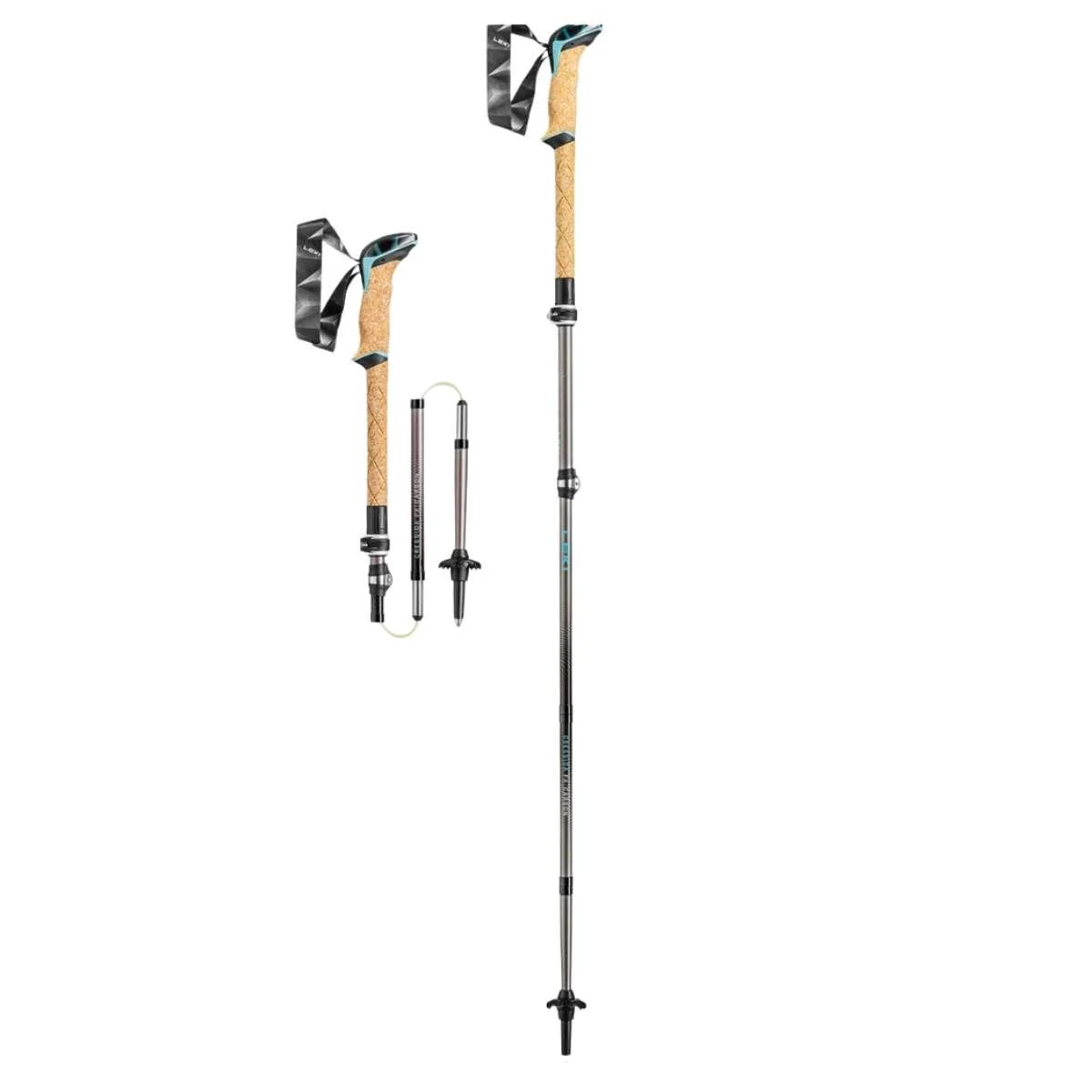
The Leki Cressida FX Carbon poles are our winner for best trekking poles for women.
The Leki Cressida FX Carbon is the women's version of the Leki Makalu FX Carbon, a legendary Leki pole. A big differentiator of this pole is the grip that helps get better control, especially on the downhill. The grip is angled and provides wrist support, similar to the design of high-end ski poles.
The Cressida is a smaller and shorter version with grips for smaller hands. We received word from Leki that the Cressida will be consolidated with the Makalu FX Carbon, but for now, we still recommend the Cressida while you can find it at retailers, usually at a discount.
Leki Cressida FX Carbon


-
We've tested the Leki Cressida FX Carbon on mountain trails, overnight backcountry routes, and even two thru-hikes of the Trans Catalina Trail. They’re a good balance of shedding some extra weight compared to aluminum poles without being delicate.
These poles aren’t bent by an awkward fall or sideways pressure. These poles don’t feel like they are just for smaller or lighter-weight people.
-
Collapsing down to an impressive 40 cm length (15”), the Cressida folded down the shortest of any poles we tested (matching the Gossamer Gear FT3). That is an ideal length for bringing on a plane without a duffel bag or for trips where hiking is just one of many things you intend to do. That length is also ideal for multi-sport trips, such as those that require a bike or paddling. It’s also a nice length for backpacking trips or thru-hikes where you’ll be storing your poles away to use an ice axe or sun umbrella.
-
We like the extended foam grips, which we found using on steeper hills more often than we thought we would.
-
While we wish there was a smaller price to pay out of pocket, the Cressida FX Carbon poles have a similar price to the old Micro Varios.
But they come with Leki's warranty, which is among the best in the trekking pole industry. And if folded size, weight, and sturdiness are important to you, these Lekis will certainly go the distance.
Best Trekking Poles for Winter Hiking: MSR DynaLock Ascent Carbon Backcountry

Pole material: Carbon
Grip material: Chunky foam grip
Collapsible: Yes
Adjustable? Yes
Lengths available: 100 -120 cm, 120 - 140 cm
Weight: 470 g per pair (100-120 cm)
What we liked: Durable, adjustable, comfortable foam grips, built for fast-and-light winter sports
What we didn’t like: Expensive, very heavy for carbon
The MSR DynaLock Ascent Carbon Backcountry poles are our winner for best winter hiking poles because they were specifically designed with this task in mind. They feature full-length pole tips for easy replacement if worn or damaged, and come with robust snow baskets. And they're the most durable poles for postholing in deeper snow. They’re meant for winter sports like fast-and-light snowshoeing, mountaineering, and splitboarding.
The MSR Dynalock Ascent Carbon Backcountry poles are winners for best winter running poles and also winners in our best ski poles guide for best poles for splitboarding. Both winter running and splitboarding require durable poles designed to go uphill that are light and fast.
Learn more in our in-depth review of the MSR Dynalock Ascent Backcountry Poles.
MSR DynaLock Ascent Carbon Backcountry
-
The poles have a single easy flip-lock and tensioner for adjustment of pole length in the field. The grips are firm foam, with an additional lower grip meant for sidehilling.
The pole handles are designed with an indented “beak” to easily hook and pull snowshoe heel lifts up. While most other collapsible poles use a central plastic-sheathed fabric string (like REI Swiftlands’ Dyneema), these use a plastic-sheathed wire, adding to their durability.
-
The MSR Dynalock Ascent Carbon ski poles are both the lightest and most packable in our test. They weigh about 100 grams less per pair than both of the other telescoping options we tested thanks in part to their carbon construction. And, rather than just telescoping, these poles actually fold up and collapse into three pieces, making them easy to stash in a pack for the downhill.
Other trekking poles we tested
Black Diamond Distance Carbon Z
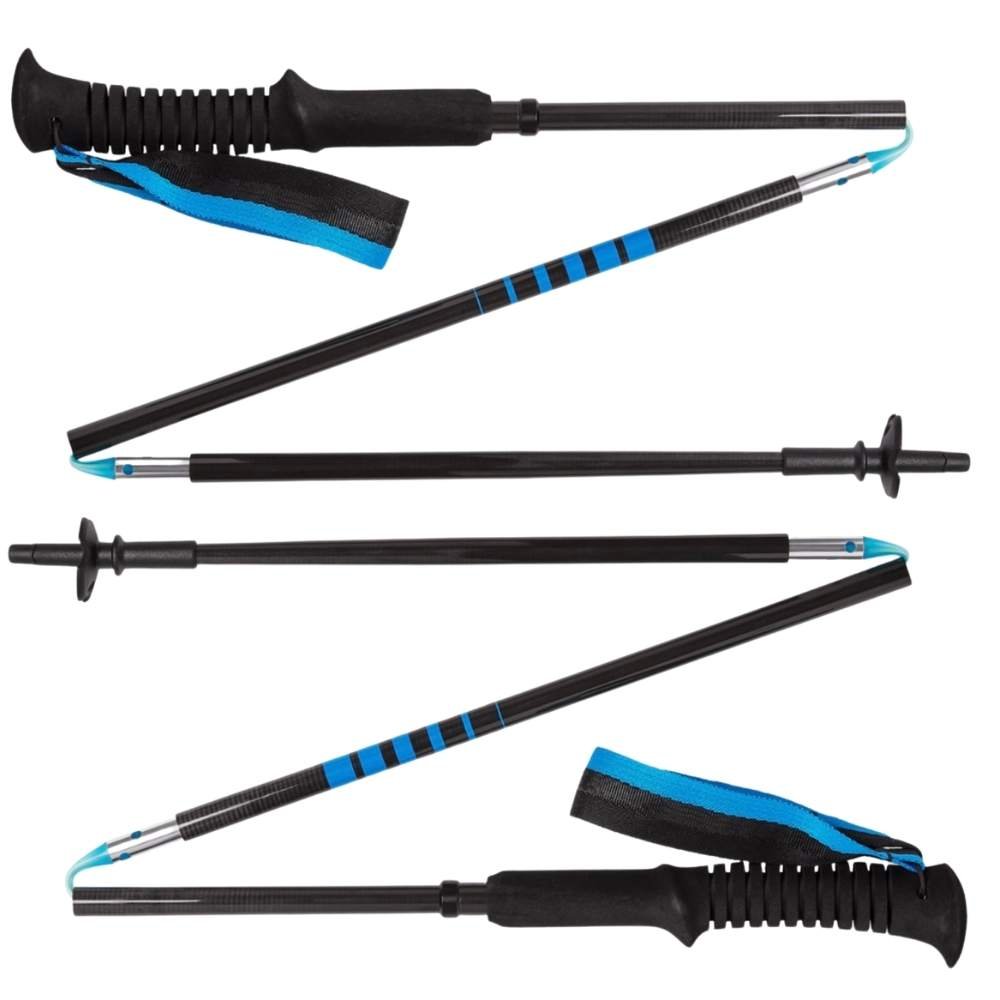
Shaft construction: Carbon fiber
Locking mechanism: Speed-cone
Grip material: EVA foam or cork handle
Weight per pair: 9.3 to 10.4 oz, depending on size
Maximum length: Fixed length. Sizes range from 110 to 130 cm
Adjustable wrist strap: Yes
Packing method: Folding
We also considered the Black Diamond Distance Carbon Z for the best carbon fiber trekking poles. However, we didn't find the interchangeable tips on the Distance Z as durable as on the Pursuit series. Additionally, the Distance Carbon Z is more expensive than the Alpine Carbon Cork. The big advantage of the Distance Carbon Z is that it folds down into three pieces and are more compact. Still, we think most users will prefer the durability of the Alpine Carbon Cork over the slight weight savings of the Distance Carbon Z.
Black Diamond Distance Carbon Z
Additionally, within the Distance series, we liked the Black Diamond FLZ better. The Black Diamond Distance Z is a fixed-length trekking pole whereas the Distance FLZ that we recommend are adjustable poles. Both the Distance Z and FLZ come in aluminum and carbon fiber models. However, we recommend an adjustable-length trekking pole for most hikers.
You can adjust the height of the pole depending on whether you are doing uphill or downhill. You can also adjust the trekking pole height for different lightweight backpacking poles that require poles of different heights. See our section on adjustable vs. fixed length trekking poles for more details.
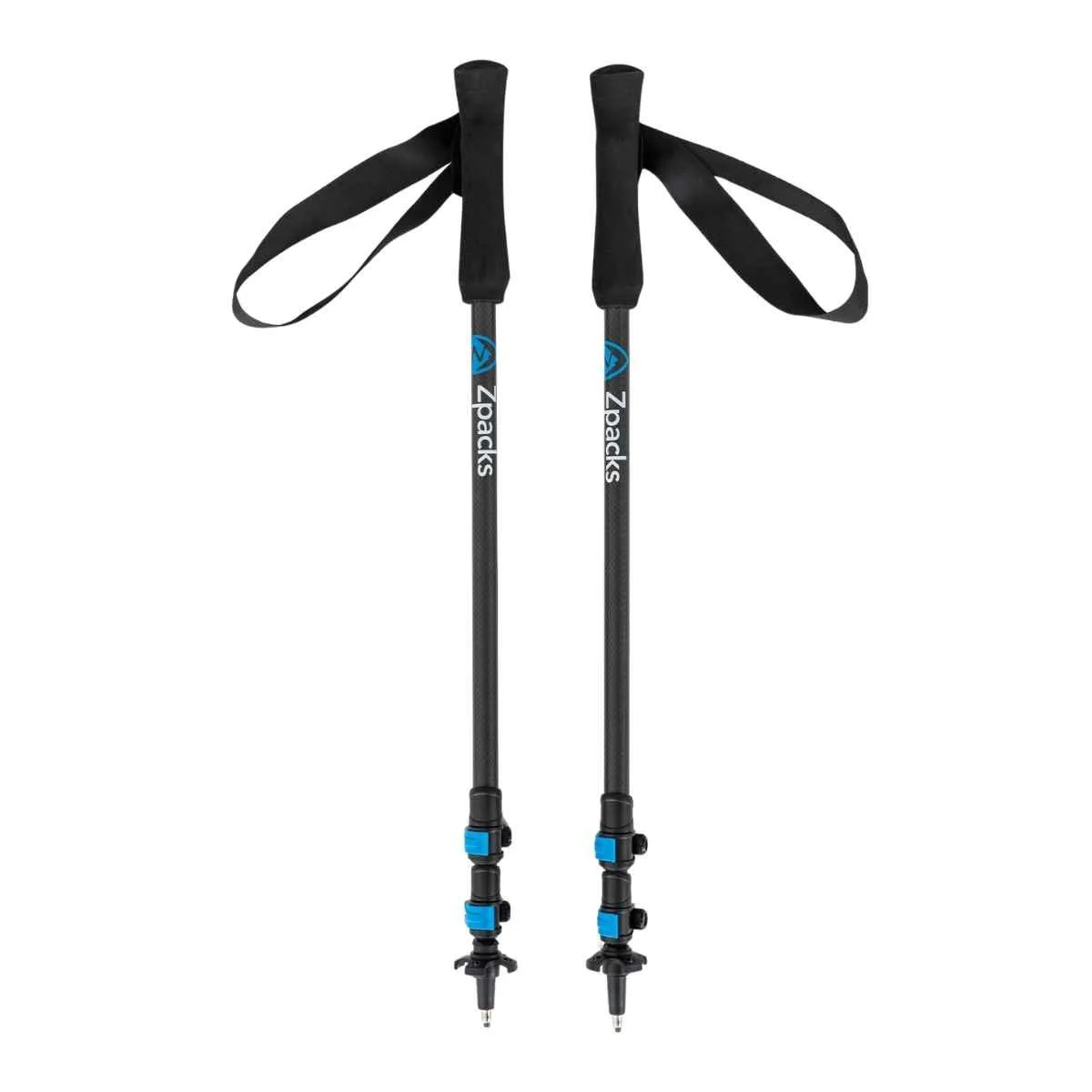
Shaft construction: Carbon fiber
Locking mechanism: Flip lock
Grip material: EVA foam or cork handle
Weight per pair: 14.4 oz
Maximum length: Fixed length. Sizes go up to 137 cm (142 for tent pitch)
Adjustable wrist strap: Yes
Packing method: Folding
The Zpacks Minimalist Trekking pole is a lightweight, minimalist alternative to our winner for Best Ultralight Trekking Poles, the Gossamer Gear LT5. The two poles weigh the same.
Like LT5 uses a twist lock and the Zpacks uses a flick lock for adjustment. However, we found that it was difficult to get the flick lock to stay put on the packs trekking poles. We also preferred the foam handles on the Gossamer Gear LT5s. The Zpacks Minimalist Trekking pole is more affordable than the LT5 so can be a good alternative if the LT5s are outside of your budget.
Zpacks Minimalist Trekking Poles
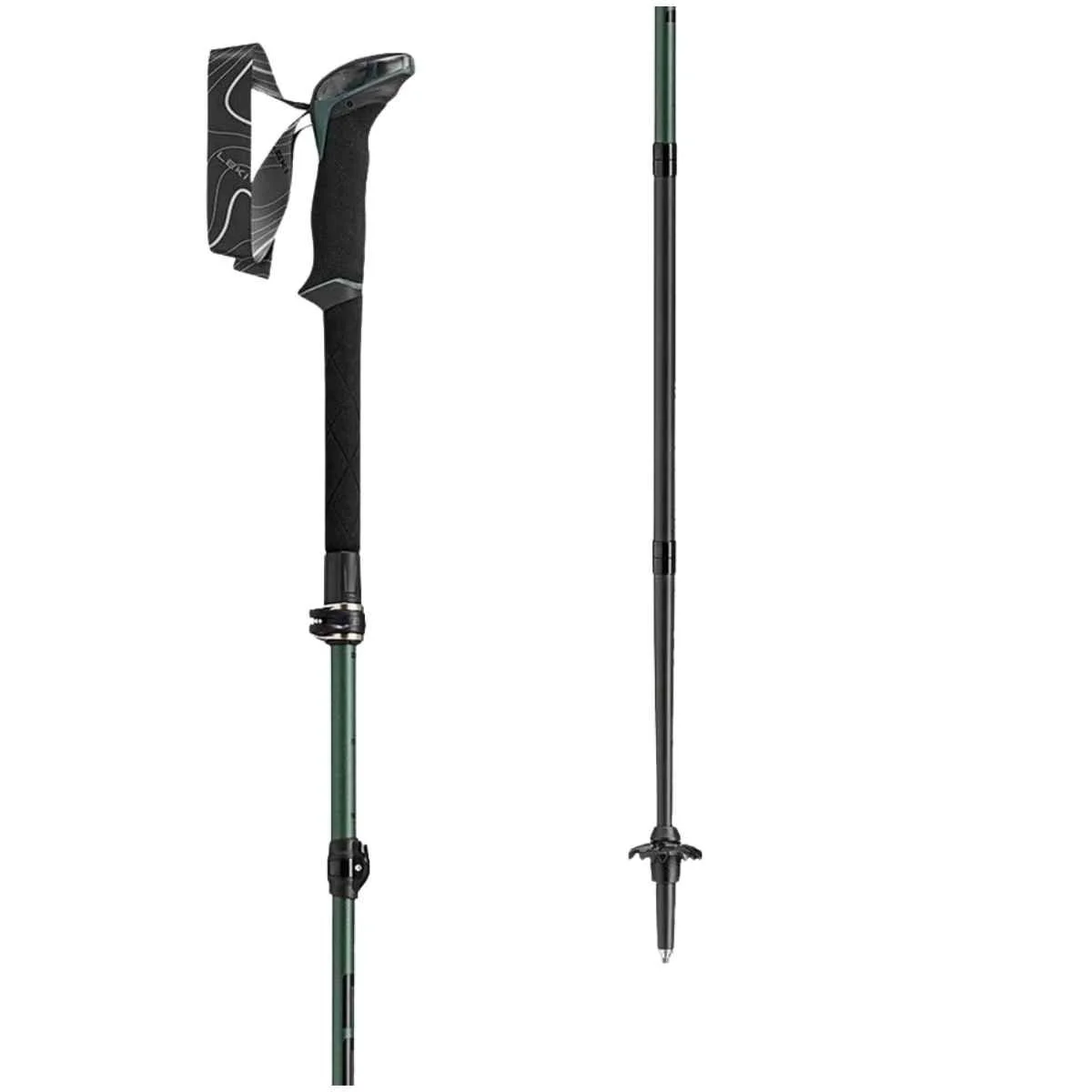
Shaft construction: Carbon fiber
Locking mechanism: External lever lock
Grip material: Foam
Weight per pair: 17.8 oz
Maximum length: 130 cm
Collapsed length: 40 cm
Adjustable wrist strap: Yes
Packing method: Folding
The Makalu FX Carbon is Leki’s replacement for the much-loved Micro Vario Carbon, our former Best Travel Poles winner. I’m rough on my gear and no stranger to trips, slips, and other kinds of torque on my poles, but I’ve never felt in danger of damaging either myself or these poles. I’ve used them to hold up my shelter, and they don’t slip or twist in the night.
Leki Makalu FX Carbon

Three PCT hikers at Crater Lake National Park, all using trekking poles. Photo by John Carr.
Do I Need Trekking Poles?

Trekking poles can be essential when crossing rushing creeks and rivers. Here PCT hikers ford a snowmelt swollen creek during the high snow year of 2006. Photo by Mike Unger.
Trekking poles reduce knee strain, secure balance on uneven terrain or during creek crossings, and are essential to set up lightweight tents, filters, and camera systems.
The most common reason people choose to use poles is to protect their knees and reduce injuries. Michael Torry, director of biomechanics research at Steadman-Hawkins Sports Medicine Foundation in Colorado, found that trekking poles reduce the risk of injury in knees, calves, thighs, and hips.
Trekking poles also mean less impact on the body over time. Steadman’s research also shows that poles can reduce 4.4% of force. That may not seem like much, but it does add up over time.
We found 14 reasons for why to use trekking poles and list them out in Why use trekking poles. From setting up shelters to helping with river crossings to keeping our fingers from swelling, trekking poles help hikers and backpackers day-after-day.
The drawbacks of trekking poles can be the extra weight—especially if you must collapse them down because your hands are too cold to keep out of your pockets in the morning. Using trekking poles can make scrambling or using an ice axe more difficult. It may also be difficult to use a sun umbrella while using trekking poles. Trekking poles without rubber tips can also cause damage to rocks or have an environmental impact on the trail.

We tested and compared trekking poles side-by-side to determine which grips feel the most comfortable and mold to hands with movement. Photo by John Carr.
What to Look for in Trekking Poles

Regardless of which brand you choose, your pole tips are going to wear out a lot faster than the rest of your poles. That’s why we advise choosing poles where tips are easy to replace, as on the Black Diamond Pursuit. Photo by Mike Unger.
Price
Most hikers will find a solid pair of poles in the $60 to $150 range. Below $60, you start to make real compromises on grip comfort and locking mechanism quality. Above $150, you're paying for carbon fiber, packability, or specialized features like the built-in hex tool on the Black Diamond Pursuit. Spending more doesn't always mean getting a more versatile pole — a $230 travel pole optimized for packability isn't necessarily better on trail than a $100 aluminum workhorse.
Pole material
Aluminum is heavier than carbon fiber but handles abuse better, especially in snow and below freezing temperatures. Carbon fiber can get brittle in cold and is more likely to shatter under the twisting forces that come with postholing. For most three-season hiking, carbon fiber is a solid choice. For winter hiking, snow travel, or anyone who is hard on gear, aluminum is the safer bet. Hybrid poles try to split the difference and can work well, but check what's actually carbon versus aluminum before assuming you're getting the weight savings you expect.
Weight
Every pair on this list comes in under 20 ounces, and several are well under that. Weight matters most if you're thru-hiking and carrying your poles for thousands of miles, or if you need to stash them frequently for scrambling or technical terrain. The Gossamer Gear LT5s at 9.8 oz per pair feel genuinely shocking when you first pick them up. But if you're a hiker who leans hard on poles or uses them in rough conditions, saving those ounces by going ultralight will cost you durability. Know which tradeoff matters more for how you actually hike.

Button lock adjustability on the Leki poles. Photo by John Carr.
Grip material
Cork is the best grip material for most conditions. It molds to your hand over time, absorbs sweat, and stays comfortable on long days in wet or hot weather. Foam grips are lighter and work fine in dry conditions but get slippery with sweat and don't mold the same way. If you're choosing between a cork-grip pole and a foam-grip pole at a similar price, go with cork. The extended foam grip extensions on the Black Diamond Pursuit are worth noting — they give you the option to choke down on the pole on technical terrain without stopping to readjust length.
Locking mechanism
Lever locks are easier to use and more reliable than twist locks. With twist locks, there's a real learning curve and the consequences of getting it wrong — a pole that collapses when you put weight on it — are not something you want to discover mid-river crossing. The Gossamer Gear LT5s use a twist lock, which is part of how they achieve their weight, but we recommend reading the directions carefully and testing at home before relying on them in the field. For everyone else, lever locks are the way to go.

We find lever lock mechanisms to be easier to use and more sturdy than twist locks. Photo by John Carr.
Adjustability
Adjustable poles are worth it for most hikers. Being able to shorten poles on steep uphills and lengthen them on descents reduces strain on knees and back over a long day. Adjustability also matters if you use poles to pitch a tarp or shelter, since different shelters need different pole heights, and being able to drop into "storm mode" with shorter poles is useful in bad weather. Fixed-length poles save a small amount of weight but give up a lot of flexibility.
Replacement parts
Tips wear out faster than anything else on a trekking pole. A pair used on rocky trails will go through tips regularly, and being able to replace them for a few dollars rather than buying new poles is significant over the life of the gear. The Black Diamond Pursuit uses carbide flex tips that consistently last 1,500 miles or more in our testing before needing replacement. The Gossamer Gear has a full replacement parts store where you can order individual sections, tips, and baskets without going through customer service. Check whether replacement parts are available and reasonably priced before buying.

If packability and portability are important to you either for travel or for hiking in areas where you may need your hands for scrambling or an ice axe, look for poles that fold. Photo by John Carr.
Shock absorption
None of our top picks include shock absorption, and we don't recommend it. The system adds weight, costs more, introduces moving parts that can fail, and in our experience makes uphill travel harder without providing meaningful benefit on the downhill. Skip it.
Packability and collapse method
If you'll be traveling by plane, scrambling on technical terrain, or carrying poles for extended stretches, how compact your poles get matters. Folding poles collapse to 13 to 15 inches and fit inside a carry-on sized suitcase, though TSA still requires poles to be checked. Telescoping poles are less compact but simpler and often more durable. Consider how often you'll actually need to stow your poles before paying a premium for the most packable option.
Baskets and tips
Most poles come with trekking baskets, which reduce noise, improve grip on rock, and lower environmental impact on trail surfaces. Snow baskets are worth having if you'll be in deep snow — without them, your pole simply sinks. Rubber tips are useful for urban hiking or Nordic walking, and keep your poles from scarring rock. For serious trail use, carbide tips provide the best grip and durability.
How to choose trekking poles

Six of almost a dozen models of trekking poles that we tested for this story. Photo by John Carr.
The best trekking poles for you depend less on which model gets the highest ratings and more on how you actually hike. Here's how to think through it.
Start with where you're going. If you're headed somewhere with snow or freezing temperatures, get aluminum. Carbon fiber can shatter under the twisting forces that come with postholing, and that's not a compromise worth making in the backcountry. For three-season trails, carbon fiber is a reasonable choice and will save you some weight.
Think honestly about how hard you are on gear. Some hikers glide along maintained trails and their poles will last for years regardless of material. Others are bushwhacking, crossing swollen rivers, and leaning hard on their poles on every steep descent. If you fall into the second category, prioritize durability over weight. The Leki Legacy Lite comes with a lifetime warranty for shaft breakage for a reason.
Weight matters most over long distances. On a day hike, the difference between a 10-ounce pair and an 18-ounce pair is barely noticeable. On a thru-hike, you'll feel every ounce over thousands of miles. If you're planning a long trail, lighter poles are worth the investment. If you're a casual day hiker, spending extra to save a few ounces probably isn't.
Consider how you'll travel with them. TSA allows “blunt-edged” trekking poles in a carry-on bag and “sharp-edged” trekking poles must be checked. What this means in practice is your TSA agent can decide whether you fly with or without your poles. Whether you carry them on or check them, if you fly with your poles, packability is worth paying for.
If you're not sure whether poles are for you, start cheap. The Cascade Mountain Tech poles at $65 will tell you whether trekking poles change your hiking before you commit to a $200+ pair. Many hikers who start skeptical become converts after their first significant descent with poles. Once you know you want them, it's worth spending more for the features that match how you actually hike.

Trekking poles can help you on steep climbs like that on the Timberline Trail around Mt. Hood, Oregon. Photo by Kate Hoch.
FAQ

Two hikers using trekking poles to secure their footing on a snowy cliff in the Sierra on the Pacific Crest Trail. Photo by John Carr.
-
Trekking poles are generally the same as hiking poles. Sometimes, you’ll hear people refer to hiking sticks or hiking staffs as hiking poles. But hiking sticks and hiking staffs generally are thicker, heavier, and designed to only be used as a single pole. Hiking poles and trekking poles are designed to be used with two poles.
-
The answer to both of these questions is yes, theoretically. However, there are some drawbacks to both situations:
Ski poles are fixed length, while trekking poles are adjustable. If you like to adjust the length of your trekking poles for sustained uphill or downhill hiking, then using your ski poles isn’t ideal.
Making a turn while skiing puts a lot of stress on the poles. You’ll risk damaging your trekking poles, or worse, risk collapsing the poles when you need them most.
If you plan on using your pole as a tent pole, then a fixed-length ski pole will not work.
-
It doesn’t matter how much experience you have in the outdoors. Sometimes, collapsing systems for poles just aren’t that intuitive. We learned this firsthand when one of our testers took out a new pair of poles. Our photographer has hiked thousands of miles with trekking poles and thought he could figure it out. But after some minutes of frustration, he called our editor from the top of a mountain on a Thursday morning to ask, “How do I collapse these things?”
Save yourself the trouble. Watch a YouTube video for your specific pair, especially if your poles have a button-release system. Your hiking self will thank you for it.
With a little practice, your new pole adjustment system will become second nature.
Always practice adjusting and collapsing your pole length before going into the field.
-
As of 2025, TSA Guidelines state you can fly with “blunt-edged” trekking poles in your carry-on. However, they can be checked luggage but “sharp-edged” trekking poles must be checked. Carry rubber tips for your pole and know that whether your poles go through depends on your TSA agent. This means it is important to ensure that your poles collapse down to the size of your checked suitcase or duffel bag. All of the poles we recommend collapse by folding, telescoping, or disassembling into a z-shape.
If your poles don’t fit into your luggage, we recommend flying with a cardboard tube. However, with many airlines charging $25 or more on baggage fees, you may find that using USPS or UPS or FedEx to ship your poles could be more cost-effective than checking in your luggage.
-
Generally, when properly used, trekking poles can relieve tension on your knees and other body parts to make hiking easier. They can also help with stability on uneven terrain. However, should a trekking pole fail and you had a lot of pressure on the pole, it may result in falling hard. This can cause severe injury, especially if you fall at a place with a deep drop. Be sure to get quality trekking poles you trust and always watch your step. No single piece is enough to stay safe on a trail.
-
We do not recommend fixed-length trekking poles if you plan to use poles with lightweight shelters. Different shelters have different recommended pole lengths to get a good pitch. With an adjustable pole, you can shorten the pole length to set up your shelter in "storm mode" in bad weather, or raise the height to get extra flow during warm nights.

Depending on your height, terrain, and the weight of your pack, you may need or want a longer or shorter pole. Photo by John Carr.

Trekking Pole Maintenance And Care
Tighten Your Lever Locks Before You Head Out For The First Time
A common complaint in Amazon reviews of first-time trekking pole users was lock slippage, which is normal immediately after purchase. Open the lever and play with the tightness until you’re sure the pole will stay put. Some lever locks require a screwdriver to tighten, but others can be tightened with a dime, or with your fingers in some cases.
What To Do When Your Hiking Pole Tips Break
Tips take the brunt of the force when you’re hiking, so they can break or wear out faster than other parts of your poles. Don’t despair! Many poles allow you to replace the tips for about 1/5th the price of buying a new set of poles (see here for replacement Leki tips). Replace your tips at home, if you can. It’s most easily done with a crescent wrench and will take you about 5 minutes. And, as with most things these days, there is a YouTube video for replacing Leki tips.
Trekking Pole Maintenance Tips
After each trip or at the end of the season, it’s good practice to:
Check for wear and tear
Replace broken tips and baskets
Clean your poles
Lubricate the joints
Adjust properly for your next trip
Store properly, free of moisture or mold or freezing temperatures

Treeline Review writer Katie Gerber tested the Micro Vario poles on the 800-mile long mostly off-trail Oregon Desert Trail. Photo by Whitney LaRuffa.
How We Tested
In researching trekking poles, we learned that while choosing the right poles may seem simple, minor differences in things like locking mechanisms can make or break a hike. No set of trekking poles is right for everyone, but knowing yourself, your trip, and your hiking style can go a long way to helping you find the trekking poles that are right for you.
For expert advice, we consulted Naomi Hudetz and Junaid Dawud, two long-distance backpackers who together have nearly 20,000 miles under their feet. In addition to being a Triple Crown hiker, Hudetz is also on the board of the American Long Distance Hiking Association - West. Dawud is a two-time Pacific Crest Trail thru-hiker and is best known for connecting all 58 of the Colorado fourteeners (14,000-foot peaks) on foot as a thru-hike. He’s previously worked for GoLite (RIP) and done hundreds of volunteer gear consultations, advising new thru-hikers on gear choices.
I personally have hiked over 3500 miles, including thru-hikes of the Pacific Crest Trail and Colorado Trail and a LASH (long-*ahem* section hike) of the Grand Enchantment Trail. Between those hikes and a stint as a Traveling Trainer for the Leave No Trace Center for Outdoor Ethics, I've slept outside for nearly a year of my life. Whether it's living on the road or living out of a backpack, traveling and just being in the outdoors is second nature to me.

Treeline writers Liz Thomas and Felicia Hermosillo hiking off-trail in the Sierra. Photo by Whitney LaRuffa.
To try to find the best trekking poles, we spent dozens of hours researching. Then we cross-referenced what we found with Amazon and REI customer reviews to determine the most important criteria for trekking pole users.
Then, we sent testers out on thru-hikes, backpacking trips, and day hikes on the Arizona Trail, Continental Divide Trail, Pacific Crest Trail, Oregon Coast Trail, John Muir Trail, and Corvallis to Sea Trail.
We also tested poles for ruggedness on off-trail routes like the Oregon Desert Trail and Blue Mountains Trail. Our testers swapped poles, took them from desert to alpine to snow.
We set up all sorts of backpacking tents with these poles. We crossed river fords like the Owyhee River on the Oregon Desert Trail and Evolution Creek on the John Muir Trail. We took them into the snow of the Steens mountains and San Juans in Colorado. We even bushwhacked with them through Joseph Canyon on the Blue Mountains Trail.
- Thru-hikes of the PCT, CDT & Colorado Trail
- John Muir Trail & Arizona Trail
- Off-trail routes: Oregon Desert Trail & Blue Mountains
- River crossings, tent pitching & snow travel
- Testers swapped poles across desert, alpine & snow
- Locking mechanism reliability under sustained load
- Grip comfort in wet, cold & hot conditions
- Collapsed length & pack stowability
- Field adjustability without tools
- Tip & basket durability over hundreds of miles
Why You Should Trust Us

Writer Amanda Jameson on the Pacific Crest Trail.
I personally have hiked over 3500 miles, including thru-hikes of the Pacific Crest Trail and Colorado Trail and a LASH (long-*ahem* section hike) of the Grand Enchantment Trail. Between those hikes and a stint as a Traveling Trainer for the Leave No Trace Center for Outdoor Ethics, I've slept outside for nearly a year of my life.
Whether it's living on the road or living out of a backpack, traveling and just being in the outdoors is second nature to me. I’m an American Hiking Society Next Generation Trail Leader and a board member at the American Long Distance Hiking Association-West, which awards the Triple Crown of Hiking. I run the popular blog Brown Girl on the National Scenic Trail, a space for intersectional writing to encourage folks of all colors and all walks of life to experience our wild spaces and preserve them for the future.
You can read all of my stories on my author page.
Sources
Hiking Poles | Transportation Security Administration
In addition to our own product testing, we aggregated reviews from the following outdoor journals:
Christopher Knight and Graham Caldwell, Journal of Applied Sciences and Biodynamics
REI Co-op Journal and Trekking Poles and Hiking Staffs: How to Choose
We supplemented our research with interviews with:
Junaid Dawud, an explorer and adventurer part of the team who pioneered a thru-hiking route connecting on-foot all Colorado 14ers (14,000 foot peaks). Interview 6/3/18