Best Backpacking Cookware Pots of 2026
The Top Outdoor Cookware Pots and Nesting Sets for Backpacking

June 4th, 2026 to add a new ultralight winner, remove discontinued products, add price changes and value changes, and add new products
Home > Gear Reviews > Backpacking
A backpacking cookpot is one of those pieces of gear where the wrong choice costs you in grams every mile and the right choice becomes something you carry on every trip for a decade. The main decision is material: titanium is the lightest and most durable, anodized aluminum distributes heat more evenly and costs less, stainless steel is the most affordable and bombproof but heaviest. Beyond that, volume, lid design, and whether the handles are insulated are the details that separate a pot that's merely functional from one that becomes a trail staple.
We've spent seven years testing backpacking cookpots across thousands of miles of thru-hiking, including the John Muir Trail, High Sierra Trail, Arizona Trail, Superior Hiking Trail, and 1,500 miles of the Pacific Crest Trail. Testing covered everything from boiling water at altitude to actual cooking on longer trips where freeze-dried food gets old fast, and we tracked how each pot held up to daily use, pack abuse, and repeated cleaning in the field.
What separates a genuinely good backpacking cookpot from one that frustrates you comes down to how the volume and shape work together for your typical meal size, how the lid fits and whether you can drain water without losing it, whether the handles stay cool enough to grip without gloves, and how well the pot fits inside a pack pocket alongside a fuel canister and stove.
Top Pick: The Toaks Titanium 750 mL earns our Best Overall award. It has been our go-to pot across thousands of trail miles and continues to be the one we reach for first. It stood out for its 3.6-ounce weight, a shape sturdy enough to handle getting banged around in a pack without warping, foldaway handles and a lid that get the job done without unnecessary weight, and a price that makes it the best value titanium pot we tested by a significant margin.
If you are looking for a backpacking stove, check out our guide to the Best backpacking stoves.
We create reader-supported, objective gear reviews independently selected by our editors. This story may contain affiliate links, which help fund our website. When you click on the links to purchase gear, we may get a commission, without costing you an extra cent. Thank you for supporting our work and mission of outdoor coverage for every body! Learn more.
Comparison Table
| COOKING POT | TREELINE AWARD | RECOMMENDED SIZE | MSRP* | WEIGHT (WITH LID) | OTHER SIZES | MATERIAL | INSULATED HANDLE OR LID? | LIQUID MEASURING LINES? | PASTA STRAINER HOLES? |
|---|---|---|---|---|---|---|---|---|---|
| TOAKS 750 Titanium | Best Titanium Read why |
750 mL | $27 | 3.6 oz | 550, 650, 900, 1100, 1600 mL | Titanium | No | Inside pot | No |
| MSR Titan Kettle | Best Titanium Upgrade Read why |
900 mL | $75 | 4.4 oz | 2 L | Titanium | Lid Only | Inside pot | Yes, spout |
| GSI Outdoors Halulite | Best Anodized Aluminum Read why |
1.1 L | $50 | 8.6 oz | 2.3 L | Anodized Aluminum | Both | Inside and outside | No |
| MSR Ceramic Solo Pot | Best Non-Teflon Non-Stick Cookpot Read why |
1.3 L | $62 | 7.5 oz | 1.5 L, 2.5 L, skillet | Ceramic and anodized aluminum | Both | Inside pot | Yes |
| MSR Alpine Stowaway | Best Stainless Steel Cooking Pot Read why |
1.3 L | $26 | 13 oz | 475 mL, 775 mL, 1.1 L, 1.6 L | Stainless steel | No | No | No |
| GSI Bugaboo Camper Cookset | Best Cookset for Camping Read why |
One size | $170 | 3 lb 11 oz | n/a | Ceramic nonstick on aluminum | Lid Only | Inside pot | Yes |
| Vargo Bot | Best for Thru-hikers Read why |
700 mL | $100 | 4.8 oz | 900 mL | Titanium | No | Outside pot | No |
| Toaks 450 ml Ultralight | Best Ultralight Read why |
450 mL | $20 | 1.7 oz | n/a | Titanium | No | Inside and outside |
*See our Deals page for discounts on our favorite gear.
The Best Backpacking Cookware
Best titanium backpacking cooking pot: Toaks Titanium 750 ml

Material: Titanium
Sizes available: 750 mL, 650 mL, 550 mL, 900 mL, 1100 mL (with pan), 1600 mL (with pan)
Weight: 3.6 oz
Insulated handle or lid? Neither
Liquid measuring lines: Inside
What we like: weight, price, lid and handles, compact shape, size availability
What we don’t like: not insulated handles or lid
The Toaks Titanium 750 mL cookpot is the #1 seller on REI and Amazon for a reason: it offers quality construction at an affordable price. The Toaks Titanium 750 wins our award for best backpacking cook pot, but it also wins our award for best budget titanium cook pot. This sleek, well-featured, and lightweight pot just happens to be an excellent value, too.
The Toaks Titanium 750 mL has foldaway handles and a pot lid that provide just enough easy gripping to get the job done without adding unnecessary weight. It fits a 110g fuel canister and a stove while its shape and size make it relatively durable for titanium cookware.
While the Toaks Titanium pot is designed for minimalists, it works so well (and is so affordable) it’s well-suited for every lightweight backpacker. In fact, even if weight isn’t your main concern, there’s a lot of reasons to choose the Toaks over other pots.
I have thousands of miles of backpacking using the Toaks 750, including thru-hikes of the John Muir Trail, High Sierra Trail, Arizona Trail, Superior Hiking Trail and 1,500 miles of the Pacific Crest Trail. It continues to be my go-to pot.
Learn more in our in-depth review of the TOAKS Titanium Backpacking Cook Pot.
Compare prices on the Toaks titanium 750 pot
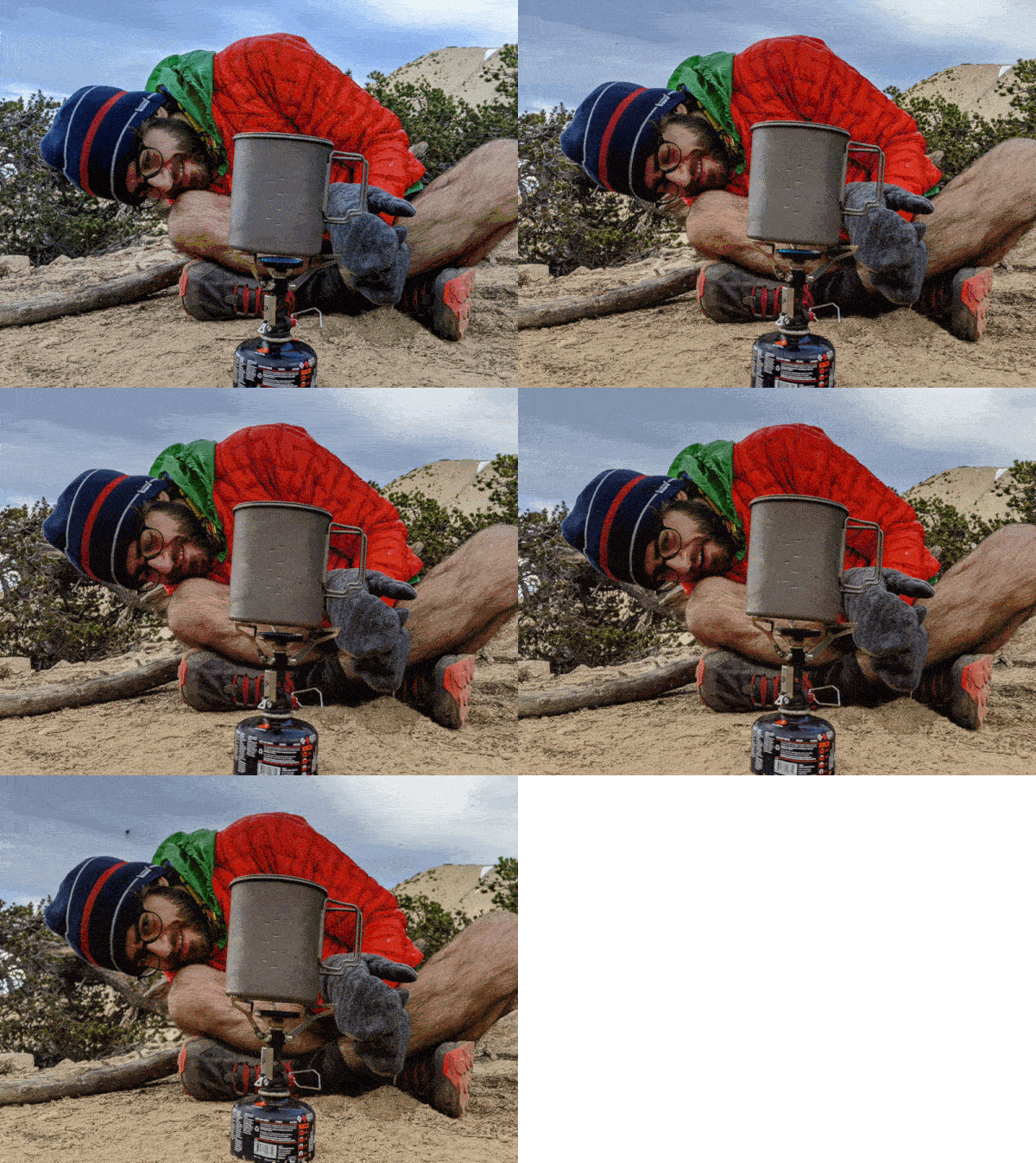
The TOAKS 750 mL is a perfect diameter and height to stay steady and wobble free with most canister backpacking stoves. Here, we’re using it with the MSR Pocket Rocket Deluxe. Photo by Liz Thomas
-
With the Toaks 750 mL, you can fit a 110g fuel canister and a small backpacking stove like the MSR Pocket Rocket 2 (see our Best Backpacking Stoves guide if you’re looking for one that will fit this pot). It also works with alcohol stoves, which we didn’t cover in our stove guide.
I think 750 mL is the best volume for a solo trekker (or a group trekker who cooks their own meal). At 3.18 cups, it’s enough to make a typical freeze-dried meal and have hot cocoa after.
The 750 L pot fits well into most backpacking backpack side pockets and front mesh, which is not the case for all pots we tested.
-
The TOAKS 750 mL is also a great shape to give the titanium pot some extra durability. I was tempted to recommend the 900 mL TOAKs Titanium D130mm pot, which has a squat shape that distributes heat quickly. However, in my experience thru-hiking with it on the Pacific Northwest Trail (and those of customer reviewers) that size/shape combo was much more prone to going from circular to oval and becoming slightly warped. The 750 mL, in comparison, can handle getting banged around in a pack better.
-
The Toaks 750 mL has a handle, lid handle, and notches measuring the volume on the inside of the pot. These are all Must-Have features for a cookpot.
However, unlike my upgrade winner, the Toaks’ handles and pot lid handle are not covered in insulation as we find on the excellent contenders, the Evernew Titanium UL pot and the Snow Peak Trek. Instead, be prepared to use potholders or gloves to handle your material. Titanium is quite good at cooling quickly, so if you have patience, it shouldn’t be a big deal and is one of the reasons why this pot is nearly half the price of those with insulation.
-
The only complaint we’ve seen (and it’s true for most Titanium pots except for the MSR Titan) is that the lid doesn’t “snap” into the pot. The lid is fairly loose, which means it’s easy to pull it off. That can be a boon if you’d rather not burn yourself when removing a pot’s lid. But it also means that you’ll need care when draining water.
-
Like all Titanium cookware, the Toaks 750 has a few drawbacks. Titanium spots when exposed to heat sources, so don’t expect your pot to look like new for long. It transfers heat more rapidly than other materials, so “real cooking” can lead to scorched food if you don’t watch it.
Like all Titanium cookware, the Toaks 750 mL cookpot is best if you boil water most of the time and are prepared to use a lower temperature when you do cook.
-
For 2026, Toaks released 3 new colors of the Toaks Titanium 750 pot.
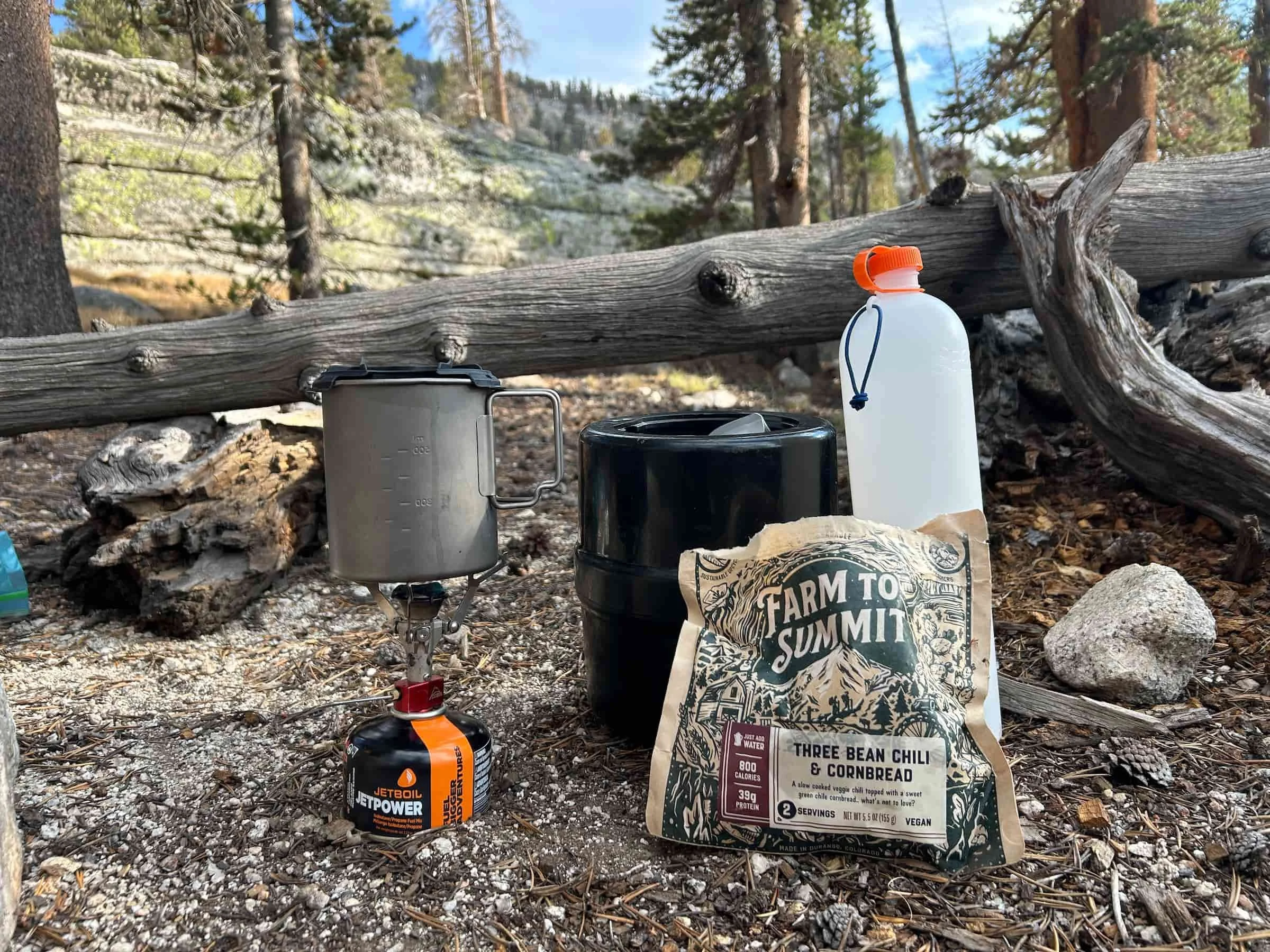
Eating from a Toaks 750 mL pot on the Continental Divide Trail.
Best Titanium Cooking Pot with Insulated Handle: MSR Titan Kettle
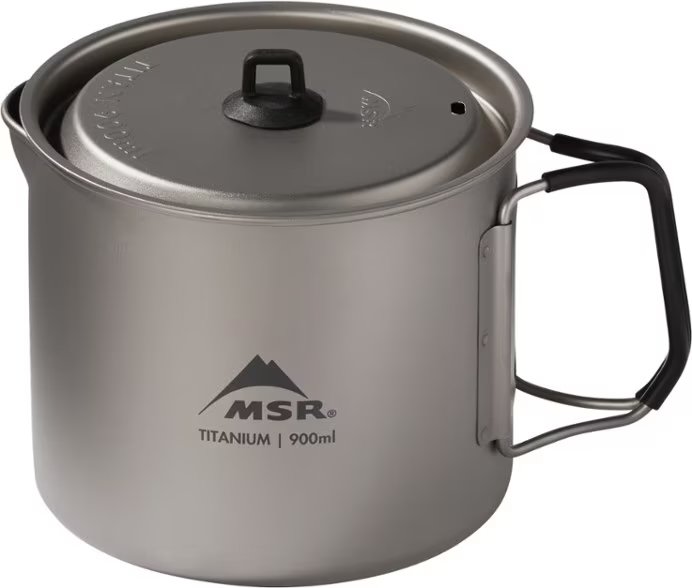
Material: Titanium
Sizes available: 0.9 L and 1.4L
Weight: 4.2 oz
Insulated handle or lid? Lid
Liquid measuring lines: Yes, but not as intuitive as on other pots
What we like: secure lid that snaps into place, excellent pour control, insulated lid handle
What we don’t like: pricier than some pots, handles aren’t insulated, liquid measure lines not as intuitive as on other pots.
A perennial favorite of almost all the professional reviewers we surveyed, the MSR Titan Kettle is a pot that will stay in your collection for more than a decade. While the MSR Titanium Kettle is more expensive than other options, we think it’s worth paying extra for something that will likely last your entire backpacking career.
The MSR Titanium Kettle has the lightweight and design aspects we love in the Toaks 750 mL with some extra features that put it above the other pots we tested. Its greatest convenience is that the lid stays flush against the pot, meaning you can use it like a kettle--controlling liquid as it comes from the spout without worrying that the whole lid will fall off and spill water everywhere.
The MSR Kettle has a few benefits over our overall budget pick that we found well worth the extra money–including an insulated lid handle and insulated folding handles.
Compare prices on the MSR titan kettle


-
The newest version of the MSR Titan kettles have a better spout for easy pouring and new silicone-coated handles on the lid and pot itself. My previous model only had an insulated lid handle. The new insulated handles fold closed for packing.
The lid is even more secure with a new snug-fit lid with a more robust knob design. It adds 0.2 oz, but most lightweight backpackers will find it worth it for the convenience of not having to use a potholder.
They've finally added internal and external graduation marks, which make for easy volume measurements, which was a complaint in the earlier version. I’m glad they fixed this issue!
-
What convinced us the MSR Titan Kettle is the best pot titanium solo upgrade pot is that the lid snaps onto the pot, staying in place as you pour and allowing you to control the flow from the spout. This seems minor, but it makes a world of difference when cooking.
We also like that the lid is rolled, which gives it extra stability and reduces the risk that it will warp. Unlike the TOAKS 750 mL, our overall winner, the MSR Titan Kettle lid always has a consistent fit, whether you’re cooking a meal or stashing your cook set in your backpack. The snug lid on the MSR Titanium kettle also makes it reliable and not leaky when straining noodles.
-
The MSR Titan Kettle is a good size for a solo backpacker. It fits a small backpacking stove and 110g fuel canister (see our Best Backpacking Stoves guide if you’re looking for a stove that will fit this pot). T
You can also cook ramen, rice, or a box of Mac & Cheese directly in the MSR Titan with some extra cocoa water to spare.
Best anodized aluminum cooking pot: GSI Outdoors Halulite boiler pot

The Halulite 1.1 L cookpot is an anodized aluminum pot with even heat distribution.
Material: Aluminum
Sizes available: 1.1 L, 1.8 L
Weight: 8.6 oz
Insulated handle or lid? Both
Liquid measuring lines: Inside and outside of pot
What we like: even burn that can handle temperature differences for ACTUAL cooking, insulated lid and handle, durability, price
What we don’t like: pricer than other aluminum pots, heavier than titanium
An REI and Amazon bestseller for hard-anodized aluminum, the GSI Outdoors Halulite 1.1 L Cookpot is an incredibly strong and affordable non-stick pot that can handle elaborate backcountry meals. If you intend to fish on your backpacking trip and cook what you catch, or just want some breakfast eggs, anodized aluminum will handle subtle temperature differences better than titanium. It’s more durable than titanium as well and comes with a non-stick coating that prevents meals from burning to the bottom.
Unlike titanium, the Halulite pot can also be used directly on a fire and on a stove and provides quick and even heat distribution. While many of the GSI’s benefits are true for all anodized aluminum pots, the Halulite has thoughtful features that make it easier to use than similar pots on the market.
Compare prices on the GSI outdoors halulite boiler pot

The Halulite 1.1 L pot has a handle that contracts and also secures the lid while your pot is in transit. To loosen the handle, press the two buttons on the side of the handle attachment area. Note that some people with arthritis or smaller hands found this to be difficult. Photo by Liz Thomas.
-
One of the advantages of the Halulite over other anodized pots we considered is GSI’s thoughtful insulated handle system. Rubber-like insulation protects your hands from the heat when handling a hot stove.
-
Its handles fold away and keep the lid in place when you’re storing your pot in your backpack (a nice feature compared to the TOAKS, which requires a rubber band to keep it in place). The handles keep the lid secure so well that one customer reported cold soaking oatmeal overnight in the stove while bear hanging the stove from a tree. That seems like a breakfast disaster waiting to happen, but it’s a testament to the secureness of the lid system.
-
Like all the pots that made our winners list, the Halulite fits a fuel canister and backpacking stove inside (see our Best Backpacking Stoves guide if you’re looking for one that will fit this pot). The Halulite’s shape allows for it to work well as a pot, bowl, and mug without being awkwardly shaped for any of those uses. As this pot is larger than the others we considered, we were pleased to see that it can also fit a 450 mL mug inside.
At 1.1L, the Halulite may be too large for some solo backpackers. But couples found it to be the perfect size for two people.
For those cooking for groups, the Halulite pot is available in a 1.8 L size.
-
Another nice feature of the Halulite is that it features liquid measuring lines that are visible on the inside and outside of the pot. This is notable because most pots choose one. They’re measured in ounces (oz) and mL so make it easy to add the correct amount of water to your freeze-dried meal, as some backpacking food brands only list one, forcing you to do some math to get dinner going.
-
Anodized aluminum is heavier than titanium, so as a category, any anodized aluminum pot will be heavier than the titanium pots we tested. The Halulite is 8.7 oz for the 1.1L version. For comparison, the solo titanium TOAKS 750 mL, the lightest pot we considered, is 3.6 oz. Split across two campers, the 4.3 oz of the Halulite isn’t unreasonable—especially for a non-stick pot that can be put directly in a fire.
-
The Halulite is slightly less expensive than the TOAKS titanium, though not by much. The main benefit of the Halulite is the durability and heat distribution benefits of aluminum over the lighter weight titanium. The Halulite is an affordable, reliable, durable option for backpackers who want more versatility in cooking than offered by titanium cookware.
Best Non-teflon non-stick cookpot: MSR ceramic solo pot
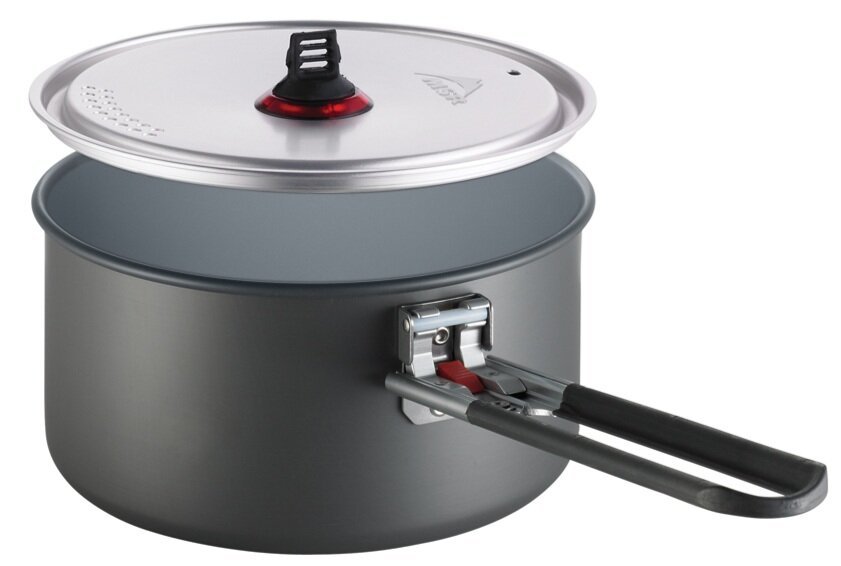
The MSR Ceramic pot is an aluminum anodized pot with non-stick properties that doesn’t use PFOA chemicals that some people choose to avoid.
Material: Fusion ceramic and anodized aluminum
Sizes available: 1.3 L, 2.5 L, 8” skillet, and 1.5 L (only in 2 pot set)
Weight: 7.5 oz
Insulated handle or lid? Both
Liquid measuring lines: Inside
What we like: non-Teflon no stick, excellent heat distribution for ACTUAL cooking, insulated easy to use lid and handle, pot with strainer
What we don’t like: price, no spout
If you’re avoiding non-stick cookware, but know you want to do more than boil water in the backcountry, we recommend the MSR Ceramic Solo Pot.
The new version of the MSR Ceramic Solo Pot has all the heat distribution benefits of other anodized pots without non-stick coatings—and even more durability.
Instead of a Teflon coating like found in other hard-anodized aluminum pots, it has an inert ceramic coating. This is ideal for backpackers and campers looking to avoid PFAS and PFC-free, which are common in waterproofing on outdoor apparel and in the manufacture of cookware.
Compare prices of the MSR Ceramic solo pot

The MSR Ceramic Pot has a shiny non-stick bottom, a lid with insulated handle and pasta strainer, and an insulated handle that’s easier to attach/detach from the main pot than the handle on the GSI Halulite. Photo by Brian Davidson.
-
With Teflon or PFOA non-stick coatings, over time and with heat, the chemical components can flake off and enter your food. There’s some evidence that this isn’t healthy to consume, and as with all chemical exposure, risks increase with repeat exposure (i.e. as you consume it over many meals). There’s more evidence that the chemicals used to make Teflon can enter waterways and cause serious ecological problems during the manufacturing process.
-
While “ceramic” implies a heavier weight to many people, the MSR Ceramic Solo Pot is surprisingly lightweight.
In fact, at 7.5 oz, it is 1.2 oz lighter than the Halulite, the other hard-anodized aluminum cookware of the same size. It’s also a bigger pot than the Halulite, so well suited for two people.
At 3.75 oz per person, it’s the same weight per person as our lightest weight option, the titanium Toaks 750 mL.
-
Despite the name, this 1.3 L pot is actually a good size for two people at a weight per person that is just as light as the titanium pots we considered.
If you’ll be cooking for more than one or two people, it’s available in a Ceramic Two-Pot Set as well. It comes with a 2.5 L pot and a special 1.5 L pot that isn’t sold as a stand-alone. If you like the ceramic non-Teflon features of the pots, there is also a Ceramic Skillet in the series.
Best stainless steel cooking pot: MSR Alpine Stowaway 775 ml
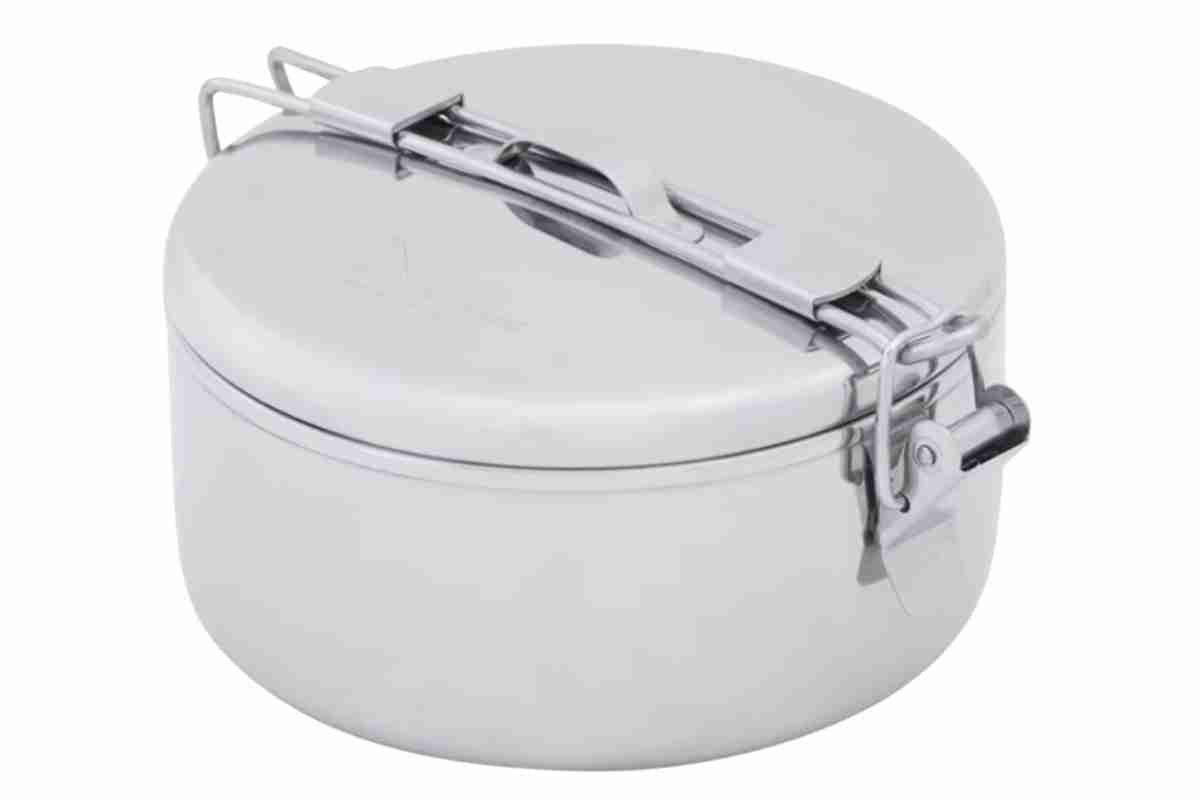
Material: stainless steel
Sizes available: 475 mL, 775 mL, 1.1 L, 1.6 L
Weight: 13 oz
Insulated handle or lid? No
Liquid measuring lines: Inside
What we like: price, can go in a fire, well-featured for the price, variety of sizes, durability
What we don’t like: weight, no insulation
If you know you want to do some real cooking in the backcountry and don’t mind the extra weight, the MSR Alpine Stowaway is almost every professional reviewers’ favorite stainless steel pot. It’s a top seller at REI and Amazon and among our editors, especially for its ability to cook directly in a campfire.
The MSR Alpine Stowaway is affordable but still thoughtfully designed for backpackers. It is relatively compact. It is designed for backpacking, so is more compact and lightweight than other stainless steel stoves we considered including those by Stanley. Rounded corners push heat up along the sides for more efficient cooking, the thoughtful kind of feature that makes it a quality product, even at a budget price.
Compare prices of the MSR alpine stowaway

Unlike titanium cookware, stainless steel pots can go directly over a campfire.
-
As one may expect for a stainless steel cook set, the MSR Alpine Stowaway is by far the most durable pot we considered. If you intend to mostly car camp or don’t mind carrying extra weight, it’s hard to beat the MSR Alpine Stowaway for the price.
It’s an excellent pot for guides who want to cook up real meals and know that their pot will see so much use, it’s not worth risking a non-stick coating.
-
Unlike other pots we considered, the MSR Alpine Stowaway has the advantages of stainless steel: including that it can be used directly in a fire.
-
You can fit a 110g fuel canister and a small backpacking stove like the MSR Pocket Rocket 2 or the newer MSR Pocket Rocket Deluxe.
The 0.775 L size is the one we recommend for most solo adventurers. But it’s also available in the bigger 1.1 L and 1.6 L sizes if you will be cooking for two or more people.
Best cookset for camping: GSI Bugaboo Camper Cookset

The GSI Bugaboo Cookset includes 2 pots, one frying pan, 1 pot gripper, 4 plates, 4 bowls, 4 sippy mugs, and a welded sink/stuff sack.
Material: Ceramic (Non-Teflon-coated) hard-anodized aluminum/polypropylene/nylon
Sizes available: one size serves 4 people
Weight: 3 lbs 11 oz (for 4 people)
Insulated handle or lid? Lid yes, handle no
Liquid measuring lines: Inside
What we like: designed to nest with each other, folding handles, very compact, everything for 4 people included
What we don’t like: weight
If you want to purchase one pot to cover the entire family’s camping or backpacking trip, the GSI Outdoors Bugaboo Camper cookset is the most widely recommended all-in-one set-up.
This multi-piece cook set has all the pots, pans, plates, bowls, and mugs you need for an outdoor trip and doesn’t require you to choose pots and pans piece-by-piece.
When looking at the GSI Pinnacle Cookset, it’s clear that the designer has backpacked and camped a lot with the goal of eliminating every common complaint a cook set user could have.
Mugs work for left and right-handed people. The pot gripper locks onto the side of the pots and pans at an angle where it’s impossible for it to scratch the pan’s nonstick coating. The carry bag can double as a sink basin.
While it’s odd to get excited about a cook set, it’s hard to not look at the GSI Bugaboo Camper Cookset and think repeatedly, “Oh, that’s really clever!”
It’s a bestseller at REI and Amazon and is highly recommended by outdoor media and customers alike. The GSI Bugaboo Camper Cookset has a well-thought-out design with well-executed features that make it the best camping cook set we've seen.
View the GSI outdoors pinnacle cookset
-
First, what you get with the GSI Outdoors Bugaboo Cookset: 2 pots, a frying pan, 4 plates, 4 bowls, 4 mugs with sippy lids, pot gripper, and a welded sink/stuff sack to carry it all in.
This should be enough to cover a couple on a camping trip and you can get two to cover a family of four.
-
The hard-anodized aluminum pots and pans heat evenly for real cooking and frying in camp. The entire system is durable enough to last decades but lightweight enough to take on a short family backpacking trip.
-
Instead of a Teflon coating like found in other hard-anodized aluminum pots, the GSI Outdoors Bugaboo has an inert ceramic coating similar to that found in high-end home kitchenware.
This is ideal for backpackers and campers looking to avoid PFAS and PFC-free, which are common in waterproofing on outdoor apparel and in the manufacture of cookware.
Additionally, as mentioned in our best non-Teflon cookware winner above, there’s evidence that this isn’t healthy to consume, and as with all chemical exposure, risks increase with repeat exposure (i.e. as you consume it over many meals). That is why we were pleased to see this family-friendly camping set has an inert ceramic non-stick coating instead.
-
What put the GSI Outdoors Pinnacle Cookset on top of other cook sets is the thoughtful features to make camp life easier. The pot lids come with easy-to-lift strainers to make draining pasta water easier. The mugs come with sippy lids so you won’t spill and insulators so small hands won’t burn on hot beverages.
Everything is color-coded so you can tell which set is yours and which piece got dragged off by a bear. All the pieces nest together to reduce space in your car’s trunk or backpack.
-
Most importantly, everything is dishwasher safe for when you get home (so don’t bother doing dishes if you’re out for one night.)
-
The downside of the GSI Pinnacle Cookset is it’s expensive. But when you consider the sheer amount of cookware pieces you get in the set, the price seems more reasonable.
Sure, you could assemble a set of disposable or Dollar Store plastic plates and cups for a lower price, but the GSI Pinnacle is the sort of quality set that will last a childhood of car camping, backpacking, and canoe trips.
Additionally, the plastic pieces are BPA-free, which you may not find so easily when assembling your own discount set.
Best for Thru-hiking: Vargo Bot

Material: Titanium
Sizes available: 700L, 900 L
Weight: 4.8 oz
Insulated handle or lid? Neither
Liquid measuring lines: Inside and outside
What we liked: usable as a pot and as a bottle
What we didn't like: can sometimes be difficult to unscrew lid if threading is not lined up correctly
An ultralight thru-hiker favorite, the Bot allows backpackers to use their cookpot as a pot, cold soak jar, or as extra water-carrying capacity (i.e. a bottle).
The bot eliminates the need for a separate cook pot and cold soaking jar for backpackers that like to have hot and cold backpacking meals. The 900 mL version weighs 4.8 oz–which is less than the same size pot and plastic bottle.
Manufacturing precise notches into titanium can get expensive and we understand why this pot costs what it does. That's why we don't necessarily think this is the best option for everyone. But for ultralight backpackers and bikepackers or those with limited space in their pack who want to avoid redundancy in their system, the Vargo Bot can be a real problem-solver.
Vargo Bot

The Vargo Bot fits a canister and backpacking stove. The nesting mug fits around the base. The lid (right) screws onto the pot to turn it into a bottle.
-
We tested both versions of the 900 mL–with handles and the lightweight version without handles. We also tested the additional nesting bot bowl. We've tested on thousands of miles on the Pacific Crest Trail from Oregon to the Sierra.
-
We recommend the shorter 700 L version, which is the most popular size. We found the height on the 700 mL is more secure on a canister stove than the taller 900 mL. Plus, it is more lightweight and more affordable.
-
One issue we've had with the Bot is getting the lid off. We found the you must go slowly when screwing on the lid, taking care to line up the threads correctly. With elevation change or changes in barometric pressure, removing the screw-on lid can be difficult because it doesn't have a way to otherwise release pressure.
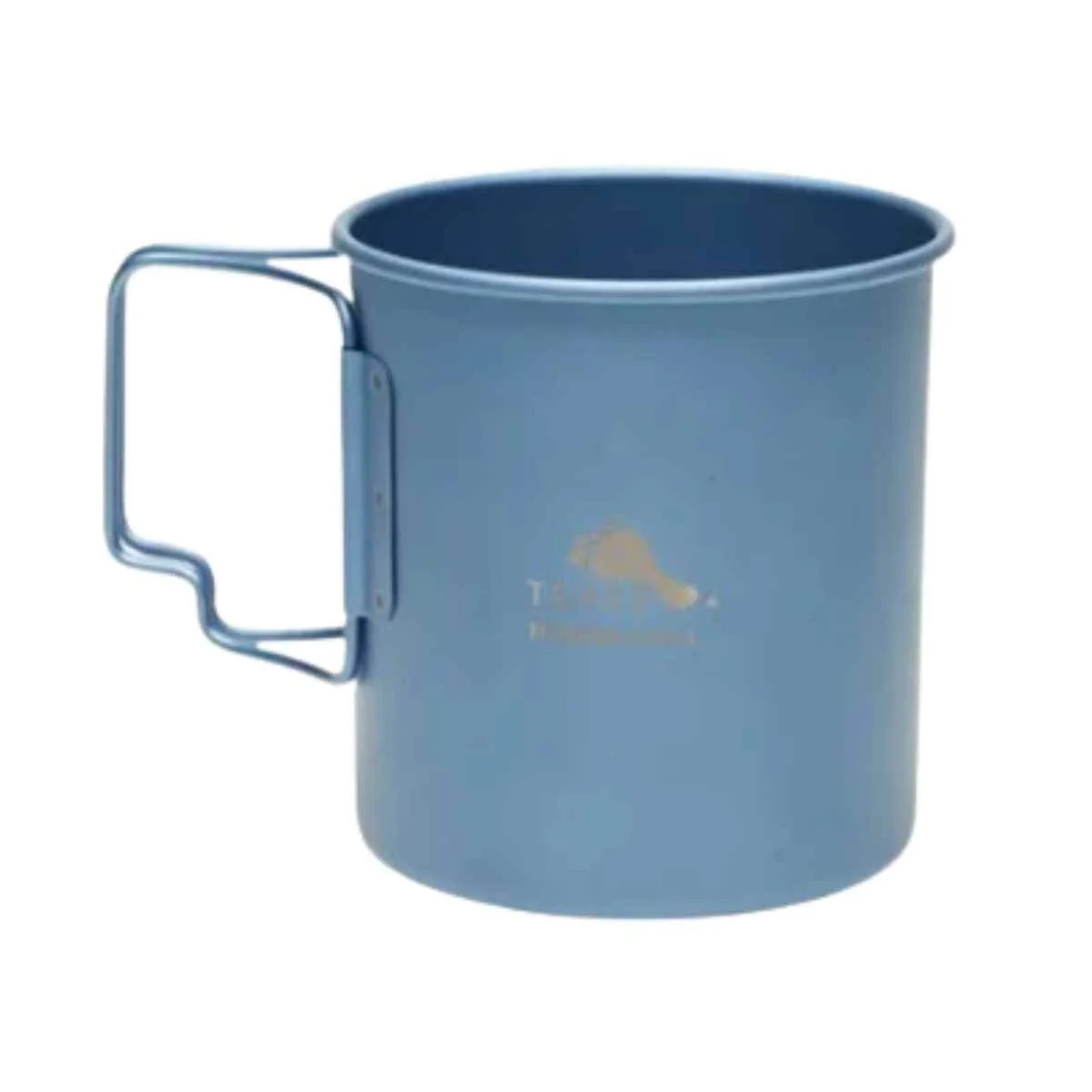
Best Ultralight Backpacking Pot: Toaks 450 Ultralight Cook Pot
Material: Titanium
Sizes available: 450 L
Weight: 4.8 oz
Insulated handle or lid? Neither
Liquid measuring lines: Inside and outside
What we liked: Extremely light for a totally functional pot, cool colors, nests inside of bigger pots
What we didn't like: can sometimes be difficult to unscrew lid if threading is not lined up correctly
If you want a cool looking ultralight cook pot that is the lightest backpacking cookpot you can find out there, the best ultralight pot is the Toaks 450 Ultralight cook pot. At 1.7 oz, you won't find a cook pot lighter out there, even ones made of old beer cans.
While 450 mL is the best size for a mug, you could have the lightest cookset out there by using the Toaks 450 mL Ultralight as your main pot. Plus, as of 2026, it comes in cool colors.
This size works best for ultralighters who are need less water (aren't eating freeze dried meals that require 2+ cups of water). Most backpackers the convenience of the 750 mL is worth the extra 1.0 oz. But if you are carrying a cook pot and want the absolute lightest out there, this will work. Plus, you can use it as a mug for backpacking trips where you don't' have to be as ultralight.
Toaks 450 Ultralight Cook Pot
-
The colored mugs are anodized titanium, which gets its hue from a micro-thin oxide layer grown from the metal itself (there is no paint or dyes to chip or flake).
-
The Toaks 450 Ultralight is designed as a mug that nests with the Toaks 750 (our overall winner). So if you are an ultralighter, you can use the 450 mL on solo trips and on more casual trips with friends, have a mug.
-
If you do go with the 550 L to save weight, it’s important to note it doesn’t fit a full ramen packet. It definitely doesn’t fit a box of Mac N’ Cheese. This pot is best for those who eat dehydrated refried beans or mashed potatoes already portioned into a ziplock bag.
Other cookware pots we tested
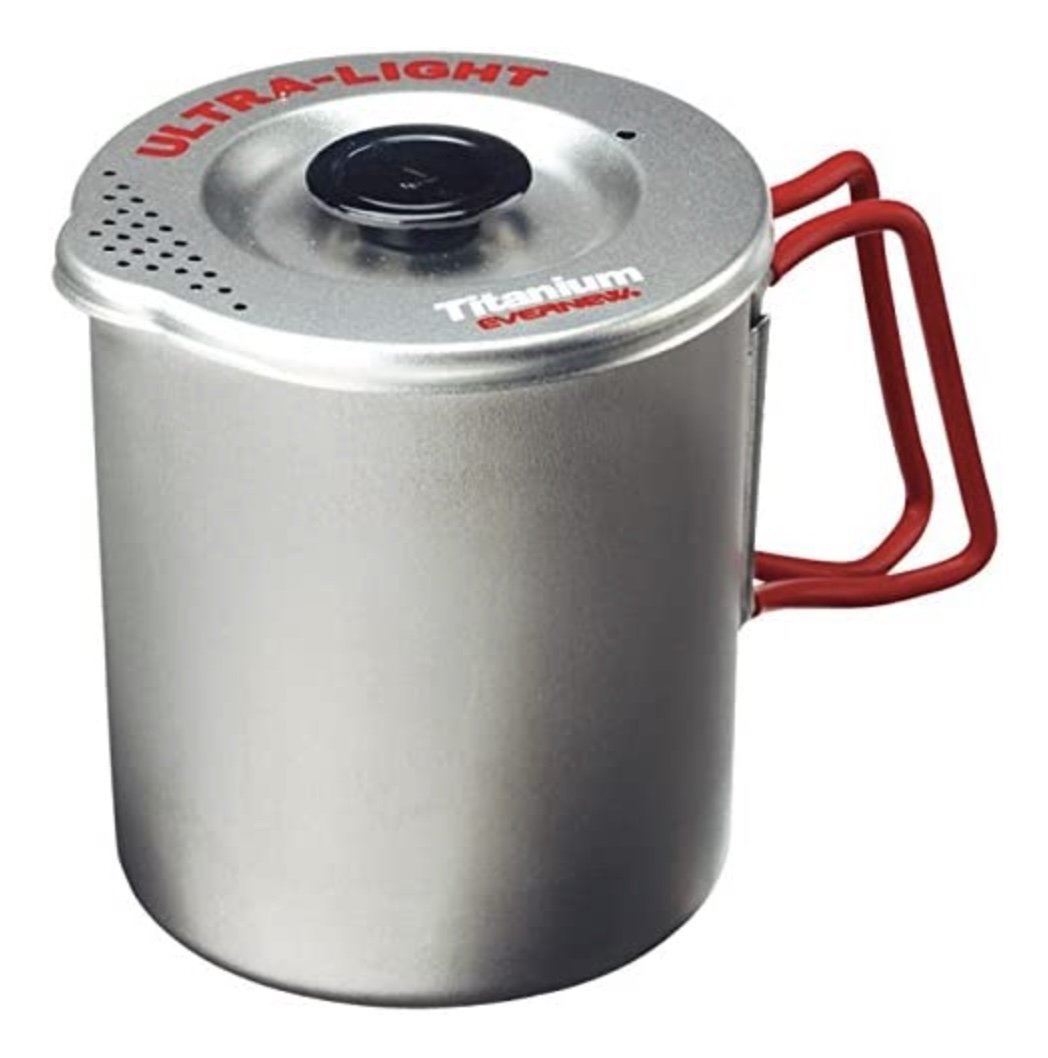
Evernew Titanium UL Pot
Material: Titanium
Sizes available: 700 mL, 1L
Weight: 3.2 oz
Insulated handle or lid? Both
Liquid measuring gradation lines: Inside
The Evernew Titanium UL Pasta Pot is our Runner Up for Best Upgrade Titanium Pot. This pot is a long-time favorite of backpackers including Treeline Review's co-founder, Naomi Hudetz. We wanted to make it a winner, but the Evernew has significantly cut back their US distribution and this pot is getting increasingly difficult to find except at specialty shops or on Amazon. In the small chance that you aren’t happy with it, customer reviews complain that returns are nearly impossible.
We like that the Evernew Titanium pots are sturdier than our overall/budget pick, the Toaks Titanium 750 mL. The most stand-out feature on Evernew pots is that all the handles are insulated (not just the lid like on the MSR Titan Kettle).
View the Evernew titanium pasta pot

An slight spout at the lip makes pouring from this pot easy. Here, the pot is shown on a section of the Pacific Northwest Trail in the Mt. Baker Wilderness in Washington. Photo by Liz Thomas.
This Evernew pot has a thoughtful pour spout lip, as found on the MSR Titan. If you can get your hands on the Evernew Pasta Pot, it’s well worth the price and will serve you for decades. Just don’t expect any refunds if you change your mind.
Material: Titanium
Sizes available: 700 mL, 900 mL
Weight: 3.2 oz
Insulated handle or lid? Both
Liquid measuring gradation lines: Inside
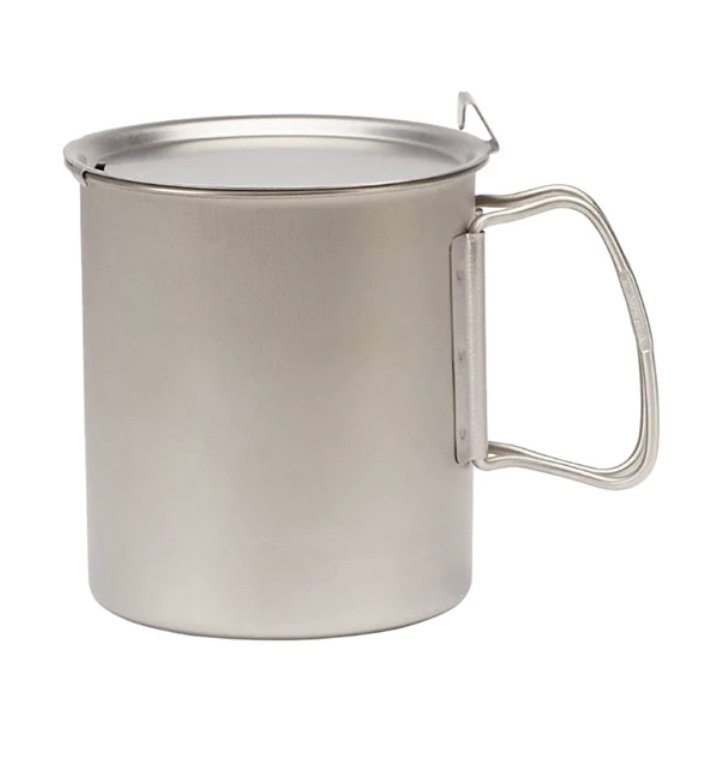
The Snow Peak TItanium Trek 700 Mug is our runner-up for Best Titanium Cooking Pot and has long been a favorite of backpackers. It’s also an REI best seller.
But the Snow Peak Trek is in an uncanny valley of “more expensive and better featured than our budget/overall pick” while also being “less expensive but not as featured” as our upgrade pick. We had to draw the line somewhere. Nonetheless, the Snow Peak Trek is a great pot and highly recommended, especially if you can get it on sale.
Compare prices of the Snow Peak Titanium Trek 700 Mug

Material: Silicone
Sizes available: 1.1 L, 1.4 L
Weight: 7.1
Insulated handle or lid? Both
Liquid measuring lines: Inside
The Sea to Summit Frontier Ultralight Collapsible Kettle is for backpackers and bikepackers who want to reduce volume. It has the benefit of being a kettle, meaning that the lid stays on securely and snaps into place, similar to the MSR Titan Kettle. Ultimately, it's heavier than similar pots and the smallest size is 1.1 L, which is too big for most solo backpackers. Still, we think it's a good option for couples and groups, especially when space is at a premium.
View the Sea to Summit Frontier Ultralight Collapsible Kettle

Material: Silicone
Sizes available: 1 L
Weight: 10.5
Insulated handle or lid? Both
Liquid measuring lines: Inside
The Sea to Summit Frontier Collapsible Pot is for backpackers and bikepackers who want to reduce volume. Like the kettle, it collapses. Only the bottom is made of metal.
It has a similar design to the GSI Outdoors Escape Pot with the difference that the Escape Pot has a Jetboil-style bottom that heats up faster. We also found the bottom more keeps bigger pots more secure when using on small backpacking stoves.
We still think the Sea to Summit Frontier is an excellent option and it's more widely available. If you're unable to locate the Escape Pot, the Frontier is a versatile pot made of quality materials and will last a long time.
View the Sea to Summit Frontier Ultralight Collapsible Pouring Pot

Material: Titanium
Sizes available: 750 mL, 900 mL, 1200
Weight: 3.7 oz
Insulated handle or lid? No
Liquid measuring gradation lines: Inside
Treeline writers have given the TOAKS 550 mL a thousand miles of backpacking use, but concluded it’s too small to cook up enough food for most adventurers.
Treeline Review writer Kate Hoch reports, “I got the [this pot] purely to save on weight knowing I just needed to boil a little water. But it’s really not much weight savings.” We recommend the 750 mL version. It weighs 1.0 oz more, but is far more useful than this mini “pot.”
If you do go with the 550 L to save weight, it’s important to note it doesn’t fit a full ramen packet. It definitely doesn’t fit a box of Mac N’ Cheese. This pot is best for those who eat dehydrated refried beans or mashed potatoes already portioned into a ziplock bag.
COMPARE PRICES OF THE TOAKS LIGHT TITANIUM 550ML POT

Material: Titanium
Sizes available: 750 mL, 900 mL, 1200
Weight: 3.7 oz
Insulated handle or lid? No
Liquid measuring gradation lines: Inside
We purchased and used the TOAKS Wide Pot for thousands of miles but ultimately found the 750 mL version (our Overall/Budget Pick) to be a size and shape that better holds up to the weathers of backpacking. We haven’t tested it yet, but are more optimistic that the TOAKS 900 mL D115mm has the rigidity of the 750 mL version that we recommend. It’s a good option if you like the 750 mL version but want a little more space.
VIEW THE TOAKS TITANIUM 900ML D130MM

Liquid gradation lines on the inside and outside of the pot can help you portion just the water you need to make freeze-dried meals or the perfect cup of coffee. Photo by Liz Thomas
What to look for in a backpacking cookware pot
All the cooking pots we considered have multiple review sites recommending them as well as happy customer reviews. Because we considered a variety of materials from titanium to ceramic, weight, cooking efficiency, and even cooking differed significantly. However, across all the pots that made our short-list, we took this non-negotiable criteria into account. All the pots that made our short-list came with these attributes:
Cooking pot volume
We considered pots 750 ML to 1.3 L in volume. This is widely considered to be the ideal volume range for most solo or couple cookers according to numerous forums on Reddit, Backpacking Light, and my favorite backpacking book, Ultralight Backpackin’ Tips by Mike Clelland.
It’s the perfect size to make a freeze-dried meal (plus have extra hot water for hot cocoa). It also is big enough to simmer a full package of ramen noodles, box of Mac N Cheese, or cook up oatmeal, rice, or spaghetti (break the noodles in half!). You can save weight with smaller pots, but having carried a 550 mL before, our writers have found it’s annoying to have to boil water multiple times to get enough water for a full meal.
Cooking pot handles

The foldaway handle on the MSR Ceramic pot was the easiest and most intuitive handle system we saw on a cookpot. Photo by Liz Thomas
We’ve tried pots without handles like the original version of the Vargo Bot (a bottle-pot that comes with a screwable lid but no handles). While we appreciate the weight savings, a handle-less design is inconvenient for all but the most gram-saving weenies.
We prefer pots with a bit of rubber insulation on their lid and side handles to avoid burns from handling a hot pot. But we didn’t hold it against a pot if it lacked the insulation. As backpackers who are sensitive to weight, we know that most of the time, a pair of wool gloves will do the trick (be wary of those with high synthetic fabric mixes, which can melt when exposed to heat).
Cooking pot size and shape
If you’re backpacking with your camping equipment, size and shape of your pot should be one of your top criteria in choosing a pot. To make our short list of cookpots, all the pots had to be of a size and shape that could hold a 110g fuel canister and a small backpacking stove.
Cook pot size and shape impact stability, packability, and fuel efficiency.
Packability
A big pot may not fit nicely into the outside front mesh pocket of a backpack, which is our preferred spot to stash cookware. Why? Because cookware can afford to get wet (unlike stuff that needs to stay inside your backpack to stay dry, like your warm clothes). A cookpot also may have residual soup or soot on the outside, so keeping it outside your pack is good practice to reduce the chance that food odors and juices may end up on your sleeping bag.
Fuel Efficiency
Squatter pots like the TOAKS 900 mL D130 wide pot that we tested, can have some benefits. They tend to be less tippy than tall pots. They also are slightly more efficient at using fuel and cooking quickly. This is because the flame hits a wider surface area of the pot so more heat transfers to your pot’s contents more quickly.
Ideally, your pot is just slightly wider than your burner’s diameter so it’s able to capture your flame and the hot exhaust gas that otherwise would escape from the sides. Squatter pots also fit more flatly in your backpack making them more convenient for packing and (theoretically) better for weight distribution in your backpack.
Stability
We’ve found that squatter titanium pots can also be more susceptible to warping and turning from circular to ovaloid. Pot size and shape are a balance of usefulness vs. structural durability. It’s a spectrum. Backpackers’ tolerance for one benefit over the other will vary.

Different pots have different handles, insulation lids, and lips. Photo courtesy Liz Thomas.
Cooking Pot Lids, Spouts, and Strainers
The least sexy part of choosing a pot is actually sophisticated. Just like cooking at home, lids keep heat inside your pot which reduces the amount of fuel needed to boil water (and also time to do so). A snug lid keeps heat in better, but some aluminum foil can do the trick, too.
Lids also reduce splatter. While reducing splatter is a nice feature of a pot in a home kitchen, when you’re in bear country, it’s nice to keep all your smelly food on one pot instead of all over your camp.
But cookpot lids can get quite sophisticated when it comes strainers, spouts, and handles. Strainers allow you to drain that pasta water quickly. Spouts turn a pot into a kettle, especially if they stay on well like on the MSR Titan.
To make our short list, all cookpots had to come with a lid, preferably with handles. We gave extra points to pots that had a way to secure their lid to the pot, at least while in transit if not during the cooking process.
Cooking pot liquid quantity gradation markings
Most of our picks have notches in their material to indicate how much water is in your pot and help with measurements. Most notches are in mL and ounces. The best notch systems are visible from the inside of the pot. If you have a pot that does not have a notch system, we recommend this practice at home: fill your pot with desired measurements then put your camping spoon into the pot. Note where the water level reaches on your spoon and make a notch on your spoon with a knife or oil-based Sharpie. Next time you’re camping and need a measurement, put your spoon in the pot and measure water up to the notch on your spoon.
How to Choose The Cookpot For You
All the pots that made our shortlist meet our minimum criteria to be an excellent pot. But to find the pot from that list that will work best for you, you need to think about your outdoor needs. For additional reading, see REI’s Advice on How to Choose a Cookpot.
These questions will direct you to find the right cook pot for you:
Are you car camping or backpacking or bicycle touring or bikepacking?
Bikepacking and backpacking

The author using the TOAKS 900 mL wide-sized pot on the Pacific Northwest Trail. Photo courtesy Naomi Hudetz.
If you’re backpacking you’ll want something lightweight. It should stay stable on a backpacking stove, avoiding becoming tipping or tall enough to be top heavy. Backpacking cookware should also try to maximize surface area hit by your backpacking stove’s flame.
After all, if you carry in the fuel, you’ll want your cook system to be as efficient as possible. Backpackers care about weight, though they may be willing to carry something heavier if they intend to cook up a fish they caught in the backcountry or otherwise make a “real” meal. Lightweight backpackers may only want to boil water for a freeze-dried meal, so can get away with lighter weight titanium pots. To learn more about preparing for backpacking, see our article on How to Get Started Backpacking.
Car camping
If you’re car camping, chances are you’ll be cooking on a grill or two-burner Coleman Classic Propane Campstove. If that’s the case, you’ll want a flat-bottomed piece of cookware that can afford to be heavy. Chances are if you’re car camping, you’ll want to show off your backcountry gourmet skills to friends and family. We recommend a hard-anodized aluminum cookpot as well as a ceramic non-stick pot that can handle subtle changes in temperature for simmering, baking, and sautéing. Our favorites for camping are the GSI Escape Pot + Frypan or the GSI Pinnacles pot set.
If you intend to put your cookware directly into a campfire, stainless steel is the only material that manufacturers recommend can survive that kind of flame. The MSR Alpine Stowaway (our best stainless steel pick) is the pot that we’d recommend.
If you’re car camping, you will likely have more burners available and should get as many pots as you have burners. You’ll also want plates, deep bowls, and mugs as well as a frying pan. For this story, we’re only considering cooking pots, although the GSI Pinnacle cookset that we recommend includes a pot, pan, plates, bowls, and mugs.
If you’re bikepacking or bicycle touring: packability will be your biggest priority. See our guide to How to Get Started Bikepacking or our Bike Touring Packing List for more information.
What’s your budget?
You can get the lightest cookpot out there made of titanium, but aluminum is slightly heavier and a heckuva lot more affordable. Anodized aluminum conducts evenly (it’s often used as a material for the pots and pans in your kitchen, too). But it can be more expensive and often comes with a non-stick coating that some folks may wish to avoid.
How durable does this need to be? are you ok with hot spots getting discolored?
Titanium and aluminum are lightweight, but can warp, dent, and scratch easily. This can really drive some people nuts.
Titanium and stainless steel are sensitive to discoloration in the area closest to the flame. But stainless steel cookware will survive some serious backcountry abuse, even if it turns a funky color. Stainless steel is the only material that manufacturers suggest will be ok if you put it in a campfire.
If you know you’re tough on gear, or are backpacking with kids, you may want something heavier duty, like anodized aluminum or stainless steel. Somewhat less robust but better for even cooking, hard-anodized aluminum is the most durable and resists dents and scratches you may normally experience while camping.
What’s your cooking style?
Your cooking style will determine your preferred cookware material. While we recommend anodized aluminum for car campers, if you know you’re the type of backpacker who goes all out on making a backcountry feast, lightweight anodized aluminum cookware will be your best friend. Hard anodized pots take longer to cool than other materials but are corrosion resistant.
How much does heat distribution matter to you?
If you’re cooking eggs, fresh meat, or veggies, go with hard-anodized aluminum. Real ingredients (aka, not pre-packaged freeze-dried or dehydrated) are more sensitive to temperature changes while cooking and will appreciate how hard-anodized aluminum can evenly spread the heat across the pot. Hard anodized aluminum has a better heat distribution than other materials, making it better for cooking real ingredients.
Aluminum is best for conducting heat (think simmering without burning the bottom of your pan). Even if you’re cooking soup, if it requires a simmer, the aluminum pot can usually handle that job better than titanium (which can get soup chunks burnt to the bottom of the pot).
If you know you’ll mostly be boiling water in the backcountry, titanium cookware is the lightest material and will do the job. It’s the favorite cookpot of those going fast and light like thru-hikers, alpine climbers, and bikepackers.
How much weight are you willing to carry?
Different outdoors people have different Willingness to Carry Weight. That’s why we considered pots of different weights.
As mentioned above, thru-hikers, alpine climbers, and bikepackers with fast and light goals will likely prefer a titanium pot. Titanium cookware is about 45% lighter than steel and stronger than aluminum.
Backpackers and adventurers who intend to catch fish or forage for mushrooms and fry them up may prefer a pan that can distribute heat more evenly and prevent scorched food, like anodized aluminum or ceramic. Anodized aluminum is, in our calculations, about 150% heavier than a titanium pot of the same size.
Campers concerned about durability and price may prefer a stainless steel pot. It’s the heaviest but will last a long time (and is the only material that can safely go directly in a campfire).
Do you avoid teflon? What do you think of non-stick coatings?
Forever chemicals like PFAS and PFCs are found in outdoor apparel waterproofing and in cookware. Many outdoors people are concerned about potential dangers associated with non-stick materials like Teflon. As a result, REI is phasing out cookware with PFAS and many outdoors people are thinking more about the coatings on their pans.
When you’re at home, it’s relatively easy to avoid scratching Teflon-like non-stick home cookware. In the backcountry, there’s a high likelihood that a scratch will develop during the packing or unpacking phase or as your cookware jostles around in your backpack.
Additionally, the manufacturing of non-stick cookware may release forever chemicals into the environment.
Ceramic non-stick coatings are popular in home cookware and are beginning to appear in outdoor cookware as well. Unlike Teflon, the non-stick materials that flake off into your food are inert. This is in contrast to Teflon and other chemical non-stick materials, which some scientists believe could potentially have harmful effects on human or ecological health.
As far as Titanium or Stainless Steel cookware, there’s no non-stick coating. Don’t expect the non-stick coating to prevent your food from sticking to the bottom if you do any actual cooking. But also, you don’t have to worry about potential health risks from that non-stick coating, either.

The GSI Pinnacle uses a super efficient cooking pot bottom that transfers heat better with heat exchanging fins. Photo by Liz Thomas
How much does efficient cooking matter to you? how quickly does your pot cook food?
As we wrote in our backpacking stove guide, fuel efficiency usually should not be a top concern for solo outdoor cooks. The exception is if you are out in the boonies in a place where it will be impossible to replenish your fuel supply, as with some international trips. Especially long trips (7 days or more between resupplies) may also require you to worry more about fuel efficiency. Group guides who are cooking for multiple people may want to consider efficiency. Lastly, and perhaps most of note, if you anticipate having to melt snow to get water, you may want a more efficient pot (and stove).
Tips for using backpacking cookware pots
Whether you’re boiling water for a freeze-dried meal or trying to whip up a backcountry gourmet trail risotto, here are a few real-world tips we've learned the hard way that can help you get the most out of your backpacking pot:
1. Nest your gear inside your pot
Make your pot work double duty as a storage container. Most 750 mL pots fit a small stove, a 4 oz fuel canister, and sometimes even a lighter or spoon. This saves pack space and keeps your cooking gear together in one spot. It also helps protect your stove from dust that can damage it and your backpack material from the pointy arms of your backpacking stove.
2. Stir often and use low heat
If you're cooking directly in your pot, aim to simmer, not sauté. Especially with titanium pots, food can scorch easily. Keep the flame low, stir frequently, and consider adding a bit more water than you think you need. Your future self will thank you at cleanup time.
3. Use your Buff or cozy to hold hot pots
If your pot doesn’t have insulated handles, use a spare Buff, thicker wool gloves, bandana, or even your beanie to lift the pot to try to avoid burning yourself. There are also after market silicone handle covers that can help (though they weigh more).
4. Clean with minimal water
The easiest way to keep your pot clean is to keep food out of it altogether. If you eat freeze-dried backpacking food, pour hot water from your pot directly into the pouch.
But if you are eating out of your pot, after the food is gome, pour a little hot water into your pot and use your spoon to scrape off food bits. Swirl, sip, and swallow (if you’re okay with it) or scatter the greywater per Leave No Trace. Don't use soap.
5. Keep your pot on a level surface
Especially with smaller diameter pots, balance is key. Uneven ground or wind gusts can lead to spilled dinner. Always make sure you place your pot and stove on a flat rock or cleared dirt patch.
6. Pack a band or stuff sack to secure the lid
Some ultralight pots (like the Toaks 750) have loose-fitting lids. A rubber band, hair tie, or the included mesh sack can help keep the lid in place when it's packed—so your fuel canister doesn’t rattle its way down the trail. One popular option is Cross Bands, which are more durable than a typical rubber band.
Backpacking pots care and maintenance tips
Although most backpacking cook pots are made to withstand drops and everyday use in rugged terrain, it still pays to take some care and to maintain it properly when you get home.
When you're on the trail or camping, best practices say to rinse it with hot water immediately after getting any food in there. That prevents food from sticking and potentially burning.
When you get home, you can take a crack at tougher stains using mild soap. If you're motivated, you can have at it with biodegradable soap in camp.
Most pot manufacturers say that abrasive scrubbers are a no-no–especially if your pot has any non-stick coatings. Soft sponges or a gentle brush should do the trick and some brands like Optimus even sell ones designed for use on their non-stick cookware.
When you get home or if you're roadtripping and won't be camping for a few days, completely dry your pot after cleaning and before packing it away. Trust me –you don't want mold and mildew growth, which can be an issue if you live in a humid place or store your gear in a moist basement. Use a clean cloth to wipe them dry and pay special attention to crevices and seams where water may collect.
When storing your cookware, a good tip is to store them pots with lids off. This gives them a little more air circulation and can prevent corrosion in case you accidentally didn't dry it all the way.
Many cook pots, like those made by TOAKS, come with a mesh bag to keep your cookware organized within your backpack. This minimizes the risk of scratching during transport or during your backpacking trip, though some ultralight backpackers like myself may choose to ditch the bag.
Lastly, before your trips, give your pots a check for signs of cracks, dents, rusting, or loose handles. Additionally, tighten any loose screws or handles as needed. This can be an issue with some of the models with clever holding handles, like the GSI Pinnacle.
FAQ
-
While some backpacking cookware pots may be labeled as dishwasher safe, it's generally recommended to hand wash them to prolong their lifespan. Dishwashers can be harsh on lightweight materials and may cause damage to non-stick coatings. That being said, I wash all my titanium cookware in my dishwasher at home and have never had an issue.
-
To prevent food from burning or sticking, follow similar practices at at home on your range. The trick is that backpacking and camping stoves can be harder to control temperature than at home–so if nothing else, turn that heat down low.
As you would at home, ensure the cookware is adequately preheated before adding ingredients. Use a moderate heat setting and stir the food regularly during cooking. Applying a thin layer of cooking oil to the pot's surface can also help prevent sticking.
-
Totally! Yes, backpacking cookware pots can be used for cold meals or food storage. Cold mashed potatoes, cold soaked backpacking meals, cold drink mixes, or storing leftovers are all fair game in a cook pot. The key is to 1) make sure that lid stays secure 2) clean them thoroughly before and after use to prevent contamination. Why? With cold food and leftovers, there's an increased risk of food contamination and foodborne illness. So seriously–clean that pot before and after if you're doing cold stuff.
-
When using backpacking cookware pots, always handle them with care to avoid burns or spills. Use pot grippers or insulated handles to protect your hands from heat. Ensure the pot is stable on the cooking surface to prevent accidents, and never leave a hot pot unattended. Lastly, be sure to keep flammable stuff far from your backpacking stove and follow fire bans. And kids and pets–they probably want to stay away from your pot, too.
How We Tested and Researched

The author testing various cook sets and pots in Northern Idaho. Photo courtesy Liz Thomas.
We've spent the past 7 years testing backpacking cook pots side-by-side on everything from intense thru-hikes to casual camping and backpacking trips. We've tested cookware in all 4-seasons, from desert to alpine, from humid temperate forests to oceanside beaches. We've tested in high wind, snow, and rain as well as more moderate conditions.
Here are some of the places we tested backpacking cookware:
Thru-hikes of the Superior Hiking Trail in northern Minnesota in October
A December/January thru-hike of the Trans Catalina Trail and February thru-hike of the Backbone Trail in the Santa Monica Mountains
A summer thru-hike of the Pacific Northwest Trail (1200 miles from Glacier National Park in Montana to Olympic National Park in Washington across alpine zones, montane forests, temperate rain forests, and the rocky coast).
Thru-hikes of the John Muir Trail and High Sierra Trail
Thru-hiking the Trans San Diego County Trail (150 miles from the Salton Sea to Torrey Pines Beach)
1500 miles on the Pacific Crest Trail
An 800-mile thru-hike of the Arizona Trail (see our full Arizona Trail gear list)
Additionally, we tested on shorter backpacking trips including:
On numerous backpacking trips in the Sierra Nevada mountain range including the Emigrant Wilderness north of Yosemite, Sequoia National Park, and in the eastern Sierra Nevada mountains
Camping and backpacking trips in Joshua Tree National Park and Anza Borrego Desert State Park
Guiding overnight backpacking trips in Big Sur, California
On a one-week winter hike in February in Central Oregon
In the Coeur d’Alene National Forest in the Idaho Panhandle
- Thru-hikes of the JMT, PCT & Arizona Trail
- Pacific Northwest Trail & Superior Hiking Trail
- High wind, snow & rain conditions
- Desert to alpine & temperate rainforest
- Boiling water & real cooking tested
- Weight & packability
- Heat distribution & fuel efficiency
- Lid fit, handles & pour control
- Durability over thousands of miles
- Value across titanium, aluminum & steel

The author cooking up broccoli in one of the TOAKS pots that we tested on the Pacific Northwest Trail, a 1200 mile long backpacking trip from Montana to the Pacific Ocean. Photo courtesy Naomi Hudetz.
Author’s Expertise & Why you should trust us
I’ve backpacked 18,000+ miles, most of it carrying a stove and cookpot. While I’m known for breaking the Fastest Known Time on the 2,181-mile long Appalachian Trail (women’s self-supported) and for first known traverses of the Wasatch Range and Chinook Trail, I’ve learned to relish the joy of a leisurely backpacking trip with multiple hot meals throughout the day and plenty of warm beverages.
I’m a lover of food—preferably hot. This love spurred me to create a subset of backpacking called “urban thru-hiking.” I’ve been called a "thru-hiking legend" and the “Queen of Urban Hiking” by Outside Magazine for innovative backpacking routes through cities. But really, it was just an excuse for good eating.
As a hot food aficionado, I’ve cooked dinner and lunch and hot coffee on many a chilly backcountry trip. Over years of adventures, I’ve taken more than a dozen cookpots on months of use and have opinions on this humble-seeming piece of gear.
In addition to using gear during my adventures, I write about outdoor gear for numerous publications including the Ask a Thru-hiker column in Backpacker and the New York Times’ product review site, Wirecutter.
My book, the National Outdoor Book Award-winning Long Trails: Mastering the Art of the Thru-hike, has chapters on gear, cooking, and nutrition — all of which are relevant to finding a good cookpot. Additionally, I regularly speak to outdoor clubs, non-profits, and universities about backpacking as well as gear clinics. Here at Treeline Review, I’m Editor-in-Chief and oversee all of our outdoor gear guides.
You can see all of Liz’s stories at her author page or at her website, eathomas.com.